Evidence: Documentation reviewed
Last checked: September 2026
What was done: Written from official documentation and the published sources linked in this article. Not hands-on tested.
Files: None
Affiliate links: No
What Is B2B Data Enrichment? How AI Turns Raw Leads Into Sales-Ready Prospects
The Problem Is Not a Lack of Leads. It Is a Lack of Context.
Most B2B companies do not have a lead problem in the way they think they do. They have a context problem. Their CRM may contain thousands of companies and contacts, yet when a salesperson opens a record, the information needed to make a good decision is often scattered across several systems, outdated, incomplete, or missing entirely. A company name and email address can tell you who exists; they cannot tell you whether that company fits your ICP, whether the person is actually relevant to the buying process, what technology the organization uses, whether anything has changed recently, or why an outreach attempt would make sense now.
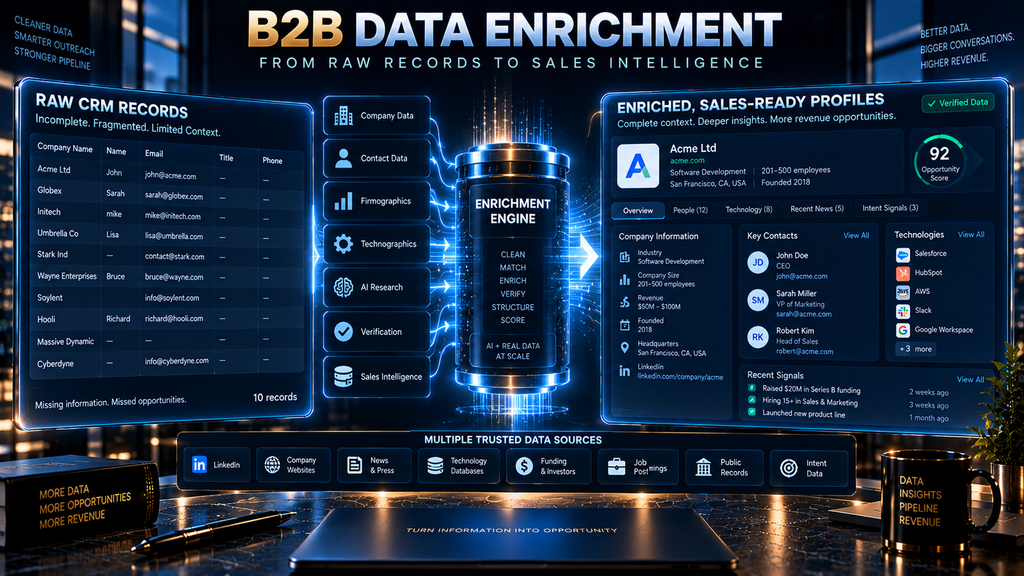
That gap is the reason B2B data enrichment exists. Salesforce defines enrichment as improving existing data by adding information from another trusted source so the record becomes more complete, current, or useful, and it explicitly distinguishes enrichment from prospecting and net-new sourcing. HubSpot’s current implementation works in much the same way: selected contact or company records are matched against commercial, third-party, and publicly available information, after which relevant business properties can be added or updated in the CRM.
The definition is straightforward. The strategic value is not.
A weak understanding of enrichment produces a predictable outcome: teams measure success by how many fields were populated, how many records were processed, or how large a provider’s database claims to be. A stronger understanding starts with a different question: what uncertainty did the enriched information remove, and what better decision did that make possible? That question changes everything—from which data fields you buy to how you evaluate providers, how often records should be refreshed, how AI should be used, and whether the entire program is generating revenue value or simply creating a more impressive-looking database.
The timing matters because AI is pushing B2B sales toward increasingly automated prospect research and decision-making. Modern platforms can now combine structured enrichment with AI-assisted research, classification, workflow triggers, and multi-source waterfall enrichment. That makes good data more valuable than before, but it also makes bad data more dangerous: when an inaccurate assumption feeds an automated scoring or outreach workflow, the mistake can propagate at a scale a human salesperson never could.
This is why B2B data enrichment deserves to be understood as more than a CRM feature. It is the intelligence layer between raw business records and sales action.
Quick Answer: What Is B2B Data Enrichment?
B2B data enrichment is the process of adding, updating, validating, or interpreting information about existing business records so a sales or marketing team can make more informed decisions about those accounts and contacts. Depending on the use case, enrichment can add firmographic data such as company size and industry, contact information such as role and seniority, technographic information about the company’s technology stack, organizational relationships, or contextual information that helps sales teams understand account fit and timing. Salesforce places enrichment after profiling and cleanup in its data-quality framework, while HubSpot’s current system uses identifying information from existing records to retrieve verified business information from multiple sources and maintain supported properties over time. (Trailhead)
The important part of the definition is existing business records. Enrichment starts with something you already know and makes that record more useful. If a company discovers a net-new account that was not previously in its system, that is fundamentally a prospecting problem; if it already has the company and wants to understand it better, that is enrichment. The two capabilities often live inside the same sales platform, which is why the distinction can appear blurry, but keeping the concepts separate makes the workflow easier to design and the economics easier to measure.
AI expands this process beyond simple field completion. A conventional enrichment provider can often answer a structured question such as “How many employees does this company have?” AI can help with less structured questions such as “Does this company appear to sell primarily to mid-market organizations?” or “What evidence suggests this account is entering a period of expansion?” Those outputs are potentially valuable because they help connect facts to decisions, but they also need stronger controls because an AI-generated interpretation is not equivalent to a verified database attribute.
That distinction should govern the entire way a company approaches the category. The goal is not to know everything about every prospect. The goal is to know enough, with enough confidence, to make a better decision about the prospects that matter.
Why a CRM Record Can Be Complete and Still Be Useless
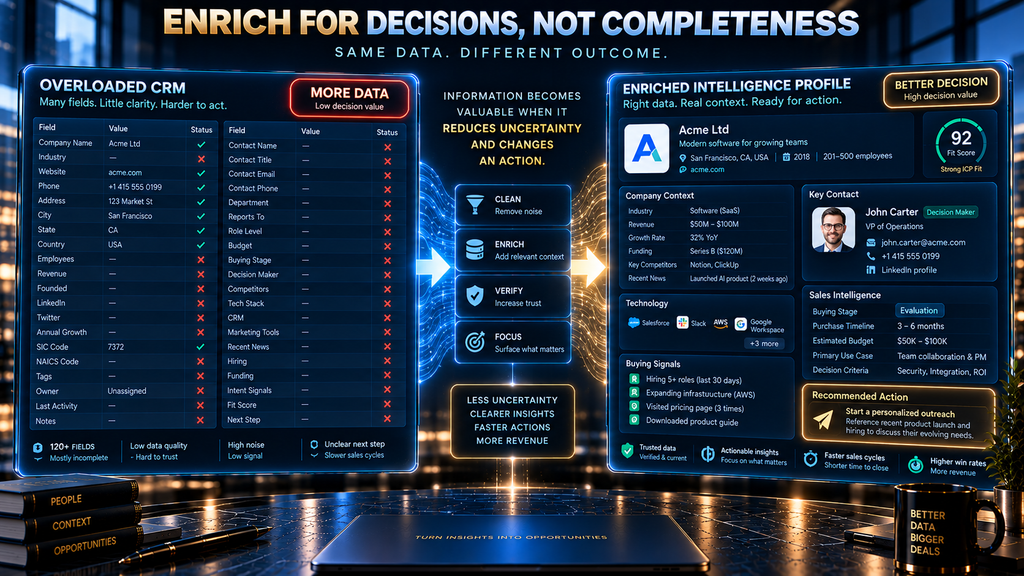
Consider a sales representative opening a record that says: Acme Software — 450 employees — United States — SaaS.
At first glance, that looks useful. It has employee count, location, and industry. Yet almost every commercially important question remains unanswered. Are those 450 employees spread across North America or concentrated in one market? Does the company actually resemble the customer’s ICP? Which executive owns the function being sold into? What systems does the business already use? Has anything changed recently? Is there a business event that makes the seller’s proposition relevant, or is this simply another company that happens to match a few superficial criteria?
The problem is that descriptive data and decision data are not the same thing. A database can describe an organization accurately without giving a sales team enough context to decide whether the organization should be prioritized. This is why Salesforce’s current enrichment guidance emphasizes not merely completeness but recency, context, and usability, and why it frames enrichment as part of a broader data-quality process rather than as an isolated “add more fields” operation.
Imagine that the same account record is enriched further. The company is confirmed as a B2B SaaS provider, its relevant department has expanded significantly, the organization recently hired a senior executive responsible for the function your product serves, its technology stack contains a platform that integrates directly with your solution, and the contact you were researching has been verified as the current decision-maker. Now the account is not merely “a 450-person SaaS company.” It has a sales context.
That is the transformation an effective enrichment program should create. The system is reducing the number of unknowns between “this account exists” and “we have a defensible reason to spend human sales time on it.”
This also explains why the largest database does not automatically produce the best prospecting results. Information has value when it changes a decision. A field that nobody uses is overhead; a field that changes account priority can be commercially significant.
What Should Actually Be Enriched?
There is no universal list of “must-have” enrichment fields because the right schema depends on the sales motion. An enterprise software company selling into large financial institutions will need a different information model from a small agency selling marketing services to local businesses. The correct way to design enrichment is therefore to start from the decisions the revenue team needs to make and work backward to the information required to make those decisions with reasonable confidence.
Firmographic information usually provides the first layer. Industry, company size, revenue range, geography, ownership, business model, company stage, headquarters and corporate relationships help answer the basic question of what kind of organization this is. These attributes are especially useful for segmenting an account universe and testing whether a company resembles the intended customer profile. Salesforce’s current enrichment framework includes granular firmographic enrichment among the common ways organizations improve customer understanding and decision-making.
Contact enrichment answers a different question: who matters inside the organization? A company may fit the ICP perfectly and still produce a bad prospecting outcome if the seller reaches the wrong person. Job title, seniority, department, work email, telephone information, professional identity, and role changes can help map the people associated with an account to the buying process. The aim should not be to collect the maximum number of names; it should be to identify the people whose roles actually intersect with the decision.
Technographic information adds another dimension by explaining how the organization operates. Knowing which CRM, analytics platform, cloud infrastructure, marketing system, ecommerce platform, or other relevant technology an account uses can change the sales strategy. It can indicate compatibility, integration potential, competitive displacement opportunities, or a reason why the prospect might not be a fit at all. Technographics therefore become useful when they are tied to a commercial hypothesis rather than treated as decorative metadata.
Then there is contextual and behavioral information. Hiring patterns, organizational changes, technology shifts, engagement activity, product usage, event participation, and other signals can help answer what is changing now. This is where the distinction between enrichment and intent becomes important. A signal can increase or decrease the plausibility of a sales opportunity, but it does not prove that a company is ready to buy. Treating every observable event as “intent” is one of the fastest ways to turn sales intelligence into noise.
Finally, there is a growing category of AI-derived information. Modern systems can classify companies, summarize accounts, identify likely use cases, normalize messy business descriptions, and answer custom research questions that do not correspond neatly to one database field. HubSpot’s current enrichment system, for example, can use public and third-party information to enrich records and supports ongoing enrichment, while Salesforce documents enrichment capabilities around standardizing, harmonizing, and categorizing data. (HubSpot Knowledge Base)
These categories should not be treated as equally authoritative. A directly verified company domain and an AI-generated description of the company’s go-to-market model are fundamentally different kinds of information. A mature enrichment system preserves that distinction instead of flattening every output into the same “truth” field.
Data Enrichment, Data Cleansing, and Prospecting Solve Different Problems
The three concepts are often bundled together because modern sales platforms increasingly expose them through one workflow, but they exist for different reasons.
Data cleansing fixes what is wrong. Data enrichment improves what is missing or outdated. Prospecting expands what you know about the market by identifying new potential accounts or contacts.
Suppose your CRM contains two records for the same company because one salesperson entered “Northstar AI” while another entered the organization’s legal name. Cleansing addresses the duplication and standardizes the record. Enrichment can then add missing information such as company size, technology, relevant contacts, or updated organizational context. Prospecting becomes relevant when the sales team goes looking for companies that are not already represented in its system.
Salesforce explicitly distinguishes enrichment of existing records from prospecting and net-new sourcing, and its data-quality framework places enrichment in the broader sequence of understanding and improving existing information. This distinction is not merely academic. If a company starts enriching millions of records before resolving identity and duplication problems, it can end up spending money to make the wrong records more detailed.
There is also a more subtle reason to preserve the distinction. Cleansing improves reliability, enrichment increases context, and prospecting increases coverage. They should therefore be measured differently. A cleansing project might aim to reduce duplicate records. An enrichment project might aim to improve account classification or contactability. A prospecting program might aim to expand the number of qualified accounts entering the funnel.
When those objectives are mixed together, management sees activity instead of outcomes.
How the Enrichment Pipeline Works Behind the Scenes
The visible experience can be deceptively simple: select records, click “enrich,” and watch new information appear. Underneath that interface, however, several distinct technical and operational steps have to work correctly.
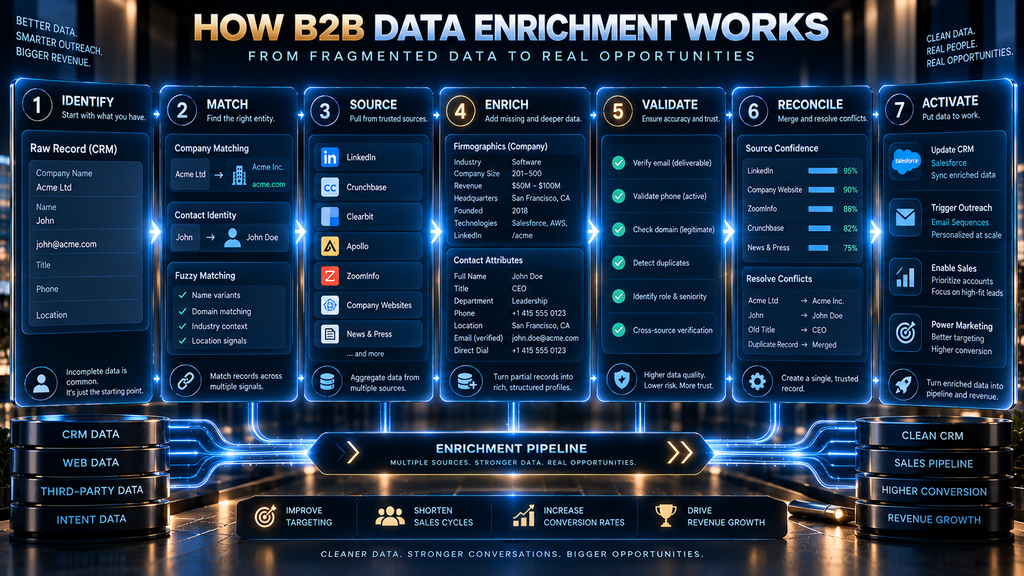
The first is identity resolution. The platform needs to determine which real-world company or person the record represents. A company may have a legal name, a brand name, multiple domains, subsidiaries, parent organizations, regional sites, or a recently changed identity following an acquisition. A person may have moved to another company while leaving an old CRM record behind. If the system matches the wrong entity, every subsequent enrichment field can be perfectly accurate and still be useless because it describes the wrong subject.
Once the identity is reasonably established, the system retrieves candidate information from one or more sources. HubSpot’s current enrichment documentation provides a useful example of the basic architecture: contact enrichment can use first name, last name, and work email as identifying information, while company enrichment can use the company domain; the platform then compares those identifiers against commercial, third-party, and public sources before updating the corresponding properties when matching information is found.
The next problem is reconciliation. What should happen when your CRM says an account has 800 employees but one provider says 650 and another says 720? Which source should take precedence? How recent is each value? Is the difference meaningful or simply a result of differing measurement methods? A credible enrichment architecture therefore needs some form of source priority, validation, timestamping, or confidence logic rather than blindly accepting the first value returned.
Only after those steps does activation become useful. The enriched information can feed segmentation, lead scoring, routing, account research, personalization, sales tasks, or other workflows. This final step is often overlooked, but it is the one that turns enrichment from a data operation into a business capability.
A useful way to think about the entire sequence is: identify the entity → establish what is known → find what is missing → evaluate the evidence → update the record → use the information in a decision → refresh it as reality changes. The important point is that enrichment is a pipeline, not a button.
Why Identity Resolution Is More Important Than the Number of Fields
A data provider can return dozens of attributes and still produce a poor result if it cannot reliably identify the correct entity.
Consider a company called “Atlas Systems.” There may be several organizations with that name, a parent company using a different domain, and a regional subsidiary operating under a separate web presence. Now add an executive named Michael Chen. If the enrichment system associates Michael with the wrong Atlas Systems entity, it can return a real job title, a real email address, a real employee count, and a real technology stack—and still deliver a completely false CRM record.
This is one reason enrichment quality should be evaluated upstream, not only at the field level.
A sensible provider evaluation asks: how well does the system match the records I actually care about? How does it handle subsidiaries? What happens when the domain changes? How does it respond to ambiguous company identities? What evidence is used to associate a contact with an account?
These questions are harder to market than “we have billions of records,” but they are far more relevant to operational accuracy.
For the same reason, a mature enrichment system should be able to distinguish between record confidence and field confidence. You can have high confidence that the company is correct while having low confidence in a particular employee count or title. Treating every field as equally certain hides useful information from the people making downstream decisions.
Where AI Actually Changes B2B Data Enrichment
The most important change AI brings to enrichment is not simply speed. It is the ability to work with information that does not naturally fit into a rigid database schema.
Traditional data enrichment is strongest when the desired answer already exists as a field in a structured dataset. Employee count, location, company domain, job title, and similar values can be matched and appended relatively directly. The problem becomes harder when the question requires interpretation across several sources.
For example, a sales team may want to know whether a company sells primarily to enterprise customers. That information might not appear in any standardized field. It may need to be inferred from customer logos, pricing, product positioning, job descriptions, website language, or other public information. AI can help gather and synthesize that evidence into a structured classification.
The same principle applies to account summaries. Instead of forcing an SDR to open several pages and mentally assemble what matters, an AI workflow can research the account and produce a concise explanation of its business model, likely use case, relevant technology, recent changes, and potential fit. Current sales-intelligence research increasingly describes this transition from static enrichment toward contextual research, prioritization, sequencing, and timing. (Apollo)
But this is precisely where organizations need to resist the temptation to call everything “data.” An employee count can be checked against a source.
An AI-generated statement such as “the company is aggressively expanding into enterprise accounts” is an interpretation. It may be correct, but its reliability depends on the evidence and reasoning used to generate it. The more consequential the resulting action, the more important it becomes to preserve provenance and confidence rather than storing the interpretation as though it were an immutable fact.
This leads to an important principle for AI enrichment: AI should increase the amount of useful context you can process, not lower the standard for what counts as evidence.
The AI Hustle World ENRICH Framework
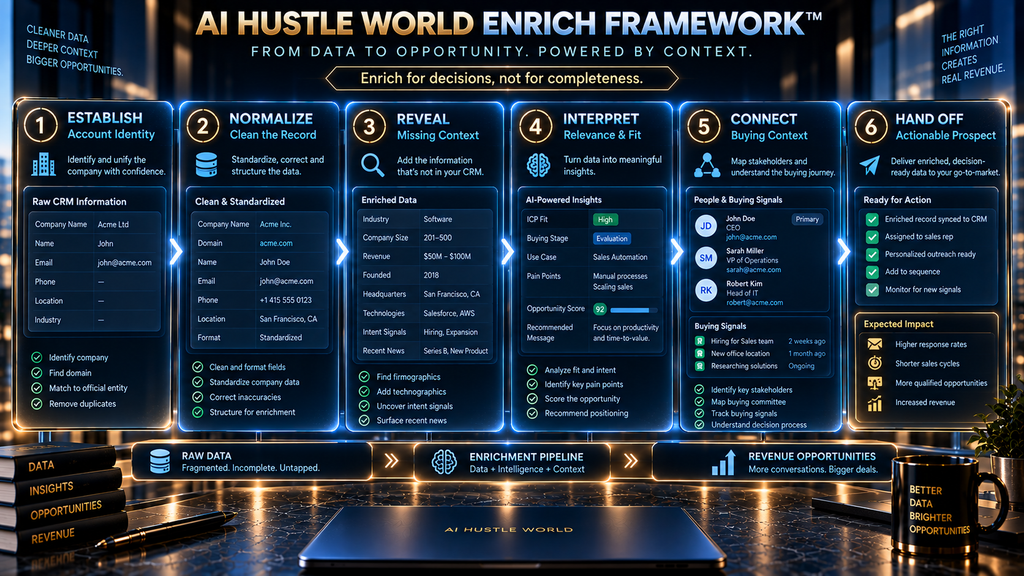
The AI Hustle World ENRICH Framework provides a practical way to design an enrichment system around decision quality instead of data volume.
Establish the account identity
Everything begins with knowing what the record actually represents. Match the company, domain, person, role, and organizational relationship before deciding what additional information should be attached. This is where duplicate resolution, company hierarchies, job changes, and ambiguous identities must be handled carefully, because errors introduced here contaminate everything downstream.
Normalize the record
Once the entity is established, standardize the data so it can be used consistently. Job titles can be normalized into role families or seniority levels; industries can be classified consistently; company names and geographic values can be standardized; existing values can be reviewed for obvious conflicts. This step looks administrative, but it determines whether the enriched information can actually drive reliable segmentation and automation.
Reveal missing context
Now identify the information gaps that matter to the sales motion. The point is not to enrich every possible field; it is to add information that improves a real decision. For one business that might mean employee count, territory, technology stack, and relevant decision-maker. For another it might mean corporate hierarchy, business model, use case, and operational maturity.
Interpret relevance
The system can then assess how closely the account resembles the ideal customer profile. This is where rules-based logic and AI classification can work together. Structured filters can eliminate obvious mismatches, while AI can help interpret less structured evidence; however, the confidence of an inference should remain visible when the decision carries material consequences.
Connect buying context
An account that fits the ICP may still be a poor sales target today. Connecting the enriched record to meaningful business changes helps answer whether something about the company’s current situation makes the proposition more relevant. This is where hiring, expansion, technology changes, executive turnover, engagement, and other signals can become useful—not because any one of them proves intent, but because they change the probability that a sales conversation is timely.
Hand off an actionable prospect
The final test is whether another human or workflow can act on the record without restarting the research process. A useful handoff contains enough trusted information to explain why the account matters, who should be approached, what context should shape the conversation, and which assumptions still require validation.
The framework deliberately ends with action, because enrichment that never affects action has limited commercial value. The system should make the next decision easier; otherwise, it is simply making the CRM bigger.
Waterfall Enrichment Solves a Coverage Problem, Not a Truth Problem
No single commercial data source necessarily has perfect coverage across every country, industry, company size, role, and contact type. That is one reason waterfall enrichment has become an important part of modern B2B data workflows.
The concept is simple: a record is checked against one source, and when that source cannot provide an acceptable result, the system moves to another source in a predefined order. Apollo’s current documentation describes exactly this model, with connected providers queried sequentially and optional email or phone validation layered into the process.
The important insight is why this architecture exists. Different datasets have different strengths. One provider may be especially useful for a particular geography; another may have broader contact coverage; another may perform better for certain fields. A waterfall therefore treats enrichment as source orchestration rather than assuming that one database must be universally superior.
That does not mean more sources automatically equal better data. Every additional provider can increase cost, latency, reconciliation complexity, and the chance of conflicting values. If Provider A says a contact’s email is valid and Provider B returns a different address, someone—or something—still needs to decide which result deserves trust.
Apollo’s latest documentation also makes the trade-off explicit by allowing teams to configure source order, choose whether to rely on Apollo alone or broader third-party coverage, and optionally add validation. Its 2026 product updates show waterfall enrichment being integrated into CSV uploads, workflows, API calls, job-change processes, and other operational paths.
So waterfall enrichment should be understood as a way to improve coverage under uncertainty. It is not a guarantee of truth.
Data Decay Is the Reason Enrichment Cannot Be a One-Time Project
One of the most damaging assumptions in B2B data management is that a record, once enriched, remains enriched. It does not.
People move companies. Job titles change. Companies acquire other businesses. Business models shift. Technology stacks are replaced. Offices open and close. Corporate domains change. Even information that was correct at the moment it entered the CRM can become wrong without anyone manually editing the record.
That means data quality has a temporal dimension. A field is not simply “accurate” or “inaccurate”; it can be accurate at a particular point in time.
The practical consequence is that enrichment needs a refresh strategy. HubSpot’s current documentation explicitly supports automatic and continuous enrichment for supported records, while Apollo’s current product capabilities include scheduled job-change and missing-data enrichment workflows.
The right refresh frequency depends on the data. A contact’s current employer can change quickly. A company’s industry classification may remain stable for much longer. A buying signal may have a useful lifespan measured in weeks rather than months. A technology attribute may need to be reconsidered when other evidence suggests a stack change.
This leads to a better operating rule: Refresh according to the volatility of the information and the cost of using stale information. A low-value field that rarely changes does not deserve the same refresh budget as a decision-maker email used in an automated outbound sequence.
Why AI Makes Bad Data More Dangerous
Before AI-driven sales workflows, bad data usually created localized damage. A salesperson emailed the wrong person, spent time researching the wrong company, or manually corrected a CRM record.
Automation changes the scale.
An inaccurate company classification can now feed a scoring model. That score can change routing. The routing can create a sales task. An AI system can draft an outreach message based on the classification. The message can be sent to hundreds of similar records. What used to be one human mistake can become a systematic workflow error.
This is one reason the data-quality problem has become more important as AI becomes more operational. Current industry reporting increasingly frames data readiness as a constraint on scaling AI in sales, while Salesforce’s broader data-quality framework emphasizes how enrichment should support more reliable analytics, automation, and AI experiences rather than merely increasing completeness.
The implication is uncomfortable but useful:
AI does not make bad data less important. It raises the cost of being wrong.
That means AI enrichment systems need stronger controls around source quality, confidence, provenance, validation, exceptions, and human review for high-impact decisions. The more autonomous the downstream workflow, the stronger those controls should be.
From Enriched Record to Sales-Ready Prospect
The phrase “sales-ready” is easy to misuse because it sounds like a state that enrichment software can create automatically. In reality, sales readiness depends on the specific sales motion.
A record can be highly complete and still not be sales-ready.
A genuinely actionable prospect usually needs enough information to answer several practical questions: Who is this account? Does it fit our ICP? Who is relevant? What information is trustworthy? Why might our proposition matter? Is there a meaningful reason to prioritize the account now?
Notice that only some of those questions are pure enrichment questions. The rest begin to approach qualification and buying-signal analysis. This is exactly where the wider B2B prospecting picture matters: this article establishes the data foundation without trying to replace the deeper work in our guides on lead qualification and buying signals.
The distinction can be illustrated with a simple progression. A raw record might identify John Smith at Acme. An enriched record could establish John’s role, the company’s size, industry, technology, geography, and corporate structure. A qualified record would then determine whether the account actually meets the business’s defined requirements. A sales-ready prospect adds sufficient context and timing evidence to justify a concrete action.
These states are related, but they should not be collapsed into one score. The objective of enrichment is to make the later decisions better informed.
The Economics: What Are You Actually Paying to Improve?
It is tempting to calculate enrichment economics using a single number such as cost per contact. That is useful, but insufficient.
Suppose an enrichment provider costs $0.10 per successfully processed record. At first glance, processing 100,000 records appears to cost $10,000. But the true economic question is what the company receives for that $10,000.
If enrichment saves thousands of hours of manual research, improves routing, eliminates invalid records, increases the proportion of accounts that match the ICP, and helps the sales team focus on higher-value opportunities, the investment may be attractive. If it merely fills fields that nobody uses, the same $10,000 is wasted regardless of how accurate those fields are.
The economic model should therefore consider decision improvement, not only data acquisition. A useful internal model is: Enrichment ROI = recovered research capacity + better sales prioritization + workflow efficiency + avoided bad-data costs − data, software, and governance costs.
The terms will vary by business. A high-volume SDR organization may value time savings enormously. An enterprise sales team may care more about reducing the cost of pursuing poor-fit accounts. A smaller sales organization may place more value on getting enough context to avoid spending half an hour researching each target manually.
This is also why provider evaluation needs to be based on the company’s own data. A vendor’s published coverage statistic is informative, but your actual economics depend on your countries, industries, company sizes, job functions, existing CRM quality, validation requirements, and downstream workflow.
The correct question is not: “Which provider has the biggest database?” It is: “Which provider—or combination of providers—reduces the uncertainty that costs our sales team the most money?”
The Data You Should Not Enrich
A mature enrichment strategy is partly defined by what it refuses to collect.
Every additional field creates some combination of cost, maintenance, storage, validation, governance, and cognitive overhead. More information is not automatically better, particularly when sales reps have to navigate dozens of low-value fields before finding the three that actually matter.
Start with the decisions your team makes. If sales leadership needs to determine territory ownership, geographic data may be essential. If the product integrates only with specific software, technographics may be essential. If the business sells to companies above a certain size, employee count or revenue bands may matter. If a field does not influence a decision, its justification becomes much weaker.
This is where field discipline becomes an important part of data strategy.
A strong schema is not the one with the most fields. It is the one where the important fields have a clear purpose, a defined source, a known freshness expectation, and a downstream use.
That principle also protects the organization from vendor-driven over-enrichment. Providers naturally expose additional data because additional attributes can make a platform appear more comprehensive. Buyers should resist the temptation to confuse platform capability with business necessity.
Privacy and Data Governance Are Part of the Product
B2B does not mean “outside privacy law.”
When enrichment involves information associated with identifiable individuals, organizations need to consider the privacy and data-protection rules that apply to their jurisdiction, purpose, source, and communication method. GDPR Article 5, for example, includes principles of lawfulness, fairness and transparency, purpose limitation, data minimization, and accuracy. It also requires personal data to be kept up to date where necessary. (Eur-Lex)
That has practical implications for enrichment architecture. Teams should know why they are collecting a field, whether it is necessary for the stated purpose, where it came from, how long it should be retained, and how inaccuracies or objections are handled. A vendor’s ability to provide the data does not automatically resolve the buyer’s own compliance responsibilities.
The same principle applies to AI-derived information. An AI-generated account summary may contain personal or business information from multiple sources, and the organization needs to consider how that information is being processed and reused. HubSpot’s current documentation explicitly separates enrichment settings from AI model-training settings and notes that organizations need to assess their own regulatory environment when using enrichment features.
The safest posture is not to treat governance as an afterthought. Data governance should be designed into the enrichment process because the more automated the workflow becomes, the harder it is to correct mistakes after they propagate.
How to Build a B2B Data Enrichment System Without Overengineering It
The best implementation begins with the ICP and the sales process, not the vendor catalog. Define what a good account looks like, identify which decisions the sales team repeatedly makes, and document the information required to make those decisions with reasonable confidence. This produces a much smaller and more useful enrichment schema than starting with every field a provider can return.
Then audit the current CRM. Identify duplicates, missing information, stale records, inconsistent classifications, unreliable fields, and gaps that salespeople repeatedly fill through manual research. Salesforce’s current guidance recommends understanding the existing data problem and assessing enrichment needs before designing the enrichment strategy, which is exactly the right sequence.
The next step should be a controlled test. Take a representative sample of accounts and contacts and run the enrichment process against them. Measure match quality, field accuracy, freshness, verification rates, coverage, cost, and the amount of manual correction still required. Do not let a vendor benchmark substitute for testing your own dataset.
Only after the data quality is understood should the workflow become automated. Connect the validated output to the systems that actually use it: CRM fields, routing rules, lead scoring, account research, sales tasks, or other defined workflows. If the data has nowhere to go, the project is not finished; it simply means the organization has not yet identified the commercial use case clearly enough.
Finally, create refresh rules. New records may be enriched on entry; high-value contact data may be revalidated periodically; job changes can trigger updates; and important account changes can trigger renewed research. HubSpot’s continuous enrichment and Apollo’s current enrichment workflows illustrate how modern systems are moving toward this ongoing model rather than relying entirely on periodic manual cleanup.
Measuring Enrichment: Stop Celebrating Filled Fields
A mature enrichment program should have three measurement layers.
The first is data quality. Match rate, duplicate rate, freshness, field validity, verification rate, completeness, and source coverage tell you whether the underlying data operation is healthy. These measures are necessary because you cannot improve a system you cannot observe.
The second layer is workflow performance. Measure how much manual research time is being removed, how quickly records are enriched, how frequently fallback sources are required, how often salespeople override enriched values, and how much enrichment costs per usable record. These metrics tell you whether the operating model is efficient.
The third layer is commercial impact. Measure changes in qualified-account rates, meetings, opportunities, pipeline, or revenue where the enrichment workflow is actually part of the causal path. Not every downstream change will be attributable to enrichment alone, so the strongest teams use controlled tests or clearly defined cohorts where possible rather than claiming every improvement as an enrichment effect.
This three-layer model prevents a common failure: optimizing the data pipeline while forgetting the sales process. A company can improve field completeness from 72% to 96% and still produce no measurable improvement in revenue.
That is not necessarily a data-quality failure. It may be a usefulness failure.
The Most Important Failure Modes to Watch
The first failure is enriching dirty data. Duplicate accounts, bad identifiers and old contacts can cause enrichment to attach correct information to the wrong record.
The second is optimizing completeness instead of relevance. If nobody knows why a field matters, adding it is unlikely to create meaningful value.
The third is trusting a provider without testing it. Commercial databases vary by geography, role, industry, source, methodology, and update frequency.
The fourth is using inferred AI information as verified fact. The more interpretive the output, the more important evidence, provenance and human review become.
The fifth is ignoring freshness. A beautifully enriched record from twelve months ago may now be a beautifully documented historical record.
The sixth is overwriting trusted first-party information. A customer-facing employee or account manager may have verified information that is more current than a commercial source. Automated enrichment should not blindly replace higher-confidence internal data.
The seventh is disconnecting enrichment from action. If the final data is never used to change prioritization, routing, research, segmentation, or another meaningful workflow, the economic rationale becomes difficult to defend.
The final failure is perhaps the most common: buying technology before defining the information problem.
A Better Way to Evaluate an Enrichment Provider
When comparing providers, database size should be near the bottom of the evaluation hierarchy.
Start with coverage for your market. A provider that performs extremely well in North America may not perform as well in your target European, Asian, Latin American, or Middle Eastern markets. Next evaluate matching quality, because the correct company and contact association is upstream of every other field.
Then examine field-level reliability. Email validity, phone availability, job-title accuracy, company size, technology data, and other attributes should be tested independently because a provider can be strong in one category and weak in another. Add freshness, because a highly accurate record from the past is not necessarily a useful record today.
Then evaluate the operational layer: API access, workflows, CRM integration, source transparency, waterfall capabilities, validation options, cost controls, and governance. Apollo’s current waterfall documentation shows why source ordering and validation are operational decisions rather than purely database questions.
Finally, evaluate commercial value. Does the provider reduce manual research? Does it improve account prioritization? Does it increase usable contact coverage? Does it save rep time? Does it improve the quality of downstream automation?
That final question should have the highest weight.
Who Benefits Most From B2B Data Enrichment?
Enrichment becomes more economically attractive as the cost of manual research rises and the sales process becomes more dependent on context.
A company with thousands of target accounts and a large SDR organization can often benefit because the cost of researching each account manually becomes enormous. A complex enterprise sales organization can benefit because account structure, technology, organizational relationships, and decision-maker information materially affect the sales strategy. A business running automated inbound routing can benefit because enrichment can help determine territory, segment, account tier, or ownership before a human touches the lead. HubSpot’s current documentation specifically describes enrichment being used to make CRM records more complete and keep supported information up to date, while Salesforce positions enrichment as a way to improve decision-making, analytics, automation, and AI experiences.
The opposite is also true. A small consultancy with 80 highly targeted accounts may not need a sophisticated waterfall architecture. If the founder personally knows the market and manually researches each account, an expensive enrichment stack could create more complexity than value.
The appropriate level of sophistication depends on record volume, research burden, sales complexity, data volatility, automation level, and the cost of a wrong decision. There is no prize for building the most complicated enrichment system.
The Second-Order Effect: CRM Is Becoming a Dynamic Model of the Market
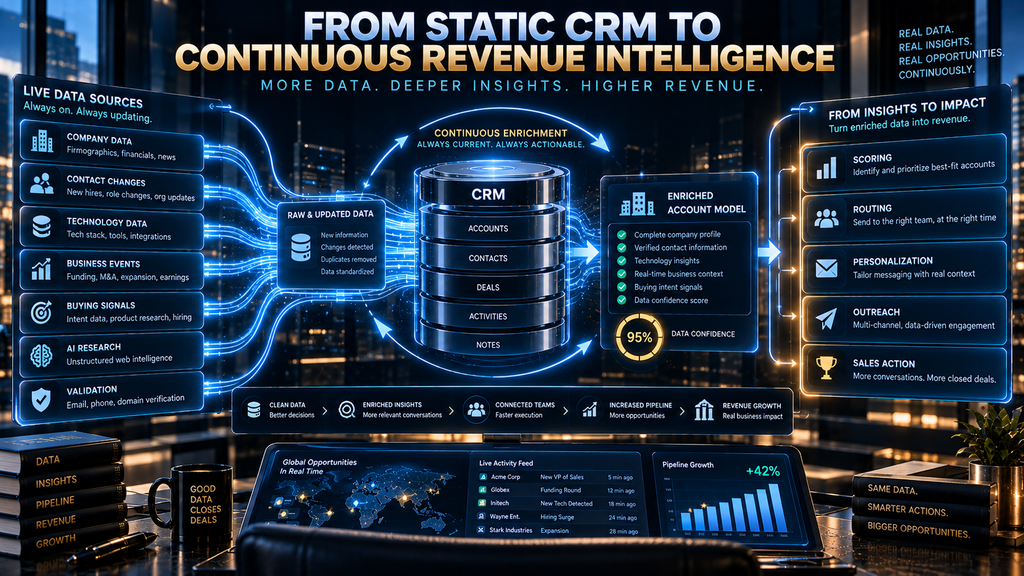
The more interesting future of enrichment is not simply cleaner CRM data. It is the emergence of a continuously updated representation of the market.
Today, many CRMs behave like historical records. A salesperson enters information, the record remains mostly unchanged, and someone eventually cleans it. The newer model is dynamic: account attributes change as new evidence appears, contacts are updated when roles change, buying context is refreshed, and AI systems can recalculate priority as the surrounding information changes.
Apollo’s current product development illustrates this direction through continuous enrichment, job-change workflows, waterfall enrichment, API capabilities, and AI-driven CRM field population. HubSpot similarly now supports continuous enrichment that can refresh supported properties after an initial record is enriched.
That has broader implications for revenue operations.
Once a company can maintain a more current representation of its accounts, AI prospecting systems can reason over that information continuously. Qualification models can be updated. Sales territories can respond to changes. Account research can become event-driven. AI SDRs can operate from richer context rather than static lists.
But this future creates a new dependency: the quality of automation becomes increasingly dependent on the quality of the information underneath it. That is why enrichment is likely to become a foundational layer for the broader AI prospecting stack rather than remaining a peripheral CRM feature.
The Contrarian View: The Best Enrichment Strategy May Produce Less Data
The B2B data market has created a natural incentive to think in terms of scale. Larger databases sound better. More records sound better. More fields sound better. More providers sound better.
But a sales organization does not need more information merely because more information exists. It needs useful information that reduces uncertainty.
Suppose an SDR team only needs seven attributes to make an initial account-prioritization decision, but the enrichment platform provides 70. If the extra 63 fields create negligible decision value, they are not necessarily an advantage. They may increase cost, clutter, maintenance, and the possibility that different fields contradict one another.
The same logic applies to AI. An AI system capable of researching an account from dozens of sources can produce a tremendous amount of context, but the best output may still be a concise, evidence-backed account brief containing only the information that changes the next action.
That is why the strongest enrichment strategy is not “collect everything.” It is “collect what changes the decision, verify what matters, and ignore what does not.”
B2B Data Enrichment Is the Foundation of the AI Prospecting Stack
This is where data enrichment connects to the broader B2B prospecting picture.
Once a business understands enrichment, the next problem becomes finding more potential companies to put into the system. That is the territory of AI lead scraping and prospect discovery. After prospects are discovered and enriched, the organization still needs to determine which ones deserve attention; that is where AI lead qualification enters the process.
From there, organizations can evaluate specific lead-generation and enrichment tools, build an end-to-end AI prospecting workflow, incorporate buying signals, compare AI prospecting with traditional methods, and eventually understand where an AI SDR fits into the operating model. That is the natural order of the topic: data enrichment first, followed by lead scraping, qualification, tools, workflow, buying signals, strategic comparison, and AI SDRs.
That relationship matters because it prevents this article from making a common mistake: trying to explain all of B2B sales automation at once. The job of enrichment is narrower and more foundational.
It improves the information available before the next decision is made. That is enough to make it strategically important.
Final Reality Check
B2B data enrichment is often sold as a way to “get more complete data,” but completeness is a weak measure of success. A CRM record can be 100% populated and still leave a salesperson uncertain about whether the account matters, who should be contacted, what the company actually does, or why the timing is relevant.
The stronger model is to treat enrichment as a process of uncertainty reduction. Establish the correct identity, clean and normalize the record, add the missing information that matters to the sales motion, use AI to interpret context where structured fields are insufficient, preserve evidence and confidence, refresh information as reality changes, and finally push the result into a workflow that can make better use of it.
AI makes this process considerably more powerful because it can interpret large volumes of fragmented information and turn unstructured context into something operational. But it also raises the standard required for data quality. An AI system can accelerate research, classification and prioritization; it cannot make unsupported information true.
The strongest B2B organizations will therefore stop asking how much data they can attach to a prospect. They will ask a much harder question: What information would materially improve the next decision—and how confident are we that the information is right? That is the real purpose of B2B data enrichment.
Final Thoughts
The simplest definition of B2B data enrichment is also the least useful one: adding more information to a business record. That describes the mechanism without explaining the value.
The real value is better decisions under uncertainty.
A raw prospect record tells a sales team that an account or contact exists. Enrichment can reveal what the company is, who matters inside it, how the organization operates, what has changed, and which information deserves confidence. AI extends that capability by interpreting information that traditional databases struggle to represent, but the technology only creates leverage when the evidence underneath it is reliable enough to support action.
That is why the future of enrichment will not be won simply by whoever has the largest contact database. It will be won by systems that can continuously turn fragmented business information into relevant, current, evidence-backed context and deliver that context to the person—or AI workflow—that has to make the next decision. Enrich for decisions, not for completeness.
Build a Smarter B2B Prospecting System
Better prospecting starts with better data. Continue the AI Hustle World B2B sales series to see how enrichment connects with prospect discovery, qualification, buying signals, and the full AI prospecting workflow.
Build the AI B2B Prospecting Workflow →Frequently Asked Questions
What is B2B data enrichment?
B2B data enrichment is the process of improving existing company and contact records by adding, updating, validating, or interpreting relevant information from internal and external sources. The purpose is to make those records more useful for sales, marketing, analytics, automation, and decision-making.
What information is typically added through B2B data enrichment?
Common enrichment categories include firmographics such as industry and company size, contact information such as job title and seniority, technographics describing technology usage, organizational relationships, geographic data, and contextual or behavioral information. AI-based systems can also generate classifications and research summaries, although those should be distinguished from directly verified facts.
Is B2B data enrichment the same as lead generation?
No. Lead generation or prospecting generally focuses on discovering new potential accounts and contacts, while enrichment improves information associated with records already known to the business. Salesforce explicitly distinguishes enrichment from net-new prospecting even though modern sales platforms may provide both capabilities in the same product.
What is the difference between data cleansing and data enrichment?
Data cleansing addresses inaccurate, inconsistent, or duplicate information already in a record. Enrichment adds missing context or updates useful information from additional sources. In a mature data workflow, cleansing and identity resolution generally help establish a reliable base before significant enrichment is applied.
How does AI improve B2B data enrichment?
AI expands enrichment beyond structured fields by helping research and interpret unstructured information, classify companies, summarize accounts, identify likely use cases, and connect evidence across sources. The important limitation is that an AI-generated interpretation is not automatically a verified fact, so confidence and provenance should remain part of the workflow.
What is waterfall enrichment?
Waterfall enrichment is a multi-source process in which one provider is checked first and additional providers are consulted when the first source cannot return an acceptable result. Modern systems such as Apollo can also layer validation into this process.
How often should B2B data be refreshed?
There is no universal schedule because different fields change at different speeds. High-volatility information such as job roles and contact details generally deserves more frequent validation than relatively stable attributes. The refresh cadence should reflect both the expected rate of change and the cost of relying on stale information.
Does more enrichment always improve sales performance?
No. More data can increase complexity without improving decisions. The useful measure is whether the information improves account selection, routing, research, personalization, qualification, or another business process. Field count and pipeline impact are not the same thing.
How should a company measure B2B data enrichment ROI?
Use three levels of measurement: data quality, workflow efficiency, and commercial outcomes. Track match and verification quality, manual research time, cost per usable record, enrichment latency, qualified-account rates, meetings, opportunities, pipeline, and other relevant revenue measures.
Should small businesses invest in B2B data enrichment?
They can, particularly when the company has enough prospect volume or manual research burden to justify it, but the system should match the scale of the sales problem. A small, tightly defined target market may benefit from a simple enrichment workflow rather than a complex multi-provider architecture.
Sources and Further Reading
- Legitimate interests: UK Information Commissioner’s Office guidance on relying on legitimate interests as a lawful basis.
- Opinion 28/2024 on data protection aspects of AI models: European Data Protection Board opinion on personal data in the context of AI models.
Related Guides
- AI Product Data for Search: Make Catalogs AI-Ready
- AI Cold Email Strategy Explained: Scale Outreach Without Hitting
- AI Compliance Tools Compared: Features, Privacy Controls & Use Cases
Written by
Muntasir Ahmad Chowdhury
Founder, AI Hustle World
Muntasir Ahmad Chowdhury is the Founder of AI Hustle World, an independent publication dedicated to making Artificial Intelligence practical, trustworthy, and easy to understand. He researches AI tools, automation, customer service, productivity, and real-world business applications, helping readers make smarter technology decisions through research-driven, experience-backed content.
Expertise:
AI Tools • AI Automation • AI Customer Service • AI Productivity • Generative AI • AI Workflows
Get Smarter With AI
Enjoyed this guide? Get practical AI tools, tutorials, and honest reviews delivered to your inbox.