Evidence: Documentation reviewed
Last checked: September 2026
What was done: Written from official documentation and the published sources linked in this article. Not hands-on tested.
Files: None
Affiliate links: No
Best AI Cold Email Software in 2026: Instantly vs. Smartlead vs. Lemlist
Choosing cold email software in 2026 is much harder than comparing three pricing pages. Instantly, Smartlead, and Lemlist now overlap across sending, warmup, lead discovery, AI personalization, inbox management, analytics, and automation, which can make the products look interchangeable at first glance. They are not. Their strongest advantages sit in different parts of the outbound system, and the right choice depends less on which platform has the longest feature list than on the type of sales operation you are trying to build.
That distinction matters because cold email software sits in the middle of a larger revenue process. The platform can help you connect mailboxes, automate sequences, research prospects, manage replies, and monitor delivery, but it does not automatically fix poor targeting, weak offers, bad data, or an unhealthy sending reputation. Google continues to enforce authentication, sender-behavior, spam-rate, and unsubscribe requirements for mail sent to personal Gmail accounts, and its guidance makes clear that senders must manage the underlying system rather than assume a software provider can guarantee inbox placement.
So this comparison takes a different approach. Instead of asking which platform is “number one” in the abstract, we will compare Instantly, Smartlead, and Lemlist by operating model, infrastructure, AI capability, personalization, multichannel reach, economics, scale, and control. Then we will use the AI Hustle World O.U.T.B.O.U.N.D. Decision Model to determine which platform fits a particular business rather than forcing every reader into the same recommendation.
AI Hustle World Editorial Note: Pricing and product capabilities change frequently in this category. The comparison below uses the current platform information available at the time of research. Vendor-reported customer results are treated as company claims rather than universal performance benchmarks.
The Three Platforms Solve Different Outbound Problems
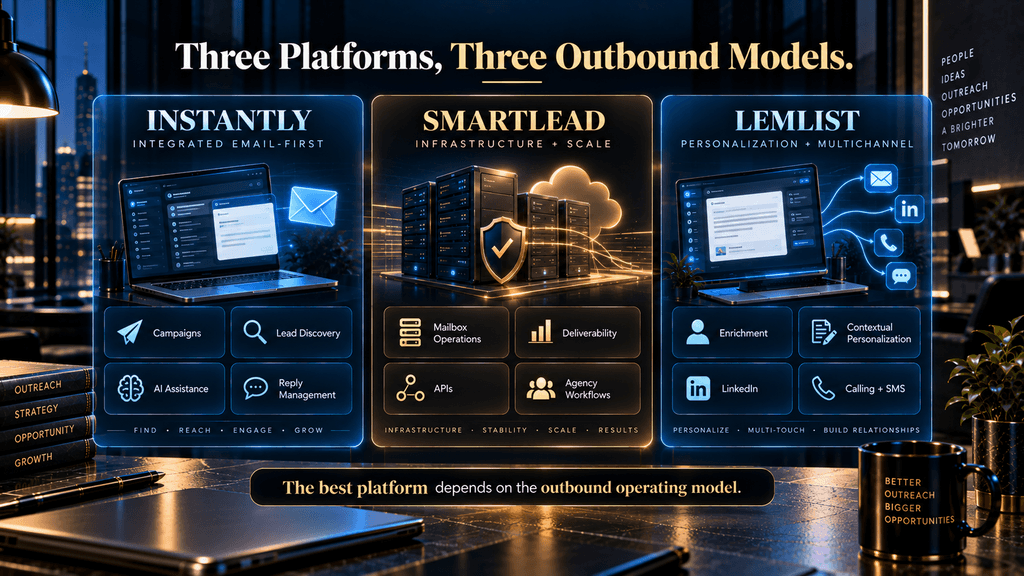
The simplest way to understand the market is to stop thinking of Instantly, Smartlead, and Lemlist as three nearly identical cold email senders. Their current product direction reveals three different centers of gravity: Instantly leans toward an integrated email-first outbound stack, Smartlead leans toward infrastructure and scalable outbound operations, and Lemlist leans toward personalization and multichannel engagement.
That does not mean Instantly cannot scale, Smartlead cannot personalize, or Lemlist cannot send large campaigns. All three can perform many of the same jobs. The difference is where each platform puts its product depth and where a user is likely to get the most leverage from that depth.
Consider three businesses. A founder with several sending accounts may value the ability to discover leads, launch sequences, manage replies, and use AI assistance without constructing a complicated operational stack. An agency managing many client campaigns may care far more about mailbox infrastructure, centralized management, testing, APIs, workspaces, and predictable operations. A sales team selling a high-value service into a narrow account list may be more interested in research-rich personalization and coordinated LinkedIn, email, calling, and messaging.
All three businesses are doing “cold email,” but they are not solving the same problem. That is why the software decision should begin with the outbound model rather than the product page.
Instantly: Best for an Integrated, Email-First Outbound Stack
Instantly has expanded considerably beyond its original identity as a cold email sending platform. Its current product structure includes Email Outreach, Credits for functions such as lead search and AI agents, CRM capabilities, inbox-placement testing, and related services, while the core outreach plans support unlimited connected email accounts and unlimited warmup. (Instantly Help Center)
The attraction is straightforward: Instantly is increasingly trying to give the user one connected environment for the major parts of an email-first outbound workflow. Instead of using one tool to discover prospects, another to enrich them, another to construct sequences, another to manage replies, and another to experiment with AI agents, a user can increasingly perform those functions inside the same product ecosystem.
That is particularly useful for smaller sales operations because operational simplicity has economic value. Every extra tool creates another integration, another login, another data flow, another potential failure point, and another system that somebody has to understand. Consolidating several activities does not automatically make every individual feature the best in the market, but it can reduce the friction involved in getting a campaign from idea to execution.
Instantly pricing and capacity
Instantly’s current Email Outreach structure includes Growth, Hypergrowth, and Light Speed plans. The platform’s current comparison documentation lists Growth at 5,000 emails per month, Hypergrowth at 125,000, and Light Speed at 500,000, while unlimited email accounts and unlimited warmup are included on the paid outreach tiers. AI and data-heavy capabilities such as SuperSearch, enrichment, verification, the AI Reply Agent, and AI Sales Agent sit within the separate Instantly Credits system. (Instantly Help Center)
That last point is strategically important. A platform’s subscription price is not necessarily the same thing as the cost of operating its full AI stack. A user who only needs campaign sending may have a relatively predictable software bill, while a user relying heavily on prospect discovery, enrichment, and autonomous AI features may consume additional credits.
That means a proper Instantly cost calculation should ask two separate questions: What will I pay for the outbound infrastructure, and what will I spend on the data and AI activities I actually use? Those numbers can be very different for different operators.
What Instantly does particularly well
Instantly’s strongest proposition is integration without excessive operational overhead. A user can connect and warm multiple accounts, upload or discover leads, construct campaigns, monitor account performance, manage responses, and layer on AI capabilities without building a highly technical outbound environment from scratch.
The platform is also becoming more agentic. Instead of limiting AI to copy generation, Instantly now exposes AI functions around sales activity and replies. That matters because the next stage of automation is not “write me an email”; it is “help me operate the campaign surrounding the email.”
This creates an important distinction between content AI and workflow AI. Content AI can save writing time. Workflow AI can potentially reduce the number of decisions and repetitive operational tasks that a sales operator must perform. The second category is more strategically significant because it touches the economics of running outbound rather than simply the economics of writing copy.
Where Instantly is not automatically the best choice
The main mistake would be to interpret integration as proof that every advanced operator should use Instantly. A platform designed for broad usability may not be the ideal environment for a team whose central challenge is deep infrastructure management.
There is also a volume trap. Instantly makes it comparatively easy to think about scaling because higher tiers increase sending capacity and paid outreach plans support unlimited accounts. But the ability to send more is not the same thing as having more valuable prospects. A campaign with poor targeting, weak data, or an unconvincing offer can become more expensive when you scale it because the underlying mistakes are multiplied.
Instantly therefore makes the strongest case when the user wants an integrated, relatively straightforward, email-first outbound system with growing AI capabilities and substantial account capacity.
Smartlead: Best for Outbound Infrastructure and Scalable Operations
Smartlead approaches cold email from a more infrastructure-oriented perspective. Its current pricing structure starts at $39 per month for Base, rises to $94 for Pro, $174 for Unlimited Smart, and $379 for Unlimited Prime on monthly billing, with much higher sending capacity at the upper tiers. Smartlead also states that all plans support unlimited email accounts, while additional products and add-ons provide sender provisioning, deliverability testing, dialer functionality, servers, and other infrastructure services. (Smartlead)
The difference becomes clearer as the operation gets larger. With several mailboxes, a sales operator can manually keep track of campaign behavior. With dozens or hundreds of mailboxes, the system becomes an infrastructure problem. Sender rotation, account health, authentication, campaign allocation, placement testing, reporting, client separation, integrations, and operational consistency all become important.
Smartlead is built around this reality.
Smartlead’s core strength is operational control
The platform’s current product architecture includes SmartSenders, SmartDelivery, SmartDialer, email verification, SmartServers, API access, and features built around account and campaign management. It also automatically rotates sending across connected mailboxes, distributing volume instead of concentrating it on one sender.
SmartDelivery is especially relevant because deliverability cannot be reduced to a warmup toggle. The current product can test campaign sequences against sender accounts and provide placement-oriented analysis, with additional functions at higher tiers.
That kind of functionality matters when a company treats outbound as an operating system rather than a one-off marketing activity. You need to understand not just what you sent, but whether the sending infrastructure is behaving as expected and where problems may be developing.
Smartlead’s pricing needs to be understood in context
The $39 Base plan looks inexpensive, but it comes with 6,000 email sends and 2,000 contacts, while larger plans expand those limits substantially. Smartlead also separates lead credits from email credits, so the number of prospects stored and the number of messages sent are not the same measurement.
That distinction becomes useful when forecasting an outbound program. If you repeatedly recycle a relatively small prospect pool, your economics look different from a system that continuously acquires new verified prospects. A software comparison that only lists monthly subscription prices misses this difference.
There is another factor that matters for agencies: mailbox economics. Smartlead explicitly states that users do not pay a separate platform fee for each email account, and its ecosystem also includes sender purchasing and setup services. That can become materially important when an operation expands beyond a handful of mailboxes.
Smartlead’s AI goes beyond copy generation
Smartlead’s AI positioning is particularly interesting because the platform is investing in operational assistance rather than only content generation. SmartAssistant is designed to work with the account context and help users with campaign-related activity, while SmartAgents extend the automation model toward more autonomous workflows.
That is a meaningful distinction. Imagine a tool that only writes a sequence. It saves a small amount of writing time. Now imagine a tool that can help build a campaign, analyze performance, identify problems, and assist with operational decisions. The second system has a larger potential impact on the cost of running outbound.
This is also where Smartlead’s technical orientation starts to make more sense. AI becomes more useful when it is connected to the actual operating context rather than isolated inside a text box.
Where Smartlead is not automatically the right answer
The same infrastructure depth that makes Smartlead appealing to an agency or high-volume operation can create unnecessary complexity for a small founder. More control is useful only when the user has enough operational complexity to benefit from it.
This is an important buying principle throughout the comparison: do not purchase infrastructure simply because infrastructure looks sophisticated. A sales team can waste just as much time over-optimizing its outbound machinery as it can under-building it.
Smartlead therefore has the strongest case when mailbox scale, infrastructure, deliverability operations, integrations, API access, agency management, or advanced outbound automation are central requirements.
Lemlist: Best for Personalization and Multichannel Outbound
Lemlist has a different center of gravity. Its current product combines email outreach with data discovery, AI agents, enrichment, a unified inbox, deliverability tooling, and multichannel capabilities. The current Email plan is listed at $69 per month, while the Multichannel plan is $109 per month; annual billing lowers those prices. The Multichannel tier adds LinkedIn automation, SMS automation, and calling-related capabilities alongside the core email functionality. (Lemlist)
That changes the nature of the comparison. If a user only wants an inexpensive email sending engine, they may not benefit from every capability Lemlist brings to the table. But if the strategy is based on richer research and multiple channels, the broader stack can replace several separate systems and therefore become economically attractive.
Lemlist’s personalization architecture is the important differentiator
Personalization is often used as a marketing buzzword, but there are several very different levels of it.
Adding a first name is personalization at the field level. Mentioning the company is slightly better. Referencing a hiring pattern, recent business event, product initiative, technology change, or specific operational signal requires actual context.
That context is where AI-driven enrichment becomes interesting. Lemlist’s current data offering includes email and phone finding, a large lead database, enrichment, intent-related signals, and AI capabilities that can be used for contextual outreach. Its pricing information also shows that certain data and intent activities are credit-based, reinforcing the idea that deeper personalization has an underlying cost.
This leads to an important economic principle: not every account deserves the same amount of research.
If the expected customer value is low, spending several minutes researching each prospect can destroy campaign economics. If one customer could be worth tens of thousands of dollars, deeper research can be rational because the return per qualified opportunity is much larger.
The best use of personalization is therefore not maximum personalization. It is economically justified personalization.
Lemlist’s multichannel advantage
The strongest case for Lemlist becomes even clearer when the outbound strategy extends beyond email. Its current Multichannel plan includes LinkedIn automation, SMS automation, and a built-in call dialer or VoIP integrations, allowing users to coordinate multiple touchpoints from a broader outbound environment.
This can matter in markets where a single email is unlikely to produce a response. A well-designed sequence may involve email for context, LinkedIn for familiarity, and a call when the account reaches a particular qualification threshold.
The key phrase is well-designed. Adding more channels does not automatically make an outbound campaign better. It can simply make a bad campaign more intrusive. Multichannel works when each interaction contributes something useful and the sequence feels like a coherent sales process rather than repeated attempts to reach the same person.
Where Lemlist is not automatically the best choice
Lemlist becomes less compelling when the user will never use its broader multichannel architecture and has little need for deep personalization. A user who only needs high-volume email infrastructure may be paying for capabilities that do not improve the workflow.
The platform can also encourage a personalization-heavy mindset even when the real problem is elsewhere. More detailed research cannot rescue an irrelevant offer or a poorly chosen market. The deeper the personalization, the more important it becomes to ask whether the underlying proposition is worth personalizing in the first place.
Lemlist therefore has the strongest strategic fit when context-rich personalization, enrichment, account-based outreach, and coordinated multichannel engagement are more important than raw email simplicity.
Instantly vs. Smartlead vs. Lemlist: Full Comparison
The feature overlap is now extensive enough that a simple list of checkmarks is not particularly useful. The more useful question is where each platform has a structural advantage.
| Category | Instantly | Smartlead | Lemlist |
|---|---|---|---|
| Core orientation | Integrated email-first outbound | Infrastructure-led outbound operations | Personalization-led multichannel outbound |
| Best fit | Founders and lean teams | Agencies, RevOps, larger outbound systems | Personalized and multichannel sales teams |
| Email infrastructure | Excellent | Excellent | Strong |
| Unlimited email accounts | Yes on paid outreach plans | Yes | Strong sender capacity |
| Warmup | Yes | Yes | Yes |
| Deliverability tooling | Strong | Very strong | Strong |
| Placement testing | Yes | SmartDelivery | Deliverability Hub |
| Lead discovery | Strong | Strong | Strong |
| AI research | Strong | Strong | Strong |
| AI writing | Yes | Yes | Yes |
| AI reply handling | Yes | Yes | Yes |
| AI operational assistance | Strong | Very strong | Strong |
| AI agents | Yes | Yes | Yes |
| API / integrations | Strong | Excellent | Strong |
| Agency operations | Strong | Excellent | Strong |
| Multichannel | Limited relative to Lemlist | Not its main differentiator | Excellent |
| LinkedIn automation | Not core | Not core | Yes |
| Calling / SMS | Not core | Additional capabilities | Yes |
| Operational simplicity | Excellent | Moderate | Moderate |
| Infrastructure depth | Strong | Excellent | Strong |
| Best reason to buy | Integrated outbound execution | Scalable outbound infrastructure | Contextual multichannel engagement |
This table should not be interpreted as a permanent ranking. It describes the current product architecture and the problems each platform is best positioned to solve. The relative winner changes with the buyer.
What Actually Makes Their AI Different?
A useful 2026 comparison needs a better definition of “AI-powered.” There are at least five different layers of AI inside a modern outbound platform.
AI writing generates emails, subject lines, follow-ups, and variations. This is increasingly commoditized.
AI research gathers information about prospects and companies and transforms that information into usable context. AI decision-making scores prospects, interprets signals, classifies replies, or determines which records deserve attention.
AI operations interacts with campaign infrastructure, diagnostics, workflows, and performance information. Agentic AI moves beyond suggestions and performs a chain of actions with limited human intervention.
The practical difference between platforms becomes much clearer through that lens. Instantly is building an increasingly integrated AI-enabled outbound ecosystem. Smartlead is particularly interesting for AI connected to operational context and outbound infrastructure. Lemlist has an especially strong case around contextual enrichment, personalization, and multichannel workflows.
This also reveals why feature-count comparisons are weak. An application with twenty AI buttons can still be strategically inferior to another with eight AI capabilities if those eight capabilities operate closer to the user’s most expensive bottleneck.

Which Platform Has the Best Deliverability?
The honest answer is that there is no universal winner.
Deliverability depends on the entire sending environment. Software can improve account management, rotation, warmup, authentication support, placement testing, and monitoring, but it cannot erase the effects of bad lists, high complaint rates, aggressive volume, poor reputation, or irrelevant messages.
Google’s current sender guidance is particularly important here. All senders to personal Gmail accounts must meet baseline requirements that include SPF or DKIM authentication, valid forward and reverse DNS, TLS, compliant message formatting, and controlled spam rates. Senders above 5,000 messages per day to Gmail accounts face additional requirements including SPF, DKIM, DMARC, alignment, and one-click unsubscribe for applicable marketing messages. (Google Support)
Google also recommends keeping spam rates below 0.10% and avoiding 0.30% or higher, while continuing to monitor sender reputation and delivery behavior through Postmaster Tools. That creates an important boundary condition for all three platforms: a sending platform can make a healthy system easier to operate, but it cannot make an unhealthy system safe merely by adding more mailboxes.
Smartlead has the strongest argument where deliverability testing and infrastructure visibility are themselves the main requirement. Instantly makes a strong case where deliverability is one component of a broader integrated outbound environment. Lemlist provides deliverability infrastructure within a workflow that places more strategic emphasis on personalization and multichannel engagement.
The distinction is not “good deliverability versus bad deliverability.” It is how much control and operational depth the user needs around deliverability.
Which One Is Cheapest?
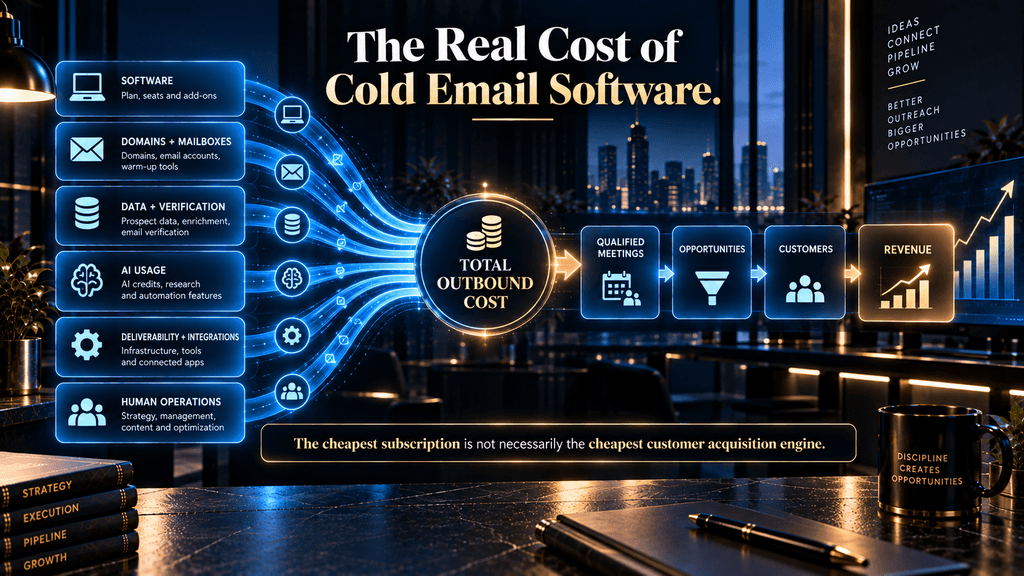
The lowest subscription price is not necessarily the lowest acquisition cost.
Smartlead’s current entry plan is $39 per month, Instantly’s paid Email Outreach plans start at a higher level, and Lemlist’s Email plan is currently $69 per month. Those numbers are useful starting points, but they do not answer the real business question because each platform structures data, credits, sending capacity, and additional services differently.
The more useful calculation is: Total outbound cost = software + domains + mailboxes + data + verification + AI usage + deliverability tooling + integrations + human operations.
Imagine two platforms. Platform A is $20 cheaper each month but requires a separate lead database, enrichment service, AI tool, and more manual campaign management. Platform B costs more but combines several of those functions. The cheaper subscription does not necessarily produce the cheaper customer acquisition engine.
The same principle applies to human time. A sales operations employee spending several hours each month moving data between tools has a real cost even though that cost does not appear on the software invoice.
This is why the right metric is not cost per email. It is closer to cost per qualified opportunity.
Why Traditional Cold Email Still Exists
It is tempting to believe that AI makes the traditional manual cold-email workflow obsolete. It does not.
The traditional workflow exists because certain decisions benefit from context, judgment, and accountability. Humans historically handled prospect selection, research, messaging, reply interpretation, and campaign adjustment because these tasks often involve incomplete information.
AI reduces the cost of performing some of those tasks, but it does not eliminate ambiguity.
A system can identify a company that is hiring aggressively. It cannot automatically know whether that hiring means the company is urgently buying a solution, preparing for growth, replacing failed staff, or simply expanding a department for unrelated reasons.
The same problem appears in replies. “Send me more information” could represent genuine interest, polite dismissal, internal forwarding, or an attempt to end the conversation. Context still matters.
This is why the strongest long-term model is unlikely to be full automation. It is selective automation, where repetitive and verifiable work is delegated while ambiguous or consequential decisions receive greater human oversight.
The AI Hustle World O.U.T.B.O.U.N.D. Decision Model
The three platforms become much easier to compare once the decision is moved away from feature checklists.
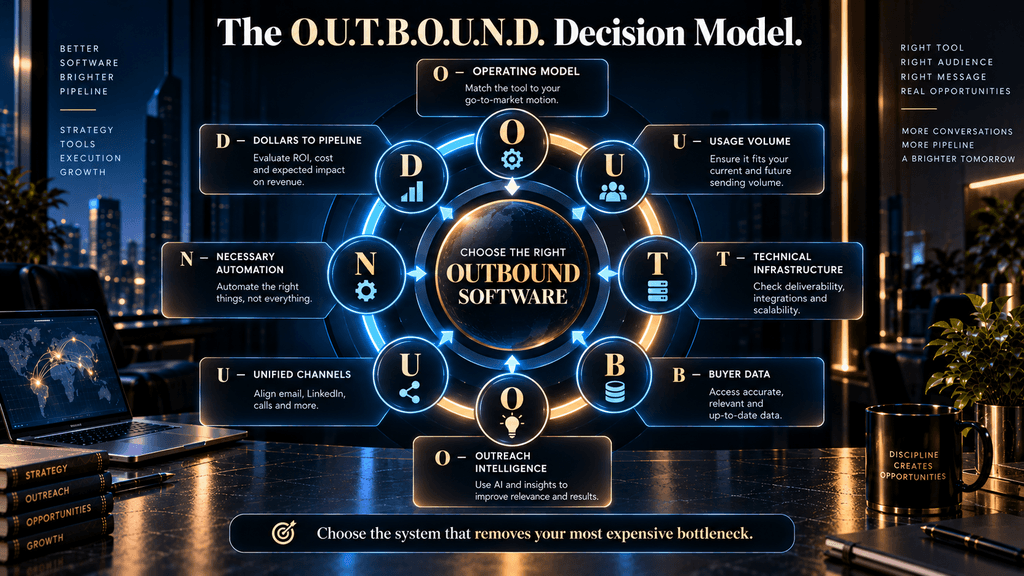
O — Operating Model
Start with how your sales operation actually works. A solo founder with five mailboxes, an SDR team with multiple users, an agency managing dozens of clients, and a RevOps department integrating outbound with a CRM all need different software.
Instantly tends to become more attractive when simplicity and integrated execution are priorities. Smartlead becomes more attractive as infrastructure and operational scale increase. Lemlist gains more strategic value when personalization and multichannel outreach are part of the core motion.
The wrong decision at this stage creates problems later because the platform becomes structurally mismatched to the organization.
U — Usage Volume
Next, estimate the number of prospects you genuinely need.
Do not start with the maximum sending capacity displayed on the pricing page. Start with the number of qualified opportunities required to hit the business target, then estimate how many prospects are needed to produce those opportunities.
This reverses the usual software-buying logic. Instead of asking, “How many emails can this plan send?” ask, “How much outbound do we actually need?”
A business that needs 3,000 highly relevant prospects does not gain much from a system optimized for 500,000 monthly emails unless that scale is expected to become strategically important.
T — Technical Infrastructure
Now consider domains, mailboxes, authentication, sender rotation, warmup, deliverability testing, infrastructure monitoring, and integrations. This is one of Smartlead’s clearest strengths, particularly when the outbound program becomes large or technically sophisticated. For a smaller operation, however, simpler infrastructure may be preferable because every additional control surface also creates another operational responsibility.
The goal is not maximum technical control. The goal is enough technical control to operate the system safely and profitably.
B — Buyer Data
Ask where your prospect data comes from.
Do you already own a clean list? Do you need email discovery? Do you need phone numbers? Do you need enrichment? Do you need buying signals? Do you need AI to research a prospect before writing a message?
This is where an apparently expensive platform can become economically competitive because integrated data can replace other subscriptions and reduce manual work. Lemlist’s current product, for example, explicitly includes email and phone finding, a large lead database, enrichment, and paid intent-related signals, while Instantly also separates lead search and enrichment into its Credits system.
O — Outreach Intelligence
Determine whether the AI is simply helping you write, or whether you expect it to participate in the operating process.
A writing assistant is useful. Research automation is more useful when personalization is important. Reply classification becomes valuable when campaign volume increases. Campaign analysis becomes important when managing many experiments. Agents become interesting when the repetitive parts of the workflow can be delegated safely.
This is where AI stops being a marketing feature and starts becoming an operational cost lever.
U — Unified Channels
Decide whether email is enough.
For some businesses it is. Others need LinkedIn touches, calls, SMS, or additional communication channels.
Lemlist becomes particularly attractive when this is a strategic requirement because its current Multichannel plan explicitly includes LinkedIn automation, SMS automation, and calling capabilities.
But adding channels should be justified by conversion economics. A badly designed multichannel sequence can increase activity without improving qualified conversations.
N — Necessary Automation
The question should not be “How much can I automate?” It should be “What should I automate?” Routine data organization, scheduling, enrichment, sequence construction, reporting, and basic classification are strong candidates for automation because they are repetitive and relatively verifiable.
Strategic offer changes, sensitive replies, complaints, unusual objections, high-value personalization, and major campaign changes generally deserve more human control because mistakes are harder to reverse and the context is less deterministic. This is the same principle that separates genuinely useful AI automation from automation for its own sake: automate the predictable, inspect the ambiguous, and keep accountability where the cost of error is high.
D — Dollars to Pipeline
Finally, connect the platform to revenue. The important chain is: software cost → qualified replies → qualified meetings → opportunities → customers → revenue.
A platform with fewer emails and higher conversion into qualified opportunities can be economically superior to a platform that sends ten times more messages. This is the number most comparison articles ignore because it is harder to calculate than subscription pricing.
When Instantly Is the Better Choice
Instantly is the strongest default candidate for users who want a broad, integrated, email-first outbound system without making infrastructure complexity the center of the project.
It is especially attractive for founders and lean teams that want to discover prospects, operate campaigns, manage multiple accounts, use AI assistance, and handle replies in one increasingly integrated environment. Its current product structure supports that broader direction.
It is also a sensible choice when the organization expects its outbound requirements to grow but does not yet want to build an elaborate operations layer. The main reason not to choose it would be a mismatch between its broad integrated approach and a business that specifically needs deep infrastructure control or a highly specialized multichannel strategy.
When Smartlead Is the Better Choice
Smartlead is the stronger candidate when outbound infrastructure itself is becoming a significant business problem. That includes agency environments, large mailbox fleets, complex campaign operations, API-heavy workflows, deliverability testing, technical integrations, and teams that expect outbound volume and operational complexity to grow substantially. Its current pricing and product ecosystem reinforce that positioning, particularly through unlimited email accounts, mailbox rotation, SmartDelivery, SmartSenders, APIs, and related infrastructure services.
The main reason not to choose Smartlead is overbuilding. A small team that does not need this level of infrastructure can end up spending time managing capabilities it does not actually use.
When Lemlist Is the Better Choice
Lemlist is the strongest candidate when the quality and context of the interaction matter more than simply increasing email volume. It is particularly well suited to account-based sales, personalization-heavy campaigns, enrichment-driven outreach, and multichannel sequences. The current Multichannel product includes LinkedIn automation, SMS automation, and calling functionality, while the broader platform also provides enrichment and AI-driven capabilities.
The main reason not to choose it is a lack of need for that broader architecture. A pure email-scale operation may gain less value from a platform whose strengths extend into channels it does not plan to use.
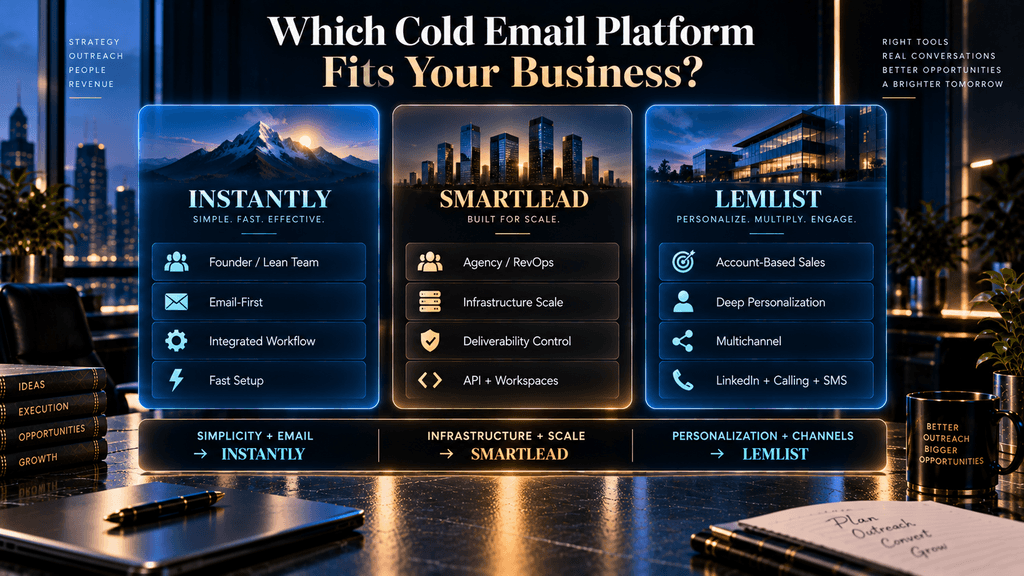
Best Platform by Business Situation
| Situation | Best Starting Point | Main Reason |
|---|---|---|
| Solo founder building first outbound engine | Instantly | Integrated email-first workflow |
| Lean sales team | Instantly | Broad capabilities with lower operational friction |
| High-volume email operation | Instantly / Smartlead | Both are strong on account and sending scale |
| Infrastructure-heavy outbound | Smartlead | Deep operational control |
| Agency managing many clients | Smartlead | Workspaces, infrastructure, APIs and scale |
| Technical RevOps environment | Smartlead | Strong API and operational orientation |
| Deep personalization | Lemlist | Strong enrichment and contextual outbound |
| Account-based sales | Lemlist | Personalization and research fit |
| Email + LinkedIn + calling + SMS | Lemlist | Broad native multichannel capability |
| Simplest integrated AI-first email workflow | Instantly | Strong combination of sourcing, sending and AI |
| Deliverability-focused operations | Smartlead | Strong testing and infrastructure controls |
Again, these are fit recommendations, not permanent rankings. They describe where each platform is most naturally aligned with the user’s problem.
Common Mistakes When Choosing Cold Email Software
The first mistake is choosing based on sending volume. A larger sending limit feels like a stronger product, but the business does not make money by sending emails. It makes money when relevant prospects move into valuable conversations and eventually become customers.
The second mistake is choosing based on AI marketing language. Every major platform now has AI, but “AI-powered” does not tell you whether the product writes copy, researches prospects, classifies replies, operates campaigns, or executes autonomous actions. Those are completely different levels of capability.
The third mistake is ignoring total cost. A platform subscription may be only one part of the outbound stack, and data, verification, domains, mailboxes, AI credits, deliverability testing, integrations, and labor can all change the economics.
The fourth mistake is treating deliverability as a software feature that can be switched on. Google continues to enforce authentication, spam-rate, infrastructure, and unsubscribe requirements, which means the sender remains responsible for the quality of the entire system.
The fifth mistake is buying complexity before the business has earned the need for it. Sophisticated infrastructure feels reassuring, but it can become a distraction when the real bottleneck is the ICP, the data, the offer, or the sales process.
The sixth mistake is over-personalizing every prospect. Personalization has a cost, even when AI performs much of the research. Higher-value accounts can justify deeper research; lower-value, high-volume segments may require lighter personalization and stronger economics.
A Practical Way to Test Before You Commit
The best software evaluation is not a product demonstration. It is a controlled test against your actual outbound workflow.
Start with a representative prospect group and build the campaign using the same type of targeting, data quality, offer, personalization depth, sending infrastructure, and follow-up process you expect to use in production. The purpose is not to prove that one platform can send email; all three can. The purpose is to discover which platform lets your particular team operate the complete workflow with the least friction and the best economic result.
Measure delivery, bounce behavior, positive replies, qualified replies, booked meetings, manual work, campaign-management time, and cost. Do not stop at opens or total replies because neither metric answers whether the campaign is producing commercially useful conversations.
Test the failure cases as well. Pause an account. Change a sequence. Inspect a reply. Find a prospect. Export data. Connect the CRM. Check how the platform handles poor performance. Run a deliverability test. Ask how much work still has to happen outside the application.
Those moments often reveal more about software quality than a polished product tour.
The Economics of Personalization
One of the most important decisions in AI-assisted outbound is determining how much research each prospect deserves. Consider two campaigns.
The first sells a $99 monthly service to a broad market. The second sells a $40,000 annual enterprise contract to a small set of target accounts. It would be economically irrational to spend the same amount of research effort on every prospect in both campaigns.
A useful model is: Personalization depth should increase with account value, probability of fit, and expected upside.
At the lowest level, the campaign may use verified basic fields and a relevant reason for contact. At the next level, the system may incorporate company context and a specific trigger. At the highest level, the campaign may involve deep research into a business problem, strategic initiative, technology stack, hiring pattern, or market event, followed by human review.
AI changes the economics because it lowers the cost of research, but it does not make research free. Data quality, model usage, enrichment credits, review time, and operational complexity all have a cost.
That is why maximum personalization is not the goal. Economically rational personalization is.
What Happens If You Do Nothing?
There is a cost to choosing no platform decision as well.
As cold-email software becomes more sophisticated, the opportunity is not simply that teams can send more messages. The larger opportunity is that outbound operations can become more measurable and less manually intensive.
A business that continues using disconnected spreadsheets, separate tools for lead data, manual follow-up management, and fragmented inboxes may spend more human time performing work that newer platforms are increasingly capable of automating.
But the opposite can also happen. A company can spend heavily on sophisticated software while continuing to send the same irrelevant messages to the same poorly targeted audience.
The cost of doing nothing is therefore not always “you will lose because competitors have AI.” Sometimes the cost is operational inefficiency. Sometimes the cost is failing to improve a broken sales process. And sometimes the correct decision really is to delay buying until the targeting, offer, and data are good enough to justify a larger outbound engine.
Measurement: What Should You Actually Track?
The software dashboard may provide dozens of metrics, but a useful outbound KPI system should follow the economic funnel.
Infrastructure KPIs
Track delivery rate, bounce rate, sender health, authentication status, spam signals, and account-level issues. These indicate whether the outbound engine can reliably deliver the workload you expect it to carry.
Engagement KPIs
Track reply rate and positive-reply rate, but treat them as diagnostic rather than final business outcomes. A campaign can generate many replies without generating valuable conversations.
Sales KPIs
Track qualified replies, booked meetings, show rate, opportunities created, opportunity value, and conversion into customers. These metrics connect the campaign to actual revenue.
Economic KPIs
Track customer acquisition cost, cost per qualified meeting, cost per opportunity, software spend per customer, and the human hours required to operate the system. That last category is especially important when comparing software because automation should ideally reduce operating cost while maintaining or improving output quality.
The platform with the highest reply rate is not automatically the winner. The better platform is the one that helps produce more valuable pipeline per unit of total outbound cost.
Where AI Should Make the Decision — and Where It Should Not
A useful rule is to map automation to two dimensions: repeatability and consequence.
Tasks that are highly repetitive and easy to verify are natural automation candidates. Organizing prospect records, enriching fields, drafting variations, applying routine scheduling rules, classifying common reply types, and producing reports can often be automated efficiently.
Tasks that are ambiguous and consequential deserve more human control. Changing the ideal customer profile, deciding how to reposition the offer, responding to sensitive objections, handling complaints, interpreting unusual buying signals, and changing the core sales strategy all require judgment.
This is not an argument against AI. It is an argument for using AI where it creates leverage instead of pretending uncertainty does not exist.
That principle should guide the buying decision as much as any feature checklist.
The Second-Order Effect: AI Will Make Personalization Cheaper
The cold-email market is entering an interesting phase.
When research and personalization were expensive, deep personalization created a meaningful barrier. Only teams willing to invest significant human labor could research every account carefully.
AI reduces that barrier. As more platforms can analyze company websites, identify signals, enrich leads, generate context, and create personalized sequences, the market will become increasingly saturated with messages that look personalized. That means personalization itself becomes less scarce.
When everyone can say something about your company, the real differentiator becomes whether the sender found the right reason to contact you at the right time with a valuable proposition. This is why the future of cold email is not simply “more personalized emails.” It is more relevant outbound decisions. The platforms that help operators move from raw personalization toward better targeting, better timing, better research, and better qualification will matter more than platforms that merely produce longer AI-generated messages.
The Biggest Contrarian Insight
The most dangerous misconception in AI-assisted outbound is that automation reduces the importance of judgment. The opposite is increasingly true.
When AI makes execution cheaper, human judgment becomes more valuable because the cost of executing a bad decision falls dramatically. A human who manually sends 100 bad emails will create limited damage. A poorly designed AI workflow can send the same bad decision thousands of times.
That means AI increases the value of deciding:
- who should be contacted,
- why they should be contacted,
- how much research is justified,
- which channels should be used,
- what should be automated,
- when a campaign should stop,
- and when a human should take over.
The winning outbound team will not necessarily be the one that automates the most. It will be the one that automates the right decisions without surrendering responsibility for the wrong ones.
Who Should Buy Which Platform?
Choose Instantly when you want a broad, integrated, email-first outbound environment and value simplicity, account scale, integrated lead workflows, and increasingly capable AI without making infrastructure management the center of the operation. Choose Smartlead when outbound is becoming an infrastructure problem and you need stronger operational controls, mailbox management, deliverability testing, API connectivity, agency workflows, or large-scale sending architecture. Choose Lemlist when contextual personalization, enrichment, account-based outreach, and multichannel engagement are central to how you sell, particularly when LinkedIn, SMS, and calling need to become part of the same broader workflow.
Choose none of them yet when the underlying problem is still your ICP, list quality, offer, positioning, sales process, or sender infrastructure. More automation will not fix a business that has not yet figured out what it should say, to whom, and why they should care.
Final Thoughts
The best AI cold email software in 2026 is not the platform with the most features, the most impressive AI label, or the largest sending limit. It is the platform that best fits the operating model behind the outbound campaign.
Instantly is the strongest all-around email-first choice for users who value integration and simplicity. Smartlead is the strongest infrastructure-oriented choice for teams that need scale, technical control, deliverability operations, or agency-level management. Lemlist is the strongest personalization and multichannel choice for teams that want richer research and coordinated outreach beyond email.
The decision becomes much easier once the question changes from “Which tool is best?” to “Which bottleneck am I paying this tool to remove?” If the bottleneck is fragmented execution, Instantly may create the most leverage. If it is infrastructure and operational scale, Smartlead may be the better investment. If it is contextual personalization and multichannel engagement, Lemlist may justify the additional complexity.
The most durable lesson is that software should follow strategy, not replace it. AI can lower the cost of researching prospects, writing messages, managing campaigns, and handling routine decisions, but it also makes it cheaper to scale bad decisions. The competitive advantage therefore moves upward: better targeting, better data, better judgment, healthier infrastructure, and more relevant offers matter more as execution becomes cheaper.
For that reason, the right cold email platform is not simply the one that sends the most messages. It is the one that helps you turn good prospects into qualified conversations at an economically sensible total cost.
Ready to Choose Your Outbound Stack?
Start with the platform that matches your real bottleneck: integrated email outreach, scalable infrastructure, or personalized multichannel selling.
Read the AI Cold Email Strategy Guide →Frequently Asked Questions
Is Instantly better than Smartlead?
Instantly is better for some operating models, while Smartlead is better for others. Instantly is particularly strong as an integrated, email-first outbound platform, whereas Smartlead is more compelling when infrastructure, deliverability operations, APIs, and large-scale mailbox management become central requirements.
Is Smartlead better than Lemlist?
Smartlead has the stronger case for infrastructure-heavy, scale-oriented outbound, while Lemlist has the stronger case for personalization-heavy and multichannel campaigns. The correct choice depends on whether the main bottleneck is operational infrastructure or contextual engagement.
Is Lemlist better than Instantly?
Lemlist becomes more attractive when deep personalization and multichannel outreach are core parts of the strategy. Instantly is generally a stronger fit when the priority is an integrated email-first system with broad outbound functionality and relatively low operational friction.
Which cold email software is best for beginners?
Instantly is a strong starting point for users who primarily need email-first outbound and want an integrated system. Beginners should still prioritize learning targeting, deliverability, list quality, and offer design before attempting aggressive volume.
Which platform is best for agencies?
Smartlead deserves the strongest consideration for agencies because its current product structure is closely aligned with mailbox infrastructure, scale, API-driven workflows, deliverability operations, and multi-client management.
Which platform has the best AI?
There is no meaningful universal winner because the platforms emphasize different forms of AI. Instantly is strong as an integrated AI-enabled outbound system, Smartlead is particularly strong in operational AI and infrastructure-connected workflows, and Lemlist has a strong position in enrichment, contextual personalization, and multichannel automation.
Which is cheapest: Instantly, Smartlead, or Lemlist?
Smartlead currently has the lowest advertised entry price among the three at $39 per month, while Lemlist’s Email plan is $69 and Instantly’s current paid outreach structure begins above Smartlead’s entry tier. However, total cost depends on sending capacity, data, AI usage, mailboxes, domains, verification, and other services, so subscription price alone is not enough to determine which platform is cheapest to operate.
Which platform is best for high-volume cold email?
Instantly and Smartlead are the strongest candidates for high-volume email-first outbound. Smartlead has a particularly strong case when the operation also requires advanced infrastructure and deliverability controls, while Instantly is attractive when the priority is an integrated outbound system with large account and sending capacity.
Which platform is best for personalized cold email?
Lemlist is the strongest candidate when deep contextual personalization is central to the campaign. Its current platform includes lead finding, enrichment, intent-related signals, and AI capabilities designed around more precise outbound.
Does cold email software guarantee inbox placement?
No. Software can improve infrastructure management, warmup, monitoring, testing, and sending controls, but inbox placement depends on authentication, sender reputation, spam rates, message quality, recipient behavior, list quality, and other factors. Google explicitly requires senders to meet its technical and sender-behavior requirements and warns that non-compliant traffic can experience spam placement or rejection.
Should I choose the platform with the most AI features?
No. The better choice is the platform whose AI capabilities address your actual bottleneck. A founder may value integrated campaign automation, an agency may value operational agents and infrastructure, while an account-based sales team may gain more from contextual enrichment and multichannel personalization.
Do I need multichannel outreach?
Not necessarily. Multichannel is useful when different channels contribute meaningfully to the same sales process. It is unnecessary complexity when email is already the most effective channel for the audience and offer. Lemlist has the clearest current multichannel orientation, but that advantage matters only when those channels are actually useful to the business.
Related Guides
- What Is an AI SDR? How AI Agents Automate B2B Prospecting, Outreach & Qualification
- Best AI Lead Generation Tools in 2026: 8 Platforms Compared by Use Case
- Best AI Email Assistants (Free & Paid): 10 Tools Compared
- Best AI Lead Scraping & Data Enrichment Tools in 2026
- Weav Pricing Explained: Cost Per Resolution vs Hiring Support Staff
Written by
Muntasir Ahmad Chowdhury
Founder, AI Hustle World
Muntasir Ahmad Chowdhury is the Founder of AI Hustle World, an independent publication dedicated to making Artificial Intelligence practical, trustworthy, and easy to understand. He researches AI tools, automation, customer service, productivity, and real-world business applications, helping readers make smarter technology decisions through research-driven, experience-backed content.
Expertise:
AI Tools • AI Automation • AI Customer Service • AI Productivity • Generative AI • AI Workflows
Get Smarter With AI
Enjoyed this guide? Get practical AI tools, tutorials, and honest reviews delivered to your inbox.