
How AI Automates Product Catalog Tagging and Categorization
Imagine a retailer with 30,000 products and a simple operational problem: the products are already in the system, but the catalog does not really understand them.
One supplier calls an item a “Men’s Performance Runner.” Another calls a nearly identical product a “Lightweight Sport Sneaker.” A third uses an internal SKU name that tells the merchandising team almost nothing. Some products have detailed descriptions and dozens of attributes; others arrive with a title, an image, and a spreadsheet row containing little more than a model number. The products can still be sold, but every downstream system now has to work around inconsistent information.
That problem becomes expensive as the catalog grows. Someone has to decide which products belong under which categories, which attributes should be extracted, which tags should be attached, and how those products should map into external taxonomies used by marketplaces, advertising platforms, or other sales channels. At a few hundred products, a merchandiser can handle much of that work manually. At tens or hundreds of thousands of products, the same approach becomes a permanent data-maintenance operation.
AI changes the economics of that process, but not quite in the way the phrase “AI product categorization” suggests.
The obvious idea is to give an AI model a product title and ask it to choose a category. That can work for simple cases, but it misses the larger opportunity. The real value of AI is turning inconsistent product information into structured product knowledge that other ecommerce systems can actually use. Categorization is one part of that process; tagging, attribute extraction, taxonomy mapping, confidence scoring, validation, and continuous correction are the parts that make the automation operationally useful.
That distinction also explains why fully automatic classification is not always the right goal. A product with an obvious category can often be processed without human intervention, while an ambiguous product may need additional evidence or human review. The strongest catalog workflows therefore do not ask, “How much of our catalog can AI classify?” They ask a more useful question: Which classification decisions are reliable enough to automate, and which ones are too uncertain or consequential to leave unattended?
The Catalog Problem AI Is Actually Solving
Product categorization exists because ecommerce systems need structure.
A customer may think of a product as “that black waterproof trail shoe,” but a store, marketplace, search engine, recommendation system, inventory platform, and advertising system need more formal representations of the same item. One system may need a category hierarchy, another may need attributes such as material or size, and another may require a specific external taxonomy value.
This is why manual catalog work has traditionally been necessary. Someone has to translate messy commercial information into a structure that software can interpret consistently. The work is not simply typing labels into a spreadsheet; it involves deciding what the product is, which distinctions matter, what information belongs in an attribute rather than a category, and which external taxonomy best represents the item.
The difficulty is that product data is usually created for commercial purposes before it is created for machine understanding. Suppliers write titles to identify products. Merchandisers write descriptions to sell them. Manufacturers use their own terminology. Marketplaces impose their own classification systems. A single product can therefore arrive carrying several different descriptions of what it is.
Consider a hypothetical catalog entry: “ProFlex X7 Men’s Outdoor Performance Shoe, Black/Red.”
A human familiar with the brand may immediately know that this is a trail-running shoe. The raw title, however, does not necessarily establish that. “Outdoor performance” could refer to hiking, trail running, general training, or another category. If the description says that the shoe has a lugged outsole and is designed for uneven terrain, the classification becomes stronger. If the product image also shows the construction associated with trail footwear, another signal becomes available.
The classification problem is therefore not really about finding the right keyword. It is about combining evidence. That is the first principle behind useful AI catalog automation.
Product Categorization, Tagging, Attributes, and Taxonomy Mapping Are Not the Same Thing
One reason catalog projects become messy is that businesses often use the words category, tag, attribute, and product type as though they mean the same thing. They do not.
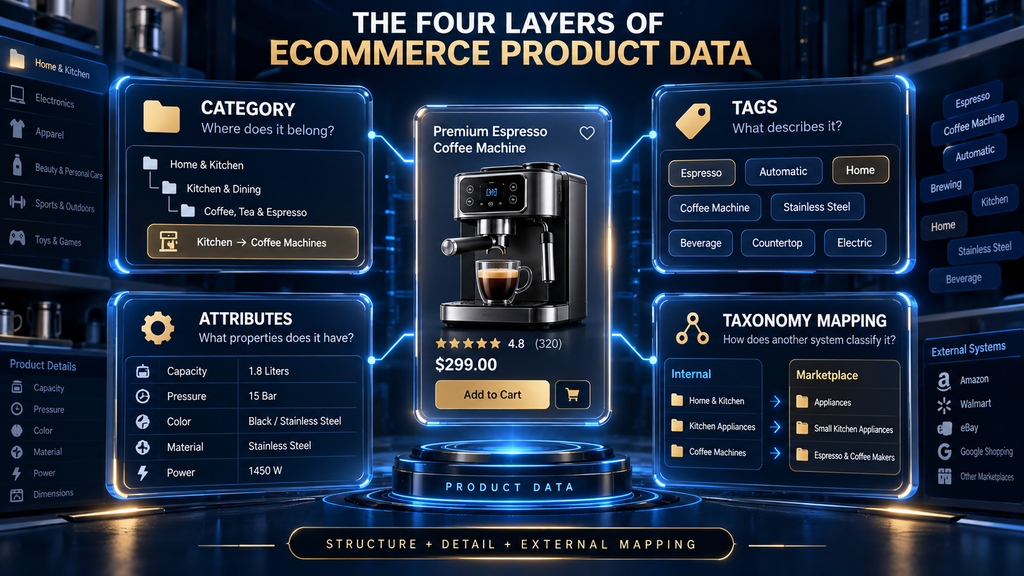
A category answers the structural question: Where does this product belong? A tag adds descriptive information that can help organize or retrieve the product. An attribute represents a structured property such as material, color, size, compatibility, or capacity. Taxonomy mapping determines how the product’s classification corresponds to another organization’s category system.
Take a hypothetical coffee machine. Its category might be: Home Appliances → Kitchen Appliances → Coffee Machines
Its attributes might include:
Type: Espresso machine
Capacity: 1.8 L
Pressure: 15 bar
Milk system: Automatic
Color: Stainless steel
Its tags might include: Espresso, Automatic, Home Barista, Stainless Steel. And if the retailer needs to send the product to an external marketplace, it may also need a mapping from its internal category to that marketplace’s taxonomy.
These layers serve different purposes. If a business turns every attribute into a category, the taxonomy becomes unnecessarily deep and difficult to maintain. If everything becomes a free-form tag, downstream systems lose the consistent structure they need for filtering, reporting, and integration.
Google’s Merchant Center provides a useful real-world illustration of this distinction. Google maintains its own predefined product taxonomy through google_product_category, while product_type can represent a merchant’s own internal categorization system. Google also uses product information such as titles, descriptions, brand, GTIN, and other signals when determining categories automatically.
The implication for AI is important: the model should be told what kind of decision it is making. Asking an AI system to “categorize this product” without defining whether the expected output is an internal category, an external taxonomy node, a tag, or an attribute creates ambiguity before the model even starts.
Why Manual Categorization Eventually Breaks
Manual categorization does not exist because ecommerce teams failed to discover automation. It exists because humans are often better than simple rules at interpreting incomplete information.
A merchandiser can look at “UltraFlex 2.0” and recognize the product because they know the brand, supplier, and assortment. They can notice that one supplier uses “trainer,” another uses “sneaker,” and another uses “athletic footwear,” even though all three refer to the same commercial category. They can also recognize when a product description contradicts the title and stop rather than confidently entering bad data.
The problem is that human judgment does not scale cheaply.
As the catalog grows, the organization begins to face a trade-off between consistency and speed. A new product may sit in an intake queue because someone needs to determine its category. A supplier update may require thousands of records to be reviewed. A marketplace taxonomy change may force a new mapping exercise. Meanwhile, different employees can make slightly different decisions about the same product.
That inconsistency creates compounding problems. Search filters depend on attributes that may be missing. Merchandising reports depend on categories that may not be applied consistently. Product feeds depend on correct taxonomy mappings. Recommendation systems can receive weaker product representations. Marketing teams may have difficulty creating reliable product groups because the catalog does not use its own classification language consistently.
The important point is that manual classification becomes expensive not only because humans are slow, but because inconsistent decisions accumulate into infrastructure debt.
AI is attractive because it can apply a classification policy repeatedly across a large volume of products. But that only works if the policy itself is clear.
How AI Actually Classifies a Product
At a technical level, AI product categorization can be understood as a sequence of transformations rather than a single prompt.
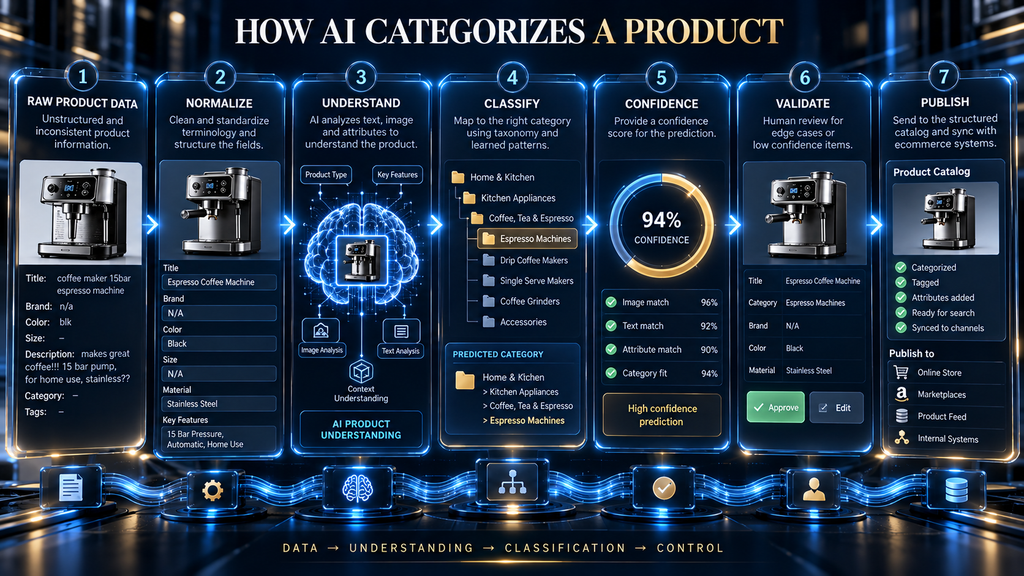
The system begins with raw product information. That information is normalized where necessary, relevant signals are extracted, the product is compared against an available taxonomy or classification scheme, a prediction is generated, and the result is evaluated before it becomes part of the live catalog.
In simplified form: Raw product data → normalization → signal interpretation → category prediction → confidence evaluation → validation → catalog update
The model may receive the product title and description as text, but a more sophisticated system can incorporate structured attributes, brand information, existing product classifications, identifiers, and images. Vision-language approaches make it possible to use visual information alongside text, which is useful when the image contains evidence missing from the written product data.
Shopify has described this evolution in its own product classification infrastructure. Its system has moved beyond basic categorization toward broader product understanding using its Product Taxonomy and vision-language models, including classification and attribute extraction, and Shopify reported processing more than 30 million predictions per day in the system described in 2025.
That scale matters because it illustrates what changes when classification is treated as infrastructure rather than an occasional administrative task. The AI is not simply producing a label. It is helping create structured representations of products that can support search, discovery, recommendations, and other systems.
The same principle can be applied at a much smaller scale.
A retailer with 20,000 products does not need a system operating at Shopify’s scale to benefit from the architecture. It needs a reliable way to transform its own product information into consistent decisions.
The Quality of the Input Still Matters More Than the AI Hype Suggests
AI does not remove the need for good product data. In many cases, it makes the quality of that data more visible.
Suppose the model receives a product title, a two-word description, no attributes, and a generic product image. The business may still expect it to determine whether the item belongs in “Outdoor Equipment,” “Camping Equipment,” or “Hiking Accessories.” A sophisticated model can make an educated inference, but there may simply not be enough evidence to make a defensible decision.
Now compare that with a richer record containing the product title, a detailed description, manufacturer category, material, intended use, dimensions, compatibility information, and a clear product image. The model has multiple independent signals that can reinforce or contradict one another.
This is why an AI classification pipeline should treat product information as evidence rather than merely as text to be summarized.
A useful input hierarchy often starts with the product title and description, then incorporates structured attributes and metadata, followed by visual information where relevant. Existing category assignments can also be used as contextual signals, although they should not automatically be treated as correct because the purpose of the workflow may be to repair precisely those historical classifications.
Google’s documentation makes a similar practical point from another angle: high-quality, relevant titles and descriptions, together with accurate pricing, brand, GTIN, and other product information, help its systems categorize products correctly. So when an AI classifier produces poor results, the first question should not always be, “Which model should we replace it with?” Sometimes the better question is, “What evidence did we fail to give the model?”
From Classification to Product Understanding
The more useful AI systems go beyond assigning a single category. Suppose the input is: “Women’s waterproof trail running shoe, breathable mesh upper, Vibram outsole, 8 mm drop.” A simple classifier might output: Category: Women’s Running Shoes.
A product-understanding workflow can produce much more:
- Category: Women’s → Athletic Footwear → Trail Running Shoes
- Material: Mesh
- Water Resistance: Waterproof
- Outsole: Vibram
- Drop: 8 mm
- Activity: Trail Running
- Audience: Women
Those outputs can then be used independently by other systems.
A search engine can use the activity and product type. A filter can use waterproofing and material. A merchandising system can group products by activity. A marketplace feed can map the category to its own taxonomy. A recommendation system can use attributes to understand similarity between products.
This is why automated tagging and categorization should be viewed as part of a broader product-data pipeline. The category is the skeleton. Attributes and tags provide the detail.
The Hardest Part Is Often the Taxonomy, Not the Model
This is one of the less obvious realities of catalog automation.
Businesses often assume that if the AI makes poor classifications, the model needs to become more sophisticated. Sometimes that is true. But sometimes the classification problem is difficult because the organization’s own taxonomy is poorly defined.
Imagine a retailer with these categories:
- Running Shoes
- Sports Shoes
- Training Shoes
- Performance Shoes
What exactly separates them?
If different merchandising managers answer differently, the problem is not primarily machine learning. The organization has created overlapping concepts and then expects a model to discover a boundary that humans themselves have not consistently defined.
AI cannot magically remove ambiguity that exists in the underlying business structure.
This becomes even more important when mapping between taxonomies. Google, for example, uses a predefined taxonomy and requires submitted google_product_category values to correspond to that taxonomy. A merchant’s own product_type structure can be different, which means the business may need to maintain a deliberate relationship between internal categories and external categories rather than assuming they are interchangeable.
The practical lesson is simple: define the classification system before trying to automate it. If the taxonomy cannot be explained clearly to a human reviewer, it is not ready to become an automated decision system.
The Confidence Problem: AI Should Know When to Stop
A classification system becomes much safer when it can express uncertainty.
Consider three catalog records: The first says “Men’s waterproof trail running shoes.” The category is relatively clear. The second says “Men’s outdoor performance footwear.” Several categories could plausibly apply. The third says “X-Pro 4000.” Without additional information, the system may not have enough evidence to classify it reliably.
Treating all three predictions equally is a mistake.
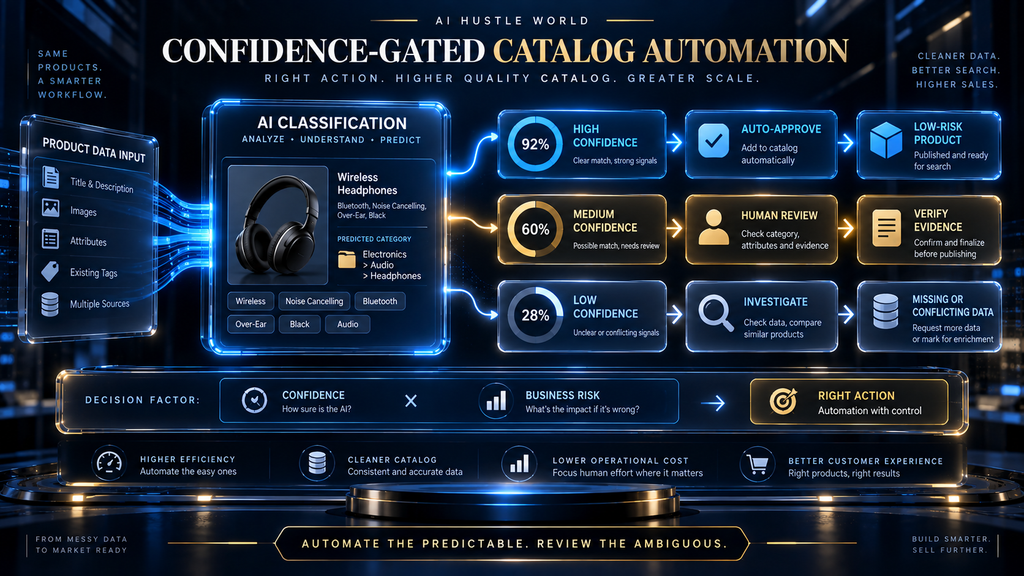
A useful catalog workflow introduces a confidence gate between the AI prediction and the live catalog. High-confidence classifications can move automatically when the business considers the category low-risk. Medium-confidence classifications can enter a human review queue. Low-confidence cases can be held for investigation or additional data enrichment.
Amazon Business has described a similar principle in its own catalog classification work. Amazon Business reported using a hierarchical machine-learning model with a classification decision threshold above 95%, and reported 91.6% product classification accuracy at the family-code level in the implementation it described. The figures are Amazon Business’s own reported results for its system, not a general benchmark for AI categorization.
The broader lesson is more important than the number itself: confidence thresholds are part of the system design. The model produces a prediction. The business decides what level of confidence is sufficient for that prediction to become an automated action. That distinction is crucial.
The AI Hustle World Confidence-Gated Automation Model
A practical way to design the workflow is to separate classification into three operational zones.
High confidence: the product has strong supporting evidence, the predicted category is clearly defined, and the consequence of a mistake is acceptable. The system can approve the classification automatically.
Review confidence: the prediction is plausible, but another category remains credible or important product information is missing. The system sends the item to a reviewer with the AI’s suggested classification and supporting evidence.
Low confidence: the model cannot establish a defensible classification. Instead of forcing an answer, the workflow flags the record for investigation, enrichment, or manual classification.
This model becomes even stronger when confidence is combined with business risk.
A high-confidence classification for a low-consequence internal category might be safe to automate. A high-confidence classification for a product where an incorrect taxonomy could create significant operational, regulatory, or commercial consequences may still deserve review.
So the real decision rule is not: “AI confidence above X = approve.” It is: “Is the evidence strong enough, and is the consequence of being wrong acceptable enough, to automate this decision?” That is a much more durable way to design AI workflows.
The Automation Ladder: From Assistance to Infrastructure
Businesses also make a strategic mistake when they treat automation as binary. A catalog does not need to be either completely manual or completely autonomous.
There is a progression.
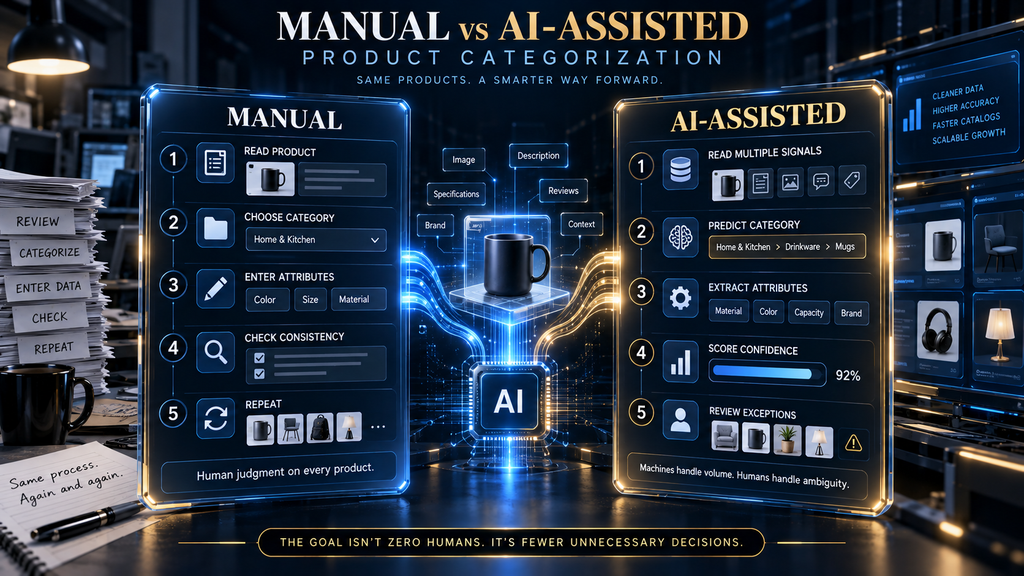
At the first level, AI acts as an assistant. It suggests categories and tags, while a human approves every result. This can already reduce repetitive work because the reviewer is validating a proposed decision instead of starting from an empty field.
At the next level, the business identifies predictable categories where AI performs consistently. High-confidence predictions in those areas can be approved automatically, while uncertain cases continue to reach human reviewers.
Eventually, some product groups can operate with very little manual intervention. The humans have not disappeared; their role has shifted from classifying every product to managing taxonomy definitions, reviewing exceptions, monitoring quality, and investigating unusual patterns.
That distinction matters because the goal of automation should be to reduce unnecessary human decisions, not eliminate human judgment altogether.
For a catalog with a large number of obvious products and a smaller number of difficult products, this approach can dramatically change where the team’s time goes. Instead of spending hours confirming predictable classifications, the team can focus on the records where their expertise actually changes the outcome.
Where AI Classification Fails
The failure cases are where a serious implementation differs from an impressive demo.
A model may perform extremely well when the product description contains the exact language used by the taxonomy. Performance becomes more difficult when the source data is vague, contradictory, incomplete, or written in terminology unfamiliar to the target classification system.
Supplier language is a common source of trouble. A manufacturer may describe a product according to its engineering terminology while the retailer’s taxonomy is organized around customer use. The AI then has to bridge two different ways of describing the same object.
Ambiguous products create another problem. A product can legitimately serve multiple purposes without fitting neatly into a single category. A “cross-training shoe” may be suitable for gym workouts, light running, and general athletic use. If the taxonomy requires one primary category, the business needs a rule for choosing it. The model cannot invent that policy reliably if the organization has never defined one.
Missing information creates a different kind of failure. When a product record does not contain enough evidence, the model may produce a plausible classification simply because the system expects an answer. That is dangerous because plausible errors are harder to detect than obvious failures.
Conflicting information is more subtle. Suppose the title says “Hiking Backpack,” the description says “Designed for overnight trekking,” and an existing attribute says “Travel Bag.” A strong system should recognize the conflict and either resolve it using a defined hierarchy of evidence or route the product for review.
The worst system is the one that produces a clean-looking catalog by hiding uncertainty. A trustworthy system makes uncertainty visible.
Why Accuracy Alone Is Not Enough
Suppose an AI classifier processes 100,000 products and correctly categorizes 98,000 of them.
A 98% accuracy rate sounds impressive. But the number alone does not tell you whether the remaining 2,000 errors are harmless or disastrous.
What if most of those errors occur in one high-value category? What if they affect products that are being exported to a marketplace? What if they cause required attributes to be missing? What if they affect the product groups used for advertising campaigns?
A useful measurement system therefore needs more than overall accuracy.
Category-level precision tells you how often assignments to a particular category are correct. Recall tells you how many products that truly belong to a category are being captured. Confidence calibration tells you whether high-confidence predictions actually deserve more trust than low-confidence predictions.
Operational metrics matter too. How many products require human review? How often do reviewers change AI classifications? How much time does the team spend per corrected product? How quickly can the system detect a new class of errors?
And then there is the metric that many AI projects neglect: business consequence. A classification error that has no meaningful downstream impact is different from one that causes a product to enter the wrong marketplace category or makes a critical attribute unavailable to shoppers. The best catalog automation systems therefore measure classification quality at two levels: model quality and business impact.
The Economics of a Wrong Classification
The cost of automation is not simply the cost of the AI model. It includes the cost of errors, review, correction, monitoring, taxonomy maintenance, and downstream problems.
Imagine that a manual reviewer needs two minutes to classify a product. At 50,000 products, that is roughly 1,667 hours of review time. An AI system may reduce the number of products requiring manual attention substantially, but if its errors are expensive to correct, the apparent efficiency gain can disappear.
Now imagine the opposite. The AI handles 80% of the catalog reliably, while 20% goes to review. The business has not eliminated human work, but it has concentrated that work on the difficult cases.
That can be much more valuable than trying to push automation to 95% simply because the percentage looks better.
The correct optimization target is therefore not maximum automation. It is maximum useful automation at an acceptable error cost.
This is one of the most important decisions an ecommerce team can make before deploying AI classification. The cheapest classification is not necessarily the one that requires the least human involvement. It is the one that produces enough reliable structure to reduce total operational cost without creating a new layer of catalog problems.
How Structured Product Data Creates a Larger Flywheel
Once a catalog has consistent categories, tags, and attributes, the benefits extend beyond the classification task itself.
Search becomes easier to structure because products share more consistent terminology. Filters become more useful because attributes are populated in predictable ways. Merchandising teams can build collections using structured characteristics instead of manually identifying products one by one.
Marketplace feeds can also become easier to maintain because products have a more consistent internal representation before they are mapped into external taxonomies. Google, for example, explicitly distinguishes its predefined product category from a merchant-defined product type, illustrating why a structured internal catalog can coexist with external classification requirements.
The downstream effects can continue into recommendation and personalization systems. A recommendation engine does not only need to know that Product A and Product B are both “products.” It can benefit from understanding that one is a trail-running shoe, another is a road-running shoe, one is waterproof, another is lightweight, and both belong to a particular audience or use case.
That does not mean categorization automatically improves recommendations. It means better structured product information gives downstream systems better raw material.
This creates what we can call the Catalog Quality Flywheel: Better taxonomy → better classification → cleaner attributes → better product discovery → better downstream product intelligence → better catalog decisions. The important part is that the flywheel starts with taxonomy and data quality, not with an AI model.
What a Practical Implementation Looks Like
The safest way to implement AI product categorization is to begin with a controlled sample rather than the entire production catalog.
Take a representative group of products from different suppliers, categories, data-quality levels, and complexity levels. Include obvious products, ambiguous products, incomplete records, and products where current human classifications disagree.
Then create a reference set. Human reviewers establish what the expected category and key attributes should be for those products. This reference set becomes the basis for evaluating the AI system.
The next step is taxonomy review. Before measuring the model, make sure the target categories are actually distinguishable. If reviewers regularly disagree between two categories, resolve that ambiguity before using AI to scale it.
After that, normalize the inputs. Standardize obvious terminology, clean malformed fields, identify missing attributes, and establish which fields should carry more authority when information conflicts.
Only then should the AI classification stage become the center of the workflow.
The system should produce more than a category whenever possible. A useful output record can include the predicted category, extracted attributes, tags, confidence level, relevant evidence, and an indication that the prediction requires review.
The final stage is the confidence gate. Products that meet the automation rules move forward. Products that do not meet them enter a review workflow.
Once the system is running, human corrections become one of the most valuable sources of information available to the business. If reviewers repeatedly correct the same category, the problem may be a weak model, poor source data, unclear taxonomy definitions, or a category boundary that needs to be redesigned.
That is why implementation should be treated as a feedback system rather than a one-time deployment.
A Simple Architecture for an AI Catalog Pipeline
A practical system can be organized around seven layers:
1. Source layer: product titles, descriptions, images, supplier data, SKUs, identifiers, existing categories, and attributes.
2. Normalization layer: terminology cleanup, field standardization, duplicate handling, missing-data detection, and supplier-specific transformations.
3. Understanding layer: AI interprets the product across available text, structured data, and images.
4. Classification layer: the system selects the most appropriate category or taxonomy node and extracts relevant tags and attributes.
5. Confidence layer: the system evaluates how strongly the available evidence supports the decision.
6. Governance layer: business rules determine whether the result is automatically approved, reviewed, or rejected.
7. Monitoring layer: classification accuracy, correction rates, exceptions, taxonomy changes, and downstream effects are tracked over time.
The important design choice is that the AI model sits inside this architecture rather than becoming the architecture itself.
That makes the workflow easier to audit and change. If the taxonomy changes, the business does not need to rebuild the entire catalog process. If a new supplier begins providing better structured data, the normalization layer can adapt. If a category becomes high-risk, the governance layer can require human approval.
This separation is what turns an AI experiment into an operational system.
Who Should Automate Aggressively?
AI product categorization is particularly useful for businesses with large catalogs, frequent product additions, multiple suppliers, marketplace feeds, inconsistent product metadata, or significant manual catalog-maintenance costs. It is also useful when the business already has a reasonably mature taxonomy and enough historical data to establish what correct classification looks like.
Smaller stores can benefit too, but the economics are different. If a merchant has 300 products and adds five new products a week, building a sophisticated automated classification pipeline may create more complexity than it removes. A lightweight AI-assisted workflow may be sufficient.
The strongest candidate for automation is therefore not necessarily the biggest catalog. It is the catalog where classification volume, repetition, and consistency requirements justify the cost of building the workflow.
Businesses should also be cautious when the consequences of incorrect classification are unusually high. In those environments, AI can still accelerate research and pre-classification, but human review may remain a required part of the process.
Who Should Not Fully Automate?
A business should be cautious about full automation when products are highly ambiguous, source information is poor, category boundaries are unstable, or incorrect classifications have substantial operational consequences.
The same caution applies when the organization has not agreed on its taxonomy. Automating a poorly defined classification system does not solve the underlying problem. It simply distributes the ambiguity faster.
Another warning sign is a catalog where humans themselves cannot agree on the correct answer. If experienced merchandisers repeatedly classify the same products differently, the first project should probably be taxonomy clarification rather than AI deployment.
This is where the idea of “AI replacing catalog managers” becomes misleading. The valuable human role changes rather than disappears. Humans increasingly define the rules, review exceptions, interpret edge cases, monitor quality, and decide how the catalog should evolve.
AI handles volume. Humans handle ambiguity and governance. That division is often more useful than trying to eliminate one side entirely.
Common Mistakes That Undermine AI Catalog Automation
One of the most common mistakes is starting with the AI model instead of the catalog structure. Teams become excited about what a model can classify and only later discover that their categories overlap, attributes are inconsistent, and suppliers use incompatible terminology.
Another mistake is forcing the system to produce an answer for every product. A classification model should be allowed to return uncertainty when the evidence is insufficient. A review queue is not a failure of automation; it is part of responsible automation.
Using only titles is another frequent weakness. Titles are often optimized for humans, suppliers, or internal systems rather than classification accuracy. Descriptions, structured attributes, images, brand data, identifiers, and existing product relationships can provide additional evidence.
Businesses also make the mistake of judging success by a single accuracy number. Overall accuracy can hide category-specific weaknesses, uneven error distribution, and expensive mistakes. Classification quality should be measured at the level where the business actually experiences the consequences.
Finally, teams often assume that once the model reaches an acceptable accuracy rate, the project is finished. Catalogs change, suppliers change, taxonomies evolve, and product assortments expand. AI classification should therefore be monitored like any other production data system rather than treated as a one-time migration tool.
What Happens If You Do Nothing?
For a small catalog, possibly nothing significant.
For a growing catalog, the cost is usually less dramatic at first and more difficult to reverse later. Inconsistent classifications accumulate gradually. Employees develop workarounds. Spreadsheet corrections multiply. Different channels develop slightly different product structures. Nobody notices the full cost because the inefficiency is distributed across merchandising, operations, marketing, and technology teams.
Eventually, a business reaches a point where improving search, filters, recommendations, marketplace feeds, or product analytics requires fixing the underlying catalog first. That is the second-order effect worth paying attention to.
Poor classification does not stay inside the catalog. It becomes a dependency problem for every system that consumes the catalog.
The earlier a business establishes consistent product structure, the less downstream cleanup it has to perform later.
The Future: From Product Classification to Product Intelligence
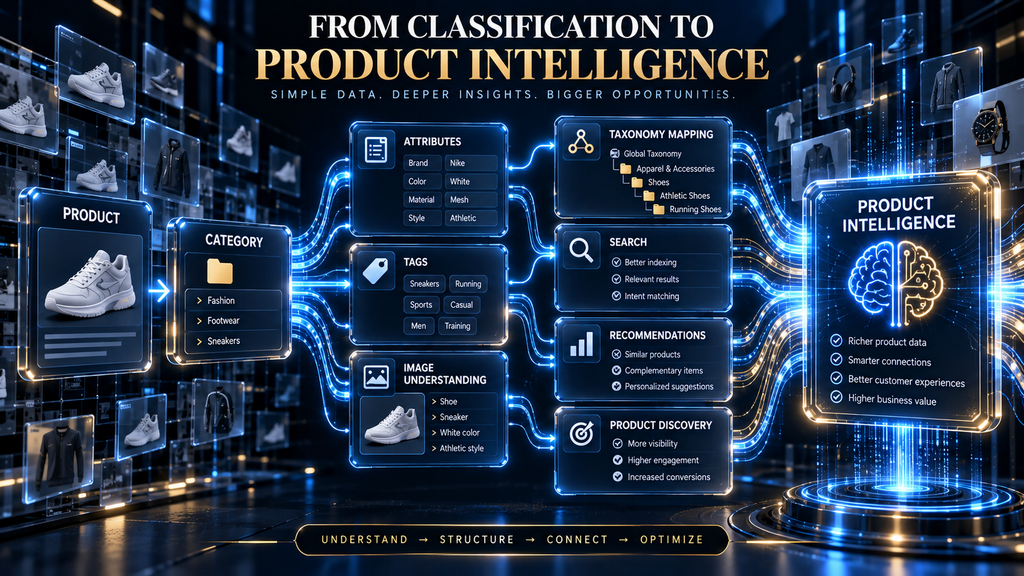
The next stage of ecommerce AI is unlikely to be defined by whether a model can assign a product to “Category A” or “Category B.” The more interesting direction is continuous product understanding.
A product-data system can increasingly combine text, images, structured attributes, historical classifications, supplier information, external taxonomies, and behavioral signals. Instead of treating classification as a single event that happens when a product enters the store, the system can treat the product representation as something that evolves as new evidence appears.
That changes the role of AI. Instead of: New product → assign category → finish. The workflow becomes closer to: New product → understand product → classify → extract attributes → map taxonomies → detect inconsistencies → monitor changes → update product representation.
Shopify’s description of its product-classification evolution points in this direction: classification is becoming broader product understanding, with category and attribute extraction serving larger search, discovery, and recommendation systems. Amazon Business’s use of hierarchical classification and confidence thresholds points toward another important component: production systems need explicit controls around automated decisions rather than assuming every prediction should become an immediate catalog change.
The long-term advantage will therefore not belong simply to businesses using the newest model. It will belong to businesses that have built a clean system around the model: clear taxonomy, useful product signals, measurable confidence, controlled automation, human review, and continuous feedback.
Final Thoughts
The most useful way to think about AI product categorization is not as an AI feature that fills in a category field. It is a method for turning messy commercial information into a structured product representation that the rest of an ecommerce operation can understand.
That shift in perspective changes the implementation strategy. You stop asking which AI model can categorize products and start asking what your taxonomy should look like, which product signals provide reliable evidence, how uncertainty should be handled, which decisions are safe to automate, and how classification quality will be measured after the system goes live.
The strongest workflow is therefore not AI instead of humans. It is AI for predictable volume, humans for ambiguity and governance. High-confidence products can move through the system automatically, uncertain cases can be reviewed, and the corrections made by humans can continuously reveal where the catalog, taxonomy, or model needs improvement.
The deeper payoff comes later. Once categories, tags, and attributes become consistent, they stop being isolated pieces of catalog administration and become infrastructure for search, filtering, merchandising, marketplace feeds, recommendations, analytics, and other AI systems.
The real breakthrough is not getting AI to label products. It is getting the entire ecommerce system to understand those products more consistently.
Build a Smarter Ecommerce AI Workflow
Product categorization is only one part of ecommerce automation. See how AI can connect product data, recommendations, customer support, inventory, and other store operations into a broader workflow.
Explore the Ecommerce AI Workflow →Frequently Asked Questions
What is AI product categorization?
AI product categorization uses machine-learning or AI systems to assign products to predefined categories or taxonomy nodes based on information such as titles, descriptions, attributes, images, brands, and other product signals. The goal is to create consistent product structure at a scale that would be difficult to maintain entirely through manual classification.
What is the difference between AI product tagging and product categorization?
Product categorization determines where an item belongs in a structured hierarchy, while tagging adds descriptive information around that item. For example, a shoe might be categorized as Trail Running Shoes and tagged with characteristics such as Waterproof, Women’s, Mesh, and Lightweight.
Can AI automatically categorize an entire ecommerce catalog?
AI can automate a large portion of many catalogs, but full automation is not automatically appropriate. A confidence-gated workflow can process obvious, low-risk classifications automatically while routing ambiguous or higher-risk products to human reviewers.
What information does AI need to categorize products?
Useful inputs include product titles, descriptions, structured attributes, brand information, identifiers, existing product information, and images. Better classification generally becomes possible when the system can combine several relevant signals rather than relying on a single title or keyword.
Can AI categorize products from images?
Yes. Vision and vision-language systems can use visual characteristics as classification evidence, particularly when text is incomplete. Image-based evidence is generally more useful when combined with product descriptions and structured attributes rather than treated as the only source of truth.
How accurate is AI product categorization?
There is no single accuracy rate that applies to all AI product categorization systems. Performance depends on the taxonomy, product category, quality of source data, model, evaluation method, and confidence thresholds. Published results from companies such as Amazon Business describe their own systems and should not be interpreted as universal benchmarks.
Should every AI classification be reviewed by a human?
No. High-confidence, low-risk classifications can often be automated, while uncertain or consequential classifications can be routed to human review. The appropriate division depends on the quality of the evidence and the cost of an incorrect decision.
What should I measure when evaluating an AI categorization system?
Measure more than overall accuracy. Category-level precision and recall, confidence calibration, human correction rate, review rate, auto-approval rate, processing time, and the business consequences of errors can provide a much clearer picture of whether the automation is actually working.
Can AI map products between different taxonomies?
Yes. AI can help identify corresponding categories between an internal catalog structure and an external taxonomy. However, the mapping should be governed by explicit rules because different taxonomies can define categories differently. Google, for example, distinguishes its predefined product taxonomy from a merchant’s own product_type structure.
Does AI product categorization improve SEO?
Not automatically. Better product structure can support better organization and more useful product data, but categorization itself does not guarantee higher search rankings. Search performance depends on the broader quality of the product page, content, technical implementation, relevance, and the specific search system involved.
What should a small ecommerce business automate first?
Start with repetitive classification tasks where product information is reasonably consistent and category boundaries are clear. For a small catalog, AI-assisted classification may be more practical than building a fully autonomous pipeline; the right choice depends on catalog volume, update frequency, and the cost of manual work.
Related Guides
- AdCreative.ai for E-Commerce: Does the Shopify Integration Actually Work?
- AI Accounting vs Traditional Accounting: What Should You Automate?
- What Is a Large Language Model (LLM)? How LLMs Really Work
- What Is an AI Agent? A Beginner’s Guide to How Autonomous AI Works
Written by
Muntasir Ahmad Chowdhury
Founder, AI Hustle World
Muntasir Ahmad Chowdhury is the Founder of AI Hustle World, an independent publication dedicated to making Artificial Intelligence practical, trustworthy, and easy to understand. He researches AI tools, automation, customer service, productivity, and real-world business applications, helping readers make smarter technology decisions through research-driven, experience-backed content.
Expertise:
AI Tools • AI Automation • AI Customer Service • AI Productivity • Generative AI • AI Workflows
Get Smarter With AI
Enjoyed this guide? Get practical AI tools, tutorials, and honest reviews delivered to your inbox.
3 thoughts on “How AI Automates Product Catalog Tagging and Categorization”