
AI Content Repurposing: The Complete System for Turning One Idea into Many Assets
A good piece of content rarely contains only one useful idea. A research article may hold a strong argument, three examples, a useful framework, several questions, a surprising data point, a practical workflow, and an opinion that could each support a different piece of content.
AI makes it easier to separate and reuse those ideas, but it also creates a new problem. When producing another post, caption, email, script, carousel, or clip becomes almost effortless, teams can confuse more output with more value and end up publishing the same thought repeatedly in different containers.
That is not a strong repurposing system. It is content duplication with extra production steps.
A better system starts with the intellectual value inside the source, identifies which parts deserve to stand alone, decides where those ideas genuinely fit, and then rebuilds each derivative for the audience, intent, medium, and evidence requirements of its destination. AI can reduce the production work, but editorial judgment still decides what deserves to exist.
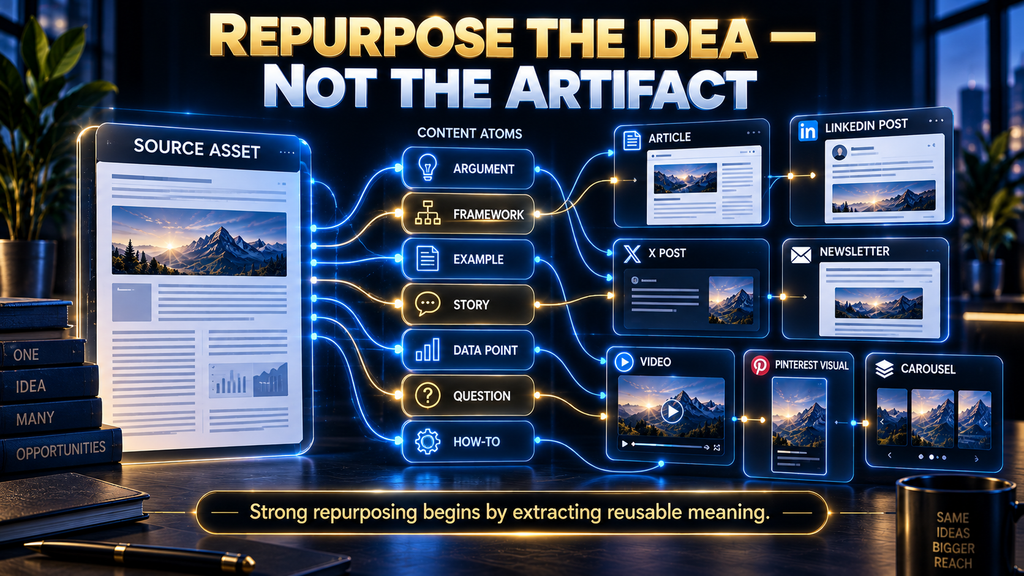
The central principle is simple: repurpose the idea, not the artifact. The article, podcast, webinar, interview, research report, or video is the source container; the reusable value lives in the arguments, evidence, examples, stories, decisions, and questions inside it.
What AI Content Repurposing Actually Means
AI content repurposing is the process of using AI to help extract, reshape, adapt, and produce new content assets from an existing source while preserving the source’s meaning and factual foundation. The objective is not to copy the same message everywhere, but to reuse strong intellectual material in forms that make sense for different audiences and channels.
That distinction separates repurposing from ordinary cross-posting. Posting the same paragraph on LinkedIn and X is distribution, while turning the same underlying idea into a detailed LinkedIn argument, a concise X observation, a visual Pinterest concept, and a short video explanation requires genuine editorial transformation.
Reposting is different again because the original asset itself is being reused. A company may reshare an old high-performing post, update an existing article, or republish an evergreen clip, which can be useful without becoming a new asset.
Repurposing creates something meaningfully different from the source while maintaining a clear relationship to it. The new asset should make sense on its own, fit the behavior of its destination, and preserve whatever evidence is necessary to support the claim being made.
AI becomes useful because many parts of that work are computationally repetitive. A model can extract arguments, identify examples, summarize sections, cluster related ideas, propose headlines, draft variations, convert prose into a script, or identify candidate clips from a transcript.
The mistake is assuming that because AI can transform text quickly, it can also decide which transformations are worth publishing. That is the editorial problem this system is designed to solve.
Why “One Idea Into 20 Pieces of Content” Often Produces Weak Work
The attractive promise of AI repurposing is multiplication. One podcast becomes ten clips, six social posts, three carousels, an article, a newsletter, and a thread, giving the creator the impression that the same hour of original work has suddenly produced weeks of distribution.
The problem appears when the production target becomes a number. If the source contains only four ideas that can survive outside their original context, asking AI for twenty derivatives usually forces the system to stretch those ideas into increasingly thin variations.
The result often looks productive internally because the content calendar fills quickly. To the audience, however, the brand may appear to be repeating itself, changing only the hook while delivering little new substance.
This problem becomes more severe because AI is very good at superficial variation. It can make the same point sound different through another headline, structure, metaphor, opening question, tone, or length without introducing another useful idea.
A repurposing system therefore needs a stopping rule. The right number of outputs is not the maximum number the model can create; it is the number of derivatives that remain worth someone’s attention after they are separated from the source.
That principle also aligns with current platform and search guidance. YouTube’s monetization policies distinguish original, meaningfully varied work from repetitive or mass-produced content, while Google warns that producing large amounts of low-value or unoriginal material primarily for search can fall under scaled-content abuse.
AI has reduced the cost of generating drafts. It has not reduced the value of having something worthwhile to say.
Source Quality Sets the Ceiling
Strong repurposing begins before the first prompt. A weak source cannot reliably produce strong derivatives simply because a capable model rewrites it in more formats.
Consider two articles about the same subject. The first repeats common advice in broad language, while the second contains a clear thesis, original distinctions, several examples, evidence, implementation detail, and a useful framework.
The second article contains many independent units of value. A framework may become a visual, one example can become a LinkedIn post, a counterargument can become an X post, the implementation section may become a short tutorial, and the evidence can support a newsletter discussion.
The first article gives the model much less to work with. Producing ten derivatives from it usually requires the AI to either repeat the same generic advice or introduce material that was not actually present in the source.
A practical source qualification test should therefore ask whether the content contains enough substance to survive decomposition. Strong candidates usually include an identifiable point of view, useful evidence, specific examples, concrete decisions, meaningful distinctions, or ideas that can still be useful when separated from the original piece.
Length alone does not make something repurposable. A three-hour webinar can contain surprisingly few distinct ideas, while a focused 1,500-word analysis may contain several concepts strong enough to support independent assets.
Performance can also help identify candidates, but it should not be the only filter. A high-traffic article may be worth revisiting because the topic resonates, yet an underperforming article can still contain a strong idea that was weakened by poor packaging, distribution, timing, or search positioning.
The first question is therefore not “What can AI make from this?” It is “What does this source contain that deserves another life?”
Extract the Intellectual Material Before You Ask for New Formats
One of the easiest ways to produce generic repurposed content is to give an AI system a full source and immediately ask for ten posts. The model then has to decide what matters, how to divide the material, which ideas are independent, how much context to retain, and how each destination should differ, all inside one transformation step.
A stronger workflow separates extraction from generation. Before writing a derivative, identify what the source actually contains.
For a research-heavy article, the extractable material might include the main thesis, key findings, supporting facts, statistics, examples, counterarguments, practical steps, caveats, definitions, original frameworks, conclusions, and questions the article answers. For a podcast or interview, the source may also contain stories, memorable statements, disagreements, audience questions, and moments where the speaker explains a difficult idea unusually well.
At this stage, the goal is not to write the social post. The goal is to build an accurate inventory of the source’s intellectual components so the team can decide which ones deserve separate treatment.
This matters because a source is rarely evenly valuable. One 4,000-word article might contain three paragraphs that are far more reusable than the other 3,500 words, while an hour-long interview may contain one five-minute explanation that deserves an entire article.
AI can perform the first extraction quickly, but human review should confirm what actually matters. The model can identify candidate ideas; the editor decides which ones represent the source accurately and are strong enough to publish independently.
Content Atomization and Repurposing Are Related, but They Are Not the Same Job
Content atomization is the process of breaking a larger source into smaller meaningful units. Repurposing begins when one of those units is rebuilt into an asset for a particular audience, purpose, and medium.
A content atom might be an argument, example, statistic, framework, story, objection, question, lesson, comparison, mistake, or recommendation. It does not need to be publishable by itself; it simply needs to contain a recognizable unit of meaning.
This distinction matters because many repurposing workflows skip directly from source to output. When that happens, the AI often summarizes the whole source rather than identifying the specific idea that should become the new asset.
Suppose a detailed ecommerce article contains an original framework explaining why recommendation systems fail. The framework is one atom, the example showing a failed recommendation is another, the explanation of data quality is another, and the implementation checklist contains several more.
A LinkedIn post does not need to summarize the entire article. It may be stronger if it develops only the failed-recommendation example and explains the lesson fully.
A Pinterest infographic might use the framework instead. An X post could isolate the most counterintuitive conclusion, while a short video could explain the same framework through a visual sequence.
The repurposing system becomes much more precise when the team knows which atom is being transformed, rather than merely knowing which source file it came from.
The AI Hustle World Repurposing Transformation Matrix
Not every derivative requires the same amount of editorial work. Turning an article section into a LinkedIn post is fundamentally different from turning a research report into a 60-second video recommendation, even if both technically begin with the same source.
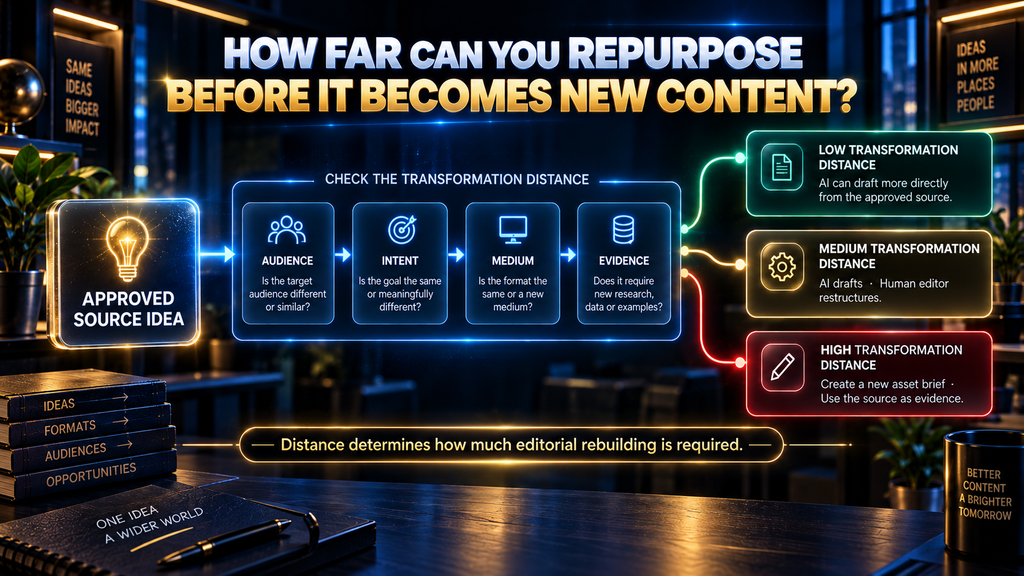
The AI Hustle World Repurposing Transformation Matrix is designed to make that difference explicit. It evaluates a proposed derivative across four kinds of distance: Audience Distance, Intent Distance, Medium Distance, and Evidence Distance.
Methodology: The AI Hustle World Repurposing Transformation Matrix is an editorial decision model for evaluating how far a derivative asset moves from its source across four dimensions: Audience Distance, Intent Distance, Medium Distance, and Evidence Distance. The framework classifies transformations as low, medium, or high distance to help determine when AI-assisted adaptation is appropriate and when the destination requires substantial human restructuring, fresh verification, or a new editorial brief. It is an editorial framework, not a scientifically validated performance score or benchmark.
| Transformation Dimension | Low Distance | Medium Distance | High Distance |
|---|---|---|---|
| Audience Distance | Essentially the same audience | Adjacent audience with different knowledge or priorities | Materially different audience with different assumptions or needs |
| Intent Distance | Same job: learn, evaluate, discuss or act | Related but different job | Different decision or outcome entirely |
| Medium Distance | Similar structure, such as article → LinkedIn post | Significant format change, such as article → carousel | Major media change, such as research → short video or podcast |
| Evidence Distance | Existing source fully supports the derivative | Some context or current verification is needed | New claims, data, examples or verification are necessary |
A low-distance transformation may involve an article section becoming a LinkedIn educational post for essentially the same professional audience. The core claim and evidence may remain unchanged, while the hook, length, pacing, and ending are rebuilt for the feed.
A medium-distance transformation may involve turning a research article into a newsletter essay. The source still supplies much of the intellectual foundation, but the newsletter may need more context, a more personal editorial voice, and a different narrative because the reader relationship is different.
A high-distance transformation occurs when the new asset changes several dimensions at once. Turning a technical report into a 60-second recommendation video for consumers may require new language, different examples, additional fact checking, visual evidence, and a completely different narrative structure.
The central rule is that transformation distance determines how much the source can safely control the new asset. Low distance allows more direct reuse, while high distance means the original should function as research material rather than a template.
That distinction helps prevent one of the most common AI repurposing failures: treating every output as a rewrite.
Audience Distance Changes What Needs to Be Explained
A source written for experienced marketers assumes knowledge that a beginner-facing Instagram carousel cannot safely assume. Even when the underlying idea remains identical, the derivative may need definitions, examples, context, or a simpler decision path.
The reverse problem also occurs. Turning a beginner guide into a LinkedIn post for senior operators may require removing basic explanation and adding implications, limitations, trade-offs, or implementation consequences that the original source did not need.
This is why changing tone alone is not enough. Telling AI to “make this more professional” or “make this beginner-friendly” addresses style, while audience distance affects what information the asset requires.
A large audience shift may therefore create evidence distance too. The new audience may ask questions the source never answered, meaning the writer has moved from repurposing toward additional research.
The practical test is simple: if the target audience would reasonably need important information that does not exist in the source, the derivative is no longer a straightforward rewrite.
Intent Distance Changes the Job the Content Must Perform
Two pieces of content can discuss the same topic while serving completely different purposes. An educational article about email deliverability and a commercial post comparing cold-email platforms may share terminology and evidence, but the reader is trying to accomplish different things.
Repurposing becomes risky when the source’s informational intent is silently converted into a stronger recommendation than the evidence supports. A neutral article explaining several AI tools cannot automatically become a “best tool” video simply because the video format rewards decisive hooks.
The same problem appears in conversion content. A thoughtful educational post may become weak when condensed into promotional copy because the original was designed to explain, not persuade someone to buy.
Intent should therefore be identified explicitly before the transformation begins. The writer needs to know whether the new asset is intended to educate, attract attention, start discussion, build trust, generate search traffic, support evaluation, create a lead, or drive another action.
AI is effective at changing rhetoric once the target job is clear. It is less reliable when asked to infer a new commercial or editorial purpose from a source that was created for something else.
Medium Distance Determines How Much Structure Must Be Rebuilt
Moving between media is not a cosmetic change. Text, images, audio, and video distribute attention differently, so the structure that works in one format may fail completely in another.
A detailed article can introduce context slowly because the reader controls the pace. A short video has to establish the idea quickly, while a carousel needs each frame to carry enough meaning to keep the sequence understandable.
Platform specifications demonstrate how different those containers can be. LinkedIn standard posts currently allow up to 3,000 characters, while standard X posts allow 280 characters; Premium subscribers can create longer X posts, but the ordinary format still imposes a much tighter constraint.
Video creates another structural shift. YouTube currently categorizes eligible square or vertical uploads of up to three minutes as Shorts, which gives creators more room than the original short-video format but still creates a very different storytelling environment from a long-form article.
Pinterest is visual-first and commonly favors vertical 2:3 creative in relevant Pin/ad formats, making hierarchy, headline density, image composition, and visual teaching central to the asset rather than secondary design choices.
The lesson is not that every platform requires completely different ideas. It is that the same idea must often be reconstructed around a different unit of attention.
Evidence Distance Is Where Repurposing Quietly Becomes New Research
Evidence distance is the most important part of the matrix when the source contains factual claims, current information, commercial recommendations, medical or legal context, statistics, product specifications, or anything else that may become misleading when compressed.
A source may contain enough context to support a qualified statement, yet the derivative can lose that qualification. For example, an article may say that a vendor reported a conversion increase in one customer case study, while an AI-generated post compresses that into “this tool increases conversion.”
The words are related, but the evidence relationship has changed.
Research on abstractive summarization has repeatedly examined this problem. Studies have documented generated summaries containing entities or information that were not supported directly by the source, showing why fluency cannot be treated as proof of factual faithfulness.
That research should not be interpreted as a benchmark of every modern AI tool. The useful conclusion is narrower: when information is compressed or rewritten, claims need to be checked against the source rather than trusted because the output sounds plausible.
Evidence distance also increases when time has passed. A 2025 source containing software prices, platform limits, regulation, product availability, or market statistics may need fresh verification before becoming a 2026 post, even if the source was completely accurate when published.
A derivative that needs substantial new verification has crossed an important boundary. At that point, the source is contributing research, but the asset itself should be treated as a newly researched piece.
When Repurposing Becomes New Content Creation
A useful system needs to know when to stop calling the job repurposing. High transformation distance is that boundary.
If the audience has changed substantially, the asset serves another intent, the medium demands a new narrative, and the evidence needs to be expanded or updated, the team is no longer simply adapting existing work. It is creating a new asset that happens to use the old source as one input.
This distinction is valuable because it changes the workflow. A simple derivative can begin with the source, while a high-distance asset should begin with a new brief that defines the audience, objective, argument, format, required evidence, and relationship to the original material.
AI can still use the source for research. It should not be told to “turn this article into a video” and expected to solve the editorial gap automatically.
This also protects quality because it removes the psychological pressure to remain too faithful to the original structure. Once the team recognizes that the destination requires a genuinely new asset, it becomes acceptable to add new examples, remove irrelevant sections, reorganize the argument, conduct new research, and challenge conclusions that no longer fit.
A source should save work where it can. It should not restrict the new asset when the new job demands something different.
Preserve, Transform, and Re-Verify
The second control layer in the system is deciding what may change during repurposing. Treating every part of the source as equally editable creates both boring derivatives and factual risk.
The AI Hustle World approach separates source material into three classes: Preserve, Transform, and Re-Verify.
| Editorial Treatment | What Belongs Here | What the Repurposing Process Should Do |
|---|---|---|
| Preserve | Core meaning, factual claims, quotations, attribution, definitions, caveats, evidence relationships | Keep the substance faithful even when wording or structure changes |
| Transform | Hook, format, order, examples, pacing, headline, CTA, visual treatment, narrative style | Rebuild aggressively for the destination while preserving underlying meaning |
| Re-Verify | Prices, platform limits, current statistics, regulations, policies, availability and other time-sensitive claims | Check the current authoritative source before publishing the derivative |
This model prevents the two opposite mistakes common in AI repurposing. Some teams preserve too much and produce awkward cross-posts, while others transform too much and weaken or change the original claim.
A direct quotation is a good example of information that should not be casually rewritten and still presented as a quotation. A statistic may be phrased differently, but its value, population, timeframe, and source should remain attached to the claim.
The opening hook behaves differently. It may need to change completely because a search article, newsletter, LinkedIn post, video, and Pinterest Pin each have different attention patterns.
Freshness creates the third category. A product price that was accurate when the source article was written does not become permanently reusable evidence simply because the derivative came from an approved source.
This is why repurposing needs editorial controls rather than only prompts.
AI Should Handle Production Friction, Not Editorial Authority
AI is useful when a task involves pattern recognition, transformation, organization, or first-pass generation. It is less suitable as the final authority over what should be claimed, what deserves publication, or what a brand should stand behind.
In a repurposing workflow, AI can transcribe audio, extract candidate ideas, cluster similar points, identify possible clips, summarize sections, draft platform variations, propose hooks, rewrite for another reading level, generate metadata, and convert an approved argument into several structural formats.
Those tasks can remove a large amount of mechanical work. They also give a small team capabilities that previously required more editing time or several specialized tools.
Human judgment remains essential at different points. Someone needs to determine whether the source is worth repurposing, which ideas matter, whether an interpretation is fair, whether a caveat can be removed safely, whether the new channel is appropriate, whether a claim requires fresh evidence, and whether the derivative actually deserves publication.
The division should follow consequence rather than ideology. AI can be given more freedom when the task is reversible and low-risk, while claims, commercial recommendations, sensitive context, rights decisions, and important brand positions deserve stronger review.
This is the same editorial principle that applies elsewhere in AI-assisted work: automation should increase the speed of acceptable decisions, not the volume of decisions nobody has time to inspect.
Platform-Native Content Means More Than Changing the Character Count
A common repurposing workflow takes an article, shortens it for LinkedIn, shortens it again for X, places the same headline on a graphic, and calls the system complete. The outputs technically differ, but the experience remains source-first rather than platform-native.
Platform-native transformation asks how people consume information in that environment. A professional LinkedIn reader may tolerate a developed argument in text, while an X post often benefits from a sharper independent observation that makes sense without the original article.
A Pinterest user is frequently evaluating visual ideas or planning resources, which makes the image’s teaching structure important. A short-video viewer experiences information sequentially and cannot scan backward through a paragraph as easily as a reader can.
The destination should therefore influence which content atom is chosen, not only how that atom is formatted.
A detailed framework may be ideal for a Pinterest infographic but too dense for one X post. A sharp contrarian statement may work on X but feel shallow as the central argument of a newsletter.
A story that takes forty seconds to establish may perform naturally as video but consume too much space inside a carousel. A useful technical comparison may deserve a native table inside an article rather than being forced into a visual with unreadably small text.
Strong repurposing is a matching problem before it is a writing problem.
One Source Does Not Need to Appear on Every Channel
The idea that every source should become something for every platform is one of the least useful habits in content operations. It produces a predictable grid rather than a responsive editorial system.
The decision should be made at the intersection of the idea, audience, channel, and available production capacity. Some ideas are naturally visual, some invite discussion, some need search depth, and some deserve only one format.
For example, a detailed methodology may justify an article, a LinkedIn explanation, and a visual diagram but offer little value as a short entertainment-oriented clip. A personal story from a podcast might become an excellent short video and newsletter paragraph while being a weak basis for an SEO page.
Leaving a channel blank is therefore a valid decision. It means the editorial system concluded that the idea did not deserve that particular transformation.
This principle also reduces audience fatigue. If followers encounter the same thought on every platform in nearly identical language, the brand may increase impressions while reducing the perceived novelty of each appearance.
Repurposing should extend the life of an idea without making the audience feel trapped inside it.
A Worked Example: One Research Article, Five Very Different Assets
Imagine a source article explaining why ecommerce AI recommendations fail when product data is inconsistent. The article contains a thesis, a technical mechanism, a scenario involving the wrong product variant, a five-layer framework, implementation advice, and several source-backed facts.
A low-distance derivative could be a LinkedIn post aimed at ecommerce operators. The post might focus only on the counterintuitive point that “better AI cannot fix contradictory product truth,” retain the original evidence logic, and use a more conversational opening.
An X post would probably need stronger compression. Instead of summarizing the article, it might isolate one distinction: a recommendation can be semantically relevant and commercially wrong if the requested variant is unavailable.
A Pinterest infographic could use the five-layer framework because the value is structural and visual. The asset should be designed from the framework itself rather than by placing the article’s paragraphs inside a vertical graphic.
A short video introduces more transformation distance. It may begin with a shopper receiving the wrong recommendation, then explain the single mechanism behind the failure; the script may use only one part of the article because a short sequential medium cannot carry every layer effectively.
A newsletter creates another kind of distance. The writer may use the source article as evidence but shift the focus toward an operational question such as why ecommerce teams keep blaming models for failures that originate in catalog governance.
All five assets come from the same source. None needs to be a shorter version of the original article.
Content Lineage Keeps Derivatives From Drifting Away From the Source
Once an idea has been repurposed several times, it becomes surprisingly easy to lose track of where a statement originated. A newsletter paraphrases an article, a LinkedIn post is adapted from the newsletter, and a video script is later generated from the LinkedIn post.
Each transformation creates another opportunity for nuance to disappear.
A mature repurposing system should therefore retain some form of content lineage. The team should be able to identify the original source, the content atom used, the supporting evidence, what changed intentionally, what required new verification, and which version was finally approved.
This does not require an expensive database. A solo creator can track source URL, atom, destination, evidence status, draft status, reviewer, and publish date in a spreadsheet or project board.
Larger teams may need stronger version control because multiple writers, editors, designers, and automation tools can act on the same source. In that environment, lineage becomes part of editorial governance rather than mere organization.
The purpose is not bureaucracy. It is to prevent the fourth-generation derivative from quietly becoming a claim nobody can support.
Build the System Around Nine Stages, Not One Mega-Prompt
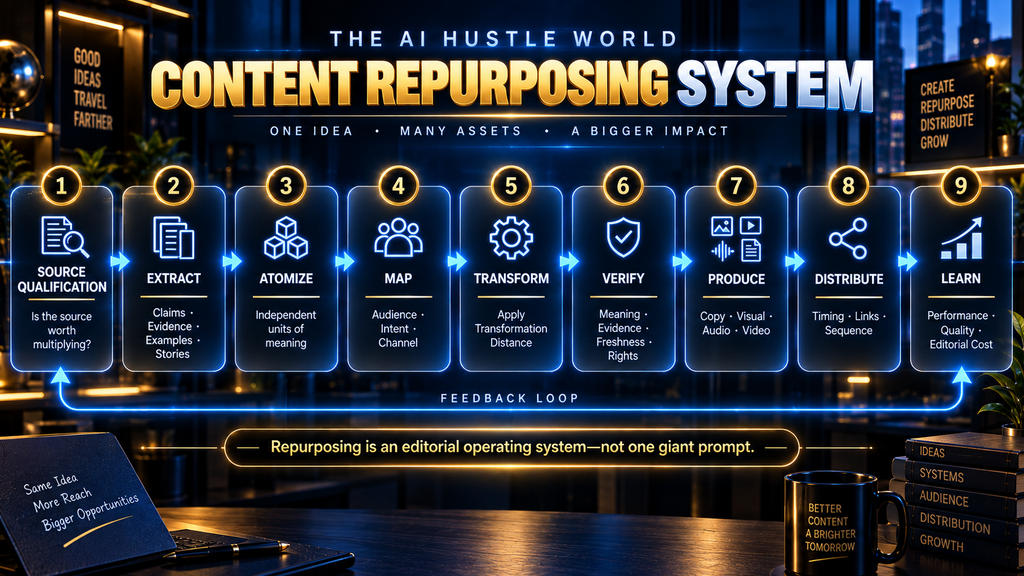
The full workflow can be represented as Source Qualification → Extract → Atomize → Map → Transform → Verify → Produce → Distribute → Learn. The value of the sequence comes from separating decisions that are often collapsed into one prompt.
Source Qualification determines whether the material contains enough value to multiply. Extract creates an accurate inventory of arguments, facts, examples, stories, frameworks, and evidence before any platform copy is written.
Atomize separates that inventory into independent units of meaning. Map then matches those units to destinations based on audience, intent, medium, and expected value rather than filling every possible channel.
Transform applies the Transformation Matrix and creates the new structure. Low-distance assets can remain close to the source, while high-distance work begins with a new asset brief.
Verify checks preserved meaning, sources, time-sensitive facts, rights, quotations, and any new information introduced during the transformation. This stage is important enough to remain separate from ordinary copyediting.
Produce completes the format-specific work such as visuals, voiceover, editing, captions, thumbnails, metadata, links, and accessibility. Distribute determines timing, sequencing, platform behavior, internal linking, and whether multiple derivatives should appear together or be spaced out.
Learn closes the loop. Performance, editorial rejection, correction patterns, audience response, and production cost should inform which ideas are repurposed next time.
This structure prevents the system from becoming a prompt library with no editorial control.
Source Qualification Should Happen Before the Content Calendar
Content teams often start with empty calendar slots and search their archive for something that can be repurposed to fill them. That reverses the logic.
The source should earn the right to generate derivatives because it contains material worth reusing. The calendar should then accommodate the useful assets rather than forcing weak transformations to satisfy a predetermined quota.
One practical qualification question is whether the source contains at least two independent units that would remain meaningful outside the original context. Another is whether a reader who already consumed the source would still gain something from encountering the derivative.
That second test is especially valuable. If the derivative provides no new framing, medium advantage, explanation, visual, argument, convenience, or audience fit, it may simply be repetition.
Evergreen sources can be particularly valuable because their core ideas can survive longer. Time-sensitive sources can also be repurposed, but they create more re-verification work as they age.
The system should treat source quality and freshness as inputs, not afterthoughts.
Mapping Comes Before Drafting
Once the useful atoms have been identified, the next task is to decide where each belongs. AI can suggest destinations, but the mapping should be based on channel fit rather than the model’s ability to generate something for every platform.
A framework may map naturally to a LinkedIn post, article visual, and Pinterest infographic. A customer story may map better to video, newsletter, and a short social post.
A technical statistic might belong in an article or visual only when the context can be preserved. Compressing it into an attention-grabbing post may increase Evidence Distance enough that the asset needs extra explanation.
Mapping also accounts for strategic priorities. A creator does not need to invest in a channel merely because one atom could theoretically work there.
The best map often contains empty cells. Those blanks represent decisions, not missed opportunities.
Verification Should Be a Separate Editorial Stage
Teams often treat fact checking as part of final proofreading, but AI repurposing deserves a clearer verification stage because the transformation itself can alter the meaning of a claim.
The reviewer should compare the derivative against the approved source rather than merely checking whether the new copy sounds reasonable. Numbers, dates, names, causal claims, quotations, qualifiers, and commercial recommendations deserve particular attention.
Current facts need a second check against their authoritative source. A software limit, pricing tier, platform policy, statistic, or product feature can become outdated even when the original article remains indexed online.
New information introduced by AI deserves special scrutiny. If the derivative contains a helpful example, statistic, conclusion, or contextual fact that did not exist in the source, it should be treated as a new claim rather than quietly inheriting the credibility of the original article.
This is the practical difference between source-grounded repurposing and fluent rewriting.
Production Should Finish the Asset, Not Rescue a Weak Idea
Design, video editing, voice generation, thumbnails, captions, and formatting can improve delivery, but they cannot solve an asset whose underlying idea does not justify publication.
This becomes relevant because modern AI tools can create polished creative very quickly. A weak content atom can now receive an excellent image, synthetic voice, clean subtitles, and professional layout before anyone stops to ask whether the message is useful.
Production should therefore begin only after the asset brief has survived editorial review. The team should know what the asset says, why this destination is appropriate, which claims are preserved, and what success looks like.
For visual platforms, the design should teach or dramatize the idea rather than merely decorate the caption. For video, the sequence should exploit motion, voice, demonstration, or storytelling instead of reading the source article aloud.
AI reduces the production cost of media. That makes idea selection more important because visual polish is no longer a reliable signal that editorial thinking occurred.
Distribution Is Part of Repurposing Strategy
Repurposing does not end when the asset is exported. The relationship among the derivatives affects how the audience experiences the idea.
Publishing five versions of the same concept on the same day may maximize short-term coverage while making the system feel repetitive. Spacing the assets can extend the lifespan of the source and allow each format to reach a different part of the audience journey.
Sequence can also matter. A short social observation may introduce an idea before a detailed article, while an article may later provide the source material for a deeper newsletter discussion.
Internal linking should be intentional where the platform allows it. A derivative can point back to the canonical source, another relevant article, a tool, a signup, or the next step in the content journey, but the destination should match the asset’s purpose rather than being added mechanically.
Distribution is therefore not merely scheduling. It determines how the repurposed pieces behave as a system.
The Feedback Loop Should Improve Both Distribution and Creation
A useful repurposing program learns which ideas travel well, not only which individual posts performed.
Suppose one article contains six content atoms and one of them repeatedly produces strong saves, replies, clicks, or watch retention across several formats. That signal can tell the creator something about what the audience values, which may influence future research and original content creation.
The opposite is also informative. An idea that performs weakly everywhere may not deserve another transformation, even if the source article itself performed well because of search intent or broader coverage.
The feedback loop should also capture editorial cost. Some assets may perform adequately but require so much rewriting, verification, production, and review that another format would generate better returns on attention.
Repurposing becomes more strategic when the system learns from idea quality, format fit, and production economics at the same time.
Measure the Source, the Asset, and the System Separately
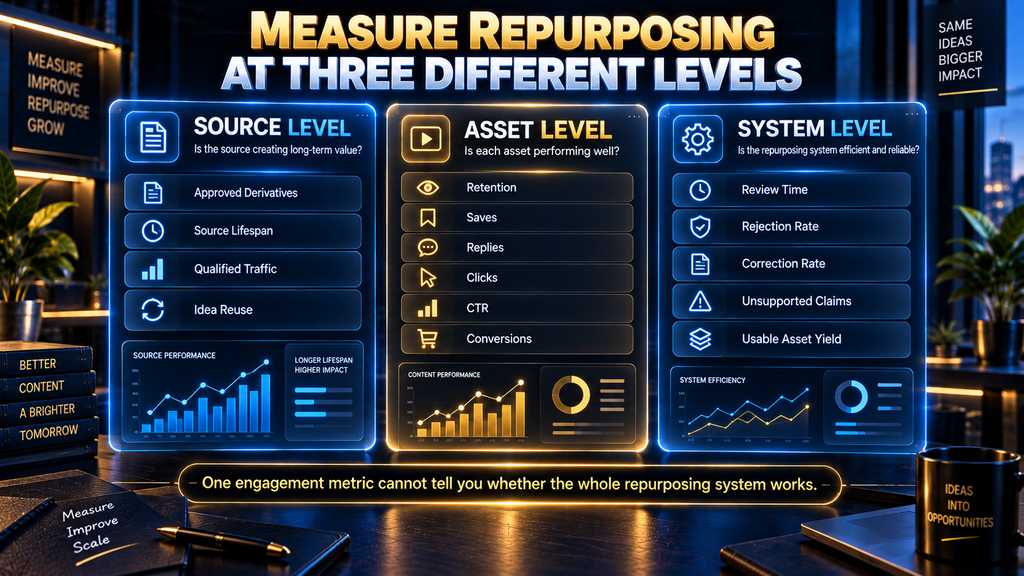
One engagement metric cannot describe an entire repurposing program. The original source, each derivative, and the production system answer different questions.
At the source level, the team can examine how many approved derivatives an idea supported, how long the source remained useful, how much qualified traffic or conversion the broader content family influenced, and whether the original continued attracting attention after derivatives were distributed.
At the asset level, measurement should match the channel. A video may be judged through retention and completion, a LinkedIn post through meaningful engagement and clicks, a newsletter through opens and click-through, while a search article may be evaluated through rankings, qualified traffic, assisted conversions, or another relevant outcome.
At the system level, quality and efficiency become central. Review time, correction rate, editorial rejection, unsupported claims, production time, publishing throughput, and reuse of approved atoms can reveal whether AI is actually improving the workflow.
The mistake is combining these levels into one vanity number. A high-performing social derivative does not prove the whole workflow is efficient, while a highly efficient workflow does not matter if the resulting assets are ignored.
Use Usable Asset Yield Instead of Celebrating Draft Count
AI can generate more drafts than most teams can reasonably inspect. That makes raw output count almost meaningless as an efficiency metric.
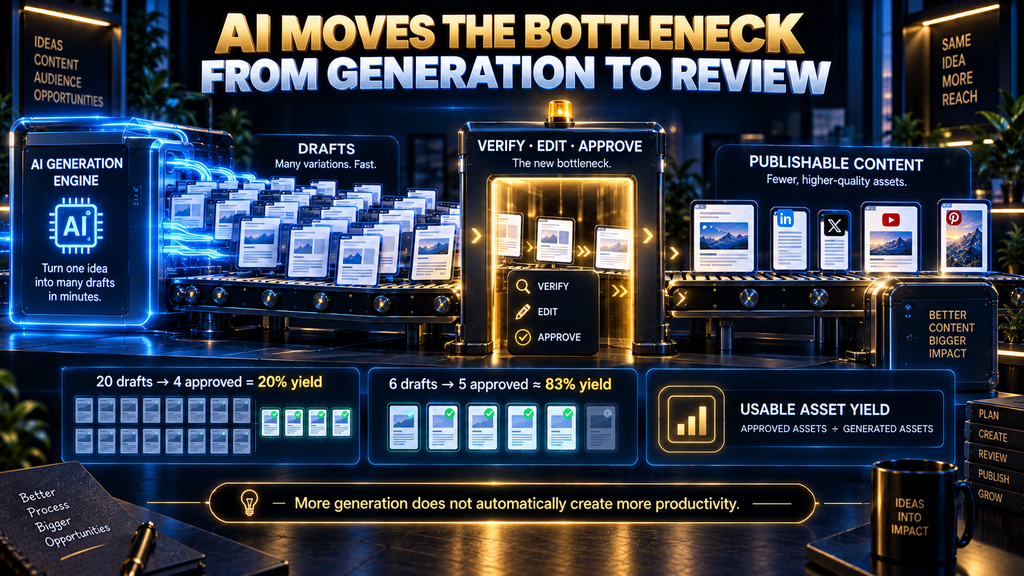
A more useful internal measure is Usable Asset Yield, calculated as the number of approved, publishable derivatives divided by the number of derivatives generated. If a team generates twenty assets and publishes four, its yield is 20%; if another generates six and publishes five, its yield is about 83%.
This is not an industry benchmark and should not be treated as one. It is simply a way to expose whether the repurposing process creates useful work or merely pushes more drafts into the review queue.
Yield should also be interpreted alongside quality. A team could inflate the number by lowering its editorial standard, which would defeat the purpose.
The metric becomes useful when the approval threshold stays stable. Over time, better source qualification, atom extraction, mapping, prompting, and editorial rules should increase the proportion of generated work that is genuinely publishable.
The Real Bottleneck Often Moves From Generation to Review
Before generative AI, drafting could be the slowest stage in a repurposing workflow. Once AI can produce several derivatives in minutes, that bottleneck often shifts to verification, editing, design, approval, and publishing.
That shift explains why teams can feel more overwhelmed after adopting automation. They are producing more work-in-progress than their editorial system can finish.
If one editor can responsibly review five derivatives per day, generating fifty does not create ten times more productivity. It creates forty-five additional decisions competing for attention.
The correct response is not necessarily more automation. The system should first improve source selection, mapping, briefs, verification rules, and rejection criteria so fewer weak assets reach the expensive review stage.
Automation should be designed around the slowest valuable stage of the workflow. Speeding up a stage that is no longer the constraint can make the entire system less efficient.
Automation Works Best After the Manual Logic Is Stable
A manual repurposing workflow may feel less sophisticated than an automated pipeline, but it has one major advantage: flaws in the logic are easier to see.
If a creator manually extracts atoms, maps destinations, writes briefs, and reviews outputs for several sources, patterns begin to emerge. Some source types repeatedly produce good assets, some channels require more evidence, and some formats create expensive review work.
Only then does it make sense to automate predictable movement between stages. A system might automatically transcribe new video, create an extraction draft, populate an asset database, generate first-pass summaries, or notify an editor when a derivative reaches review status.
The judgment stages should remain deliberately gated. A model should not automatically publish a high-distance derivative simply because the source entered the workflow.
The more autonomous the system becomes, the more important explicit approval and evidence rules become.
Repurposing Someone Else’s Content Is a Different Problem
Repurposing content you own is primarily an editorial and operational question. Repurposing material created by another person introduces rights, attribution, platform-policy, and potentially legal considerations that are separate from the productivity workflow.
Public availability is not automatically permission to reproduce something in another format. A creator may be allowed to quote or comment on material in a particular context, but that does not mean the entire source can be converted into a derivative asset and treated as original work.
Platform rules add another layer. YouTube’s reused-content policy distinguishes meaningful transformation and original value from minimally modified reused material, and its monetization rules separately address repetitive or mass-produced content.
The safest repurposing system begins with content the creator or business owns or has clear permission to reuse. When rights are uncertain, the question should be resolved before production rather than after publication.
This article provides workflow guidance, not legal advice. Rights-sensitive cases deserve appropriate professional review when the stakes justify it.
Repurposing Can Damage Search Quality When It Becomes Page Multiplication
Content repurposing becomes especially risky when a team interprets every content atom as a reason to create another SEO page. Search visibility can create a strong incentive to turn one source into many keyword variations that add little distinct value.
Google’s current guidance is clear that generative AI can help with research and structuring original content, but large-scale production without added user value can violate scaled-content policies. Google also advises creators to focus on useful, satisfying content rather than producing pages for every possible query variation.
This is another reason the Transformation Matrix matters. A new page should not exist merely because its wording or keyword differs from the source.
If the new search intent deserves a distinct answer, additional evidence, examples, decision support, or implementation guidance, a new page may be justified. If it is simply a rearranged version of an existing article, internal improvement or consolidation is usually the stronger editorial choice.
Repurposing should increase useful coverage, not manufacture topical volume.
The Same Principle Applies to Video
AI tools can now find clips automatically, generate captions, resize footage, create synthetic voice, write titles, and assemble short-form video from longer sources. Those capabilities make video repurposing much cheaper.
They also make repetitive output easier to produce. YouTube’s current monetization policy explicitly emphasizes original and authentic content and says generic, repetitive, or mass-produced material can be ineligible, regardless of whether AI or another production method created it.
A good short therefore needs more than a clean clip. The selected moment should work without excessive missing context, the opening may need rebuilding, and supporting visuals or commentary may need to be added.
The same source video can produce several strong shorts when the moments genuinely express different ideas. Cutting one argument into several nearly identical clips because the tool can do so is a production capability, not necessarily an editorial strategy.
Common Failure: The Source Becomes Less Accurate With Every Generation
A repurposing chain can resemble a game of telephone. The article becomes a newsletter, the newsletter becomes a social post, the social post becomes a video script, and the script later becomes a carousel.
Each generation may be coherent, but the distance from the original evidence grows. A qualifier disappears in the newsletter, the social post makes the conclusion stronger, and the video script later treats the stronger version as source truth.
The solution is simple: derivatives should point back to the approved original source or evidence record, not rely entirely on the previous derivative. This rule is especially important when AI is involved because the model may confidently preserve the latest wording even when that wording already contains drift. Source lineage therefore protects both factuality and editorial intent.
Common Failure: Everything Sounds Like the Same AI Brand Voice
Repurposing systems often use one master prompt describing the brand voice, then generate all derivative assets with the same rhythm. The result can be stylistically consistent while still feeling strangely repetitive across channels.
A brand should have recognizable principles, vocabulary, expertise, and point of view without forcing every platform into identical sentence structure. A newsletter can be reflective, a LinkedIn post analytical, a short video conversational, and an X post compact while still clearly coming from the same creator.
Voice should therefore be defined at two levels. The first is brand identity, which remains stable; the second is channel expression, which can change.
AI becomes much more useful when instructed with both. “Use our brand voice” is too broad, while “preserve our analytical, evidence-first position but make this feel native to a professional LinkedIn feed” gives the model a clearer editorial objective.
Consistency should come from thinking, not from identical syntax.
Common Failure: The Team Automates Production Before Defining Rejection Rules
Most workflow diagrams focus on how content moves forward. A practical repurposing system also needs rules for when content should stop.
A derivative should be rejected when it cannot preserve the original meaning, requires evidence the team cannot verify, repeats another scheduled asset without adding value, does not fit the destination, exceeds review capacity, or fails to justify the production cost.
These rules reduce sunk-cost bias. Once a draft, image, or video exists, teams become more likely to publish it simply because someone already spent time producing it.
AI lowers that production cost, which should make rejection easier. A generated draft is not an asset until it passes the editorial gate.
A strong content system therefore treats deletion as part of productivity.
Who Benefits Most From AI Content Repurposing
The system is especially valuable for creators and businesses that already produce substantive source material. Researchers, educators, consultants, B2B teams, podcasters, video creators, ecommerce publishers, newsletter writers, and subject-matter experts often have more ideas inside their primary content than they currently distribute.
Teams with expensive source production also benefit. If a research report, interview, webinar, customer study, product analysis, or detailed article required significant work, repurposing can extend the value of that investment when derivatives remain faithful and useful.
The model is less useful for organizations whose main problem is lack of original substance. If the source material is thin, repurposing can increase volume while making the weakness more visible.
It is also a poor fit when approval cost is already the bottleneck. Adding AI generation to an overloaded review process may simply create more unfinished drafts.
Repurposing works best when there is already something worth preserving.
What a Solo Creator Actually Needs
A solo creator does not need an elaborate automation stack to use this system. One reliable source repository, an AI assistant, a simple tracking sheet or database, a review checklist, a publishing calendar, and access to platform analytics are enough to run the workflow.
The important structure lives in the decisions. Track the source, the atom, intended audience, destination, Transformation Distance, evidence status, current draft, and publication result.
AI can help with the labor-intensive parts, but the creator should avoid creating a system that requires so much administration that repurposing becomes its own full-time job.
Start with one source and two or three derivatives. If the process reliably produces useful assets, add more channels or automation gradually.
A smaller repeatable system is better than a sophisticated workflow that collapses after two weeks.
What a Team Needs That a Solo Creator May Not
Teams need clearer ownership because repurposing crosses research, writing, design, video, social, legal, brand, and analytics responsibilities. A source can quickly become difficult to govern when several people create derivatives independently.
The team should establish who approves the original source, who owns the atom inventory, who decides destination fit, who verifies claims, and who has final publishing authority. High-risk or high-distance assets may require additional review.
Templates become useful at this scale, but they should standardize decision information, not force every asset into the same creative form. An asset brief can require audience, intent, atom, evidence, channel, CTA, transformation class, and approval status without dictating the same structure every time.
Teams should also maintain a canonical source location. Otherwise an editor may unknowingly generate from an outdated version while another team member works from the revised source.
Coordination is part of content quality.
How to Implement the System in the First 30 Days
The first implementation goal should not be maximum output. It should be proving that the workflow can produce several distinct, accurate assets from a strong source without overwhelming review.
Begin with three existing sources that represent the kind of material the business wants to scale. Extract the content atoms manually with AI assistance, then identify only the destinations where each atom has a clear reason to exist.
Classify every planned derivative using the Transformation Matrix. Low-distance assets can be drafted directly from the approved atom, while medium-distance assets receive a short restructuring brief and high-distance assets receive a new editorial brief before any generation begins.
Apply Preserve, Transform, and Re-Verify during review. This will quickly reveal which types of claims are creating the most verification work and which prompts are causing meaning to drift.
Publish a deliberately limited set of derivatives rather than the maximum possible quantity. Track source, asset, review time, corrections, channel result, and whether the derivative would still be considered publishable if AI generation were free.
After several cycles, review what failed. If most rejected assets came from one channel, one source type, one transformation class, or one prompt pattern, fix that part of the system before increasing output.
Automation belongs at the end of this first learning cycle, not the beginning.
What Happens If You Never Build a Repurposing System
Without a system, useful ideas often disappear after one publication cycle. The team repeatedly starts from blank pages even though previous sources contain arguments, research, examples, and frameworks that could support new work.
That wastes intellectual investment. It also makes content planning unnecessarily difficult because every channel appears to demand completely new ideas.
The opposite problem occurs when repurposing happens casually. Writers copy paragraphs, social teams summarize articles independently, video editors select clips without understanding the argument, and evidence relationships become increasingly difficult to trace.
A system solves both extremes. It helps a team reuse more without letting reuse become careless.
The objective is not to make every idea permanent. It is to give strong ideas enough opportunities to reach the people and formats where they remain useful.
Where AI Content Repurposing Is Heading
AI repurposing tools are moving beyond one-time generation toward systems that can ingest libraries, monitor new sources, extract clips, produce derivative copy, create visuals, schedule assets, and eventually use performance data to propose the next transformation.
That direction will make output increasingly abundant. The competitive advantage will therefore shift away from the ability to produce derivatives and toward the ability to select, verify, differentiate, and govern them.
Agents may eventually maintain content lineage automatically, flag stale claims, detect overlap with existing assets, recommend channels based on past performance, and create briefs appropriate to Transformation Distance. Those capabilities could reduce operational work substantially.
They will not remove the need for editorial judgment. A system can estimate which asset may perform, but the brand still needs to decide which claims it wants to make, what evidence is sufficient, which interpretations are fair, and whether publishing another derivative improves the audience’s experience.
As generation becomes easier, restraint becomes more valuable.
A Practical Decision Framework for Every Source
Before repurposing any source, begin by asking whether it contains an idea worth preserving. If it does not, improving the original or creating something new is likely more valuable than multiplying it.
Next, identify the independent atoms and determine which audience might genuinely benefit from each one. The destination should follow from that audience and purpose, rather than from a requirement to fill every platform.
Then assess Transformation Distance. When audience, intent, medium, and evidence stay close to the source, AI can handle more of the drafting; as the distance grows, human restructuring and new research should increase.
Finally, apply Preserve, Transform, and Re-Verify before approving the asset. The derivative should be recognizably native to its destination without losing the factual and intellectual integrity that made the source worth repurposing in the first place.
That is the complete system in one decision chain: find the value, isolate it, choose where it belongs, transform only what should change, verify what must remain true, and publish only when the new asset deserves to exist.
Final Thoughts
AI content repurposing is often sold as a multiplication trick: create one asset, ask a model for many variations, and fill the calendar faster. That version of the workflow solves production speed while ignoring the harder questions of originality, evidence, audience fit, review capacity, and whether every derivative provides enough value to justify publication.
A stronger system begins with source quality and works outward. It extracts the intellectual material, separates useful atoms, maps them to appropriate destinations, measures Transformation Distance, preserves the claims that must remain stable, rebuilds the parts that should change, and re-verifies facts that may no longer be current.
The AI Hustle World Repurposing Transformation Matrix adds an important boundary to that process. When audience, intent, medium, and evidence remain close to the original, repurposing can be efficient; when those dimensions move far enough, the source should become research for a new asset rather than a template to be rewritten.
AI is valuable throughout the system because it can remove a large amount of repetitive production work. Its role becomes more useful, not less, when the editorial boundaries are clear because the model is no longer expected to decide what matters, what is true, and what deserves publication at the same time.
The long-term advantage is not the ability to produce the largest number of assets from one idea. It is the ability to recognize which ideas deserve another form, rebuild them without losing their substance, and create a content library where every derivative still has a reason to exist.
Ready to Turn the System Into a Real Three-Platform Workflow?
See how one source can be adapted specifically for YouTube, Pinterest, and Instagram without simply copying the same asset across all three platforms.
See the 3-Platform Repurposing Workflow →Frequently Asked Questions
What is AI content repurposing?
AI content repurposing is the use of AI to help extract, adapt, restructure, and produce new content assets from an existing source. A strong workflow preserves the source’s factual meaning while changing the format, structure, hook, pacing, examples, or presentation to fit another audience or channel.
What is the difference between content repurposing and cross-posting?
Cross-posting publishes essentially the same asset or message across multiple channels, while repurposing rebuilds the underlying idea for another format or audience. A paragraph copied from LinkedIn to X is cross-posting, while converting the same idea into a concise independent X observation is repurposing.
How many pieces of content should one source become?
There is no useful universal number because source quality and idea density vary dramatically. One article may contain ten strong content atoms, while another may contain only two that can stand alone without repetition or missing context.
Should every article be repurposed?
No. An article is worth repurposing when it contains ideas, examples, frameworks, evidence, or explanations that can create additional value outside the original format.
What should AI do in a content repurposing workflow?
AI is particularly useful for transcription, extraction, clustering, summarization, content-atom discovery, draft generation, structural variations, metadata, headline options, format conversion, and early production support. These tasks reduce repetitive work while allowing the team to process larger source libraries.
How do I stop AI repurposed content from sounding repetitive?
Begin with different content atoms rather than repeatedly summarizing the whole source. Then give each asset a clear audience, job, and destination so the model is solving a different communication problem instead of producing another stylistic variation.
How can I keep facts accurate when repurposing with AI?
Keep the derivative linked to the approved source and verify claims against that source rather than trusting the generated wording. Apply a Preserve / Transform / Re-Verify rule so factual meaning and evidence remain stable, creative presentation can change, and time-sensitive information is checked again before publication.
When does repurposing become completely new content?
Repurposing begins to become new content when the audience, intent, medium, or evidence requirements move substantially away from the source. A high Transformation Distance usually means the team should create a new editorial brief and use the original as research rather than as a rewrite template.
How should I measure content repurposing performance?
Measure at three levels: source, derivative asset, and system. The source level shows how much useful life an idea produced, the asset level measures performance according to the destination, and the system level measures editorial efficiency and quality.
Can AI content repurposing hurt SEO or platform monetization?
It can when repurposing becomes low-value duplication or mass production. Google warns that generating many low-value pages without meaningful added value can violate scaled-content policies, while YouTube’s monetization rules emphasize original, authentic content and address repetitive or mass-produced material.
Related Guides
- How to Turn Articles Into Social Media Content With AI
- Turn Video Transcripts Into Articles, Clips and Social Posts With AI
- 8 Best AI Content Repurposing Tools in 2026
Written by
Muntasir Ahmad Chowdhury
Founder, AI Hustle World
Muntasir Ahmad Chowdhury is the Founder of AI Hustle World, an independent publication dedicated to making Artificial Intelligence practical, trustworthy, and easy to understand. He researches AI tools, automation, customer service, productivity, and real-world business applications, helping readers make smarter technology decisions through research-driven, experience-backed content.
Expertise:
AI Tools • AI Automation • AI Customer Service • AI Productivity • Generative AI • AI Workflows
Get Smarter With AI
Enjoyed this guide? Get practical AI tools, tutorials, and honest reviews delivered to your inbox.
8 thoughts on “AI Content Repurposing: Turn One Idea Into Many Assets”