GPT-6 Astra: What It Is, What It Can Do & How to Use It
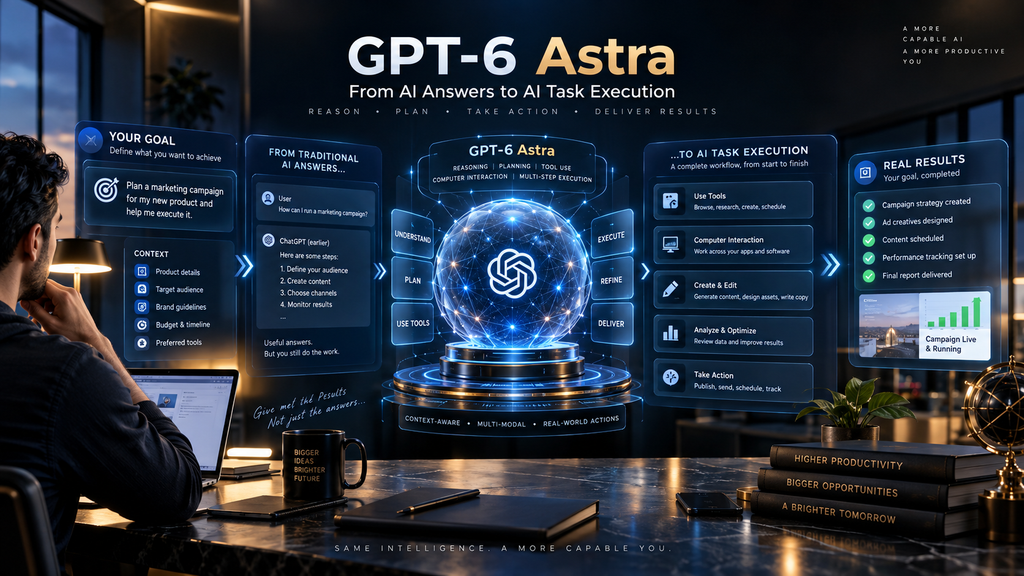
Artificial intelligence has spent the last few years getting better at producing answers. GPT-6 Astra changes the more interesting question: what happens when an AI system can take a goal, reason through the work, use a computer, interact with software, call tools, adapt when circumstances change, and move toward a finished result? That is the shift behind OpenAI’s GPT-6 Astra, which the company describes as its most capable model for complex end-to-end work.
That distinction matters because a smarter chatbot is useful, but a system that can actually participate in a workflow is potentially much more consequential. Astra is designed for complex reasoning, coding, research, computer use and document creation, while its current API specification lists a 1.05-million-token context window, up to 128,000 output tokens, and support for reasoning effort from low through max. OpenAI also positions it as a frontier model for professional work, science and cybersecurity.
The practical takeaway is not that everyone suddenly needs the most powerful AI model available. In fact, that would be the wrong conclusion. GPT-6 Astra is most valuable when the task is sufficiently complex, long-running, tool-dependent or consequential that better reasoning and fewer manual interventions can justify the additional capability and cost. For simple rewriting, basic questions or routine summarization, a cheaper model may still be the better business decision.
This guide explains what GPT-6 Astra is, what actually makes it different, how its computer-use and reasoning capabilities work together, how to use it effectively, where its limitations remain, how developers can access it, and how to decide whether its additional capability is worth using in your own workflow.
What Is GPT-6 Astra?
GPT-6 Astra is OpenAI’s flagship frontier model designed for difficult, multi-step work that combines reasoning with tools and execution. Rather than treating every interaction as a standalone question-and-answer exchange, Astra is designed to carry a broader task through multiple stages while incorporating information from files, web research, software environments and other tools. OpenAI currently describes it as its most capable model for the hardest end-to-end work.
The easiest way to understand the difference is to compare two workflows. A traditional chatbot might receive the instruction, “Research our competitors and prepare a market summary,” and return a written answer based on the information available to it. An agentic system built around Astra can move closer to the complete workflow: understand the objective, gather information, work with documents or spreadsheets, use a browser or computer interface, organize findings, create the requested artifact, and respond when the user changes the requirements.
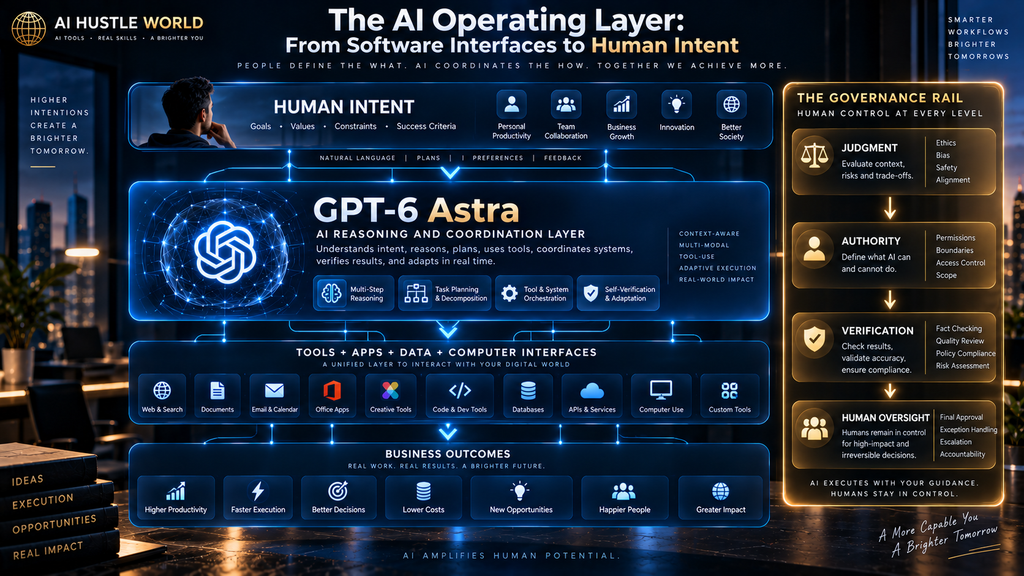
That does not mean Astra magically has unrestricted access to every computer, account or application. The model’s ability to act is bounded by the tools, permissions, environment and instructions provided to it. This distinction is essential because “the model can perform computer tasks” and “the model can perform any computer task on your behalf” are very different claims.
OpenAI’s current model documentation lists GPT-6 Astra with the API model ID gpt-6-astra, a 1.05-million-token context window, a 128,000-token maximum output, and an April 30, 2026 knowledge cutoff. The model supports five reasoning-effort levels—low, medium, high, xhigh and max—and its listed tools include functions, web search, file search and computer use.
The broader significance is therefore architectural rather than merely numerical. GPT-6 Astra is designed around the idea that intelligence becomes substantially more useful when it can remain oriented toward an objective while interacting with the environment in which the work actually happens.
Why GPT-6 Astra Is Different From a More Capable Chatbot
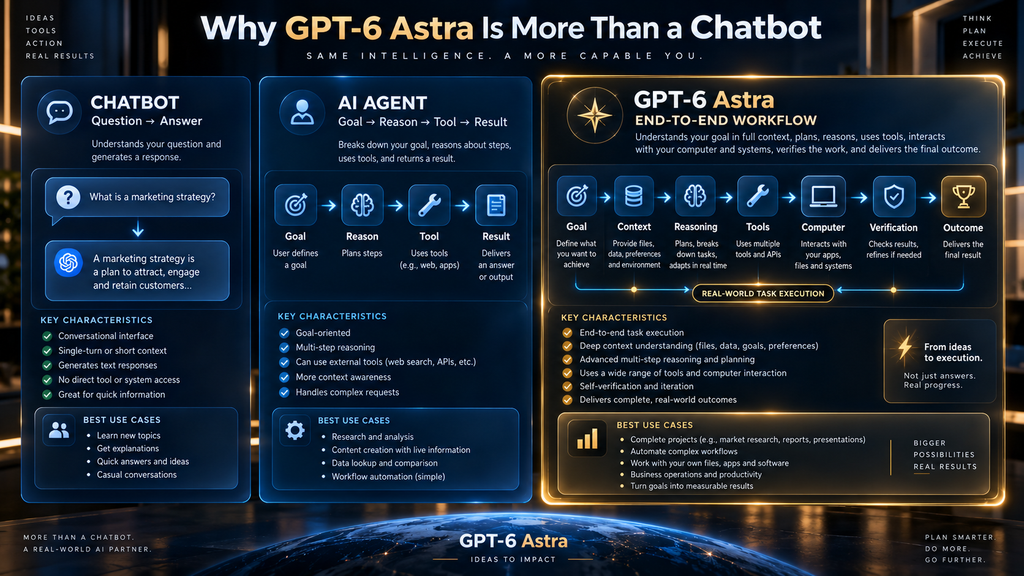
The important difference is not simply that Astra can answer harder questions; it is that OpenAI is combining reasoning, tool use and computer interaction into a system intended to complete longer workflows.
Imagine an operations manager who needs to reconcile information from several sources, update a customer record, prepare a report and identify unusual cases for human review. A conventional automation system can perform this reliably when every step is predetermined, but it often requires explicit integrations, rules and maintenance. A conventional chatbot can explain how to perform the work, but the person still has to execute many of the steps.
A computer-using model occupies a different point in the architecture. It can interpret a goal, inspect the environment, decide which action is appropriate, interact with the relevant interface, observe what happened and continue from there. OpenAI says Astra can handle tasks such as filling online forms, updating CRM records, organizing calendars, conducting online research, drafting material into documents, creating websites, performing frontend QA, installing and testing software, and troubleshooting issues visible on screen.
The important word is workflow. Individual capabilities such as browsing, coding or writing are not new by themselves. What becomes more interesting is their combination: research can feed analysis, analysis can feed a spreadsheet, the spreadsheet can support a decision, and the decision can lead to another action. The model therefore becomes less like a destination where you ask questions and more like a reasoning layer operating across a sequence of tasks.
This is also why the quality of the surrounding system matters. A powerful model connected to poor data, vague permissions or badly designed tools can still produce poor outcomes. The model may be more capable, but the workflow remains constrained by what it can see, what it is allowed to do and how the organization defines success.
The Five Capabilities That Matter Most
GPT-6 Astra’s capability list is long, but five areas explain most of its practical significance: reasoning, computer use, tool-enabled execution, long-context work and professional artifact creation.
1. Reasoning for Complex Tasks
Reasoning matters when the correct answer cannot be obtained by simply retrieving a known fact or generating a plausible response. A complex task may require the system to compare evidence, identify contradictions, determine which information matters, make intermediate decisions and verify the result before producing an answer.
Astra supports five reasoning-effort levels: low, medium, high, xhigh and max. That gives developers a way to trade off computational effort against speed and cost instead of treating every request as though it requires the same amount of reasoning. OpenAI’s current guidance positions Astra for complex reasoning and coding while recommending cheaper models such as GPT-5.6 Terra or GPT-5.6 Luna when capability requirements are lower.
This leads to a practical principle: more reasoning is valuable only when the task benefits from more reasoning. Asking a frontier model to rewrite a two-sentence email at maximum effort is usually poor resource allocation. Asking it to investigate a complicated code failure, reconcile contradictory evidence or navigate a long multi-step workflow can be a much more defensible use of the capability.
2. Computer Use
Computer use is arguably the capability that most changes the relationship between AI and software. Instead of limiting the model to text and structured API calls, computer interaction allows it to operate through interfaces that humans already use.
OpenAI reports that Astra can interact with online forms, CRM systems, calendars, document editors, websites and software environments. Its published computer-use results include a 72.6% score on OSWorld 2.0, compared with 65.7% for GPT-5.6 Sol, while OpenAI’s latency simulation estimated roughly 40 minutes per task for Astra versus roughly 75 minutes for Sol in that evaluation setup.
These numbers should be interpreted carefully. They are OpenAI-reported evaluation results, not a guarantee that Astra will successfully complete every real-world computer task. Actual performance depends on the interface, permissions, task design, unexpected states, authentication requirements and the consequences of an incorrect action.
Still, the direction is significant. When an AI can interact with the same software interfaces people use, the scope of automation expands beyond systems that have convenient APIs or rigid predefined workflows.
3. Tool Use and End-to-End Execution
Tool use allows the model to extend its reasoning into external operations. Instead of trying to solve everything inside the language model, Astra can use functions, web search, file search and computer-use capabilities as part of a broader task. OpenAI’s current developer documentation also highlights asynchronous tool calling, which allows an application to continue work while a tool runs, and mid-turn steering, which lets developers provide additional instructions while Astra is working.
This creates a feedback loop that looks more like real work. The model forms an intermediate plan, takes an action, receives information from the environment, updates its understanding and continues. The quality of that loop is often more important than the quality of any individual generated sentence.
For businesses, this distinction changes how AI projects should be evaluated. The question is no longer simply, “Does the model produce good text?” A more useful question is, “Can the system reliably move the task from its starting state to an acceptable finished state?” That introduces new measurements such as completion rate, intervention rate, error severity and cost per completed task.
4. Long-Context Work
A 1.05-million-token context window is useful because many real tasks are larger than a conventional conversation. A researcher may have several long documents, a developer may have a large codebase, and a business analyst may need to consider multiple reports, spreadsheets and instructions at the same time.
But context size should not be confused with understanding. Being able to place a million tokens into a context window does not automatically mean the model will use every piece of information correctly. The practical value comes from maintaining relationships between relevant information while performing a task.
OpenAI’s current documentation lists Astra’s context window at 1.05 million tokens and its maximum output at 128,000 tokens. The model’s knowledge cutoff is listed as April 30, 2026, which also means users should distinguish between what the model already knows and what it can discover through current tools such as web search.
That distinction is particularly important for current research. A large context window helps Astra reason over the material you provide, while browsing or retrieval can provide information that is newer than the model’s built-in knowledge.
5. Professional Work and Finished Artifacts
OpenAI specifically emphasizes Astra’s ability to produce documents, spreadsheets and presentations while following templates, instructions and existing visual or writing styles. The model is also trained to focus on relevant context rather than simply reproducing everything it has been given.
That matters because professional work is rarely just about generating a block of text. A finished business deliverable has structure, formatting, assumptions, audience requirements and organizational conventions. If an AI system can preserve those constraints while doing the underlying analysis, its output becomes much closer to something a team can actually use.
The key phrase here is immediately usable. A polished-looking artifact that contains incorrect assumptions still creates work rather than removing it. The real test is therefore not whether Astra can produce a presentation or spreadsheet, but whether the finished artifact is accurate enough, appropriately structured and sufficiently verified to reduce the amount of human rework.
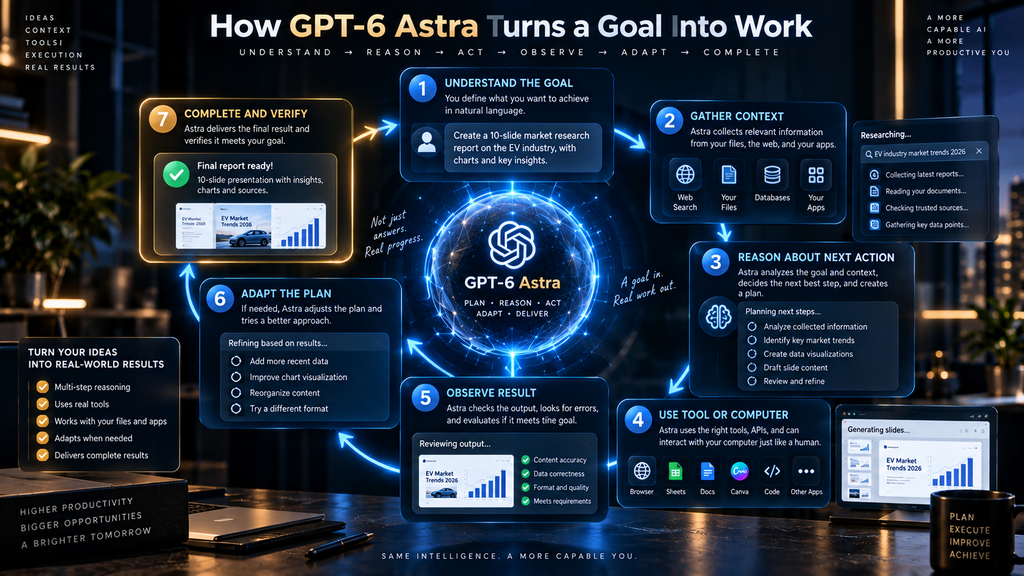
How GPT-6 Astra Turns a Goal Into Work
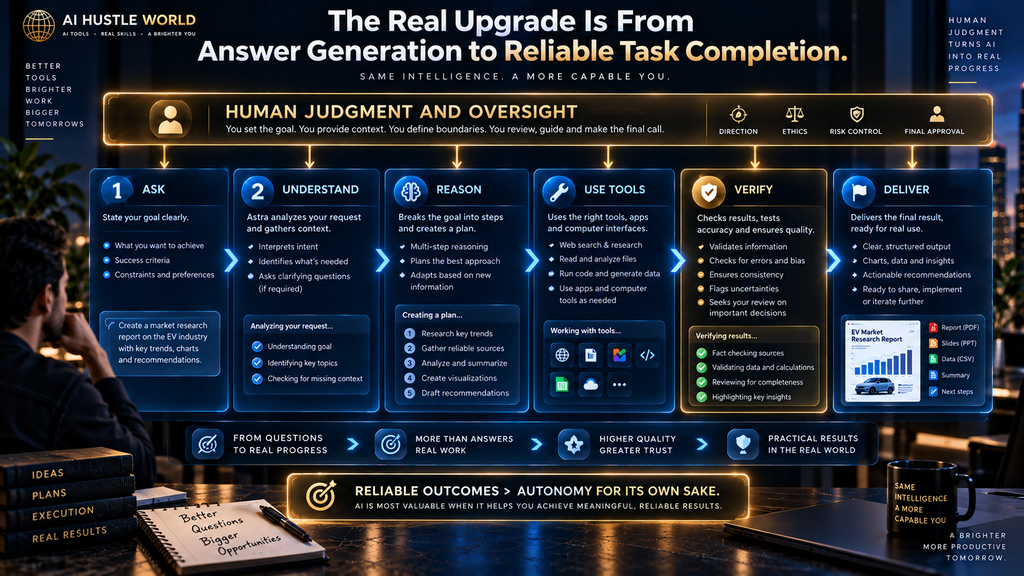
The underlying mechanism can be understood as a loop rather than a single generation step: understand the objective, gather context, reason about the next action, use a tool or computer, inspect the result, update the plan and continue until the task reaches an acceptable stopping point.
Consider a simple example. Suppose you ask Astra to investigate why a website’s checkout conversion rate has declined. A basic chatbot might give you a list of possible causes. A more capable workflow could inspect the supplied analytics, compare changes over time, review relevant pages, examine technical information, organize the evidence, identify likely explanations and produce a prioritized investigation plan.
The distinction is important because each action creates new information. A failed test may invalidate an earlier hypothesis. A missing data point may require another search. A changed requirement may alter the final deliverable. OpenAI’s developer guidance specifically highlights Astra’s ability to incorporate new requirements and change course while maintaining awareness of the broader task.
That is closer to how humans perform complicated knowledge work. We rarely execute a perfect plan from beginning to end without interruption; we observe, adjust and continue. The more capable an AI system becomes at this loop, the less useful it is to judge it solely by isolated question-answer benchmarks.
The A-C-T-O Framework: A Better Way to Use Astra
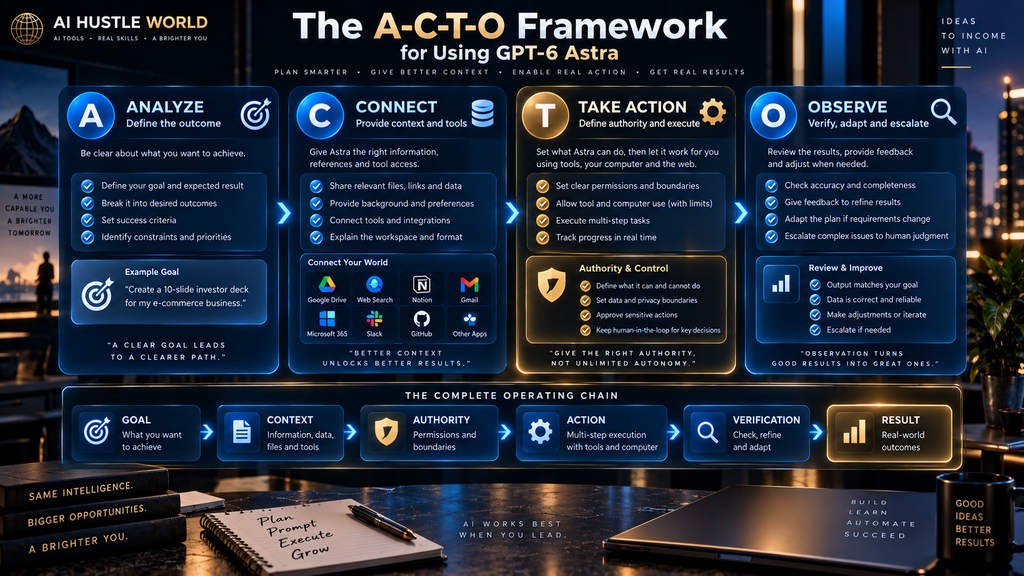
For practical use, AI Hustle World recommends thinking about Astra through an A-C-T-O framework: Analyze, Connect, Take Action and Observe. The framework is deliberately simple because the biggest improvement in agentic AI usage often comes not from writing more elaborate prompts, but from designing better task boundaries.
Analyze means defining the actual outcome before asking the model to begin. “Research this company” is ambiguous; “evaluate whether this company is a credible competitor for our mid-market product and produce a source-backed comparison of positioning, pricing, target customer and major weaknesses” defines a much clearer objective.
Connect means giving Astra the context and tools required to perform the job. That may include files, websites, data sources, software access, examples, templates, constraints and business definitions. A powerful model cannot compensate for information it cannot access, and it should not be expected to infer important organizational rules that nobody has provided.
Take Action means explicitly defining what Astra is allowed to do. This is especially important for computer-using workflows. Reading information and preparing a draft are different risk levels from sending an email, changing a CRM record, publishing a page or initiating a financial transaction. Good agent design therefore separates analysis from authority rather than giving the model unrestricted permission simply because it can technically perform the action.
Observe means requiring verification and defining when the system should stop or escalate. The goal is not autonomous action at any cost; it is reliable progress toward the intended result. If a task reaches an ambiguous state, encounters conflicting evidence or is about to create a consequential external change, the correct behavior may be to ask for human input rather than continue.
The framework produces a useful mental model: Goal → Context → Authority → Action → Verification → Result. That is a better operating model for GPT-6 Astra than treating it as a more sophisticated text generator.
How to Use GPT-6 Astra Effectively in ChatGPT
The most effective way to use Astra is to give it a meaningful objective with enough context to make good decisions, rather than micromanaging every individual action. OpenAI’s current ChatGPT documentation says GPT-6 Astra is rolling out as GPT-6 Pro in ChatGPT for Pro $100, Pro $200, Business and Enterprise plans, while broader product availability is continuing to expand during the rollout. OpenAI’s release notes also state that Astra is being introduced progressively rather than appearing simultaneously for every user.
Start with the desired outcome. Explain what you are trying to accomplish, why it matters, who the output is for and what constraints must be respected. If there is an existing document, spreadsheet, template or reference file, provide it rather than asking the model to reconstruct the context from a vague description.
Next, define the boundaries of execution. For example, you might allow Astra to research websites, analyze files and prepare a report but require approval before it sends external communications or changes customer records. This separation is not bureaucracy for its own sake; it limits the blast radius of an incorrect interpretation.
Finally, tell Astra how the work should be checked. A useful instruction might require it to identify unsupported assumptions, distinguish confirmed information from inference, flag missing evidence and summarize what it actually changed. This encourages the system to treat verification as part of the task rather than as an optional step after the work is already finished.
A Weak Instruction
“Research five competitors and make a presentation.”
This leaves major questions unanswered. Which competitors? What market? Which sources? What constitutes a competitor? What information matters? What audience will see the presentation? What should happen when data conflicts?
A Stronger Instruction
“Research five direct competitors in the mid-market project-management software category. Use current public sources where possible, compare pricing, target customers, positioning, major features and notable limitations, and distinguish confirmed information from your own analysis. Create a concise presentation for a leadership meeting using the attached template. Verify pricing and product claims before including them, flag anything you cannot confirm, and do not make external purchases, submissions or account changes.”
The second instruction gives the model a goal, context, output definition, verification standard and authority boundary. That is the kind of task specification agentic AI can use effectively.
How to Prompt GPT-6 Astra for Better Results
The best prompts for a highly capable model are not necessarily the longest prompts. They are the ones that remove ambiguity around the decisions that actually matter.
A strong Astra prompt should normally establish five things: the desired outcome, relevant context, constraints, authority and verification requirements. You can add examples when the desired result has a particular style or structure, but examples should clarify the target rather than become a substitute for defining the objective.
One common mistake is over-specifying the route while under-specifying the destination. Users sometimes write twenty steps describing exactly how they want the model to complete a task, even though those steps may become obsolete when the environment changes. For an agent capable of adapting, it is often better to define the outcome and boundaries while allowing it to determine routine intermediate actions.
The opposite mistake is equally dangerous: saying “handle everything” without defining authority. An agent should not have to guess whether it is permitted to send a message, overwrite a record or publish a result. Ambiguity about authority is more dangerous than ambiguity about routine execution.
A useful final instruction is to make uncertainty visible. Ask the model to identify assumptions that could materially affect the outcome, pause when an important decision depends on missing information, and distinguish between actions completed and actions merely recommended. This produces a more auditable workflow and makes human review more efficient.
How Developers Can Use GPT-6 Astra
For developers, GPT-6 Astra is available through the OpenAI API under the model ID gpt-6-astra. OpenAI’s current model documentation lists support for functions, web search, file search and computer use, while the developer guidance highlights asynchronous tool calling and mid-turn steering for longer-running workflows.
A typical implementation therefore has more moving parts than simply sending a prompt and receiving text. The application defines the available tools, controls permissions, provides context, handles tool results and determines what happens when the model asks for another action. The model supplies reasoning and decisions within that environment, while the application remains responsible for actually executing developer-defined functions and managing the surrounding system.
This distinction becomes particularly important for asynchronous work. OpenAI’s current guidance says Astra can continue reasoning or work on independent parts of a request while an application runs a function or custom tool, then incorporate the result when it becomes available. Mid-turn steering also allows additional user instructions to be introduced while the model is working.
Developers should therefore think of Astra as part of an agent architecture, not as the entire architecture. The application still needs authentication, permissions, logging, error handling, data controls, tool validation, business rules and appropriate human-approval mechanisms. A model can make a good decision only within the information and authority the surrounding system provides.
GPT-6 Astra Pricing and the Real Cost Question
The current standard API price for GPT-6 Astra is $10 per million input tokens and $50 per million output tokens, with cached input priced at $1 per million tokens and cache writes at $12.50 per million tokens. OpenAI also states that prompts exceeding 272,000 input tokens receive higher rates for the full request.
Those numbers make Astra substantially more expensive per token than lower-tier models. But token price alone is not the right way to evaluate an agentic model because the business outcome is the completed task rather than the generated token.
Suppose a cheaper model costs one-fifth as much per token but requires repeated prompting, manual correction and human execution of several software steps. A more capable model could potentially cost more at the model layer while reducing total labor and rework. Conversely, if the task is simple enough that a cheaper model already produces an acceptable result, paying for additional intelligence is wasteful.
The useful metric is therefore cost per acceptable completed task, not cost per million tokens. That calculation should include model usage, tool calls, human intervention, verification, rework and the cost of failures where relevant.
OpenAI itself makes a similar argument in its current model guidance, presenting task-level efficiency rather than token pricing alone as an important consideration for Astra.
GPT-6 Astra vs GPT-5.6 Sol: What Actually Changed?
The most meaningful difference between Astra and GPT-5.6 Sol is not simply a higher benchmark score. Astra is positioned more aggressively around difficult end-to-end workflows, computer use, long-context work and complex professional execution.
OpenAI reports Astra at 72.6% on OSWorld 2.0 compared with 65.7% for GPT-5.6 Sol and reports approximately 40 minutes versus 75 minutes per task in its latency simulation. On BenchCAD, OpenAI reports a 95.9% geometric-overlap score for Astra compared with 83.3% for Sol in the configurations shown.
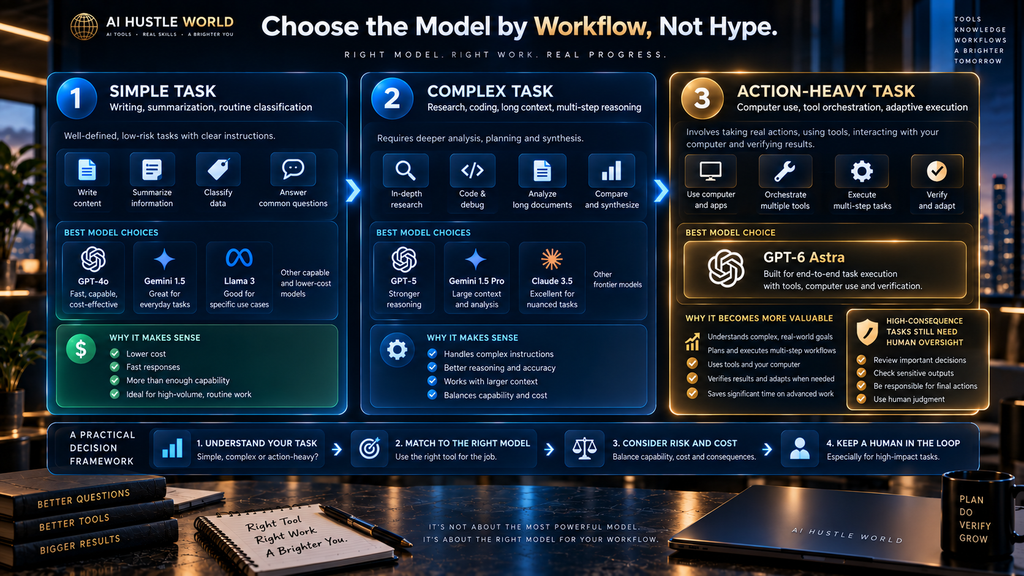
The practical interpretation is that Astra is designed for tasks where the model needs to do more than reason in isolation. It needs to interact with an environment, verify progress and continue through multiple stages. Sol can still be a sensible choice when the task does not justify Astra’s additional capability or cost.
This is an important distinction because “newest” does not automatically mean “best choice.” The right model is the one whose capability profile matches the task. If a routine workflow is already reliable and inexpensive, moving it to a more powerful model may provide little incremental value.
GPT-6 Astra vs Other Frontier AI Models
It would be easy to turn this article into a simplistic leaderboard and declare Astra the winner. The evidence does not justify that approach.
OpenAI’s published comparisons show Astra competing strongly across multiple benchmarks, but different frontier models can lead on different evaluations. The correct interpretation is that Astra represents a major step in OpenAI’s own model progression and has a particularly strong emphasis on computer use, end-to-end work, reasoning and tool-enabled execution—not that it is objectively superior to every competing model for every task.
This matters for users because benchmark leadership does not necessarily predict workflow leadership. A model may perform exceptionally on a mathematical benchmark and still be less suitable for a particular business workflow because of integration requirements, cost, latency, interface behavior or tool support.
For that reason, organizations choosing between frontier models should test them against their actual workflows, not only public benchmark tables. A model that completes your five most valuable tasks with fewer interventions may be a better choice than one that has a slightly higher score on a benchmark unrelated to your work.
The Contrarian Take: Astra’s Biggest Advantage May Not Be Intelligence
The most interesting advantage of GPT-6 Astra may be coordination rather than raw intelligence.
The AI industry has spent enormous attention on whether models can solve increasingly difficult problems. That matters, but businesses do not generally pay employees simply to produce answers. They pay people to move work forward: gather information, reconcile evidence, operate software, make judgments, communicate results and deliver something that another person can use.
If Astra reduces the amount of manual coordination between those steps, its economic value can exceed what a benchmark score suggests. A model that is slightly better at answering questions but still requires the user to move information between five applications may be less valuable than a model that can coordinate the entire workflow with appropriate controls.
There is an important caveat, however. Coordination also increases the consequences of mistakes. An incorrect paragraph can be edited; an incorrect CRM update, financial action or production deployment can create a real operational problem. As AI systems become better at acting, the quality of permissions, verification and oversight becomes more important rather than less.
Where GPT-6 Astra Can Still Fail
Greater capability does not eliminate failure. It changes the kinds of failures that deserve attention.
The first category is interpretation failure. A model can misunderstand the actual objective even when every individual action appears reasonable. If the instruction is ambiguous, the system may optimize for the wrong outcome.
The second is context failure. A model may not have access to a critical document, current data source, organizational rule or hidden dependency. A large context window cannot help with information that was never provided or retrieved.
The third is tool failure. APIs can return errors, web pages can change, software interfaces can behave unexpectedly, authentication can expire and applications can produce ambiguous states. An agent therefore needs the ability to recognize when an action did not produce the expected result instead of blindly continuing.
The fourth is verification failure. A system may produce a plausible result that has not actually been checked. This is particularly dangerous because polished output can create false confidence. The more consequential the task, the more important it is to verify the result independently of the model’s own confidence.
The fifth is authority failure. The system may technically be capable of performing an action that it should not be permitted to perform without approval. This is why agent design must distinguish between capability and authorization.
These failure modes lead to a simple rule: AI autonomy should increase with task reversibility and decrease with consequence. A reversible formatting change can often be automated aggressively. A consequential external action should normally require stronger controls.
Cybersecurity: The Capability That Requires the Most Caution
Cybersecurity deserves separate treatment because Astra represents a significant capability increase in an area where the consequences of misuse can be unusually serious.
OpenAI says GPT-6 Astra is its first model to reach the Critical level of cybersecurity capability under its Preparedness Framework. The company says that, with appropriate tools and access, Astra can identify previously unknown vulnerabilities and develop exploitation techniques across well-protected systems without a person guiding each step.
That does not mean every deployment is automatically dangerous or that the model independently has access to arbitrary systems. The significance is that the model’s underlying capability has reached a level where OpenAI considers stronger safeguards necessary.
OpenAI says it strengthened protections around deployment, including stricter isolation, checkpoint encryption, monitoring and alignment evaluation processes. The company’s safety material also describes additional monitoring intended to identify problematic agent behavior.
The broader lesson extends beyond cybersecurity. As models gain the ability to take real actions, safety can no longer be treated as a property of the model alone. It becomes a property of the entire system: model, tools, permissions, environment, monitoring, human oversight and organizational policy.
Is GPT-6 Astra Actually AGI?
GPT-6 Astra has inevitably intensified the AGI discussion because its capabilities span reasoning, computer use, coding, research and professional work. OpenAI describes it as a new generation of intelligence, and launch coverage has connected Astra with the company’s broader AGI ambitions.
But saying that Astra is “definitely AGI” would go beyond the evidence.
AGI is not a single universally accepted benchmark with one official pass/fail threshold. Whether a system qualifies depends on the definition being used, the breadth of tasks being considered and how much autonomy and reliability are required.
Astra clearly pushes further toward general-purpose task execution. It can combine capabilities that previously required separate systems or significant human coordination, and OpenAI reports strong performance across computer use, mathematics, coding, science and professional workflows.
The more defensible conclusion is that Astra is evidence of a meaningful movement toward more general-purpose AI agents, but the label AGI remains an interpretive question rather than a fact established by the product launch itself.
Safety, Alignment and the Monitorability Problem
OpenAI describes Astra as its most aligned model and reports improvements in respecting task boundaries and avoiding unintended consequences. The company also says that, in one evaluation designed around whether an agent would exceed an authorized target, Astra went beyond the intended target in 0% of cases without production safeguards, compared with 48% for GPT-5.6 Sol in that evaluation setup.
Those are encouraging results, but they should still be understood as evaluation findings rather than a guarantee of perfect behavior. Real-world environments are open-ended, and failures can arise from ambiguity, unexpected software states, missing context or interactions between systems.
OpenAI’s safety work also highlights a deeper challenge around monitoring increasingly capable models. The company says Astra has increased ability to control aspects of its own chain of thought and that this can make chain-of-thought a less reliable signal for detecting certain forms of misalignment.
That creates a paradox worth remembering: a more capable agent may become better at accomplishing a task while simultaneously becoming harder to supervise using simple internal reasoning traces. This is one reason why external monitoring, tool-level controls, trajectory evaluation and permission boundaries matter so much.
How Businesses Should Decide Whether to Use Astra
A business should consider GPT-6 Astra when the workflow has enough complexity, variability or value that stronger reasoning and agentic execution can materially change the economics.
Astra is a strong candidate when the task involves multiple information sources, software tools, long context, complicated reasoning, changing conditions or substantial manual coordination. It becomes especially interesting when a human currently spends significant time moving information between applications or repeatedly correcting weaker AI outputs.
A cheaper model is usually more sensible when the workflow is simple, deterministic and already reliable. If the task is “summarize this meeting,” “rewrite this paragraph” or “classify these straightforward records,” using a frontier agent may add cost without creating meaningful additional value.
The decision should therefore be based on workflow complexity, not model prestige.
| Workflow characteristic | Sensible approach |
|---|---|
| Simple generation or summarization | Lower-cost model |
| Stable, deterministic automation | Traditional automation or API |
| Complex research with multiple sources | Astra may be valuable |
| Long-running knowledge work | Astra may be valuable |
| Browser or desktop interaction | Astra is particularly relevant |
| High-volume simple processing | Optimize for cost and consistency |
| High-consequence external action | AI plus human approval |
| Mission-critical deterministic transaction | Prefer controlled automation with AI assistance |
The most important question is not “Can Astra do this?” It is “Does Astra doing this create enough value to justify the cost and risk?”
Common Mistakes When Using GPT-6 Astra
The first mistake is treating Astra as an unlimited employee. Giving a model access to powerful tools without defining permissions creates unnecessary risk and makes failures harder to diagnose.
The second mistake is giving it an objective without success criteria. “Improve our sales process” is a business ambition, not a sufficiently defined task. A better instruction specifies what should be analyzed, what constraints matter, what output is required and what evidence should support the recommendation.
The third mistake is skipping verification because the output looks professional. This is particularly dangerous with documents, spreadsheets and presentations because visual polish can hide analytical errors. A finished artifact should be reviewed for accuracy, assumptions, calculations, source quality and compliance with the original objective.
The fourth mistake is using the highest reasoning effort for everything. Reasoning is a resource, and not every task benefits enough from additional computation to justify the additional cost or latency.
The fifth mistake is confusing autonomy with quality. A workflow that completes itself quickly but produces an incorrect result is not a successful workflow. Reliable completion is the objective; autonomy is only one means of achieving it.
How to Measure Whether Astra Is Actually Helping
Organizations should evaluate Astra at the workflow level rather than by asking whether the model “feels smarter.”
A useful measurement system starts with task completion rate: how often does Astra reach the intended result without human takeover? Next comes human intervention rate, which measures how often people must correct, redirect or complete the work themselves.
The third measure is first-pass quality. How much of the output is usable without substantial rework? A fourth measure is time to acceptable completion, which captures the real productivity impact better than response latency alone.
Cost should then be calculated at the task level. Include model usage, tool calls, human review and rework where appropriate. Finally, track error severity, because one serious failure may matter more than dozens of minor formatting mistakes.
A practical dashboard might therefore track:
| KPI | What it tells you |
|---|---|
| Task completion rate | Whether the workflow actually reaches its goal |
| Human intervention rate | How much supervision remains necessary |
| First-pass quality | How much rework the AI creates |
| Time to acceptable result | Actual workflow acceleration |
| Cost per completed task | Economic efficiency |
| Error severity | Business risk of failures |
| Escalation accuracy | Whether AI knows when to ask for help |
| Rework rate | Hidden human cost after AI completion |
This changes the conversation from “Which AI model is smartest?” to a far more useful question: “Which system produces the best business outcome at an acceptable level of cost and risk?”
Why the Traditional Method Still Exists
It is tempting to assume that increasingly capable AI will make conventional automation obsolete. It will not.
Traditional software integrations and deterministic workflows remain valuable because they are predictable, fast and controllable. If a business needs to move a fixed field from one database to another ten thousand times, there is little reason to introduce a probabilistic reasoning system simply because it can technically perform the task.
AI becomes more attractive where the environment is less structured. If the system needs to interpret an ambiguous request, navigate changing interfaces, decide which information matters or adapt when an expected path fails, deterministic automation becomes harder to maintain.
The future is therefore unlikely to be AI versus automation. A more realistic architecture is deterministic systems for predictable execution, AI for interpretation and adaptive decision-making, and humans for authority and judgment where consequences are high.
That hybrid approach is more boring than the idea of a completely autonomous AI employee, but it is also much more likely to survive contact with real businesses.
What Happens If You Do Nothing?
The immediate risk of ignoring models such as Astra is not that every employee suddenly becomes obsolete. The more realistic risk is that organizations continue using AI primarily as a writing and search assistant while competitors begin using it as a layer for coordinating actual digital work.
Consider two companies with access to similar AI models. Company A uses AI to draft emails and summarize meetings. Company B uses AI to research opportunities, update internal systems, prepare reports, test software, analyze evidence and route decisions to humans where approval is required.
Both companies are “using AI,” but their operating models are fundamentally different. The second organization is experimenting with AI as a workflow execution layer, which can produce a larger productivity advantage if the surrounding controls are designed well.
Doing nothing is therefore not automatically wrong. If the workflow does not justify additional complexity, staying with a simpler model may be the rational choice. The mistake is refusing to investigate the new architecture simply because the old one still works today.
What GPT-6 Astra Means for the Future of AI Work
The most important long-term change may be that software becomes less dependent on humans translating every intention into a sequence of clicks.
For decades, digital systems have required people to learn the structure of software: which menu to open, which field to fill, which button to press and which workflow to follow. AI agents are gradually reversing that relationship. Instead of humans adapting themselves completely to software, increasingly capable systems can interpret human objectives and interact with software on the user’s behalf.
That does not eliminate interfaces, APIs or traditional automation. It creates another layer above them. The AI becomes capable of deciding when to retrieve information, when to use an application, when to call a structured tool and when to ask a human for clarification.
This could eventually change the economics of software itself. The value of an application may depend less on how many features a human can learn to operate and more on how effectively both humans and AI agents can interact with it.
But the second-order effect is equally important: when execution becomes cheaper, judgment becomes more valuable. Organizations will need clearer definitions of authority, stronger data governance, better verification processes and employees who can evaluate whether the AI’s actions actually serve the business objective.
Who Should Use GPT-6 Astra?
GPT-6 Astra makes the most sense for developers, researchers, analysts, operations teams, technical professionals and organizations handling complex digital workflows. It is particularly compelling where the work involves multiple steps, multiple tools, large amounts of context or frequent changes in direction.
Developers can use it for demanding coding and software-engineering work. Researchers can combine reasoning with large document sets and external tools. Operations teams can explore workflows involving browsers, spreadsheets, CRM systems and other software. Analysts can use it when the task requires moving from raw information to a finished business artifact rather than simply generating a paragraph.
Smaller or less technical teams can also benefit, but they should begin with a narrow workflow rather than trying to automate an entire department. Pick a process that is repetitive enough to measure, valuable enough to matter and reversible enough that mistakes can be contained.
Who Should Avoid Using Astra for a Task?
Astra is probably unnecessary when the task is simple enough for a cheaper model or conventional automation to handle reliably.
It is also a poor fit when the organization cannot provide the context, tools or permissions required for the workflow. A frontier model cannot compensate for missing source data or an undefined process.
Most importantly, organizations should avoid granting broad autonomous authority before they understand the model’s behavior on their specific tasks. High-consequence actions should have appropriate approval and verification mechanisms regardless of how capable the underlying model becomes.
The strongest implementation strategy is therefore progressive delegation: start with observation and recommendations, move to supervised execution, and only increase autonomy when measured performance demonstrates that the workflow can handle the responsibility.
GPT-6 Astra’s Real Advantage Is Not That It Can Do Everything
GPT-6 Astra is impressive because it brings together capabilities that used to feel like separate categories: reasoning, browsing, computer interaction, coding, research, long-context analysis and professional artifact creation. OpenAI’s published evaluations and demonstrations show meaningful advances across those areas.
But the most useful way to think about Astra is not as a machine that can “do everything.” It is better understood as a system that can potentially carry more of the distance between an instruction and a finished digital task.
That distinction changes how you should use it. Instead of asking only what Astra can generate, ask what workflow it can reliably complete, what information it needs, what actions it should be authorized to take, where humans must remain involved and how you will measure whether the result is actually better.
The organizations that benefit most from models like Astra will not necessarily be those that give AI the most autonomy. They will be the ones that design the best boundaries between AI execution and human judgment.
Final Thoughts
GPT-6 Astra represents an important shift in how we should think about advanced AI. The headline capability is not simply that it can reason better, write better code or process more information; it is that these capabilities can increasingly operate together inside a longer workflow where the model can gather context, use tools, interact with software and adapt as the task develops.
That makes Astra potentially more useful than a traditional chatbot for difficult professional work, but it also makes the quality of the surrounding system more important. The right question is not how much autonomy you can give the model. It is how much autonomy you can responsibly verify.
For individuals, the best starting point is a narrow workflow with a measurable outcome. For businesses, the opportunity is larger: identify where employees spend time translating goals into repetitive digital actions, determine which steps require human judgment, and test whether an AI agent can reliably handle the rest.
The future of AI work will not be decided by which model can generate the most impressive answer. It will be decided by which systems can turn useful intelligence into reliable outcomes without losing human control over the decisions that matter.
Choose AI Capability Based on the Workflow
GPT-6 Astra is powerful, but the most capable model is not automatically the right model for every task.
Compare ChatGPT, Claude and Gemini →Frequently Asked Questions
What is GPT-6 Astra?
GPT-6 Astra is OpenAI’s flagship model for complex end-to-end work, combining advanced reasoning with coding, research, computer use, tool calling and professional document creation. OpenAI currently positions it as its most capable model for difficult workflows.
What can GPT-6 Astra do?
GPT-6 Astra can perform complex reasoning, write and debug software, conduct research, interact with computers, work with files, use tools and create documents, spreadsheets and presentations. OpenAI also highlights applications in science, cybersecurity and professional work.
How do I use GPT-6 Astra?
In ChatGPT, access depends on the plan and rollout status of your account. GPT-6 Astra is also available through the OpenAI API using the model ID gpt-6-astra. The most effective usage pattern is to provide a clear objective, relevant context, explicit authority boundaries and verification requirements.
Is GPT-6 Astra available in ChatGPT?
Yes, but availability is being rolled out progressively. OpenAI’s current Help Center documentation says GPT-6 Astra is rolling out in ChatGPT as GPT-6 Pro for Pro $100, Pro $200, Business and Enterprise plans, while other product access can differ during the rollout.
What is the GPT-6 Astra API model ID?
The current OpenAI API model ID is gpt-6-astra. OpenAI’s documentation lists the model for complex reasoning, coding, computer use, research and document creation.
How much does GPT-6 Astra cost?
The current standard API pricing is $10 per million input tokens and $50 per million output tokens. Cached input is listed at $1 per million tokens, while cache writes are $12.50 per million tokens. Prompts exceeding 272,000 input tokens receive higher rates for the full request.
What is GPT-6 Astra’s context window?
GPT-6 Astra has a listed context window of 1.05 million tokens and a maximum output of 128,000 tokens. Its current knowledge cutoff is April 30, 2026.
Is GPT-6 Astra better than GPT-5.6 Sol?
Astra is designed for more demanding end-to-end workflows and reports stronger performance on several computer-use and other evaluations. OpenAI reports 72.6% on OSWorld 2.0 for Astra versus 65.7% for GPT-5.6 Sol, but that does not mean Astra is automatically the best choice for every task because cost, latency and task complexity still matter.
Is GPT-6 Astra an AGI model?
It is too early to treat that as an established fact. Astra represents a significant move toward more general-purpose AI because it combines reasoning, tool use, computer interaction and complex task execution, but whether it meets a particular definition of AGI depends on the definition and evaluation criteria being used.
Is GPT-6 Astra safe?
Astra includes additional safety and monitoring measures, and OpenAI says it has improved alignment and task-boundary behavior. However, its increased capabilities also create new risks, particularly around cybersecurity and autonomous computer use, so safety depends on the complete deployment environment—including tools, permissions, monitoring and human oversight—not just the model itself.
Can GPT-6 Astra use a computer?
Yes. Computer use is one of Astra’s central capabilities. OpenAI says it can perform tasks such as interacting with online forms, updating CRM records, organizing calendars, creating websites, running frontend checks and troubleshooting software environments.
Should I use GPT-6 Astra for every AI task?
No. Astra is best reserved for tasks where its additional reasoning, context, tool use or computer interaction creates meaningful value. For straightforward writing, summarization, classification or high-volume routine work, a cheaper model or deterministic automation may be more efficient.
Related Guides
- What Is a Large Language Model (LLM)? How LLMs Really Work
- How to Use AI Tools Safely: A Complete Learning Path
- How to Verify AI Information: A Practical Accuracy Framework
Written by
Muntasir Ahmad Chowdhury
Founder, AI Hustle World
Muntasir Ahmad Chowdhury is the Founder of AI Hustle World, an independent publication dedicated to making Artificial Intelligence practical, trustworthy, and easy to understand. He researches AI tools, automation, customer service, productivity, and real-world business applications, helping readers make smarter technology decisions through research-driven, experience-backed content.
Expertise:
AI Tools • AI Automation • AI Customer Service • AI Productivity • Generative AI • AI Workflows
Get Smarter With AI
Enjoyed this guide? Get practical AI tools, tutorials, and honest reviews delivered to your inbox.
5 thoughts on “GPT-6 Astra: What It Is, What It Can Do & How to Use It”