AI Copyright Explained: What Businesses Need to Check Before Publishing Generated Content
Generative AI has made it possible for a small marketing team to produce in an afternoon what once required a writer, designer, photographer, editor, researcher and production budget. That efficiency is real, but it creates a new problem that is easy to underestimate: the fact that an AI system can generate an asset does not automatically tell you whether your business can safely publish it, whether you can claim copyright in it, or whether someone else could challenge your use of it.
Imagine an ecommerce company creating a product campaign with an AI image generator. The team writes a prompt, produces an image, makes a few edits, adds the company’s logo and publishes the result in a paid advertising campaign. From a production perspective, the workflow looks complete. From a rights perspective, however, several questions remain unanswered: Did the team have the right to use every reference image supplied to the system? What does the AI provider’s current contract actually say about the output? Did humans contribute enough creative expression for copyright protection to exist? Could the final image resemble someone else’s protected work or implicate trademark or publicity rights? And if a dispute arises six months later, can the company demonstrate how the asset was created and why it believed publication was permitted?
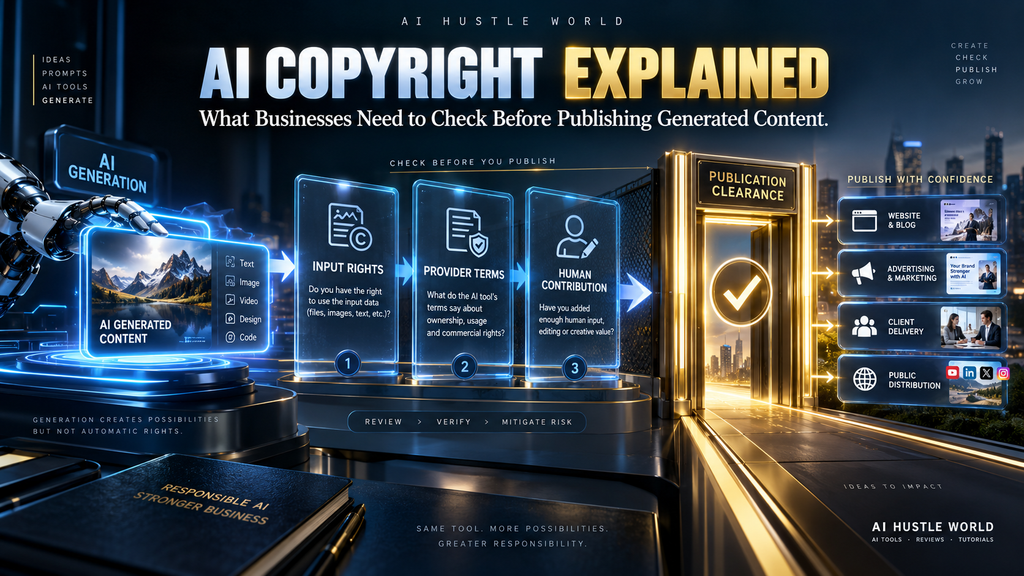
Those questions reveal why “Can I copyright AI-generated content?” is not actually the most useful business question. Copyrightability is only one part of the decision. A responsible publishing workflow needs to consider permission, ownership, human authorship, third-party rights, provider terms and provenance together. The U.S. Copyright Office, for example, has concluded that generative-AI outputs can receive copyright protection when a human author determines sufficient expressive elements, while merely supplying prompts is not enough; at the same time, AI assistance or AI-generated material incorporated into a larger human-authored work does not automatically prevent copyright protection. (U.S. Copyright Office)
This article takes the practical business view. It explains what AI copyright actually means, separates contractual ownership from copyright protection, examines where infringement risk can enter, shows why AI-provider terms matter, compares important jurisdictional differences, and builds a practical framework for deciding whether an AI-assisted asset is ready for publication. The goal is not to turn a marketing team into a law firm. It is to make the publishing decision more disciplined.
Important: This article is an educational guide, not legal advice. Copyright, trademark, publicity, privacy and related rules vary by jurisdiction and by the facts of a particular case. For high-value, high-risk or disputed material, obtain advice from a qualified professional in the relevant jurisdiction.
AI Copyright Is Really Several Different Questions
The cleanest way to understand AI copyright is to stop treating “AI-generated content” as a single legal category. A business usually needs to answer at least four separate questions: Do we have the right to use the inputs? Does the provider permit our intended use of the output? Is there protectable human authorship in the final work? And could publication nevertheless interfere with someone else’s rights?
These questions overlap, but they are not interchangeable. A provider can give you contractual rights to an output without guaranteeing that the output qualifies for copyright protection. A work can contain AI-generated material while also containing substantial human-authored expression. An asset can be permitted under a provider’s terms and still create a separate trademark, publicity or copyright issue because of what appears in the final result. Treating all of these issues as “ownership” produces exactly the kind of false certainty that businesses should avoid.
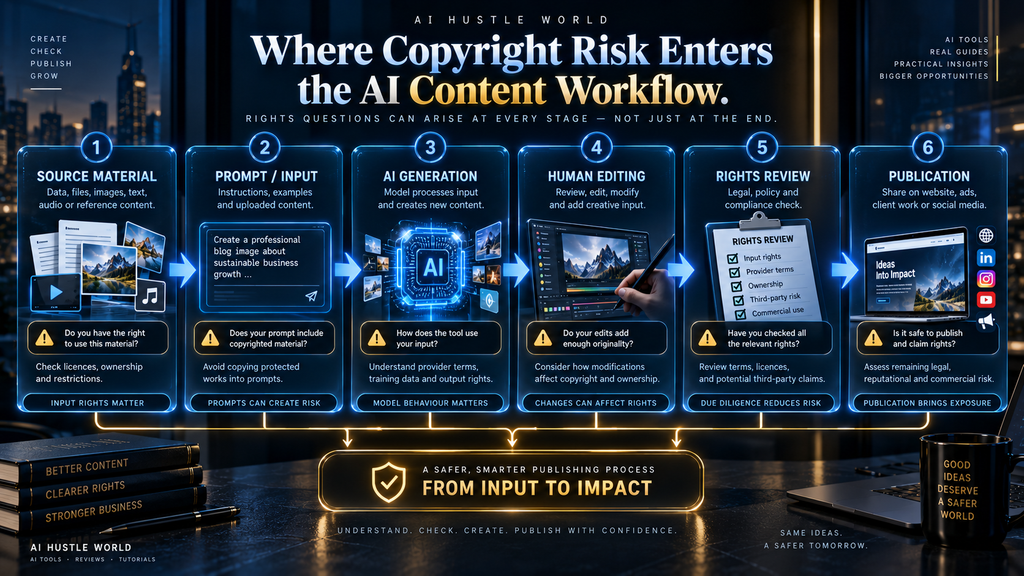
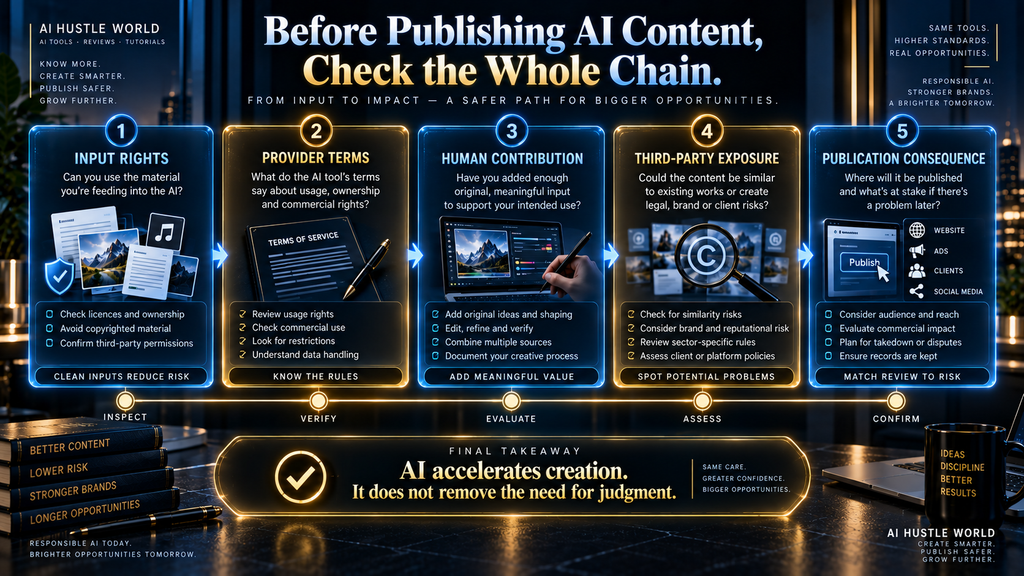
A useful mental model is therefore: Inputs → Provider Terms → Human Contribution → Third-Party Exposure → Publication. The publishing decision sits at the end of that chain, not at the moment the model finishes generating the asset.
This distinction also explains why a paid AI subscription does not magically solve the problem. Payment establishes a commercial relationship with the provider; it does not rewrite copyright law, grant rights you did not possess in uploaded material, or guarantee that every output is unique. OpenAI’s current terms, for example, say that users own output as between themselves and OpenAI to the extent permitted by applicable law, while also warning that outputs may not be unique and placing responsibility for inputs and output use on the customer. (OpenAI)
The practical lesson is straightforward: “the tool lets us use it” and “we own enforceable copyright in it” are different statements.
What Copyright Protects in AI-Assisted Work
At its core, copyright protects qualifying original expression rather than every idea, fact, instruction or technical result. That principle becomes complicated with generative AI because a finished asset may contain several different layers of contribution: material created directly by a person, material generated by a model, material selected or arranged by a person, and material modified after generation.
In the United States, the Copyright Office’s January 2025 report provides an important framework. It says that generative-AI outputs can be protected when a human author has determined sufficient expressive elements. The Office gives examples that can include human-authored material perceptible in an AI output and creative human arrangements or modifications. It also concludes that mere prompting does not, by itself, provide sufficient human authorship.
That distinction matters because the public discussion often swings between two extremes: either “AI content has no copyright” or “I made the prompt, so I own the copyright.” Neither is an adequate description of the issue.
Consider an AI-assisted article. If a person simply enters “write a detailed article about workplace AI adoption” and publishes the resulting text with no meaningful creative intervention, the human contribution may be limited. But suppose an editor develops the argument, conducts original research, decides which evidence to use, structures the narrative, writes substantial sections, rewrites generated material, develops original examples and makes the final expressive decisions. The finished article may contain AI-generated material, but that does not mean the entire work should automatically be treated as having no human authorship.
The same reasoning can apply to visual work. A designer might use generative AI to produce dozens of candidate compositions, reject most of them, select particular elements, combine them with original artwork, redraw portions, manipulate typography, alter composition and make other creative decisions. The resulting work is not conceptually identical to an untouched model output.
The important business distinction is therefore between using AI as part of a creative process and delegating the expressive decision itself to the model. The more important the final expressive choices are, the more important it becomes to understand what the human actually contributed and to preserve evidence of that contribution.
A Prompt Is an Instruction, Not Automatically an Authorship Certificate
Prompts can involve substantial creative thinking, but the fact that a prompt is creative does not automatically mean that the resulting output receives copyright protection.
This is one of the areas where AI discussions become unnecessarily binary. A detailed prompt can specify subject matter, tone, composition, camera angle, lighting, color relationships, mood, narrative context and numerous other constraints. Those instructions may represent real creative effort. But copyrightability asks a different question: who determined the expressive elements that appear in the resulting work?
The U.S. Copyright Office’s current position is particularly important here because it distinguishes prompting from human control over expressive output. Its conclusion is not that prompts are useless or irrelevant; rather, prompting alone does not ordinarily provide the degree of human authorship required for copyright protection of the resulting expressive material.
That means a business should not build its rights strategy around the assumption that a carefully engineered prompt automatically makes the output its copyrighted work. A much stronger process is to treat the prompt as one piece of evidence in a broader creative workflow.
For example, imagine a brand designer generating an AI image for a campaign. The designer writes a sophisticated prompt, generates 40 alternatives, selects three, combines two of them, removes unwanted elements, redraws the product packaging, adds original typography, changes the composition and then integrates the result into a larger campaign layout. The prompt matters because it documents the creative direction, but the more meaningful issue is the entire human-controlled process surrounding the generation.
This is also why keeping records can become valuable. If an organization later needs to explain how an important asset was created, “we typed a prompt and downloaded the image” is a much weaker provenance record than a documented creative workflow showing the inputs, alternatives, human decisions and final modifications.
Ownership, Copyright Protection and Permission Are Not the Same Thing
One of the most important distinctions in AI content is between contractual ownership, copyright protection and permission to use the content.
These concepts often travel together in ordinary creative production, which is why they are easy to confuse when generative AI enters the workflow. A company may commission a photograph under a contract that specifies ownership or licensing. With generative AI, the provider’s terms may say that the customer owns or may use the output, while applicable copyright law separately determines what rights actually exist in that output.
OpenAI’s current consumer terms say that, between the user and OpenAI and to the extent permitted by applicable law, the user owns the output. The terms also expressly warn that output may not be unique and that another user may receive similar output.
Canva’s current AI Product Terms take a similar but more nuanced approach: they state that, as between Canva and the user and to the maximum extent permitted by applicable law, the user owns output, while making exceptions for output incorporating licensed Canva content and certain AI-generated audio. Canva also warns that outputs may not be unique and that the user is responsible for ensuring that input and output comply with the applicable terms. (Canva)
The wording matters.
If a provider says “you own the output,” that is primarily a contractual statement about the relationship between the provider and the customer. It does not mean the provider can create a new copyright regime for every country in which the customer operates. Nor does it necessarily mean that the output is exclusive, registrable, enforceable or free from third-party claims.
That is why a serious publishing workflow should ask three separate questions:
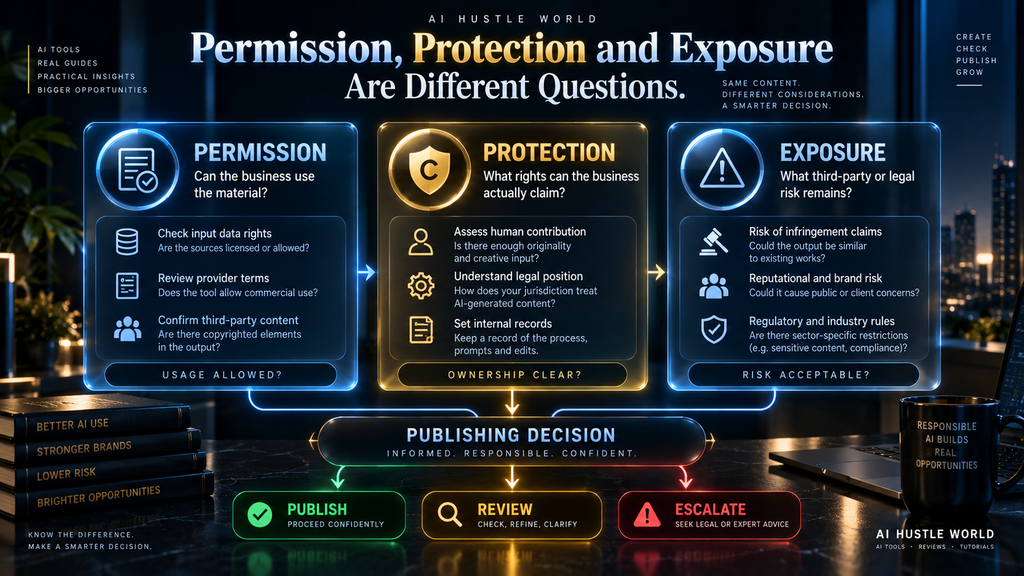
| Question | What it actually asks |
|---|---|
| Do we have permission to use it? | Does the provider contract and applicable licenses permit our intended use? |
| Can we claim copyright in it? | Does applicable law recognize sufficient human authorship or other qualifying protection? |
| Could someone else challenge our use? | Could the asset implicate another party’s copyright, trademark, publicity, privacy or contractual rights? |
A “yes” to the first question does not automatically produce a “yes” to the other two.
The Input Is Part of the Copyright Risk
Businesses often inspect the output while ignoring the material they supplied to generate it. That is backwards.
If your team uploads a copyrighted photograph, a client manuscript, a competitor’s design, a proprietary document, licensed music or another protected asset into an AI system, the organization needs to know whether it actually has the rights and permissions required for that use. The provider does not necessarily acquire those rights for you, and a provider’s output policy does not cure a problem with the input.
OpenAI’s current services agreement, for example, places responsibility on customers for their inputs and states that customers represent and warrant that they have the rights, licenses and permissions required to provide those inputs. (OpenAI) Canva’s current AI terms similarly state that users are responsible for their inputs and represent that they have the necessary rights, licenses and permissions to use them.
This creates an important workflow principle: The rights check begins before generation, not after it.
Suppose a marketing agency receives a client’s existing product photographs and uses them as references for an AI-generated campaign. The agency should not assume that because the client owns the photographs, the agency can automatically upload them into every AI service for every purpose. The agency needs to understand the scope of the client’s permission, the service’s terms and any confidentiality or contractual restrictions.
The same principle applies to text. A company may have access to a paid industry report, customer database or licensed publication without having the right to upload that material to an AI system for processing. Access and permission are not synonymous.
This is where AI copyright intersects with AI privacy and data governance. Copyright asks whether you have rights in the material; privacy and confidentiality controls ask whether you are permitted to disclose or process it in the particular environment. A business can satisfy one and fail the other.
What Happens After the Model Generates the Output?
The output should be treated as a new review stage, not as the end of the creative workflow.
The first question is obvious: does the asset satisfy the creative brief? But the second question is more important for publishing risk: what exactly is in the asset?
For text, that can mean checking whether the generated passage contains unusually specific language, copied material, fabricated quotations, distinctive passages or references that should be independently verified. For images, it can mean looking for recognizable logos, characters, artworks, products, faces, distinctive designs or visual elements that could create additional rights concerns. For audio and video, the inspection can extend to voices, music, likenesses, clips and other recognizable material.
The fact that an output was generated rather than copied by a human does not make the output automatically harmless. Nor does similarity automatically establish infringement. The legal analysis depends on the jurisdiction, the nature of the material, the degree and significance of similarity, the rights involved and the circumstances of the use.
The practical point is simpler: AI generation should trigger review rather than replace it.
This is particularly important for high-value commercial material. A business may spend thousands of dollars promoting an AI-generated campaign while spending almost no time examining the asset’s rights exposure. That is an asymmetric risk. The cost of checking an asset before publication is usually much smaller than the cost of replacing a campaign after launch.
Copyright Is Not the Only Right You Need to Think About
A narrow AI-copyright discussion can create another blind spot: businesses may focus so heavily on copyright that they overlook other rights.
A generated image might not copy a copyrighted artwork but could still create a trademark problem if it incorporates a protected brand identifier in a commercial context. A generated advertisement might not violate copyright but could raise publicity or personality-rights questions if it uses a recognizable person’s likeness. A generated voice can create issues that are not adequately described by simply asking whether the audio is copyrighted.
The practical categories worth considering include:
- Copyright: protected creative expression, images, text, music, video and other qualifying works.
- Trademark: names, logos, symbols and other identifiers used to distinguish goods or services.
- Publicity or personality rights: commercial use of a person’s name, image, likeness or voice, depending on jurisdiction.
- Privacy: use or disclosure of personal information, particularly when source material or generated content involves identifiable people.
- Contractual rights: restrictions imposed by licenses, client agreements, stock-media terms or platform contracts.
- Confidentiality: proprietary information that should never have entered the AI workflow in the first place.
These categories can overlap, but they should not be collapsed into “copyright risk.” Doing so can produce false confidence precisely where a commercial publishing decision needs the most caution.
Why AI Provider Terms Matter More Than Most Teams Realize
AI providers are not simply software vendors in the traditional sense. Their terms can determine important parts of the commercial workflow, including who owns output contractually, what the customer promises about inputs, whether outputs can be similar across users, what indemnification may cover, and which conditions or exclusions apply.
The key mistake is reading only the marketing page. For a high-value publishing workflow, the team should inspect the actual terms applicable to the product, account type and date of use.
OpenAI provides a useful example of why this matters. Its current service terms include IP-related indemnification for certain API, Enterprise and Business customers, but the protection is subject to exclusions. Among other things, the terms exclude situations involving known or reasonably foreseeable infringement, failure to use relevant safeguards, modification or combination of output in certain circumstances, lack of rights in inputs, and some trademark-related claims.
That is materially different from saying: “The provider guarantees that everything the model creates is copyright-safe.” It does not.
The difference between those two statements is the difference between risk transfer under defined contractual conditions and universal legal immunity. Businesses should never confuse them.
Canva’s terms offer another useful example. Its current AI terms state that users own output to the extent permitted by applicable law, but they also explain that some output involving licensed Canva content is governed by the underlying license, that certain AI-generated audio is licensed rather than owned, and that outputs may not be unique.
The broader lesson is that AI provider terms are part of your publishing workflow. They should be reviewed with the same seriousness you would apply to a stock-photo license, music license or software agreement.
The Three-Gate AI Publishing Decision
A practical business workflow becomes easier when copyright questions are converted into decisions rather than abstract legal theory.
Gate 1: Permission
Are we permitted to use the inputs and output for this particular purpose? Check the rights attached to the source material, the provider’s current terms, the subscription or enterprise agreement, the intended commercial use and any relevant licensing restrictions.
If this gate fails, stop. There is little value in debating copyrightability when the organization lacks permission to use the material in the first place.
Gate 2: Protection
What rights can we reasonably claim in the finished work?
Look at the human contribution, creative selection, arrangement, modification and the law applicable to the relevant market. Do not assume that a prompt automatically creates copyright, and do not assume that AI involvement automatically destroys all copyright protection. The U.S. Copyright Office’s current position specifically recognizes human-authored expression and creative modifications or arrangements in AI-assisted works while rejecting mere prompting as sufficient on its own. (U.S. Copyright Office)
Gate 3: Exposure
Could publication still create a claim involving someone else?
Inspect the final asset for copyright, trademark, likeness, privacy and contractual concerns. Consider the context in which it will be used, especially when the content is commercial, public-facing or likely to receive significant distribution.
Only after passing all three gates should a business move confidently toward publication.
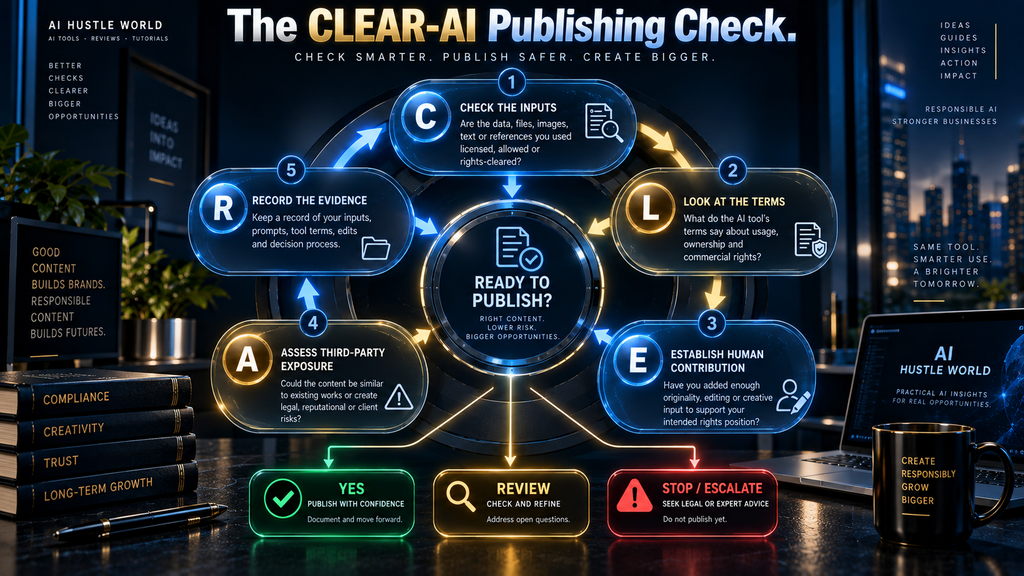
The CLEAR-AI Publishing Test
The three gates provide a decision structure, but businesses also need a repeatable workflow. For AI Hustle World, a useful framework is the CLEAR-AI Publishing Test.
C — Check the Inputs
Start with the material supplied to the AI system. Identify photographs, text, audio, video, datasets, logos, customer material, internal documents and other reference content. For each meaningful input, ask whether the business has the rights and permissions required for the intended AI workflow.
This stage exists because the cleanest output in the world cannot compensate for an input that should never have been used.
L — Look at the License
Review the AI provider’s applicable terms rather than relying on a sales page or a vague statement such as “commercial use allowed.” Confirm the relevant product, account type, subscription tier, output provisions, prohibited uses, licensed content restrictions and any indemnification conditions.
This is also where teams should record the version or effective date of the terms when the asset is commercially important. Provider contracts can change, and a future dispute may depend on what terms applied when the content was created.
E — Establish Human Contribution
Document meaningful human creative decisions. That does not mean manufacturing artificial “human involvement” simply to make a copyright claim stronger. It means honestly identifying what people actually did: selecting source material, developing original expression, choosing among outputs, arranging components, rewriting, editing, composing, transforming and making final creative decisions.
The objective is not to game copyright law. It is to understand the actual authorship structure of the finished work.
A — Assess Third-Party Exposure
Inspect the finished asset for recognizable copyrighted expression, trademarks, people, voices, logos, characters, distinctive designs and other material that could create separate rights concerns. The more commercially consequential the publication, the more rigorous this review should become.
A small internal experiment and a national advertising campaign should not receive identical clearance procedures.
R — Record the Evidence
Preserve the information necessary to reconstruct the workflow. Depending on the risk level, that can include the provider, product and plan, relevant terms, important inputs, licenses, significant prompts, generated alternatives, human modifications, final files, reviewer and approval date.
The goal is not bureaucratic perfection. It is defensible provenance.
The framework can therefore be summarized as: Check → Look → Establish → Assess → Record → Approve. That sequence is intentionally broader than a copyright checklist because the actual business decision is broader than copyright.
What a Practical AI Content Provenance File Should Contain
For low-risk experimentation, maintaining a detailed file for every generation may be unnecessary. For high-value campaigns, client work, commercial assets or content likely to be reused for years, a lightweight provenance record becomes much more valuable.
A practical AI Content Provenance File can include:
| Record | Why it matters |
|---|---|
| AI provider and product | Identifies the system used |
| Account or plan type | Terms and protections can differ |
| Date created | Establishes the relevant contractual context |
| Major source inputs | Shows what entered the workflow |
| Input permissions | Demonstrates why those materials could be used |
| Relevant provider terms | Records the contractual basis for use |
| Important prompts | Documents creative direction where useful |
| Significant generated alternatives | Shows the selection process |
| Human modifications | Documents creative intervention |
| Final approved asset | Establishes what was actually published |
| Reviewer | Identifies responsibility for clearance |
| Approval date | Creates an internal audit trail |
| Publication channel | Establishes the intended use |
This is an AI Hustle World operational recommendation, not a universal legal requirement. Its value is practical: it turns an invisible creative process into something an organization can inspect and explain.
That matters because generative AI can make content production extremely cheap while simultaneously making the production history less obvious. Traditional creative workflows often produce contracts, invoices, licenses, source files and revision histories almost automatically. AI workflows can produce a finished asset in seconds without leaving an equally intuitive paper trail.
The answer is not to recreate every traditional production bureaucracy. It is to preserve enough evidence for the value and risk of the asset.
Real-World Example: AI-Generated Blog Content
Consider a software company that uses generative AI to draft an article. The marketing manager supplies a topic and a rough outline, the system produces the first draft, and an editor then rewrites large sections, incorporates original company research, verifies claims, adds original examples and restructures the article for the company’s audience.
The business should not ask only, “Does the AI own this?” It should ask whether the provider’s terms permit the intended use, whether the input material was authorized, what human expression exists in the final article, whether any generated passages require further review, and whether the business has documented the editorial process.
The economics are also worth considering. AI may reduce drafting time substantially, but the value of the workflow does not come from eliminating editorial review. It comes from moving human effort toward research, judgment, verification and distinctive expression instead of spending most of the budget on first-draft production.
The mistake would be to treat AI as a substitute for the editorial process when its stronger role is often to accelerate the lower-value production stages while leaving the higher-value decisions with people.
Real-World Example: AI-Generated Product Images
Now consider an ecommerce business generating product lifestyle images.
The team may think the process is simple: upload a product photo, describe a setting, generate an image and publish it. In practice, the rights analysis can be more complicated because the input photograph may have licensing restrictions, the provider may impose conditions on uploaded material, the generated image may contain recognizable third-party elements, and the final commercial use may involve trademarks or people’s likenesses.
Suppose the team uses a photograph supplied by a freelance photographer. The fact that the company paid for the photograph does not necessarily answer whether it can upload that image to an external AI service for transformation. The original photography agreement and the AI provider’s terms both matter.
Now suppose the final image is used in a nationwide paid advertising campaign. The commercial exposure is materially greater than if the same experiment remained inside the design team’s private workspace. That should influence the level of review.
This is the broader principle: The more valuable and public the asset, the more valuable a formal clearance workflow becomes.
Real-World Example: AI-Generated Music and Voice
Audio demonstrates why businesses should avoid treating AI copyright as a single issue.
A brand might generate background music for an advertisement, create a synthetic voiceover and combine both with original video. The team may then ask whether the audio is “copyrighted.”
That question is incomplete. The workflow may involve copyright, contractual licensing, voice or likeness rights, commercial-use restrictions and provider-specific limitations. Canva’s current AI terms, for example, distinguish AI-generated audio from other output: users may use the audio in personal and commercial projects under specified conditions, but may not sell, sublicense or distribute the audio as a standalone track or claim, register or enforce intellectual-property rights in it.
The lesson is important because it shows how easily a business can make a wrong generalization from one category to another. AI-generated image terms cannot be assumed to apply to AI-generated audio, and one provider’s output policy cannot be assumed to apply to another provider.
Why “Commercial Use Allowed” Is Not the End of the Conversation
“Commercial use allowed” is useful information, but it is not a complete legal conclusion.
Commercial permission usually answers a contractual question: does the provider allow you to use the generated material for commercial purposes under the stated conditions? It does not necessarily answer whether the output is protectable by copyright, whether another party has rights in something depicted by the output, whether your input was authorized, or whether a particular jurisdiction imposes additional requirements.
That is why the phrase should be treated as the beginning of a review rather than the end. The same applies to “you own the output.” Ownership language can be commercially important, but it should be read alongside uniqueness disclaimers, licensed-content provisions, prohibited-use rules, indemnification conditions and applicable-law limitations.
This is one of the areas where AI purchasing decisions deserve more scrutiny than ordinary software subscriptions. A normal productivity application might primarily determine what functionality your employees receive. An AI generation platform can influence the origin, transformation and distribution of creative assets, which means its contractual terms can become part of the organization’s intellectual-property workflow.
U.S. Copyright Rules Are Important, but They Are Not the Whole World
Businesses publishing internationally should resist the temptation to treat the U.S. approach as a universal answer.
The United States currently provides a particularly clear and influential framework through the Copyright Office’s work on AI. The Office’s January 2025 report concludes that copyright can protect human-authored expressive elements in AI-assisted outputs while stating that mere prompting is insufficient by itself.
The Office’s broader AI initiative is also examining separate questions involving the use of copyrighted works in AI training, demonstrating that copyrightability of output and copyright questions surrounding AI training are different issues.
That distinction matters for businesses because headlines about AI training lawsuits can easily be misread as statements about the rights of an individual customer publishing an AI-generated image or article. They are not the same legal question.
The UK Shows Why Jurisdiction Matters
The UK provides an especially useful contrast because its legal framework has historically included a category for certain computer-generated works without a human author.
The UK government’s March 2026 report on copyright and AI examines the use of copyrighted works in AI systems and separately considers computer-generated works, licensing, transparency, enforcement and digital replicas. The report reflects an evolving policy environment rather than a settled global consensus. (GOV.UK)
For a business, the practical lesson is not to memorize every UK rule. It is to recognize that the answer to “who owns this AI-generated work?” can depend on where the rights are being assessed and what type of work is involved.
If a company creates content in one country and distributes it globally, its legal team may need to consider multiple jurisdictions. The marketing team therefore should not build a global publishing policy around a single sentence such as “AI-generated content is not copyrighted.”
The EU Adds a Transparency Dimension
The European Union introduces another important distinction: copyright and transparency are separate compliance questions.
Under the EU AI Act, certain transparency obligations concerning AI-generated or manipulated content apply from August 2, 2026, with requirements addressing areas such as machine-readable marking and disclosure of certain AI-generated or manipulated content. The European Commission’s guidance explains how these obligations apply to providers and deployers within the relevant scope.
That means a business could face two completely different questions: Can we use and potentially protect this content? and Do we need to disclose or technically mark that AI was involved?
Those questions should not be merged. The distinction becomes especially important for marketing teams because content can be legally usable from one perspective while still requiring a particular disclosure or provenance treatment under another regulatory regime.
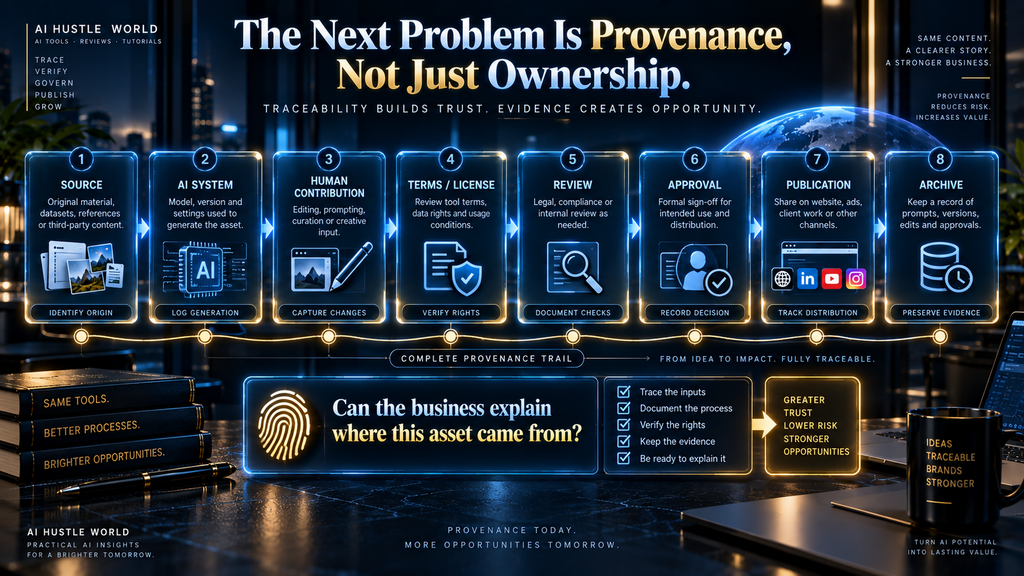
This is also why AI content governance is increasingly moving toward provenance, not merely ownership. Businesses are beginning to care not only about who owns an asset but also about where it came from, what systems touched it, what humans changed and what disclosure obligations may apply.
AI Training and AI Output Are Different Copyright Problems
Another common mistake is using the phrase “AI copyright” to describe everything happening around generative AI. There are at least two very different questions.
Question one: What copyrighted material was used to develop the AI system?
This concerns training data, licensing, text and data mining, fair use or related exceptions, rights reservations and other policy questions.
Question two: What rights exist in the content generated for the customer?
This concerns output copyrightability, human authorship, provider contracts, third-party similarity and commercial publication.
The U.S. Copyright Office treats these as separate areas within its AI initiative. Its Part 2 report addresses copyrightability of generative-AI outputs, while its subsequent work addresses generative-AI training.
The UK government’s 2026 report likewise devotes substantial attention to the use of copyright works in AI development while separately examining output transparency and computer-generated works.
This distinction matters because a business publishing an AI-generated advertisement does not suddenly become responsible for resolving every question surrounding how a foundation model was trained. Those questions may affect the broader legal environment, but the business still has its own direct obligations concerning inputs, output use and publication.
The Real Business Risk Is Often Not the Lawsuit
Copyright discussions tend to focus on litigation, but many organizations encounter operational problems long before a courtroom becomes involved.
An asset can be challenged by a client, rejected by a platform, removed from an advertising campaign, questioned by a legal department or replaced because the company cannot confidently demonstrate where it came from. A marketing campaign can be delayed because an image needs to be recreated. A client can ask whether the agency has the right to sublicense an AI-assisted deliverable. A publisher can discover that a supposedly unique image cannot be defended as exclusively owned.
These are business problems, even when they never become lawsuits. The cost therefore has at least four components: Direct legal exposure + replacement cost + operational delay + lost commercial value. AI makes the production component cheaper, but that does not make downstream disruption free.
In fact, cheap generation can create a new economic trap: when production becomes almost effortless, teams may generate and publish more assets without increasing their review capacity. The result is a larger rights surface with less scrutiny per asset.
That is why AI should lower production cost without lowering clearance standards proportionally.
Why the Traditional Creative Workflow Exists
It is tempting to assume that traditional creative production was inefficient simply because it involved more people and more paperwork. That misses an important point.
Traditional workflows often embed rights management into the production process. A photographer signs an agreement. A stock image comes with a license. A voice actor signs a release. A music library provides usage terms. A designer delivers source files. An agency maintains contracts and invoices. A publisher keeps records of permissions.
The process is expensive partly because it creates provenance and accountability.
Generative AI removes much of the friction, which is one reason it is economically attractive. But when generation becomes instantaneous, the rights history does not necessarily become equally automatic.
The strategic opportunity is therefore not to return to the old workflow in full. It is to preserve its most valuable property — traceability — while eliminating unnecessary production friction.
A modern AI content workflow might therefore look like: Brief → Rights check → Generate → Human selection/editing → Output review → Approval → Publish → Archive provenance. That is faster than many traditional production workflows while still retaining a defensible control layer.
When Should a Business Use More Human Review?
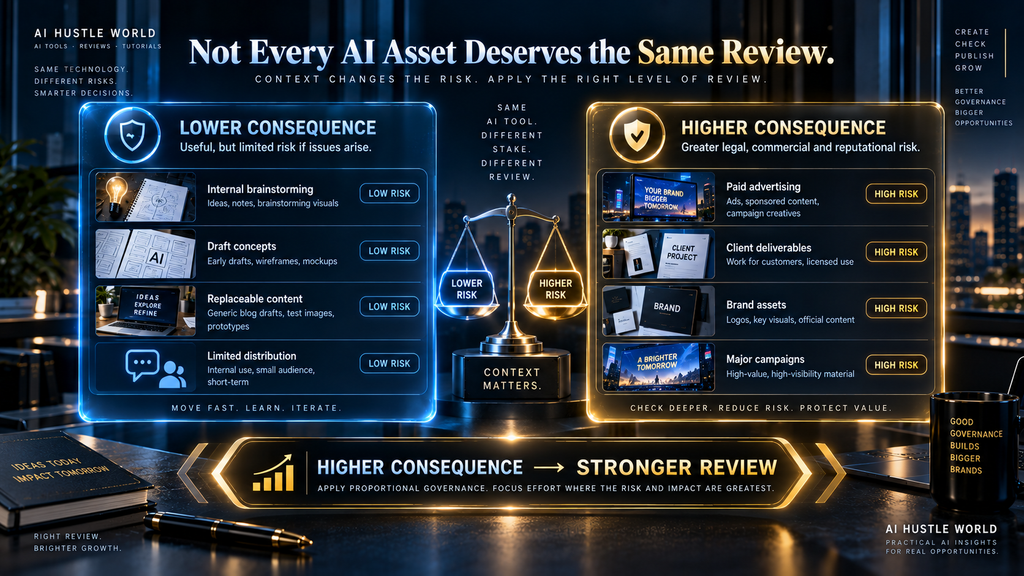
Not every AI-generated asset deserves the same clearance process. A useful approach is to classify content by consequence, value and exposure.
| Content situation | Suggested review level | Why |
|---|---|---|
| Private brainstorming | Low | Limited external exposure |
| Internal draft material | Low–Moderate | Still check sensitive inputs |
| Routine social graphic | Moderate | Public but generally lower consequence |
| Blog article | Moderate | Public and potentially searchable indefinitely |
| Client deliverable | Moderate–High | Contractual and reputational exposure |
| Paid advertising campaign | High | Significant commercial distribution |
| Brand identity asset | High | Long-term exclusivity matters |
| Celebrity/person likeness | High | Additional rights may apply |
| High-value illustration or campaign concept | High | Replacement and dispute costs are larger |
| Legal, regulated or public-interest content | High | Additional compliance and accuracy issues |
This does not mean every “high” category automatically requires a lawyer. It means the business should increase the level of human review as the consequences of being wrong increase.
That is the same principle we apply to many other AI governance decisions: automation is most useful where mistakes are cheap and reversible; human judgment becomes more valuable where mistakes are expensive, ambiguous or difficult to undo.
Common AI Copyright Mistakes Businesses Make
Assuming a paid subscription means everything is protected
A subscription may give you contractual rights to use output, but it does not automatically create copyright protection, guarantee uniqueness or eliminate third-party rights.
Assuming a prompt automatically creates copyright
The U.S. Copyright Office’s current position specifically rejects mere prompting as sufficient human authorship by itself.
Assuming AI output is automatically public domain
The legal treatment of AI-generated material is more nuanced than a blanket “public domain” label. Human-authored elements, jurisdiction and the specific work matter.
Ignoring the input
Uploading material into an AI system does not magically give you permission to use it there. Provider terms can place responsibility for input rights on the customer.
Treating “commercial use allowed” as “copyright-safe”
Commercial permission and copyright protection are separate questions.
Assuming every provider has the same rules
OpenAI, Canva and other providers can use materially different contractual structures, restrictions and protections. Current Canva terms, for example, treat certain licensed-content and AI-audio situations differently from ordinary AI output.
Ignoring trademarks and likeness
Not every rights problem is a copyright problem. A generated commercial image can raise separate questions about brands, people or other protected interests.
Failing to preserve the workflow
If nobody records the inputs, provider terms, human modifications or approval process, reconstructing the history later can be difficult.
Publishing first and checking later
The safest point to identify a serious rights problem is before the campaign, product page, book, advertisement or client deliverable goes public.
A Practical Pre-Publication Checklist
Before publishing an important AI-assisted asset, the responsible reviewer should be able to answer the following questions.
Inputs
- Did we have permission to use the source material?
- Did we upload any client, confidential or licensed material?
- Did the source license permit this AI workflow?
- Did the provider’s terms impose any additional requirements?
Provider
- Which AI service generated or transformed the content?
- Which product and account tier were used?
- Which terms applied when the asset was created?
- Does the provider permit our intended commercial use?
- Are there restrictions on output, licensed content or particular asset categories?
- Does any indemnification actually apply to our use case?
Human contribution
- What meaningful creative decisions did people make?
- Did humans select, arrange, rewrite, modify or transform the output?
- Which parts of the final work are clearly human-authored?
- Have we documented those contributions where the asset is valuable enough to justify it?
Output
- Does the output contain recognizable third-party material?
- Does it resemble a known protected work closely enough to warrant review?
- Does it contain trademarks, logos, characters or other protected identifiers?
- Does it depict a recognizable person or voice?
- Is the content accurate and appropriate for its intended use?
Publication
- Where will the asset be published?
- Is it being used commercially?
- Is the exposure local or international?
- Does the target market impose additional transparency or disclosure requirements?
- Is the asset important enough to justify legal review?
If the team cannot answer these questions, the problem is not necessarily that the content cannot be published. The problem is that the organization does not yet know enough to make a confident publishing decision.
What Should You Measure?
Copyright compliance can become a vague policy exercise unless organizations measure the workflow. For teams that regularly publish AI-assisted content, useful operational KPIs include:
| KPI | What it tells you |
|---|---|
| AI assets with documented source inputs | How consistently provenance is captured |
| Assets with provider terms verified | Whether commercial permissions are being checked |
| Assets with human contribution documented | Whether important workflows are traceable |
| Assets flagged during output review | Where generation creates recurring problems |
| Assets rejected before publication | How effective pre-publication review is |
| Average clearance time | Whether the process is becoming a bottleneck |
| Post-publication rights incidents | Whether controls are working |
| Assets requiring remediation | Where workflow design needs improvement |
| Percentage of high-risk assets receiving escalation | Whether risk-based review is functioning |
The goal is not to maximize the number of checks. It is to reduce avoidable risk per published asset without destroying the productivity advantage of AI.
That distinction matters because a governance system that takes two hours to clear a $5 social post is not necessarily sophisticated. It may simply be badly designed.
The Contrarian View: AI Does Not Make Copyright Less Important
There is a common assumption that because AI makes content cheap, copyright and licensing become less important. I think the opposite is closer to the truth.
As the cost of producing content falls, the volume of content rises, and that increases the number of assets that can create rights exposure. A company that once produced 20 campaign images may now produce 200 variations. A publisher that once commissioned ten illustrations may now generate hundreds. An agency that once delivered five concepts may now show a client fifty.
The unit cost of creation falls, but the rights surface expands.
That changes the economics of governance. The answer cannot be a manual legal review of every generation. Instead, organizations need risk-tiered workflows that reserve deep human review for high-value or high-exposure assets while keeping low-risk experimentation lightweight.
In other words, AI should make rights management more scalable, not optional.
A Second-Order Effect: AI May Make Provenance More Valuable Than Ownership
There is another shift happening underneath the copyright debate. For many AI-assisted assets, the ability to prove how something was created may become nearly as important operationally as proving who owns it.
Consider two companies that publish similar AI-generated images. Company A has the final image but cannot explain which model created it, what source material was used or what human modifications were made. Company B has a simple provenance file showing the source input, applicable provider terms, creative process, human modifications and approval.
Even if both companies believe their publication is lawful, Company B is in a stronger operational position because it can reconstruct its decision.
This is one reason provenance, content credentials and AI-content transparency are becoming increasingly relevant. The EU’s AI Act transparency requirements, for example, make disclosure and machine-readable marking part of the broader regulatory conversation rather than leaving the issue entirely to voluntary company policy.
The strategic implication is significant: future AI content operations may manage provenance as routinely as they currently manage file names, licenses and version histories.
What Happens If You Do Nothing?
For a small internal experiment, perhaps nothing. That is precisely why risk-based governance matters.
But if a company uses AI-generated material in high-value advertising, client work, product packaging, publishing or brand assets and does nothing to review rights, several problems can accumulate silently. The business may not discover the weakness until a client asks for ownership documentation, a campaign is challenged, a platform removes content, an internal legal review blocks publication or a team member needs to reproduce an asset months after the original creator has left.
The absence of a dispute today is not proof that the workflow is sound. A mature organization therefore asks a more useful question:
If someone challenged this asset six months from now, could we explain why we believed we had the right to publish it?
If the answer is no, the workflow has a governance gap even if the asset itself ultimately turns out to be lawful.
Who Can Safely Use AI-Generated Content?
Almost every business can use generative AI in some form, but not every asset deserves the same level of confidence or the same publishing workflow.
Lower-risk use
AI is generally easier to deploy when the content is:
- experimental
- internal
- low-value
- easily replaceable
- not dependent on third-party references
- not representing a person’s identity
- not central to long-term brand equity
Moderate-risk use
Additional review becomes sensible for:
- public blog content
- regular marketing graphics
- social campaigns
- client deliverables
- ecommerce imagery
- public educational content
Higher-risk use
The organization should consider stronger review when AI content is:
- central to a major advertising campaign
- intended as a long-term brand asset
- based on third-party copyrighted material
- built around a recognizable person’s likeness or voice
- likely to be licensed or sublicensed
- used in regulated or high-consequence environments
- intended to establish exclusive intellectual-property rights
- financially significant enough that replacement would be costly
The right answer is not “never use AI in high-risk work.” It is use AI with stronger controls when the consequences of being wrong justify them.
A Better AI Publishing Workflow
A mature AI content operation can integrate copyright review without turning every generation into a legal project.
Step 1: Classify the asset
Before generation, determine whether it is low, moderate or high consequence.
Step 2: Check the inputs
Confirm that reference material can legally and contractually enter the AI workflow.
Step 3: Check the provider
Review the actual terms applicable to the product and account.
Step 4: Generate
Use AI to accelerate exploration, drafting, composition or transformation.
Step 5: Apply human judgment
Select, rewrite, arrange, edit, transform and refine where the creative process requires it.
Step 6: Review the output
Inspect for third-party material, trademarks, likenesses, obvious similarity and other risks relevant to the asset.
Step 7: Document the decision
Create an appropriate provenance record for important assets.
Step 8: Approve and publish
The person or team with appropriate responsibility makes the final decision.
Step 9: Archive
Keep the final asset and relevant provenance information long enough to support the business’s normal recordkeeping needs. This workflow preserves the speed advantage of generative AI while adding controls where they actually create value.
Final Thoughts
The biggest mistake businesses can make with AI-generated content is asking the wrong question.
“Do we own this AI output?” sounds precise, but it compresses several different issues into one. A responsible publishing decision asks whether the organization had the right to use its inputs, whether the AI provider permits the intended use, what human contribution exists in the final work, whether third-party rights could be affected, whether the relevant jurisdiction imposes additional requirements, and whether the business can explain how the asset was created.
That is why the most useful mental model is not AI-generated versus human-generated. It is permission, protection and exposure.
The technology will continue to change, and the legal environment will continue to evolve. Provider terms will change, AI systems will become more capable, provenance mechanisms will become more sophisticated and governments will continue to refine their approaches to AI-generated content and training. A workflow built around one provider’s current wording or one country’s current interpretation will eventually become outdated.
A workflow built around rights in the inputs, contractual permissions, human creative control, third-party risk and provenance is much more durable.
The practical takeaway is simple: AI can make content dramatically cheaper to produce, but that does not make rights management less important. It makes scalable rights management more important.
If an AI-assisted asset is valuable enough to publish, it is valuable enough to understand where it came from, what rights support its use, what humans contributed, and what could go wrong before it reaches the public.
Building a Safer AI Workflow? Start With Governance.
Before adding more AI tools to your workflow, make sure you know what information enters the system, what the output can actually be used for, and where human review still matters.
Explore AI Governance →FAQ: AI Copyright and Generated Content
1. Can AI-generated content be copyrighted?
It depends on the jurisdiction and the human contribution to the work. In the United States, the Copyright Office says generative-AI outputs can receive copyright protection where a human author has determined sufficient expressive elements, while merely providing prompts is not enough by itself.
2. Who owns AI-generated content?
There is no universal answer. AI providers may assign or recognize contractual rights in output, but those contractual rights are separate from the question of whether copyright protection exists under applicable law. OpenAI and Canva, for example, currently contain ownership provisions while also warning about legal limits or output similarity.
3. Does paying for an AI tool give me copyright?
No. A paid plan may provide commercial permissions or other contractual rights, but it does not automatically establish copyright protection or eliminate third-party rights.
4. Does writing a detailed prompt give me copyright?
Not automatically. In the United States, the Copyright Office’s current position is that merely providing prompts is insufficient by itself to establish the necessary human authorship in the resulting output.
5. Can AI-generated content infringe copyright?
Potentially, yes. AI generation does not create a universal exemption from copyright law. Businesses should review outputs for potentially problematic third-party material and consider the relevant jurisdiction and circumstances.
6. Can I commercially use AI-generated images?
Often, but the answer depends on the provider’s terms, the source inputs, the applicable law and the content of the final image. “Commercial use allowed” should not be interpreted as a universal guarantee of copyright protection or infringement immunity.
7. Does human editing make AI content copyrightable?
Human editing can contribute to copyright protection when it involves sufficient original expression, but the answer depends on what the person actually contributed and the applicable law. The U.S. Copyright Office specifically recognizes human-authored material, creative arrangements and modifications as potentially protectable elements.
8. Should businesses keep records of AI-generated content?
For important commercial assets, maintaining a provenance record is a strong operational practice. It can document the provider, inputs, permissions, human contribution, applicable terms, final asset and approval process, making later review substantially easier.
9. Are AI copyright rules the same in every country?
No. Copyright systems differ by jurisdiction, and countries are actively developing policy around AI-generated content, training, transparency and computer-generated works. The United States and UK, for example, approach aspects of AI-generated works differently, while the EU adds important transparency requirements under the AI Act.
10. When should a business ask a lawyer before publishing AI content?
Consider professional review when the asset has substantial financial or reputational value, relies heavily on third-party material, involves a person’s likeness or voice, is intended to establish important exclusive rights, has already attracted a dispute, or will be deployed in a jurisdiction or industry with significant additional requirements. For routine low-risk content, a well-designed internal clearance process may be sufficient.
Written by
Muntasir Ahmad Chowdhury
Founder, AI Hustle World
Muntasir Ahmad Chowdhury is the Founder of AI Hustle World, an independent publication dedicated to making Artificial Intelligence practical, trustworthy, and easy to understand. He researches AI tools, automation, customer service, productivity, and real-world business applications, helping readers make smarter technology decisions through research-driven, experience-backed content.
Expertise:
AI Tools • AI Automation • AI Customer Service • AI Productivity • Generative AI • AI Workflows
Get Smarter With AI
Enjoyed this guide? Get practical AI tools, tutorials, and honest reviews delivered to your inbox.
1 thought on “AI Copyright Explained: What Businesses Need to Check Before Publishing”