Evidence: Documentation reviewed
Last checked: August 2026
What was done: Written from official documentation and the published sources linked in this article. Not hands-on tested.
Files: None
Affiliate links: No
AI Due Diligence Explained: How AI Reviews Large Document Sets
At the beginning of a major diligence review, the problem is rarely that nobody knows what to look for. The buyer wants to know which customer contracts need consent, whether material agreements can terminate after a change of control, whether intellectual-property rights are owned or merely licensed, whether a data room contains the requested documents, and what facts could alter price, deal structure, disclosure, or the decision to proceed. The problem is that the answers are scattered across hundreds or thousands of documents that were not created to be read together.
A virtual data room can make that problem look solved. It contains folders, PDFs, spreadsheets, scans, employment agreements, customer contracts, policies, board materials, disclosure schedules, and answers to follow-up questions. But a full data room is not the same as a complete diligence picture. Files can be duplicated, mislabeled, unsigned, superseded, unreadable, outside the requested scope, or connected to another document through an amendment or schedule. A relevant clause may sit in the one agreement a reviewer did not open because its filename suggested it was routine.
AI can change the first pass of this work. It can inventory and classify documents, identify likely contract families, retrieve candidate passages, extract standard data points, compare language across a portfolio, build review tables, surface inconsistencies, and create source-linked issue candidates. Those capabilities can reduce the time a team spends opening files, searching repeatedly for the same provision, and copying passages into a spreadsheet.
But AI does not convert a data room into a transaction conclusion by itself. It does not know the negotiated deal thesis, the materiality threshold, the buyer’s risk appetite, the legal significance of a local-law exception, whether the correct amendment was included, or which finding should change a client’s decision. It can retrieve evidence. A qualified team must decide what that evidence means.
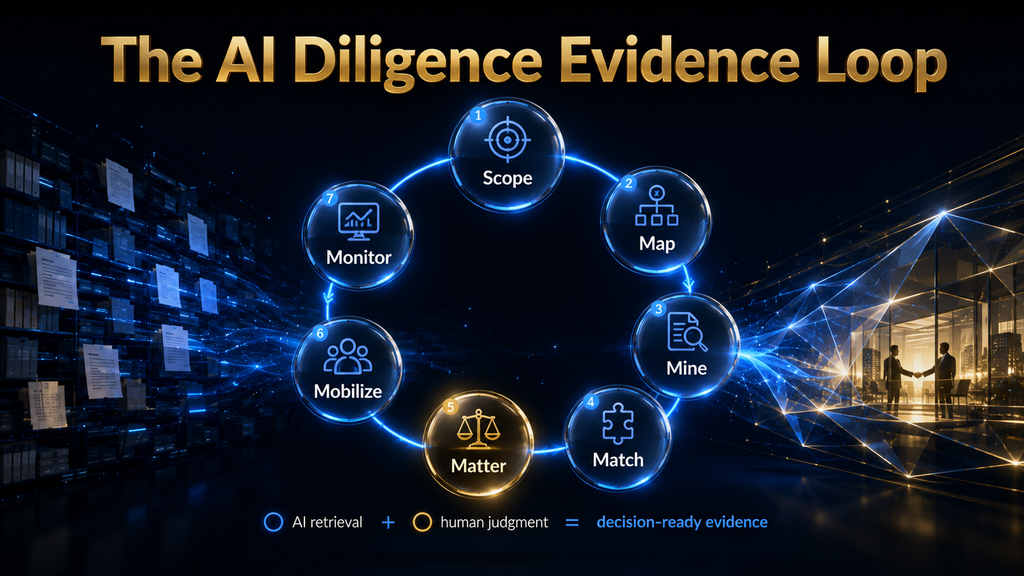
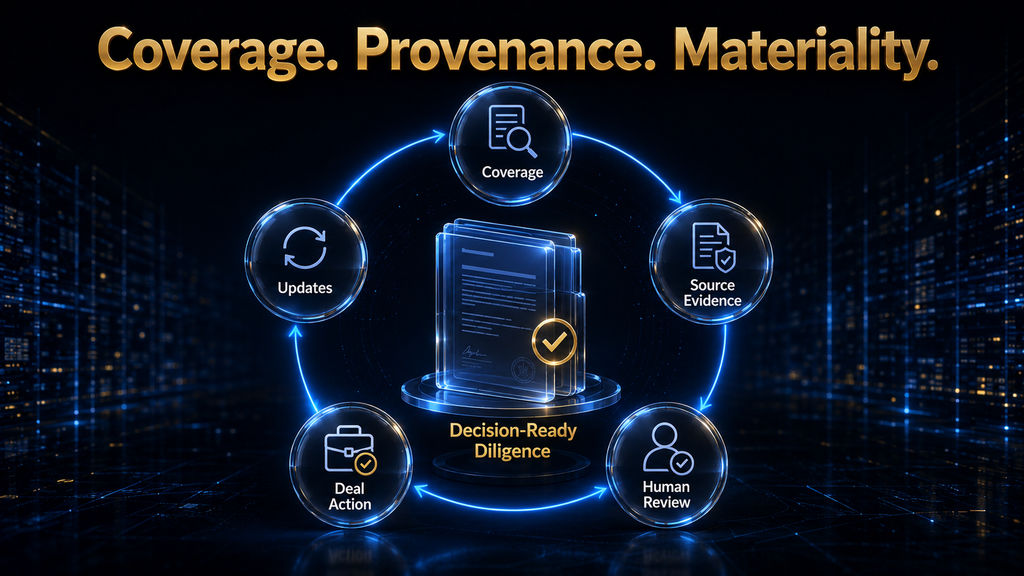
The right mental model is therefore not data room → AI summary → diligence complete. It is document universe → evidence retrieval → source verification → human materiality judgment → transaction action. We call this the AI Diligence Evidence Loop. It helps a team use automation where it is genuinely useful while keeping completeness, professional judgment, and accountability visible.
This article covers AI-assisted legal and transaction due diligence on large document sets: M&A, financing, sell-side preparation, significant commercial reviews, and similar work where the issue is not one contract but a connected corpus. It does not replace the broader legal-AI overview, individual contract redlining, AI legal research, or post-signature obligation management covered elsewhere on this site. It also does not primarily address due diligence on an AI company or AI vendor. That is a related but distinct inquiry into AI systems, training data, governance, privacy, intellectual property, and regulation.
Throughout, the claim type is made clear. Research finding refers to independent or authoritative research. Vendor-documented workflow describes a published product or company workflow rather than an independent performance guarantee. AI Hustle World analysis is our conclusion from the evidence and practical mechanics. Any scenario is an illustrative example, not a client matter.
The short answer: AI makes diligence faster by locating evidence, not by deciding the deal
AI due diligence is the use of document-processing, retrieval, extraction, and comparison systems to help a transaction team identify relevant information across a large collection of files. A well-designed system first maps the document universe, then retrieves candidate material against defined diligence questions, links every finding to its source, and gives human reviewers a structured way to decide whether it is material, uncertain, routine, or requires escalation.
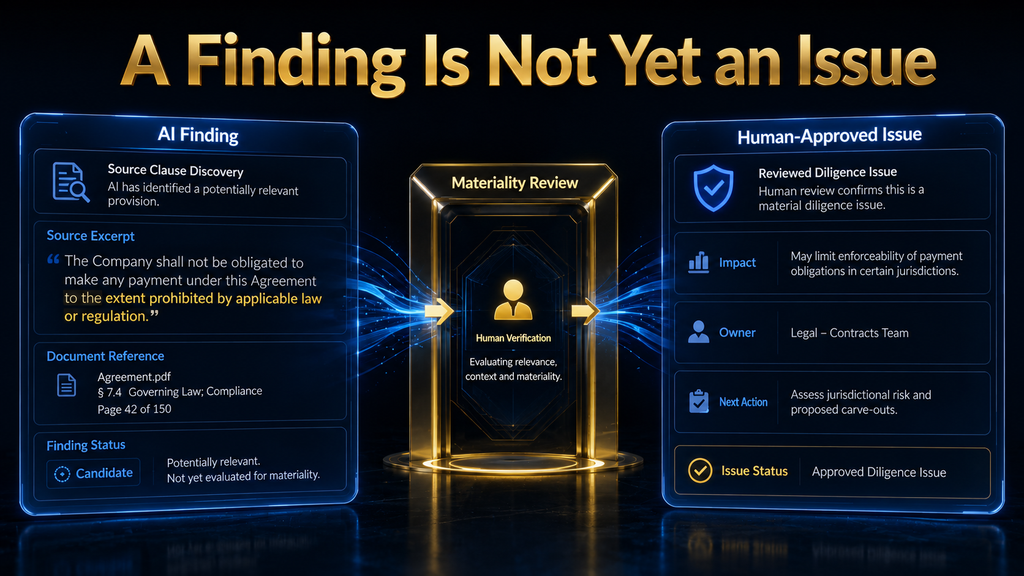
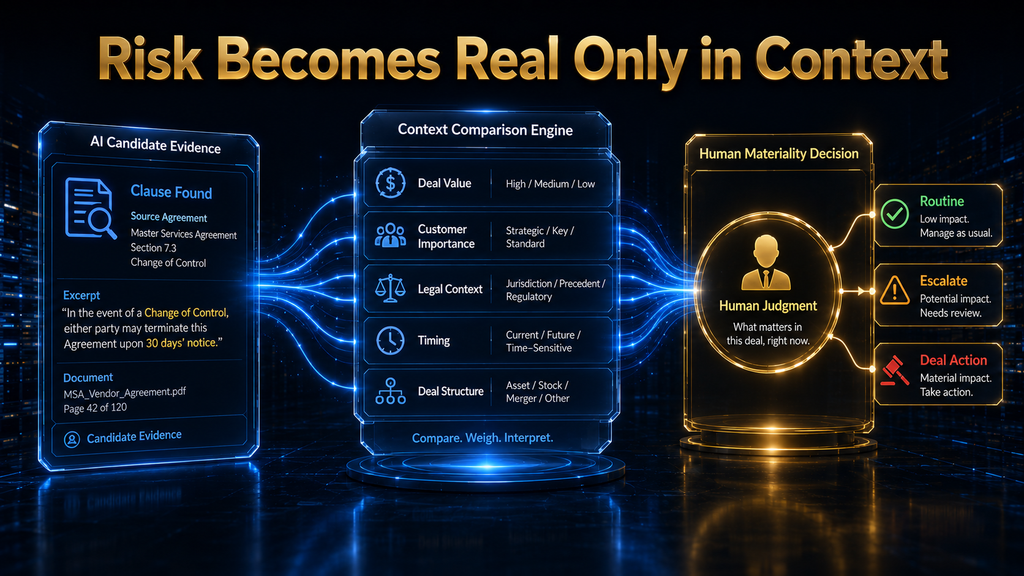
That last step is non-negotiable. A clause saying an agreement may terminate on a change of control is a finding. Whether it threatens a material revenue stream, can be cured with consent, has been amended, belongs to an immaterial entity, or requires a condition to closing is a transaction issue. AI can accelerate the journey to the first answer; it cannot safely make the second judgment without the deal context and professional responsibility held by the legal and business team.
Research finding: due diligence has long been formalized as a two-part problem: identify relevant passages in a set of legal documents, then use those passages to assess potential transaction risk. The ACM/SIGIR study on identifying passages for due diligence makes this distinction explicitly. It is a useful first-principles boundary for the article: retrieval and extraction are technical tasks; materiality and advice are human decisions.
The practical value comes from improving the evidence path. Instead of asking an associate to search 400 agreements individually for change-of-control language, a system can surface the candidates, show the source text, group similar patterns, and reveal which documents have not yet been processed. The associate or lawyer can then spend their time resolving versions, exceptions, legal effect, and commercial impact—the work that actually requires judgment.
What AI due diligence is—and the two meanings people confuse
AI due diligence usually means one of two things. The first, and the focus of this article, is using AI to conduct diligence: applying AI to review contracts and other materials in a data room. The second is conducting diligence on AI: assessing a target’s AI products, models, data rights, customer commitments, governance, and regulatory exposure. Both matter in modern transactions, but they answer different questions and require different checklists.
The first use case is operational. A team may need to identify assignment restrictions in customer contracts, find the contracts with most-favored-nation provisions, identify litigation references across board materials, compare employee agreements for non-competes, or extract key terms from a portfolio of leases. AI assists by making an unstructured corpus more searchable, structured, and reviewable.
The second use case is substantive and sector-specific. It may require examining model inventory, data lineage, open-source use, customer representations, high-risk deployment, privacy practices, contractual restrictions, and intellectual-property ownership. It deserves its own article because the diligence questions are different. Do not blur it into a generic feature list here just because “AI due diligence” is an ambiguous phrase.
For this article, the working definition is: AI-assisted due diligence is a controlled workflow that helps a human transaction team find, organize, evidence, and prioritize relevant information across a defined document universe. This definition deliberately avoids claiming that the system “understands the deal.” The system has a role; the team retains the decision.
Why traditional diligence exists, and where large document sets break it
Traditional due diligence is a disciplined response to uncertainty. A buyer, lender, investor, or counterparty needs to test what is being represented, identify obligations or restrictions that could survive the transaction, and learn whether facts create exposure or require a negotiated response. The work is not simply collecting documents. It involves deciding which categories are relevant, requesting missing evidence, reading source material, comparing the findings with the transaction structure, and explaining risks in a report a client can act on.
Manual review has important strengths. A lawyer can notice that a clause is unusual because of the surrounding negotiation history, recognize that a schedule changes a broad statement in a master agreement, interpret a local-law exception, or ask the next question when an answer appears incomplete. The traditional approach also makes it easier to preserve professional ownership of the analysis.
The strain emerges with volume and repetition. A transaction may involve hundreds of contracts that must be reviewed for the same set of provisions. Human reviewers may spend hours locating document families, searching filenames, opening near-duplicates, copying clauses into spreadsheets, and repeating the same first-pass comparison. Time pressure encourages sampling, which can create a dangerous gap between what was reviewed and what the final report appears to cover.
Research finding: the due-diligence corpus is technically difficult because the documents are sensitive, long, and heterogeneous. A 2024 ACL industry paper on AI-assisted legal due diligence notes the lack of publicly available transaction data, the sensitivity of M&A materials, and the challenge of documents that can exceed model-length limits. In the study’s underlying dataset, relevant sentences were rare compared with the overall document length. That is a reminder that a system can process a large amount of text and still fail to retrieve the few passages that matter.
AI does not eliminate the reason diligence exists. It can lower the mechanical burden of getting from document volume to candidate evidence. The team still has to decide whether the evidence is complete, current, material, and actionable.
How AI reviews a large document set in practice
The phrase “AI reads the data room” hides several distinct steps. A reliable workflow combines document ingestion, structure recovery, classification, search or retrieval, extraction, comparison, and human review. Each step answers a smaller question and creates evidence for the next one.
First, the system maps the document universe
Before it searches for clauses, the workflow should establish what has been received and how it relates to the diligence request. The system can inventory filenames, file types, locations, upload dates, document dates, signature indicators, entities, languages, page counts, duplicate signals, and optical-character-recognition quality. It can also classify likely document types: customer agreement, supplier agreement, lease, employment agreement, board material, policy, litigation document, intellectual-property agreement, amendment, or disclosure schedule.
This mapping is not administrative overhead. It defines the population against which any later claim of coverage must be made. If 60 contracts are in the “customer agreements” folder but 14 are scans that could not be read, then the team has not reviewed 60 customer agreements in the same way. If an amendment is found in a separate folder, the workflow must link it to the base agreement before treating either document as controlling.
Then it recovers structure and finds candidate evidence
Document AI can identify headings, sections, tables, exhibits, signature pages, definitions, and cross-references. Retrieval systems use the team’s diligence questions to locate potentially relevant passages even when the exact keywords differ. Extraction can populate fields such as parties, effective date, term, governing law, assignment language, consent requirements, exclusivity, payment terms, service levels, or termination rights.
The key word is candidate. A passage can be relevant without being decisive. “Neither party may assign this Agreement without the other party’s consent” may be a candidate for a change-of-control review, but the full answer can depend on the definition of assignment, any affiliate exception, a later amendment, the deal’s structure, and the contract’s materiality to the target.
Finally, it creates a reviewable evidence table
The usable output is not a chat transcript. It is a structured review table or issue workspace where each row has a document, source excerpt, question, extracted answer, confidence or review status, related documents, reviewer note, and escalation outcome. The table can be filtered to show all documents with a change-of-control clause, all files lacking a signature page, all contracts expiring within a period, or all agreements flagged for a specific business unit.
Vendor-documented workflow: Harvey describes this kind of process for diligence reviews: a team can configure review-table columns for targeted questions, inspect exact source language behind each result, then filter and export the output. Harvey’s published diligence example is a helpful illustration of source-linked review tables. It is not proof that any system will identify every relevant issue in every data room.
AI Hustle World analysis: a good diligence interface behaves more like a controlled evidence workspace than an answer generator. It makes the document, clause, question, reviewer, and decision visible together. That design is what helps the team spot gaps and defend its reasoning later.
The AI Diligence Evidence Loop
The article’s core framework is Scope → Map → Mine → Match → Matter → Mobilize → Monitor. It is designed for the real job: moving from a large document set to a decision-ready diligence position without confusing an AI retrieval with a legal conclusion.
| Stage | AI can help with | Human team must own |
|---|---|---|
| Scope | Convert request lists into structured questions and categories | Transaction priorities, materiality, jurisdictions, and risk appetite |
| Map | Inventory, classify, de-duplicate, and identify likely document families | Completeness, access permissions, document hierarchy, and scope changes |
| Mine | Retrieve candidate passages, dates, terms, entities, and anomalies | Validate the search design and decide which candidates merit review |
| Match | Link amendments, schedules, related entities, and repeated clause patterns | Determine the controlling documents and legal relationship |
| Matter | Group and summarize potential issues | Analyze legal effect, materiality, and commercial consequence |
| Mobilize | Populate risk logs, disclosure questions, consent trackers, and action lists | Assign owners, approve conclusions, negotiate remedies, and advise the client |
| Monitor | Detect newly uploaded documents and changed records | Re-open affected conclusions and control report versions |
Scope: define the questions before the system sees the corpus
The quality of diligence begins with the question set. “Find all risks” is not a diligence plan. It is an invitation to produce broad, inconsistent, and hard-to-review output. A better scope defines the transaction, the entities, the document types, the information needs, the reporting format, and the materiality criteria.
For a share acquisition, the team might ask: Which material contracts require consent or permit termination upon change of control? Which agreements contain exclusivity, non-compete, most-favored-nation, assignment, or unusual pricing commitments? Which contracts are unsigned or expired? Which agreements govern valuable intellectual property? What data-processing commitments or security requirements apply? Which documents have not been produced or cannot be read?
Each question should have an expected evidence type and an owner. A change-of-control question may require the relevant clause, the agreement’s parties, any amendment, the contract value or business owner, and a lawyer’s legal conclusion. A signature-status question may require less legal interpretation but still needs a clear rule for what counts as executed. This structure tells the AI what to retrieve and tells reviewers how to assess it.
Map: build the corpus before making claims about it
The Map stage creates a document-universe register. It records not only what files exist but what their status means. A document can be received, missing, unreadable, a duplicate, outside scope, superseded, pending classification, processed, or reviewed. It may also be linked to a parent agreement, amendment, schedule, entity, business unit, or data-room request.
This is the stage that stops a false sense of completeness. An AI tool cannot retrieve a clause from a contract that was never uploaded. It cannot reconcile a base agreement with a missing amendment. It cannot know whether a folder containing “Customer Contracts 2023” includes the current contracts unless the workflow checks. Mapping turns those unknowns into visible diligence gaps rather than invisible limitations.
Mine: retrieve broadly, then extract precisely
The Mine stage uses the scope questions to identify candidate material. The system can search for exact terminology, related concepts, clause patterns, document metadata, and semantic similarities. It may extract a source excerpt, normalize the response into a field, and assign a preliminary category such as “assignment restriction,” “possible consent requirement,” “early termination,” or “no clause found.”
Broad retrieval is useful because legal drafting varies. A change-of-control provision may appear under assignment, termination, consent, affiliate transfer, merger, or a clause with no descriptive heading. But broad retrieval must be tested. A question that finds every use of the word “control” may return a large number of irrelevant passages; a question that only searches “change of control” may miss nonstandard wording. The team needs sample review, negative testing, and a record of how the question was configured.
Match: connect documents that change each other’s meaning
Contracts rarely live alone. A master agreement can be modified by an order form, schedule, side letter, pricing amendment, data-processing addendum, or consent. A board record may refer to litigation that appears in a separate folder. An entity may be described differently across corporate and commercial documents. The AI can suggest connections through names, dates, references, and semantic similarity, but a reviewer must determine whether the link is correct and legally controlling.
This stage is a natural protection against the “good clause, wrong answer” failure. An extracted assignment restriction from a 2019 agreement may look serious until the reviewer finds a 2025 amendment that permits the exact transaction. Conversely, a clean summary of a base agreement may look harmless until the reviewer sees a side letter that creates an obligation outside the standard template.
Matter: convert evidence into an issue only when it changes a decision
This is the human judgment boundary. The system can label a clause, but legal and business reviewers decide whether it matters. Materiality can depend on revenue, counterparties, transaction structure, consent feasibility, sector, jurisdiction, timing, remedies, negotiation leverage, insurance, existing relationships, and the client’s risk appetite.
An issue record should therefore include more than a risk score. It should contain the source document and clause, a concise description of the finding, why it matters, uncertainty or assumptions, affected entity or deal component, recommended next step, owner, status, and reviewer approval. This turns AI output into a transaction work item rather than a colorful dashboard.
Mobilize: make the output change the transaction workflow
Approved issues can feed a risk log, consent tracker, disclosure schedule, management question list, disclosure request, negotiation point, condition-to-closing list, or post-closing integration plan. The right destination depends on the transaction. The important rule is that the action should be connected to the supporting evidence and the person with authority to decide it.
For example, a material change-of-control consent issue may generate a request to confirm the counterparty relationship, a legal task to check the transaction structure, an executive decision about mitigation, and a draft disclosure item. An AI-generated table cell is not a completed diligence outcome. The work begins when the team understands what the evidence requires.
Monitor: diligence is a moving evidence set
Data rooms change. New documents are uploaded, answers to Q&A requests arrive, missing schedules appear, contracts are amended, and the deal structure evolves. A static AI report becomes stale quickly if it cannot show what was reviewed, when it was reviewed, and which conclusions depend on changed documents.
Set a review protocol for incremental updates. New files should be inventoried and classified; affected questions should be re-run; source-linked findings should be compared; and reviewers should be notified when an existing issue may have changed. The diligence report should record a cutoff date and make open gaps visible. “Current as of” is meaningful only when the workflow can show what it included.
The Diligence Coverage Map: why “not found” is not a clean answer
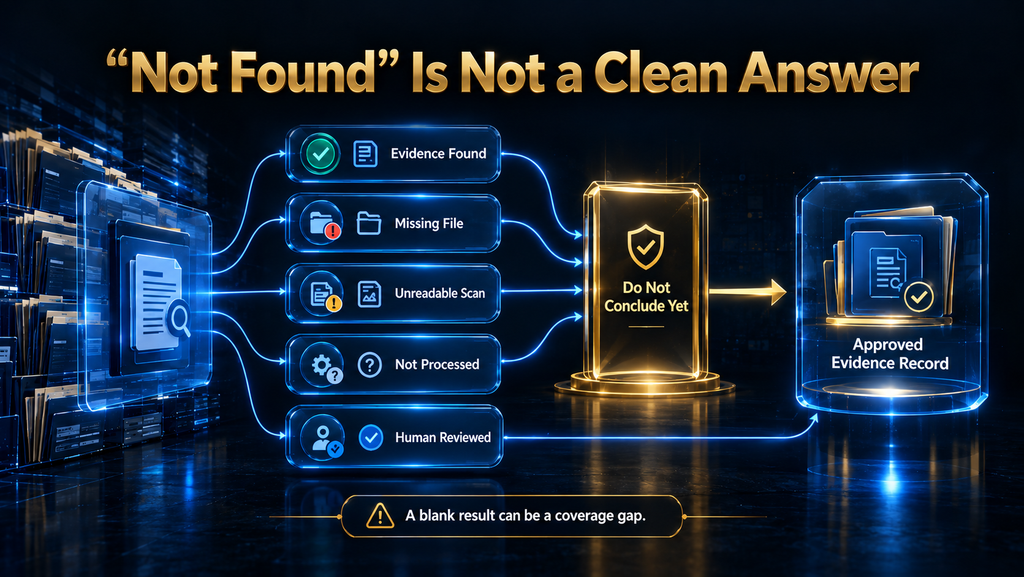
The most dangerous sentence an AI diligence system can imply is “no issue found” when it actually means “the system did not retrieve a relevant passage.” In a transaction, silence can be caused by several different things, and the team needs to distinguish them.
| Result status | What it actually means | Appropriate response |
|---|---|---|
| Relevant clause found | Candidate evidence exists | Verify source, context, amendment status, and materiality |
| No clause found in processed documents | The system did not find the item in documents it processed | Review coverage and consider targeted human or alternative search |
| Relevant document missing | Requested evidence was not produced | Add a diligence gap or follow-up request |
| Document unreadable or unprocessed | No reliable analysis occurred | Obtain a usable copy or conduct manual review |
| Document outside defined scope | It was intentionally excluded | Confirm the exclusion remains appropriate |
| Conflicting sources found | More than one document may control | Escalate to resolve hierarchy and legal effect |
The Coverage Map should track the document population alongside the findings. For each key diligence question, record which document categories were expected, received, readable, classified, processed, manually checked, source-cited, and escalated. The team can then report a real position: “The assignment review covered 302 readable agreements, with 18 pending scans and seven missing amendments.” That is much more honest and useful than a sweeping statement that “all contracts were reviewed.”
AI Hustle World analysis: completeness is a workflow property, not a model property. Even a highly accurate retrieval system cannot make an incomplete data room complete. A strong article should teach readers to manage the evidence universe first, then measure AI performance inside that universe.
A worked example: buy-side review of a fragmented contract portfolio
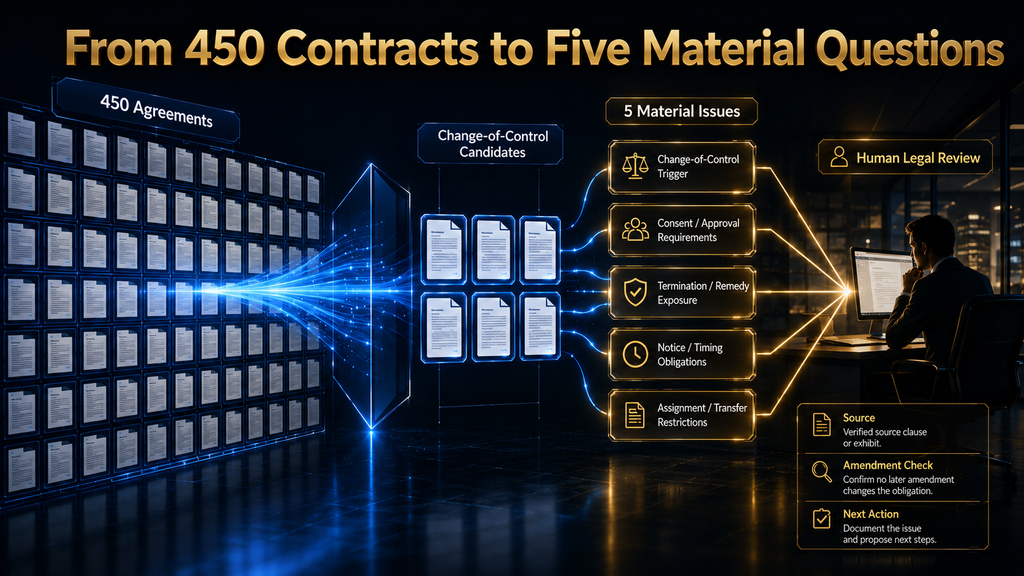
Consider an illustrative acquisition of a software company with 450 commercial agreements across customer, reseller, supplier, cloud-service, and partner relationships. The buyer is worried about change-of-control restrictions, assignment rights, exclusivity, most-favored-nation provisions, upcoming renewals, privacy commitments, and agreements with unusually broad liability exposure. The data room contains several years of contracts, amendments in a separate folder, scans of old agreements, and a spreadsheet that does not match every filename.
Without a controlled workflow, a junior review team divides the folders, searches for familiar terms, writes summaries, and creates a spreadsheet. It may work well for obvious agreements, but the review has no reliable way to show which files were duplicates, which amendments were linked, which scans failed OCR, which clauses were searched for using nonstandard language, or which documents arrived after the initial pass.
With the AI Diligence Evidence Loop, the team starts with Scope. It creates a question set, defines which agreement types are material, confirms the transaction structure, identifies entities, and agrees on report categories. It also decides that consent and termination questions require source excerpts, amendment checks, and lawyer approval before an item enters the risk log.
At Map, the system inventories 450 files and detects 37 likely duplicates, 24 unreadable scans, 31 amendment-like documents, and 12 files that cannot be matched to the provided spreadsheet. Those are not side notes. The team asks the seller to provide clean scans and clarify the unmatched files before treating the contract universe as covered.
At Mine, the AI retrieves candidate assignment, merger, consent, and termination language across the readable agreements. It produces review rows with document name, entity, clause location, source excerpt, candidate classification, and link to related amendments. It also identifies files that appear to lack signature pages and flags 19 contracts with renewal language inside the next 12 months.
At Match, lawyers discover that an apparently restrictive customer agreement was amended two years later to permit an internal reorganization but not a third-party acquisition. They find another agreement with no obvious “change of control” phrase but a termination right triggered if the customer is acquired by a named competitor. AI helped surface both candidates; the legal team determined the actual implications.
At Matter, the team sorts the candidate findings into three groups. One group contains routine clauses in immaterial contracts. The second contains consent issues requiring commercial outreach but unlikely to alter the deal. The third includes five high-revenue customer agreements whose termination rights could materially affect the valuation thesis. The high-priority records include assumptions, source links, amendment history, business owner, estimated revenue exposure, and next action.
At Mobilize, the five high-priority issues become an executive decision item, a consent strategy, a seller representation question, and a potential closing-condition discussion. At Monitor, the team updates the register when the seller uploads two missing amendments and changes the transaction structure. The issue list changes because the new evidence changes the legal position.
The AI did not determine whether the buyer should proceed. It helped ensure that the team’s most expensive human attention went to the contracts and evidence most likely to affect the deal.
Human verification safeguards for large-scale diligence
Due diligence is not a safe place to treat a fluent answer as evidence. The consequences of an overlooked contract, misleading summary, or untested assumption can affect value, representations, indemnities, closing conditions, disclosure, integration plans, and client advice. The controls should be proportionate to the stakes.
Preserve source provenance on every candidate and issue
Every candidate finding should show the document name or identifier, version, entity, page or clause, verbatim source excerpt, related documents, extraction date, system or question used, reviewer, reviewer date, and status. An issue should add the materiality rationale, action owner, and resolution history. This is not bureaucracy. It is how a supervising lawyer or deal lead can review what the system found, challenge what it missed, and explain the basis for a conclusion.
The NIST Generative AI Profile emphasizes information integrity, traceability, and transparency about the degree of vetting. It also warns about automation bias—the tendency to defer too readily to an apparently capable automated system. Diligence systems should make the source evidence easier to inspect, not make the source invisible behind a confident score.
Apply a consequence-based review tier
Not every extracted item needs the same review depth. Basic file metadata may be safely auto-populated after testing and spot checks. A standard provision in a low-value agreement may require a contract-manager review. Material customer contracts, consent requirements, termination rights, regulatory matters, security commitments, IP ownership, litigation, or financial exposure should receive qualified legal and business review.
Build that tiering into the workflow at the beginning. Otherwise, teams tend to over-review low-value metadata and under-review high-value edge cases because the review queue looks uniform. The correct question is not “how confident is the AI?” alone. It is “what happens if this answer is wrong?”
Separate an extracted fact from an approved conclusion
The system may extract that an agreement ends on a date, includes a consent requirement, or refers to a claim. That should remain an extracted fact until a reviewer confirms it. A conclusion such as “consent required before closing” must additionally account for the transaction structure, definition of assignment, exceptions, amendments, governing law, and business facts. The workflow should make those different states visible.
This approach follows the professional-responsibility logic in ABA Formal Opinion 512: AI may help with contract review and due diligence, but users must remain competent, protect client information, supervise the work, and independently review consequential output. The opinion is not a transaction checklist, but the underlying principle is directly relevant.
Test on representative historical work before relying on it in a live deal
Before deploying a workflow on a deal, test it using completed or safely anonymized reviews where the team knows the relevant document universe and final issues. Include standard contracts, heavily amended contracts, scans, tables, short documents, long documents, multiple languages where relevant, and examples of the exact provisions the team expects to find.
Measure precision, recall, source-link completeness, amendment matching, entity accuracy, reviewer correction rate, and time to review. Track false negatives separately from false positives. A system that produces a few extra candidates may be manageable; a system that silently misses rare but material provisions is far more dangerous. Do not rely on a vendor’s generic accuracy percentage, because field definitions, source documents, and error costs vary by transaction.
Common failure modes and how to prevent them
The incomplete-data-room failure
An AI system cannot analyze documents that were not provided. The fix is a request-to-receipt register, a Coverage Map, and visible open gaps. Do not let an empty result be written as a clean diligence conclusion when the requested population is incomplete.
The amendment failure
A system extracts a clause from the base agreement but misses a later amendment, side letter, consent, or schedule. Prevent this by using document-family matching, amendment detection, reviewer confirmation of controlling version, and mandatory source links for material issues.
The source-detachment failure
The output says “assignment restriction” or “litigation risk” without showing the exact material. This should block approval. A finding without evidence may be a useful lead, but it is not report-ready diligence work.
The no-results fallacy
The system cannot find a provision and the team assumes the provision does not exist. Use explicit statuses such as “not found in processed documents,” “not reviewed,” “missing source document,” and “human confirmation required.” These phrases are less elegant than a simple green checkmark, but they protect the team from false certainty.
The materiality substitution failure
The system finds a clause and assigns a high score, but no one asks whether the counterparty is material, whether the provision is enforceable, whether a consent is obtainable, or whether the deal structure triggers it. Prevent this by separating candidate findings from human-approved issues and requiring a written rationale for material-risk classification.
The confidentiality failure
Transaction documents can contain confidential business data, personal information, trade secrets, privileged material, and competitively sensitive terms. Before loading a data room into an AI tool, assess access controls, storage location, retention, training use, encryption, audit logs, vendor terms, export permissions, deletion procedures, and matter-level authorization. The Law Society’s practical AI guidance similarly emphasizes confidentiality, output accuracy, vendor data processing, and audit trails before deployment.
The stale-report failure
A final report is prepared before the data room stops changing. New files, Q&A responses, corrections, or transaction-structure changes can invalidate a conclusion. Record the data cutoff, maintain an update queue, and link conclusions to their supporting documents so affected issues can be reopened quickly.
Practical implementation: start with a bounded diligence question set
The best first implementation is not “run AI across every file in every deal.” Start with one repeatable question family, such as change-of-control and assignment restrictions across customer contracts, or signature and expiration status across a lease portfolio. The use case should be important enough to create business value, narrow enough to evaluate, and repetitive enough that structured extraction reduces meaningful work.
Step 1: choose the decision the workflow should improve
Name the decision, not the technology. For example: “Identify material contracts that need consent before closing,” “Determine whether the target’s top 100 customer agreements can terminate after acquisition,” or “Find agreements that create exclusivity or most-favored-nation exposure.” The decision tells the team which document types, fields, reviewers, and output actions are necessary.
Step 2: build the question-and-evidence template
For each question, define the candidate clause types, related document types, required fields, source evidence, legal reviewer, business reviewer, materiality threshold, and possible outcomes. A change-of-control question should not return only yes/no. It should capture source language, party, clause type, exception, amendment check, entity, contract value or business importance, consent requirement, notice rule, reviewer status, and action.
Step 3: establish the Diligence Coverage Map
Create statuses for requested, received, unreadable, duplicate, out of scope, processed, source-cited, reviewed, escalated, and resolved. Assign an owner to the document register. This is the control that converts a large data room from a pile of files into a measurable review population.
Step 4: run a parallel test before a live reliance decision
Use prior or low-risk data to compare AI-assisted results with a human-reviewed reference. Look beyond speed. Review false negatives, amendment matching, source quality, reviewer rework, and gaps in the question design. Revise prompts, retrieval rules, document handling, and review tiers based on observed failures.
Step 5: operationalize review and escalation
Route candidates to the right people. Legal should own legal effect; commercial teams should validate relationship importance and practical consent risk; finance may validate value exposure; security or privacy teams may validate operational commitments. Each material issue needs a named owner, next action, deadline, and source link. AI should make the handoff cleaner, not create an extra inbox of unowned alerts.
Step 6: preserve a defensible audit trail
Record the documents processed, question set, system version or workflow configuration, results, reviewer edits, open gaps, and report cutoff. The audit trail does not need to be burdensome, but it must be sufficient for a deal lead to understand what work was performed and what uncertainty remains.
How to measure whether AI is improving diligence
Measure time, but do not stop there. The purpose of diligence is not to process files quickly; it is to produce reliable, decision-useful work under time constraints.
| KPI | What it shows |
|---|---|
| Document-universe coverage | Whether the claimed review population was actually received and processed |
| Question coverage | Whether each priority question ran across the intended document categories |
| Candidate retrieval recall | Whether known relevant passages are being found in test sets |
| Source-link completeness | Whether reviewers can validate each finding efficiently |
| Amendment and version-match rate | Whether the workflow connects controlling documents correctly |
| Reviewer correction rate | Which document types, fields, or questions create avoidable rework |
| Material-issue escalation rate | Whether the workflow surfaces the issues that warrant attention |
| Cycle time to reviewed issue | Whether AI reduces the time from upload to decision-ready evidence |
| Open-gap aging | Whether missing documents and unresolved questions are being managed |
| Post-report change impact | Whether new evidence is detected and conclusions are updated |
AI Hustle World analysis: an honest ROI calculation includes the time spent building the question set, validating output, resolving exceptions, and maintaining the Coverage Map. The result may still be valuable because it shifts expert attention toward material questions and reduces repetitive search. But “the model processed the documents in minutes” is not a complete business case.
Who should use AI-assisted due diligence, and who should slow down?
AI-assisted diligence is a strong fit for law firms, corporate development teams, in-house legal departments, private-equity or investment teams, lenders, and transaction groups that repeatedly review large collections of related documents under deadline pressure. It is most useful where the team can define recurring questions, has a credible source-of-truth process, and can assign qualified reviewers to material results.
Teams should slow down when the document universe is not controlled, the data is highly sensitive and the proposed AI environment is not approved, the transaction is unusually bespoke, the legal consequences are extreme, the document quality is poor, or no one is available to verify the output. A small transaction with 15 complex contracts may benefit more from an experienced human reviewer and a clean manual issue list than from an elaborate AI implementation.
The decision is not “AI or human diligence.” It is whether AI removes enough low-value searching and copying to give the human team more capacity for the interpretation and decisions that cannot be delegated.
Final Thoughts
AI can make due diligence substantially more useful when it shortens the distance between a large document set and the evidence a transaction team needs to evaluate. It should not be used to create a superficial impression that the data room has been understood, the risks have been assessed, or the transaction is safe.
The durable workflow is evidence-led: define the questions, map the document universe, retrieve and link the candidate material, confirm the controlling context, let qualified people decide what matters, turn approved issues into action, and update conclusions as the evidence changes.
Use AI to Surface Evidence—Then Make Better Decisions
From large document reviews to everyday AI decision support, trustworthy workflows preserve sources, review steps, and human accountability.
Read More From AI Hustle World →Frequently asked questions
Can AI replace lawyers in M&A due diligence?
No. AI can accelerate document inventory, classification, retrieval, extraction, comparison, and first-pass summaries. Lawyers and appropriate business specialists must still assess completeness, controlling documents, materiality, legal effect, transaction structure, and client advice. The safest design treats AI output as source-linked candidate evidence, not final diligence conclusions.
Can AI review an entire data room at once?
It can process large sets of documents, but that does not prove that every file was readable, correctly classified, in scope, or interpreted accurately. A reliable review tracks the document universe, data-room changes, version relationships, question coverage, and source evidence. Large context windows are helpful, but they do not remove the need for corpus management and quality control.
What is the difference between AI contract review and AI due diligence?
AI contract review often focuses on analyzing a particular agreement for clauses, deviations, risks, and redlines. AI due diligence works across a larger document population and connects individual findings to transaction questions, completeness, materiality, reporting, follow-up requests, and deal actions. Article 4’s obligation-extraction workflow begins after execution; diligence focuses on evidence and risk assessment during a transaction or significant review.
What should an AI diligence finding include?
At minimum: document identity, entity, version or date, source location, verbatim excerpt, question asked, extracted answer, related document links, review status, and reviewer notes. If the item becomes a material issue, add why it matters, uncertainty, action owner, next step, decision status, and report treatment.
How can a team test AI due diligence before using it on a live deal?
Use completed or anonymized work where the final issue list and relevant documents are known. Build a representative set of standard, amended, scanned, long, and unusual documents. Test retrieval recall, source citation, entity matching, amendment handling, correction rate, and time to reviewed output. Keep the human-reviewed reference set and compare every important miss.
Does “no clause found” mean the company has no exposure?
No. It can mean the document was missing, unreadable, misclassified, outside scope, written in nonstandard language, or not retrieved by the system. The Diligence Coverage Map should distinguish a clean negative result in processed documents from an unknown or incomplete review population.
Is it safe to upload confidential data-room documents to AI tools?
Only after the organization has evaluated the tool’s data handling, access controls, storage location, retention, training use, encryption, audit logs, contractual commitments, and privilege/confidentiality requirements. The answer depends on the documents, the jurisdiction, the client or counterparty terms, and the approved technology environment.
Related Guides
- How to Build a Content Atom Workflow with AI
- How to Set Up an AI Customer Support Agent With Weav: Step-by-Step
- AI Contract Management vs Traditional CLM: Where AI Adds Real Value
Written by
Muntasir Ahmad Chowdhury
Founder, AI Hustle World
Muntasir Ahmad Chowdhury is the Founder of AI Hustle World, an independent publication dedicated to making Artificial Intelligence practical, trustworthy, and easy to understand. He researches AI tools, automation, customer service, productivity, and real-world business applications, helping readers make smarter technology decisions through research-driven, experience-backed content.
Expertise:
AI Tools • AI Automation • AI Customer Service • AI Productivity • Generative AI • AI Workflows
Get Smarter With AI
Enjoyed this guide? Get practical AI tools, tutorials, and honest reviews delivered to your inbox.