Evidence: Documentation reviewed
Last checked: August 2026
What was done: Written from official documentation and the published sources linked in this article. Not hands-on tested.
Files: None
Affiliate links: Yes
AI Conversation Intelligence Explained
Affiliate Disclosure: This article contains affiliate links. If you use a link to try Speak AI, AI Hustle World may earn a commission at no additional cost to you. Our recommendations are based on the tool’s documented capabilities, use cases, limitations, and fit for specific workflows.
Your Business Is Already Sitting on a Massive Dataset
A customer tells your salesperson why they are hesitating to buy. A researcher spends an hour interviewing a customer about a product. A support representative hears the same complaint for the twentieth time. A product manager conducts ten user interviews and notices that several people describe the same problem in completely different words. A consultant runs a series of stakeholder interviews and hears subtle disagreement between departments. An executive meeting contains a decision that never makes it into the meeting notes.
All of that information has something in common: it exists inside conversations. For years, organizations have treated those conversations as temporary events. Someone records a call, writes a few notes, updates a CRM field, sends a follow-up email, or produces a research summary, and then the original conversation effectively disappears into a recording library, inbox, shared drive, or meeting platform. The problem is not that businesses lack conversations. The problem is that most organizations cannot systematically extract, compare, and reuse the information contained inside them.
That is the problem conversation intelligence is designed to address. Conversation intelligence uses AI to turn spoken or written conversations into structured, searchable information that can be analyzed for topics, themes, sentiment, entities, patterns, objections, questions, and other signals. IBM describes the category as using AI-powered tools to analyze business conversations and extract actionable insights, with workflows that can include capturing interactions, transcription, natural-language processing, sentiment analysis, and identification of pain points or key moments. IBM
But there is an important distinction that gets lost in many explanations. Conversation intelligence is not simply better transcription. A transcript tells you what was said. A summary tells you what an AI system thinks was important in one conversation. Conversation intelligence becomes strategically interesting when you can ask a larger question: What keeps appearing across hundreds of conversations, which people or groups experience it differently, and what should the organization do about it?
That is where a recording becomes data, data becomes evidence, and evidence can become a business decision. This guide explains how that transformation works, where AI creates genuine leverage, where it can mislead you, and how to build a practical conversation-intelligence workflow without handing important judgment over to an algorithm.
What Is Conversation Intelligence?
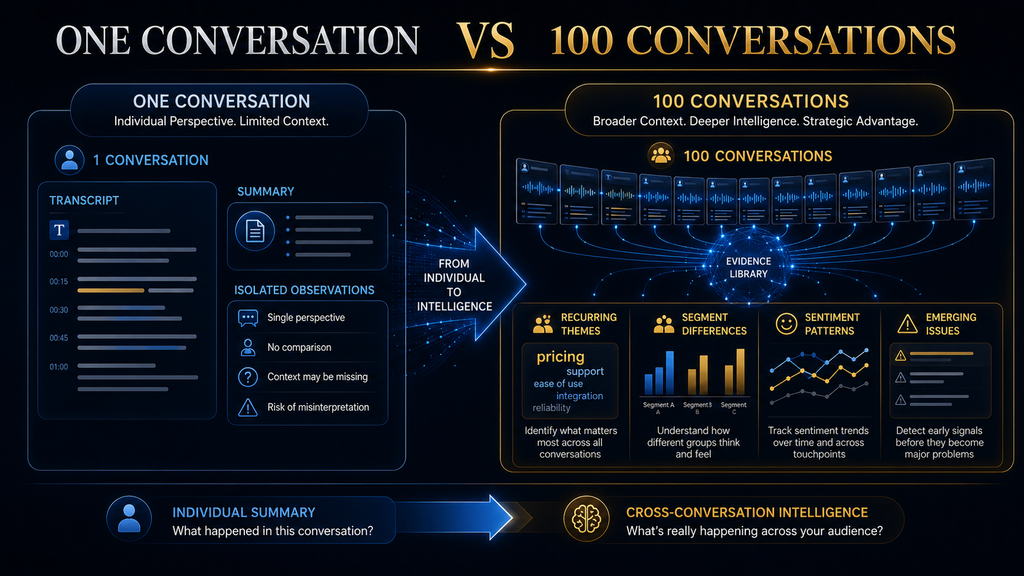
Conversation intelligence is the use of AI to capture, transcribe, structure, analyze, and compare conversations so organizations can identify meaningful patterns and turn them into actionable insights. The important word is compare. If you have one customer interview, you can summarize it. If you have 100 customer interviews, you can begin looking for patterns. If you have 1,000 interviews collected over time, across different products, customer segments, regions, or research projects, the opportunity becomes much larger: you can begin treating conversations as a continuously growing source of organizational evidence.
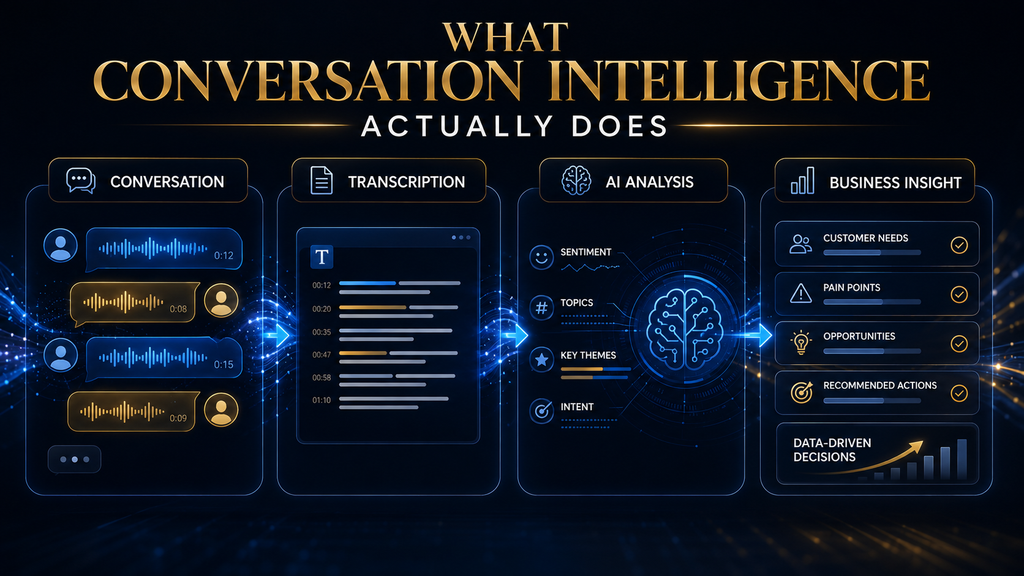
A modern conversation-intelligence system can combine several capabilities, including speech-to-text transcription, speaker identification, topic detection, keyword extraction, sentiment analysis, entity recognition, thematic analysis, search, and AI-assisted querying. For example, Speak AI currently describes a workflow that combines transcription, automated theme coding, sentiment analysis, cross-participant comparison, and AI Chat across research recordings. Speak AI That means the technology is best understood as a layer between raw conversation and organizational decision-making. A useful way to visualize the concept is:
Conversation → Transcript → Structured Signals → Patterns → Insight → Decision → Action The transcript is necessary, but it is not the destination. That distinction matters because a company could spend thousands of hours generating transcripts and still have very little conversation intelligence if nobody can reliably identify what those transcripts collectively mean.
Run One Conversation Through Speak AI
Upload a single recorded call or interview and see what themes and sentiment the analysis surfaces from your own material.
Analyze One Conversation With Speak AI →Affiliate disclosure: We may earn a commission if you subscribe through this link, at no additional cost to you.
Conversation Intelligence Is Not the Same as Transcription
This is one of the most important distinctions to understand before evaluating any platform. Once you have transcripts, you can also turn video transcripts into articles, clips and social posts. Once you have transcripts, you can also turn video transcripts into articles, clips and social posts.
Transcription answers. “What was said?” A transcription system converts audio or video into text. More sophisticated systems can identify speakers, add timestamps, recognize specialized terminology, and support multiple languages. That is valuable because searchable text is dramatically easier to review than raw audio. But transcription alone does not tell you whether the same complaint appeared in 50 other conversations. Summarization answers. “What happened in this conversation?” An AI summary might identify the major points discussed, decisions made, questions asked, or follow-up tasks. Again, useful. But it still treats the individual conversation as the primary unit.
Conversation intelligence asks:
“What can we learn from this conversation, and how does it relate to everything else?” That is a much broader question. Imagine a company has 500 customer calls. A transcription system can turn those calls into 500 searchable transcripts. A meeting-summary system can create 500 summaries.
A conversation-intelligence system can potentially help the organization identify that customers repeatedly mention the same onboarding problem, that the issue is concentrated among a particular customer segment, that sentiment around the topic is deteriorating, and that the problem appears in several different teams’ conversations. That is the jump from documentation to intelligence.
Why Conversations Are Such Valuable Business Data
Businesses already have structured databases for many important things. They know:
- how much a customer spent,
- when an account was created,
- which plan a customer uses,
- whether an invoice was paid,
- which sales stage a deal occupies,
- how many support tickets were opened,
- which product features were used.
But structured systems often struggle to capture why something happened. A CRM might tell a sales manager that a deal was lost. The conversation might reveal that the buyer considered the product too difficult to implement. A customer-support dashboard might show an increase in tickets. The conversations might reveal that customers are confused by one particular workflow. A product analytics platform might show that users rarely activate a feature. User interviews might reveal that customers do not understand what the feature is supposed to solve.
The structured system records the outcome. The conversation often contains the explanation. That is why conversational data can become strategically valuable. It captures the language, reasoning, objections, questions, frustrations, preferences, assumptions, and contextual details that are difficult to reduce to a handful of database fields. This does not mean conversations are automatically more truthful than structured data. They are not. People misunderstand things. They change their minds. They exaggerate. They forget. Interviewers introduce bias. Customers may describe an intention that does not match their eventual behavior. The value comes from combining conversational evidence with other evidence, not replacing one with the other.
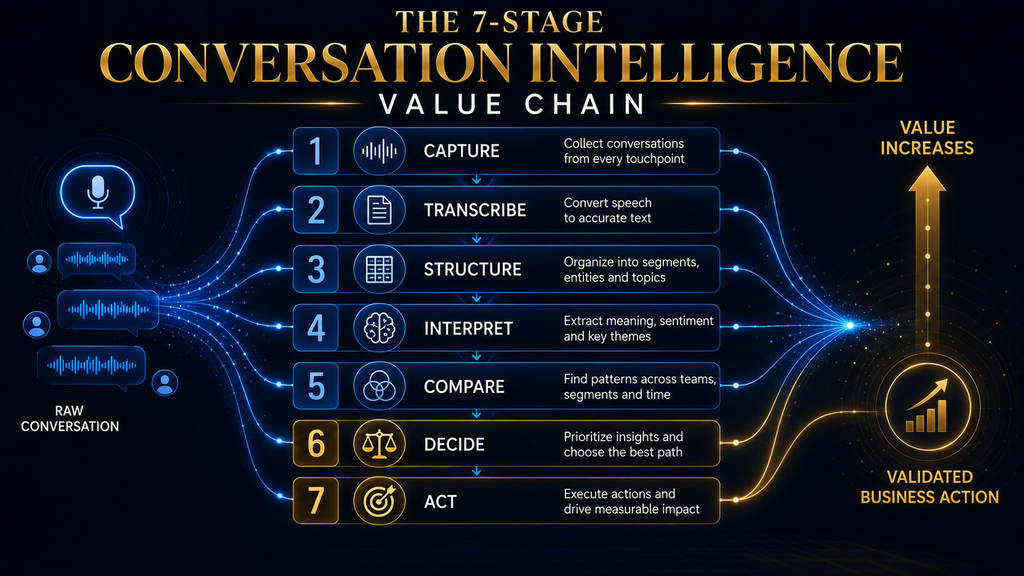
The Seven-Stage Conversation Intelligence Value Chain
A useful way to understand the entire category is to treat it as a seven-stage system. 1. Capture the Conversation. Everything starts with the source material. That might be:
- a sales call,
- customer-support call,
- research interview,
- focus group,
- usability session,
- stakeholder interview,
- internal meeting,
- recorded consultation,
- podcast interview,
- or another audio, video, or text conversation.
The quality of everything downstream depends partly on the quality and completeness of this source. If important conversations are never recorded, the AI cannot analyze them. If the recording has severe audio problems, analysis becomes less reliable. If speakers cannot be distinguished, attribution becomes difficult. This is why conversation intelligence is not purely an AI problem. It is also a data-capture problem.
2. Transcribe the Conversation. The next step is converting speech into text. This matters because text can be searched, categorized, compared, quoted, indexed, and analyzed far more efficiently than raw audio. Modern systems can also attach additional information to the transcript, such as speaker labels and timestamps. Speak AI, for example, currently describes transcription with speaker identification and timestamped transcripts across research interviews and focus groups. Speak AI But transcription accuracy is not binary.
A transcript can be mostly correct and still contain errors that matter. Names can be misheard. Industry terminology can be incorrectly interpreted. Two speakers can be confused. Overlapping dialogue can become difficult to attribute. Accents and background noise can affect results. That means the question should not simply be: “Is this AI transcription accurate?” A better question is: “Is the transcript accurate enough for the decision I am trying to make?” That is a much more useful evaluation standard.
3. Structure the Conversation. Raw text is still messy. The system needs to turn it into something that can be analyzed. This can include:
- speaker identification,
- timestamps,
- keywords,
- entities,
- topics,
- sentiment,
- categories,
- custom fields,
- and other structured attributes.
Speak AI’s current Insights documentation describes automatic extraction of keywords, sentiment, entities, and topics from recordings after transcription, with the ability to configure categories and compare insights across a broader library. Speak AI Docs This stage is important because structure makes comparison possible. Consider two customers saying: “The setup process took forever.” and: “We couldn’t get the implementation completed without involving our IT team.” The wording is different. But the underlying theme may be similar: implementation friction. AI can help surface those relationships even when people do not use the same vocabulary.
4. Interpret the Signals. This is where the system moves beyond simple extraction. The AI can look for patterns such as:
- positive or negative sentiment,
- recurring themes,
- common objections,
- repeated questions,
- customer pain points,
- product requests,
- emerging concerns,
- competing brands,
- or changes in how a topic is discussed.
This is also where the risk increases. The more interpretive the task becomes, the more dangerous it is to treat the AI’s output as unquestionable truth. “Customer mentioned pricing” is relatively straightforward. “Customer is frustrated by pricing” is more interpretive. “Pricing is the primary reason customers are leaving” is a much stronger claim. The evidence required for each statement is different. This is why good conversation intelligence should help humans investigate hypotheses, not manufacture certainty.
5. Compare Conversations. This is where the category becomes significantly more powerful. Suppose a researcher conducts 12 interviews. Reading and analyzing each transcript individually may produce useful observations. But the bigger questions are comparative:
- Which themes appeared in most interviews?
- Which themes were unique to certain participants?
- Which complaints appeared repeatedly?
- Which customer segment expressed the strongest concern?
- Did sentiment differ between groups?
- Which topics became more important over time?
- Which ideas appeared in one interview but disappeared elsewhere?
Speak AI explicitly supports cross-participant comparison and analysis across multiple interviews and focus groups, including comparing themes, sentiment and participant responses. Speak AI This is the difference between reading conversations and analyzing a conversation corpus. And that distinction is one of the strongest reasons to care about the technology.
6. Turn Patterns Into Decisions. A pattern is not automatically an insight. Suppose an AI system finds that 42% of customer interviews mention onboarding. That is a signal. The next question is: So what? Perhaps most of those mentions are positive. Perhaps customers are simply describing onboarding because the interview guide explicitly asked about it. Perhaps the issue is concentrated among enterprise customers. Perhaps the problem affects only one region. Perhaps the frequency increased after a product change.
The number itself does not tell you what to do. A useful insight needs context. That is why a good conversation-intelligence workflow should move from: Signal → Context → Validation → Interpretation → Decision rather than: Signal → Automatic decision The first approach uses AI as an analytical accelerator. The second risks turning statistical or linguistic patterns into false certainty.
7. Put the Insight Into Action
The final stage is where conversation intelligence earns its business value. The output could influence: How AI turns feedback into roadmap decisions is covered in how AI turns customer feedback into product insights. How AI turns feedback into roadmap decisions is covered in how AI turns customer feedback into product insights.
- product priorities,
- sales coaching,
- customer-support processes,
- marketing messaging,
- research reports,
- UX improvements,
- training,
- operational decisions,
- customer segmentation,
- or strategic planning.
If the insight never changes anything, the organization may have built an impressive analysis pipeline without creating meaningful value. This leads to a simple principle: The purpose of conversation intelligence is not to produce more analysis. It is to improve the quality and speed of decisions. That should be the standard against which every platform is evaluated.
What AI Can Actually Extract From Conversations
One reason the category feels confusing is that “AI analysis” covers several different levels of sophistication. A useful way to separate them is into four layers. Layer 1: Explicit Information. These are things directly present in the conversation. Examples include:
- names,
- companies,
- products,
- competitors,
- prices,
- dates,
- feature requests,
- questions,
- objections,
- commitments,
- complaints,
- and decisions.
This is usually the safest layer because the system is primarily identifying information that is explicitly present. Layer 2: Behavioral Signals. Some platforms can analyze characteristics of the conversation itself. Examples include:
- speaking time,
- word count,
- speaking rate,
- interruptions,
- speaker participation,
- or other conversational patterns.
These signals can be useful in sales coaching, research analysis, or team communication. But behavioral data should not automatically be interpreted as a psychological diagnosis. Someone speaking less does not necessarily mean they are disengaged. Someone speaking quickly does not necessarily mean they are nervous. Context still matters. Layer 3: Semantic Signals. This layer focuses on meaning and subject matter. AI can identify:
- topics,
- themes,
- keywords,
- entities,
- concepts,
- categories,
- recurring phrases,
- and relationships between ideas.
This is where AI can dramatically reduce the amount of manual sorting required when dealing with large amounts of qualitative data. Speak AI currently markets automated theme coding, topic identification, sentiment analysis, and cross-participant comparison specifically for research workflows. Speak AI
Layer 4: Interpretive Signals
This is the most powerful and the most dangerous layer. Examples include:
- customer frustration,
- purchase intent,
- underlying motivations,
- emerging concerns,
- emotional intensity,
- hidden themes,
- or explanations for behavior.
These outputs can be extremely useful as hypotheses. But they deserve stronger human review because the AI is no longer merely locating words. It is interpreting human communication. And human communication is messy. Sarcasm can reverse the meaning of a sentence. Cultural context can change how emotion is expressed. A participant may use positive language while describing a negative experience. An interviewer can unintentionally lead the respondent. Two people can use the same words to mean very different things. The more interpretive the claim, the more important human validation becomes.
The Biggest Shift: From Single-Conversation Summaries to Conversation Intelligence
This is where many organizations misunderstand the category. Imagine you run one customer interview. An AI summary might tell you: “The customer likes the product but is concerned about implementation time and pricing.” Useful. Now imagine you have 100 interviews. You could ask: “Which implementation problems appear most frequently?” Then: “Which customer segments experience them?” Then: “Which features are most often associated with implementation complaints?” Then: “Are implementation concerns becoming more or less common over the last six months?” Our guide to how AI finds themes, patterns and sentiment across conversations goes deeper on the method.
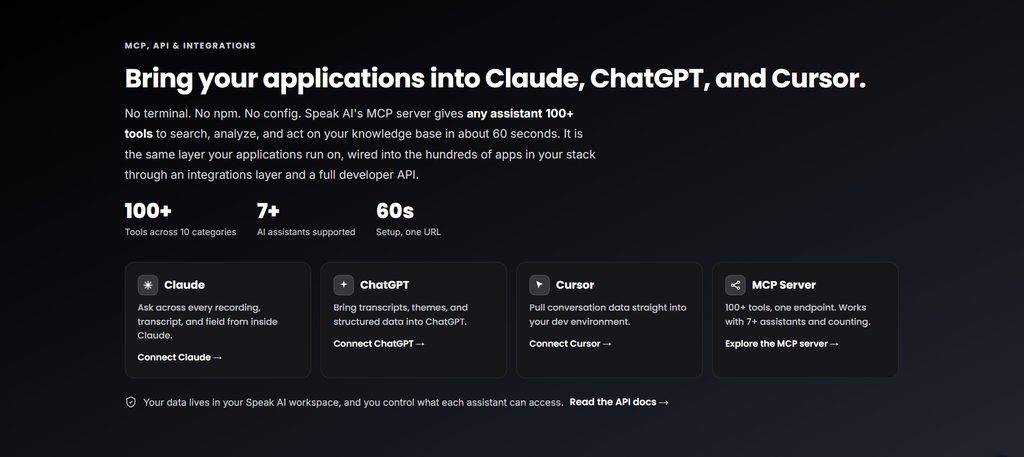
Then: “What exact language do customers use when describing the problem?” Now you are no longer asking AI to summarize. You are asking it to interrogate a body of evidence. That is a much more powerful workflow. Speak AI’s current research platform is explicitly designed around this kind of cross-recording analysis. Its research offering describes comparing participants, identifying themes across interviews and focus groups, and querying a research library through AI Chat. Speak AI
This is why I would not evaluate a conversation-intelligence platform purely by asking whether its summaries are good. A better question is: How well does the platform help me move from individual conversations to defensible patterns across conversations?
Why This Matters for Qualitative Research
Qualitative research is a particularly interesting application because researchers already have a sophisticated process for extracting meaning from conversations. The traditional workflow often looks like this: Interview → Recording → Transcription → Familiarization → Coding → Categorization → Theme Development → Interpretation → Report The problem is that some of these steps are extremely time-consuming. Transcribing interviews takes time. Reading hundreds of pages takes time. Finding recurring passages takes time. For research teams, see AI qualitative research explained. For research teams, see AI qualitative research explained.
Applying codes consistently takes time. Comparing participants takes time. AI can potentially compress some of this administrative and first-pass analytical work. Speak AI currently positions its platform specifically for qualitative researchers, describing workflows for interviews, focus groups, automated thematic analysis, sentiment analysis, quote extraction, participant comparison and AI Chat over research data. Speak AI But there is an important methodological boundary. Automating analysis is not the same as automating research judgment. That distinction matters enormously.
What AI Should Do in a Qualitative Research Workflow
A sensible division of labor looks like this. AI is useful for first-pass work. It can help: Our guide to how AI finds themes, patterns and sentiment across conversations goes deeper on the method.
- transcribe,
- organize,
- search,
- classify,
- surface recurring themes,
- identify candidate quotes,
- compare groups,
- and generate initial questions.
Humans remain responsible for interpretation.
Researchers should still determine: We compare the two approaches in AI conversation analysis vs manual research. We compare the two approaches in AI conversation analysis vs manual research.
- whether a theme is meaningful,
- whether the coding framework makes methodological sense,
- whether context changes the interpretation,
- whether contradictory evidence matters,
- whether a finding is supported,
- and how the final conclusion should be presented.
This isn’t just a philosophical preference. Recent research into AI-assisted qualitative research continues to highlight the importance of human oversight, contextual interpretation, reflexivity, and researcher judgment. A 2026 study of expert qualitative researchers found ambivalence around AI adoption and emphasized human oversight, contextual interpretation, reflexivity, and researcher identity as important counterbalances to AI’s more mechanistic tendencies. PubMed The strongest workflow therefore isn’t: AI replaces the researcher. It is: AI reduces the mechanical workload so the researcher can spend more time on interpretation.
A Practical Example: Turning Customer Interviews Into a Product Decision
Consider a fictional software company that has conducted 50 customer interviews. The company wants to understand why new users fail to activate a particular feature. Without conversation intelligence, the research team may have to read every transcript, manually highlight relevant sections, create codes, group those codes, and compare themes. That work can be valuable, but it is also labor-intensive. With an AI-assisted workflow, the team could begin by transcribing the interviews and identifying speakers. See how AI interview analysis works for the transcript-to-insight workflow. See how AI interview analysis works for the transcript-to-insight workflow.
Next, the system could surface recurring topics associated with the feature. Suppose the initial analysis produces three recurring themes:
- Customers do not understand the feature’s purpose.
- Customers understand the feature but cannot find it.
- Customers find it but do not know how to configure it.
That is already more useful than a collection of 50 summaries. But the team should not immediately conclude that the product has three confirmed problems. Instead, researchers could inspect representative interviews from each theme, compare the evidence across customer segments, review contradictory cases, and examine whether the interview questions themselves influenced the responses. After validation, the organization might discover that the most important problem is not functionality at all. It is discoverability.
That could lead to a product change, onboarding change, or interface redesign. The AI did not make the product decision. It helped the researchers find the evidence faster. That is the appropriate role.
Compare AI Summaries With Your Own Notes
Check the automated summary of one conversation against what your team noted by hand to see where AI adds value.
Test a Conversation Analysis →Affiliate disclosure: We may earn a commission if you subscribe through this link, at no additional cost to you.
The Same Principle Works in Sales
Conversation intelligence became especially visible through sales applications because sales conversations contain enormous amounts of potentially useful information. A sales representative may record dozens of calls each month. A manager cannot realistically listen to every call in full. An AI system can help surface:
- objections,
- competitor mentions,
- recurring questions,
- pricing concerns,
- buying signals,
- unanswered questions,
- and other patterns.
IBM identifies sales and customer conversations as important sources of information for conversation intelligence and notes applications including identifying pain points, sentiment and key moments. IBM The important strategic shift is that managers can potentially move from sampling a few conversations to analyzing much larger portions of the conversation corpus. But again, the output should be treated as evidence for investigation. If an AI system flags a sales call as containing a pricing objection, a manager can inspect the relevant section.
If the same objection appears across dozens of calls, the organization now has a stronger signal that pricing, packaging, positioning, or value communication deserves attention. That is far more valuable than simply having 50 neat call summaries.
Customer Experience Is Another Natural Use Case
Customer-support conversations contain a different kind of intelligence. Customers describe: Our guide to analyzing customer feedback, calls and interviews at scale applies the same ideas to support and product teams. Our guide to analyzing customer feedback, calls and interviews at scale applies the same ideas to support and product teams.
- problems,
- frustrations,
- expectations,
- workarounds,
- confusion,
- feature requests,
- and reasons for dissatisfaction.
Traditional customer-support analytics often rely heavily on structured fields such as ticket category, resolution time, customer rating, and escalation status. Conversation intelligence can add another layer by examining the language customers actually use. For example, a support organization might discover that many customers technically receive successful resolutions but repeatedly express confusion about the same product workflow. That tells you something that “ticket resolved” does not. The ticket system measures operational completion. The conversation reveals the experience behind the completion. That distinction can influence training, product design, documentation, and customer experience strategy.
Conversation Intelligence Can Also Become an Organizational Memory Layer
This is one of the more interesting long-term implications. Organizations lose knowledge constantly. Employees leave. Meetings disappear into calendars. Customer interviews become old folders. Research findings get buried in presentations. Important context remains trapped inside people’s memories. If conversations are consistently captured, transcribed, structured, and indexed, they can become part of a searchable organizational knowledge layer. Instead of asking: “Who remembers why we made this decision?” A team could potentially ask:
“What did customers say about this problem during the last six months?” Or: “Which research interviews first raised this concern?” Or: “What objections did enterprise prospects raise about this feature?” That changes the role of conversation data. It is no longer merely a record of what happened. It becomes institutional memory that can be queried.
This direction is becoming increasingly relevant as AI systems gain access to larger organizational information stores, although it also raises significant questions about privacy, access, employee expectations, and governance. Recent reporting on AI-enabled workplace knowledge systems illustrates both the potential value of centralized conversational data and the tension around privacy and transparency. The Wall Street Journal
The Reality Check: More Conversation Data Does Not Automatically Mean Better Decisions
This is where the conversation-intelligence hype needs to be challenged. AI can make it easier to analyze thousands of conversations. That does not mean the resulting conclusions are automatically correct. In fact, scale can sometimes make a bad analytical process more dangerous. If you incorrectly define a category and apply it to 10 interviews, a researcher may catch the problem. If an automated system applies the same flawed interpretation to 10,000 conversations, you can produce a very convincing dataset built around a flawed premise. For meeting-focused tools, see our list of the best AI meeting assistants. For meeting-focused tools, see our list of the best AI meeting assistants.
This creates a paradox: AI reduces the cost of analysis, but that makes analytical discipline more important, not less. When analysis is expensive, teams naturally limit the amount they do. When analysis becomes cheap, teams can analyze everything. The danger is assuming that because something can be measured, it is meaningful.
Signal Is Not Insight
This is the framework I want AI Hustle World to own within this article. Our comparison of the best AI research assistants covers the desk-research side. Our comparison of the best AI research assistants covers the desk-research side.
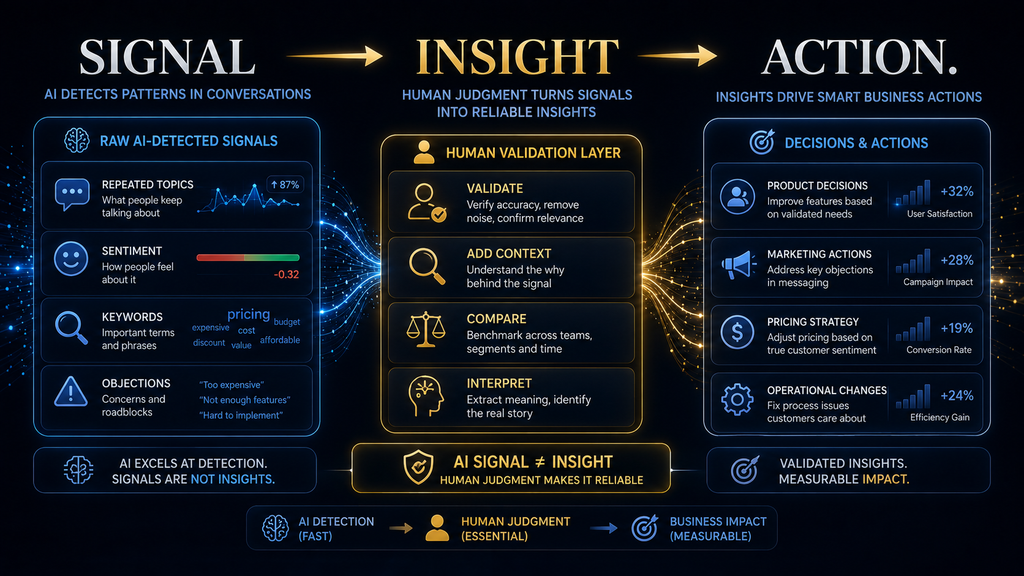
The SIGNAL → INSIGHT → ACTION Framework
A conversation-intelligence system can produce a signal. For example: “Pricing” appeared in 31% of conversations. That is not yet an insight. The next question is: What does that signal mean? Researchers might discover that pricing was mentioned because the interviewer specifically asked every participant about pricing. That changes the interpretation. Perhaps the next layer reveals that negative sentiment around pricing appears primarily among small businesses. Now the signal has context.
The researchers then inspect the relevant conversations and discover that customers aren’t necessarily saying the product is too expensive. They are saying they do not understand which plan they need. Now you have something closer to an insight. The organization can act: “Improve pricing communication and plan-selection guidance.” That is the full chain: Signal → Context → Validation → Insight → Action This is why the best conversation-intelligence workflow is not the one that generates the most AI output. It is the one that makes it easier to move from raw signals to defensible decisions.
Where Conversation Intelligence Can Fail
There are several recurring failure modes worth understanding before adopting the technology. Transcription Errors Can Contaminate Analysis. If the transcript is wrong, downstream analysis can also be wrong. A misidentified product name can affect entity analysis. A speaker-attribution error can associate a statement with the wrong participant. A missing sentence can change the meaning of an exchange. For high-stakes research or business decisions, important passages should be reviewed against the original recording.
Sentiment Is Not Human Emotion. Sentiment analysis can be useful for identifying broad patterns in language, but it should not be treated as a perfect emotional detector. A sarcastic comment can be misinterpreted. A polite complaint can appear positive. A culturally specific expression can be misunderstood. A participant can use neutral language while communicating strong dissatisfaction. Sentiment should therefore be treated as a signal, not a psychological measurement.
Theme Detection Can Flatten Context. Imagine several participants mention “price.” That does not mean they have the same pricing problem. One may think the product is expensive. Another may want more flexible billing. Another may have no complaint and simply mention the price while describing the purchasing process. The word is the same. The meaning is different. Good analysis preserves that distinction.
AI Can Reinforce the Researcher’s Assumptions. This is particularly important in qualitative research. If you tell an AI system: “Find evidence that customers dislike our onboarding.” you are not conducting neutral discovery. You are asking the system to search for confirmation. A better process is: “Identify the major themes related to onboarding, including positive, negative, neutral, and contradictory evidence.” That preserves room for unexpected findings.
Why Human Oversight Still Matters
NIST’s AI Risk Management Framework emphasizes trustworthy AI and explicitly discusses the need to define human roles and responsibilities in AI systems. Its human-AI interaction guidance also warns that converting complex human phenomena into measurable representations can remove necessary context. NIST That principle applies directly to conversation intelligence. Human oversight should increase when:
- the decision is consequential,
- the conversation contains sensitive information,
- interpretation depends heavily on context,
- cultural nuance matters,
- the evidence is contradictory,
- or the AI’s output will directly affect people.
The goal is not to keep humans manually doing every task. The goal is to place humans where their judgment creates the most value. That is a much better automation strategy.
Privacy Is Not a Side Issue
Conversation data can be extremely sensitive. Depending on the use case, recordings may contain:
- personal information,
- customer information,
- employee information,
- confidential business strategy,
- financial details,
- research-participant information,
- health-related information,
- or proprietary product information.
Before deploying conversation intelligence, organizations should understand:
- Where is the data stored?
- Who can access it?
- How long is it retained?
- Can users delete it?
- How is it protected?
- What happens when data is sent to third-party AI models?
- What permissions apply to different team members?
- Do participants know they are being recorded and analyzed?
These are not merely technical questions. They are governance questions. NIST’s AI RMF is designed to help organizations incorporate trustworthiness considerations into the design, deployment, use, and evaluation of AI systems, including concerns around privacy, accountability, transparency, explainability, and bias. NIST A conversation-intelligence platform should therefore be evaluated partly as a data-governance system, not just an AI feature.
How to Evaluate a Conversation Intelligence Platform
If you are considering a platform, avoid comparing products based solely on the number of AI features listed on their websites. Instead, evaluate the entire workflow. Our roundup of the best AI conversation intelligence tools compares the main options. Transcription Quality. Ask whether the system handles your actual: Our roundup of the best AI conversation intelligence tools compares the main options.
- accents,
- languages,
- terminology,
- recording conditions,
- speaker counts,
- and audio quality.
A vendor’s general accuracy claim is less useful than testing representative samples from your own workflow. Speaker Identification. This matters especially for:
- interviews,
- focus groups,
- panels,
- sales calls,
- and research sessions.
If the system cannot reliably tell you who said what, many downstream analytical tasks become less useful. Analysis Depth. Look beyond summaries. Does the platform provide:
- keywords,
- topics,
- entities,
- sentiment,
- themes,
- custom fields,
- coding,
- search,
- structured extraction,
- or other analytical capabilities?
The answer should match your use case. Cross-Conversation Analysis. This may be one of the most important criteria. Can you analyze:
- one recording,
- a folder,
- a project,
- a customer segment,
- an entire research library,
- or a time period?
The ability to compare conversations is what separates basic AI note-taking from deeper conversation intelligence. Search and Querying. Ask whether you can quickly locate evidence. A powerful conversation-intelligence platform should make it easier to answer questions such as: “Which customers mentioned implementation problems?” or: “Which interviews discussed the new feature?” or: “What themes appeared across all focus groups?” Speak AI currently positions its AI Chat and research workflows around querying conversations, finding themes, pulling quotes, and comparing participant responses across a research project. Speak AI
Human Review. Look for workflows that allow people to:
- inspect transcripts,
- correct errors,
- review themes,
- modify codes,
- validate findings,
- and trace insights back to source material.
An AI system that produces conclusions without making the underlying evidence easy to inspect creates a trust problem.
Where Speak AI Fits
Speak AI is particularly relevant to this article because its current product positioning extends beyond simple meeting transcription. Its research platform is designed around transcribing interviews and focus groups, identifying themes, extracting quotes, comparing participants, analyzing sentiment, and querying research data through AI Chat. Its current Insights documentation also describes automatic extraction of keywords, sentiment, entities, and topics from recordings, followed by broader library-level analysis through its Explore functionality.Docs For qualitative research specifically, Speak AI describes workflows covering market research, UX research, academic research, policy research, healthcare research, and media/journalism.
That makes it a particularly relevant example of the broader conversation-intelligence category we are discussing here. But it is important to keep the positioning honest. Speak AI is an example of how the category works. It is not proof that every AI-generated insight is automatically accurate or that every organization needs the platform. If your only requirement is occasional meeting transcription, a simpler tool may be enough. If you are working with dozens or hundreds of interviews, focus groups, customer conversations, or other qualitative datasets, the value proposition becomes much more compelling because cross-conversation analysis becomes more important. Explore Speak AI’s conversation and research capabilities
A Practical Workflow for Using Conversation Intelligence
You do not need to automate everything on day one. A better approach is to start with a specific decision. Step 1: Define the Question. Do not begin with: “Let’s analyze all our conversations.” Begin with: “What decision are we trying to improve?” For example: “Why are new customers struggling during onboarding?” That question gives the analysis direction. Step 2: Define the Evidence Set. Determine which conversations are relevant. You might use:
- the last 50 customer interviews,
- all enterprise sales calls from the last quarter,
- three focus groups,
- or a specific set of support calls.
The quality of the dataset matters.
- Step 3: Transcribe and Structure. Generate transcripts and identify speakers. Then extract useful signals such as topics, keywords, entities, sentiment, and candidate themes.
- Step 4: Search for Patterns. Ask broad questions first. What topics recur? What problems appear repeatedly? What differences exist between groups? What evidence contradicts the dominant pattern?
- Step 5: Investigate the Evidence. Do not accept the first AI-generated theme. Open representative conversations. Read the underlying passages. Check whether the AI’s interpretation matches what participants actually said.
- Step 6: Compare Segments. Look for differences by:
- customer type,
- geography,
- product,
- experience level,
- participant group,
- or time period.
Averages can hide important differences. Step 7: Turn the Finding Into a Decision. Ask: “If this finding is correct, what should change?” If there is no clear decision or action, the analysis may not yet be useful enough.
Step 8: Track What Happens Next
If the organization changes something based on the insight, measure the outcome. Did complaints decrease? Did activation improve? Did conversion increase? Did the next research wave confirm the finding? This closes the loop. For a method refresher, see Nielsen Norman Group’s guide to thematic analysis.
Who Should Use Conversation Intelligence?
Conversation intelligence becomes most valuable when an organization has both a large volume of conversational data and decisions that depend on understanding that data. It is particularly relevant for: For a method refresher, see Nielsen Norman Group’s guide to thematic analysis.
- Research Teams. Researchers handling large volumes of interviews, focus groups, open-ended responses, or longitudinal studies can use AI to accelerate transcription, organization, first-pass coding, and comparison.
- UX Teams. UX researchers can analyze interviews and usability sessions for recurring pain points, feature requests, and behavioral patterns.
- Customer Experience Teams. Support and customer-success teams can analyze conversations for recurring problems, customer sentiment, and emerging issues.
- Sales Organizations. Revenue teams can use conversation analysis to identify objections, questions, buying signals, and recurring deal risks.
- Consultants. Consultants working with stakeholder interviews and discovery conversations can use AI to organize large evidence sets and surface recurring themes.
- Product Teams. Product teams can combine conversational evidence with behavioral and product data to understand why users behave the way they do.
Who Should Probably Avoid It?
Not every team needs conversation intelligence. It may be unnecessary if you only conduct a handful of conversations each month and can analyze them manually without creating a bottleneck. It may also be premature if your organization has no clear process for turning insights into decisions. And it may be inappropriate to deploy casually in highly sensitive environments without first resolving consent, privacy, retention, access, and governance requirements. The technology should solve a real analytical bottleneck. It should not become another subscription simply because “AI” appears on the product page.
Common Mistakes to Avoid
Buying a Transcription Tool and Calling It Conversation Intelligence
Transcription is only the foundation. If you need cross-conversation analysis, thematic analysis, structured extraction, or organizational insight, evaluate those capabilities separately.
- Analyzing Everything Without a Question. More data does not create more clarity. Start with a decision or research question.
- Trusting Sentiment Scores Blindly. Sentiment is useful as a signal, but context can completely change meaning.
- Ignoring Contradictory Evidence. A strong insight should survive inconvenient evidence. If 80% of participants express one view and 20% express the opposite, the minority perspective may still matter enormously.
- Letting AI Replace Methodology. In qualitative research, methodology is not just transcription and coding. Research design, sampling, questioning, interpretation, reflexivity, and contextual understanding still matter.
- Measuring AI Output Instead of Business Outcomes. The number of transcripts processed is not a meaningful success metric by itself. Better measures include:
- time saved,
- research turnaround,
- insight quality,
- decision speed,
- recurring issue detection,
- customer experience improvement,
- or measurable business outcomes.
The Economics: Where the ROI Actually Comes From
The economics of conversation intelligence are relatively simple. Suppose a research team has 100 one-hour interviews. That is 100 hours of raw conversation. But the actual workload is much larger because someone must:
- prepare the recordings,
- transcribe them,
- review the transcripts,
- code the material,
- search for evidence,
- compare participants,
- build themes,
- and prepare the final report.
The economic value of AI does not necessarily come from eliminating the researcher. It comes from reducing the amount of low-value mechanical work surrounding the research. If AI can compress transcription and first-pass analysis from days into hours, the researcher can spend more time on interpretation and strategic synthesis. Speak AI explicitly positions its research workflow around reducing manual transcription and analysis work so researchers can focus more heavily on insight delivery.
But ROI should always be calculated against your actual workflow. If you spend only two hours a month analyzing conversations, the savings may be trivial. If a research team spends hundreds of hours each month processing interviews and focus groups, the economics can be very different.
The Future: Conversation Intelligence Is Moving Toward Organizational Intelligence
The most interesting development is not better summaries. Summaries are already becoming commoditized. The more important direction is the creation of queryable organizational conversation memory. Imagine a company with five years of customer interviews. Instead of treating each research project as a separate island, the organization could potentially query the accumulated conversation archive. A product manager might ask: “How have customers described onboarding problems over the last two years?” A researcher might ask:
“Which themes appeared consistently across our three most recent studies?” A marketing team might ask: “What language do customers naturally use when describing this problem?” A sales leader might ask: “Which objections have become more common since the pricing change?” This moves conversation intelligence from a productivity tool toward something more strategic. It becomes part of the organization’s evidence infrastructure. And that is where the category becomes much more interesting.
The Contrarian Insight: The Best Conversation Intelligence May Be the System That Knows When Not to Conclude
There is a temptation to judge AI systems by how confidently they answer questions. That is the wrong standard for conversation analysis. A useful system should sometimes effectively say: “There is not enough evidence to make that conclusion.” That is a feature, not a weakness. Suppose 12 interviews produce a possible theme. If the evidence is inconsistent, the correct response is not to manufacture a clean narrative. It is to surface the inconsistency.
If sentiment scores are mixed, the correct response is not necessarily to label the customer segment “negative.” If two participant groups disagree, the disagreement itself may be the most important finding. The value of conversation intelligence therefore depends partly on epistemic discipline. The system should make uncertainty easier to investigate, not easier to hide.
A Simple Decision Framework
Before adopting a conversation-intelligence platform, ask five questions.
- Volume. Do we have enough conversations that manual analysis is becoming a bottleneck?
- Complexity. Do we need more than transcription and basic summaries?
- Comparison. Do we need to compare themes, sentiment, participants, customers, or time periods?
- Consequence. Will the resulting insights influence meaningful business, research, product, or customer decisions?
Governance. Can we responsibly record, store, analyze, and control access to the underlying conversations? If the answer is yes to most of these questions, conversation intelligence deserves serious consideration. If the answer is mostly no, a simpler transcription or note-taking tool may be the better choice.
Final Thoughts: The Value Is Not in Listening Faster
Conversation intelligence is easy to misunderstand because the technology begins with something familiar: a recording. That makes it tempting to think the category is simply the next generation of transcription or meeting notes. It is not. The deeper opportunity is to make conversations computable.
Once speech becomes searchable text, text can become structured signals. Once signals can be compared, patterns become visible. Once patterns are validated against context and evidence, they can become insights. And when those insights influence a real decision, conversation data becomes strategically valuable. That does not mean AI should replace the people who understand the business, the customer, or the research methodology. Quite the opposite. The strongest model is a partnership:
AI handles the scale. Humans handle the judgment. AI can search thousands of conversations faster than a person can. It can surface recurring language, organize evidence, compare groups, and point researchers toward passages worth investigating. Platforms such as Speak AI are increasingly built around exactly this transition from transcription toward cross-conversation analysis, thematic discovery, and AI-assisted querying. But the final question should never be: “What did the AI find?” The better question is:
“What does the evidence actually support, what remains uncertain, and what should we do differently because of it?” That is the point at which conversation intelligence stops being another AI productivity feature and becomes part of a serious decision-making system. And that is the distinction worth remembering: Transcription gives your conversations a searchable form. Conversation intelligence gives you a way to investigate what those conversations collectively mean.
Decide Whether Conversation Intelligence Fits Your Team
Match the volume of calls and interviews you collect with the plan and workflow you would need before you commit.
Review Speak AI Plans →Affiliate disclosure: We may earn a commission if you subscribe through this link, at no additional cost to you.
FAQ: AI Conversation Intelligence
What is AI conversation intelligence?
AI conversation intelligence is technology that uses AI to transcribe, structure, analyze, and compare conversations so organizations can identify useful patterns, themes, sentiment, topics, objections, and other signals that can support decisions. Speak AI lists its current plans on its pricing page, and its documentation covers the API and integrations.
Is conversation intelligence the same as AI transcription?
No. Transcription converts speech into text. Conversation intelligence goes further by analyzing conversations and, in more advanced systems, comparing information across multiple recordings to identify broader patterns and insights. Speak AI lists its current plans on its pricing page, and its documentation covers the API and integrations.
What can conversation intelligence analyze?
Depending on the platform, it can analyze transcripts for topics, themes, keywords, entities, sentiment, speaker information, recurring patterns, quotes, and other structured signals. Some systems also allow users to query multiple recordings with AI.
Is conversation intelligence useful for qualitative research?
Yes. It can be particularly useful for interview and focus-group workflows because researchers often need to process large amounts of spoken qualitative data. AI can assist with transcription, first-pass coding, theme discovery, quote extraction, and cross-participant comparison, while researchers remain responsible for interpretation and methodological judgment. Speak AI specifically markets these capabilities for qualitative research.
Can AI replace qualitative researchers?
It should not be treated as a replacement for qualitative research expertise. AI can accelerate mechanical and first-pass analytical work, but contextual interpretation, methodological judgment, reflexivity, and validation remain important, particularly for complex or consequential research.
Is conversation intelligence useful outside sales?
Absolutely. Although sales is a major use case, conversation intelligence can also support customer experience, UX research, qualitative research, market research, product discovery, consulting, support analysis, and other workflows involving substantial conversational data.
What is the biggest benefit of conversation intelligence?
The biggest benefit is not simply faster transcription. It is the ability to move from individual conversations toward searchable, comparable evidence across many conversations, allowing organizations to identify recurring patterns that would otherwise be difficult and time-consuming to detect.
What is the biggest risk?
The biggest risk is treating AI-generated interpretations as established facts. Transcription errors, weak context, biased prompts, misleading sentiment classifications, and false thematic patterns can all produce convincing but incorrect conclusions.
Written by
Muntasir Ahmad Chowdhury
Founder, AI Hustle World
Muntasir Ahmad Chowdhury is the Founder of AI Hustle World, an independent publication dedicated to making Artificial Intelligence practical, trustworthy, and easy to understand. He researches AI tools, automation, customer service, productivity, and real-world business applications, helping readers make smarter technology decisions through research-driven, experience-backed content.
Expertise:
AI Tools • AI Automation • AI Customer Service • AI Productivity • Generative AI • AI Workflows
Get Smarter With AI
Enjoyed this guide? Get practical AI tools, tutorials, and honest reviews delivered to your inbox.