Evidence: Documentation reviewed
Last checked: August 2026
What was done: Written from official documentation and the published sources linked in this article. Not hands-on tested.
Files: None
Affiliate links: Yes
Best AI Conversation Intelligence Tools in 2026
Affiliate Disclosure: This article contains affiliate links. If you purchase or sign up through some links on this page, AI Hustle World may earn a commission at no additional cost to you. Our recommendations are based on product capabilities, use cases, limitations, pricing information, and research—not on affiliate relationships.
Conversation intelligence has quietly changed from a transcription problem into an analysis problem. A few years ago, the main question was whether software could record a meeting accurately and turn it into a usable transcript. In 2026, that is no longer enough. Teams increasingly want to search hundreds of conversations, identify recurring themes, compare customer groups, understand sentiment, find evidence behind an insight, and turn unstructured conversations into decisions.
That shift has created a problem of its own: the phrase “conversation intelligence” now describes several very different categories of software. A sales organization may want conversation intelligence to identify objections, deal risks, coaching opportunities, and buying signals. A product researcher may want to analyze dozens of interviews and discover recurring usability problems. A customer-experience team may need to combine calls, surveys, support interactions, and other feedback. A general business team may simply want every meeting transcribed, summarized, searchable, and available later.
Those are not the same job. That is why there is no defensible universal answer to the question, “What is the best AI conversation intelligence tool in 2026?” The better question is: which platform is best for the conversations you actually need to understand, the decisions you need to make, and the level of human verification your work requires?
For this guide, we evaluated the category through that lens. The shortlist includes Speak AI, Dovetail, Qualtrics, Gong, Otter, and Fireflies, but the goal is not to produce a superficial leaderboard. Instead, this guide explains what each platform is designed to do, where each one is strongest, where it becomes excessive or insufficient, and how to choose between them without being distracted by feature counts. The central argument is simple: the best conversation-intelligence platform is not necessarily the one that generates the smartest summary. It is the one that helps your team move from raw conversation to defensible decision with the least unnecessary friction.
What Is AI Conversation Intelligence?
AI conversation intelligence is software that captures, transcribes, analyzes, searches, and interprets conversations so teams can extract structured information from otherwise unstructured communication. If you are new to the topic, start with AI conversation intelligence explained.
The important distinction is between conversation capture and conversation intelligence. A recording simply preserves what was said. A transcript makes the recording searchable. Conversation intelligence adds another layer by identifying topics, sentiment, entities, patterns, themes, questions, objections, decisions, or other signals that would otherwise require people to review the underlying conversations manually.
That distinction becomes much more important as the dataset grows. If you have three interviews, manually reviewing them may be perfectly reasonable. If you have 300 interviews, customer calls, support conversations, or meetings, the limiting factor is no longer whether a human can read the material. The limiting factor is whether that person can do it consistently, quickly, and thoroughly enough to produce a reliable conclusion.
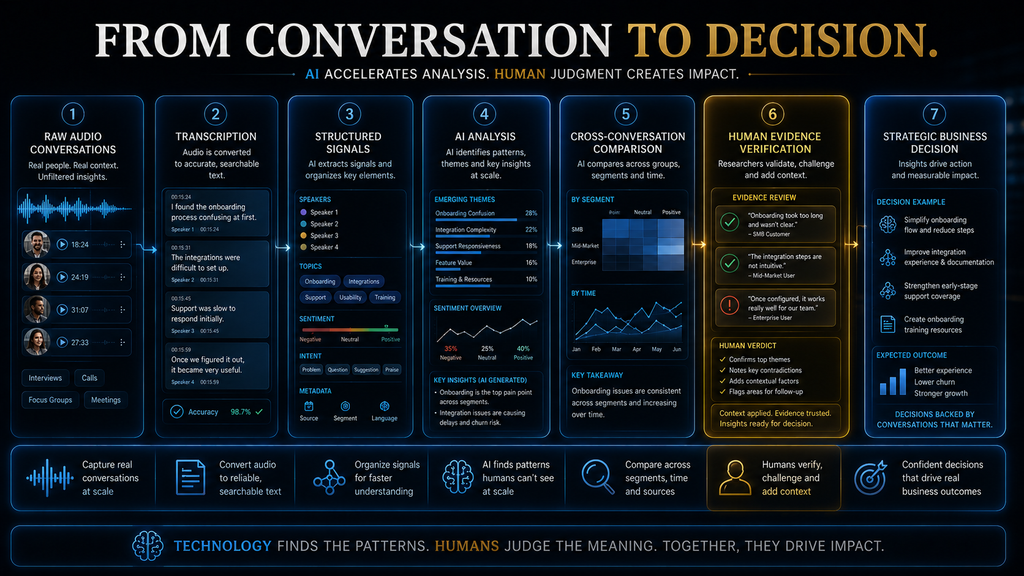
Modern platforms increasingly address that problem by allowing users to search and analyze entire conversation libraries rather than treating every recording as an isolated object. Speak AI, for example, describes its conversation-intelligence workflow around transcription, sentiment, keyword extraction, topic detection, speaker analysis, cross-conversation search, and AI-driven querying across a conversation library. That is the fundamental progression: Recording → transcription → structured signals → cross-conversation analysis → evidence → decision. The final step is important because conversation intelligence is not valuable merely because it produces analytics. It is valuable when those analytics improve a decision.
Test Speak AI on Your Own Recordings
Upload one call or interview and see whether the analysis fits the way your team reviews conversations.
Try Speak AI →Affiliate disclosure: We may earn a commission if you subscribe through this link, at no additional cost to you.
Why the “Best Tool” Question Is More Complicated Than It Looks
Search for conversation-intelligence software and you will quickly encounter products that appear comparable because they all advertise transcription, AI summaries, sentiment analysis, search, and conversation analytics. But those shared features conceal major differences in product philosophy.
A sales platform may interpret a conversation primarily through the lens of pipeline progression. A research platform may care more about themes, evidence, participant groups, coding, and research repositories. A customer-experience platform may be designed to combine conversational data with survey and service data across an enterprise. A meeting assistant may optimize for capturing what happened and turning it into action items. The underlying technology may overlap, but the decision environment does not.
That means feature comparison alone is a weak purchasing method. If two tools both offer sentiment analysis, that does not mean they are equally useful for a UX researcher. If two platforms both provide AI chat, that does not mean they provide the same level of evidence traceability. If two tools both transcribe meetings, that does not mean they are equally appropriate for analyzing 500 customer interviews. A better buying process begins with the job.
Ask what happens immediately before the software is used, what happens immediately after its analysis is produced, and what kind of decision depends on the result. That simple exercise usually reveals whether you need a research platform, customer-intelligence platform, sales conversation platform, or meeting intelligence system. This is also why the shortlist in this article deliberately spans different parts of the market rather than pretending that every product belongs to one homogeneous category.
The Four Types of AI Conversation Intelligence Tools
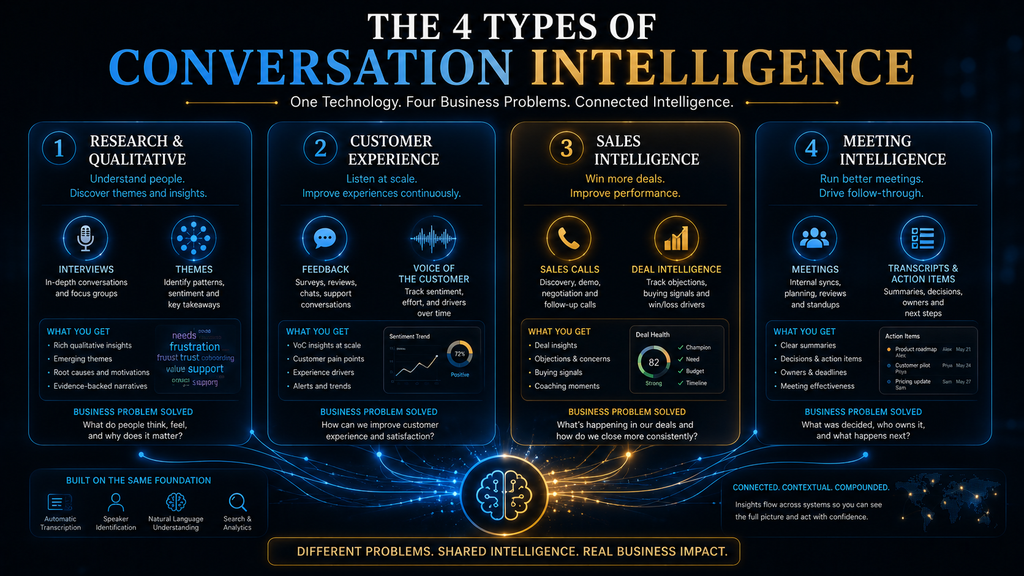
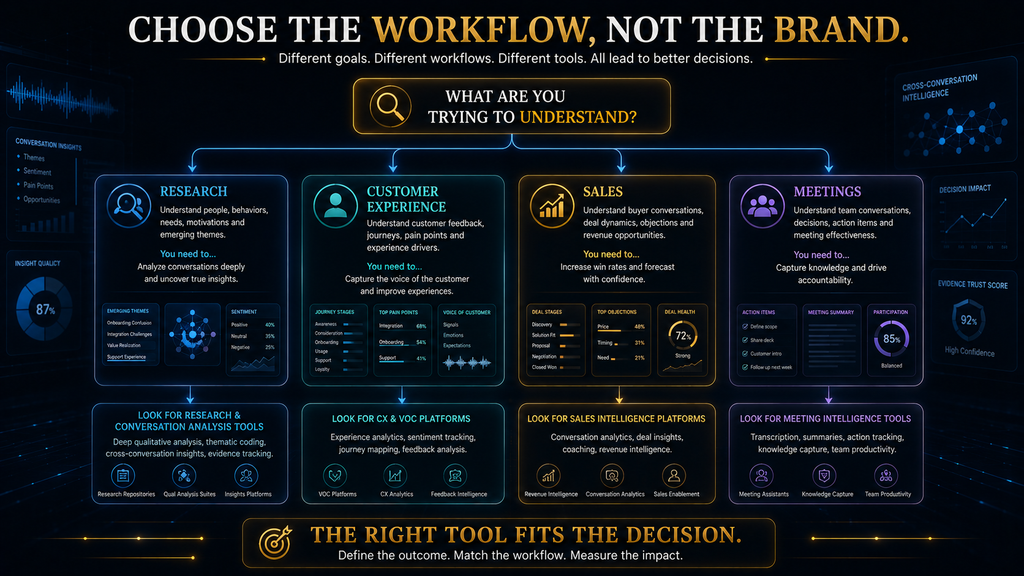
The market is easiest to understand when divided into four broad categories: research and qualitative analysis, customer experience and voice of customer, sales conversation intelligence, and meeting intelligence. These categories overlap technically, but their workflows and buying criteria are different.
1. Research and Qualitative Analysis Platforms. Research-first platforms are designed around interviews, focus groups, customer research, usability studies, transcripts, research repositories, themes, evidence, and synthesis. The key question here is not simply, “What happened in this conversation?” It is more likely to be, “What are the recurring patterns across these conversations, what evidence supports them, and what should we conclude?”
This category is particularly relevant to teams analyzing qualitative datasets where context matters. A researcher may need to compare themes across demographic groups, identify contradictory evidence, retrieve representative quotes, and repeatedly return to the source material while building a synthesis. Strong candidates: Speak AI and Dovetail.
2. Customer Experience and Voice-of-Customer Platforms. Customer-experience platforms operate at a broader level. They may combine surveys, calls, support interactions, digital feedback, reviews, and other sources into a larger customer-intelligence environment. Qualtrics, for example, supports automated text analytics that can identify topics and themes in unstructured customer data, while its Insights Explorer can identify major themes, generate headlines, and summarize open-ended feedback. This category makes sense when conversations are only one component of a larger customer-data strategy.
3. Sales Conversation Intelligence. Sales conversation platforms are optimized for revenue workflows. The question is often not “What are customers saying in general?” but “What does this conversation tell us about the deal, the buyer, the objection, the competitive environment, or the rep’s execution?” Gong explicitly positions its conversation intelligence around revenue teams and describes workflows involving customer interactions, deal risks, buying signals, coaching, CRM updates, and sales execution. That makes Gong highly relevant to sales organizations while making it less naturally aligned with a research team conducting qualitative interviews.
4. Meeting Intelligence Platforms
Meeting intelligence tools usually begin with capture. They record or ingest meetings, generate transcripts and summaries, identify action items, and make previous conversations searchable. Otter describes its product as a conversational knowledge engine that turns meetings into searchable knowledge, while its AI Chat can answer questions across conversations. Fireflies has moved beyond simple meeting notes as well, with meeting-level Smart Search and aggregate analytics designed to identify patterns across meetings. For meeting-focused tools, see our list of the best AI meeting assistants.
These platforms are excellent when the problem is meeting memory. They are not automatically the best answer when the problem is formal qualitative analysis.
How We Evaluated the Best AI Conversation Intelligence Tools
The most useful comparison is not a feature-count contest. For this article, the platforms are evaluated against seven practical dimensions.
- Capture. Can the platform reliably get your conversations into the system? This includes recordings, uploaded audio or video, meetings, calls, interviews, and other sources.
- Transcription. Can it turn conversations into usable, searchable text with speaker attribution and reasonable handling of different recording conditions?
- Analysis. Can it extract themes, sentiment, topics, keywords, entities, patterns, summaries, or other signals that matter to the intended workflow?
- Cross-Conversation Intelligence. Can it analyze multiple conversations as a dataset rather than forcing the user to repeat the same analysis one recording at a time?
- Evidence Traceability. Can the user move from an AI-generated insight back to the conversation, transcript, segment, or underlying evidence?
- Workflow Fit. Does the platform naturally support the actual job being performed—research, CX, sales, or meetings?
Human Validation
Does the workflow make it practical to inspect, challenge, verify, and contextualize AI-generated findings? That final criterion is not a minor detail. It may become one of the most important criteria in the category. We compare the two approaches in AI conversation analysis vs manual research.
A 2026 survey of 332 research practitioners by Condens found that 91% were using AI in some form and that 71% said AI allowed them to analyze data significantly faster. But the same study found that 71% also agreed that validating AI outputs still takes significant time, while only 21% agreed that they could trust AI outputs with minimal review. That creates an important paradox: AI can make analysis faster without making judgment unnecessary.
1. Speak AI — Best for Conversation Research and Cross-Conversation Analysis
Best for: researchers, customer-insight teams, consultants, analysts, and organizations that want transcription plus structured conversation analysis without building a large enterprise speech-analytics operation. Speak AI is the most strategically relevant platform in this comparison for the type of workflow covered throughout this guide because it sits directly at the intersection of transcription, qualitative analysis, speech analytics, and conversation intelligence. Its current product materials describe capabilities including transcription, sentiment analysis, keyword extraction, topic detection, speaker-level analysis, cross-session trends, custom AI analysis, dashboards, and AI Chat across conversation libraries. For research teams, see AI qualitative research explained.
The important feature is not any one of those capabilities in isolation. It is the way they combine. Imagine a research team with 150 customer interviews. A basic transcription platform can convert those interviews into text. A stronger conversation-intelligence workflow lets the researcher ask what themes recur, which topics differ between customer groups, where sentiment shifts, which keywords are becoming more common, and which conversations contain evidence related to a particular research question.
Speak AI currently positions its AI Chat as a way to query a broader conversation library and compare patterns across recordings rather than reading every transcript sequentially. That makes it particularly relevant to the central idea behind conversation intelligence: the shift from analyzing individual conversations to analyzing the conversation dataset as a whole.
What Speak AI does particularly well
The first strength is breadth within the conversation-analysis workflow. The platform can combine transcription with sentiment, themes, keywords, entities, speaker analysis, cross-session trends, and AI-driven questioning.
The second is accessibility. Speak AI’s current pricing page offers pay-as-you-go usage, a Pro subscription, and custom enterprise options. Its published pay-as-you-go rates currently include $2 per hour for standard transcription, $3 per hour for premium languages, $4 per hour for meeting transcription, and AI Chat from $0.08 per chat. Its Pro plan is currently listed at $20 per user per month when billed annually, with a pool of credits for usage.
The current free trial lasts seven days, includes premium functionality, and provides two credits for activities such as transcription or AI Chat.
That pricing structure matters because conversation analysis can have radically different usage patterns. A consultant may need intense analysis for one research project and very little the following month. A larger team may have recurring call volume. A flexible credit model can be more sensible than paying for a large enterprise platform simply because the software category sounds “enterprise.”
Where Speak AI becomes particularly interesting
The strongest use case is not transcription. It is cross-conversation intelligence. Suppose a company interviews 80 customers after launching a new product. A conventional workflow might involve transcribing the interviews, manually highlighting relevant statements, assigning codes, grouping those codes, and eventually building a synthesis. AI can reduce much of that mechanical workload. But the real leverage appears when the dataset becomes large enough that the team begins asking comparative questions:
Which complaints recur across customers? Which themes are concentrated in one customer segment? Did sentiment change between interviews conducted before and after a product release? Which issues are frequently mentioned together? Which concerns are emerging rather than already dominant? Which conversations contain evidence supporting a particular hypothesis? Those are dataset-level questions. Speak’s cross-conversation analysis capabilities are directly aligned with that kind of workflow.
The limitation you should understand
Speak AI should not be treated as an automatic qualitative researcher. Its own product capabilities can surface themes, sentiment, keywords, and patterns, but the existence of a pattern does not establish its importance. Frequency can be misleading. Sentiment classification can miss sarcasm, mixed emotions, cultural context, or domain-specific language. A theme that appears frequently may be less strategically important than a rare but severe issue. This is where the Condens research becomes relevant. Researchers reported substantial speed gains but continued to spend significant effort validating AI outputs.
So the best Speak AI workflow is not: AI analyzes → publish conclusion. It is: AI analyzes → researcher identifies candidate pattern → researcher checks source evidence → researcher interprets context → team makes decision. That distinction is fundamental.
Who should choose Speak AI. Choose it if your primary work involves interviews, customer calls, qualitative datasets, conversation analytics, speech analytics, or cross-conversation insight discovery and you want a platform that combines transcription and analysis. It is especially attractive if you want a more accessible alternative to large enterprise speech-analytics deployments and need to move from individual transcripts toward dataset-level analysis.
Who should look elsewhere. A sales organization seeking deeply embedded revenue operations, deal intelligence, forecasting, and sales coaching may find a sales-first platform such as Gong more naturally aligned with its workflow. A massive enterprise CX program spanning surveys, contact centers, digital feedback, and broader experience management may need something closer to Qualtrics. A team that primarily needs meeting notes and action items may not need a research-oriented conversation-analysis platform at all. Editorial verdict: One of the strongest overall choices for research-oriented conversation intelligence and cross-conversation analysis, particularly when you want a broad conversation-analysis workflow without starting with a heavyweight enterprise deployment. If you want to evaluate the platform directly, you can try Speak AI through the AI Hustle World affiliate link.
2. Dovetail — Best for Research Repositories and Organization-Wide Insight
Best for: UX research teams, product teams, customer-insight organizations, and companies that want to centralize research and feedback rather than simply analyze recordings. Dovetail occupies a slightly different position from Speak AI. Its strength is not just conversation analysis; it is the broader research and customer-intelligence repository. Its current platform supports calls, recordings, documents, surveys, research projects, semantic search, AI Chat, AI summaries, AI clustering, dashboards, AI opportunity tracking, AI agents, translation, integrations, and structured metadata. How AI turns feedback into roadmap decisions is covered in how AI turns customer feedback into product insights.
That matters because mature research teams eventually encounter a problem that transcription alone cannot solve: knowledge fragmentation. Research lives in one tool. Customer calls live somewhere else. Survey responses sit in a spreadsheet. Product feedback is in a support platform. A researcher remembers an insight but cannot find the original evidence. A product manager asks whether anyone has ever researched a particular issue. A research repository is designed to solve that organizational problem.
Dovetail’s current pricing page shows a free tier with one channel and one project, while its enterprise offering is custom-priced and expands capabilities such as channels, projects, AI features, dashboards, integrations, and organizational controls.
Where Dovetail has an advantage. The platform is particularly strong when the objective is to make research reusable. That distinction is subtle but important. Conversation intelligence answers: “What does this conversation dataset tell us?” A research repository asks a broader question: “How can our organization continuously find, organize, compare, and reuse what we have learned from customers?” Dovetail’s current feature set includes AI clustering, AI opportunity tracking, AI Chat, semantic search, global tags, metadata fields, dashboards, and integrations.
For a growing UX or product research function, that broader ecosystem can be more valuable than having the strongest individual transcription feature.
The trade-off. The broader the platform becomes, the more its value depends on the organization actually using the research system consistently. A small team with 20 interviews and a straightforward need for transcription plus cross-conversation analysis may not need a full research-operations layer. A larger product organization with years of research history may find that repository capability becomes essential. This is a classic example of why “best” should be tied to workflow maturity.
Editorial verdict: A strong choice when the primary problem is organizing and reusing research knowledge across a team, not simply analyzing conversations.
3. Qualtrics — Best for Enterprise Customer Experience Intelligence
Best for: large organizations that need to analyze customer feedback across multiple channels rather than relying on conversation data alone. Qualtrics is operating at a broader level than most tools in this list. Its current customer-experience capabilities include automated text analytics designed to identify emerging topics across customer feedback, while Insights Explorer can identify themes, generate headlines, and summarize open-ended feedback. That makes Qualtrics particularly relevant to organizations where calls are only one component of the customer signal. Our guide to analyzing customer feedback, calls and interviews at scale applies the same ideas to support and product teams.
Imagine an airline, bank, healthcare organization, telecom provider, or large retailer. Customer understanding may involve surveys, contact-center interactions, digital feedback, service interactions, social listening, and other sources. Treating every source as a separate analysis problem creates fragmentation. Qualtrics is designed to operate across that wider experience-management environment. Its 2026 product announcements emphasize omnichannel capabilities, automated text analytics, and the ability to bring customer feedback from different sources into a broader CX workflow.
Where Qualtrics shines. The biggest advantage is scale of context. If a customer mentions a problem in a call, gives a low survey score, complains through another channel, and later shows signs of churn, the business may want those signals considered together. That is a different problem from analyzing 30 interview transcripts. Qualtrics is therefore a strong candidate for organizations that need a comprehensive customer-experience intelligence layer.
The trade-off. The same breadth that makes Qualtrics powerful can make it unnecessary for a smaller or more focused research workflow. If your immediate need is to analyze interviews and compare recurring themes, buying an enterprise experience-management ecosystem may be solving a much larger problem than the one you currently have. That is not a criticism of the platform. It is a reminder that software scope should match operational scope. Editorial verdict: A powerful enterprise option when conversation analysis is part of a broader voice-of-customer and experience-management strategy.
Compare Features Against Your Workflow
Check transcription, analysis and export options against the tasks your team repeats every week.
Compare Speak AI Features →Affiliate disclosure: We may earn a commission if you subscribe through this link, at no additional cost to you.
4. Gong — Best for Sales Conversation Intelligence
Best for: revenue teams, sales managers, sales operations, and organizations that want conversations connected directly to pipeline and sales execution. Gong demonstrates why the term “conversation intelligence” can be misleading. Its platform captures and analyzes customer interactions, then connects those conversations to sales workflows. Gong describes use cases including deal-risk detection, buying signals, coaching, CRM automation, and sales-performance analysis. That is a highly specialized form of conversation intelligence. For a sales leader, the most important question may be: See how AI interview analysis works for the transcript-to-insight workflow.
“Which objections are appearing repeatedly in late-stage deals?” For a sales manager, it might be: “What do top-performing reps do differently?” For revenue operations, it could be: “Which customer signals indicate deal risk before the CRM shows a problem?” Gong is built around those questions.
Where Gong has an advantage. The key advantage is workflow specialization. Rather than simply analyzing conversations, Gong connects conversation data to revenue processes. Its current product materials describe workflows involving automated capture, transcription, AI analysis, deal signals, coaching, CRM updates, and sales recommendations. That specialization is valuable because the output is immediately connected to an operational system.
Why Gong may be wrong for a researcher
A qualitative researcher is not necessarily trying to predict a deal. They may be investigating how users describe a product, why participants abandon a workflow, how customers experience a feature, or what themes emerge across interviews. Trying to force a sales-first platform into that workflow can create unnecessary friction. This is why Gong should not be ranked lower simply because it is not the best research platform. It is strong because it solves a different problem. Editorial verdict: One of the strongest choices when conversation intelligence is fundamentally a revenue and sales-performance problem.
5. Otter — Best for Meeting Capture and Conversational Memory
Best for: professionals and teams that need reliable meeting capture, searchable transcripts, summaries, action items, and access to historical meeting knowledge. Otter is particularly interesting because its positioning has expanded beyond the traditional “AI meeting notes” category. Its current site describes Otter as a conversational knowledge engine that turns meetings into searchable knowledge, while AI Chat can answer questions across meetings and connected information. That means the product is moving toward a broader organizational-memory model.
The value is easy to understand. A meeting ends. Three weeks later, somebody asks what was agreed, who committed to what, or why a particular decision was made. Instead of searching through calendars and notes, the organization can search the conversational record. Otter also documents speaker recognition and transcript processing that separates dialogue by speaker, helping create a more usable searchable record. Its 2026 product direction is also moving toward making meeting knowledge accessible outside the original application, including an MCP server that allows connected AI applications to search and analyze Otter conversation data.
Where Otter is strongest. The core strength is meeting memory. If the problem is: “We have hundreds of meetings and nobody remembers what happened.” Otter is highly relevant. If the problem is: “We need a formal qualitative research workflow for 300 interviews, with structured research synthesis and evidence management.” The evaluation changes. Otter can provide the raw material and analysis layer, but it is not automatically the same thing as a dedicated research repository. Editorial verdict: A strong option for teams where the primary value of conversation intelligence is capturing, remembering, searching, and operationalizing meetings.
6. Fireflies — Best for Meeting Intelligence and Cross-Meeting Analytics
Best for: teams that want meeting transcription combined with searchable history, AI analysis, and workflow-oriented conversation analytics. Fireflies has expanded beyond simple transcription and meeting summaries. Its current documentation describes Smart Search for detailed meeting-level insights and an Analytics Dashboard for aggregated analysis across meetings. That makes it an interesting middle ground. The product can answer questions about an individual meeting, but it can also help identify patterns across a larger collection of meetings.
For example, a manager could examine recurring questions, speaker behavior, sentiment, or other patterns across multiple conversations rather than reviewing them independently.
Where Fireflies fits best. Fireflies is especially compelling for organizations that want a meeting-centric intelligence layer without turning their entire research operation into a dedicated research repository. It is therefore closer to Otter than to Dovetail in workflow orientation, although the exact capabilities and depth of analysis can vary considerably by plan and configuration.
The trade-off. If your business is fundamentally a research organization, the question is whether meeting intelligence is enough. If your business is fundamentally a sales organization, the question is whether a sales-specific platform provides more relevant workflow intelligence. The best use case for Fireflies is often the middle: teams that want meetings to become searchable, analyzable organizational data without requiring a highly specialized research or revenue platform. Editorial verdict: A strong meeting-intelligence choice for teams that want to move beyond summaries into searchable and aggregated conversation analysis.
Which AI Conversation Intelligence Tool Is Best?
There is no single winner because the six tools are solving different versions of the same underlying problem. The practical answer looks more like this:
| Tool | Best For | Core Strength | Biggest Reason to Choose | Main Limitation |
|---|---|---|---|---|
| Speak AI | Research, customer insights, conversation analysis | Cross-conversation analysis | Strong combination of transcription + themes + sentiment + AI analysis | Human validation is still essential |
| Dovetail | UX/product research | Research repository + synthesis | Makes research reusable across teams | Broader platform may be unnecessary for simple analysis |
| Qualtrics | Enterprise CX | Omnichannel customer intelligence | Connects conversation data with wider CX signals | Larger and more complex than many teams need |
| Gong | Sales | Revenue conversation intelligence | Connects conversations directly to sales workflows | Sales-centric rather than research-centric |
| Otter | Meetings | Searchable meeting knowledge | Excellent for capture, memory and meeting retrieval | Less research-oriented |
| Fireflies | Meeting intelligence | Meeting analysis + aggregation | Strong meeting-centric intelligence workflow | Not a dedicated qualitative research environment |
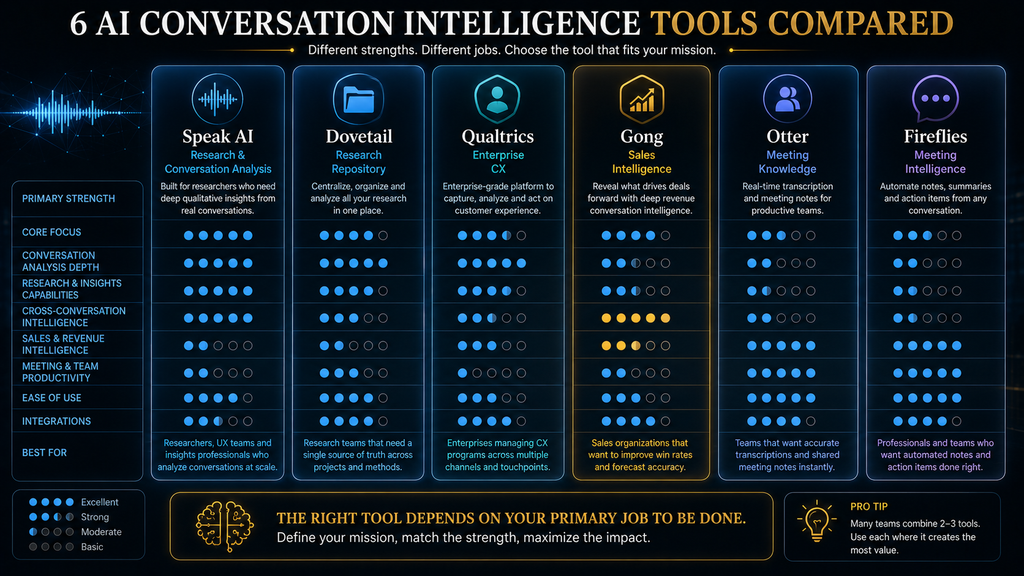
The table illustrates why a universal ranking would be misleading. If you are a UX researcher, Gong should not win simply because it is a famous conversation-intelligence platform. If you are a sales leader, Dovetail should not win simply because it is excellent at research organization. If you are running an enterprise CX program, a lightweight meeting assistant may not provide enough context. The correct question is what happens to the information after the AI analyzes it? That is the buying decision most comparison articles miss.
The Conversation Intelligence Buying Matrix
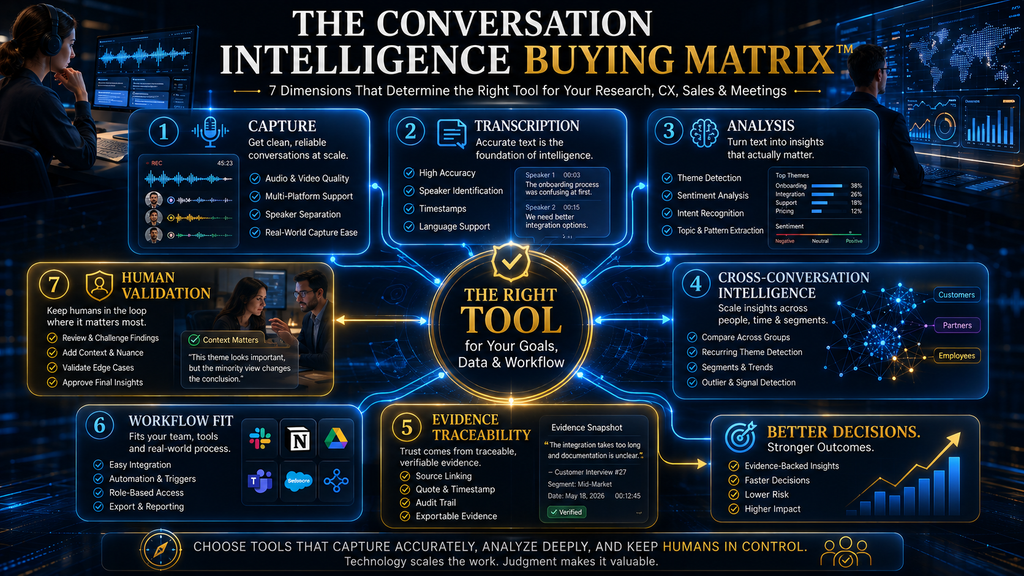
To make the decision easier, AI Hustle World recommends evaluating platforms through seven dimensions rather than feature count.
1. Capture: Can You Get the Right Conversations In. Start with the data. If your conversations come from Zoom, Google Meet, phone calls, uploaded recordings, interviews, focus groups, customer-support systems, or mixed sources, determine whether the platform handles those sources cleanly. A brilliant analysis engine is irrelevant if the workflow required to get data into it is painful. The practical test is simple: map your actual conversation sources before choosing the software.
2. Transcription: Can You Trust the Underlying Record. Every analysis downstream depends on the transcript or source representation. Speaker attribution, accents, background noise, overlapping speech, technical vocabulary, multiple languages, and recording quality can all affect the output. Do not evaluate transcription accuracy using a vendor’s generic statement that its system is “highly accurate.” Evaluate it against your own conversation environment. A research team working with clean one-on-one interviews has a very different transcription problem from a contact center dealing with noisy calls and overlapping speakers.
3. Analysis: Does the AI Surface Useful Signals. Themes, sentiment, keywords, entities, summaries, classifications, and custom questions can all be valuable. But more analysis does not automatically mean better analysis. The real question is whether the outputs correspond to decisions your team actually needs to make. If you never use speaker talk-time analysis, it should not receive the same weight as evidence traceability. If you rarely need sentiment, paying heavily for sentiment functionality may not make sense.
4. Cross-Conversation Intelligence: Can It See the Pattern. This is one of the biggest dividing lines between basic transcription software and genuine conversation intelligence. The ability to analyze one conversation is useful. The ability to compare 100 conversations is transformative. Suppose ten customers mention onboarding problems. That is interesting. Suppose 500 customers mention onboarding problems, and the platform allows you to compare the frequency of that theme across customer segments, time periods, product versions, or regions. That is much closer to organizational intelligence.
Cross-conversation analysis turns isolated observations into potentially meaningful patterns. But remember the caveat: patterns are hypotheses until they are interpreted and validated.
5. Evidence Traceability: Can You Get Back to the Source. This criterion is underrated. An AI system may tell you: “Customers frequently complain about onboarding complexity.” That sounds useful. But what happens next? Can you find the conversations behind that statement? Can you inspect the actual passages? Can you determine whether “complexity” means setup time, unclear terminology, missing documentation, pricing confusion, or something else? Can you retrieve representative examples? Without source traceability, an AI insight can become a polished conclusion that is difficult to audit. For serious research and decision-making, that is dangerous.
6. Workflow Fit: Does the Tool Match the Job. A tool that requires your team to constantly work around the product is not a good fit, regardless of how impressive the feature list looks. The best research platform should fit research. The best sales platform should fit sales. The best meeting platform should fit meetings. This sounds obvious, but software buying decisions frequently go wrong because organizations buy the most famous platform rather than the platform whose workflow most closely matches their actual problem.
7. Human Validation: Can a Person Challenge the AI?
This is the final and arguably most important criterion. AI should accelerate the movement from raw data to candidate insight. It should not eliminate the point where a knowledgeable person asks: Is this actually true? The Condens study provides strong evidence for this. While 71% of respondents reported faster analysis, the same percentage reported that validating AI outputs still takes significant time, and only 21% said they could trust AI outputs with minimal review. That means a good conversation-intelligence platform should not merely make AI output fast. It should make verification practical.
AI Conversation Intelligence vs Manual Research: Where AI Actually Adds Value
The right way to think about AI versus manual research is not replacement. It is division of labor. Humans are generally better positioned to understand research context, recognize contradictions, evaluate significance, challenge assumptions, interpret ambiguous statements, and make judgments that depend on organizational or domain knowledge. AI is particularly useful for repetitive analytical work involving large volumes of data. That creates a practical division:
| Task | AI Advantage | Human Advantage |
| Transcription | Speed and scale | Exception checking |
| Search | Broad retrieval | Query framing |
| Initial theme detection | Consistency and volume | Meaning and significance |
| Sentiment classification | Large-scale screening | Context and nuance |
| Pattern discovery | Cross-dataset comparison | Causal interpretation |
| Quote retrieval | Speed | Representative selection |
| Summarization | Compression | Judgment about what matters |
| Final interpretation | Limited | Strong |
| Strategic decision | Limited | Strong |
The mistake is assuming that because AI can perform the left column, it should also perform the right column. That is not what the evidence suggests.
The research instead points toward a supervised model in which AI performs substantial analytical work while humans review and approve the output. The Condens survey found that the dominant preferred approaches all involved human review or synthesis, while only a small minority wanted fully autonomous analysis. That is a more realistic model of AI-assisted research.
Why Manual Research Still Exists
It is tempting to describe manual qualitative analysis as an inefficient old method that AI has finally made obsolete. That would be a mistake. Manual research exists because meaning is contextual. A participant can say: “The product is simple.” That could mean the product is genuinely intuitive. Or it could mean the participant did not explore advanced features. Another participant might say: “I hate this interface.” That may sound negative, but perhaps they are reacting to one frustrating screen while still rating the overall product highly.
A machine can classify the words. A researcher must understand the meaning. The traditional method also exists because qualitative research is not simply counting words. Researchers develop codes, compare evidence, investigate contradictions, consider participant context, and revise interpretations as they learn more. AI can accelerate parts of that process. It does not remove the intellectual responsibility.
The AI + Human Validation Loop
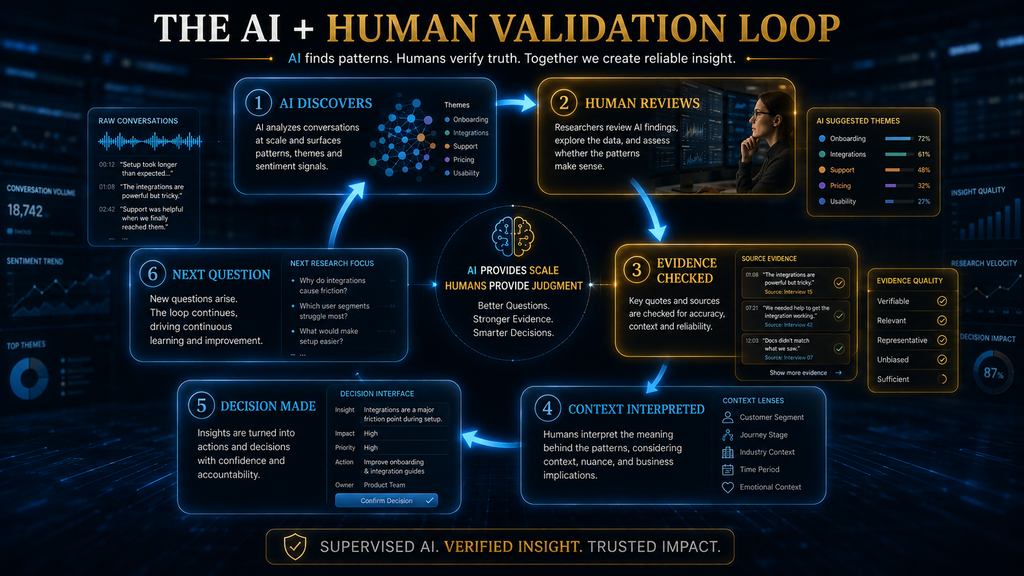
A stronger operating model looks like this: AI discovers → Human verifies → Evidence is checked → Context is interpreted → Decision is made → Results inform the next analysis. The first step is intentionally broad. AI can examine a much larger dataset than a person can comfortably inspect line by line. The second step introduces skepticism. The researcher selects candidate findings and checks whether they are actually supported. The third step returns to source evidence. This is where misleading summaries, incorrect classifications, outliers, and missing context can be discovered. Our comparison of the best AI research assistants covers the desk-research side.
The fourth step is interpretation. The team asks why the pattern matters, what might explain it, and whether the evidence is strong enough to act upon. The fifth step is decision-making. The sixth step closes the loop by creating new questions and improving future research. This is more powerful than treating AI as either a magical analyst or a useless summarizer.
Common Mistakes When Choosing Conversation Intelligence Software
Mistake 1: Choosing the Tool With the Longest Feature List. A long feature list is not a strategy. If your team only needs interview transcription, search, themes, and evidence retrieval, dozens of sales features may add complexity rather than value. Choose based on the workflow you need to operate.
Mistake 2: Treating Sentiment as Objective Truth. Sentiment analysis is useful for screening large datasets and identifying potentially important sections. It is not a perfect measurement of human emotion. Sarcasm, mixed feelings, cultural context, tone, and domain-specific language can all complicate classification. Use sentiment as a signal, not as a final verdict.
Mistake 3: Confusing Frequency With Importance. If 40% of customers mention a minor annoyance and 3% mention a catastrophic problem, the 40% theme is more frequent but not necessarily more important. AI systems are very good at finding recurring patterns. Humans still need to determine whether those patterns deserve action.
Mistake 4: Trusting a Summary Without Returning to Evidence. A concise AI summary can feel authoritative because it is written clearly. Clarity is not proof. Whenever an insight matters to a significant product, customer, financial, or strategic decision, the team should be able to inspect representative source evidence.
Mistake 5: Ignoring the Cost of Validation. AI can reduce analysis time while creating a new validation workload. That does not mean the technology failed. It means the economics must be measured across the whole workflow. The right question is not: “How much time did transcription save?” It is: “How much did the complete research-to-decision cycle improve?”
Mistake 6: Buying Enterprise Software Before Defining the Problem. A large organization does not automatically need the largest platform. Start by defining the workflow, volume, data sources, compliance requirements, number of users, and downstream integrations. Then select the smallest system that can reliably support the required workflow.
Mistake 7: Uploading Sensitive Conversations Without Reviewing Governance
Conversation data can contain personal information, confidential business information, customer details, proprietary strategy, or other sensitive material. Before uploading large datasets, review the vendor’s retention, access, deletion, security, data-processing, and contractual controls. NIST’s AI Risk Management Framework is useful as a broader reference for evaluating AI risks, governance, validation, and human oversight rather than treating the software as a black box.
How to Build a Practical Conversation Intelligence Workflow
The software is only one component. A strong workflow starts before the first recording is uploaded.
Step 1: Define the Decision. Do not start with: “Let’s analyze our calls.” Start with: “What decision do we need this analysis to improve?” Maybe the decision is whether to redesign onboarding. Maybe it is whether customers are dissatisfied with pricing. Maybe it is whether a sales objection is becoming more common. Maybe it is whether a feature is creating confusion. The decision determines what evidence matters.
Step 2: Define the Dataset. Decide which conversations belong in the analysis. Do not automatically throw every recording into one giant library and assume the AI will discover the right answer. Define the relevant period, participant group, product version, market, channel, or research project. Segmentation is part of analysis.
Step 3: Establish the Analytical Questions. Write the questions before examining the output. For example:
- What recurring problems are customers describing?
- Which problems appear across multiple segments?
- Which themes increased after the product release?
- What objections appear most frequently?
- What evidence contradicts the dominant pattern?
- Which findings require deeper qualitative review?
These questions give the AI a job instead of asking it to “find insights.”
Step 4: Let AI Perform the First Pass. Now the software can perform the mechanical work. Transcribe. Search. Cluster. Extract themes. Identify sentiment. Surface keywords. Find relevant segments. Generate candidate summaries. The purpose is not to accept everything. It is to reduce the search space.
Step 5: Verify the Findings. Select important outputs and return to the underlying evidence. Check whether the theme is genuinely present. Check whether the AI misunderstood a statement. Check whether the finding is based on enough conversations. Check whether there are contradictory examples. Check whether the strongest evidence comes from one unusual participant. This is where human expertise creates disproportionate value.
Step 6: Convert Findings Into Decisions
An insight is not finished when it is written. It becomes useful when someone knows what to do with it. For example:
- Finding: Customers repeatedly struggle with onboarding.
- Interpretation: The primary problem is not the number of steps but uncertainty about what happens after account creation.
- Decision: Redesign the onboarding sequence to clarify the next action and expected outcome.
- KPI: Activation rate within the first seven days.
That final step is what separates conversation analytics from business intelligence.
How to Measure Whether Your Conversation Intelligence Tool Is Actually Working
Do not measure success solely by the number of transcripts processed. Measure the workflow.
- Time to first useful insight. How long does it take to move from raw recordings to a credible finding?
- Analysis hours saved. How much manual transcription, search, tagging, and initial coding has been reduced?
- Validation burden. How much time does the team still spend checking AI output? This is particularly important because the Condens research shows that validation remains significant even when analysis becomes faster.
- Evidence coverage. For major findings, what percentage can be traced back to actual source evidence?
- Insight reuse. How often can previous conversation findings be retrieved and reused rather than rediscovered?
- Decision impact. How many product, customer, sales, or operational decisions were influenced by the analysis?
- Outcome improvement. Where possible, connect insights to measurable business outcomes such as:
- customer satisfaction
- churn
- activation
- conversion
- sales-cycle length
- support resolution
- product adoption
- research turnaround time
The final KPI is not “AI generated 500 summaries.” It is whether the organization made better decisions with less wasted analytical effort.
What Happens If You Do Nothing?
The cost of not adopting conversation intelligence is not necessarily “you will fall behind in AI.” The more immediate cost is that conversation data remains trapped in individual recordings, notes, memories, spreadsheets, and disconnected systems. As conversation volume increases, organizations face a familiar problem: more evidence becomes available while the percentage of evidence that humans can realistically review declines. That creates a dangerous asymmetry. The organization may have hundreds of hours of customer conversations but still make decisions based on the few conversations someone happened to remember.
Conversation intelligence does not automatically solve that problem, but it can reduce the gap between available evidence and usable evidence. That is the real strategic value.
What Changes Next in Conversation Intelligence?
The category is moving beyond transcription and summaries toward conversation agents and organizational knowledge systems. Speak AI is already positioning its product around conversation agents that move from capture and transcription toward automated analysis and querying across conversation libraries. Otter is similarly moving toward a conversational knowledge model, including MCP connectivity that allows external AI systems to search and analyze meeting data. Dovetail is expanding toward AI agents that continuously track customer signals and help organizations move from discovery toward action.
These developments point toward a larger shift. Today, the user often asks: “Analyze these conversations.” Tomorrow, the system may continuously monitor a defined conversation environment and surface meaningful changes without waiting for someone to launch an analysis manually. That sounds attractive, but it creates a new governance problem. If AI continuously watches conversations, the organization needs to decide:
- What should be monitored?
- What counts as meaningful?
- Who receives the signal?
- How is it validated?
- What evidence is retained?
- When should the system act automatically?
The more autonomous conversation intelligence becomes, the more important human-defined boundaries become.
Second-Order Effect: Faster Analysis Can Create More Demand for Analysis
There is an interesting consequence of making conversation analysis cheaper. When research takes three weeks, stakeholders learn to ask only the biggest questions. When AI reduces the analytical cost dramatically, stakeholders may start asking dozens of smaller questions. That sounds positive, but it can create a new bottleneck. The research team may spend less time manually coding transcripts while spending more time responding to requests for analysis, validating outputs, and explaining what the findings actually mean.
The Condens research hints at exactly this system-level issue: AI can make the researcher faster without necessarily making the broader organization equally self-sufficient. So the mature goal should not be: Analyze everything faster. It should be: Create a system where important questions can be answered faster without reducing analytical quality. That is a much more valuable objective.
Speak AI vs Dovetail vs Qualtrics vs Gong vs Otter vs Fireflies
The easiest way to make the final decision is to start with your primary workflow.
If you are primarily doing qualitative research. Start with Speak AI or Dovetail. Choose Speak AI when the core requirement is conversation analysis, transcription, themes, sentiment, speech analytics, and cross-conversation querying. Choose Dovetail when the broader requirement is a research repository that organizes customer evidence and makes research reusable across an organization.
- If you run enterprise customer experience. Start with Qualtrics. The broader omnichannel CX environment becomes more important than the sophistication of one individual conversation-analysis feature.
- If you run a sales organization. Start with Gong. The value comes from connecting conversation intelligence directly to revenue workflows, coaching, deal risk, buying signals, and CRM processes.
- If your main problem is meeting overload. Start with Otter or Fireflies. Both are positioned around capturing, searching, summarizing, and analyzing meeting conversations, with increasingly sophisticated cross-meeting capabilities.
- If you need a broad research and customer-intelligence ecosystem. Look closely at Dovetail and Qualtrics. The difference is organizational scale and scope. Dovetail is highly relevant to research and customer knowledge workflows, while Qualtrics operates across a much broader experience-management environment.
Which Tool Should You Actually Choose?
If you want the shortest possible decision framework, use this: For a method refresher, see Nielsen Norman Group’s guide to thematic analysis.
- Choose Speak AI if your core problem is understanding recorded conversations at scale.
- Choose Dovetail if your core problem is organizing and reusing research knowledge across teams.
- Choose Qualtrics if your core problem is enterprise-scale customer experience intelligence across multiple channels.
- Choose Gong if your core problem is sales conversations and revenue execution.
- Choose Otter if your core problem is capturing and remembering meetings.
- Choose Fireflies if your core problem is meeting intelligence with broader analytics and workflow automation.
None of those recommendations requires pretending that one product is universally superior. That is the point.
A Practical 30-Day Adoption Plan
Choosing the software is only half the job. If your organization wants to introduce conversation intelligence without creating a new technology project that nobody uses, start small. Speak AI lists its current plans on its pricing page, and its documentation covers the API and integrations.
- Week 1: Define the Use Case. Choose one conversation type. Do not analyze everything. Pick customer interviews, sales calls, product interviews, support calls, or internal meetings. Define the decision you want to improve.
- Week 2: Build the Dataset. Collect a representative sample of conversations. Include different participants, outcomes, and situations. Avoid selecting only the conversations that confirm what you already believe.
- Week 3: Run AI-Assisted Analysis. Use the platform to transcribe, search, classify, identify themes, compare conversations, and generate candidate insights. Keep a record of what the AI finds. Then manually review a sample of those findings against the source material.
- Week 4: Measure the Workflow. Compare the AI-assisted process against the previous manual process. Measure:
- time required
- number of conversations reviewed
- useful findings discovered
- validation effort
- evidence quality
- decisions influenced
If the workflow produces faster analysis without sacrificing confidence, expand it. If it produces faster but less trustworthy conclusions, change the validation process before expanding.
Final Thoughts
The conversation-intelligence market is becoming more capable, but it is also becoming more confusing. The temptation is to compare platforms by the number of AI features they advertise. That approach misses the most important question: what happens after the software generates the insight?
A researcher needs evidence and context. A product team needs patterns that can influence what gets built. A sales organization needs signals connected to deals and coaching. An enterprise CX team needs customer feedback connected across channels. A busy professional may simply need to remember what happened in yesterday’s meeting. The same underlying technology can support all of those workflows, but the right product architecture is different.
That is why the most useful way to choose conversation intelligence software is to work backward from the decision. Identify the conversations you need to understand, the questions you need to answer, the evidence you need to verify, and the workflow that needs to happen after the analysis. Then choose the tool. The strongest conversation-intelligence system is not the one that removes humans from the process. It is the one that removes the repetitive work that prevents humans from spending enough time on the parts that actually require judgment.
Choose the workflow, not the brand.
Decide Which Tool Fits Your Use Case
Match the tools in this list to your data types, team size and budget before you commit to a platform.
Review Speak AI Plans →Affiliate disclosure: We may earn a commission if you subscribe through this link, at no additional cost to you.
FAQ
What is the best AI conversation intelligence tool in 2026?
There is no universal winner because the leading platforms serve different workflows. Speak AI is particularly strong for conversation research and cross-conversation analysis, Dovetail for research repositories, Qualtrics for enterprise customer experience, Gong for sales intelligence, and Otter and Fireflies for meeting intelligence.
Is Speak AI good for qualitative research?
Yes. Speak AI currently provides transcription, theme extraction, sentiment analysis, keyword and entity detection, speaker analysis, cross-session trends, and AI-powered analysis across conversation datasets. Those capabilities make it particularly relevant to qualitative research and customer-insight workflows.
Is Dovetail better than Speak AI?
Not universally. Dovetail is particularly compelling when research organization, repository management, customer-feedback centralization, and organization-wide reuse are priorities. Speak AI is particularly compelling when the central requirement is conversation capture, speech analytics, themes, sentiment, and cross-conversation analysis.
What is the difference between conversation intelligence and meeting transcription?
Meeting transcription converts spoken conversation into text. Conversation intelligence adds analysis and retrieval capabilities that can identify themes, sentiment, topics, patterns, or other signals and may allow users to compare multiple conversations. Once you have transcripts, you can also turn video transcripts into articles, clips and social posts.
Can AI replace qualitative researchers?
AI can automate or accelerate many mechanical parts of qualitative analysis, but current research does not support treating human interpretation as unnecessary. A 2026 survey of 332 research practitioners found that AI increased speed and reduced workload, but validation remained significant and only a minority trusted AI output with minimal review.
Is sentiment analysis reliable enough for business decisions?
Sentiment analysis can be useful as a large-scale signal, but it should not automatically be treated as a definitive measurement of human emotion. Context, sarcasm, mixed feelings, language, culture, and domain-specific terminology can affect interpretation. Important decisions should be validated against the underlying conversation. Our guide to how AI finds themes, patterns and sentiment across conversations goes deeper on the method.
What should businesses check before uploading customer conversations?
Review data retention, access controls, deletion policies, security documentation, contractual terms, data-processing arrangements, and any applicable privacy requirements. The more sensitive the conversation data, the more important these checks become.
Is a meeting assistant the same as a conversation-intelligence platform?
Not necessarily. Meeting assistants typically emphasize capture, transcription, summaries, and action items, while conversation-intelligence platforms may provide deeper cross-conversation analysis, thematic analysis, sentiment analysis, research workflows, sales intelligence, or customer-experience analytics.
Written by
Muntasir Ahmad Chowdhury
Founder, AI Hustle World
Muntasir Ahmad Chowdhury is the Founder of AI Hustle World, an independent publication dedicated to making Artificial Intelligence practical, trustworthy, and easy to understand. He researches AI tools, automation, customer service, productivity, and real-world business applications, helping readers make smarter technology decisions through research-driven, experience-backed content.
Expertise:
AI Tools • AI Automation • AI Customer Service • AI Productivity • Generative AI • AI Workflows
Get Smarter With AI
Enjoyed this guide? Get practical AI tools, tutorials, and honest reviews delivered to your inbox.