Best AI Text-to-Speech APIs for Developers in 2026: Compared for Latency, Voices and Pricing
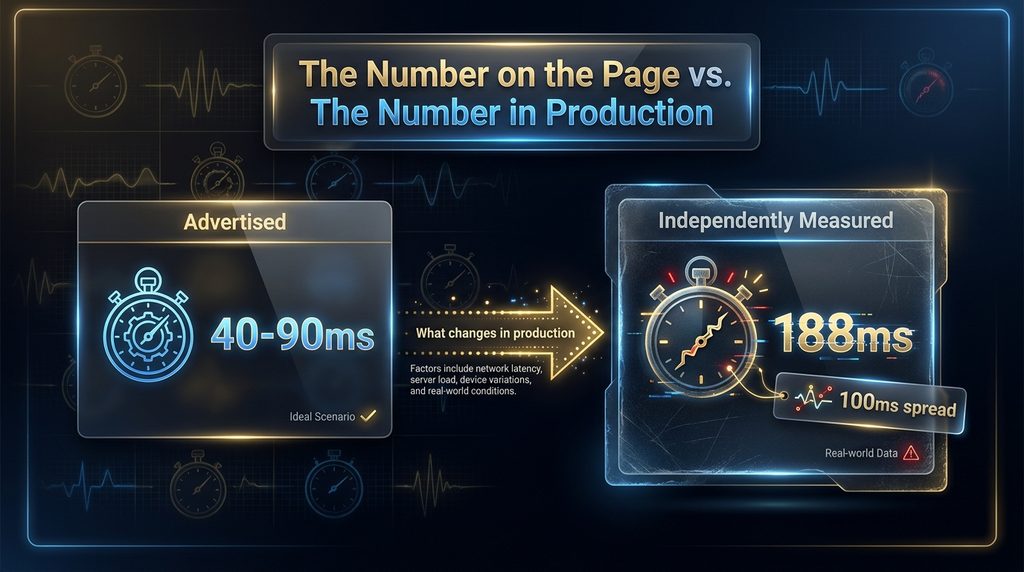
Cartesia advertised 40 to 90 milliseconds of latency for its Sonic-3 model. An independent benchmarking platform that tests these APIs under real production conditions measured its actual median at roughly 188 milliseconds — with a spread so wide that some requests came in far slower than the headline number ever suggested.
That gap isn’t a scandal. It’s just what happens when a vendor’s own demo conditions meet a real production workload. Every TTS API in this comparison publishes a latency number, and almost none of those numbers survive contact with an independent test the same way.
This guide compares the current field of developer-facing TTS APIs on the three things that actually determine whether an integration works in production: latency (measured independently, not vendor-quoted), compliance fit for your specific use case, and real cost at the volume you’ll actually run.
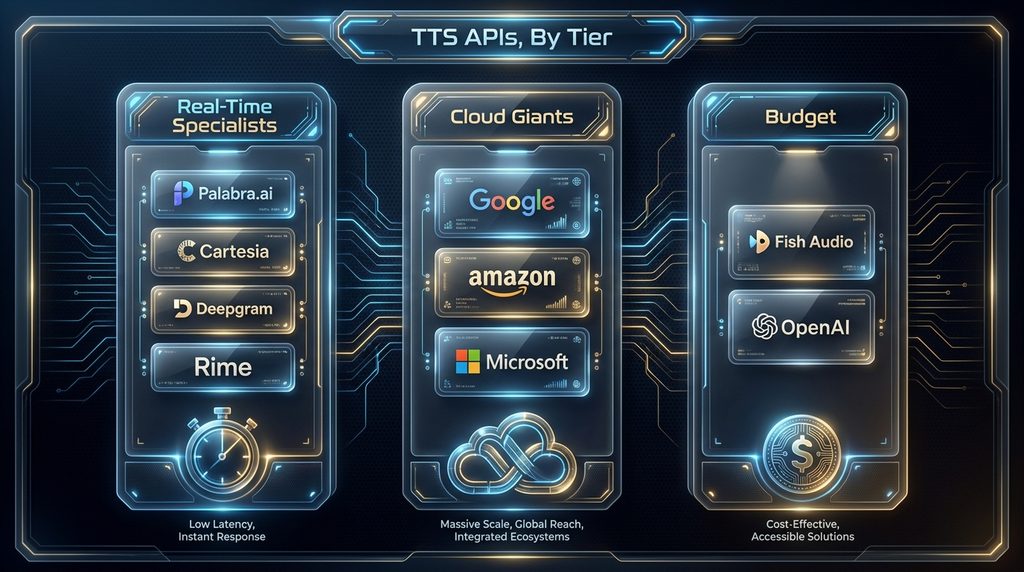
Ten APIs are covered here, spanning three cloud giants, five latency-focused specialists, and two budget-oriented options — deliberately more than most comparisons in this space, because the right answer genuinely depends on which of those three categories your project actually falls into.
Disclosure: this article may contain affiliate links. If you sign up through one, AI Hustle World may earn a commission at no extra cost to you. Every recommendation here is based on independent benchmark data, published pricing, and documented compliance posture — never on which program pays the most.
What This Article Covers
This piece compares TTS APIs specifically for developers integrating voice into a product — latency under real conditions, pricing at production scale, voice/language coverage, and compliance posture for regulated use cases.
It does not re-explain how TTS works mechanically — our text-to-speech explainer covers that. It also isn’t the same as our voice cloning comparison, which evaluates consumer/creator tools on realism and consent; the audience, criteria, and tools here are different, even where a company name overlaps.
It also covers ground most “best TTS API” roundups skip: how to read a benchmark that might be run by a vendor grading its own product, what compliance frameworks actually require versus what marketing copy implies, and how to verify a vendor’s numbers hold up once your own traffic is running through them.
Test ElevenLabs Against Your Latency Budget
Prototype one real request in ElevenLabs and measure how quickly audio starts against the requirements of your application.
Test the ElevenLabs API →Affiliate disclosure: We may earn a commission if you subscribe through this link, at no additional cost to you.
Why Vendor Latency Numbers Don’t Survive Production
Most TTS latency claims measure Time to First Byte — how fast the server responds at all — rather than Time to First Audio, how long until the first playable sound actually reaches a listener. In a streaming response, the first bytes back are often container metadata like WAV headers or MP3 ID3 tags, not audio a person can hear.
A server can return those header bytes in 50 milliseconds while the first real audio samples arrive 200 milliseconds later. A benchmark measuring the wrong thing reports 50ms. The person on the other end of a live voice agent experiences 250ms of silence.
An independent platform called Coval, which doesn’t sell TTS itself and raised a $28 million Series A specifically to evaluate voice AI, tests TTS and STT models on the metric that actually matters — Time to First Audio — under standardized conditions, with results refreshed continuously and methodology published rather than kept private.
That’s the difference between the 40-90ms Cartesia advertised and the roughly 188ms Coval measured: one is a number chosen to showcase the system at its best, the other is what a real request looks like when nobody’s picking the conditions in advance.
How We Got From Cloud TTS to Sub-100ms
A decade ago, “TTS API” meant one of a handful of cloud giants — Amazon Polly, Google Cloud TTS, Microsoft’s Azure Speech — all built around the same assumption: generate a complete audio file, then send it. Latency wasn’t a headline feature because nobody was building a live conversation on top of it.
Streaming changed that assumption. Instead of waiting for an entire response to render before sending anything, a streaming TTS API starts pushing audio chunks to the client as soon as the first few are ready, which is what makes a genuinely live voice agent possible at all — and it’s also exactly why measuring the wrong latency metric (Time to First Byte instead of Time to First Audio) became such an easy, common mistake once everyone started racing to advertise smaller numbers.
The current generation of specialist providers — Cartesia, Deepgram, Rime, and now Palabra.ai — exist specifically because the cloud giants’ architecture wasn’t built around chunked, low-latency streaming from the ground up. Retrofitting speed onto a system designed for batch generation is a fundamentally harder problem than building for streaming from day one, which is the real reason a newer, smaller company can out-pace an established cloud provider on this one specific metric.
The AI Hustle World TTS Fit Test
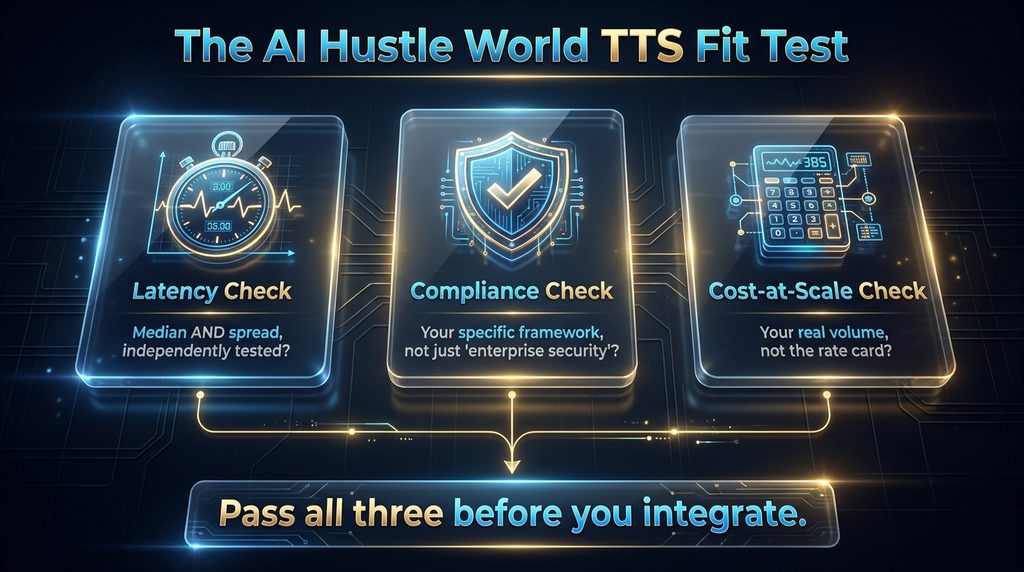
Before choosing an API from the comparison below, run your use case through three checks. We call this the TTS Fit Test, and unlike a vendor’s pricing page, it forces you to look past the headline numbers.
The Latency Check: what’s the median Time to First Audio under independent testing, not vendor marketing — and just as important, how wide is the spread around that median? A tool with a great median and a terrible tail latency will feel inconsistent to real users even when the average looks fine.
The Compliance Check: does this API actually meet the specific framework your use case requires — SOC 2, HIPAA with a signed BAA, GDPR data residency, PCI-DSS — rather than just “enterprise-grade security” marketing language that doesn’t map to any of them specifically?
The Cost-at-Scale Check: what does this actually cost at your real production volume, not the per-character rate on the pricing page? A cheap-looking rate can still be the most expensive option once you model your actual monthly character count against it.
| Check | Question | If it fails |
| Latency | What’s the median AND the spread, under independent testing? | Inconsistent real-world performance even with a good average |
| Compliance | Does it meet your SPECIFIC framework (HIPAA/PCI/GDPR), not just “enterprise security”? | Failed procurement review or a real compliance incident, covered later |
| Cost at Scale | What does your real monthly volume actually cost, not the rate card number? | A cheaper-looking API turns out to be the pricier one at your volume |
The APIs, Compared
A note on how this comparison was built: latency figures below come from Coval’s independent benchmark, not from us running our own tests. Pricing and feature detail come from vendor documentation. Treat every specific figure as a snapshot — this space moves fast enough that a leaderboard position can change within a couple of months — and verify current numbers before you commit.
ElevenLabs offers the broadest voice library in this comparison (3,000-5,000+ voices depending on tier, 29-70+ languages) across several models: Multilingual v2 for maximum quality, Flash v2.5 and Turbo v2.5 for lower latency, and the newer v3 for expressiveness.
Independent Coval data put Turbo v2.5 at roughly 264ms median latency with a relatively tight 28ms spread, and Flash v2.5 close behind at roughly 288ms — both usable for real-time work, though neither is the fastest option here. Multilingual v2, the highest-quality model, measured around 1,232ms independently — fine for narration, not viable for a live conversation.
Pricing runs $5-330/month in subscription tiers plus per-character API rates, generally the most expensive option in this comparison at high volume, with an enterprise tier offering SOC 2, HIPAA, GDPR and a Zero Retention Mode.
Cartesia’s Sonic-3 is the model at the center of this guide’s opening example: advertised at 40-90ms, independently measured by Coval at roughly 188ms median with a 100ms interquartile range — the widest spread of any major tool in this comparison, meaning real-world consistency lags well behind the headline number. Pricing is credit-based, roughly $5-37 per 1M characters depending on plan.
Deepgram’s Aura-2 is positioned specifically for developers building voice agents, with a roughly $30 per 1M character pay-as-you-go rate and Coval-measured latency around 313ms median with a 68ms spread — slower on the median than Cartesia, but more consistent, which matters more than the raw number for many production use cases. Deepgram’s own published benchmarking work with Coval extends beyond TTS to its speech-recognition side too, positioning the company’s Nova line as a latency leader on the transcription half of a voice-agent stack — relevant if you’re evaluating Deepgram as a combined speech-to-text-and-text-to-speech provider rather than sourcing each half from a different vendor.
Rime AI targets voice agents specifically, with sub-200ms latency generally (sub-100ms when self-hosted on-prem), 300-plus voices, and — notably for regulated use cases — SOC 2 certification with a Business Associate Agreement available, which few competitors in this list offer explicitly.
Its model lineup splits by purpose: Mist v2/v3 for general conversational latency, and Arcana specifically tuned for more expressive, higher-fidelity output when quality matters more than shaving the last few milliseconds. Pricing runs $20-30 per 1M characters with a 10,000-character free tier.
Documentation and SDK Quality Matter More Than the Comparison Charts Suggest
Almost every comparison in this space ranks providers on latency, voices, and price, and almost none mention integration friction — which is a genuine gap, since a slightly slower API with clear documentation and a well-maintained SDK can cost a team less total time than a faster one that requires reverse-engineering undocumented behavior.
The established cloud providers (Google, Amazon, Microsoft) generally offer the most mature, thoroughly documented SDKs across the widest range of languages, a direct benefit of being platforms with years of broader developer-tooling investment behind them, not just a TTS feature bolted on. Newer, latency-focused specialists tend to have leaner documentation focused specifically on the streaming/WebSocket integration path their product is built around, which is fine if that’s exactly the integration you’re building and frustrating if you need something outside that narrow path.
This is worth testing directly rather than trusting a comparison chart: spin up the smallest possible working integration with your top two or three candidates before committing, and pay attention to how much you had to guess versus how much the documentation actually told you. Rate limits and concurrent-request ceilings are a related, frequently overlooked integration detail: a provider’s advertised latency figure assumes your requests aren’t competing with thousands of others for the same infrastructure, and a free or low tier’s concurrency cap can bottleneck a production launch even when the underlying model itself is fast enough on paper.
OpenAI’s TTS lineup (tts-1, tts-1-hd, and the newer token-priced gpt-4o-mini-tts at roughly $0.015/minute) is convenient if you’re already building on OpenAI’s other APIs, but tts-1-hd measured around 2,295ms independently — by far the slowest tool in this comparison, and not a candidate for anything real-time. Google Cloud Text-to-Speech offers the broadest tiered pricing structure ($4 for Standard/WaveNet up to $160 for Studio voices per 1M characters) and 220-380+ voices across 40-75+ languages, with 200-500ms latency — built for narration and GCP-ecosystem integration rather than live conversation.
Amazon Polly is the budget-and-AWS-ecosystem pick, roughly $4-100 per 1M characters with a generous free tier, 60-plus voices, and native low latency for AWS-hosted applications specifically. Microsoft Azure AI Speech has the broadest language coverage found in this research — 400-plus voices across 140-plus languages — at $16-100 per 1M characters, positioned around enterprise and Microsoft-ecosystem integration with a Personal Voice cloning option. Fish Audio is the budget option worth knowing about specifically: $15 per 1M characters with a notably cheap voice-cloning add-on around $0.10 per voice, at 44.1kHz quality — a real option for cost-sensitive projects that don’t need enterprise compliance.
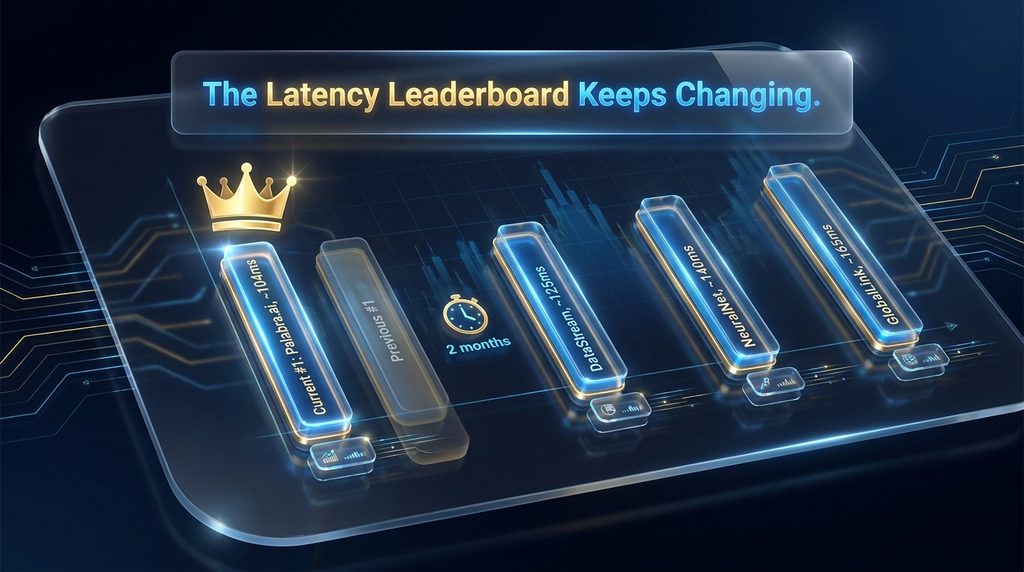
Palabra.ai is the newest name in this comparison and the current Coval latency leader as of a recent capture, at roughly 103-104ms median — nearly twice as fast as the next competitor at that snapshot. It’s new enough that broader developer experience and long-term reliability data are still limited, which is itself worth weighing against its speed.
Beyond the ten named above, self-hostable open-source options — Piper, Coqui’s XTTS, StyleTTS2 — are worth knowing about specifically for teams that want full infrastructure control and no per-character billing at all. None were deeply benchmarked in this research pass; treat them as a real option for a team with the engineering capacity to run and maintain the infrastructure themselves, not a drop-in replacement for a managed API.
How to Read Any “Fastest TTS API” Ranking
The same pattern found in our voice cloning comparison repeats here: at least one site publishing TTS comparison content ranks its own TTS product first, citing an independent benchmark it references but doesn’t run itself — a subtler version of a vendor grading its own homework.
The tell is the same as before: a real comparison names its exact methodology (which benchmark, which capture date, which conditions) the way the best sources in this research do. A ranking that just asserts a #1 spot without that detail is worth reading as marketing dressed as analysis.
This guide’s own limitation deserves the same honesty: none of the latency figures above come from tests we ran ourselves. They’re drawn from Coval’s published, methodologically transparent benchmark — a meaningfully more defensible source than an undisclosed vendor test, but still not the same as independent hands-on verification, and worth confirming against Coval’s live, continuously-updated leaderboard before you commit budget to any one API.
What This Actually Costs
Per-1M-character pricing across this comparison spans roughly $4 (Amazon Polly and Google’s Standard tier) to $330/month in ElevenLabs’ top subscription tier, with most developer-focused options landing between $15 and $37 per 1M characters.
The rate card number is the wrong number to plan a budget around, though. Put in concrete terms: a voice agent handling 10,000 calls a month, each averaging 500 characters of generated speech per call, uses 5 million characters monthly — at $30/1M (Deepgram Aura-2’s rate) that’s $150/month, but at ElevenLabs’ higher API tiers the same volume could run several times that, and at Google’s Studio-voice tier it could run higher still.
That’s the real reason the Cost-at-Scale Check exists: two APIs that look similarly priced on a per-character basis can diverge sharply once you model your actual monthly volume against each one’s specific tier structure, free-tier ceiling, and volume discounts.
A batch/narration use case models differently: an audiobook publisher converting a 90,000-word backlist title (roughly 500,000 characters) runs about $2 on Amazon Polly’s standard tier, versus $60-150 on ElevenLabs’ higher-quality models — a gap that matters far less per-title than the voice-agent example above, since a publisher runs this cost once per book rather than continuously across thousands of monthly calls. Matching the pricing model to whether your usage is continuous or one-off changes which “cheap” option actually is cheap.
Free tiers are worth modeling separately from paid pricing, since they determine how far you can validate an idea before any cost enters the picture at all: Google’s 4M Standard/1M WaveNet characters per month, Rime’s 10,000-character tier, and Amazon Polly’s generous new-account allowance all support meaningfully different amounts of real prototyping before a credit card is required.
Against the alternative of building and maintaining your own TTS infrastructure, even the higher end of this pricing range is typically cheaper than the engineering time required to train, host, and maintain a comparable in-house model — which is the same “buy vs. build” calculus that applies across noise cleanup, music generation, and podcast production.
See What the API Costs at Your Volume
Estimate your monthly characters and compare API pricing with plan credits before you choose a provider.
Compare ElevenLabs Pricing →Affiliate disclosure: We may earn a commission if you subscribe through this link, at no additional cost to you.
Enterprise Compliance: SOC 2 Isn’t Enough
SOC 2, HIPAA, GDPR, and PCI-DSS are four different frameworks with different requirements, and treating “enterprise-grade security” marketing language as proof of any specific one of them is a mistake that shows up in failed procurement reviews constantly.
SOC 2 audits general security, availability, and confidentiality controls. HIPAA specifically requires a signed Business Associate Agreement, encryption of protected health information in transit and at rest, and the ability to prove PHI can be purged on request — none of which SOC 2 certification alone satisfies. A TTS vendor can be genuinely SOC 2 certified and still not be HIPAA-ready.
The cost of getting this distinction wrong is not abstract: the average healthcare data breach cost roughly $9.77 million in 2024, with about 68 percent traced back to a third-party vendor or a misconfigured integration point. The FCC fined a single robocall operation $300 million in 2023; HHS separately extracted a $4.75 million settlement from Montefiore Medical Center over a PHI-handling failure.
Those numbers aren’t cited to be alarmist — they’re cited because they’re the actual scale of what “we assumed SOC 2 covered it” turns into once something goes wrong. A team building a healthcare voice application on the wrong compliance assumption isn’t risking a slow support ticket; it’s risking the kind of incident regulators specifically fine at a scale that ends products and careers.
Data residency adds a layer of subtlety most teams miss even after they think they’ve solved it: storing call recordings in an EU-region storage bucket doesn’t make a pipeline GDPR-compliant if the TTS or STT inference itself runs on US-based servers during processing. Data residency, data sovereignty, and where AI inference actually happens are three separate questions, and a vendor answering one doesn’t mean the other two are covered.
PCI-DSS adds yet another distinct layer specifically for any voice application that might touch payment card data — a caller reading a card number aloud during a support call, for instance. An architecture that doesn’t specifically redact or avoid processing that data at the point of capture can pull an entire voice pipeline into PCI audit scope even if the TTS vendor itself was never handling payment data directly.
Newer frameworks are entering procurement conversations too: ISO 42001, an AI-governance standard, is increasingly requested in enterprise RFPs; the EU AI Act’s obligations for general-purpose and high-risk systems are phasing in through August 2026. And a wrinkle specific to voice agents handling live calls: several US states, including California, Illinois, Florida, and Pennsylvania, require all-party consent to record a phone call — a legal requirement entirely separate from whatever compliance posture your TTS vendor has.
Real-World Examples: Where This Already Works
11x, an AI sales-agent company backed by Andreessen Horowitz and Benchmark with more than $76 million raised, built “Julian,” a real-time AI voice agent for outbound sales calls, specifically on Cartesia. For a persuasive, live sales conversation, the company needed both low latency and natural delivery — even minor unnatural pauses undermine trust fast enough to hurt conversion, which made Cartesia’s speed-first positioning the deciding factor over competitors.
That decision is worth reading alongside this guide’s opening example rather than in isolation: 11x picked Cartesia for exactly the metric where Coval’s independent testing later showed the biggest gap between advertised and measured performance. That’s not a criticism of 11x’s choice — Cartesia’s real 188ms is still fast — it’s a reminder that even a well-resourced, technically sophisticated team can end up choosing based on a number that needed independent verification.
ElevenLabs’ own published customer stories span a genuinely wide range: Immobiliare.it, an Italian real estate platform, built a conversational agent in days; Anarock scaled its sales voice agents fivefold using the same platform; language-training and multilingual customer-support deployments round out the pattern. These are vendor-published stories, worth treating as illustrative rather than independently audited results.
A more independently-sourced signal comes from a genuine third-party AWS Marketplace review describing Deepgram powering automated customer-support voice agents with what the reviewer called a significant reduction in manual query handling — thinner on hard numbers than the vendor case studies, but a real, unprompted customer account rather than marketing copy.
Why Human Review Still Belongs in the Loop
None of this argues for removing people from a voice-agent pipeline entirely, and the reason connects directly to the Fit Test’s Compliance Check. An API can pass every latency and accuracy benchmark and still generate a response that’s technically correct and contextually wrong — a tone mismatch on a sensitive support call, a mispronounced name that undermines trust, a compliant-on-paper disclosure read in a way that doesn’t actually land with the caller.
11x built “Julian” on Cartesia specifically because sales conversations are persuasive and high-stakes enough that voice quality alone doesn’t guarantee results — the company still layers monitoring and human oversight on top of the underlying API rather than treating the model as a finished product the moment it’s integrated. That’s the same pattern seen in music, podcast production, and voice cloning: the API is the fast, competent first pass; a human review layer is what turns it into something a business can actually stand behind at scale.
Common Mistakes to Avoid
Benchmarking Time to First Byte instead of Time to First Audio is the most common technical mistake, and it can understate real perceived latency by 150-200ms — exactly the gap between when a server responds at all and when a listener actually hears something. Trusting a vendor’s median latency without checking the spread is a close second: a tool with an excellent P50 and a wide interquartile range will still feel inconsistent under real production load, which is precisely the pattern Coval’s data exposed in Cartesia’s numbers.
Treating SOC 2 certification as proof of HIPAA or PCI readiness is a third, and it’s the mistake most likely to stall a deal in procurement review rather than show up as a technical bug — confirm the specific framework your use case requires, not just “enterprise-grade” language. Modeling cost from the per-character rate card instead of your actual monthly volume is a fourth — the Cost-at-Scale Check exists because the cheapest-looking rate and the cheapest actual bill are frequently not the same API.
Choosing based on a vendor’s own demo audio, recorded under ideal conditions, rather than testing on your own scripts and expected concurrency is a fifth — the gap between a polished demo and your actual traffic is exactly where the vendor-claim-vs-reality problem this guide opened with comes from. Assuming a single benchmark snapshot stays accurate is a sixth: this comparison itself will need updates within months given how fast the Coval leaderboard has moved in the period covered by this research — treat every specific latency figure in this guide as dated the moment it’s read, not as a permanent ranking.
Who Should Use Which API
If you’re building a real-time conversational voice agent where every 50 milliseconds of latency is felt by the person on the call, prioritize Coval’s independently-measured latency and consistency over any vendor’s advertised number — as of this research, Palabra.ai and Deepgram Aura-2 are worth close evaluation specifically for that consistency. If your use case is narration, batch content generation, or anything not latency-sensitive, ElevenLabs’ voice quality and language breadth, or Google Cloud TTS’s tiered pricing and SSML control, matter more than shaving milliseconds off a response that isn’t happening live.
If you’re in healthcare, finance, or another regulated industry, start from the Compliance Check, not the latency leaderboard — Rime AI’s SOC 2 certification with BAA availability, or ElevenLabs’ and Azure’s enterprise tiers with explicit HIPAA/GDPR support, narrow the field before speed ever becomes the deciding factor. If you’re cost-sensitive and building a prototype or a low-stakes project, Amazon Polly’s free tier and AWS-native pricing, or Fish Audio’s budget rates, let you validate an idea before committing to a pricier production-grade option.
If you’re already deep in one cloud ecosystem, the native option — Polly on AWS, Azure Speech on Microsoft’s stack — often wins on integration friction alone, even when a specialist competitor is faster or cheaper on paper. If you’re evaluating a genuinely new entrant like Palabra.ai specifically for its latency lead, weigh that speed against the real cost of building on a less-established provider — thinner documentation, a smaller community to draw troubleshooting help from, and less production track record than a Cartesia or Deepgram carry by now.
If your product needs to serve a genuinely global audience, weigh voice/language breadth as heavily as latency — Azure’s 140-plus languages and Google’s 75-plus language variants cover markets that latency-focused specialists, several of which are still English-primary, simply don’t reach yet.
What Still Goes Wrong
No single API leads on both latency and word-error-rate accuracy simultaneously, per Coval’s own published findings — the fastest options tend to trade some accuracy for speed, and the most accurate options are rarely the fastest, which means the Fit Test’s Latency Check has to be weighed against your tolerance for occasional mispronunciation, not treated in isolation. Benchmark leaderboards shift fast enough that a specific ranking can be outdated within a couple of months — Palabra.ai’s rise to the top latency spot happened within roughly two months of an earlier snapshot showing a different leader, which means any specific number in this guide should be re-checked against Coval’s live leaderboard rather than trusted as a permanent ranking.
Newer, faster entrants like Palabra.ai carry a real trade-off competitors with longer track records don’t: less publicly available data on reliability, uptime under sustained load, and long-term consistency, since there’s simply been less time for that data to accumulate.
Regional network latency is a variable no benchmark can fully account for on your behalf: Coval’s figures are measured from Coval’s own testing infrastructure, which may sit closer to or farther from a given provider’s servers than your own users are. A provider that benchmarks well overall can still be the wrong choice if its nearest data center is on the other side of the world from your actual user base.
What Happens If You Skip the Compliance Check
Skipping the Latency or Cost-at-Scale checks mostly costs you a worse product experience or a higher bill than expected. Skipping the Compliance Check is different in kind: a healthcare or financial deployment built on a TTS API that turns out not to meet the specific framework you needed can stall in procurement, fail an audit, or in the worst case contribute to exactly the kind of breach that cost the industry $9.77 million on average per incident in 2024.
The opposite failure — choosing the slowest, most conservative, most expensive enterprise option out of excess caution for a project that never actually handles regulated data — has its own real cost: overpaying for compliance guarantees a low-stakes internal tool never needed in the first place.
How to Verify Your Own Production Latency
Once you’ve picked an API, don’t rely on Coval’s or the vendor’s numbers indefinitely — measure Time to First Audio in your own production environment, under your own real traffic patterns and concurrency, since network path and geographic distance to the API’s servers both affect the number you’ll actually experience. Track the spread, not just the average: log P50, P90, and P99 latency separately, since a tool that looks fine on average can still be delivering a noticeably bad experience to the unlucky tail of your users.
Re-benchmark after any major vendor model update, the same way this guide’s own figures need re-checking against Coval’s live leaderboard — a model swap on the vendor’s side can shift your production latency without any change on your end at all. Set an internal threshold before you launch, not after: decide what P50 and P99 latency your specific use case can tolerate before you see the numbers, so a borderline result doesn’t get rationalized as “good enough” simply because switching providers feels like more work than shipping with what you already integrated.
Build a simple internal dashboard rather than relying on memory of “how it felt” during testing: log every request’s TTFA alongside the specific voice, script length, and time of day, so a gradual regression — a vendor’s infrastructure getting slower under growing load, for instance — shows up as a trend rather than going unnoticed until a user complains.
What’s Next
The clearest trend to watch is how quickly the latency leaderboard itself keeps changing — Palabra.ai’s rapid rise suggests this market hasn’t settled, and another new entrant beating today’s fastest option within the next few months would be entirely consistent with the pace found in this research. A second thread is price pressure: as more credible competitors enter at aggressive per-character rates, expect the established players — particularly ElevenLabs, the most expensive option in this comparison — to face real pressure on pricing at the high-volume end of the market specifically.
A third is compliance becoming a bigger differentiator than latency for enterprise buyers specifically, as frameworks like ISO 42001 and the EU AI Act’s phased obligations turn “compliance-ready” from a nice-to-have into a procurement requirement that eliminates non-compliant options before speed is ever compared. A fourth, more speculative thread: as independent benchmarking platforms like Coval become the reference point buyers actually trust over vendor marketing, expect more of this market’s competitive energy to shift toward performing well on those specific public benchmarks — which is a genuine improvement over pure marketing claims, but not the same thing as every provider getting better at everyone’s actual production conditions simultaneously.
A second-order effect worth watching is on the developer tooling around these APIs rather than the APIs themselves: as more teams build voice agents on top of whichever provider wins this month’s latency race, expect more abstraction layers and multi-provider routing tools to emerge specifically so a team can swap the underlying TTS API without rewriting their whole voice stack — insulating themselves from exactly the kind of leaderboard churn this guide describes. A third second-order effect is on the independent benchmarking layer itself: as Coval’s methodology becomes the de facto reference this guide treats it as, expect vendors to start optimizing specifically for what Coval measures, the same way search engine optimization emerged once Google’s ranking factors became known — which means even an independent benchmark’s numbers should be revisited periodically for whether they still reflect real production conditions or have started reflecting benchmark-specific tuning.
Final Thoughts
The 40-90ms Cartesia advertised and the roughly 188ms Coval measured aren’t really a story about one company’s marketing — they’re a preview of what happens to almost every vendor-quoted number in this market once it meets a real production workload instead of a demo. If you are choosing a voice for content rather than an application, our guide to using ElevenLabs for YouTube and faceless videos and the ElevenLabs dubbing explainer cover the creator side.
The decision that actually matters isn’t which API has the best headline number. It’s which one clears your latency bar under real conditions, actually satisfies the specific compliance framework your use case needs, and costs what you expect once your real volume runs through it — not the number on the pricing page. Run the Fit Test before you integrate anything, and re-verify it in your own production environment after you do.
None of the ten APIs compared here is wrong, exactly — each is the right answer for a specific shape of problem: Palabra.ai or Cartesia for raw speed, Rime for regulated voice agents, ElevenLabs for voice and language breadth, the cloud giants for ecosystem integration and mature tooling. The mistake this guide is built to prevent isn’t picking the wrong one; it’s picking based on a number that was never going to survive your actual traffic in the first place.
Decide Whether ElevenLabs Fits Your Stack
Weigh voice quality, latency and cost per minute against the other providers in this comparison before you commit.
Review ElevenLabs for Your Stack →Affiliate disclosure: We may earn a commission if you subscribe through this link, at no additional cost to you.
Frequently Asked Questions
What is the fastest text-to-speech API in 2026? Palabra.ai currently holds the top spot on Coval’s independent benchmark at roughly 103-104ms median Time to First Audio, though this leaderboard changes quickly — verify current standing before treating any single ranking as settled, since the #1 position changed at least once during the research period behind this guide. What’s the difference between Time to First Byte and Time to First Audio?
Time to First Byte measures how fast a server responds at all, including container metadata like WAV headers that arrive before any playable sound. Time to First Audio measures when a listener actually hears the first real audio, which is the number that determines perceived responsiveness — and the two can differ by 150-200ms on the same request.
Why did Cartesia’s real latency differ from its advertised number? Cartesia advertised 40-90ms for Sonic-3, but Coval’s independent, production-realistic benchmark measured a median closer to 188ms with a wide spread around it — a common gap between vendor demo conditions and real-world testing across this entire market, not unique to one company. Is ElevenLabs or Cartesia better for a voice agent?
It depends on what you’re optimizing for: ElevenLabs offers broader voice and language selection with independently-verified latency in the 260-290ms range for its faster models, while Cartesia targets lower latency specifically but showed more variability in independent testing — test both against your own use case rather than picking on reputation alone. Is SOC 2 certification enough for a healthcare voice application?
No. HIPAA requires a signed Business Associate Agreement, encryption of protected health information in transit and at rest, and provable data deletion — requirements SOC 2 certification alone does not satisfy, even though the two are often marketed together.
How much does a TTS API cost at production scale? Pricing spans roughly $4 to $330 per 1 million characters depending on the provider and tier, but the number that matters is your actual monthly character volume multiplied by a specific tier’s rate — a cheaper-looking per-character price can still produce a higher bill depending on your usage pattern and tier structure. Can I trust a “best TTS API” ranking I find online?
Check whether it discloses its actual testing methodology and whether the publisher has a stake in the outcome — at least one site in this space ranks its own TTS product first while citing an independent benchmark it doesn’t itself control, a pattern worth watching for generally. Which TTS API works best for narration instead of real-time use?
ElevenLabs’ Multilingual v2 and Google Cloud TTS’s higher tiers prioritize voice quality over speed and are well-suited to narration, audiobooks, and other non-conversational content where a one-second-plus generation delay doesn’t affect a live listener. Do I need to worry about state laws when using a TTS voice agent?
Yes, separate from your API provider’s own compliance posture — several US states, including California, Illinois, Florida, and Pennsylvania, require all-party consent to record a phone call, which applies to voice-agent calls regardless of which TTS vendor you use. Will newer, faster APIs like Palabra.ai replace established providers like ElevenLabs and Cartesia? Not necessarily outright — newer entrants often lead on a single metric like latency while lacking the years of production reliability data, broader language support, or established enterprise compliance certifications that longer-established providers have built up, which is exactly the trade-off worth weighing before switching on speed alone.
Written by
Muntasir Ahmad Chowdhury
Founder, AI Hustle World
Muntasir Ahmad Chowdhury is the Founder of AI Hustle World, an independent publication dedicated to making Artificial Intelligence practical, trustworthy, and easy to understand. He researches AI tools, automation, customer service, productivity, and real-world business applications, helping readers make smarter technology decisions through research-driven, experience-backed content.
Expertise:
AI Tools • AI Automation • AI Customer Service • AI Productivity • Generative AI • AI Workflows
Get Smarter With AI
Enjoyed this guide? Get practical AI tools, tutorials, and honest reviews delivered to your inbox.
6 thoughts on “Best AI Text-to-Speech APIs for Developers in 2026: Compared for Latency, Voices and Pricing”