AI Music Generation Explained: How AI Composes, Arranges and Produces Original Tracks
Dario makes lo-fi hip-hop beats in his spare bedroom, and for years his bottleneck wasn’t ideas — it was that turning a melody in his head into a finished, arranged track took a weekend he didn’t always have. Now he opens Suno, types a mood and a genre, and has a full arrangement — drums, bass, a lead melody — in under a minute.
What he does with that minute matters more than the minute itself. Some of what comes out is genuinely usable. Some of it falls apart the moment you listen past the first thirty seconds. Knowing which is which, and what’s actually happening underneath it, is what this guide covers.
What This Article Covers
To be specific about scope: this piece covers how AI music generation actually works at the token and sequence-model level, why music is a structurally harder problem than AI speech, a practical framework for judging whether a generated track is ready to use, and the current 2026 legal landscape around training-data rights.
It does not rank or recommend specific AI music tools against each other — tools are named here only as mechanism examples. It also doesn’t repeat the broader five-domain overview of generative audio; start there first if you haven’t read it.
Before Neural Networks: Algorithmic Composition
Generating music with rules rather than a human hand isn’t new — it’s just changed method. Long before neural networks, composers and researchers built rule-based and algorithmic systems, sometimes called generative music, that used fixed procedures or chance operations to produce evolving, non-repeating compositions.
Those systems could produce genuinely interesting music, but they worked from hand-coded rules a person had to write for every musical decision — how a chord should resolve, when a phrase should repeat. There was no learning involved, only the rules the composer built in advance.
The neural approach inverts that entirely: instead of a person encoding music theory into rules, the model learns statistical patterns directly from thousands of real recordings. That’s the same shift our noise cleanup guide found in a completely different domain — from hand-coded rules to learned patterns — just applied to composition instead of cleanup.
Composer David Cope’s algorithmic composition systems, built from the 1980s onward and later extended into a program he called Emily Howell, are one of the better-known bridges between the two eras — rule-based enough to be hand-tunable, but already using statistical analysis of existing scores to generate new ones, well before anyone called it machine learning.
How AI Actually Builds a Song
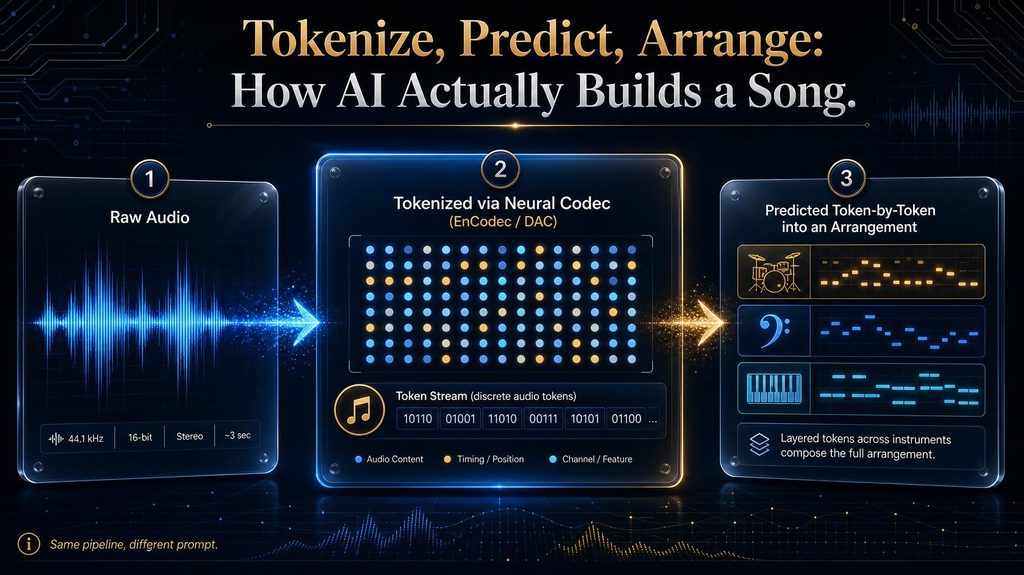
The starting point is the same one our generative audio guide covers for any generative audio system: a model needs to convert raw audio into something it can learn statistical patterns from. For music, that step has a name — audio tokenization — and it typically runs through a neural audio codec, most commonly Meta’s EnCodec or Descript’s DAC.
That codec compresses a waveform into a sequence of discrete tokens, the same basic move a large language model makes with words, just for sound instead of text. Once music exists as a token sequence, a transformer-style model can do what transformers do: predict what’s statistically likely to come next, given everything generated so far.
That’s the mechanism in one sentence — tokenize the audio, then predict the next token, over and over, until a full arrangement exists. The prompt — a genre, a mood, a reference melody — just sets the starting condition the prediction runs from.
Our generative audio guide covers two competing engines behind generative audio generally — autoregressive token prediction and diffusion — and music is where that distinction has real, audible consequences. Stability AI’s Stable Audio uses a diffusion transformer working in a compressed latent space, and by its own maker’s account excels at loops, ambient textures and sound design, but isn’t built for long, structured full songs.
Meta’s MusicGen takes the autoregressive route — predicting EnCodec tokens one at a time, the same approach this section describes — and by independent technical accounts holds together well as a baseline but starts to struggle past roughly thirty seconds. Suno’s current models are widely understood to be hybrids: an autoregressive core for structure, paired with diffusion-style components for audio quality.
That’s not a trivia detail — it’s the same trade-off the autoregressive-vs-diffusion table in our generative audio guide describes, just showing up as the difference between a tool that’s great for a 15-second ad loop and a tool built to hold a verse-chorus-verse structure together for three minutes.
Why Music Is a Harder Problem Than Speaking
A text-to-speech model only has to keep one signal coherent: a single voice, saying one thing at a time. A music model has to keep several signals coherent at once — melody, harmony, rhythm, and usually multiple instruments — and make sure all of them stay musically related for the length of an entire song.
That’s why the token-context problem shows up harder in music than in speech: predicting the next token means remembering not just what the lead melody was doing thirty seconds ago, but what key the whole arrangement is in and whether a chord change ahead will still make harmonic sense. In practice, that’s the real, technical reason AI songs are more likely than AI speech to drift or lose structure the longer they run — not a vague “AI isn’t creative enough” explanation, but a specific consequence of how much more the model has to track at once.
It’s also why generating separable stems — covered in the next section — is a harder engineering problem than it sounds. The model isn’t just producing one coherent signal and calling it done; it has to produce several coherent signals that were never actually recorded separately, then split its own internal representation of “the song” back into parts a human mixer can use independently.
From Generated Track to Produced Song
The most useful current tools don’t just hand you a finished, mixed-down song — they generate separable stems, meaning the vocal, drum, bass and instrumental layers come out as individual tracks rather than baked together. Suno’s v5 and v5.5 releases, for example, separate a generation into as many as a dozen individual stems.
That distinction is the difference between AI music as a finished product and AI music as a starting point a human can keep producing. Dario doesn’t use the raw Suno output as his final beat — he pulls the drum and bass stems into his own session and builds the rest of the track around them himself.
That’s the same pattern our generative audio guide identified for AI narration: the tool’s real value isn’t “finished output,” it’s a fast, competent first pass that a human still finishes. Composers who deliver to sync-licensing and production-music libraries professionally have converged on something close to a standard hybrid workflow: generate a musical foundation with an AI platform, export stems at 48kHz/24-bit, import them into a DAW and align tempo, add human performance layers on top, edit structure and transitions by hand, mix with professional tools, then master to broadcast loudness standards.
Notice what that workflow is not: it’s not “generate and upload.” Every step after generation is a human production task, which is exactly why the Readiness Test below treats a generated track as a draft to evaluate, not a deliverable to ship.
The AI Hustle World Music Readiness Test
Before using a generated track for anything beyond a personal sketch, it’s worth running it through three checks. We call this the Music Readiness Test, and it takes about as long as listening to the song once.
The Structural Check: does the song hold together — intro, development, a recognizable chorus or hook — or does it wander past the first minute? This is where the token-context problem above shows up most obviously, and it’s the fastest sign a track needs more human arrangement work.
The Alignment Check: if there are lyrics, do they land naturally on the beat, or does the phrasing feel stretched to make the words fit? Lyric-melody alignment is one of the more persistent weak points in current tools, and it’s usually audible within the first verse.
The Rights Check: do you know which tool generated this, what its licensing terms say about commercial use, and whether that tool is currently named in active litigation? This is the check most creators skip, and it’s covered in detail later in this guide.
| Check | Question | If it fails |
| Structural | Does the song hold together past the first minute? | Needs a human arrangement/editing pass |
| Alignment | Do the lyrics land naturally on the beat? | Needs a rewrite or a different generation |
| Rights | Do you know the tool’s licensing and litigation status? | Don’t monetize until you do — regardless of how it sounds |
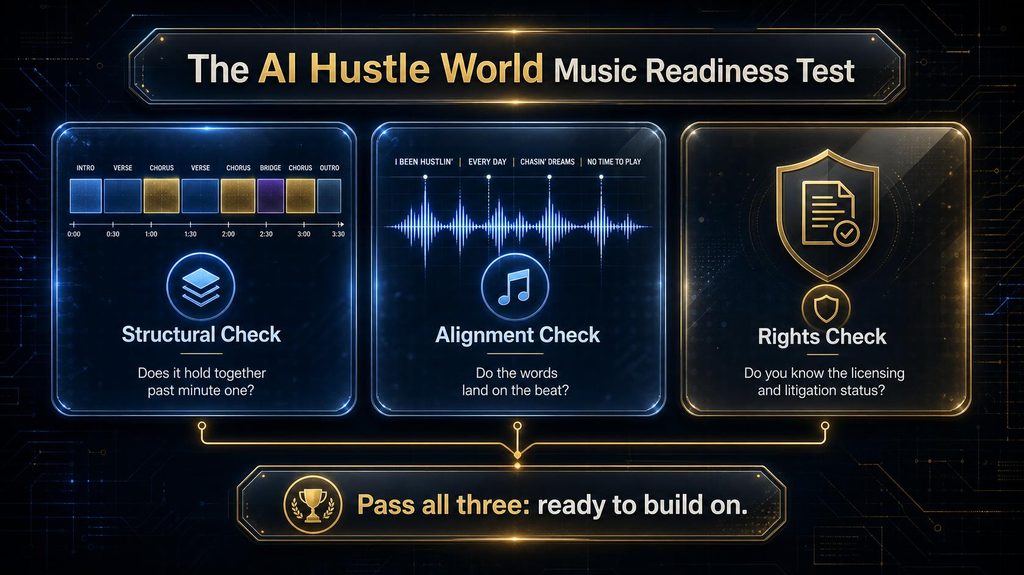
A track that passes all three is genuinely ready to build on. One that fails Structural or Alignment needs a human pass before it’s usable publicly. One that fails Rights needs a different tool entirely, no matter how good it sounds.
Run it every time you’re deciding whether to use a track for anything beyond your own ears, not just once when you first try a tool — a platform’s rights status and a model’s output quality both change often enough in 2026 that last month’s answer isn’t a reliable guide to today’s.
What’s Actually New in 2026
Suno and Udio remain the two most-discussed commercial music generators, and the gap between them has become more about rights than sound: Suno is generally positioned as the safer commercial choice post-settlement, with cleaner vocal output, while Udio still holds an edge on niche genres like lo-fi and ambient.
Beyond those two, a distinct tier of tools — AIVA, Soundraw, Loudly, Artlist AI, Mubert — targets marketers and content creators rather than musicians, typically through subscription or per-track licensing. That’s a different problem being solved: royalty-free background music, not original artistic composition. AIVA specifically has carved out a niche in instrumental, cinematic and orchestral generation rather than competing on vocal tracks at all.
One development worth flagging as unconfirmed: reporting suggests OpenAI is building its own music generator to compete with Suno. Nothing about pricing, capability or timing is confirmed as of this writing, but it’s worth watching given how fast OpenAI has moved into adjacent generative media.
On the research side, a system called DiffRhythm has pushed the diffusion approach further than Stable Audio, generating a complete song with both vocals and instrumental accompaniment — up to roughly four and a half minutes long — in about ten seconds. It’s a preview of how quickly the gap between the two engines described earlier might close.
None of the pricing or capability details above should be taken as verified fact — they’re vendor and reviewer claims in a market that shifts month to month, worth re-checking before you rely on them.
A note on how this section was researched: tool capabilities and pricing above come from vendor documentation, reviewer comparisons and litigation reporting, not from generating tracks ourselves. Hands-on comparison of specific tools is outside the scope of this mechanism-and-rights explainer.
Conditioning also varies by tool, beyond a plain text prompt: Stable Audio’s audio-to-audio feature, for instance, lets you upload an existing sample and reshape it through natural-language instructions, extending the same underlying prediction process to transforming sound that already exists rather than generating from nothing. Udio, notably, was founded by former Google DeepMind engineers and has positioned itself around audio fidelity and instrumental quality rather than Suno’s vocal-first approach.
What Still Goes Wrong
The Readiness Test’s three checks exist because these are the specific, recurring ways generated tracks fail, not hypothetical edge cases. Structural drift is the most common: a song holds together for the first verse and chorus, then loses its way in a bridge or second verse as the model’s grip on the earlier material weakens.
Mastering and mix quality often sound technically clean but emotionally flat — correct levels and frequency balance, without the small imperfections and dynamic choices a human engineer makes on purpose. Vocal artifacts show up especially on uncommon words, proper nouns, or emotionally complex lines, where pronunciation or emphasis can land slightly wrong in a way that’s hard to place but easy to hear.
There’s also a sameness problem several reviewers and producers have flagged: generations from the same tool, even across different prompts, can converge on similar chord progressions, drum patterns or vocal textures — a side effect of a model trained toward statistically common patterns tending to produce statistically common output.
None of these are reasons to avoid the tools. They’re reasons the Readiness Test exists in the first place, and reasons the hybrid production workflow covered earlier — human hands finishing what the model started — has become the standard rather than the exception among working composers.
The Real Fight Isn’t About Quality — It’s About Exposure Math
By 2026, nobody seriously argues AI-generated music sounds bad. The argument still being fought in court is narrower, and much more about numbers than art: how many songs can a rights-holder prove were used in training, and what does that number do to a company’s legal exposure?
Universal Music Group settled with Udio in October 2025 but remains in active litigation against Suno. Warner Music settled with Suno the following month. Sony Music hasn’t settled with either company, and its case against Udio is the one that produced the most consequential ruling of the three.
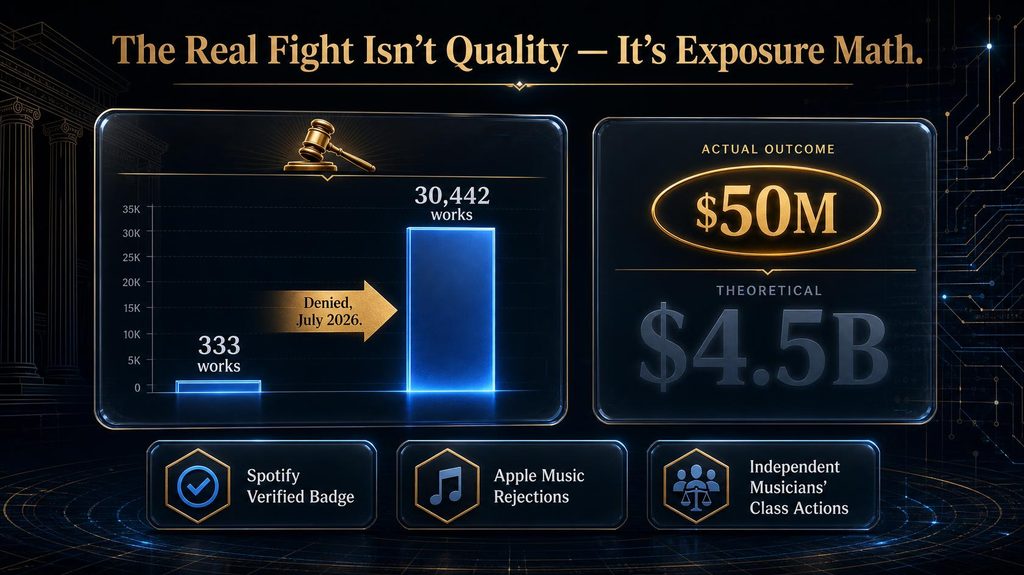
In May 2026, Sony moved to expand its case from the 333 works in its original 2024 complaint to 30,442 works, using audio-fingerprinting evidence from discovery. Songs reportedly at stake include Elvis Presley’s “Hound Dog,” Beyoncé’s “Say My Name,” and Harry Styles’ “As It Was.”
On July 2, 2026, US District Judge Alvin K. Hellerstein denied that expansion, ruling it would unfairly delay the case, and capped the litigation at the original 333 works. Under US statutory damages rules — up to $150,000 per willfully infringed work — that caps Udio’s exposure at roughly $50 million instead of a theoretical $4.5 billion.
That single procedural ruling shaped Udio’s financial future more than any argument about whether its music sounds convincing. A separate DMCA claim was also added, alleging Udio circumvented YouTube’s protections to “stream-rip” training data — a sign this fight is being fought on process and evidence, not musical merit.
The pressure is visibly changing vendor behavior, not just legal filings: Suno, which raised $400 million in a June 2026 funding round at a $5.4 billion valuation — more than double its November 2025 figure — has said it will build its next model on licensed catalog and phase out its earlier, unlicensed-data models. The company has reported roughly two million paid subscribers generating more than seven million songs a day.
There’s a second, separate legal wrinkle worth knowing even if a track’s training data is perfectly clean: current US Copyright Office guidance, issued in January 2025, holds that a fully AI-generated piece of music, with no human creative authorship involved, isn’t copyrightable at all — which matters if you’re counting on owning the track you generate, not just being allowed to use it.
That ruling means an unedited, fully AI-generated track isn’t just unprotected — it’s functionally public domain, so anyone, including a rival producer or an ad agency, could take that exact file and use it commercially without paying you anything. The human production layer covered earlier in this guide isn’t only about sound quality; it’s what actually gives you something legally yours to protect.
Artists Are Handling This Differently
Working artists are responding to this shift in genuinely different ways, and two real examples show the range. Grimes was the first mainstream artist to license out her own voice for AI use, through a platform called Elf.Tech: anyone can generate a song using an AI clone of her voice, with royalties split 50/50 between her and the creator, distributed through TuneCore at no cost to use.
Her October 2025 track “Artificial Angels” — written from an AI’s perspective, using AI-generated vocals in the intro and outro around otherwise traditional production — captures the ambivalence running through this whole guide. “This is what it feels like to be cast out by something smarter than you,” she said of the track, embracing the technology and naming the unease at the same time.
Timbaland’s approach with TaTa Taktumi, introduced in our generative audio guide, runs on a more specific ratio than that overview covered: he records raw demos with melodic and rhythmic ideas, uploads them to Suno to build out full productions, then has a team add human-written lyrics — a workflow he’s described as roughly 85 percent human creative work and 15 percent AI. Grimes licensed the tool out; Timbaland built a production pipeline around it. Neither treated it as a finished-song vending machine.
What Happens If You Ignore This
It’s tempting to treat all this as a fight between billion-dollar companies with nothing to do with a solo creator generating a beat for a video. That’s not quite right, and the distribution platforms are already acting like it isn’t.
Spotify has launched a “Verified by Spotify” badge specifically for non-AI artists — a signal the platform expects listeners to start caring about the distinction. Apple Music has begun rejecting some AI-generated submissions outright rather than hosting everything uploaded to it.
Publishing or monetizing a track without knowing which tool made it, and that tool’s current legal status, is a decision that’s gotten measurably riskier over the past year — not because you’ll be sued personally, but because a platform or client increasingly might ask, and “I don’t know” is a worse answer than it used to be.
The scale involved makes this more than a Western-platform story. Tencent Music’s platforms reportedly take in roughly 107,000 new song uploads a day, with AI-generated songs accounting for about 36.2 percent of all new releases by December 2025 — a different region, a different platform, and a similar signal to Deezer’s numbers that this shift is global, not a Suno-and-Udio-specific phenomenon.
None of that scale is a reason to panic about using these tools — it’s a reason to treat the Rights Check as routine rather than optional, the same way checking a stock photo’s license became routine once stock photography went digital and cheap enough for anyone to use without thinking about it.
What This Actually Costs
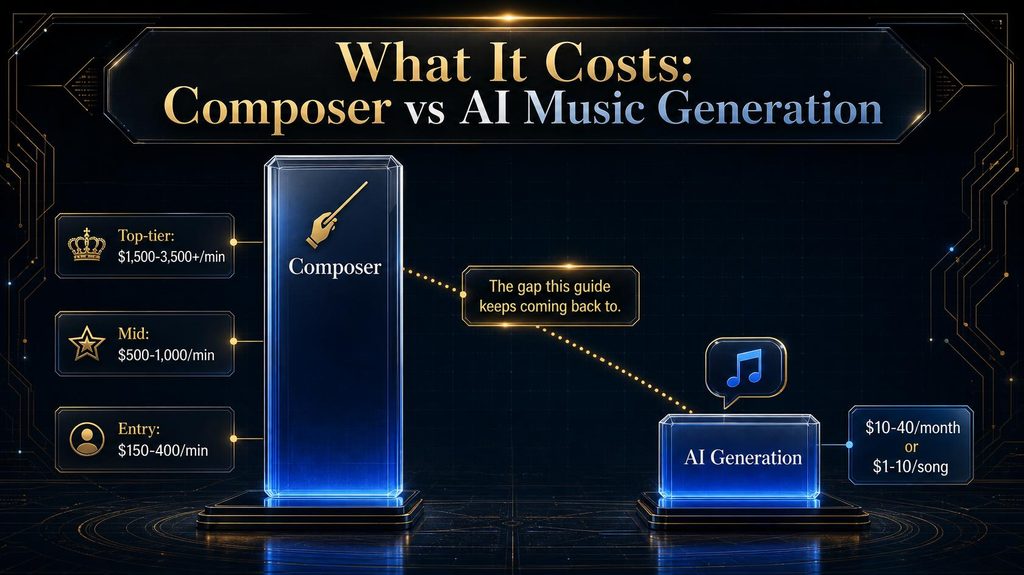
Industry pricing guides for 2026 put entry-level composer rates at roughly $150–$400 per finished minute, mid-level professionals at $500–$1,000 per minute, and top-tier film or game composers at $1,500–$3,500-plus per minute. A full project scales further: an indie short film’s score runs $500–$5,000, a mid-budget film $5,000–$50,000, a feature film $50,000–$100,000-plus.
Against that, AI music generation runs $10–$40 a month across most subscription tools, or roughly $1–$10 per generated song on pay-per-track platforms. Production-music-library tools aimed at marketers range from about $15 to $240 a month depending on commercial usage rights.
This gap is starker than almost anything else in AI audio, and the honest read isn’t “composers are obsolete” — it’s that AI opened up original-music budgets to creators who never had composer money to spend, while the legal and quality-control trade-offs in this guide are exactly the cost a $150-a-minute composer doesn’t carry.
The shift shows up in mainstream culture, not just industry filings. Actor Jeff Bridges demonstrated Suno on Theo Von’s podcast in 2026, generating a full song — vocals, instruments, arrangement — from a prompt live on air, and remarked that working Nashville session musicians are already using it to skip sessions that used to cost real money: “All the guys in Nashville are using it now… they can do this for nothing, man.”
Common Mistakes to Avoid
Publishing the raw, unedited output as a finished track is the most common mistake, and it’s usually the Structural or Alignment check catching up with you after the fact — a track that wanders or feels awkward rarely improves by ignoring the problem.
Assuming “royalty-free” or “commercial rights included” means the same thing on every platform is a close second. Suno and Udio’s commercial terms and indemnity language differ, and both are attached to companies currently in active litigation — read the specific terms, not the marketing page.
Treating the composer-vs-AI cost comparison as the whole decision is another trap: for a solo creator’s YouTube background music, cost is the whole story; for a brand campaign or client work, the legal exposure covered in this guide is often the bigger number. Assuming a generated track is automatically yours to protect is a fourth: if you want copyright ownership over the final result, the human production work you add on top is what supports that claim, not the initial generation step.
Publishing several tracks that all sound similar without noticing is a subtler, fifth mistake tied to the sameness problem covered earlier — worth a periodic listen across your last several generations as a set, not just each one in isolation.
Who Should Use This Now — and Who Should Still Hire a Composer
AI music generation is a strong fit for solo creators prototyping an idea, YouTubers and podcasters needing low-stakes background music, and musicians like Dario who want a fast first pass to build a real production around rather than a finished product. A human composer is still the better call for brand campaigns and client work where legal indemnity matters, film or game scoring where a scene’s emotional timing needs a composer’s judgment, and any project where your tool’s litigation status could become a client’s problem too.
There’s a middle case worth naming: composers delivering to sync-licensing and production libraries at volume, where the hybrid workflow covered earlier — AI foundation, human production on top — is becoming the practical default rather than a compromise, since it’s faster than composing from scratch without sacrificing the accountability a library client expects.
There’s also a distinct fourth path Grimes’ Elf.Tech model points toward: artists licensing out their own voice or style for others to build on, taking a royalty share rather than doing the generating themselves. That’s a genuinely different business decision than either using the tools personally or ignoring them, and it’s likely to become more common as more artists watch how her arrangement plays out.
Why Human Composers Still Win Sometimes
None of this makes a human composer obsolete, and the reason connects directly to why the Structural and Alignment checks exist. A composer scoring a film scene makes a judgment call about exactly when the music should swell, go quiet, or clash intentionally with what’s on screen — a decision tied to the story, not statistical likelihood.
A composer also carries something no subscription tier does: accountability. If a licensed track turns out to infringe someone’s copyright, a professional composer’s contract and reputation are on the line in a way a $10-a-month tool’s terms of service simply isn’t built to address.
How to Know If It’s Actually Working
“It sounds good to me” isn’t a reliable measure here any more than it was for noise cleanup — the person who generated and picked the track is the person least likely to notice the sameness or drift problems covered above.
A useful number to track, especially if you’re generating music regularly, is your Readiness Test pass rate: what share of generations pass all three checks without a human production pass. A pass rate that’s dropping over time on the same prompt style is a sign to change tools or change how you prompt, not a sign to keep generating more takes.
Time-to-usable-track is the second number worth watching — not the generation time itself, but the total time from first prompt to a track you’d actually publish, including every human production step. If that number isn’t meaningfully faster than working with a composer for your specific use case, the tool isn’t saving you what you think it is.
For anyone delivering to clients or libraries, tracking how often a delivered track gets flagged — for sounding generic, for a rights question, for a quality issue — closes the loop the Readiness Test can’t catch alone, since a client’s ear and risk tolerance are what actually matter for that relationship.
What’s Next
The clearest legal thread to watch is Sony’s case itself — whether it goes to trial, settles like Universal and Warner did, or produces another ruling as consequential as Judge Hellerstein’s exposure-capping decision. A second thread is the platforms: if Spotify’s badge and Apple Music’s rejections gain traction, expect others to build similar distinctions.
A second-order effect worth watching is on independent musicians specifically — several have filed their own class actions arguing the UMG and Warner settlements protect major-label catalogs while leaving independents with no equivalent deal, which could reopen the same exposure-math fight from a different set of plaintiffs. A third is on composers themselves: as AI absorbs the low-budget, high-volume end of original music, composers who differentiate on judgment and story-specific scoring — the same split our noise cleanup guide found for audio editors — are likely to hold their value better than composers competing purely on being affordable.
A fourth, slower-moving effect is on listening culture itself: as more of the accessible, high-volume end of music comes from a smaller number of underlying models, some critics worry about a broader sonic homogenization — a concern that echoes older debates about algorithmic playlists, and one likely to grow alongside generation volume rather than fade.
Final Thoughts
Dario’s Suno drafts used to feel like magic the first time he heard them, and now they mostly feel like a fast first draft — which is exactly what they are. The song that comes out of a text prompt in under a minute isn’t the finished product; it’s the raw material the Music Readiness Test and a human’s own judgment turn into one.
Grimes licensed her voice out, Timbaland built an 85-percent-human production pipeline around it, and Sony is still in court fighting over the difference between 333 songs and 30,442 — three completely different responses to the same underlying technology, none of them “ignore it” or “trust it blindly.” That range is the realistic picture, not a single verdict on whether AI music is good or bad.
The technology solved the sound a while ago. What’s still being worked out — in a New York courtroom, on Spotify’s badge system, in the fine print of a subscription’s commercial terms — is who’s allowed to make that sound, under what conditions, and who’s on the hook when it goes wrong. That’s the part worth tracking, not the next model version number.
Cleanup, Narration, Music — One Bigger Idea
Every tool in this article runs on the same underlying mechanism our generative audio guide breaks down — see the full map of how AI creates, edits and transforms sound.
See the Full Generative Audio Map →Frequently Asked Questions
How does AI actually generate music? AI music generators convert audio into discrete tokens using a neural codec, then use a transformer-style model to predict what token should come next based on everything generated so far — the same basic mechanism a language model uses for text, applied to sound. Why does AI-generated music fall apart after a few minutes?
Because the model has to track melody, harmony, rhythm and multiple instruments staying consistent with each other the whole time, not just one voice. That’s a harder memory problem than speech, and it’s why structure is more likely to drift the longer a track runs.
What’s the difference between AI music generation and AI speech generation?
Speech generation only needs to keep one signal — a single voice — coherent over time. Music generation has to keep several simultaneous, harmonically-related signals consistent with each other, a fundamentally harder version of the same underlying problem.
Is AI-generated music copyrighted? The output itself typically isn’t covered by someone else’s copyright unless it closely resembles a specific existing song, but the live legal fight is over whether the training data used to build these models was properly licensed in the first place. Can I own the copyright on a song I generate with AI?
Current US Copyright Office guidance holds that a fully AI-generated work, with no human creative authorship, isn’t copyrightable at all. If ownership matters to you, the human production steps you add on top — arrangement, editing, mixing — are what can support a copyright claim, not the raw generation.
Is it legal to use AI-generated music commercially? It depends on the specific platform’s commercial terms and that tool’s current legal status, which is changing month to month as lawsuits and settlements progress — check the actual terms rather than assuming “AI-generated” automatically means safe to monetize. What happened with Sony’s lawsuit against Udio?
Sony tried to expand its copyright case against Udio from 333 works to 30,442 works using new discovery evidence. A federal judge denied that expansion in July 2026, capping the case at the original 333 works and, with it, Udio’s potential financial exposure.
How much does it cost to use AI to make music versus hiring a composer? Composers typically charge $150 to $3,500-plus per finished minute depending on experience and project type, while AI music tools run roughly $10 to $40 a month or $1 to $10 per generated song — a much larger gap than most other AI-vs-human cost comparisons. Can I edit or produce further with AI-generated music, or is it a finished product?
It’s best treated as a starting point. Current tools like Suno’s v5 generate separable stems — vocals, drums, bass, instrumentation — specifically so a human can keep producing from there rather than treating the raw output as final.
Will Spotify or Apple Music reject AI-generated music?
Some platforms are starting to distinguish rather than reject outright: Spotify has introduced a “Verified by Spotify” badge for non-AI artists, while Apple Music has begun rejecting some AI submissions. Policies are still evolving and vary by platform.
Will AI replace composers and musicians? It’s changing the economics of composing more than replacing composers outright — AI is absorbing low-budget, high-volume work, while composers who bring judgment, story-specific timing and accountability are likely to hold their value in higher-stakes work.
Related Guides
- How to Create an AI-Assisted Podcast Workflow from Script to Publish
- What Is a Large Language Model (LLM)? How LLMs Really Work
- What Is an AI Agent? A Beginner’s Guide to How Autonomous AI Works
Written by
Muntasir Ahmad Chowdhury
Founder, AI Hustle World
Muntasir Ahmad Chowdhury is the Founder of AI Hustle World, an independent publication dedicated to making Artificial Intelligence practical, trustworthy, and easy to understand. He researches AI tools, automation, customer service, productivity, and real-world business applications, helping readers make smarter technology decisions through research-driven, experience-backed content.
Expertise:
AI Tools • AI Automation • AI Customer Service • AI Productivity • Generative AI • AI Workflows
Get Smarter With AI
Enjoyed this guide? Get practical AI tools, tutorials, and honest reviews delivered to your inbox.
3 thoughts on “AI Music Generation Explained: How AI Composes, Arranges and Produces Original Tracks”