
How AI Product Recommendations Work and When They Improve Conversions
A product recommendation module looks simple on the screen. A shopper opens a product page, sees a row such as “Recommended for you” or “You may also like,” and is presented with a handful of products. Behind that small interface, however, there can be a fairly sophisticated decision system trying to answer a difficult question: given everything the store knows about this shopper, this product, and this moment, which other products are most relevant right now?
That question is much more important than the visual widget itself. A recommendation can help a shopper discover a better fit, find a useful complementary product, or continue shopping without starting another search. It can also do the opposite: surface irrelevant products, repeat items the shopper has already rejected, promote products simply because they are popular, or consume valuable page space without producing any incremental business value.
The commercial temptation is therefore easy to understand. If a recommendation system appears to increase clicks or average order value, a merchant may conclude that personalization is working. But there is a critical difference between a customer buying after seeing a recommendation and a recommendation causing a customer to buy something they otherwise would not have bought. That distinction sits at the heart of this article.
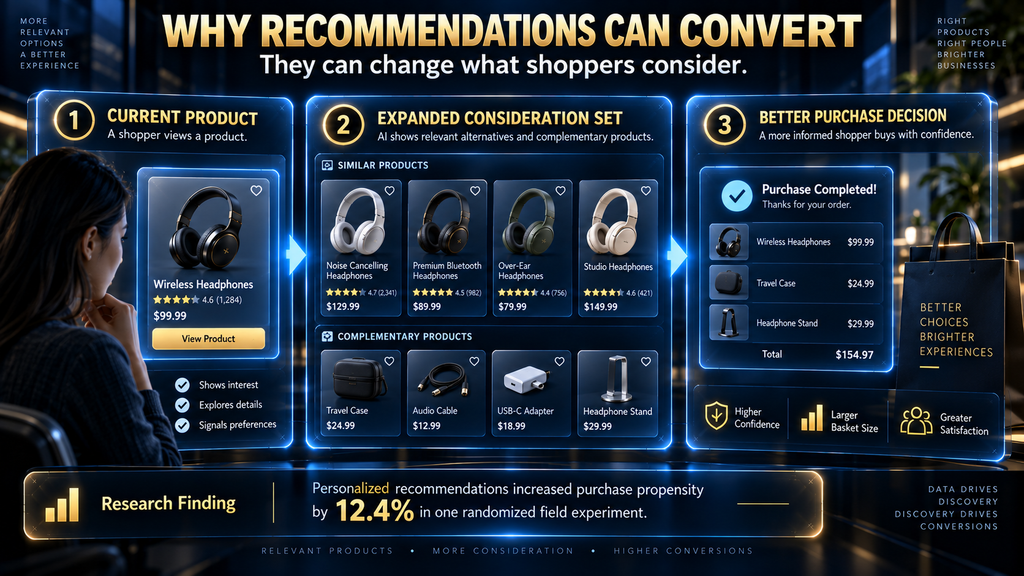
The evidence is more nuanced than the usual ecommerce claim that “personalization increases conversions.” A randomized field experiment published in Information Systems Research found that personalized recommendations increased purchase propensity by 12.4% and basket value by 1.7% in the study environment, with much of the effect operating through changes in the products consumers considered. At the same time, other research has found that recommendation systems can create trade-offs, including reduced sales diversity when collaborative filtering concentrates exposure around already-popular products.
The practical lesson is not that every store needs a sophisticated AI recommender. It is that recommendations work when the system improves the customer’s decision at the right moment and creates measurable incremental value for the business. The model, data, placement, objective, and measurement method all matter.
This guide explains how those systems work, which recommendation approaches exist, why some recommendations convert while others do not, where to place them, how to measure their real effect, and when a simpler rule-based system can be a better choice than a more sophisticated AI model.
What an AI Product Recommendation System Actually Does
At the simplest level, a product recommendation system selects a set of products that it predicts will be relevant to a particular shopper, context, or transaction.
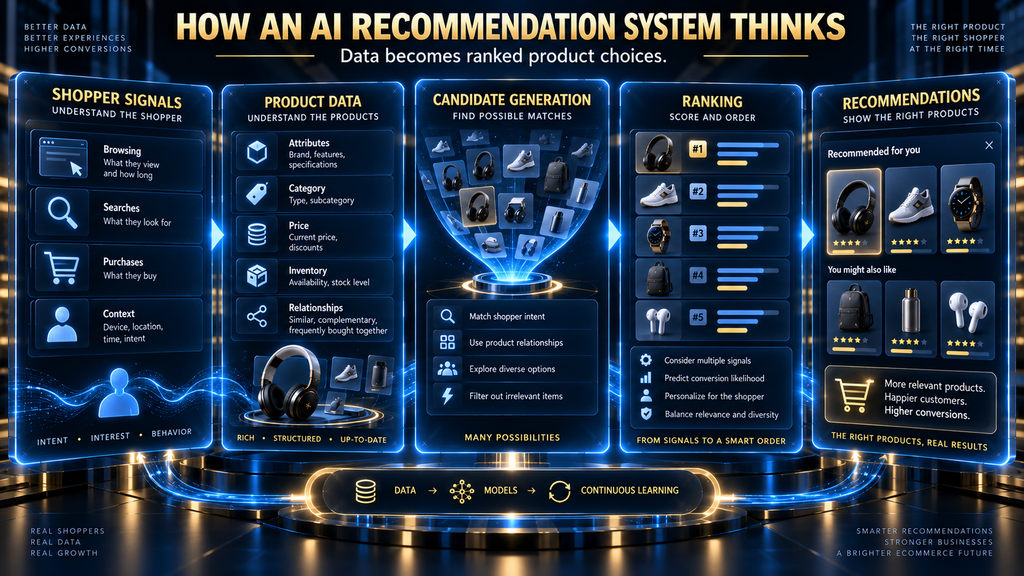
That sounds straightforward until you consider how many possible products may exist. A store with 10,000 products cannot reasonably evaluate every item with the same level of attention for every visitor. The recommendation system has to narrow that universe, determine which candidates have a plausible relationship to the shopper or current product, rank them, and then decide which small subset should actually appear in the interface.
The process therefore looks less like “AI chooses a product” and more like a multi-stage filtering and ranking problem. The system gathers signals, generates candidates, estimates relevance, applies business constraints, and then selects a final recommendation set.
A simplified version can be represented as: Shopper and product signals → Candidate generation → Ranking → Business constraints → Placement → Shopper response → New data
The signals can come from many places. A system might observe what the shopper has viewed, purchased, searched for, or ignored. It may also consider the attributes of the product currently being viewed, relationships between products, inventory status, price, seasonality, category behavior, or the behavior of similar shoppers.
The intelligence is therefore not simply inside the model. It emerges from the interaction between the data available to the model, the recommendation objective, the rules surrounding it, and the location where the result is shown.
That last point is especially important. A recommendation that makes sense on a product page may be completely wrong in a shopping cart, because the shopper’s intent has changed. Product recommendations are therefore contextual systems rather than static lists.
Why Recommendations Can Change Buying Behavior
The easiest way to understand the value of recommendations is to think about what happens when a shopper has to search manually.
Suppose someone arrives on a product page for a $60 running shoe. They may already have a strong purchase intention, but they may also need socks, a shoe-care product, a different color, or a more suitable alternative. Without assistance, the shopper has to remember those possibilities and search for them independently. A recommendation system can introduce relevant options at exactly the moment when the shopper is already engaged with the category.
This can change the shopper’s consideration set, which is one of the most useful mechanisms for understanding recommendation value. Instead of trying to persuade a shopper who has no interest in buying, the system can make additional relevant options visible to someone who is already evaluating a purchase.
The randomized field experiment mentioned earlier is valuable for precisely this reason. Its findings suggest that personalized recommendations influenced purchase behavior partly by changing which products consumers considered, rather than simply acting as a promotional message attached to the page.
That distinction has an important implication for ecommerce operators. A recommendation does not have to “convince” the customer in the traditional advertising sense to create value. It can create value by reducing search effort, exposing relevant alternatives, revealing useful complements, or helping the shopper discover a product that would otherwise have remained outside their consideration set.
That is a stronger mechanism than the vague idea that “AI personalizes the shopping experience.”
How AI Decides What to Recommend
The underlying recommendation process usually starts with a pool of potential products. A simple store might generate candidates from rules such as “products frequently bought with this item” or “best sellers in this category.” A more advanced system can generate candidates based on similarities between products, similarities between shoppers, browsing behavior, semantic product attributes, or combinations of several signals. Once candidates exist, the system needs to rank them.
This is where recommendation models become more interesting. Two products may both be relevant in theory, but one may be more appropriate because the shopper has already viewed it, because it fits the current product more closely, because its price matches previous behavior, or because its inventory position makes it more commercially useful.
Modern recommendation systems can incorporate many different forms of information, including product features and user-event data. Google Cloud’s current commerce recommendation documentation, for example, distinguishes multiple recommendation models and objectives rather than treating every recommendation as the same type of prediction.
The final stage involves constraints and presentation. A product that scores highly may still need to be excluded because it is out of stock, already purchased, unavailable in the shopper’s market, or inappropriate for the current placement. After that, the selected products have to be displayed in a context that makes sense to the shopper.
This is why the recommendation problem is really an end-to-end system problem. A better model does not automatically produce a better customer experience if the wrong candidates are generated, the wrong objective is optimized, or the recommendations appear in an unhelpful part of the journey.
The Four Main Recommendation Approaches
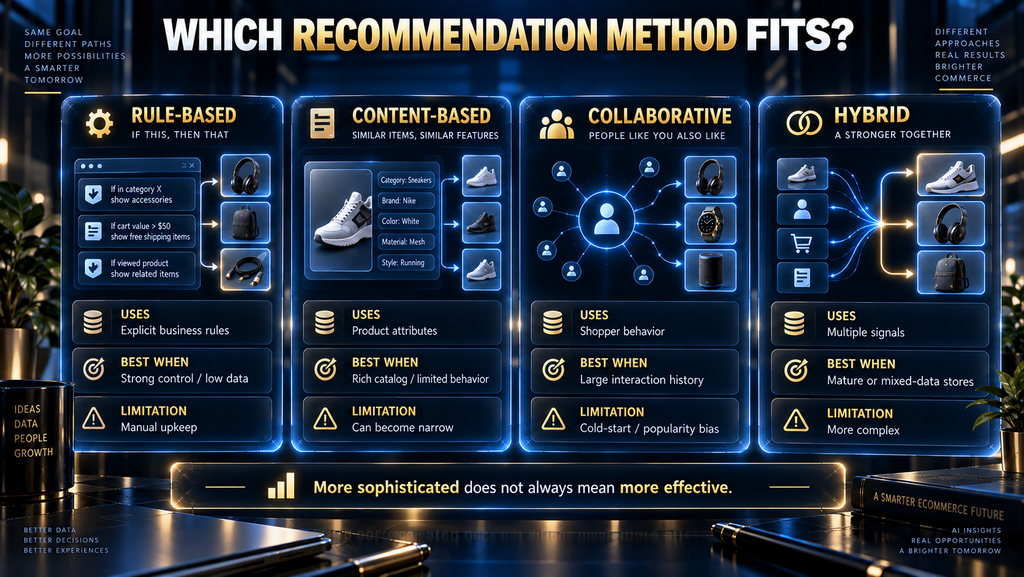
Not every recommendation system needs the same underlying method. In practice, four broad approaches cover much of the landscape: rule-based recommendations, content-based recommendations, collaborative filtering, and hybrid systems that combine several signals.
Rule-Based Recommendations
Rule-based recommendations use explicit business logic rather than statistical personalization.
A retailer may decide that a camera should be shown with a particular memory card, that a phone should be paired with a compatible case, or that customers viewing a winter jacket should see matching accessories. Merchants can also use popularity rules, best-seller logic, category rules, margin priorities, or inventory conditions.
The biggest advantage is control. The merchant knows why the recommendation is appearing and can change the logic directly. For stores with limited behavioral data, complicated catalogs, or strong merchandising requirements, this can be a very reasonable starting point.
The limitation is that rules can become increasingly difficult to maintain as the number of products and customer contexts grows. A merchant can define useful relationships manually, but it becomes harder to capture subtle patterns across thousands of shoppers.
That does not mean rule-based recommendations are obsolete. It means they solve a different problem.
Content-Based Recommendations
Content-based systems recommend products that are similar to what the shopper is currently viewing or has previously interacted with, based on product attributes.
Imagine a shopper browsing a leather laptop bag. A content-based system may look at material, category, size, color, price range, style, and other attributes, then surface other products with similar characteristics.
This approach is useful when the product catalog contains rich structured information. It can also help with new products because a product does not necessarily need a long history of purchases before the system can identify similar products.
The limitation is that similarity can become too narrow. If the system only knows that shoppers viewing one product also need “similar” products, it may repeatedly show variations of the same thing rather than complementary products or alternatives that broaden the shopper’s options.
A content-based system is therefore especially useful when the store has strong product data and wants recommendations grounded in product relationships.
Collaborative Filtering
Collaborative filtering uses patterns in shopper behavior rather than relying primarily on explicit product similarity.
The basic idea is that shoppers with similar behavior may provide useful signals about what another shopper could find relevant. If many customers who purchased product A also purchased product B, the system may learn a relationship between those products even if their product descriptions have little in common.
This can produce recommendations that a merchant might not have thought to create manually.
It also introduces limitations. New products may not have enough behavioral history, new shoppers may provide too little information, and popularity can influence the system strongly. A product that already receives substantial interaction can create more data, which can then lead to more recommendations and even more interaction.
That can create a feedback loop. Research has also found that collaborative recommendation systems can reduce aggregate sales diversity by concentrating attention on certain products. That does not mean collaborative filtering is inherently harmful, but it does demonstrate that relevance and commercial diversity are not always the same objective.
Hybrid Recommendations
Hybrid systems combine multiple approaches. A retailer might use product attributes to understand new products, collaborative signals to learn from customer behavior, rules to enforce business constraints, and contextual signals to adapt recommendations to the current shopping session.
This often makes practical sense because ecommerce data is rarely complete. A new shopper may have little behavioral history, while a long-term customer may have a rich interaction record. A new product may have strong attributes but no sales history, while a popular product has extensive behavioral data.
A hybrid architecture allows the system to rely on different sources of evidence depending on what information exists. Google Cloud’s recommendation documentation reflects this broader reality by providing different recommendation model types, training signals, and objectives for different commerce situations rather than suggesting one universal recommendation algorithm.
The important point for merchants is not to memorize model names. It is to understand what information the system has available and what kind of decision it is trying to make.
The Cold-Start Problem
One of the most practical reasons recommendation systems fail is that the information needed to make a good recommendation does not always exist yet.
A new shopper may have viewed only one product. A new product may have no meaningful sales history. A new store may have too little interaction data for sophisticated personalization.
This is known as the cold-start problem, and it explains why an apparently advanced recommendation engine can perform poorly in a newly launched store.
The solution is usually to combine behavioral signals with other forms of information. Product attributes can support content-based matching, while popularity, category rules, business logic, contextual information, and other signals provide fallbacks when personalized data is sparse.
This is another reason merchants should resist the assumption that “more AI” automatically means “better recommendations.” A sophisticated collaborative model cannot manufacture a decade of customer behavior out of thin air. In a low-data environment, a well-designed hybrid strategy can be more useful than a highly complex model that lacks the information required to personalize effectively.
When Recommendations Actually Improve Conversions
Recommendations are most likely to create meaningful value when they solve a real decision problem for the shopper.
That can happen in several ways. A recommendation can introduce a relevant product that the shopper did not know existed, reduce the effort required to compare alternatives, identify a complementary product, help complete a purchase, or reconnect the shopper with something they previously considered.
The placement matters because shopper intent changes throughout the journey.
On a product page, recommendations can help with alternatives and complements. On a category page, they can help personalize which products deserve attention. In the cart, they can introduce accessories or complementary products. After purchase, they can support replenishment or related purchases.
Google’s current recommendation-placement guidance explicitly connects different recommendation models to different page contexts and commercial objectives. That is an important lesson: placement is part of recommendation strategy, not merely a design decision.
The strongest recommendations also tend to be specific enough to make their relevance obvious. “You may also like” is a generic label. “Compatible accessories for this camera” tells the shopper why those products are being shown.
Context reduces cognitive effort. That matters because a recommendation has to earn attention before it can influence a decision.
Conversion Rate and AOV Are Not the Same Thing
Ecommerce teams sometimes use conversion rate, average order value, revenue per session, and click-through rate as if they were interchangeable measures of recommendation success.
They are not. A recommendation can increase the probability that someone buys without increasing the size of the basket. Another recommendation can increase basket value among customers who were already likely to purchase without meaningfully changing overall conversion.
This is why recommendation objectives should be defined before the model is evaluated.
If the business wants to increase completed purchases, conversion may be an appropriate primary metric. If the objective is to increase basket size, average order value may be more useful. If margin matters more than revenue, contribution margin may be the better commercial metric. If the system is intended to reduce product-search friction, engagement and product-discovery measures may provide useful supporting evidence even if direct conversion impact is initially modest.
Google’s recommendation systems documentation explicitly distinguishes between optimization objectives such as click-through rate, conversion rate, and revenue-oriented outcomes. This reinforces a broader principle: the recommendation engine is only as good as the objective the business asks it to optimize.
Why Clicks Do Not Prove a Recommendation Worked
This is one of the most important measurement problems in ecommerce personalization.
Suppose 5% of visitors click a recommendation and those visitors convert at a higher rate than visitors who do not click. It is tempting to conclude that the recommendation created the extra purchases.
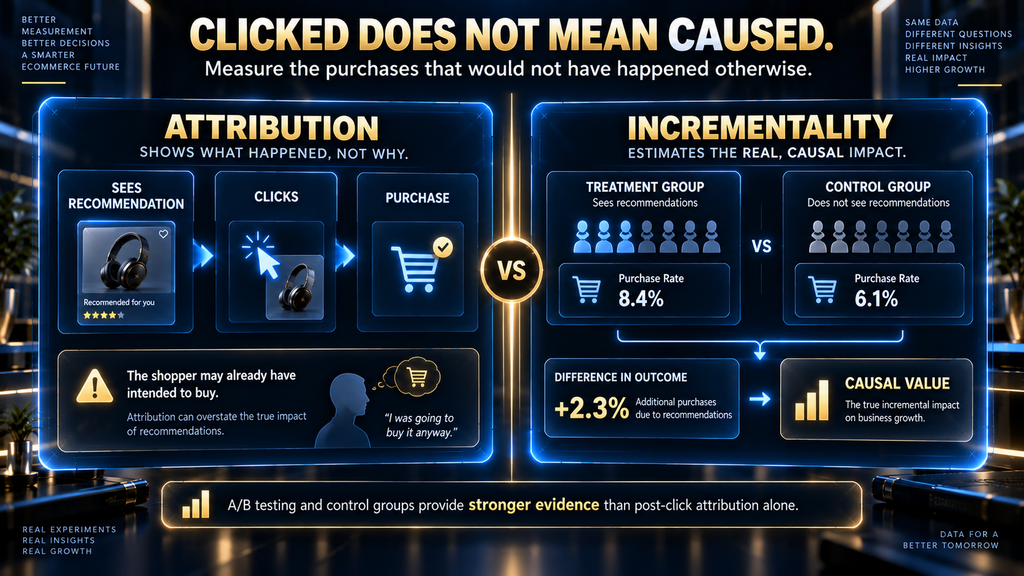
But another explanation is possible: the shoppers who were already more interested in buying may simply have been more likely to click. This is the difference between attribution and incrementality.
Attribution asks: “Which sales occurred after interaction with the recommendation?” Incrementality asks: “How many additional sales occurred because the recommendation was shown?”
Those questions are not equivalent. A recommendation module can receive substantial engagement while adding little incremental value if it mostly helps customers who would have purchased anyway.
That does not make the recommendation useless. It simply means the business should not overstate its causal impact.
To establish incrementality, the strongest approach is controlled experimentation. A store can expose one group of shoppers to the recommendation and compare its outcomes with a comparable control group that does not receive the recommendation, while keeping other important factors as consistent as possible.
This is one reason rigorous experiments are more valuable than simply watching recommendation dashboards.
How to Measure Recommendation Performance Properly
A useful measurement system starts with a primary objective and then adds supporting and guardrail metrics.
For conversion-focused recommendations, the primary measure might be conversion rate or purchase probability. Supporting measures could include recommendation CTR, product-page engagement, basket value, and revenue per session, while guardrails might include return rate, cancellation rate, margin, or customer complaints.
For cross-selling, average order value may become more important, but the business should still examine whether the additional products create healthy economic value. A recommendation that increases AOV by encouraging low-margin products may look good in a dashboard while weakening contribution.
The same logic applies to inventory. A recommendation engine that prominently displays products with poor availability may increase customer frustration or cause abandoned shopping sessions, even if recommendation clicks remain high.
Measurement should therefore follow the full customer journey rather than stopping when someone clicks. A useful hierarchy is: Recommendation exposure → interaction → product consideration → purchase → basket value → margin → downstream outcome. The further downstream the measurement, the more useful it becomes for judging actual business value.
Why A/B Testing Matters
A controlled experiment gives the merchant a much better chance of understanding whether recommendations are actually creating incremental value.
The simplest version compares a treatment group receiving recommendations with a control group that does not, then examines the difference in outcomes. In more sophisticated testing, the merchant can compare different recommendation models, placements, objectives, labels, ranking strategies, or levels of personalization.
The important point is to change one meaningful variable at a time whenever practical.
Suppose a store launches personalized recommendations, changes the product-page design, introduces a new discount, and changes the checkout process in the same week. Even if conversion improves, nobody can confidently attribute the result to the recommendation system. Good experimentation reduces that ambiguity.
The business should also avoid stopping a test simply because the first few days look exciting. Ecommerce traffic can vary significantly by weekday, campaign, season, product category, and audience composition, so the experiment needs enough exposure to produce a useful comparison.
The exact statistical method and sample requirement will depend on the business, but the principle is universal: measure recommendations against a meaningful baseline rather than against intuition.
Where Recommendations Belong in the Shopping Journey
The same recommendation engine can perform differently depending on where it appears.
Product Pages
Product pages are often strong environments for recommendations because the shopper has already expressed a specific interest. The store can show similar products, alternatives, complementary items, or products frequently purchased alongside the current item.
The choice depends on the objective. Similar-product recommendations can help shoppers compare options, while complementary recommendations can increase basket value. Trying to use one recommendation type for every product page can weaken relevance.
Category and Homepage
At the category or homepage level, the system has less certainty about exactly what the shopper wants. Personalization can therefore be useful for prioritizing products based on previous behavior, current session signals, popularity, or preferences.
The risk is that personalization can become too aggressive. A returning shopper may appreciate continuity, but a new shopper may need broader discovery rather than a narrow prediction based on minimal data.
Cart
The cart is a commercially sensitive placement because the shopper has already demonstrated purchase intent. This can make complementary recommendations especially useful, but poor recommendations can also distract from checkout.
The best cart recommendations are usually tightly connected to the current purchase rather than simply showing unrelated popular products.
Post-Purchase
Post-purchase recommendations can be powerful when the product naturally creates future needs. Replenishment products, accessories, consumables, and complementary items can be surfaced based on the customer’s actual ownership context.
The timing also matters. A recommendation for replacement filters two months after purchasing a product may be more useful than the same recommendation immediately after checkout.
The key principle is that recommendation relevance has a temporal dimension.
When AI Is Better Than Simple Rules
AI becomes more attractive when the number of possible relationships becomes too large for humans to manage comfortably.
A retailer with 30 products can create many useful rules manually. A retailer with 30,000 products, millions of browsing sessions, multiple customer segments, and constantly changing inventory has a very different problem.
AI can identify patterns that would be difficult to maintain through static rules, especially when customer behavior changes over time.
It can also personalize at a level of scale that manual merchandising cannot match. That does not mean AI should replace every rule.
A mature system often combines learned recommendations with deterministic business constraints. The model may decide which products appear most relevant, while rules ensure that out-of-stock items, incompatible accessories, restricted products, or strategically excluded items never appear.
The strongest systems are often not “AI instead of rules.” They are AI for prediction and ranking, rules for control and governance.
When Simple Rules Can Beat AI
There is a common assumption that an AI recommendation engine is automatically superior to a rule-based system. That is not necessarily true.
A merchant with limited traffic and sparse behavioral data may not have enough information for a sophisticated model to personalize reliably. In that environment, a clear rule such as “show the best-selling compatible accessories” may outperform a complex system that is trying to infer patterns from too little evidence.
Rules can also be superior when business logic is unusually important. Suppose a retailer needs every camera recommendation to exclude accessories that are incompatible with the customer’s model. A deterministic compatibility rule should remain authoritative even if an AI system is involved elsewhere in the ranking process.
The right question is therefore not “Is AI more advanced?” It is “Does the additional complexity produce enough measurable value to justify itself?” That is the standard a merchant should use.
The Product-Data Requirement
Recommendation quality depends heavily on how well the system understands the products it is trying to recommend.
A content-based model needs meaningful attributes. A semantic recommendation system needs useful product text and representations. A shopping assistant needs reliable product facts. Even collaborative models benefit from accurate product identities and consistent catalog structures.
Poor product data creates poor recommendations in several ways. Products may be considered similar for the wrong reasons, complementary products may be mismatched, variants may be treated as separate products when they should be grouped, or useful attributes may simply be invisible to the system.
This is closely connected to the broader ecommerce AI strategy covered in our guide to AI in ecommerce. Product data is not simply a content asset; it is an operating input for search, recommendations, customer support, and increasingly AI-mediated shopping.
Google’s commerce documentation emphasizes product catalog quality and event data as part of the foundation for recommendation systems. For merchants, the practical takeaway is straightforward: before judging an AI recommender, make sure it has a trustworthy representation of the products it is supposed to understand.
The Hidden Cost of Irrelevant Recommendations
Bad recommendations do more than fail to convert. They consume attention.
Every recommendation module competes with another element on the page. If the suggestions are irrelevant, repetitive, or obviously generic, the shopper learns to ignore the module. Over time, that can make future recommendations harder to notice even if the system improves later.
There is also a trust dimension. If a retailer repeatedly recommends products that do not fit the shopper’s stated needs, personalization can begin to feel like commercial pressure rather than assistance.
This creates an important asymmetry. A good recommendation can produce value. A bad recommendation can reduce the value of the surrounding shopping experience.
That is why relevance should be treated as a quality metric in its own right rather than simply assuming that more recommendations are better.
Popularity Is Useful but Dangerous
Popularity is one of the simplest signals in ecommerce because it is easy to measure and often genuinely informative. If thousands of customers buy a particular product, there is a reasonable chance that it deserves visibility.
But popularity can also become self-reinforcing. Products that receive more exposure generate more clicks and purchases, which create stronger popularity signals, which can then produce more exposure.
This feedback loop can make the recommendation system increasingly concentrated around already-visible products. Academic research has shown that recommendation systems can reduce sales diversity under certain conditions, which provides an important counterweight to the simplistic assumption that more personalization is always better.
The strategic response is not necessarily to eliminate popularity signals. It is to understand their role.
A retailer may deliberately want bestselling products to receive more exposure, but it may also want to preserve discovery across long-tail products, new products, higher-margin products, or strategically important categories. Recommendation objectives should reflect that commercial context.
The AI Hustle World Recommendation Value Framework
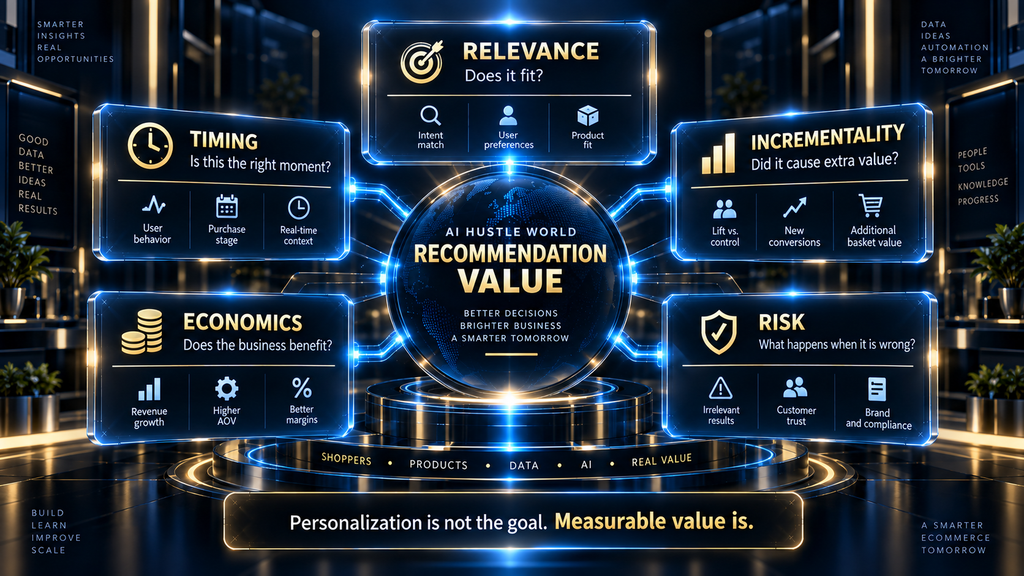
For AI Hustle World, a useful way to evaluate a recommendation strategy is to move beyond model sophistication and look at five practical dimensions: Relevance, Timing, Incrementality, Economics, and Risk.
Relevance
Does the recommendation make sense for the shopper and the current product or context? A high-quality recommendation should have a defensible reason for appearing, whether that reason comes from behavioral similarity, product compatibility, complementary use, or another meaningful relationship.
Timing
Is the shopper seeing the recommendation at the moment when it can actually help? A complementary product may make sense on a product page or in a cart but be less useful immediately after purchase. Timing determines whether relevance becomes useful action.
Incrementality
Did the recommendation create behavior that would otherwise not have occurred? This is where experimentation becomes critical because recommendation engagement alone cannot establish causality.
Economics
Does the recommendation improve the business outcome that actually matters? More clicks are not necessarily better if they do not improve conversion, basket value, margin, or another meaningful objective.
Risk
What happens if the recommendation is wrong? Inaccurate compatibility, unavailable products, irrelevant upsells, excessive personalization, or inappropriate ranking can damage customer trust or create operational problems.
This framework deliberately places incrementality and economics alongside relevance. A recommendation can be highly relevant and still deliver little incremental value if the shopper was already going to make the same purchase.
Likewise, a recommendation can generate impressive engagement but still be commercially weak if the additional purchases have poor margins or high return rates.
A Practical Recommendation Strategy for a Small Ecommerce Store
A smaller merchant does not need to begin by building a sophisticated AI recommendation architecture. The first step should be to identify one specific recommendation problem.
Perhaps customers frequently buy products together. Perhaps shoppers struggle to find alternatives. Perhaps the store has a large catalog and visitors rarely discover beyond the first few products. Perhaps repeat customers need replenishment recommendations.
Once the problem is defined, establish a simple baseline.
If the store currently has no recommendations, a well-designed rule-based module may be enough to create the first benchmark. If the store already has recommendations, measure what happens without them and compare that outcome against the current system.
Then determine whether more advanced personalization is justified by the data.
A merchant with strong traffic, meaningful behavioral history, and a large catalog may benefit from more sophisticated recommendation models. A smaller store with limited interaction data may get better results from a hybrid approach that combines business rules, product attributes, popularity, and simple behavioral signals. The objective is not to build the most advanced system.
It is to build the simplest system that can solve the actual merchandising problem and produce measurable evidence.
A Practical Recommendation Strategy for a Larger Store
Larger retailers can justify more sophisticated recommendation infrastructure because the number of customer interactions and product relationships creates more learning opportunities. The challenge becomes governance.
Different teams may optimize different objectives. Merchandising may prioritize strategic products. Marketing may prioritize conversion. Finance may prioritize margin. Customer experience teams may prioritize relevance and trust.
If the recommendation system is optimized for only one of those goals, the resulting behavior may create friction elsewhere. A mature recommendation program should therefore establish a primary commercial objective, define guardrails, identify ownership, and determine how recommendation quality will be monitored over time. It should also account for catalog changes, seasonal behavior, inventory availability, new products, returning customers, and shifts in customer intent.
At scale, recommendation systems become less like website features and more like commercial decision infrastructure. That is why measurement and governance become just as important as model quality.
Common Recommendation Mistakes
One common mistake is assuming that every customer wants personalized recommendations. A first-time visitor may benefit more from popular products or category-level discovery because there is too little information to personalize intelligently.
Another mistake is showing the same recommendation logic everywhere. Product pages, category pages, carts, and post-purchase screens represent different customer contexts, so the recommendation objective should change accordingly.
A third mistake is optimizing only for clicks. Clicks are useful behavioral signals, but they do not tell the merchant whether the recommendation increased profitable purchases, improved customer satisfaction, or simply redirected attention.
A fourth mistake is ignoring inventory and operational reality. Recommending unavailable products or products with incompatible variants can produce a technically personalized but commercially poor experience.
The most expensive mistake, however, is probably assuming that a sophisticated model automatically produces better results than a simpler one. Complexity should be earned through evidence. If a basic merchandising rule achieves most of the available value, adding more model complexity may increase cost without improving the customer experience.
How to Know When Your Recommendations Need Improvement
A recommendation system deserves investigation when engagement is high but downstream commercial results remain weak, or when recommendation-driven traffic produces unusually poor conversion, high return rates, or frequent customer complaints.
Another signal is repetitive exposure. If shoppers repeatedly see the same products regardless of their behavior, the system may be over-weighting popularity or failing to incorporate enough contextual information.
Poor coverage can also indicate a problem. If recommendations work well for a small group of popular products but perform poorly across the long tail, the system may have insufficient data or weak product representations.
The strongest diagnosis combines behavioral and commercial evidence. A sudden fall in recommendation CTR may matter, but so might stable CTR accompanied by declining margin or rising returns.
The system should therefore be monitored as a business process, not only as a machine-learning component.
The Road to More Contextual Recommendations
The next generation of recommendation systems is likely to become more contextual rather than simply more personalized. Instead of relying primarily on historical preferences, systems can increasingly interpret the shopper’s immediate intent, current conversation, constraints, product use case, and stage in the purchase journey. This is particularly visible in the movement toward AI shopping assistants, where the shopper can describe what they want in ordinary language and receive a shortlist based on several criteria at once.
That changes the nature of recommendations. The system is no longer simply asking: “What did people like this shopper buy?” It can ask: “Given what this shopper is trying to accomplish right now, which products actually solve that problem?”
That is a more powerful question. It also increases the importance of product data because contextual recommendation requires the system to understand product attributes and relationships with much greater precision.
Recommendations and the Future of AI-Mediated Shopping
As AI becomes a more common interface for shopping, recommendations may move from being a component of a retailer’s website to being part of the broader product-discovery layer.
Recent NIQ research indicates that AI is already becoming a meaningful part of consumers’ product-discovery behavior, although autonomous AI purchasing remains much less common than assisted research and evaluation. Major commerce platforms are simultaneously building infrastructure that allows AI systems to interact with merchant product information and commerce workflows.
A shopper may increasingly begin with an intention rather than a product name. The AI system may interpret that intention, retrieve products, compare them, and present a shortlist. Recommendation technology then becomes less about placing a widget on a product page and more about determining which products belong in the shopper’s consideration set in the first place.
If an AI system cannot understand why a product matches a shopper’s need, that product may never reach the shortlist.
Final Thoughts
AI product recommendations are often sold as a straightforward conversion tactic, but the underlying reality is more interesting. A recommendation system is a decision engine that tries to determine which products deserve a shopper’s attention, using whatever evidence the business can provide.
Its value depends on several things working together. The product data has to be reliable, the recommendation method has to fit the available information, the placement has to match the shopper’s context, and the business objective has to be clearly defined. Even then, the recommendation should be evaluated against a meaningful baseline because engagement and attribution do not prove incremental value.
For most merchants, the practical path is therefore not to begin with the most sophisticated AI model available. Start with a clearly defined merchandising problem, create a simple baseline, choose the recommendation objective, test one placement, and measure the downstream result. If stronger behavioral data and larger product volumes justify more advanced personalization, the system can become more sophisticated without losing the operational discipline established by the initial experiment.
The central lesson is simple, but it is more demanding than the usual personalization pitch: a recommendation is valuable when it improves the shopper’s decision and creates incremental business value, not merely when it looks personalized.
Ready to Turn Ecommerce AI Into a Real Workflow?
Recommendations are only one part of ecommerce automation. Learn how to connect AI with triggers, apps, decisions, and actions so the technology solves a measurable business problem.
Explore AI Workflow Automation →Frequently Asked Questions
How do AI product recommendations work?
AI product recommendation systems analyze information about products, shoppers, and context to identify and rank products that are likely to be relevant. Depending on the system, they can use product attributes, browsing and purchase behavior, similarities between shoppers, relationships between products, inventory information, and other contextual signals before selecting a small group of products to display.
What is the difference between AI recommendations and rule-based recommendations?
Rule-based recommendations rely on explicit business logic, such as showing compatible accessories or frequently purchased products. AI recommendation systems can learn relationships from product data and customer behavior, which allows more dynamic personalization, but they also require stronger data and monitoring. Many effective ecommerce systems combine AI-based ranking with deterministic business rules.
Do AI product recommendations increase conversion rates?
They can, but improvement is not guaranteed. A randomized field experiment found that personalized recommendations increased purchase propensity by 12.4% in the studied environment and increased basket value by 1.7%, but those results should not be treated as a universal benchmark for every ecommerce store.
Why do product recommendations improve conversions?
Recommendations can improve purchasing behavior by expanding the shopper’s consideration set, reducing search effort, presenting relevant alternatives, or identifying complementary products. Research suggests that the effect can occur partly because recommendations change which products consumers consider during the shopping process.
Where should product recommendations appear on an ecommerce site?
The best placement depends on the business objective and the shopper’s stage in the journey. Product pages can support alternatives and complements, category pages can support discovery, carts can support complementary purchases, and post-purchase experiences can support replenishment or related products. Different placements should not automatically use the same recommendation logic.
How many products should a recommendation module show?
There is no universal number that works for every store. The recommendation set should be large enough to offer meaningful choice but small enough that the shopper can process it without feeling overwhelmed. The right number should be tested against engagement, conversion, and other relevant downstream outcomes rather than chosen solely from a generic best-practice rule.
What data is needed for AI product recommendations?
The requirements depend on the recommendation approach. Product attributes are particularly important for content-based and semantic recommendations, while collaborative systems depend more heavily on historical customer interactions such as views, purchases, and product relationships. A mature hybrid system can use multiple forms of information and apply different signals depending on how much data exists for each shopper and product.
What is the cold-start problem in product recommendations?
Cold start occurs when a shopper or product has little or no historical interaction data, making it difficult for a recommendation system to personalize effectively. Stores often address this by combining behavioral models with product attributes, popularity signals, business rules, and other contextual information until enough interaction history becomes available.
Can AI recommendations increase average order value?
They can, particularly when recommendations surface complementary products that naturally belong with the customer’s primary purchase. However, a higher average order value does not automatically mean the recommendation system is creating better economics; merchants should also examine margin, returns, cancellations, and whether the additional purchase was genuinely incremental.
How do you measure whether AI recommendations are actually working?
Start with a clearly defined objective such as conversion rate, average order value, revenue per session, or contribution margin, then compare the recommendation experience against a meaningful baseline. Controlled A/B testing is particularly valuable because recommendation clicks and post-click purchases show attribution but do not necessarily prove that the recommendation caused an incremental result.
Related Guides
- Best AI Product Recommendation Platforms for Ecommerce
- Best AI Shopping Assistants for Ecommerce Businesses
- 10 Best AI E-Commerce Tools for Content & Support (2026)
Written by
Muntasir Ahmad Chowdhury
Founder, AI Hustle World
Muntasir Ahmad Chowdhury is the Founder of AI Hustle World, an independent publication dedicated to making Artificial Intelligence practical, trustworthy, and easy to understand. He researches AI tools, automation, customer service, productivity, and real-world business applications, helping readers make smarter technology decisions through research-driven, experience-backed content.
Expertise:
AI Tools • AI Automation • AI Customer Service • AI Productivity • Generative AI • AI Workflows
Get Smarter With AI
Enjoyed this guide? Get practical AI tools, tutorials, and honest reviews delivered to your inbox.
5 thoughts on “How AI Product Recommendations Work and When They Improve Conversions”