
How to Build an AI Shopping Assistant Without Sacrificing Accuracy
A shopper opens an online store and types, “I need waterproof running shoes for wide feet, under $150, and I want something available in size 10.” A conventional search box may struggle because the request combines several requirements in ordinary language. An AI shopping assistant can interpret those requirements, search the catalog, compare suitable products, explain the trade-offs, and help the customer move toward a purchase.
The difficult part is not making the assistant sound intelligent. The difficult part is making sure it does not recommend a shoe that is not waterproof, quote yesterday’s price, confuse a parent product with an unavailable variant, ignore the shopper’s budget, or confidently describe an attribute that does not exist in the catalog. Once the assistant participates in a buying decision, conversational fluency matters less than whether its claims can be trusted.
That changes how an AI shopping assistant should be built. The language model can interpret ambiguous requests and explain options, but it should not become the store’s source of truth for products, variants, prices, availability, policies, or purchase actions. Those facts should come from authoritative commerce systems and be verified at the moment they matter.
This distinction is becoming more important as conversational shopping moves beyond simple product chatbots. Shopify now provides structured interfaces that allow AI agents to search catalogs, retrieve products, manage carts, answer policy questions, and participate in checkout flows, while OpenAI is expanding AI-native product discovery around current merchant data and conversational refinement. Shopify
The real question, therefore, is not simply how to build an AI shopping assistant. It is how to build one that can reason flexibly without being allowed to invent commerce facts, and how to test that reliability before customers begin depending on it.
An AI Shopping Assistant Is More Than a Chatbot
An AI shopping assistant is a conversational product-discovery system that interprets shopper intent, retrieves relevant products, evaluates constraints, explains recommendations, and may eventually perform actions such as adding an item to a cart. The language interface is only the visible layer; underneath it sits a chain of product data, search, ranking, business rules, live commerce information, and controlled actions.
That is different from a conventional customer-service chatbot. A support chatbot may answer questions about shipping, returns, account access, or order status. A shopping assistant is expected to reason about what the customer should consider buying, which makes errors more consequential because the system is influencing a commercial decision rather than merely retrieving a policy answer.
It is also different from a traditional recommendation carousel. A recommendation system might show “customers also bought” or “recommended for you” based on behavior and similarity, while a shopping assistant can work with explicit needs expressed in language. A shopper can say that they need a laptop for video editing, dislike heavy devices, have a fixed budget, and need particular ports, then refine those priorities during the conversation.
The assistant therefore sits at the intersection of search, recommendation, conversational reasoning, and commerce operations. That combination explains both its usefulness and its risk. Each additional capability gives the shopper a more natural experience, but it also creates another place where an apparently convincing answer can become wrong.
The Model Should Never Be the Store’s Source of Truth
The most important architectural principle is simple: the language model should reason about commerce data, not replace commerce data. A model can interpret “I need a lightweight jacket for rainy commuting,” but it should not be expected to remember which jacket is currently in stock, which sizes exist, what today’s price is, or whether a particular variant is actually waterproof.
Language models are designed to generate likely text from context, not to behave like transactional databases. Even when a model has seen product information previously, that information may be incomplete, stale, summarized incorrectly, or detached from the exact variant the shopper is considering. Commerce facts change too frequently for model memory to be a safe authority.
A better design separates reasoning authority from commerce authority. The model decides what information it needs, interprets shopper language, compares retrieved evidence, and explains the result. The catalog, inventory service, pricing system, policy database, customer account system, cart, and checkout infrastructure remain responsible for facts and transactional state.
Shopify’s current Storefront MCP architecture illustrates this separation clearly. Product discovery, product lookup, cart operations, and policy retrieval are exposed through structured tools, allowing the AI layer to request current commerce information rather than inventing it from conversation history. Shopify
This principle becomes more important as the assistant gains more autonomy. A wrong sentence about a product is undesirable, but a wrong cart mutation or incorrect variant selection can directly affect an order. The closer the AI gets to taking action, the more deterministic verification should surround the model.

Start With the Shopping Job, Not the Language Model
Many AI projects begin with the wrong question: “Which model should we use?” A shopping-assistant project should begin with a narrower question: what specific shopping problem should this assistant solve better than the existing experience?
An apparel retailer might initially need help converting natural-language preferences into product discovery. An electronics store might care more about comparing specifications and checking compatibility. A furniture retailer may need an assistant that can interpret dimensions, room constraints, material preferences, and delivery requirements without confusing similar-looking products.
Those problems require different levels of data quality and reasoning. A store that only wants conversational product search does not need the same architecture as one that allows the assistant to modify carts, access customer accounts, recommend replacements, or help initiate checkout. Treating all of these as one project usually increases both complexity and the number of failure modes.
A narrow first use case also creates something that can actually be evaluated. “Answer any shopping question” is difficult to test because the possible behaviors are almost unlimited. “Help customers choose running shoes using activity, budget, fit, surface, weather, and available size” provides a defined problem, a measurable catalog scope, and a practical set of test conversations.
The first version should therefore solve one valuable shopping job well enough to earn additional responsibility. More capabilities can be added after the system has demonstrated that its product retrieval, factual grounding, recommendation logic, and action controls work reliably.
How a Reliable AI Shopping Assistant Actually Works
A reliable shopping assistant turns ordinary language into a controlled sequence of information retrieval and decisions. The conversation may feel open-ended to the shopper, but the underlying system should have a much more disciplined structure.
Suppose a shopper asks for “a waterproof black backpack for a 16-inch laptop, under $120, that does not look too outdoorsy.” The model first needs to identify the important constraints: waterproofing, color, laptop size, budget, and style preference. It should also recognize that some requirements are hard constraints while others are subjective preferences.
The assistant then searches the product catalog using those constraints and retrieves possible candidates. Semantic search can help match descriptions such as “minimal office style” even when the catalog does not use the exact phrase, while structured filters can enforce requirements such as price, laptop capacity, color, or availability when those fields exist.
Candidate products then need to be evaluated against the request. If one backpack fits a 16-inch laptop but costs $145, it should not survive a strict $120 budget unless the shopper has indicated flexibility. If another product is described as water-resistant rather than waterproof, the assistant should not silently treat those terms as equivalent.
Before the final recommendation is presented, facts that can change should be refreshed or verified. Current price, exact variant, stock status, delivery availability, and other transactional details should come from live commerce systems rather than from the earlier retrieval result or model context.
Only then should the model explain the recommendation in natural language. The conversational layer should tell the shopper why each option fits, where it compromises, and what information remains uncertain instead of manufacturing certainty to make the answer sound more complete.
This sequence is what separates a shopping system from an impressive demo. The conversation may be generated by an LLM, but the reliability comes from everything surrounding that model.

Product Data Sets the Accuracy Ceiling
An AI shopping assistant cannot consistently make accurate recommendations from a catalog that does not contain the facts needed to answer the shopper’s question. Better prompting cannot recover a material attribute, compatibility rule, exact dimension, variant relationship, or availability status that the commerce system never recorded correctly.
Consider a shopper who asks for a “machine-washable wool sweater.” If the store records material but not care instructions, the assistant has an evidence problem. It may know from general knowledge that some wool garments can be machine washed, but that does not prove anything about the specific product being sold.
The correct behavior is not to fill the gap with a plausible assumption. The assistant should either retrieve care information from another authoritative product source or acknowledge that the available catalog data does not confirm the requirement. That response may feel less impressive, but it is more useful than recommending an item based on an invented property.
Variant structure is especially important because product-level facts and variant-level facts can differ. A shoe may be available in the shopper’s preferred model while the requested size and color combination is sold out. An assistant that retrieves only the parent product can truthfully say the shoe exists while still making an inaccurate recommendation for the exact item the customer needs.
Current merchant-data standards reflect this need for structured accuracy. Google Merchant Center requires information such as price and availability to match the actual purchase experience, while Shopify’s current catalog interfaces distinguish searching from product and variant lookup so agents can resolve exact identifiers rather than relying only on descriptive similarity. Shopify
This does not mean every retailer needs a perfect product-information system before experimenting with conversational shopping. It means the first assistant should be scoped around the parts of the catalog where the required data is sufficiently reliable, while missing attributes are treated as known limitations rather than hidden behind model confidence.
Retrieval Helps Ground the Assistant, but RAG Is Not Truth
Retrieval-augmented generation is useful because it gives the model relevant external information at the moment it answers. Instead of relying entirely on what the model learned during training, the system can search product records, policies, specifications, guides, reviews, or other approved sources and pass the relevant evidence into the model’s context.
That solves an important problem, but it does not solve every accuracy problem. Retrieval can return the wrong evidence, miss the right product, rank an irrelevant document too highly, or provide information that conflicts with another source. Even when the correct evidence is retrieved, the language model can still interpret or summarize it incorrectly.
Recent RAG research continues to examine exactly this problem. Work on factual-confidence prediction and contextual faithfulness treats retrieval accuracy and answer faithfulness as separate stages because generated answers can remain inconsistent with the evidence supplied to the model. arXiv
For shopping, the distinction is practical rather than academic. Imagine that the retrieved product record says a jacket is “water-resistant” and the assistant responds that it is “waterproof.” The retrieval step worked because the relevant specification was available, but the generation step still changed the meaning.
A reliable shopping assistant therefore needs controls after retrieval. Important factual claims can be restricted to known catalog fields, generated recommendations can be checked against the underlying product records, and high-risk attributes can require explicit evidence before the assistant is allowed to present them as facts.
The useful mental model is that RAG gives the model evidence; it does not automatically force the model to respect that evidence. That is why retrieval quality and generation faithfulness need to be evaluated separately.
Hard Constraints and Soft Preferences Should Not Be Treated the Same
One of the most useful jobs an AI shopping assistant can perform is converting a vague conversational request into structured buying criteria. The problem is that not every criterion has the same importance, and treating all of them as loose semantic preferences can produce recommendations that sound reasonable while violating what the shopper actually asked for.
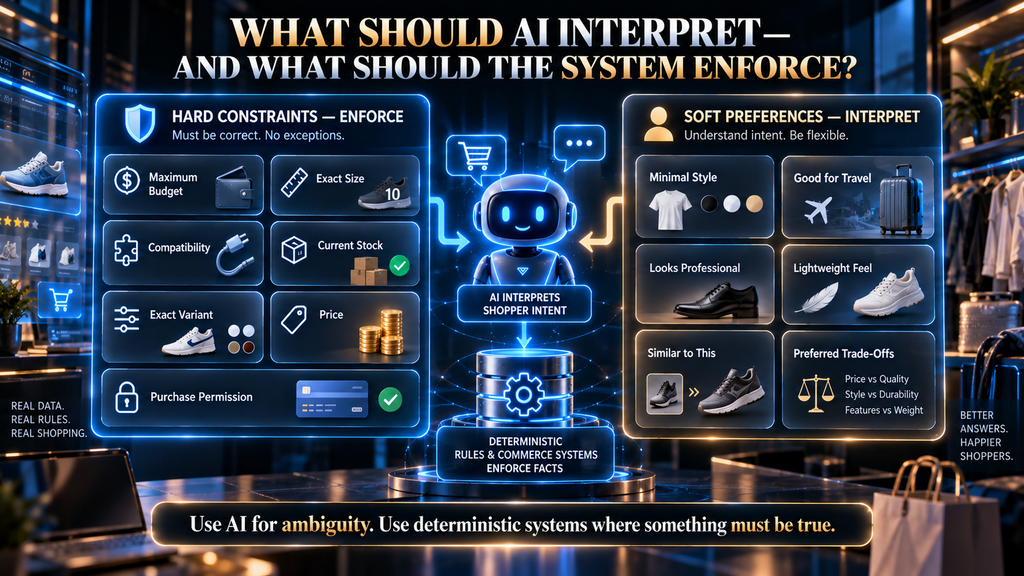
A budget ceiling is often a hard constraint. Required compatibility, safety certification, device dimensions, shoe size, dietary restrictions, or an explicitly required material may also be hard constraints depending on the purchase. If the assistant recommends something that fails one of those requirements, a strong semantic match on other attributes does not make the recommendation correct.
Other criteria are naturally softer. “Minimal design,” “good for travel,” “not too formal,” or “something similar to this style” require interpretation and ranking rather than binary filtering. The model is useful precisely because it can reason about these fuzzy preferences after deterministic constraints have narrowed the candidate set.
This suggests a practical architecture: structured systems should enforce what must be true, while the AI layer can help reason about what the shopper would probably prefer. A $180 product should not outrank a $120 product for someone with a strict $130 maximum simply because the model thinks the more expensive product has a better design.
The assistant should also learn when a requirement is ambiguous. If the user says “around $100,” the system can reasonably treat the budget differently from “maximum $100.” Rather than silently deciding how flexible that constraint is, the assistant can ask a short clarification when the difference materially affects the recommendation.
This is where conversation becomes genuinely useful. The model does not need to pretend that every request is fully specified; it needs to recognize which missing detail would change the result enough to justify asking another question.
Accuracy Depends on the Exact Variant, Price, and Stock
Product discovery is only the beginning of a reliable recommendation. As soon as the shopper becomes interested in a specific item, the system should move from approximate matching toward exact validation.
A product page can represent dozens of variants. Size, color, storage capacity, material, bundle configuration, region, or other options may change price and availability, so telling the shopper that “this product is in stock” can be misleading when the exact requested configuration is unavailable.
The same problem applies to prices. Promotional pricing, regional pricing, customer-specific discounts, bundles, taxes, and time-sensitive campaigns can make previously retrieved information stale. The model should not preserve a price in conversation memory and treat it as permanently valid if the commerce system can provide a current value.
Cart systems provide a useful verification boundary because they work with exact identifiers and quantities rather than descriptive product names. Shopify’s current commerce architecture, for example, separates catalog discovery from cart and checkout capabilities and expects exact cart state to be retrieved and validated during the purchase flow. Shopify
This means the assistant should become more conservative as the shopper gets closer to purchase. Early discovery can tolerate broad semantic exploration, but a statement such as “size 10 in black is available for $129” should be backed by a current variant-level lookup.
That shift from exploratory reasoning to transactional verification is one of the most important design changes between an AI search experience and a dependable shopping assistant.
Good Recommendations Need More Than Factual Accuracy
A recommendation can contain completely accurate product facts and still be a poor recommendation. If a shopper says battery life matters more than screen brightness, the assistant can accurately describe two laptops yet choose the wrong one because it failed to preserve the shopper’s priorities.
This is why recommendation fit needs to be evaluated separately from factual grounding. The question is not only whether every sentence about the product is correct, but whether the recommended product genuinely satisfies the user’s stated needs better than the available alternatives.
The assistant should therefore preserve the shopper’s important constraints and preferences across the conversation. When priorities change, the recommendation logic should change as well. If the shopper raises the budget, changes the required size, or says portability is no longer important, old assumptions should not continue driving the ranking invisibly.
Explanations help expose this reasoning. Instead of simply saying “I recommend Product A,” the assistant can explain that Product A meets the hard budget and compatibility requirements, while Product B has better performance but exceeds the price limit. The explanation gives the shopper a way to notice when the system has misunderstood what matters.
The explanation should still remain grounded in product evidence. A natural-language justification is useful only when the assistant can point back to real attributes and shopper preferences rather than generating a persuasive story after choosing the product.
More Context Can Sometimes Make Recommendations Less Stable
Personalization sounds like an obvious improvement for shopping assistants, but more context does not always produce more dependable recommendations. Past purchases, remembered preferences, reviews, browsing behavior, external sources, and earlier conversations can all help, yet they can also compete with the shopper’s current request.
Recent research from Wharton Generative AI Labs tested roughly 26,000 agentic shopping scenarios and found that recommendations became less predictable as additional contextual influences were introduced. Reviews, source ordering, injected memory, competing information, and differences in retrieval could all shift which product the agent selected. Wharton Generative AI Labs
That finding introduces an accuracy dimension that is easy to overlook: recommendation stability. If the user’s real requirements remain unchanged, irrelevant changes in context should not cause the assistant to jump unpredictably between fundamentally different recommendations.
This does not mean memory or personalization should be removed. It means current explicit intent should normally outrank weak historical signals, and the system should distinguish a persistent preference from something the shopper happened to mention once.
Suppose the assistant remembers that a customer previously preferred premium products, but the current request explicitly asks for a low-cost gift under $40. The remembered preference should not quietly override the active budget because the current conversation provides stronger evidence about what the shopper needs now.
Testing should therefore include controlled variations of the same request. A reliable system should remain reasonably consistent when irrelevant context changes and should change its recommendation when genuinely decision-relevant information changes.
The AI Shopping Assistant Accuracy Stack
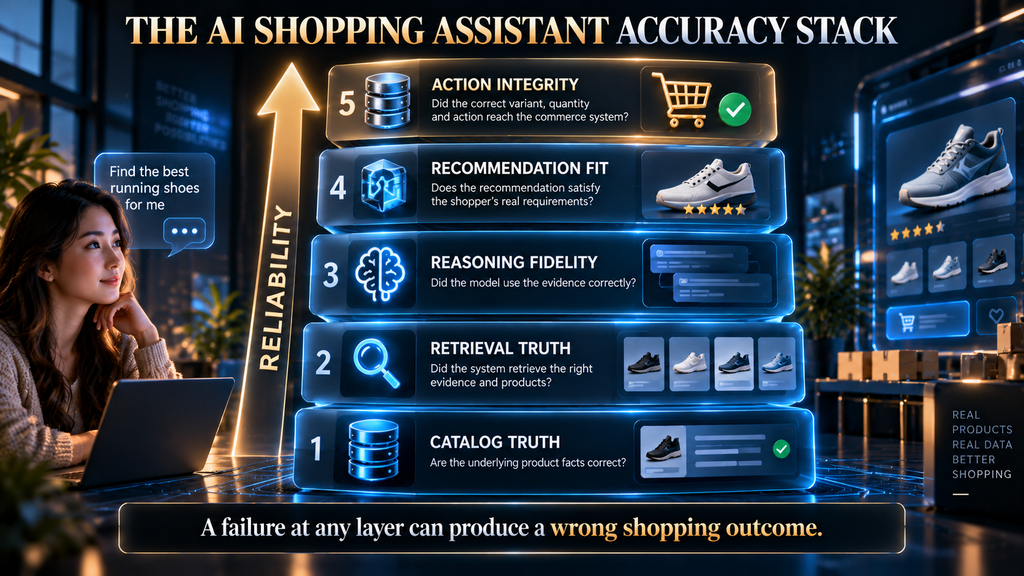
AI shopping accuracy is easier to manage when the system is treated as a chain rather than as a single model score. AI Hustle World’s AI Shopping Assistant Accuracy Stack separates reliability into five layers so teams can identify where a wrong recommendation actually originated.
The first layer is Catalog Truth. This asks whether the underlying product data correctly describes the products, variants, prices, attributes, policies, and availability the assistant needs. If the commerce system says the wrong thing, the assistant can faithfully repeat bad information and still fail the customer.
The second layer is Retrieval Truth. The right information can exist while the search system retrieves the wrong candidate, misses an important product, or selects outdated supporting content. Retrieval should therefore be measured independently from whatever the language model eventually says.
The third layer is Reasoning Fidelity. Here the question is whether the model uses the retrieved evidence correctly. Turning “water-resistant” into “waterproof,” confusing one variant’s specifications with another, or merging facts from two different products are reasoning failures even when the source material was available.
The fourth layer is Recommendation Fit. A product may be described accurately but still fail the shopper’s real needs. This layer checks whether hard constraints were honored, priorities were interpreted correctly, compromises were made explicit, and the recommendation makes sense relative to other candidates.
The fifth layer is Action Integrity. Once the assistant interacts with a cart, checkout, customer account, or another transactional system, the exact product identifier, variant, quantity, price state, and shopper intent must remain aligned. A correct recommendation followed by the wrong cart action is still an inaccurate shopping experience.
The value of this framework is diagnostic. When a customer receives a bad recommendation, “the AI hallucinated” is often too vague to guide a fix. The real cause may be missing catalog data, weak retrieval, generation drift, poor ranking, stale state, or an incorrect tool call.
The Assistant Should Know When It Does Not Know
A reliable shopping assistant should be allowed to express uncertainty. Systems become dangerous when their design rewards always producing an answer, even when the evidence needed for a trustworthy recommendation is missing.
Consider a shopper asking whether a particular child car seat is compatible with a specific vehicle model. If compatibility is not verified in the available product data or approved documentation, a confident guess is more harmful than an incomplete answer. The assistant should explain the limitation and direct the shopper toward the source that can verify it.
The same principle applies to ordinary retail questions. If the catalog does not record whether a bag fits under a particular airline seat, the assistant can report the product dimensions and explain that compatibility depends on the airline’s limits rather than converting that uncertainty into an unsupported yes.
Useful uncertainty is specific rather than vague. “I’m not sure” tells the shopper little, while “the catalog confirms the dimensions but does not provide a waterproof rating” makes the information boundary clear and allows the customer to decide what to do next.
Human escalation belongs here as well. High-consequence, unusual, account-specific, or poorly documented questions should have an escape route to human support rather than forcing the model to continue beyond the evidence available to it.
The goal is not to make the assistant timid. It is to make confidence proportional to evidence.
Shopping Actions Need Stronger Controls Than Shopping Advice
There is a meaningful difference between suggesting a product and acting on the shopper’s behalf. The system should recognize that difference because the cost of an error rises sharply once conversation begins changing transactional state.
Adding an item to a cart may seem harmless, but even that action needs exact product, variant, and quantity information. If the shopper says “add the second one in medium,” the system has to preserve which recommendation “the second one” refers to and confirm that medium exists for the intended variant.
Checkout requires stronger safeguards. Current Shopify architecture separates cart iteration from checkout and requires authenticated or signed interactions for checkout capabilities, illustrating how commerce platforms distinguish reversible exploration from more consequential purchase steps. Shopify
Confirmation should increase with consequence. Searching the catalog does not require explicit approval after every step, while replacing a cart item, changing quantity significantly, using personal account information, or initiating a purchase may justify a clear confirmation boundary.
The model should also avoid constructing transactional facts itself. Final totals, taxes, shipping options, and purchase state should be returned by the commerce system after validation rather than calculated informally inside the conversation when authoritative systems are available.
This creates a useful division of labor. The AI layer manages interpretation and dialogue; the transactional layer validates and executes.
How to Build the First Reliable Version
The first implementation should begin by defining a narrow customer problem and mapping the data required to solve it. A retailer building an assistant for product discovery should identify which product attributes shoppers regularly use in decisions, which of those attributes are reliably structured, and which questions still depend on unstructured descriptions or human knowledge.
The next step is to define the assistant’s authority. Decide which information can be generated conversationally, which claims must come directly from catalog fields, which facts require live verification, and which actions require explicit user confirmation. These boundaries should exist before prompts are written because they determine what the model is allowed to do.
Retrieval can then be designed around the actual catalog. Semantic search is useful for interpreting descriptive needs, while filters or structured queries should enforce requirements that have exact fields. A hybrid approach often makes more sense than asking a vector search system to handle every constraint through similarity alone.
Recommendation logic comes after retrieval. The system should preserve hard requirements, rank softer preferences, explain meaningful compromises, and ask clarifying questions when an unresolved ambiguity could substantially change the result. The model’s job is not merely to select something from the retrieved products; it is to help the shopper make a better decision from valid candidates.
Live verification should happen as the customer moves toward a specific item. Exact variant, price, availability, and cart state should be refreshed from authoritative systems, particularly before the assistant makes transactional claims or performs an action.
Only after those layers are working should additional autonomy be introduced. Account history, deeper personalization, cart modification, checkout, returns, and other workflows can add considerable value, but they also expand the surface area that must be tested.
Testing Should Begin Before Real Customers Depend on the Assistant
Testing an AI shopping assistant requires more than reading a handful of friendly conversations and deciding that the answers sound good. The system needs a repeatable evaluation set containing normal requests, difficult requests, ambiguous requests, incomplete catalog data, variant conflicts, unavailable products, changing preferences, and intentionally adversarial combinations.
Shopify’s current testing guidance reflects this operational view by recommending checks across product search, cart operations, exact variants, quantities, pricing, conversation flow, and complete shopping journeys. The point is not simply whether the model responds; the system needs to perform the intended commerce operation correctly. Shopify
Retrieval quality should be measured first because a model cannot recommend an appropriate product that never enters the candidate set. Teams should check whether relevant products are retrieved, whether important alternatives are missed, and whether structured constraints eliminate products that clearly violate the request.
Grounded claim accuracy then evaluates whether factual statements about products are supported by authoritative data. This should include attributes that are easy to confuse, such as water resistance versus waterproofing, included accessories versus optional accessories, or product-level features versus variant-level features.
Constraint adherence evaluates the decision itself. A useful test set should contain requests with strict budgets, sizes, compatibility requirements, exclusions, and preference hierarchies so the team can identify recommendations that sound persuasive while violating a requirement.
Recommendation stability can be evaluated by changing irrelevant context while holding the shopper’s core intent constant. If a minor change in source order, conversational wording, or unrelated memory repeatedly produces completely different recommendations, the system may be too sensitive to context.
Tool and action accuracy should be evaluated separately from recommendation quality. The assistant must call the correct commerce capability with the correct identifier and quantity, then interpret the returned state accurately. Retries should also be tested so a network or model retry does not create duplicate actions.
The evaluation process should remain after launch. Catalogs change, promotions change, product descriptions are edited, models are updated, retrieval systems evolve, and new shopper behavior appears, so a test suite that once passed can become outdated without any obvious code failure.
Conversion Is Not Enough to Measure Success
A shopping assistant exists in a commercial environment, so business outcomes matter. Assisted conversion rate, add-to-cart rate, revenue per assisted session, engagement, and shopping-session completion can help show whether customers find the system useful.
Those numbers should not stand alone because a persuasive but inaccurate assistant can sometimes increase short-term action. If customers buy the wrong size, misunderstand compatibility, return unsuitable items, or contact support to correct recommendations, a higher add-to-cart rate may hide a lower-quality decision.
Reliability metrics should therefore sit next to commercial metrics. A retailer can track grounded factual accuracy, constraint adherence, exact-variant correctness, tool-call success, unsupported-claim rate, uncertainty handling, recommendation stability, and downstream correction or return patterns where those outcomes can be measured responsibly.
Latency also matters because an assistant that performs ten verification steps but takes an uncomfortable amount of time to answer can damage the shopping experience. The objective is not maximum verification at any cost; it is to apply stronger validation to the claims and actions where being wrong matters most.
This is also why one global “accuracy score” is usually insufficient. A system may perform well on descriptive questions but poorly on variant availability, or retrieve relevant products accurately while failing to preserve budgets during long conversations. Layered measurement makes those differences visible.
The commercial test should ultimately be whether the assistant helps shoppers make better decisions without creating hidden downstream costs. Conversion is part of that answer, but not the whole answer.
Common Failure Modes Are Usually System Failures, Not Just Model Failures
Many shopping-assistant failures are blamed on the language model because the model produces the visible sentence. That explanation often misses the actual engineering problem.
A recommendation for an unavailable size may begin with stale inventory data. A false product attribute may come from an incomplete catalog combined with a model that was never instructed to abstain when evidence was missing. An incompatible accessory may result from semantic similarity being used where a deterministic compatibility rule should have been enforced.
Long conversations introduce another category of error. The shopper may change the budget, replace one preference with another, or switch from shopping for themselves to shopping for someone else. If old context remains equally influential, the assistant can produce recommendations that appear inconsistent because its internal representation of the active requirements is outdated.
Personalization can create a similar conflict. Historical preferences may improve recommendations in ordinary situations, but they should not override explicit current instructions. A shopper who usually buys premium products can still ask for a cheap temporary replacement, and the assistant should treat the current requirement as stronger evidence.
Action errors can happen even after excellent reasoning. The assistant may identify the right product but send the wrong variant ID to the cart tool, misread a returned price, repeat an action during a retry, or refer to stale cart state after the shopper changes something outside the conversation.
The lesson is important because different failures require different fixes. Better prompting cannot repair inaccurate source data, and better catalog data cannot prevent a tool from receiving the wrong identifier. Reliability improves when each layer is tested according to the type of mistake it can create.
When a Simpler Shopping Experience Is Better Than AI
Not every ecommerce store needs a conversational assistant. If shoppers typically know exactly what they want, the catalog is small, filters work well, purchase decisions require little explanation, and the store receives few complex discovery questions, conventional search and navigation may already solve the problem efficiently.
AI adds the most value when language captures needs that are difficult to express through menus. Complex product comparisons, compatibility questions, subjective preferences, large catalogs, unfamiliar categories, and purchases that require several trade-offs create stronger reasons for conversational assistance.
The quality of the underlying operation also matters. A retailer with inconsistent inventory records, incomplete specifications, unclear product relationships, and outdated policies may gain more from fixing those systems before adding a conversational layer. AI can make information easier to access, but it cannot make unreliable information true.
There is also an organizational cost. A shopping assistant needs monitoring, evaluation, prompt and tool governance, data maintenance, incident handling, and continued testing as models and commerce systems change. If the expected customer value is modest, that maintenance burden can exceed the benefit.
A useful decision is therefore not “AI assistant or no AI assistant.” The retailer should identify which part of the shopping journey contains enough friction, ambiguity, or decision complexity to justify the additional system.
Build Versus Buy Is Really a Control Decision
Some retailers will build custom shopping assistants, while others will use ecommerce platforms or specialist vendors. The important difference is not simply development cost; it is how much control the retailer needs over product retrieval, ranking, business rules, data access, user experience, evaluation, and transactional behavior.
A platform-based approach can reduce implementation work because catalog connectors, chat interfaces, retrieval, and commerce actions may already exist. That can be appropriate when the store’s requirements fit the platform’s model and the retailer is comfortable with its data handling, extensibility, and evaluation capabilities.
Custom development becomes more attractive when the shopping logic itself is strategic. A retailer with proprietary recommendation rules, complex product compatibility, unique customer data, unusual workflows, or strict control requirements may need architecture that generic tools cannot reproduce comfortably.
Neither approach removes the accuracy problem. A purchased assistant still depends on the retailer’s product data and should still be tested against the store’s real catalog, while a custom system does not become trustworthy simply because the retailer owns the code.
The more useful buying question is therefore: which option gives us enough control to verify the parts of the shopping journey that matter to our customers? Detailed vendor comparison belongs in a separate commercial evaluation, but the underlying decision should begin with that requirement.
What Happens When Accuracy Is Treated as a Later Problem
It can be tempting to launch a conversational assistant quickly, measure engagement, and improve reliability after customers begin using it. That strategy underestimates the way shopping errors affect trust.
A conventional search result that fails to find the right product is usually understood as a search problem. A conversational assistant that confidently recommends the wrong product creates a different psychological expectation because it sounds as though it has interpreted the shopper’s needs and evaluated the options.
The cost may appear outside the conversation. Customers can purchase unsuitable products, create avoidable returns, contact support for clarification, abandon the store after noticing contradictory information, or become less willing to trust future recommendations.
Accuracy problems can also scale quietly. A faulty compatibility rule or missing catalog attribute may affect hundreds of conversations before anyone notices because the responses are individually plausible and do not trigger technical errors.
That is why reliability should be part of the launch definition rather than a later optimization category. A narrower assistant with well-tested boundaries is usually a stronger starting point than a broad assistant that can discuss everything but cannot reliably distinguish what it knows from what it is guessing.
From Shopping Assistant to Shopping Agent
The category is moving from conversational recommendation toward systems that can participate more directly in commerce. Product discovery, comparison, cart creation, checkout coordination, order management, and other steps are increasingly being exposed to AI through structured protocols and tools.
OpenAI’s Agentic Commerce Protocol work reflects this direction by connecting conversational product discovery with merchant-provided product information and commerce capabilities. Shopify is developing related catalog, cart, checkout, and storefront-agent infrastructure that allows agents to move from search toward transaction while preserving structured commerce state. OpenAI
Amazon provides another indication of scale. The company reported that Rufus helped more than 300 million customers during 2025 and has since integrated that shopping intelligence into Alexa for Shopping; those numbers are Amazon’s own reported usage figures rather than independent evidence of effectiveness. Amazon News
The technical direction is significant because an agent capable of taking action needs a stronger reliability model than a chatbot that merely produces text. Search mistakes, state errors, stale data, identity problems, duplicated actions, and misunderstood consent can all become operational failures once the system participates in the transaction.
This makes accuracy architecture more valuable, not less, as models improve. Better reasoning can increase what the assistant is capable of doing, but greater capability also increases the number of decisions that need trustworthy data and controlled execution.
The future shopping experience may feel less like using a website filter and more like explaining a need to a capable assistant. Behind that simple interaction, however, the strongest systems will probably become more structured, not more improvisational.

A Practical Rule for Deciding What AI Should Control
The most reliable boundary is to use AI where ambiguity needs interpretation and deterministic systems where truth or irreversible action needs enforcement. That keeps the model focused on the work it is good at while preventing linguistic confidence from becoming transactional authority.
AI can interpret phrases such as “professional but not formal,” compare trade-offs across products, summarize differences, recognize that a shopper has conflicting requirements, and ask the question that would most improve the recommendation. These tasks benefit from flexible language reasoning.
Deterministic commerce systems should remain responsible for product identity, exact variants, live inventory, current prices, formal compatibility rules, account permissions, order state, and final transaction details. These are not areas where creative interpretation creates additional value.
There will always be borderline cases. The correct boundary depends on the cost of an error, the reliability of the available data, and whether the action can be reversed easily. A low-consequence product suggestion can tolerate more model discretion than a compatibility claim or purchase action.
The guiding question is therefore not how autonomous the technology can become. It is where autonomy genuinely improves the shopping experience without weakening the reliability of the decision.
Final Thoughts
A useful AI shopping assistant should feel simple from the customer’s perspective. The shopper describes what they need, the assistant understands the request, finds appropriate products, explains the differences, answers follow-up questions, and helps the customer move toward a decision.
Building that experience reliably is not simple because the model sits between human ambiguity and transactional truth. The assistant has to understand fuzzy preferences without relaxing hard constraints, use retrieved evidence without distorting it, preserve changing conversational state, and verify live commerce information before presenting it as certain.
That is why model choice is only one part of the system. Product data determines what can be known, retrieval determines what evidence reaches the model, reasoning determines how that evidence is used, recommendation logic determines whether the answer fits the shopper, and commerce controls determine whether actions are executed correctly.
The AI Shopping Assistant Accuracy Stack makes that relationship explicit: Catalog Truth → Retrieval Truth → Reasoning Fidelity → Recommendation Fit → Action Integrity. Reliability breaks when any one of those layers is treated as somebody else’s problem, even if the conversational model itself is highly capable.
The strongest implementation strategy is therefore not to make the assistant autonomous as quickly as possible. It is to give the model enough freedom to handle ambiguity while keeping factual authority and consequential actions under controlled, verifiable systems.
When that boundary is designed properly, the assistant does more than produce better chat. It becomes a trustworthy layer between what the customer means and what the store can actually sell.
See Where a Shopping Assistant Fits in the Bigger Ecommerce System
A reliable shopping assistant is only one part of ecommerce AI. See how product data, recommendations, customer support, inventory, and other workflows can work together across an online store.
Explore the Ecommerce AI Framework →Frequently Asked Questions
What is an AI shopping assistant?
An AI shopping assistant is a conversational system that helps shoppers discover, compare, and select products using natural-language requests. More advanced versions can connect to product catalogs, inventory, policies, carts, customer accounts, and checkout systems so the conversation can support more of the buying journey.
The language model usually handles interpretation and explanation, while ecommerce systems provide authoritative product and transaction information. A reliable implementation keeps those responsibilities separate rather than allowing the model to invent commerce facts.
How is an AI shopping assistant different from an ecommerce chatbot?
A typical ecommerce chatbot focuses on support questions such as shipping, returns, order status, or frequently asked questions. A shopping assistant participates more directly in product discovery and recommendation, which requires understanding shopper preferences and comparing products against them.
The two capabilities can exist in the same interface, but their accuracy requirements differ. Recommending what someone should buy introduces product-fit and decision-quality problems that a standard FAQ chatbot may never encounter.
Does an AI shopping assistant need RAG?
Many shopping assistants benefit from retrieval because they need access to current product information that should not come from the language model’s memory. Retrieval can supply catalog descriptions, specifications, policies, and other approved evidence at answer time.
RAG alone does not guarantee correctness. The system still needs to retrieve the right evidence, interpret it faithfully, verify live commerce data where necessary, and prevent unsupported product claims.
Can an AI shopping assistant hallucinate product information?
Yes, particularly when required product information is missing, ambiguous, outdated, or presented to the model without strong grounding controls. The model may also misinterpret correctly retrieved information, such as converting “water-resistant” into “waterproof.”
The safest architecture restricts factual claims to authoritative product evidence and allows the assistant to acknowledge missing information. High-risk attributes should be verified rather than inferred.
How should an AI shopping assistant handle prices and inventory?
Current prices and inventory should come from live or authoritative commerce systems rather than from the model’s remembered context. Exact variant-level validation is especially important because a product may exist while the requested size, color, or configuration is unavailable.
Verification should become stricter as the customer moves closer to purchase. Exploratory recommendations can use retrieved catalog information, but transactional claims should reflect current commerce state.
Should the assistant ask clarification questions?
It should ask when unresolved ambiguity could materially change the recommendation. A shopper saying “around $100” may not require clarification if several suitable products are close to that range, while missing compatibility information may make a reliable recommendation impossible.
Too many questions create friction, so the assistant should not interrogate the shopper unnecessarily. The best clarification question is usually the one that would eliminate the largest uncertainty in the decision.
How do you test an AI shopping assistant?
Testing should cover retrieval quality, factual grounding, constraint adherence, exact variants, changing preferences, unavailable items, tool calls, cart state, uncertainty handling, and complete shopping journeys. The evaluation set should include difficult and ambiguous requests rather than only straightforward examples.
Commercial metrics should be monitored alongside reliability metrics after launch. A higher conversion rate does not compensate for recommendations that cause wrong purchases or avoidable downstream problems.
Can AI shopping assistants use customer memory?
Memory can improve personalization when it contains relevant preferences, but current explicit instructions should normally take priority over weaker historical signals. A remembered preference for expensive products should not override a shopper who clearly asks for an inexpensive option in the current conversation.
Memory should also be tested for unintended influence. Research on agentic shopping suggests that additional contextual information can make recommendations less predictable, so personalization needs controls rather than being treated as automatically beneficial. Wharton Generative AI Labs
Should a small ecommerce store build an AI shopping assistant?
It depends on the shopping problem. A small store with a simple catalog and effective filters may gain little from adding conversational complexity, while a specialist retailer with difficult comparisons or frequent pre-purchase questions may benefit even with fewer products.
The store should first confirm that its product data is reliable enough to support the questions customers ask. Fixing catalog structure can produce more value than adding an AI layer to unreliable information.
What is the most important rule when building an AI shopping assistant?
The language model should not become the store’s source of truth. It should interpret shopper intent and explain recommendations, while authoritative commerce systems control product facts, live state, and transactional actions.
That single architectural principle does not solve every problem, but it prevents many of the most damaging ones. The more responsibility the assistant receives, the more important that separation becomes.
Written by
Muntasir Ahmad Chowdhury
Founder, AI Hustle World
Muntasir Ahmad Chowdhury is the Founder of AI Hustle World, an independent publication dedicated to making Artificial Intelligence practical, trustworthy, and easy to understand. He researches AI tools, automation, customer service, productivity, and real-world business applications, helping readers make smarter technology decisions through research-driven, experience-backed content.
Expertise:
AI Tools • AI Automation • AI Customer Service • AI Productivity • Generative AI • AI Workflows
Get Smarter With AI
Enjoyed this guide? Get practical AI tools, tutorials, and honest reviews delivered to your inbox.
2 thoughts on “How to Build an AI Shopping Assistant Without Sacrificing Accuracy”