
How to Turn Articles into Social Media Content with AI
A long-form article usually contains far more social content than its headline suggests. Inside one well-developed article, there may be a central argument, several supporting claims, one useful framework, a process, a statistic, an example, a trade-off, an implementation lesson, and a limitation that deserves its own discussion.
The common AI workflow ignores that structure. Someone pastes the whole article into a model, asks for five LinkedIn posts, five X posts, an Instagram carousel, and a video script, then receives a batch of polished variations that keep repeating the same summary in different lengths.
That approach is fast, but speed is not the difficult part anymore. The difficult part is deciding which ideas inside the article deserve to become independent social assets, which formats can carry those ideas without damaging their meaning, and how much context or evidence must survive when the article is compressed.
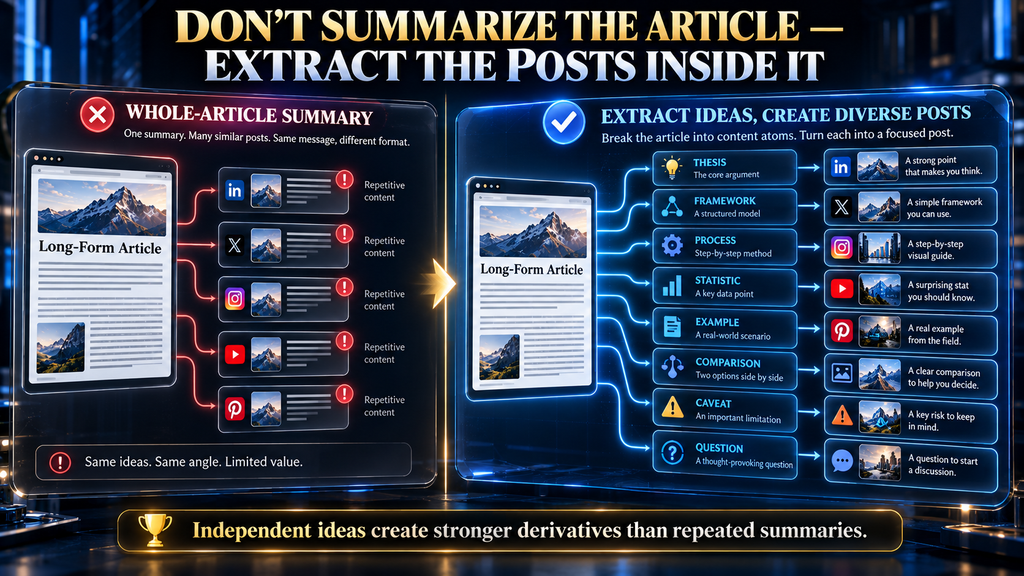
The better method is not to shrink the article. It is to extract the posts already inside it, then rebuild each one for the social environment where it can work naturally.
AI is extremely useful in that process because it can identify structure, classify ideas, draft alternatives, compress material, propose hooks, and help convert one approved argument into several formats. The editorial decisions still matter, because not every section deserves a social post and not every strong idea survives every type of compression.
A Long-Form Article Is Not One Piece of Social Content
A completed article may appear to be one asset in a content calendar, but editorially it is closer to a container holding several types of intellectual material. The introduction may establish the problem, the middle sections may explain mechanisms and evidence, while later sections handle implementation, trade-offs, failure modes, and decisions.
Those parts behave differently when separated from the article. A clear opinion can become a text post with little restructuring, while a technical process may need visual sequencing and a research finding may need enough surrounding context to prevent the result from becoming misleading.
This is why “summarize this article for social media” is usually the wrong first instruction. Summarization treats the article as one unit when the strongest repurposing opportunities often live several levels below the document.
A useful social workflow begins by identifying the article’s internal structure before choosing any platform. Only then can the editor determine whether a particular idea deserves a LinkedIn post, X thread, carousel, short video, Pinterest visual, or no social derivative at all.
The core principle is simple: do not start with the channel. Start with the intellectual unit you are trying to preserve.
Why Article Summaries Usually Make Weak Social Posts
A summary has a legitimate job. It helps someone understand the overall contents of a longer source without reading every section.
A strong social post often has a different job. It usually needs one clear reason to exist: a useful argument, an unexpected insight, a practical method, a memorable example, a question worth discussing, or a visual idea that stands on its own.
When AI summarizes an article, it tends to compress several of those ideas into a short overview. That may accurately describe the source, but description is not the same thing as a useful social asset.
Consider an article about why ecommerce recommendation systems fail. A summary might say the article covers product data, recommendation quality, inventory, experimentation, and merchant controls.
That summary tells the audience what the article contains. It does not necessarily give them an idea worth remembering.
A stronger LinkedIn post could instead develop one conclusion from the article: a recommendation can be semantically relevant and still be commercially wrong when the exact variant is unavailable. That narrower post delivers an independent lesson before the reader ever clicks the article.
This distinction is important because social content should not depend entirely on the source link to become valuable. The article can provide more depth, evidence, and implementation detail, but the derivative should offer enough value to justify the audience’s attention by itself.
Extract the Article Before You Generate Anything
The first AI task should be structural extraction, not social-media writing.
Give the model the article and ask it to identify what the document actually contains: its central thesis, supporting claims, evidence, frameworks, processes, examples, trade-offs, statistics, caveats, questions, and practical recommendations. This creates an inventory that can be reviewed before any social copy is generated.
That separation matters because extraction and writing involve different decisions. During extraction, the question is whether the model understood the source accurately; during generation, the question becomes how to express one approved idea in another environment.
Combining both stages hides mistakes. If the model misunderstands which point was central, omits a qualifier, or treats an example as a general rule, that error can propagate across the entire social batch before anyone notices.
A practical extraction schema can look like this:
| Article Component | What AI Should Extract |
|---|---|
| Thesis | The primary position or conclusion of the article |
| Supporting claims | Independent points that help establish the thesis |
| Evidence | Research, statistics, documentation, quotations or facts supporting claims |
| Frameworks | Named models, categories, relationships or decision systems |
| Processes | Ordered workflows where sequence affects the outcome |
| Examples | Cases, scenarios or stories that make an abstract idea concrete |
| Comparisons | Trade-offs, alternatives, similarities or differences |
| Practical actions | Checklists, implementation steps or decision questions |
| Caveats | Conditions where the advice weakens, changes or stops applying |
| Questions | Reader objections, FAQs and unresolved decisions |
The output of this stage is not a content calendar. It is an editorial inventory.
Someone should review that inventory before the workflow continues. AI can often surface many candidate atoms quickly, but a human editor is still better positioned to decide which ones are genuinely distinctive, well supported, and useful outside the full article.
Not Every Section Is a Social Post
A long-form article is written as a sequence. Some sections make sense only because earlier sections established definitions, context, assumptions, or evidence.
This creates a common repurposing mistake: treating every H2 or H3 as an independent post merely because it has a heading. A heading can mark an editorial shift without containing enough standalone meaning for social distribution.
The correct unit is therefore not “section.” It is independent idea. An independent idea should survive a simple test: if someone encounters it without reading the article, can they understand the central point without being misled by missing context?
If the answer is no, the idea may still be reusable, but it needs restructuring or additional explanation. If the missing context is too large, the asset may not be worth creating at all.
This is where article quality strongly influences repurposing potential. A dense article with well-separated arguments, examples, frameworks, and practical lessons can support many derivatives, while a long article that repeats one broad idea in several sections may produce surprisingly few strong posts.
The AI Hustle World Article-to-Social Fit Map
The AI Hustle World Article-to-Social Fit Map is an editorial decision model for matching the type of information extracted from a long-form article with social formats that can carry that information without unnecessarily damaging its meaning.
It is not a statistical performance ranking. The purpose is to evaluate editorial fit, context requirements, compression risk, and verification needs before AI begins writing the social asset.
Methodology: The AI Hustle World Article-to-Social Fit Map is an editorial decision model that classifies common long-form article atoms—including thesis, framework, process, statistic, example, comparison, checklist, caveat, and question—according to the social formats that can carry them most naturally. It also evaluates standalone potential, context requirements, evidence-loss risk, and the editorial controls needed during compression. The map is designed to guide format selection and verification; it is not a statistically validated performance ranking of social formats.
| Article Atom | Strong Natural Fits | Standalone Potential | Context Requirement | Evidence-Loss Risk | Main Editorial Rule |
|---|---|---|---|---|---|
| Thesis / Point of View | LinkedIn text, X post/thread, short commentary video | High | Low–Medium | Medium | Develop one argument fully instead of summarizing the entire article |
| Supporting Claim | LinkedIn, X, caption, short video | High | Medium | Medium | Preserve the reason or mechanism supporting the claim |
| Framework / Model | LinkedIn document, Instagram carousel, Pinterest infographic, video explanation | High | Medium | Low–Medium | Preserve relationships among framework components |
| Process / Sequence | Carousel, thread, tutorial video, document post | High | Medium | Medium | Do not remove steps that materially change the outcome |
| Statistic / Research Finding | Evidence post, data visual, LinkedIn analysis, thread | Medium | High | High | Preserve source, population, date, unit and material qualifiers |
| Example / Scenario | Story post, short video, carousel, LinkedIn | High | Medium | Medium | Keep enough scenario detail for the lesson to remain valid |
| Comparison / Trade-Off | Thread, LinkedIn analysis, document post, carousel | Medium | High | High | Preserve alternatives and boundaries; avoid creating a fake universal winner |
| Checklist / Practical Advice | Carousel, Pin, LinkedIn, X thread | High | Low–Medium | Low | Use only actions that remain useful without full article context |
| Caveat / Limitation | LinkedIn, X, commentary video | High | Medium | Medium | Preserve the condition that makes the limitation meaningful |
| Question / Objection / FAQ | LinkedIn, X, short video, community post | High | Low–Medium | Low–Medium | Answer one question completely rather than teasing the article |
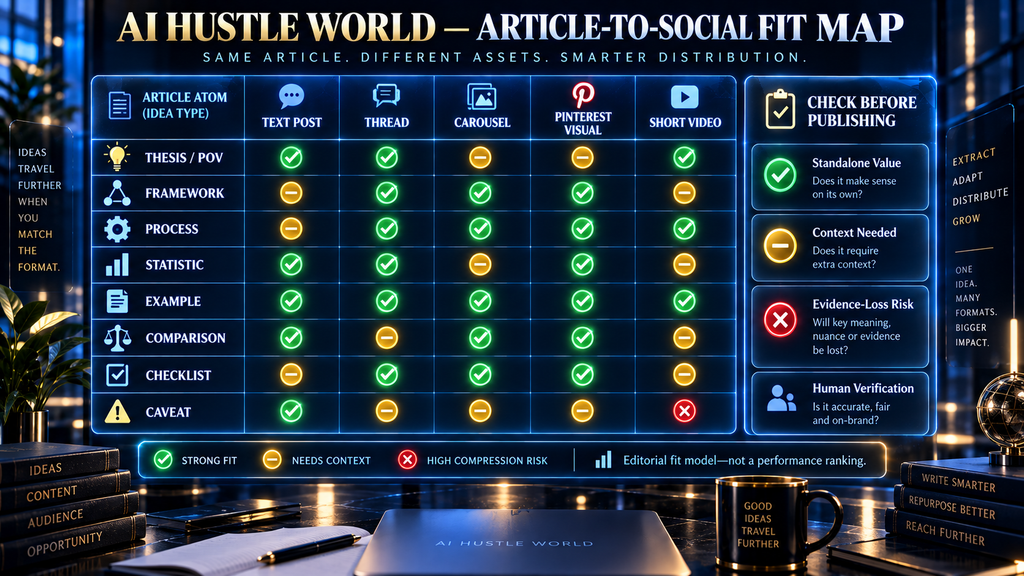
The map starts with the article rather than the platform because the information itself constrains how safely it can be compressed. A five-part framework and a qualified research statistic may both come from the same article, but their best social treatment is unlikely to be identical.
A platform is therefore the second decision. The first decision is what kind of intellectual unit are we working with?
Thesis and Point-of-View Posts Usually Need Expansion, Not Summary
An article’s thesis is often one of its strongest social atoms because it can give the audience a clear position to consider. The mistake is reducing that position to a slogan without preserving the reasoning that made it credible.
Suppose the original article argues that businesses should measure AI content repurposing by usable asset yield instead of total draft output. A weak social version might simply say, “Quality matters more than quantity.”
That statement is true but generic. The original article’s value came from the mechanism: AI makes draft generation cheap, editorial review remains constrained, and a large pile of unusable drafts can reduce rather than increase operational efficiency.
A stronger LinkedIn post could develop that mechanism in several paragraphs and then present the usable-asset-yield idea as the conclusion. An X post would need to compress more aggressively, but it could still retain the cause-and-effect logic rather than collapsing the point into a motivational phrase.
This is why thesis posts often benefit from one argument per asset. Trying to include every supporting point from the article can make the social version feel like an abstract rather than a post.
Frameworks Naturally Want Visual or Sequential Formats
Frameworks already contain structure, which makes them particularly repurposable. Categories, stages, matrices, ladders, and decision systems can often become carousels, document posts, diagrams, Pinterest visuals, or short explanatory videos more naturally than plain text.
The important rule is to preserve the relationship among components. If the framework only works because several parts interact, extracting one attractive element and presenting it as the entire method can distort the original idea.
A five-stage process is a simple example. If step four depends on the outputs of steps two and three, turning step four into “the secret” may create a more dramatic hook while weakening the model.
Visual transformation also changes what the audience needs. A framework that was explained across 800 words in an article may need labels, arrows, hierarchy, examples, and a compact explanation when converted into a carousel.
The social asset is not a screenshot of the article’s table. It is a reconstructed teaching object based on the same intellectual model.
Processes Need Their Sequence Protected
Processes are attractive social material because they provide immediate practical value. They also carry a subtle risk: sequence often matters.
An article may describe a workflow such as research → extraction → verification → drafting → review. If an AI-generated carousel removes verification because the slide count feels too long, the shorter process may no longer represent the method accurately.
The editor therefore needs to identify which stages are essential and which are supporting detail. Compression is legitimate when it simplifies explanation without changing the logic.
This is especially relevant to content that deals with safety, compliance, research, current facts, or consequential decisions. A step that looks like operational friction may actually exist because it controls error.
The best carousel or thread is not necessarily the shortest version. It is the shortest version that still produces the same practical outcome.
Statistics Have the Smallest Compression Budget
Statistics look ideal for social media because numbers create clear visual anchors. They are also among the easiest content atoms to distort.
A statistic usually has more context than the number alone. The underlying population, timeframe, metric definition, sample, methodology, source, or qualification may materially change what the number means.
For example, Buffer’s 2026 analysis of more than 45 million social posts found different engagement patterns across platforms and formats, including particularly strong median engagement for LinkedIn carousel/document posts in its dataset and strong text performance on X. Buffer itself cautions that audiences differ and that format choice depends on goals such as reach versus engagement rather than one universal winner.
That nuance matters if the research becomes a social post. “Carousels are the best format” would be a much stronger claim than the underlying data supports because Buffer’s finding comes from its dataset and one engagement metric, not a controlled experiment proving a universal law.
A repurposed statistic should therefore retain enough information for the reader to understand what was actually measured. If that context cannot fit safely into the destination, use a more suitable format or choose another content atom.
Comparisons Lose Meaning Faster Than Most Content Types
Long-form articles are good at comparison because they have room for trade-offs. A product can be stronger for one use case while weaker for another, and a methodology can work well under one condition while creating unnecessary complexity under another.
Social compression often pushes comparisons toward winners and losers because decisive language is easier to package. That can create a claim the original article never made.
Suppose an article explains that Platform A suits enterprise teams with large catalogs while Platform B fits smaller Shopify stores. A weak derivative may become “Platform A is better than Platform B.”
The comparison has technically been compressed, but the logic has disappeared.
Comparison atoms therefore need enough space to preserve decision criteria. Threads, LinkedIn posts, document posts, and carousels are often more appropriate than one short sentence when several trade-offs matter.
If the destination does not offer enough room, the editor should reduce the comparison to one explicit dimension rather than pretending to resolve the entire decision.
Caveats Can Be Excellent Social Content
Caveats are often treated as boring material that should be removed during social repurposing. In expert content, they can become some of the most distinctive assets.
A limitation frequently exposes where common advice breaks. That makes it useful for professional audiences who have already seen the simpler version of the idea many times.
An article about AI automation might explain that the workflow saves time only when the cost of reviewing exceptions remains low. That limitation can become a strong LinkedIn post because it challenges the assumption that more automation necessarily creates more efficiency.
The caveat should remain a real boundary, not be exaggerated into contrarian performance. “Automation has limits” is weak; explaining which condition causes the economics to change is much more useful.
Good repurposing does not strip nuance out of the article. Sometimes it promotes the nuance into the main asset.
A Social Post Should Be Able to Survive Without the Article Link
One of the strongest quality tests for repurposed social content is simple: remove the source URL and ask whether the post still delivers a coherent idea.
If the answer is no, the asset may be functioning mainly as an announcement. Announcements can have value, but they are different from genuine content repurposing.
A post saying “I just published a new guide covering seven ways to improve ecommerce recommendations—read it here” promotes an article. A post explaining why a relevant recommendation can still be commercially wrong because the requested variant is unavailable creates independent value.
The second post can still link to the article. The article now offers additional evidence, depth, frameworks, and implementation rather than supplying the missing point.
This distinction improves both editorial quality and audience trust. Social followers should not have to leave the platform every time they want to understand what the post is actually saying.
Platform Adaptation Changes Information Architecture
The reason one social version should not simply be copied everywhere is not that each platform requires a different “tone.” The containers themselves support different forms of information. LinkedIn currently allows standard posts up to 3,000 characters and also supports media and document-based publishing options, giving writers room for developed arguments or multi-page visual explanations.
Pinterest recommends a 2:3 aspect ratio for standard image creative and supports visually led discovery, which changes the role of hierarchy, typography, composition, and the relationship between image and accompanying metadata. YouTube currently categorizes eligible square or vertical uploads of up to three minutes as Shorts, giving creators much more sequential storytelling capacity than a static post while still requiring a substantially tighter structure than long-form video.
The editorial consequence is straightforward: changing the channel changes the structure required to communicate the idea well. The content atom may remain stable, but its architecture usually should not.
LinkedIn Works Best When the Atom Can Sustain an Argument
LinkedIn is especially useful for article atoms that require a developed professional argument, practical interpretation, or a multi-step explanation. The platform’s current 3,000-character standard post limit gives considerably more room than many short-text environments.
A strong LinkedIn derivative should therefore avoid becoming an abbreviated table of contents. Instead, choose one thesis, mechanism, trade-off, example, or limitation and develop it enough that the reader receives a complete intellectual unit.
For example, an article about AI content repurposing may contain a section arguing that the bottleneck shifts from generation to review. That section alone can support a LinkedIn post with a problem, explanation, example, and conclusion without needing to summarize the rest of the article.
Frameworks and processes can also work as LinkedIn documents or carousels when the visual sequence adds clarity. Buffer’s large 2026 dataset found unusually high median engagement for LinkedIn carousel/document posts within the posts it analyzed, but that result should be treated as evidence that format can matter rather than as proof that every idea should become a carousel.
X Forces a Harder Compression Decision
Short-text environments force the editor to decide what can survive with much less explanation. That makes X particularly useful for sharp observations, independent claims, concise counterpoints, questions, and conclusions whose reasoning can remain intelligible at smaller scale.
A weak workflow asks AI to shorten the LinkedIn post until it fits. A stronger workflow returns to the original article atom and asks what the smallest complete version of that idea actually is.
Sometimes the answer is one post. Sometimes a thread is necessary because the logic depends on several connected points.
The important distinction is whether the thread exists because the idea genuinely needs sequence or because the writer could not decide what to remove. A strong thread still has a clear thesis and progression rather than splitting an article summary across multiple posts.
Compression is therefore an editorial constraint, not only a character constraint.
Carousels Should Rebuild the Idea Visually
Carousels are often where article repurposing becomes most obviously mechanical. Teams paste one paragraph onto each slide, add a headline, and call the result visual content.
That approach changes the container but barely changes the information architecture.
A useful carousel should have a visual reason to exist. Processes can become sequential frames, comparisons can become parallel columns, frameworks can become diagrams, checklists can create progressive actions, and examples can show before-and-after states.
The slide sequence should also create movement. A good article section may begin with explanation and then reveal the conclusion, while a good carousel may need to state the practical problem first and reveal the mechanism over several frames.
AI can help propose slide architecture, but a designer or editor should still inspect whether each slide has one clear job. If the audience must read article-length paragraphs on every frame, the format choice was probably wrong.
Pinterest Requires a Strong Visual Promise
Pinterest is not simply another place to upload the carousel. Standard Pinterest image creative is commonly designed around a 2:3 vertical format, which gives the asset a very different visual hierarchy from a horizontal article graphic or text post.
Long-form articles often contain visual atoms that translate well into this environment: frameworks, checklists, decision trees, comparisons, workflows, definitions, and practical systems. The strongest Pin usually presents a specific visual promise rather than trying to represent every section of the article.
An article called “How AI Product Recommendations Work” might produce a Pin titled around a specific mechanism such as “Why Recommendation Systems Need More Than Click Data.” That is more focused than placing the full article title onto an infographic and shrinking several sections underneath it.
Pinterest can still drive readers toward the deeper source. The visual asset should first communicate enough value to justify being saved, examined, or clicked.
Short Video Needs a New Narrative, Not a Spoken Article
Video is one of the highest-transformation destinations for a written article because the audience experiences information in sequence rather than scanning a page.
A short-video script should therefore be rebuilt around one idea that can be understood through spoken language and visual progression. Reading an article paragraph aloud rarely produces the strongest result because written prose and spoken explanation distribute context differently.
YouTube Shorts can currently run up to three minutes for eligible square or vertical uploads, which gives creators more room than the earliest short-video formats but still requires deliberate sequencing.
A useful structure may begin with a concrete scenario, reveal the underlying mechanism, explain the implication, and end with one practical takeaway. The source article provides the substance, while the video receives its own narrative.
This is a medium-distance transformation in many cases. AI can produce a first script, but the editor should verify whether it sounds like something a person would naturally explain rather than something copied from an article and read into a microphone.
Social Format Should Follow the Atom
One article can contain material for several platforms, but the workflow should not begin by demanding one asset for every channel. Imagine a long-form article with five strong atoms:
- a contrarian thesis;
- a four-step process;
- one current statistic;
- a practical comparison;
- a customer scenario.
The thesis may become a LinkedIn text post because it benefits from developed reasoning. The process may become a carousel because its value comes from sequence.
The statistic may become a visual evidence post if its source and context can be preserved. The comparison may require a thread or document post because the trade-offs are too important to reduce into one claim.
The scenario may become the strongest short video because stories naturally translate into sequential media.
This is why a fixed workflow such as “every article becomes one LinkedIn post, one Reel, one thread, one Pin, and one carousel” is too rigid. Some articles genuinely support that mix; others do not.
Article Length Does Not Determine Social Output Count
A 6,000-word article does not automatically contain more strong social assets than a 2,000-word article. Length measures volume, not idea density.
A long article can spend substantial space explaining one mechanism carefully. A shorter analysis may contain several distinct arguments, examples, and decisions that all remain useful independently.
This is why output quotas such as “one article should create ten posts” are weak editorial targets. They encourage the system to keep generating after the source has stopped providing independent value.
The correct stopping point appears when additional derivatives begin repeating ideas that already exist in the batch. AI makes that repetition harder to notice because it can change wording, hooks, and formats easily.
The editor should therefore judge intellectual duplication, not textual duplication.
Build a Social Batch Around Different Intellectual Jobs
A strong batch from one article should not simply contain different formats. It should contain different reasons for the audience to engage.
One useful model is to distribute the source across six intellectual jobs: Position, Mechanism, Evidence, Application, Boundary, and Example.
The Position asset presents the central point of view. The Mechanism asset explains why something happens, while the Evidence asset highlights research or proof supporting the argument.
The Application asset shows what the audience should do. The Boundary asset explains where the recommendation weakens or fails, and the Example asset shows what the concept looks like in practice.
These six categories do not have to produce six posts. They are simply a way to inspect whether the social batch is intellectually diverse.
If five planned derivatives all perform the Position job, the batch probably repeats itself even when the formats look different.
Claim-Preserving Compression Should Be a Formal Review Step
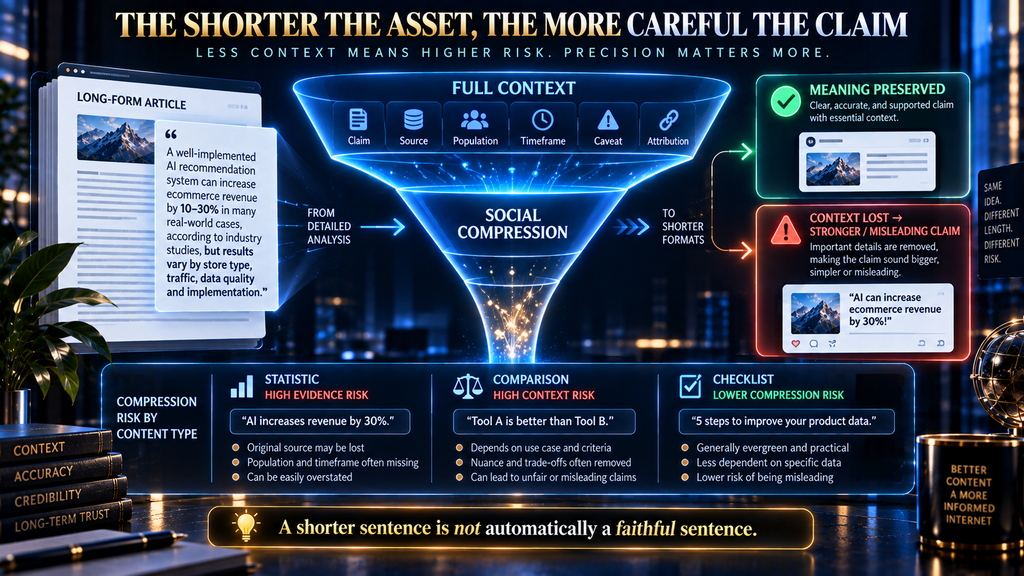
Compression changes more than word count. It can change certainty, attribution, timeframe, population, causality, and the relationship between evidence and conclusion.
For fact-heavy articles, the reviewer should compare the derivative against the source rather than simply editing the social copy for readability. If the source says “Buffer’s dataset found X among posts analyzed through its platform,” the social version should not silently become “X is the best format.” The first is a bounded finding, while the second is a universal recommendation.
The same logic applies to vendor case studies. “Vendor X reports that Customer Y achieved a 20% increase” is materially different from “Vendor X increases results by 20%.”
A shorter sentence is not automatically a faithful sentence.
This review stage becomes increasingly important as Transformation Distance rises. The more the destination encourages compression, spectacle, or decisiveness, the easier it becomes to erase the conditions that kept the source accurate.
Use the Parent Transformation Distance Model Instead of Inventing New Rules
Our AI Content Repurposing guide introduced four transformation dimensions: Audience Distance, Intent Distance, Medium Distance, and Evidence Distance.
Article-to-social repurposing can use the same framework practically. A section written for ecommerce operators and adapted into a LinkedIn post for the same professional audience may have low audience distance and low evidence distance, even if the structure changes substantially.
Turning the same section into a general-audience short video may increase audience and medium distance. If the video also makes a stronger recommendation than the article, evidence distance rises too.
High-distance social assets should receive more human restructuring and potentially fresh research. The article remains useful as source material, but it should no longer dictate the new asset automatically.
This keeps the supporting workflow connected to the broader repurposing system rather than inventing a separate method for every content type.
Give AI One Asset Brief at a Time
Once the article atoms and target formats are approved, AI becomes much more effective when given one clear asset brief instead of being asked for an entire campaign in one response. The brief should specify the approved atom, intended audience, social objective, platform, format, evidence that must remain intact, content that may be transformed freely, and any link or CTA requirement.
For example, a LinkedIn brief might say that the approved atom is a limitation from the article, the audience is ecommerce operators, the purpose is discussion, the post must preserve one documented statistic and its attribution, and the final asset should stand alone without requiring the article link. A carousel brief for the same source might specify a five-stage process, require all essential stages to remain, and instruct the model to build a visual sequence instead of rewriting the article paragraphs.
This one-asset-at-a-time approach makes errors easier to diagnose. If the output is weak, the editor can determine whether the atom, format selection, brief, or generation was responsible.
Mega-prompts hide those distinctions.
A Reusable AI Extraction Prompt
A good extraction prompt should ask AI to analyze the article without generating social content immediately. For example, the instruction can ask the model to identify the thesis, independent claims, frameworks, processes, statistics, examples, comparisons, practical advice, limitations, and questions, then attach supporting source passages or evidence where relevant.
The model should also be asked to flag ideas that do not stand alone safely. That prevents the extraction stage from rewarding quantity.
A more advanced version can request an initial Article-to-Social Fit assessment, but those suggestions should remain proposals. The editor still decides whether the format really makes sense for the audience and production resources available.
The key is that generation remains downstream of approval.
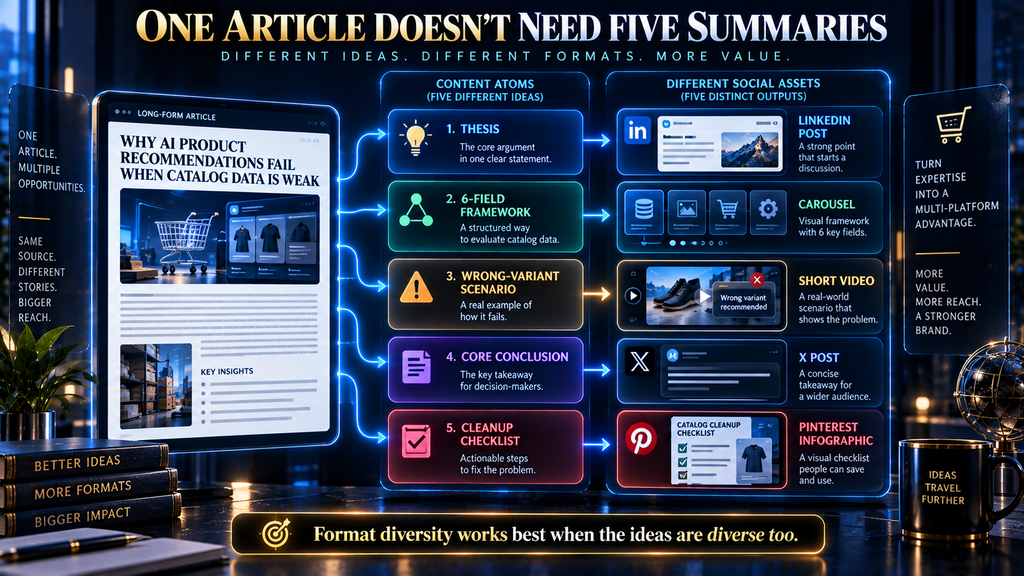
A Worked Example: One Article, Five Distinct Social Assets
Consider a hypothetical long-form article titled “Why AI Product Recommendations Fail When Catalog Data Is Weak.” This is an illustrative example, not a performance test. Assume the article contains five strong atoms: the thesis that AI cannot compensate for contradictory product data, a six-field catalog framework, a scenario where an unavailable variant is recommended, a practical catalog-cleanup checklist, and a conclusion that recommendation quality should be evaluated against commerce truth rather than conversational relevance.
The thesis could become a LinkedIn post. Instead of summarizing the entire article, the post might open with the idea that “better models cannot repair conflicting product truth,” explain why product identity and availability sit upstream of recommendation quality, and finish by asking teams what system actually owns those facts.
The six-field framework could become an Instagram or LinkedIn carousel. Each slide would teach one required data field, while the final slide would show how missing or contradictory information affects the recommendation system.
The unavailable-variant scenario could become a short video. The script would show a customer asking for a product in a specific size, receiving a relevant but unavailable recommendation, and then explain why semantic relevance is not the same thing as a valid commerce action.
The conclusion could become an X post because it is compact enough to survive heavy compression: a product recommendation can be “relevant” and still be wrong if the exact SKU cannot be purchased.
The cleanup checklist could become a Pinterest infographic designed for saving and later reference. It would not reproduce the article; it would turn the practical actions into a visual operating aid.
Five social assets now come from one article, but they do not repeat one summary five times. Each uses a different atom and performs a different intellectual job.
AI Should Preserve the Source’s Point of View
One reason AI-generated repurposed content feels generic is that the model often preserves topics while losing the source’s position. An article may have a specific editorial stance such as “automation should be limited where consequences are high,” but a social rewrite can easily flatten that into “AI can help businesses work faster.” The words remain related to the subject, but the intellectual identity has disappeared.
A useful asset brief should therefore include the article’s position, not only its subject. The model needs to know what the source concludes, what it rejects, what it remains uncertain about, and which trade-offs matter.
Brand voice works the same way. Voice is not merely whether the writing sounds casual or formal; it includes how the publication reasons, what kinds of evidence it values, how confidently it speaks, and whether it acknowledges uncertainty.
A social derivative should feel like the same publication thinking in a different format, not like a generic social-media model discussing the same keyword.
Platform-Native Does Not Mean Chasing Every Format Trend
Current platform data can help guide experiments, but it should not dictate every repurposing decision.
Buffer’s 2026 dataset covering more than 45 million posts found substantial differences among content formats. In its data, LinkedIn carousel/document posts recorded especially strong median engagement, Instagram carousels generated stronger engagement per person reached than Reels while Reels achieved wider reach than single images, and X text posts led its median engagement comparison there.
Those findings are useful because they demonstrate that format performance varies by platform and objective. They do not prove that a carousel is always the right destination for an article framework or that every Instagram idea should become a carousel.
The editor should therefore combine external platform evidence with the brand’s own analytics. The best format is the one that fits the atom, supports the intended outcome, and performs credibly with the actual audience.
Link Strategy Should Follow the Social Asset’s Job
Not every repurposed post needs a link to the article.
A LinkedIn post designed to create discussion may work better as a complete native argument. A Pinterest visual may naturally support deeper discovery through the linked source, while a social post focused on awareness may not require an immediate click at all.
The link becomes more useful when the article genuinely provides a next level of value. If the social asset explains one finding and the article contains the full framework, methodology, examples, and implementation process, the reader has a clear reason to continue.
A weak link strategy treats the social post as bait. A stronger strategy treats the post as complete at its own level and the article as the next layer.
This distinction also improves measurement because the team can evaluate different jobs separately. A post designed for conversation should not be declared unsuccessful simply because it generated fewer article clicks than a traffic-oriented post.
Distribution Should Extend the Article’s Life
Publishing every derivative immediately after the article can create a short burst of activity, but it also compresses the useful life of the source.
A more deliberate schedule can release different intellectual angles over time. The initial post may introduce the thesis, a later carousel can teach the framework, another post may examine a limitation, and a short video can revisit the idea through an example.
This sequencing has two advantages. The audience receives distinct material rather than repeated launch announcements, while the publisher receives several opportunities to direct attention back toward a durable source when doing so makes sense.
The order does not need to follow the article structure. In fact, the most interesting social atom may come from the middle of the article rather than the introduction.
Repurposing is therefore distribution across ideas and time, not merely formats.
Measure Each Asset According to Its Job
A social batch can contain awareness assets, discussion assets, save-worthy resources, traffic assets, and conversion-supporting content. Treating all of them as successful only when they generate clicks would distort the system.
A LinkedIn argument may be evaluated through substantive comments, shares, saves, profile activity, or qualified clicks. A short video may be judged through retention and completion, while a Pinterest visual can be assessed through saves, outbound clicks, and long-tail discovery.
The source article has another layer of measurement. Social referral traffic, returning visitors, backlinks, assisted conversions, newsletter subscriptions, or additional engagement around the topic can show whether the broader distribution effort extends the value of the original source.
Workflow performance matters too. Track how many derivatives were generated, how many were approved, review time, corrections, unsupported claims, and how quickly an approved source becomes a publishable social batch.
These measurements answer different questions and should remain separate.
Reuse Usable Asset Yield From the Parent System
Our AI Content Repurposing guide introduced Usable Asset Yield, calculated as approved publishable derivatives divided by generated derivatives. Article-to-social workflows benefit from the same metric because AI can make draft count look impressive even when most outputs require heavy rewriting or rejection.
If a model generates twelve social drafts and the team publishes three, the workflow may be less efficient than a more focused system that generates five drafts and approves four. The calculation does not tell the team whether the approved posts performed well, but it does reveal whether generation is aligned with editorial requirements.
The metric should never become a target that encourages weaker approval standards. Its value comes from using a stable quality threshold and observing whether source extraction, mapping, briefs, and prompts improve over time.
Reusing the metric also creates consistency across the content-repurposing cluster instead of introducing a new productivity score for every workflow.
The Bottleneck Can Move From Writing to Review
A long article may contain enough material for ten plausible social derivatives, and AI may draft them in minutes. The team still has to inspect every claim, remove repetition, adjust platform structure, create visuals, verify current facts, approve brand positioning, schedule the assets, and eventually respond to the audience.
This is where AI can create a false sense of productivity. Generation becomes cheap while review remains expensive.
If the editorial team can responsibly finish only four assets, generating twenty does not automatically increase throughput. It may slow the system by increasing the number of decisions competing for limited attention.
The solution is stronger filtering earlier in the workflow. Only atoms that have a clear purpose, suitable format, acceptable evidence risk, and reasonable production cost should reach generation.
The most efficient social workflow is not the one that produces the most possibilities. It is the one that minimizes wasted review while preserving good ideas.
Common Failure: The Platform Changes but the Idea Does Not
A social batch may look diverse because it includes text, video, carousel, and infographic formats. If every asset repeats the same central claim, the audience still experiences repetition.
This is why format diversity is weaker than intellectual diversity. A useful batch might include one asset explaining the position, another teaching the mechanism, another presenting evidence, another showing implementation, and another explaining the limitation.
The formats can then be selected according to those intellectual jobs. Changing both the idea and its presentation is what gives one long-form article a genuinely extended life.
Common Failure: The Carousel Becomes an Article Screenshot
Carousels encourage slide-by-slide organization, which can tempt teams to distribute the article’s paragraphs across frames.
That creates a poor experience because the audience receives dense reading without the advantages of the original page. The visual format adds friction instead of clarity.
A strong carousel rebuilds the source around a visual sequence. It may reduce an article section to a five-part decision path, compare two options side by side, illustrate a process, or reveal a framework over several frames.
Each slide should have a reason to exist. If the only reason for the slide is that the article had another paragraph, the transformation has not gone far enough.
The asset should be designed from the content atom, not from the article layout.
Common Failure: The Video Sounds Like Written Prose
Written articles can carry long sentences, nested explanation, citations, qualifications, and paragraphs that depend on visual scanning. Spoken content places a different cognitive burden on the audience.
When an AI tool turns article prose directly into a short-video script, the result often sounds unnaturally formal even if every sentence is grammatically correct.
A better script uses shorter spoken units, transitions that sound natural aloud, and a sequence that reveals the idea at a pace the viewer can follow. Visual opportunities should also influence the script rather than being added only after the narration is complete.
The article provides facts and reasoning. The script is a new communication object.
This difference is why video often has higher medium distance than a text post.
Common Failure: An Old Article Spreads Old Facts Everywhere
A published article can remain useful while some of its current facts become outdated. Prices change, software features move, policies are revised, statistics age, and platform specifications evolve.
Repurposing can multiply those stale facts quickly because the source appears authoritative simply because it has already been published.
Every time-sensitive atom should therefore receive a freshness check before social generation. The editor should identify the original authoritative source, verify the current value, and update the derivative rather than blindly repeating the article.
If the original article itself is materially outdated, the social workflow may reveal the need to update the source first. Repurposing should not become a mechanism for distributing yesterday’s accuracy faster.
Common Failure: AI Removes the Source’s Qualifiers
AI systems often produce stronger, cleaner claims because decisive language sounds more natural in promotional or social formats. That can subtly alter an evidence-based article.
“May help under these conditions” can become “will help.” “One vendor case study reported” can become “studies show.” “Best fit for one use case” can become “best overall.” These changes are small linguistically but large epistemically.
Editors should therefore review changes in certainty, not only changes in factual nouns and numbers. The wording around evidence matters just as much as the evidence itself.
A faithful derivative does not need to reproduce every caveat, but it must preserve the conditions that materially affect whether the claim is true.
Common Failure: The Social Batch Has No Editorial Hierarchy
AI can easily return fifteen candidate posts in one list. When everything is treated as equally important, the team loses the ability to prioritize the strongest ideas.
A useful batch should identify primary, secondary, and optional assets. The primary assets carry the strongest ideas from the article, while secondary assets deepen or extend them.
Optional assets should be generated only when the team has capacity and a clear reason to publish them. This prevents the calendar from being filled with material that exists only because the AI found another possible angle.
Editorial hierarchy is especially important when the source article itself is part of a larger content cluster. Some social posts may be better used to direct attention toward another supporting article rather than repeatedly promoting the same page.
Distribution should follow the broader content system, not only the individual source.
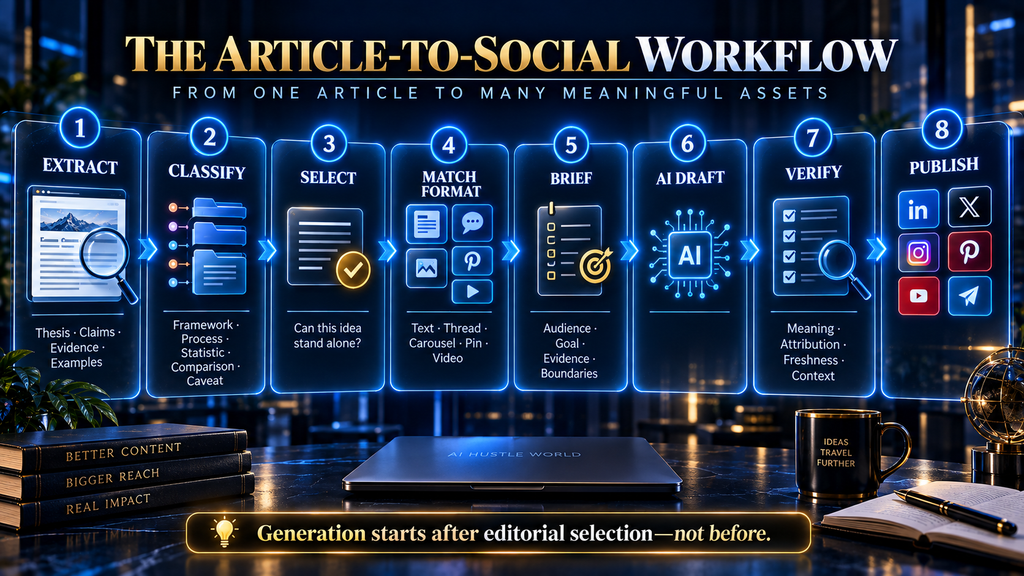
A Practical Article-to-Social Workflow
The complete execution process can remain simple even though the editorial logic is rigorous.
Start with an approved article and ask AI to extract its intellectual structure. Review the thesis, claims, evidence, frameworks, processes, examples, comparisons, actions, limitations, and questions until the inventory accurately represents the source.
Next, identify which atoms can stand alone. Remove weak, repetitive, highly dependent, or outdated ideas before social formats enter the discussion.
Then apply the Article-to-Social Fit Map. Match each approved atom with one or two formats capable of carrying its meaning without excessive compression or missing context.
Check Transformation Distance. Low-distance assets can remain relatively close to the article, while higher-distance assets should receive a stronger human brief and possibly fresh evidence.
Create one brief per asset and let AI produce a first draft. The brief should include audience, objective, platform, format, approved claim, required evidence, tone boundaries, CTA or link behavior, and anything the model must not change.
Review the resulting draft against the original source. Verify important claims, freshness, attribution, qualifiers, and whether the asset still delivers value when separated from the article.
Finally, inspect the batch as a whole. Remove intellectual duplicates, assign publishing priority, distribute the assets over time, and measure each one according to its intended job.
This approach is slower than requesting twenty posts in one prompt. It is also far more likely to produce a smaller batch that someone actually wants to publish.
A Simple 30-Minute Version for Solo Creators
A solo creator does not need to turn every article into a complicated production pipeline. The underlying method can be condensed while keeping the important controls.
Spend the first few minutes extracting the article’s strongest atoms with AI. Choose three ideas that are meaningfully different from one another and decide which social environment suits each.
Create separate briefs rather than one batch prompt. Ask AI to draft each asset, then compare the result with the source and check whether anything important changed.
Reject anything that feels like a generic summary or repeats another asset. If one derivative requires more verification or production than it is worth, remove it rather than forcing the content calendar to stay full.
The process may produce only two strong social posts from some articles. That is still successful if both are useful.
A Team Workflow Needs Clear Ownership
Teams face a different problem because the person writing the article may not be the same person managing LinkedIn, designing carousels, editing video, or checking facts.
That separation makes the article inventory especially valuable. Instead of handing the social team a URL and asking for “content,” the source can be converted into an approved set of atoms with evidence and editorial notes.
Each derivative can then carry a simple record: source article, atom, format, intended goal, evidence status, owner, reviewer, publish date, and final URL.
The workflow does not need to become bureaucratic. Its purpose is to prevent five people from independently summarizing the article and producing five versions of the same point.
Clear ownership also improves feedback. The team can learn whether weak performance came from the original atom, the format decision, creative execution, distribution timing, or something else.
Without that distinction, every failure gets blamed vaguely on “social content.”
The Article Should Remain the Canonical Source of Depth
Repurposing works best when the long-form article retains a distinct role. Social derivatives should extend its reach and reinterpret its ideas without making the source redundant.
The article remains the place for full evidence, methodology, definitions, complex caveats, related links, detailed implementation, and connections to the wider content cluster. Social assets can then select one useful layer at a time.
This creates a healthy information hierarchy. The audience can receive a complete insight on social media and still find substantially more value by continuing to the long-form source.
If the social asset contains everything and the article contains nothing more, the article may not have been deep enough. If the social post contains almost nothing without the article, the derivative was probably too promotional.
Good repurposing keeps both layers useful.
How to Know When an Article Is Exhausted
An article has reached the end of its useful social life when new derivatives stop creating distinct value.
This does not necessarily happen after a fixed number of posts. A research-heavy article may continue supporting discussion for months, while a narrow announcement may produce only one useful derivative.
Three signals are particularly useful. The first is intellectual duplication: new drafts keep repeating ideas already published from the same source.
The second is rising transformation cost: every remaining angle requires so much additional context, research, or production that it would be better treated as a new content project. The third is declining strategic relevance: the topic is no longer important enough to justify more distribution even though additional derivatives are technically possible.
At that point, stop repurposing. The system should move to the next source rather than mining the old one indefinitely.
Final Thoughts
Turning a long-form article into social media content with AI should not begin with a request for ten posts. That workflow asks the model to determine what matters, how to divide the article, which formats fit, how much context to preserve, and how each platform should differ all at once.
A stronger system separates those decisions. First extract the article’s intellectual structure, then identify the independent ideas, match each idea to a format capable of carrying it, assess how much transformation is required, and only then ask AI to draft the asset.
The AI Hustle World Article-to-Social Fit Map adds a practical control to that workflow by treating thesis, framework, process, statistic, example, comparison, checklist, caveat, and question as different editorial objects. Each type has different context requirements and different risks when compressed.
The long-form article should remain the source of depth, evidence, and connected reasoning. Social media then becomes a portfolio of focused interpretations rather than a collection of summaries promoting the same link.
AI can make that portfolio much faster to produce. The quality advantage comes from being selective enough to use that speed well.
Want the Full System Behind This Article-to-Social Workflow?
Article repurposing is only one part of the process. See how to qualify a source, extract content atoms, measure transformation distance, verify claims, and turn one strong idea into multiple useful assets.
See the Complete AI Content Repurposing System →Frequently Asked Questions
How do I turn a blog post into social media content with AI?
Begin by asking AI to extract the article’s thesis, independent claims, frameworks, processes, examples, statistics, comparisons, practical advice, and limitations rather than asking it to write social posts immediately. Review that inventory, select the ideas that can stand alone, and then match each approved atom to a suitable social format.
How many social posts should I create from one article?
There is no reliable universal number because articles vary in idea density. A long article may contain only three distinct social atoms, while a shorter article may contain a framework, story, statistic, checklist, and several independent arguments.
Should every article become a LinkedIn post, X post, carousel, Pin, and video?
No. The social format should follow the type of information extracted from the article and the audience goal, not a predetermined production quota.
What is the best way to turn a blog post into a LinkedIn post?
Choose one independent argument, mechanism, example, limitation, or practical lesson from the article and develop that idea as a complete LinkedIn post. Avoid summarizing every section of the article because the result usually reads like an abstract.
How do I turn an article into an Instagram carousel?
Look for article atoms with visible structure, such as frameworks, processes, checklists, comparisons, myths, or before-and-after examples. Rebuild the idea as a slide sequence rather than copying article paragraphs onto different frames.
Can AI turn an article into a short video script?
Yes, but the strongest script usually requires more than shortening article prose. Short video is sequential, so the source idea should be reconstructed around spoken explanation, visual opportunities, pacing, and a clear progression from problem to mechanism to takeaway.
How do I keep statistics accurate when repurposing an article?
Preserve the parts of the statistic that affect its meaning, including the value, metric, population, timeframe, source, and important qualification. Compare the final social asset against the original evidence rather than trusting the generated wording.
Should social posts always link back to the original article?
No. Some social assets are designed primarily for reach, discussion, saves, or audience education and can work better as complete native posts.
How do I stop AI-generated social posts from sounding repetitive?
Do not ask AI to create many variations of the same article summary. Extract several independent content atoms first and give each derivative a different intellectual job, such as position, mechanism, evidence, application, boundary, or example.
How should I measure article-to-social repurposing?
Measure each social asset according to its intended job, using signals such as reach, saves, watch retention, replies, shares, clicks, profile visits, or qualified conversions where appropriate. Also track source-level outcomes such as referral traffic and which article atoms generate repeat engagement.
Sources and Further Reading
- How to specify a canonical URL: Google Search Central. How to consolidate duplicate or near-duplicate URLs.
- Google Search’s guidance on generative AI content on your website: Google Search Central. What Google says about using generative AI to produce content.
Related Guides
- How to Repurpose Research into LinkedIn Posts, X Threads and Newsletters
- How to Optimize Blog Posts for ChatGPT, Perplexity & Gemini
- Best AI Tools for Writing Blog Posts (Free & Paid)
Written by
Muntasir Ahmad Chowdhury
Founder, AI Hustle World
Muntasir Ahmad Chowdhury is the Founder of AI Hustle World, an independent publication dedicated to making Artificial Intelligence practical, trustworthy, and easy to understand. He researches AI tools, automation, customer service, productivity, and real-world business applications, helping readers make smarter technology decisions through research-driven, experience-backed content.
Expertise:
AI Tools • AI Automation • AI Customer Service • AI Productivity • Generative AI • AI Workflows
Get Smarter With AI
Enjoyed this guide? Get practical AI tools, tutorials, and honest reviews delivered to your inbox.
2 thoughts on “How to Turn Articles Into Social Media Content With AI”