
How to Build a Content Atom Workflow with AI
Publishing one substantial article, podcast, webinar or video often requires more work than its first distribution cycle can justify. The source may contain several useful explanations, examples, claims and decisions, yet most of that value remains locked inside one format after publication. A content atom workflow gives those ideas additional routes to the audience without asking a team to start from a blank page every day.
AI makes this process faster, but speed creates a misleading sense of progress. A model can turn a transcript into many captions in minutes, even when several repeat the same point, remove essential context or introduce language the speaker never used. The result is a larger draft folder rather than a dependable content system.
A useful content atom workflow solves a different problem. It creates a controlled path from a known source idea to a distinct, platform-appropriate asset with a recorded purpose, reviewer and update history. AI can support extraction, classification, drafting and formatting, but humans remain responsible for meaning, evidence, rights and publication.
This guide explains how to build that system from the source layer through measurement. It also introduces the AI Hustle World Content Atom Traceability Ledger, a reusable method for connecting every derivative asset to the exact idea from which it came.
What Is a Content Atom Workflow
A content atom workflow is a repeatable production system that identifies useful ideas inside a larger source, turns selected ideas into self-contained assets and records how each asset relates to its source. The workflow covers more than writing. It includes source selection, extraction, prioritization, platform adaptation, editorial review, publishing, measurement and later correction.
The word “atom” is useful only when it describes a meaningful unit. A sentence copied from an article is a snippet. A cropped section of a webinar is a clip. Either can become a content atom, but only after it carries enough context to stand on its own and has a reason to exist for a particular audience.
That distinction matters because automated repurposing systems are good at producing small pieces. They are less reliable at deciding whether each piece remains faithful to the source, differs from the other outputs and deserves to be published. A content atom workflow adds those editorial decisions to the production process.
Content Atoms, Pillars and Repurposed Assets Are Not the Same Thing
A content pillar is a broad subject or substantial source around which a publisher develops multiple pieces. Content repurposing is the general practice of adapting existing material for another format, audience or channel. A content atom is the individual managed unit that moves through that process.
| Term | What it describes | Example | Main management question |
|---|---|---|---|
| Content pillar | A broad topic or foundational body of content | A complete guide to AI content repurposing | What should the publication own on this subject? |
| Source asset | The original material from which ideas are derived | An article, interview, webinar, report or podcast | Is the source accurate, useful and suitable for reuse? |
| Candidate atom | An idea or moment proposed for adaptation | A claim, example, quote, objection or process step | Is this distinct and strong enough to develop? |
| Approved content atom | A self-contained derivative that has passed editorial review | A LinkedIn post built around one verified source insight | Does it preserve meaning and serve a clear purpose? |
| Published asset | The final channel-specific expression of the atom | A live carousel, short video, email section or post | How did it perform, and when must it be reviewed? |
This article focuses on the system that manages those units. The broader strategy and value of reusing a strong idea are covered in AI Content Repurposing: Turn One Idea Into Many Assets.
Why Content Atom Workflows Break After the First Experiment
Most repurposing experiments begin with an exciting demonstration. Someone places a long article or transcript into an AI tool, requests several social posts and receives a large batch of drafts. The team publishes a few, saves the rest and assumes it has built a scalable process.
The weakness appears during the second or third cycle. Nobody remembers which source produced a particular claim, several posts repeat the same idea, approvals become inconsistent and old derivatives remain live after the source changes. Because the system recorded outputs but not their relationships, maintenance becomes harder with every publishing round.
There are five common reasons this happens. The source was never registered as the authoritative parent. Candidate ideas were not separated from publishable atoms. Platform requirements were applied before the editorial purpose was clear. Review was treated as proofreading rather than source verification. Finally, the team measured how much AI generated instead of how much useful content it approved.
The practical consequence is editorial debt. Each untracked derivative becomes another asset that may contain an outdated figure, missing qualification, incorrect attribution or inconsistent position. Generating more content increases the liability when the workflow has no way to locate and correct those relationships.
Why the Manual Method Still Matters
Traditional repurposing usually involves a writer rereading or rewatching the source, marking useful moments, choosing an angle, drafting for a channel and asking an editor to review the result. This method exists for a good reason: the person doing the work can notice nuance, understand why a qualification matters and reject an attractive quote that becomes misleading outside its original discussion.
The manual method becomes expensive when the same cognitive and administrative work must be repeated across many sources and channels. A person may review the same transcript several times for clips, social posts, newsletters and article ideas. Notes are often scattered across documents, messages and design files, making it difficult to see whether a source has been used well or merely used often.
AI should remove that repeated processing, not the judgment that gives the content integrity. It can create a searchable transcript, segment a source, propose candidate ideas, populate structured fields and generate channel-specific drafts. A human can then spend more time deciding what deserves publication and less time locating the relevant passage.
What AI Should and Should Not Control
The safest division of work follows consequence rather than convenience. Tasks with high volume and clear structure are good candidates for automation. Tasks involving ambiguous meaning, evidence, permission or reputational risk require accountable human judgment.
| Workflow responsibility | AI can assist with | Human must retain control of |
|---|---|---|
| Source processing | Transcription, segmentation, summarization and entity extraction | Selecting the authoritative source and correcting transcription errors |
| Candidate discovery | Identifying claims, examples, quotes, objections and teaching moments | Deciding whether an idea is accurate, distinct and worth publishing |
| Atom planning | Suggesting audiences, formats, hooks and content objectives | Choosing strategic priority and preventing unnecessary duplication |
| Drafting | Producing variations within a defined brief | Protecting meaning, nuance, attribution and brand judgment |
| Production | Resizing, captioning, formatting and metadata preparation | Rights clearance, sensitive-content decisions and final presentation |
| Publishing | Scheduling approved assets and recording URLs | Final approval and responsibility for what becomes public |
| Measurement | Collecting results and calculating workflow metrics | Interpreting performance and deciding what to repeat, revise or retire |
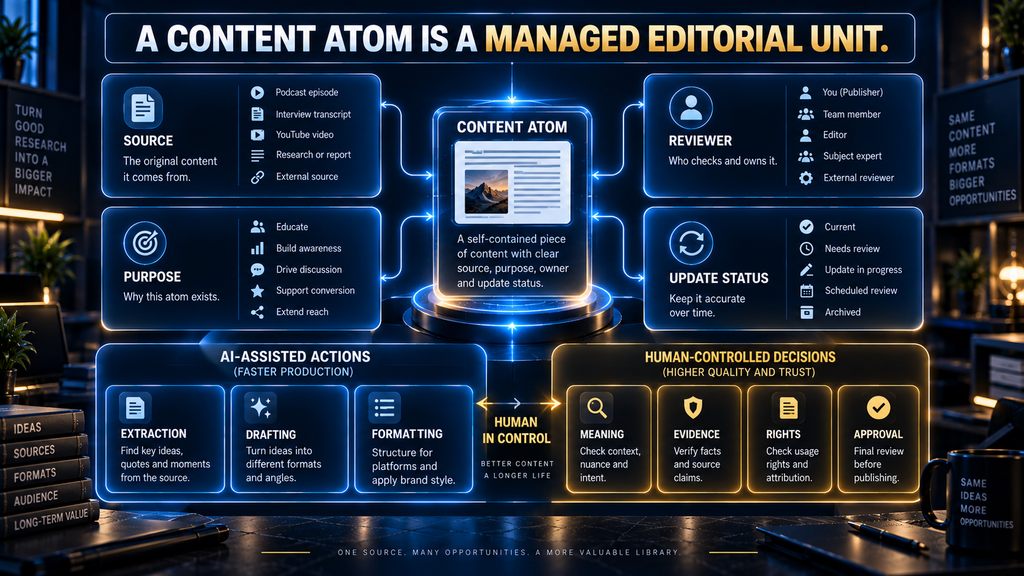
The boundary should become stricter when the source contains legal, medical, financial, safety or reputational consequences. It should also become stricter when a guest, client or employee could be misrepresented. Automation can still support those workflows, but it should not silently convert a plausible draft into an approved statement.
Google’s current guidance on generative AI content emphasizes accuracy, quality, relevance and added value. It also recommends giving readers appropriate context about how automation was used. Those principles support a workflow in which AI assists production while identifiable people remain responsible for verification and publication.
Who Should Build a Content Atom Workflow
This system is most useful for creators and teams that regularly produce substantial source material and distribute ideas through several channels. A weekly podcast, research newsletter, webinar program, YouTube channel or publication archive creates enough reusable material to justify a structured atom inventory.
Agencies can also use the method to separate client sources, permissions and approval states. Educators and subject-matter experts may find it valuable because the ledger helps preserve qualifications when complex explanations are shortened. Small teams benefit when the same person manages research, writing and distribution, since the system reduces the need to reconstruct decisions from memory.
The full workflow is unnecessary for everyone. A creator who publishes occasionally on one platform may need only a source document and a short review checklist. A team with weak source material should improve its original content before automating derivatives, because atomization multiplies the strengths and weaknesses already present.
Organizations that cannot provide appropriate review should avoid high-volume automation for sensitive topics. A system that produces more drafts than the team can verify does not create leverage. It transfers effort from writing into an approval queue and makes unnoticed errors easier to distribute.
The Content Atom Workflow From Source to Measurement
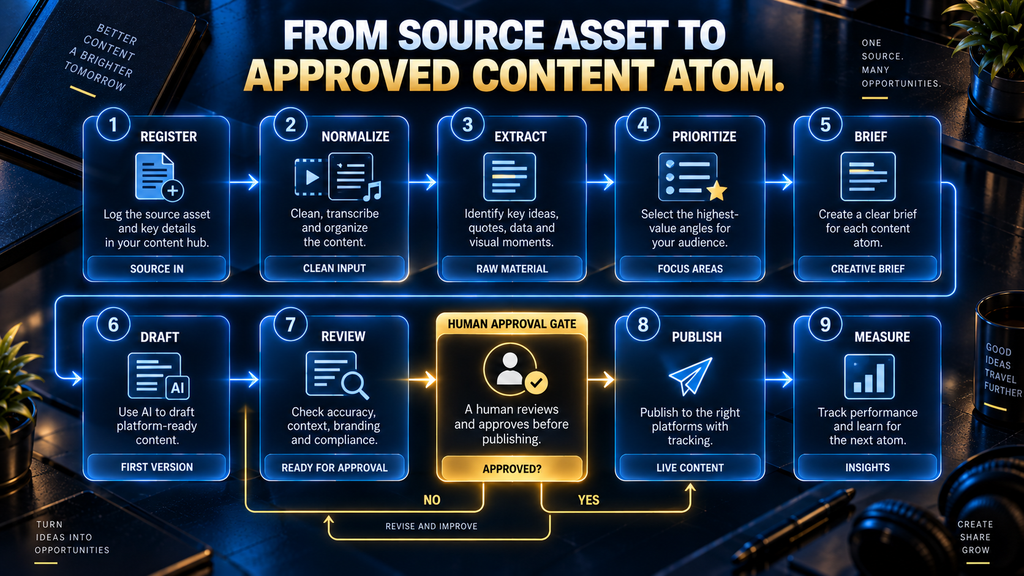
The complete workflow has nine stages. The order matters because each stage reduces a different type of risk. Skipping the source and selection stages may produce irrelevant content, while skipping review and maintenance may produce content that is attractive but unreliable.
Step 1 Register the Source Asset
Begin by assigning the parent source a stable ID and recording its title, URL or file location, owner, publication date and current status. For audio or video, preserve the original recording as well as any transcript because a transcript can omit tone, visual evidence or speaker distinctions.
The source record should also identify whether the asset is authoritative enough to support derivatives. A finished report with verified citations is different from a brainstorming call or an unreviewed AI draft. If the parent is weak, the workflow should stop before generating a larger family of weak descendants.
For an article-based workflow, the source may already be live and reviewed. The specific process for turning that material into social formats is covered in How to Turn Articles Into Social Media Content With AI. The atom workflow adds an inventory and governance layer above that conversion process.
Step 2 Normalize the Source
AI works more consistently when the source has a clear internal structure. Convert recordings into transcripts, preserve speaker names and timestamps, retain article headings and keep citations attached to the claims they support. Remove navigation text, advertisements and unrelated metadata that might be mistaken for source content.
Normalization should not flatten everything into one block of text. A heading, timestamp or page number gives the future atom a location that a reviewer can check. The workflow becomes more dependable when the model can point to a source passage instead of saying that an idea appeared “somewhere in the transcript.”
For video sources, the normalized record should preserve visual dependencies. A transcript line such as “this section is the problem” may be meaningless without the chart or screen demonstration that accompanied it. The same principle applies to podcasts with multiple speakers, where a clean transcript must preserve who said what. Detailed workflows for those source types appear in Turn Video Transcripts Into Articles, Clips and Social Posts With AI and Repurpose Podcasts Into Short-Form Content With AI.
Step 3 Extract Candidate Ideas
Ask the AI system to identify units with editorial potential rather than requesting finished posts immediately. Useful candidate types include claims, mechanisms, examples, objections, definitions, mistakes, decisions, stories, quotations and process steps. Each candidate should include its exact source location and enough surrounding context for a reviewer to assess it.
This stage should produce a candidate inventory, not a publication queue. The difference is important because extraction favors recall: it is acceptable to find more possibilities than the team will use. Approval favors precision: only a smaller set should consume writing, design and review time.
A structured extraction request can require fields such as candidate ID, source location, candidate type, verbatim supporting passage, concise interpretation and context warning. If a platform supports schema-constrained responses, those fields can be required programmatically. OpenAI’s Structured Outputs documentation explains how a model response can be constrained to a supplied JSON schema, reducing missing keys and invalid field values.
Schema compliance does not establish factual accuracy. A model can place a wrong interpretation inside a perfectly valid field. The source location and supporting passage therefore remain essential because they allow a person to verify the content instead of trusting the shape of the response.
Step 4 Prioritize Candidates Before Drafting
Candidate selection should consider source strength, audience relevance, distinctiveness and format potential. A surprising sentence is not automatically valuable if it requires two minutes of missing explanation. A less dramatic process step may be more useful because it solves a clear reader problem and survives outside the original format.
Prioritization should also compare candidates with the existing atom inventory. If four approved posts already explain the same lesson, a fifth version may create frequency without adding meaning. The team can instead choose an underused source idea, deepen an earlier atom or retire the candidate.
One practical decision rule is to advance a candidate only when the editor can answer three questions: What does the audience gain? Why is this source qualified to support the idea? Why should this become a separate asset instead of a sentence inside another one? If those answers remain vague, drafting should not begin.
Step 5 Create an Atom Brief
An atom brief translates a selected source idea into a production instruction. It should define the audience, job, destination, format, central claim, required context, evidence, tone boundaries and desired next action. The brief also states what the asset must not claim, which is often more useful than adding another stylistic adjective.
For example, the same source idea could support a LinkedIn post for managers, a short video for beginners and a newsletter section for existing subscribers. The source meaning remains stable, but the framing, depth, opening and presentation change. Treating those as separate briefs prevents the AI from copying one generic caption across every channel.
A useful atom brief is specific enough that another editor can judge whether the draft succeeded. “Make an engaging post” offers no meaningful test. “Explain why untracked derivative content becomes difficult to correct, using one operational example and no performance promises” creates a reviewable assignment.
Step 6 Generate a Platform Native Draft
AI can now draft from the atom brief, the approved source passage and the relevant brand instructions. The model should not receive an unrestricted request to use the entire source if the atom depends on one particular idea. Limiting the evidence boundary reduces the chance that unrelated claims are blended into a polished but unsupported output.
Platform adaptation should change more than length. A short video requires a spoken opening, visual progression and enough context to make the clip intelligible. A newsletter can carry more explanation. A carousel distributes one argument across slides, while a concise social post may focus on a single tension and invite discussion.
Some tools automate parts of this transformation. Descript states that its Create Clips feature scans a composition and proposes short, self-contained cuts that users can review and edit. That is useful candidate generation, but the tool’s selection still needs to be judged against the speaker’s meaning, permissions and the publisher’s goals.
Step 7 Apply the Content Atom Integrity Gates
Every draft should pass six checks before approval. These gates are intentionally binary because a combined score can hide a serious defect. A beautiful atom with unclear rights should not pass because it performed well in five other categories.
Traceable: The reviewer can locate the exact source passage, timestamp, page or section. General familiarity with the source is not sufficient because future editors must be able to repeat the check.
Faithful: The atom preserves the source’s meaning, certainty and attribution. It does not turn a possibility into a prediction, a vendor claim into an independent fact or one speaker’s opinion into the publication’s conclusion.
Self-contained: The audience receives enough context to understand the point without the missing section changing its meaning. An atom does not need to reproduce the entire source, but it must carry the qualification that prevents a misleading interpretation.
Supported: Evidence, quotations and statistics remain attached to their correct sources. If an atom introduces a new factual claim during adaptation, that claim must be verified independently rather than assumed to come from the parent asset.
Permitted: The team has the necessary rights and approvals for quoted speech, guest likeness, client information, screenshots, music, photographs and other protected material. The appropriate standard depends on the source and jurisdiction, so this gate is an editorial checkpoint rather than legal advice.
Purposeful: The atom serves a distinct audience, channel, stage or question. A reworded duplicate fails even when its grammar and facts are correct.
Failure at any gate sends the atom back for revision, clarification or rejection. This prevents a common workflow mistake in which every AI suggestion is treated as an asset that must eventually be published.
Step 8 Publish and Record the Asset
After approval, record the destination, live URL, publication date, owner and current status. Scheduling software can automate publication, but the record should not change to “published” until the platform confirms that the asset is live and accessible.
An automated workflow can connect extraction, drafting, review and publishing without removing the human checkpoint. For example, an official n8n repurposing workflow template takes long-form input, creates several output branches and routes drafts through Microsoft Teams for approval. The useful principle is not the particular collection of tools; it is that generation and approval remain separate workflow states.
The atom record should also note its relationship to other assets. A carousel may expand a concise post, while a newsletter may link to the original article. Recording those relationships helps editors avoid competing calls to action and understand how a group of atoms supports the same source.
Step 9 Measure and Maintain the Atom
Performance data should return to the atom record rather than living only inside each platform. Record the metrics that match the atom’s job, such as qualified clicks, meaningful replies, saves, watch completion or newsletter actions. Avoid comparing unlike formats through one universal engagement number.
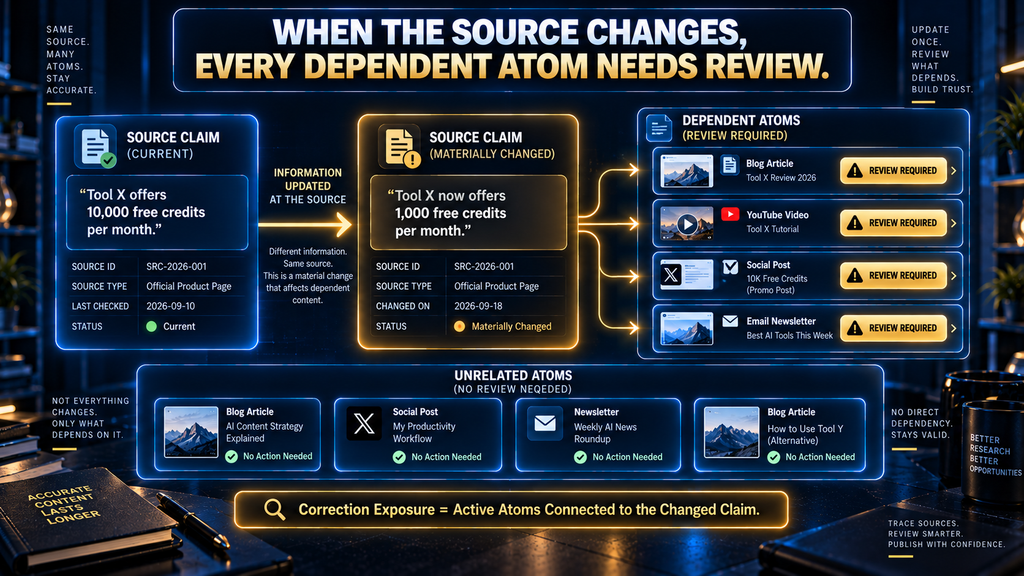
Maintenance is equally important. When a parent source changes materially, the workflow should identify every active atom connected to the changed claim. Editors can then update, annotate, unpublish or retire those assets according to their importance and platform controls.
Without this reverse connection, content atomization creates a correction problem. A source article may be updated in one place while dozens of derivative statements continue circulating with the earlier information. Traceability turns that hidden exposure into a visible editorial task.
The AI Hustle World Content Atom Traceability Ledger
The Content Atom Traceability Ledger is a structured record that follows each atom from candidate discovery through retirement. Its purpose is to preserve source lineage, editorial responsibility and maintenance history without forcing teams to adopt a particular AI model, database or publishing tool.
The ledger can begin as a spreadsheet. A larger team may implement the same fields in a database, content management system or project-management platform. The technical surface matters less than using stable IDs, defined statuses and consistent source references.
| Ledger field | What to record | Why it matters |
|---|---|---|
| Atom ID | A unique and permanent identifier | Prevents confusion when titles, formats or URLs change |
| Parent source ID | The stable ID of the article, recording, report or interview | Connects the derivative to its authoritative parent |
| Source location | Heading, paragraph, page, timestamp or transcript range | Makes source verification repeatable |
| Source idea or claim | The meaning the atom must preserve | Gives reviewers a clear fidelity standard |
| Supporting evidence | Citation, quotation, example or demonstration used by the source | Prevents evidence from becoming separated from the claim |
| Transformation type | Excerpt, compression, reframing, explanation or synthesis | Shows how far the output moved from the original expression |
| Audience and objective | Intended reader and the job the asset performs | Stops format production from replacing strategy |
| Destination format | Platform, content type and relevant production requirements | Guides channel-specific adaptation |
| Required context | Qualifications or surrounding facts that must remain | Protects against misleading compression |
| Rights status | Permission, ownership or licensing notes | Prevents unresolved material from moving to publication |
| Reviewer | The person responsible for final editorial approval | Establishes accountability |
| Workflow status | Candidate, drafted, revision required, approved, published, updated or retired | Makes the production state visible |
| Published location | Live URL, platform post ID and publication date | Creates a usable derivative inventory |
| Review trigger | Date, source change or external condition requiring review | Supports maintenance instead of permanent neglect |
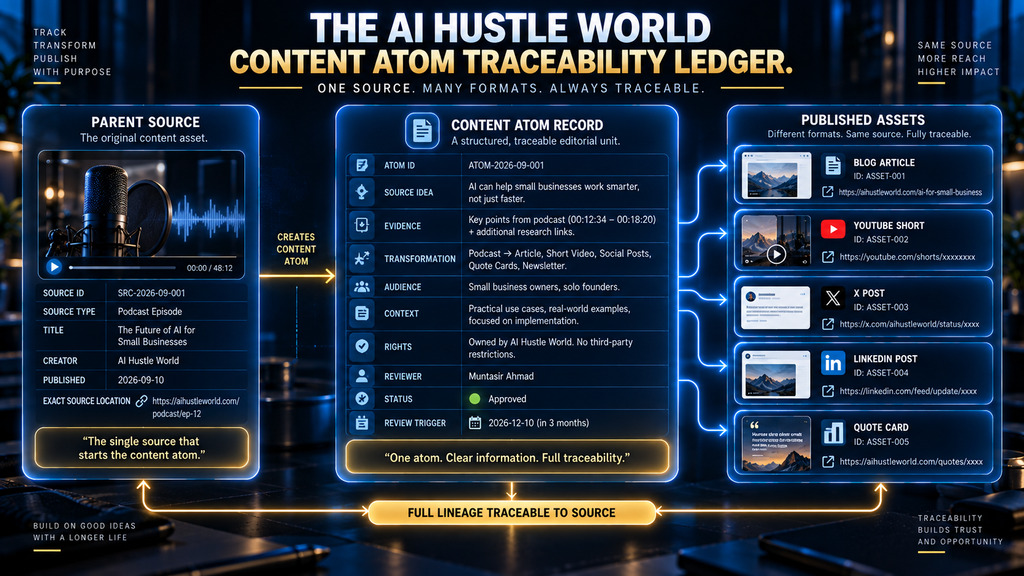
Source note: The AI Hustle World Content Atom Traceability Ledger is an editorial framework developed by AI Hustle World by adapting provenance concepts from W3C PROV-DM to content operations. It is a practical method for documenting source-to-asset relationships, not a formal standard, legal control system or validated performance benchmark.
How the Content Atom Traceability Ledger Was Developed
This framework is original to AI Hustle World, but it was not created without a foundation. Its source relationship is adapted from the W3C PROV Data Model, an authoritative model for describing provenance through entities, activities, agents and derivations. W3C defines derivation as the transformation of an entity into another or the construction of a new entity based on a preceding one.
Applied to publishing, the parent article, report, transcript or recording is an entity. Extraction, adaptation, editing and approval are activities. AI systems, writers, editors and organizations act as agents with different responsibilities. The resulting content atom is a derived entity whose relationship to the parent can be recorded.
AI Hustle World adapted those general concepts into practical editorial fields, then checked the design against recurring weaknesses in current content-atomization and AI-repurposing guidance. Those weaknesses include lost source locations, missing qualifications, duplicate outputs, unclear approval responsibility, absent rights checks and no dependable way to update derivatives after the parent changes.
The integrity gates were added to prevent a combined score from hiding a critical failure. The measurement formulas were selected because they can be calculated from ordinary workflow records without relying on unverifiable industry benchmarks. The method is designed to be tool-neutral so that a solo creator using a spreadsheet and a larger team using an automated content system can apply the same underlying controls.
Methodology Limitations
The ledger is an editorial operations framework, not an academic standard, legal compliance system or scientifically validated predictor of content performance. AI Hustle World has not conducted a controlled study showing that the framework increases traffic, conversions or productivity by a specific amount. No such performance claim should be inferred from its inclusion here.
The framework also does not replace fact-checking, copyright review, contractual approval or specialist legal advice. Its fields help a team make those responsibilities visible, but a completed cell does not prove that the underlying decision was correct.
Readers can verify the framework by applying it to their own source material, checking whether another reviewer can trace each atom and recalculating the workflow metrics from their records. The worked example below is illustrative rather than a report of an actual campaign.
Worked Example From One Source Idea to Several Atoms
Consider a fictional webinar called “Why Customer Support Automations Fail After Launch.” One section makes this illustrative point: an automated answer can become unreliable when a company changes a policy but does not update the knowledge source used by the support system.
The workflow first records the webinar as source WB-014 and the relevant explanation as source location 18:40–21:15. AI identifies several candidates, but the editor does not immediately request ten posts. The team chooses one source idea and creates separate atom briefs only where the audience job is distinct.
| Atom ID | Planned asset | Distinct job | Context that must remain | Decision |
|---|---|---|---|---|
| WB-014-A01 | LinkedIn text post | Explain the operational risk to support managers | The failure comes from an outdated source, not proof that all automation is unreliable | Approve for drafting |
| WB-014-A02 | Short educational video | Show a simple policy-change scenario | The scenario is illustrative and must not be presented as client data | Approve for drafting |
| WB-014-A03 | Newsletter checklist | Help operators identify update triggers | The checklist needs ownership and review-frequency fields | Approve for drafting |
| WB-014-A04 | Quote graphic | Repeat a dramatic sentence from the webinar | The sentence becomes misleading without its qualification | Reject |
| WB-014-A05 | Second LinkedIn post | Restate the same risk with a different hook | It duplicates A01 without a different audience job | Reject |

The approved assets share one source idea, but they are not copies. The LinkedIn post explains the management problem, the short video demonstrates the mechanism and the newsletter checklist supports implementation. Their wording and structure change because their jobs change, while the qualification about the source of failure remains stable.
If the fictional company later changes its conclusion, the source record can flag A01, A02 and A03 for review. The rejected candidates remain useful records because they show why the team did not publish every attractive option. That history can prevent the same weak idea from re-entering the queue during another automated extraction.
How to Structure the AI Extraction Output
A reliable extraction request should separate evidence from interpretation. The model needs an exact source location, supporting text, a concise explanation of the candidate and any context risk. It should also be allowed to return “insufficient context” instead of being forced to invent a usable atom for every section.
A practical structured record might contain the following fields. The exact labels can change, but the separation between source evidence, interpretation and risk should remain.
This schema is a collection format rather than a fact-checking mechanism. The supporting passage allows a reviewer to compare the interpretation with the source. Risk flags tell the workflow where additional attention may be required, but the model should not decide that permission or verification is complete.
The same principle applies when repurposing formal research. Evidence, limitations and uncertainty must travel with the idea rather than being removed to make the derivative sound more decisive. A dedicated process for adapting research across LinkedIn, X and newsletters appears in How to Repurpose Research Into LinkedIn Posts, X Threads and Newsletters.
Example AI Extraction Record
The extraction output should use consistent fields so an editor can verify every candidate against its source. The table below shows what the AI should return for each potential content atom.
| Field | What it should contain |
|---|---|
| Candidate ID | A unique identifier, such as SRC-001-C01 |
| Source location | The exact heading, page, paragraph or timestamp |
| Candidate type | Claim, example, process, objection or quotation |
| Supporting passage | The exact source text supporting the candidate |
| Candidate interpretation | A concise explanation of the idea |
| Required context | Any qualification needed for standalone use |
| Possible formats | Suitable formats such as a text post, carousel or short video |
| Risk flags | Attribution, changing facts, permissions or sensitive context |
| Confidence note | Anything that remains uncertain and requires human review |
A consistent structure makes candidate comparison and review easier, but it does not verify the model’s interpretation. An editor must still compare the supporting passage, source location and required context with the original material before approving the candidate.
Choose an Implementation Level That Matches the Workload
The best workflow is the least complicated system that preserves the necessary controls. A small creator does not need enterprise content infrastructure, while a team producing hundreds of assets should not depend on one person’s memory and an unstructured chat history.
Level 1 Manual Workspace With AI Assistance
At the first level, the source lives in a document or transcript, AI proposes candidates and a spreadsheet stores the ledger. The creator copies approved briefs into writing or design tools and records the live links manually. This setup requires little technical work and makes the editorial logic visible.
Its weakness is administrative friction. IDs, statuses and URLs depend on consistent manual entry, and information may drift between tools. This level is still appropriate for validating the process because it reveals which fields and gates the team genuinely uses before automation makes the structure harder to change.
Level 2 Structured Database and Reusable Templates
At the second level, sources, candidates and atoms live in a structured database or project-management system. Standard forms capture the brief, review state and platform requirements. Automations can create tasks, notify reviewers and move approved atoms into production queues.
This level suits a recurring publishing operation with several source types or collaborators. It reduces copying while keeping human decisions visible. The main risk is designing too many statuses and fields before the team understands its real bottlenecks.
Level 3 Automated Orchestration With Approval Gates
At the third level, publishing events or file uploads trigger source processing, candidate extraction and draft generation. Structured outputs populate the atom database, and routing rules send relevant drafts to reviewers. Only approved records move to scheduling or publishing systems.
Automation should be added after the team can operate the workflow manually. Otherwise, it scales unclear decisions and hides them inside integrations. The strongest candidate for automation is usually record movement, field population and notification, not the final decision about whether an asset is accurate and worth publishing.
Build the Workflow Around Bottlenecks, Not Tools
Tool selection should begin with the constraint that consumes the most avoidable time. A video-first team may struggle with transcription and clip discovery. A research publication may need citation preservation and structured extraction. An agency may need client approvals and separation between accounts.
Buying an all-in-one platform before identifying the bottleneck can move the problem without solving it. Faster generation may expose a design shortage, while better scheduling may reveal that nobody owns editorial approval. The workflow should make those queues measurable before the team pays to accelerate them.
The source format also changes the required controls. Articles offer clean text but may contain hyperlinks and footnotes that must remain connected. Podcasts require speaker attribution and guest permissions. Video may depend on visible demonstrations. Research adds evidence and uncertainty requirements. The ledger stays consistent, while the source-specific fields and review depth adjust.
Measure Editorial Yield Instead of AI Output
Raw draft volume is a poor performance indicator because generation is usually the least scarce part of an AI-assisted workflow. A system that creates one hundred candidates and publishes five may be useful, wasteful or both. The answer depends on why the other ninety-five failed and how much review they consumed.
The following measures evaluate the workflow without inventing industry benchmarks. Teams should establish their own baseline and compare like-for-like sources, formats and review conditions over time.
Approved Atom Yield
Approved atom yield equals approved atoms divided by candidate atoms. It shows how selective and well-directed the extraction process is. A low result may indicate a weak source, overly broad extraction, repetitive candidates or unclear selection criteria.
Approved Atom Yield = Approved Atoms / Candidate Atoms
The goal is not to force this ratio upward at any cost. A research-oriented extraction may deliberately favor broad candidate recall, while an automated weekly workflow may need tighter precision. The trend becomes useful when compared within the same process and source type.
First Pass Approval Rate
First-pass approval rate equals atoms approved without substantive revision divided by atoms reviewed. This helps distinguish minor editing from drafts that misunderstand the source or brief.
First-Pass Approval Rate = Atoms Approved Without Substantive Revision / Atoms Reviewed
A very low rate may point to weak briefs, poor source segmentation or a model that receives too much unrelated material. A suspiciously high rate may mean reviewers are applying only surface-level checks, so the number should be interpreted alongside correction history and review time.
Priority Source Coverage
Priority source coverage equals the number of priority source ideas used divided by the number identified. This prevents a workflow from repeatedly selecting the easiest quotes while ignoring the source’s strongest mechanisms, evidence or decisions.
Priority Source Coverage = Priority Source Ideas Used / Priority Source Ideas Identified
Coverage should not become a quota that forces every idea into a derivative. Some source sections are valuable precisely because they support the larger argument and do not stand alone. The metric is a diagnostic for neglected value, not a requirement to publish everything.
Cost per Approved Atom
Cost per approved atom combines human labor cost and the allocated tool cost, then divides the total by approved atoms. It is more honest than calculating cost per generated draft because rejected and heavily revised outputs still consume resources.
Cost per Approved Atom = (Human Labor Cost + Allocated Tool Cost) / Approved Atoms
Teams can also track review minutes per approved atom and substantive revisions per draft. These measures reveal whether a supposedly efficient model is transferring work into editing rather than reducing it.
Correction Exposure
Correction exposure is the number of active published atoms connected to a source claim that has materially changed. Unlike an engagement metric, this count describes maintenance risk. A higher number is not automatically bad, but it tells the team how widely the correction must travel.
The ledger makes this calculation possible because the derivative relationships already exist. Without source IDs and locations, editors must search platforms manually and may never find every affected asset.
Common Failure Modes and How to Fix Them
Treating Every Extracted Point as an Atom
AI extraction is designed to find possibilities, which means it will often return weak, repetitive or context-dependent ideas. Publishing all of them confuses production with value. Keep a separate candidate state and make rejection an expected part of the process.
Starting With Formats Instead of Source Ideas
“Create five carousels and ten posts” encourages the model to fill containers whether the source supports them or not. Start with source ideas, then choose formats based on audience need and explanatory fit. A strong source may produce three useful atoms, while another may support fifteen.
Removing the Qualification That Made the Claim Accurate
Short formats reward compression, but qualifiers often carry the most important part of a claim. Words such as “may,” “under these conditions” or “according to the vendor” cannot be removed merely to make the hook stronger. The required-context field should capture those boundaries before drafting begins.
Asking AI to Imitate a Platform Stereotype
Prompts that demand a “viral LinkedIn voice” or “high-engagement X thread” often produce exaggerated hooks and familiar templates. Define the audience problem, content job and evidence boundary instead. Platform-native content should fit how people consume the format without becoming a parody of the platform.
Losing Attribution During Rewriting
A claim can move from a report into an article, then into a carousel and finally into a short video. Each transformation makes the original attribution easier to lose. Record the evidence at the atom level and require the final asset to preserve attribution when the claim depends on an external source.
Automating Publication Before Review Is Stable
Direct publishing feels efficient because it removes a handoff. It also removes the moment when someone accepts responsibility for the final wording. Automate the movement of approved content first; automate approval only when the decision is genuinely rule-based and low consequence.
Ignoring Rights and Guest Approval
The publisher may own the recording but still have contractual, ethical or reputational reasons to seek approval for a sensitive excerpt. A technically usable clip is not automatically an appropriate one. The rights field should stop production rather than become a note that editors overlook.
Measuring Only Channel Performance
Views, clicks and saves matter, but they do not reveal whether the production system wastes review time or repeats the same ideas. Combine outcome metrics with workflow metrics so the team understands both audience value and operating cost.
Failing to Retire Old Atoms
Content libraries accumulate assets that no longer reflect current products, prices, policies or conclusions. Review triggers and source relationships allow the team to retire those assets deliberately. A smaller accurate inventory is more valuable than a large archive nobody can trust.
A Practical Seven Day Pilot
A pilot should test the editorial system before adding integrations. Choose one strong source with clear ownership, stable evidence and enough internal variety to support several candidates. Avoid beginning with the most sensitive or complicated material in the library.
On the first day, register and normalize the source. On the second day, use AI to extract candidates with source locations and context warnings. On the third day, review the inventory, reject duplicates and create briefs for a small number of distinct atoms.
Use the fourth day for drafting and platform adaptation. Apply the integrity gates on the fifth day, recording why each atom passed, required revision or failed. Publish the approved assets on the sixth day and complete the ledger with their live locations.
On the seventh day, review the workflow rather than pretending that meaningful channel performance is already available. Measure candidate count, approved atom yield, first-pass approval, review time and the reasons for rejection. Those findings determine whether the next improvement should involve better source preparation, tighter extraction, clearer briefs or a limited automation.
The pilot should remain small enough that every decision can be inspected. Automating an unclear process makes its weaknesses faster and less visible. A manually verified first cycle gives the team a reliable baseline for later tooling.
What Happens If You Keep the Create Publish Forget Cycle
Without an atom workflow, high-value sources become one-time events. The team repeatedly researches ideas it already owns, while useful explanations disappear into archives that nobody searches. Distribution depends on individual memory, so some sources are overused and others are forgotten.
The larger cost appears when facts change. Editors may update the parent article or recording description without knowing which social posts, newsletters, clips and graphics still carry the older version. Each untracked derivative becomes an unmanaged representation of the brand’s position.
Doing nothing may still be rational for a low-volume creator with one channel. The system becomes worthwhile when source reuse is frequent enough that discovery, approval and maintenance repeat. Complexity should follow operational need, not the attractiveness of automation.
The Future of Content Atom Workflows
As generation becomes cheaper, editorial attention becomes the scarce resource. The advantage will shift from producing the largest number of derivatives to maintaining a well-structured source library, selecting stronger ideas and moving corrections through the content system quickly.
Structured content will also make automation more precise. When a source already identifies its thesis, claims, evidence, examples and limitations, an AI system does not need to infer that structure from a flat document during every run. The atom ledger extends that structure into distribution and maintenance.
The next stage is not necessarily autonomous publishing. A more valuable development is dependable change propagation: when a source claim changes, the system identifies every dependent atom and creates a review task. This turns content operations from a one-way production line into a maintained network of editorial relationships.
Publishers should still resist the assumption that every idea must appear everywhere. Platform diversity creates value when each asset performs a distinct job. The smallest useful content system is not the one with the fewest words or the most automation; it is the one that preserves meaning while placing the right idea in the right format.
Final Thoughts
A content atom workflow should make a publication more selective, not merely more productive. Its purpose is to convert the value already present in strong source material into assets that remain traceable, faithful, useful and maintainable.
AI can reduce the repetitive work of finding moments, filling records, drafting variations and preparing formats. It cannot accept editorial responsibility for a misleading claim, unresolved permission or stale derivative. That responsibility remains with the people who choose what becomes public.
The practical starting point is simple: register one source, extract candidates with exact locations, approve only distinct ideas and record every published relationship. Once that process works under human inspection, automation can support it without turning the content library into an unmanageable pile of drafts.
Turn One Strong Source Into a Repeatable Content System
See how AI content repurposing fits into the broader strategy for turning one idea into useful assets across formats and channels.
Explore the Content Repurposing Guide →Frequently Asked Questions
What is a content atom?
A content atom is a self-contained editorial asset derived from a larger source and designed to perform a specific job for an audience or channel. It should remain traceable to its parent source and preserve the context, evidence and attribution necessary for its meaning.
What is the difference between a content atom and a content pillar?
A content pillar is a broad topic or foundational asset that supports a larger body of publishing. A content atom is one smaller, managed unit derived from a source, such as a short video, carousel, email section or social post built around one idea.
Is content atomization the same as content repurposing?
Content repurposing is the broader practice of adapting existing material into another format or channel. Content atomization breaks a substantial source into distinct idea-level units that can be tracked, adapted and maintained separately.
What source content works best for atomization?
The strongest sources contain several clear ideas, reliable evidence and enough depth to support different audience needs. Detailed articles, research reports, webinars, interviews, podcasts and long-form videos often work well, provided their ownership and factual quality are clear.
Can AI automate the complete content atom workflow?
AI can automate transcription, segmentation, candidate extraction, record population, drafting, formatting and some workflow routing. Human review should remain in control of source selection, factual meaning, evidence, rights, sensitive context and final publication decisions.
How many content atoms should one source produce?
There is no defensible universal number. The appropriate output depends on the number of distinct, useful ideas in the source and the team’s ability to review and maintain them. Stop when additional derivatives would repeat existing atoms or remove context to justify another format.
What tools are required to build the workflow?
A basic workflow needs a source repository, an AI assistant, a ledger and the production tools required for the chosen formats. A spreadsheet can manage the first version. Databases, automation platforms and publishing integrations become useful when recurring volume creates measurable administrative friction.
How do you stop AI-generated atoms from sounding repetitive?
Select distinct source ideas before drafting and give every atom a specific audience job. Compare candidates with the existing inventory, use separate platform briefs and reject variations that change only the hook or wording without adding a new purpose.
How should content atom performance be measured?
Match channel metrics to the asset’s objective, then combine them with workflow measures such as approved atom yield, first-pass approval rate, priority source coverage, review time and cost per approved atom. Draft volume alone does not show whether the workflow produces useful content.
When should a content atom be updated or retired?
Review an atom when its source claim, evidence, product, policy, permission or audience context changes materially. Update it when the platform allows a clear correction and the asset remains valuable. Retire it when the underlying idea is no longer accurate, relevant or supportable.
Related Guides
- How to Repurpose Content Across YouTube, Pinterest, and Instagram
- How AI contract Obligation, Deadlines & Risks from Extraction
- AI Contract Management vs Traditional CLM: Where AI Adds Real Value
Written by
Muntasir Ahmad Chowdhury
Founder, AI Hustle World
Muntasir Ahmad Chowdhury is the Founder of AI Hustle World, an independent publication dedicated to making Artificial Intelligence practical, trustworthy, and easy to understand. He researches AI tools, automation, customer service, productivity, and real-world business applications, helping readers make smarter technology decisions through research-driven, experience-backed content.
Expertise:
AI Tools • AI Automation • AI Customer Service • AI Productivity • Generative AI • AI Workflows
Get Smarter With AI
Enjoyed this guide? Get practical AI tools, tutorials, and honest reviews delivered to your inbox.
4 thoughts on “How to Build a Content Atom Workflow with AI”