Evidence: Documentation reviewed
Last checked: September 2026
What was done: Written from official documentation and the published sources linked in this article. Not hands-on tested.
Files: None
Affiliate links: No
AI Customer Service Explained: How It Works, Benefits, and Real Business Examples
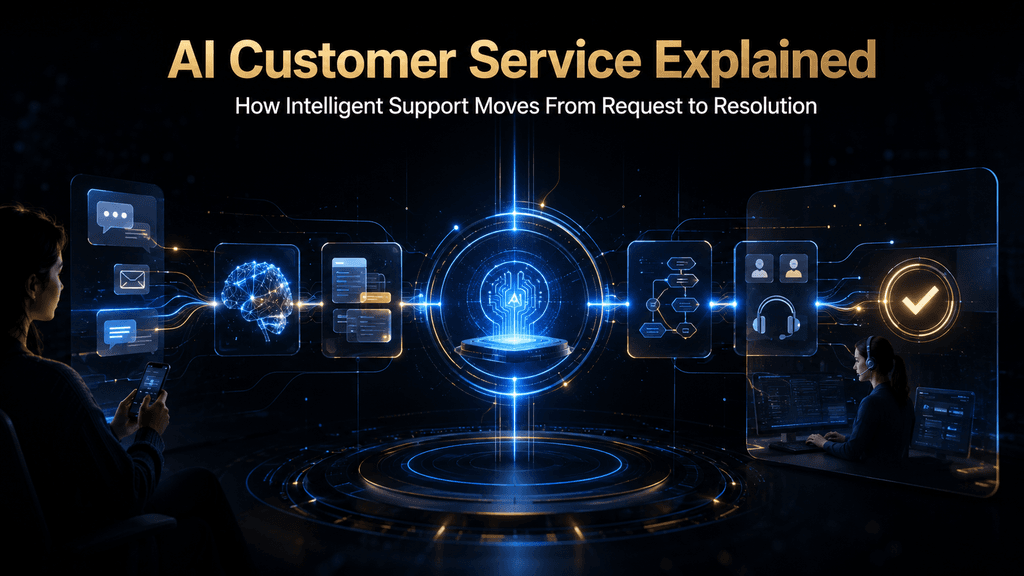
At 2:13 in the morning, a customer opens a company’s website because an order still has not arrived. In a traditional support operation, the customer may have to wait until morning, search through a help center, or send an email that joins a queue. In a well-designed AI customer service system, the experience can be very different: the system can understand the request, identify the customer, retrieve the order, check the latest delivery information, explain what happened, and take an approved next step without requiring an employee to manually perform every part of the investigation.
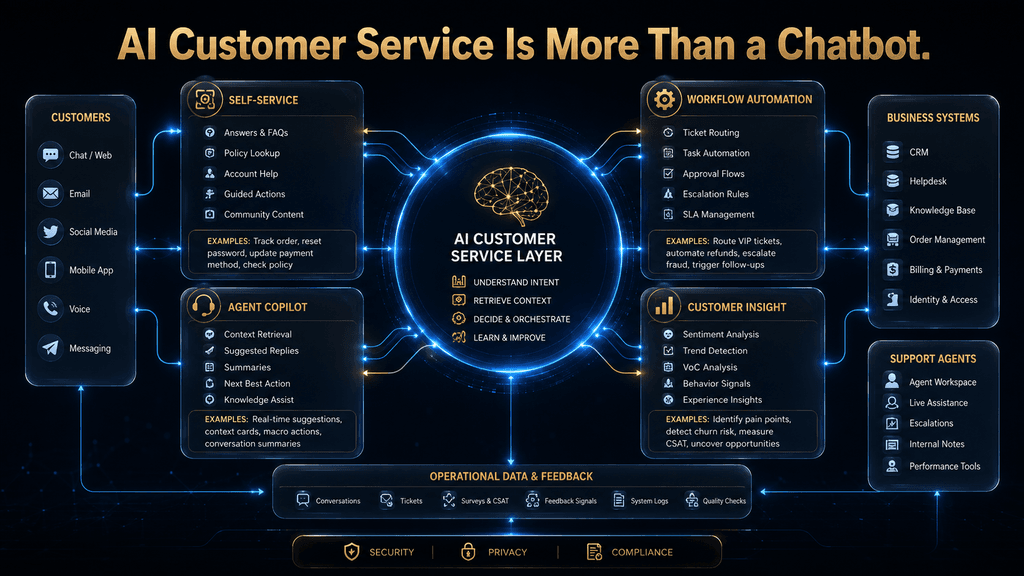
That sounds like a chatbot, but the chatbot is only the visible surface. Behind a useful AI customer-service experience there may be a language model interpreting the request, a knowledge base supplying approved answers, a customer database providing account context, business rules determining what actions are allowed, software integrations performing those actions, and a human support team handling cases that are too sensitive, ambiguous, or consequential for automation. The quality of the experience therefore depends on how those components work together, not simply on how impressive the conversational interface sounds.
This distinction matters because businesses are increasingly being offered a simple promise: automate more customer conversations and reduce the cost of support. The promise is not completely wrong, but it can encourage the wrong objective. A customer does not care whether a conversation was “deflected” to AI if the underlying problem remains unresolved, and a business does not actually become more efficient when a chatbot prevents a human from seeing a case only to force the customer to contact support again later.
The more useful question is not whether a company should replace customer-service employees with AI. It is which parts of the customer-service process should be automated, which should be assisted, which should remain human, and what information the system needs in order to make those decisions safely. Once customer service is viewed that way, AI becomes less about building a smarter chatbot and more about designing a better service operation.
What Is AI Customer Service?
AI customer service is the use of artificial intelligence to understand customer requests, retrieve relevant information, automate or assist service tasks, and improve the overall support process. That definition is intentionally broader than “AI chatbot.” A customer-service system can communicate directly with customers through a website, email, voice, messaging platform, or mobile application, but it can also operate almost invisibly behind the scenes by classifying tickets, summarizing conversations, retrieving policies, recommending responses, translating messages, routing cases, identifying recurring complaints, or preparing a human agent for a difficult conversation.
The difference matters because customer service is not one task. It is a chain of related decisions. A customer may ask a question, but the system still needs to determine who the customer is, what they are trying to accomplish, which information is relevant, whether the request is safe to automate, whether the company permits the requested action, and what should happen if the answer is uncertain. AI can contribute to several of those stages, but a language model alone does not provide the whole operating system.
This broader view is consistent with how IBM describes AI’s role in customer service across customer self-service, assistance for human representatives, and contact-center operations. The underlying technology can include natural-language processing, machine learning, large language models, retrieval, speech recognition, workflow automation, and analytics, but a business does not need every component to benefit from AI. The right architecture depends on the specific service problem being solved.
A small online retailer may need AI mainly for order questions, product information, and returns. A large financial institution may use AI to assist agents with policy retrieval and conversation summaries while keeping sensitive decisions under tighter controls. Both are using AI customer service, but the risk, data, integration, and governance requirements are very different.
AI Customer Service Is More Than a Chatbot
A chatbot is an interface. AI customer service is the wider system behind the interface.
A simple chatbot may offer a menu, answer a fixed set of frequently asked questions, collect a customer’s contact details, and transfer the conversation when it reaches the edge of its rules. A more advanced system can interpret natural language, retrieve information from company systems, remember relevant context, execute approved workflows, and prepare a human specialist when automation is no longer appropriate.
That means two companies can both advertise an “AI chatbot” while providing completely different experiences. One might essentially be a conversational FAQ. The other could be connected to a customer relationship management system, order database, billing platform, internal knowledge base, and workflow engine, allowing the AI to do much more than generate text.
This is also where the distinction between AI customer service and AI agents becomes useful. A conversational model can explain a return policy without being able to issue a return. An agentic system may be able to verify the order, check eligibility, create the return request, update the account, and notify the customer, subject to the permissions and workflow rules the business has configured. Modern customer-service platforms increasingly emphasize this move from answering questions toward executing multi-step tasks through connected systems.
The practical implication is important: do not evaluate an AI customer-service platform by its conversation quality alone. A fluent chatbot can create a pleasant first impression while still being operationally weak if it cannot access authoritative information, perform approved actions, preserve context during escalation, or recognize when it should stop.
How AI Customer Service Actually Works
The easiest way to understand a modern AI customer-service system is to follow a request from the moment it arrives until the business learns something from the outcome. Imagine a customer writes, “I was charged twice for the same order and need my money back.”
The system cannot safely answer that question from the sentence alone. It needs to capture the request accurately, locate the relevant customer and transaction information, evaluate what the customer is asking and whether the requested action is permitted, then either resolve the case, assist a human, or escalate it. Afterward, the business needs to determine whether the problem was actually resolved.
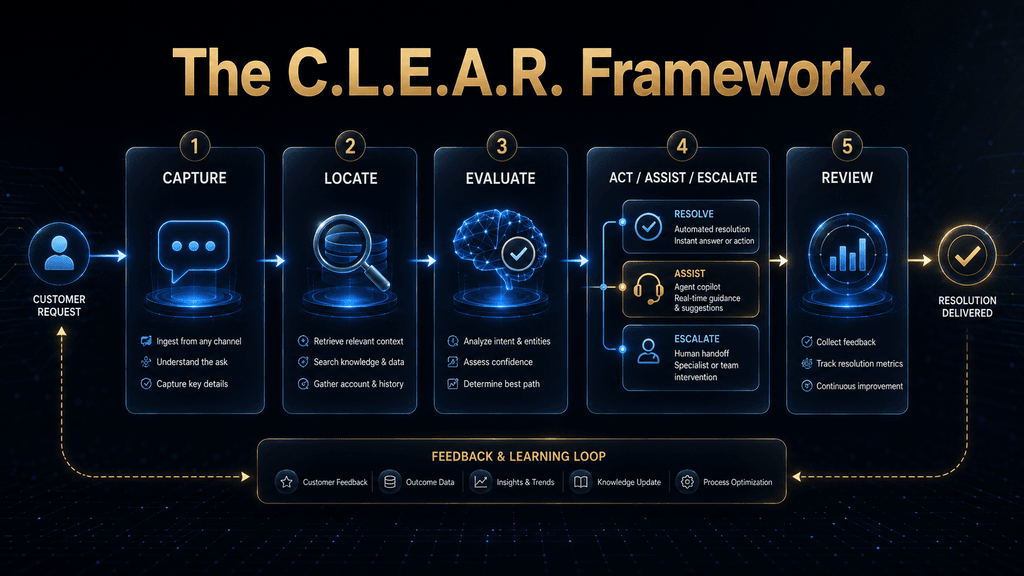
That is the logic behind the AI Hustle World C.L.E.A.R. Framework:
Capture → Locate → Evaluate → Act, Assist, or Escalate → Review. The value of the framework is that it treats customer service as a decision process rather than a conversation-generation problem.
C — Capture the Customer’s Request
Every service interaction begins with information arriving from somewhere.
That might be a website chat, email, phone call, social-media message, SMS, WhatsApp conversation, in-app support request, or form submission. Voice interactions may first require speech recognition to convert spoken language into text, while an email could contain attachments, order numbers, screenshots, or several paragraphs of explanation that all contribute to the case.
The system should therefore capture more than the customer’s words. It may need the customer’s identity, account, current channel, conversation history, attached files, order details, and other metadata required to understand what is happening. A public social-media complaint, for example, may carry a very different business risk from a private email about the same underlying problem.
This first stage is easy to underestimate because it happens before the model “does anything interesting.” Yet mistakes here propagate downstream. If an order number is missed, a screenshot is ignored, or the wrong account is associated with the conversation, everything that follows can be fast and completely wrong.
That creates a basic rule for AI customer service: The quality of the answer cannot be better than the quality of the request and context the system captured.
L — Locate the Information That Actually Matters
Understanding what the customer wrote is only half of the problem. The system also needs the information required to answer accurately or perform the requested action.
For a simple product question, that might mean retrieving the current product documentation. For an order problem, it could involve customer records, shipping status, inventory, refund policy, and purchase history. For technical support, the system may need the customer’s product version, error logs, current service status, and known troubleshooting guidance.
This is where retrieval becomes central to modern AI customer service.
A language model can generate a grammatically excellent explanation without having the correct company policy in front of it. Retrieval helps ground the response in business information that exists outside the model itself. The broader retrieval-augmented generation approach works by finding relevant external information and placing it into the context used to generate the response.
But retrieval introduces its own engineering problem: not every information source is equally trustworthy.
A customer-service environment may contain an approved refund policy, an outdated internal note, a marketing article, an old chatbot answer, and a draft document that was never approved. The AI cannot responsibly treat those sources as equivalent.
A serious support architecture therefore needs some concept of source authority. Approval status, version, publication date, permissions, account identity, and other metadata can help determine which information should influence the response.
This is one reason an AI project can expose weaknesses in a company’s documentation. A business may discover that its policies were already inconsistent before AI arrived. The AI simply makes the inconsistency impossible to ignore.
A sophisticated language model connected to bad documentation is still capable of producing sophisticated misinformation.
E — Evaluate Intent, Risk, and Confidence
Once the system understands the request and has located relevant information, it has to determine what kind of case it is dealing with. This is where many simplistic AI customer-service strategies fall apart.
Consider three customers asking apparently similar questions about payments. One wants to understand a routine pending charge. Another is asking why an expected refund has not arrived. The third suspects that someone used their card without permission. The words may overlap, but the operational risk is completely different.
The system therefore needs to evaluate several dimensions at once: customer intent, urgency, available evidence, business rules, confidence, potential financial impact, and whether the situation requires human judgment. This is also where deterministic rules remain valuable.
Suppose the AI recognizes that a customer wants a refund. The language model can interpret the request and explain the process, but a business rule can determine whether the order is within the refund window, whether the item qualifies, whether the purchase has already been refunded, and whether the refund can be issued automatically.
The safest architecture is often therefore a hybrid:
AI interprets. Rules constrain. Systems verify. Humans handle exceptions.
That is considerably safer than giving a language model unrestricted authority over every customer-service decision.
A — Act, Assist, or Escalate
After evaluation, the system needs to decide what happens next. This is the point where the differences between automation, assistance, and escalation become practical.
If the request is simple, low-risk, well documented, and supported by a clear workflow, the AI may be able to resolve it directly. If the request is more complex but still benefits from AI assistance, the system may prepare a response, retrieve information, summarize the case, or recommend the next action for a human representative. If the situation is risky, emotionally sensitive, ambiguous, or beyond the system’s authority, it should escalate.
The goal is not to maximize the percentage of conversations that remain inside the AI system. The goal is to route each case to the most appropriate level of automation.
A good escalation is therefore not a failure of AI. It is evidence that the system recognized its boundary.
What AI Can Safely Resolve
AI tends to work best when the information is available, the workflow is repeatable, the policy is clear, and the success condition can be determined objectively.
Order tracking is an obvious example. The system can identify the order, retrieve the latest status, communicate the expected delivery information, and provide tracking details. Password resets, appointment scheduling, routine subscription changes, product FAQs, basic troubleshooting, and certain account-verification workflows can have similar characteristics.
These tasks are attractive because they combine high volume with predictable logic. The business can define what a successful outcome looks like, and the AI does not need to invent policy to get there.
The important qualification is that “appropriate for automation” does not mean “always safe to automate.” Even a normally routine task can become an exception. A shipping question becomes more complicated when an expensive order appears lost. A refund becomes more sensitive when fraud is suspected. A password-reset request becomes high risk when account ownership cannot be verified.
The system therefore needs boundaries around the workflow rather than a blanket instruction to automate the entire category.
When AI Should Assist a Human
There are many support situations where AI can create value without becoming the final decision-maker.
A representative might spend several minutes searching for the customer’s history, locating the current policy, reading a long previous conversation, and writing a response that still needs to be reviewed. AI can reduce that administrative burden by collecting the relevant information and presenting it in one place.
This approach has strong research support. The NBER study “Generative AI at Work” examined data from 5,179 customer-support agents and found that access to a generative-AI assistant increased issues resolved per hour by 14% on average, with a larger 34% improvement for novice and lower-skilled workers and minimal impact among experienced, highly skilled workers. The researchers also found evidence of improved customer sentiment and employee retention. The results are important partly because they show that AI’s value does not require autonomous replacement: assistance can raise human productivity, particularly where workers are still developing expertise. (National Bureau of Economic Research)
That finding also reveals an important boundary. AI does not improve every worker equally, and productivity gains do not automatically mean every service outcome improves. A support team should therefore measure the actual effect of AI on both the work being done and the customer experience.
When AI Should Escalate
Escalation is necessary when the case requires judgment, authority, empathy, investigation, or a level of confidence the system cannot safely provide.
Fraud investigations, legal disputes, serious complaints, unusual financial cases, medical decisions, vulnerable customers, and emotionally charged situations are obvious examples. The details vary by industry, but the underlying principle remains consistent: the higher the consequence of being wrong, the less sensible it is to let a generative system operate without appropriate human oversight.
The handoff itself matters almost as much as the decision to escalate.
Customers hate being transferred from a bot to a person only to repeat the entire story. A useful AI system should pass along the customer’s request, identity and relevant account information, actions already attempted, records consulted, the reason for escalation, and a concise summary of the interaction.
The human should inherit context rather than inherit a blank screen. That single design decision can make the difference between automation that reduces customer effort and automation that simply moves the customer’s work from one interface to another.
R — Review the Outcome
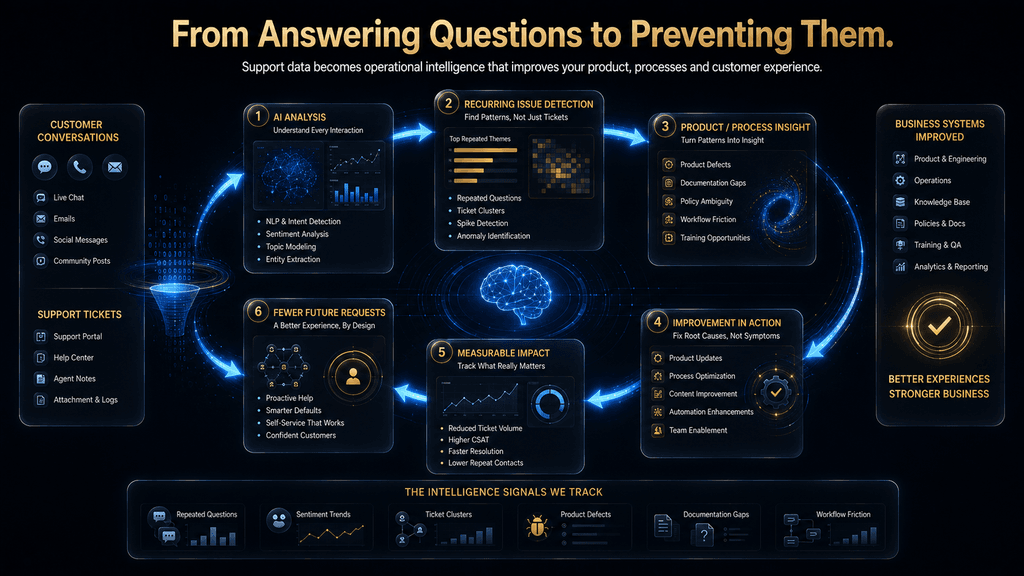
The conversation is not finished simply because the AI sent a response. The business should ask whether the customer’s underlying problem was solved, whether the answer was accurate, whether the policy was followed, whether escalation happened at the right time, whether the customer needed to contact support again, and how much effort the customer had to spend to reach the outcome. This is the stage where AI customer service becomes a continuous improvement system instead of a static chatbot.
Failed conversations reveal knowledge gaps. Repeated escalations reveal missing workflows. Repeated questions can reveal confusing product experiences.
Incorrect answers can reveal documentation or retrieval problems. Long resolution times can reveal operational bottlenecks. The output of the review stage should therefore improve not only the AI but also the business itself.
Sometimes the best result from analyzing ten thousand support conversations is not a better chatbot. It is discovering that the checkout page is confusing, the product documentation is incomplete, or the billing workflow is unnecessarily complicated.
That is a more powerful use of AI than simply answering more tickets.
The Difference Between a Response and a Resolution
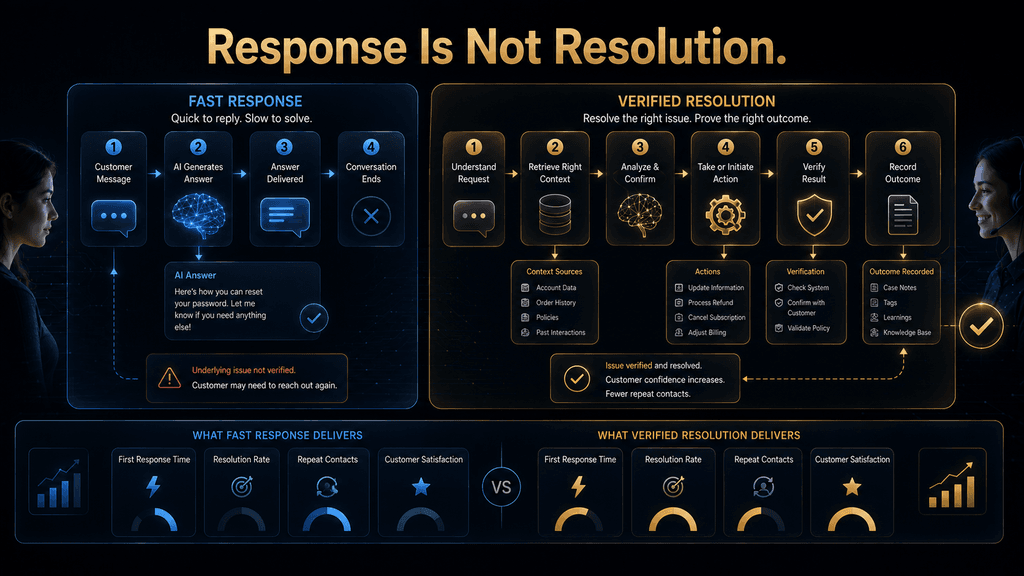
This distinction deserves special attention because it changes how an organization should measure AI customer service. A response means the system said something. A resolution means the customer’s underlying need was successfully addressed.
Those are not the same outcome. Imagine someone writes, “Why was I charged twice?” An AI system responds immediately:
“One of the charges may disappear automatically within several business days.”
The customer has received a response.
But what if the second charge is not pending? What if it is an actual duplicate transaction? The customer’s financial problem remains.
A better service process would inspect the transaction records, distinguish a pending authorization from a completed duplicate charge, explain what the evidence shows, determine whether the business is authorized to reverse the charge, and escalate the case when it is not. This difference becomes particularly important when vendors and businesses advertise high automation, containment, or deflection rates.
A high percentage of conversations handled without humans can be operationally impressive. It does not prove that the customer problems were solved.
Klarna’s own reporting provides a useful illustration of the scale possible with AI customer service: its 2025 annual report says its AI assistant, launched with OpenAI in 2024, handled 80% of customer-service chats during 2025, with no drop in consumer satisfaction according to the company’s internal surveys. The filing also reports 31 million conversations since launch and cites 2024 cost savings of $39 million, while explicitly identifying the underlying figures as based on Klarna’s service-chat data and internal surveys. Those numbers should therefore be understood as company-reported results, not universal benchmarks.
The more useful lesson from Klarna is not “80% is the target.” It is that automation rate only becomes meaningful when it is connected to actual customer outcomes and the cost of delivering them.
The Three Roles of AI in Customer Service
A useful way to understand the business landscape is to separate three roles AI can play.
The first is direct customer self-service, where the customer interacts with the AI and the system resolves appropriate tasks. This is the most visible implementation and often the easiest for customers to understand.
The second is employee assistance, where AI operates behind the representative. The customer may never know an AI system summarized the case, retrieved the policy, translated the message, or suggested a response. The value comes from giving the employee better information and reducing repetitive administrative work.
The third is operations and quality intelligence, where AI analyzes large quantities of support activity to identify patterns that humans would struggle to spot manually. It can surface recurring complaints, identify knowledge gaps, classify issues, support quality review, and reveal product problems that are generating unnecessary support demand.
The third role is easy to overlook because it does not produce a flashy chatbot experience. It may also be the most strategically important.
A customer-service team that discovers that thousands of contacts are being caused by the same confusing product instruction has learned something about the product itself. Fixing the instruction may remove more support work than adding another AI agent.
That is why mature AI customer service should not be measured only by what happens inside support. It should also be measured by what support intelligence helps the rest of the business improve.
What Technologies Power AI Customer Service?
The technology stack can look intimidating, but most of it becomes easier to understand when organized around its job. Natural-language processing helps systems interpret language, identify entities, detect intent, and connect related concepts. Large language models generate and transform language, summarize interactions, classify information, explain retrieved material, translate messages, and support more flexible conversations.
Retrieval systems locate relevant information from help centers, internal documentation, customer records, knowledge bases, and connected applications. Speech recognition converts customer speech into text, while text-to-speech enables AI voice responses. Machine learning can support classification, prediction, routing, forecasting, and other patterns that do not depend on a single conversational exchange.
Workflow automation translates a recognized request into defined operational steps. Analytics systems examine the larger support operation, helping companies identify recurring problems, measure quality, and detect changes in demand.
Not every AI customer-service deployment needs every component. A simple support assistant may use a language model and a curated knowledge base. A more advanced system could connect the model to customer records, business rules, transactional systems, workflow tools, and analytics.
The sophistication of the architecture should follow the problem. Not the other way around.
Where AI Customer Service Appears
AI customer service can operate across nearly every channel through which customers already interact with a business. Website chat is a common starting point because it provides a controlled environment for FAQs, account support, lead qualification, and order-related questions.
Email support can use AI to classify messages, extract important details, draft replies, identify urgency, and route cases. This can be particularly valuable because email often contains large amounts of unstructured text that would otherwise require manual reading.
Voice support introduces another layer. AI can transcribe conversations, identify intent, retrieve information, provide spoken responses, summarize calls, and assist human representatives during the interaction.
Messaging platforms such as WhatsApp, Messenger, SMS, and in-app messaging can also support AI workflows, particularly where businesses already communicate with customers outside traditional help desks. The channel itself does not determine how valuable AI will be. The decisive factor is still the underlying workflow.
The Knowledge Problem: Why Good AI Depends on Good Information
One of the least glamorous parts of AI customer service may also be the most important. If the company does not have reliable information, the AI has nothing trustworthy to retrieve.
Consider a business with three different refund policies scattered across its help center, internal documentation, and old support notes. An AI system might retrieve the wrong one with complete confidence. The problem looks like an AI hallucination, but the deeper problem is information governance.
A useful customer-service knowledge environment needs clear ownership, versioning, approval status, permissions, and a process for removing outdated information.
The same issue appears with customer data. A system should retrieve information from the right customer account and only expose information that the current interaction is authorized to access.
This means AI customer service is partly a knowledge-management project.
A company can spend thousands of dollars on a more capable AI model while leaving the knowledge base outdated and contradictory. In that situation, the marginal benefit of upgrading the model may be much smaller than the benefit of fixing the information architecture.
The model is not the entire system. The information it receives is part of the system too.
The AI Hustle World Automation Boundary
The most useful question for a business is not “What can we automate?” It is: “What should AI own, what should it assist, and what should remain human?” A practical decision model looks like this:
| Customer-Service Situation | Appropriate AI Role | Why |
|---|---|---|
| Routine, repetitive, low-risk request | Resolve | Clear rules and objective outcome |
| Information lookup | Retrieve + explain | AI accelerates access to approved information |
| Standard multi-step workflow | Execute within limits | Automation removes repetitive operational work |
| Complex technical investigation | Assist | AI gathers context while specialists retain judgment |
| Sensitive complaint | Assist + escalate | Human empathy and judgment matter |
| Fraud or high-risk financial case | Detect + route | Consequences of error are high |
| Medical or legal decision | Support information flow, not final judgment | Professional responsibility remains critical |
| Ambiguous request | Clarify or escalate | Low confidence should reduce autonomy |
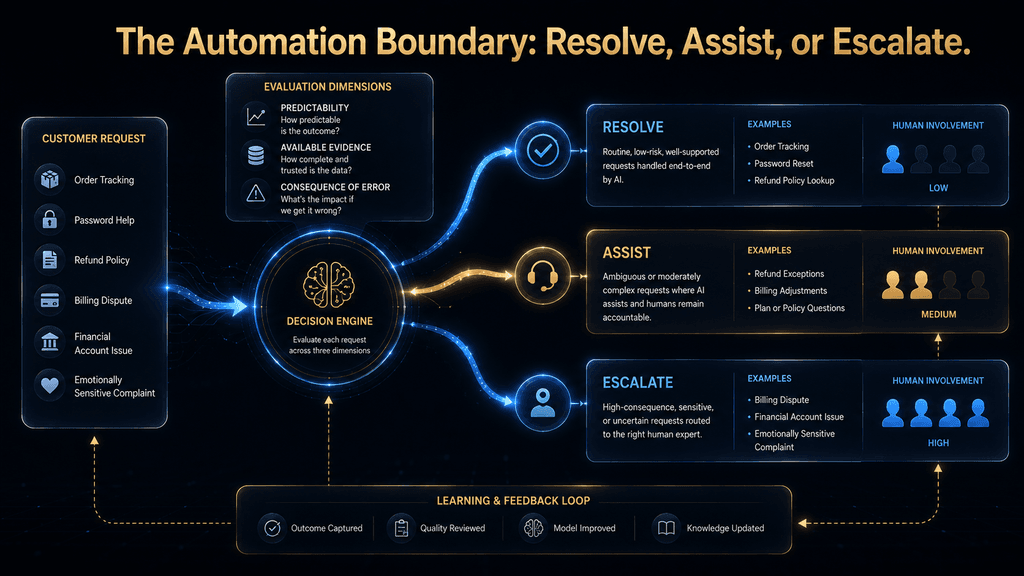
This framework is deliberately conservative.
It does not assume that automation is always the goal. It treats risk, ambiguity, authority, and reversibility as factors in deciding how much autonomy a system should have.
That is a better operating principle than trying to push every interaction toward zero human involvement.
Real Business Examples of AI Customer Service
Hypothetical examples help explain the mechanism, but real deployments reveal something more valuable: how businesses actually choose to use the technology.
Klarna: Large-Scale Customer-Service Automation
Klarna is one of the clearest examples of customer-facing AI operating at significant scale.
Its 2025 annual report says the AI assistant handled 80% of customer-service chats during the year, with no drop in consumer satisfaction according to internal surveys. The company reported that the assistant had handled 31 million conversations since launch and estimated that it performed work equivalent to more than 700 full-time agents based on reductions in chat and telephone interactions after launch. Klarna also reported that its AI assistant’s average query-resolution time was around two minutes compared with 12 minutes for human agents as of September 2024, based on its service-chat data. (Securities and Exchange Commission)
The important lesson is not that every business should target the same automation level. Klarna operates at unusual scale and has resources, data, and operational infrastructure that most companies do not have.
The more useful lesson is that high-volume customer service is one of the areas where AI can generate substantial operational leverage when the workflows, data, and economics support it.
Klarna also illustrates why AI customer-service strategy cannot be reduced to a cost-saving story. The more automated the operation becomes, the more important it is to understand which cases still require human expertise and how that expertise is preserved.
Unity: Deflecting Demand Through Self-Service
Unity provides a different kind of example.
According to Zendesk’s published customer story, Unity used self-service and automation to deflect nearly 8,000 tickets, which the company estimated represented about $1.3 million in savings from reduced ticket volume. Zendesk also reports that Unity saw a 25% increase in monthly ticket resolutions through self-service between September 2021 and January 2022. These are customer-story figures published by Zendesk, so they should be treated as vendor-reported deployment results rather than independent benchmarks. (Zendesk)
The interesting part is the mechanism. The value was not simply that AI could answer questions.
Self-service reduced the number of cases requiring human intervention, while agents could spend more time on cases that actually needed them. That is a useful example of AI removing unnecessary support workload without implying that all support work should disappear.
CoreWeave: AI Helping Experts Rather Than Replacing Them
CoreWeave demonstrates another model.
According to Cohere’s customer story, CoreWeave integrated AI into its Slack-based support workflow to improve intake, gather context, and route customer problems to the appropriate technical experts. Cohere reports that average resolution time decreased from 4–8 days to 2–5 days, while customer-satisfaction scores remained around 4.9–5.0 for the majority of support tickets after deployment. The company also reported improved routing accuracy. Because these are vendor-published customer-story figures, they should be treated as reported deployment outcomes rather than independently verified benchmarks. (Cohere)
What makes this example valuable is that the architecture does not depend on replacing the person who knows the answer. The AI removes the administrative work surrounding expertise. Instead of an engineer spending time collecting logs, reconstructing the history, searching for documentation, and asking the customer for information that was already available somewhere else, the AI helps assemble the case so the engineer can focus on diagnosis and resolution.
That model is often overlooked in “AI will replace support” conversations. In complicated environments, making experts faster can be more valuable than trying to make experts unnecessary.
avatarin and Yamada Denki: Voice-Based AI Customer Service
OpenAI’s July 2026 customer story describes how avatarin built a multilingual shopping-support agent for Yamada Denki using GPT-Realtime. During a two-week public experience, approximately 30,000 shoppers engaged with the system, and OpenAI reports that 92% of post-use survey responses were positive. The system was designed to provide 24/7 voice-based shopping assistance and help customers move from product discovery toward purchase decisions. These figures are reported by OpenAI as part of a customer story. (OpenAI)
This example broadens the way customer service should be understood. Support does not always begin after a purchase problem occurs. An AI system can also help customers before the transaction by explaining products, answering questions, guiding decisions, and making expertise available outside normal store hours.
It also demonstrates the growing importance of voice and multilingual interaction. As conversational systems become more capable of handling real-time speech, customer service is no longer confined to text chat.
What These Business Examples Actually Have in Common
Klarna, Unity, CoreWeave, and avatarin are very different companies operating in very different environments. Yet their AI deployments share a pattern. The systems are valuable because AI is connected to real business context.
That context may be customer records, documentation, support history, transaction information, technical data, business rules, or expert knowledge. The AI is not valuable because it can produce fluent sentences. It is valuable because those sentences are connected to a workflow that can actually help the customer or the employee.
This is one of the most important distinctions to carry forward: Language is the interface. Information and workflow are the infrastructure.
Without the infrastructure, a highly capable conversational system can remain a polished front end sitting on top of weak operational logic.
The Business Benefits of AI Customer Service
AI customer service can create meaningful benefits, but each benefit has a condition attached to it.
Faster Responses
AI can handle multiple interactions simultaneously and does not require a support representative to be awake or available for every routine request. This makes 24/7 availability possible for certain classes of support.
But response speed is only useful when the answer is accurate and relevant. A wrong answer delivered in three seconds is not necessarily better service than a correct answer delivered more slowly.
Lower Repetitive Workload
Routine questions can consume a disproportionate amount of support-team capacity. If customers repeatedly ask the same questions about shipping, password resets, subscription changes, or basic troubleshooting, automating those workflows can free human representatives to spend more time on difficult cases. This is one of the clearest areas of potential ROI because businesses can compare the cost of handling repetitive work manually against the cost of automating the appropriate portion of that workload.
The important word is appropriate. Automating a difficult workflow simply because it is expensive does not necessarily produce savings if the automation creates more escalations, complaints, refunds, or repeat contacts.
Greater Consistency
A well-designed AI system can use approved knowledge and standardized workflows to deliver more consistent information than a large team handling the same question manually. That can reduce variation in how policies are explained and make quality monitoring easier.
But consistency creates an uncomfortable truth: if the knowledge base is wrong, AI can deliver the wrong answer consistently. Consistency is therefore a benefit of good information governance, not a magical property of AI.
Higher Human-Agent Productivity
The NBER research provides an important independent data point here. AI assistance increased issues resolved per hour by 14% on average in the studied support environment, with substantially larger benefits for newer and lower-skilled workers. (National Bureau of Economic Research)
The deeper implication is that AI may redistribute expertise inside a support organization.
A new employee can receive some of the guidance that previously depended on more experienced colleagues. An experienced employee can spend less time locating information and more time handling difficult cases.
That does not mean AI becomes the expert. It means the system can make expertise easier to access.
Better Customer Insights
Every support interaction contains information about the product.
If hundreds of customers ask how to use the same feature, the feature may be confusing. If many customers request the same refund exception, the policy may need review. If complaints spike after a software release, the product change may be creating friction.
AI can analyze conversations at a scale that would be difficult to achieve manually and help businesses identify these patterns. This turns customer service into a source of product intelligence.
The strongest service organization may eventually be the one that needs fewer support conversations because the business has learned how to prevent the underlying problems.
Improved Scalability
Traditional support often scales by adding people as customer volume increases. AI can change the economics for predictable interactions because one system can assist many customers simultaneously.
But the relationship is not “AI replaces the people required for growth.” A better description is: AI absorbs predictable demand while humans concentrate on complexity.
That distinction becomes especially important as ticket volume increases. If the business continues to receive complex and unusual cases, a smaller human team may still need enough capacity to handle them well.
Scalability is therefore about changing the mix of work, not making human support disappear.
What AI Customer Service Does Poorly
The weaknesses are just as important as the benefits.
Hallucination
Language models can produce confident statements that are not supported by the available evidence. In customer service, the consequence can be serious because customers often assume support information reflects company policy.
Grounding responses in approved knowledge and current business data reduces the risk, but it does not eliminate it.
Outdated Knowledge
A system connected to yesterday’s policy may be highly accurate relative to yesterday and still be wrong today. This is why knowledge maintenance is a continuous operational requirement.
Poor Retrieval
The correct information may exist but fail to surface for the current request. From the business’s perspective, this can look like a model problem when the underlying failure is search, indexing, ranking, metadata, or retrieval configuration.
Excessive Automation
A business can over-optimize for automation rate. If customers are unable to find a human when they clearly need one, the system may reduce staffing costs while increasing frustration and reputational risk. The objective should be lower customer effort, not simply lower employee involvement.
Loss of Context During Escalation
Automation can fail even when the human is capable of solving the problem. The customer is transferred, the human receives a blank ticket, and the customer has to explain the entire situation again.
That is not intelligent escalation. The system should transfer the relevant context with the customer.
Privacy and Security Risks
Customer-service systems can handle names, addresses, financial information, account records, health-related information, internal documents, and other sensitive data. The business therefore needs to decide what data the AI can access, which systems it can act on, what information the customer is authorized to see, how conversations are stored, and who can inspect them. The question is not merely: “Can the AI access this database?”
It is: “Should this AI access this database for this user for this task?” That is an access-control question as much as an AI question.
The Human + AI Model
The most credible vision for AI customer service is not a binary choice between machines and people. It is a division of labor. AI is strong at repetitive processing, information retrieval, summarization, classification, translation, preparation, and certain well-defined workflows.
Human employees remain especially valuable when the situation requires empathy, negotiation, relationship management, creative problem-solving, difficult judgment, or responsibility for consequential decisions. The strongest organizations will often use AI to make human support more selective rather than simply smaller. That distinction matters economically too.
If AI resolves thousands of routine cases, humans have more time for high-value cases. If AI prepares complex cases before escalation, specialists spend less time gathering basic information. If AI analyzes conversations and discovers recurring product problems, the company can reduce future demand.
In that model, the purpose of AI is not simply to reduce the number of people involved in customer service. It is to improve where human attention is spent.
How Businesses Should Measure AI Customer Service
This is where a lot of implementations go wrong. Businesses tend to measure what the technology can easily count: number of AI conversations, containment, automation rate, response time, or cost per contact.
Those metrics can matter. But they should not become the definition of success. A stronger measurement hierarchy starts with the customer outcome.
| Metric | What It Tells You |
|---|---|
| Response time | How quickly the system responds |
| Automation / containment rate | How many interactions remain outside human support |
| Resolution rate | How often the customer’s actual issue is solved |
| First-contact resolution | Whether the problem was solved without another contact |
| Repeat-contact rate | Whether customers had to return because the issue remained unresolved |
| CSAT | How customers evaluated the experience |
| Escalation quality | Whether AI transferred cases appropriately |
| Agent productivity | Whether human representatives can resolve more work effectively |
| Knowledge accuracy | Whether the system used correct business information |
| Customer effort | How much work the customer had to do to reach a solution |
| Business outcome | Whether the service improvement affects retention, revenue, cost, or another meaningful objective |
Consider a hypothetical system that claims a 95% automation rate. That sounds impressive until you discover that many of those customers contacted the company again because the issue was not resolved. Now compare it with a system that automates only 65% of conversations but successfully resolves 90% of those automated cases while escalating the rest with complete context.
The second system may be substantially more useful. This is why the guiding metric should be verified resolution, not automation volume.
The Economics of AI Customer Service
The business case should also include both savings and new costs. Potential savings can come from reducing repetitive agent workload, increasing case throughput, lowering manual triage, reducing after-hours staffing needs, improving self-service, and helping specialists spend more time on difficult problems. But AI introduces its own expenses.
There may be model or platform usage costs, integration work, data preparation, knowledge-base maintenance, quality evaluation, security controls, monitoring, human escalation, and ongoing optimization. A business therefore should not ask: “How much does this AI tool cost?”
It should ask: “How much does the entire AI-assisted service workflow cost, and what outcome does it produce compared with the existing workflow?” That is a more realistic ROI calculation.
Suppose a company spends $10 per automated interaction but previously spent $15 handling the same routine case manually. The AI is not automatically a $5 savings if a percentage of the automated interactions still require human follow-up.
The real cost includes the full path to resolution. A useful economic model is: Total cost of service = AI operating cost + human escalation cost + maintenance cost + failure cost.
The last term is easy to ignore. An incorrect refund, unnecessary escalation, repeat contact, customer churn event, or compliance problem can cost much more than the original AI interaction.
The cheapest response is not always the cheapest resolution.
What Should Businesses Automate First?
The safest starting point is usually work that is high-volume, predictable, well documented, low to moderate risk, and objectively verifiable. Order tracking is a good candidate. So are standard account questions, appointment scheduling, routine troubleshooting, known billing explanations, and repetitive knowledge requests.
A business should be more cautious with tasks involving financial consequences, legal responsibility, sensitive personal circumstances, fraud, unusual exceptions, or high-value customer relationships. The goal is not to identify the most expensive support task.
It is to identify the task with the best combination of: volume + repeatability + information quality + low ambiguity + manageable risk. That is where automation has the best chance of creating real value.
How to Implement AI Customer Service Without Overbuilding
The implementation process should begin with the support operation, not the AI vendor.
First, map the current workload. Which questions appear repeatedly? Which cases consume the most agent time? Where do customers get stuck? Which interactions are low-risk and predictable? Which cases generate the highest number of escalations?
Then examine the information layer. Are the policies current? Are documents contradictory? Can customer data be accessed reliably? Does the business know which source is authoritative?
Next, select one narrow workflow and pilot it. Do not begin by trying to automate the entire support department.
A small pilot gives the business an opportunity to test the actual experience. Measure accuracy, resolution, repeat contact, escalation quality, customer effort, and agent workload. Review failed interactions manually. Fix the knowledge gaps. Adjust the workflow boundaries.
Only then should the business expand. This sequence can be summarized as: Map → Prepare → Pilot → Escalate → Measure → Improve → Expand. The important part is the order.
Businesses often want to start with “Which AI platform should we buy?” The better first question is: “Which support workflow is worth improving?”
Why the Traditional Support Model Still Exists
It is easy to look at AI and assume traditional support is obsolete.
It is not. Human support exists because customer problems are not all equally structured.
A customer may not know exactly what they need. They may be angry because a previous process failed. Their case may contain information the company has never seen before. They may be asking for an exception that requires discretion. They may need someone to negotiate rather than merely explain a policy.
These are not software bugs in the support process. They are characteristics of human service work. AI is extremely effective where the problem can be represented as information plus a repeatable workflow. Human expertise becomes disproportionately valuable as uncertainty and consequence increase.
That is why the long-term model is unlikely to be “AI everywhere.” It is more likely to be AI around the predictable parts and humans around the consequential parts.
The Most Important Mistakes Businesses Make
One of the biggest mistakes is automating everything because automation is available. A system should earn the right to become more autonomous through evidence that it can handle a particular class of interaction safely and accurately.
Another mistake is ignoring knowledge quality. Businesses sometimes spend heavily on AI while leaving their documentation outdated, contradictory, or difficult to retrieve. That creates a much larger problem than the model itself.
A third mistake is hiding the human path. Customers should not feel trapped inside an automated loop when their case clearly requires human attention. Escalation should be a designed feature, not an emergency workaround.
Another common mistake is optimizing for deflection rather than resolution. Preventing a ticket from reaching a human is not success if the customer still needs help.
Businesses also make mistakes by forgetting the employee experience. AI should reduce unnecessary work for representatives, not add another system they must constantly monitor and correct.
Finally, many organizations treat deployment as the end of the project. It is actually the beginning of an evaluation cycle. The business needs to review failed interactions, recurring questions, knowledge gaps, escalation patterns, and customer outcomes continuously.
Customer-service AI should improve over time because the business is learning from the interactions.
The Future of AI Customer Service
The next generation of AI customer service will likely look less like a chatbot and more like an intelligent operating layer across the support organization.
AI agents will increasingly be able to retrieve information, use tools, update records, initiate approved workflows, and complete multi-step tasks. The customer may still see a simple conversational interface, but the back end will increasingly connect language understanding with real business actions.
Memory will also become more important. A support system that can responsibly preserve relevant customer context, previous issues, preferences, and historical interactions can reduce repetition and create more personalized experiences. But memory introduces its own requirements around freshness, accuracy, privacy, permissions, and correction. More remembered information is not automatically better; the system needs to know which information is still valid and relevant.
Multimodal support will expand as well. Customers already communicate through screenshots, documents, images, audio and video, and AI systems are increasingly capable of processing these formats. A customer might upload a photograph of a damaged product, a screenshot of an error message, or a video demonstrating a technical problem, and the support system could use that evidence before deciding what should happen next.
Voice will also become more natural. OpenAI’s avatarin/Yamada Denki deployment illustrates how real-time multilingual voice interaction can extend service beyond text and beyond traditional business hours. (OpenAI)
But perhaps the most important development will be proactive support.
Instead of waiting for a customer to report a delayed order, the company can notify them first. Instead of waiting for users to complain about a confusing feature, the system can identify patterns in usage and support conversations. Instead of waiting for a subscription problem, the business can intervene before the customer reaches the point of frustration.
The best support experience may increasingly be the support interaction that never has to happen.
A More Contrarian View: The Best AI Customer Service May Create Fewer Support Conversations
Most companies approach customer service AI as a way to answer support requests more efficiently.
That is useful, but it is only the first level. A more ambitious system uses support data to identify why customers are contacting the company in the first place.
Suppose an AI system analyzes 100,000 support conversations and discovers that a large percentage of customers cannot understand one part of the checkout process. The company could improve the chatbot, train more agents, or create another help article.
Or it could fix the checkout page. The fourth option may be the highest-value outcome. This is where customer service becomes a feedback mechanism for the entire business.
The support organization begins telling product, marketing, engineering, operations, and finance where customers are experiencing friction. AI makes that feedback loop faster because it can analyze far more interactions than a human team can manually review.
That leads to a broader definition of customer-service AI: The system should not only help answer the questions customers ask. It should help the business understand why those questions exist.
That is a much more durable reason to invest in the technology than simply reducing ticket volume.
Who Should Use AI Customer Service?
AI customer service is particularly compelling for businesses with substantial support volume, repetitive questions, strong documentation, clear workflows, structured customer data, and enough consistency in their operations to make automation useful. Ecommerce companies, SaaS businesses, online services, financial platforms, travel companies, telecommunications providers, education platforms, and other customer-heavy businesses can all benefit from some form of AI-assisted support.
The form it takes should differ. A smaller business might begin with knowledge retrieval and email assistance. A larger company might deploy customer-facing AI plus agent assistance and analytics.
A highly regulated organization may use AI primarily to help human employees retrieve information and prepare cases while keeping critical decisions under strict human control. The size of the company is therefore less important than the nature of the support workload.
Who Should Be Cautious?
Businesses should be cautious when their support volume is too low to justify the implementation cost, when documentation is unreliable, when support interactions are highly customized, or when the consequences of an incorrect answer are unusually high. A company should also hesitate if its only reason for adopting AI is the belief that employees are expensive.
That is not a sufficiently precise problem. The better question is where employee time is currently being consumed by work that a machine can reliably perform.
If the answer is “most of our support work is unique and relationship-driven,” aggressive automation may create little value. If the answer is “our team spends half the day answering the same ten questions and searching for information across six systems,” the opportunity is much clearer.
Final Thoughts
AI customer service is becoming far more capable than the old chatbot model suggests, but its real value does not come from making conversations sound human. It comes from connecting language understanding with reliable information, business rules, customer context, workflows, and appropriate human judgment.
The businesses most likely to benefit are not necessarily the ones that automate the largest percentage of their conversations. They are the ones that understand which work should be automated, which work should be assisted, where the AI needs authoritative information, and where the consequences of being wrong are high enough that a human should remain responsible.
That is why response time, automation rate, and ticket deflection are useful but incomplete measures. Customers ultimately care whether their problem was solved, how much effort they had to spend, and how they were treated when the situation became complicated. Businesses should care about those outcomes too, because a fast answer that creates another support contact is not efficiency, and an AI system that reduces staffing while damaging trust is not a successful transformation.
The strongest AI customer-service architecture is therefore neither “AI replaces humans” nor “AI simply assists humans.” It is a carefully designed division of labor in which AI handles predictable information and workflows, employees concentrate on complexity and judgment, and the organization continuously learns from the support interactions passing through both.
The technology will keep improving. AI agents will gain greater ability to use tools, memory will become more sophisticated, multimodal systems will understand richer customer evidence, and voice interactions will become more natural. But the central business principle is unlikely to change: automate the right work, ground it in the right information, preserve a clear path to human judgment, and measure whether the customer’s actual problem was solved.
That is what turns AI customer service from a faster chatbot into a better service operation.
Ready to Compare the Best AI Customer Service Tools?
Now that you understand how AI customer service actually works, compare the leading tools, their capabilities, pricing considerations, and best-fit use cases before choosing a platform.
Compare the Best AI Customer Service Tools →Frequently Asked Questions
What is AI customer service?
AI customer service is the use of artificial intelligence to understand customer requests, retrieve relevant information, answer questions, assist human representatives, automate approved service workflows, and analyze support interactions. It can include customer-facing chat or voice systems as well as behind-the-scenes tools that employees use during support.
Is AI customer service the same as a chatbot?
No. A chatbot is one possible interface for customer interaction, while AI customer service can include knowledge retrieval, customer-data access, workflow automation, agent assistance, analytics, routing, and human escalation. A simple chatbot may only answer predefined questions, while a connected AI system can potentially retrieve information and perform approved actions.
How does AI customer service work?
A modern system generally captures the customer’s request, identifies relevant customer and business context, evaluates intent and risk, then decides whether to resolve the issue, assist a human representative, or escalate it. Afterward, the business reviews the outcome to determine whether the issue was actually solved and what should be improved.
Can AI actually resolve customer problems?
Yes, when the problem is predictable, the necessary information is available, the business rules are clear, and the system is authorized to perform the required action. Order tracking, routine account questions, appointment scheduling, certain password workflows, and other structured tasks are good candidates, while ambiguous or high-consequence cases generally need stronger human oversight.
Can AI completely replace customer-service representatives?
AI can automate substantial portions of repetitive support work, but complete replacement is unrealistic for many organizations. Human representatives remain especially important for complex investigations, sensitive complaints, negotiation, empathy, unusual exceptions, and decisions where the consequences of an incorrect response are significant.
Does AI customer service really reduce costs?
It can, but the answer depends on the workflow and the quality of implementation. Businesses may reduce repetitive workload, improve agent productivity, increase self-service, and handle more routine interactions without increasing staffing proportionally. Those savings must be weighed against software, integration, maintenance, monitoring, human escalation, and the cost of AI-caused errors or repeat contacts.
What is more important: automation rate or resolution rate?
Resolution rate is generally more meaningful as a customer outcome. Automation or deflection can indicate how much work the system handles without human intervention, but neither metric proves that the customer received the correct outcome. A strong system should monitor automation alongside verified resolution, repeat contacts, customer effort, satisfaction, and escalation quality.
Why does the knowledge base matter so much?
AI customer-service systems depend on reliable information to answer questions and make decisions. If policies are outdated, contradictory, incomplete, or poorly organized, the AI may retrieve the wrong information and produce a confident but incorrect answer. Improving documentation, source authority, version control, and retrieval quality can therefore be just as important as choosing the underlying AI model.
What are the biggest risks of AI customer service?
The most significant risks include hallucinated or outdated answers, poor retrieval, inappropriate automation, privacy and access-control failures, weak escalation, loss of conversation context during handoffs, and excessive reliance on AI in situations requiring human judgment. The risk becomes more serious as the financial, legal, medical, or emotional consequences of mistakes increase.
What is the future of AI customer service?
AI customer service is moving toward systems that can retrieve information, use tools, execute approved workflows, maintain relevant context, process multiple input types, support natural voice conversations, and proactively identify customer needs. The broader direction is toward AI becoming an operational layer across customer service rather than simply a chatbot sitting on a website.
Written by
Muntasir Ahmad Chowdhury
Founder, AI Hustle World
Muntasir Ahmad Chowdhury is the Founder of AI Hustle World, an independent publication dedicated to making Artificial Intelligence practical, trustworthy, and easy to understand. He researches AI tools, automation, customer service, productivity, and real-world business applications, helping readers make smarter technology decisions through research-driven, experience-backed content.
Expertise:
AI Tools • AI Automation • AI Customer Service • AI Productivity • Generative AI • AI Workflows
Get Smarter With AI
Enjoyed this guide? Get practical AI tools, tutorials, and honest reviews delivered to your inbox.