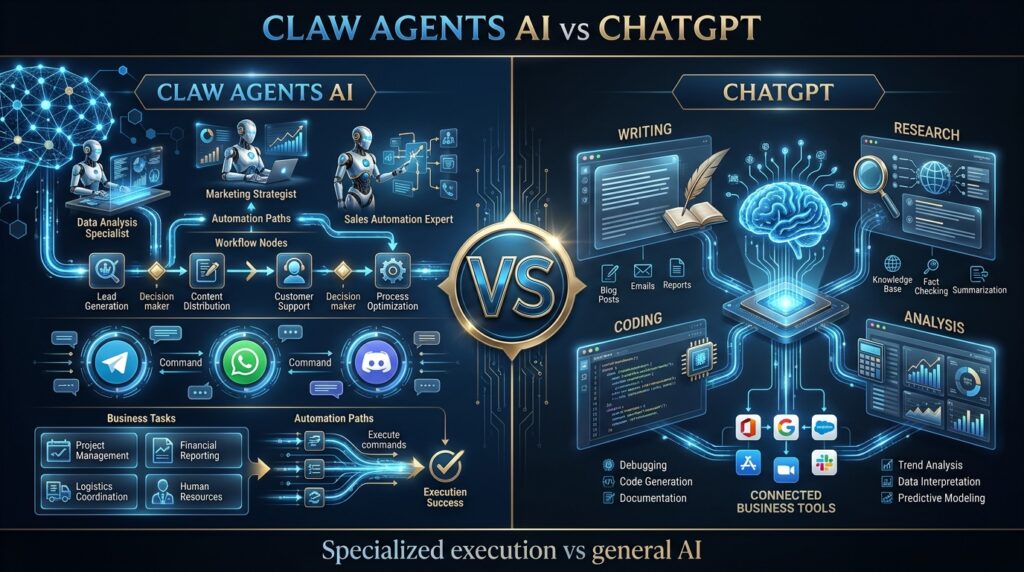
Evidence: Documentation reviewed
Last checked: September 2026
What was done: Written from official documentation and the published sources linked in this article. Not hands-on tested.
Files: None
Affiliate links: Yes
Last updated: September 2026
Claw Agents AI vs ChatGPT: Which AI Assistant Is Better in 2026?
Affiliate Disclosure: This article contains affiliate links. If you purchase Claw Agents AI through one of our links, AI Hustle World may earn a commission at no additional cost to you. Our comparison is based on documented features, current pricing information, product positioning, limitations, alternatives, and buyer fit—not on the commission.
No income is promised here. Claw Agents AI’s sales page uses income language, and AI Hustle World has not verified any earnings example. This comparison looks at features, pricing and fit, and it does not treat income claims as a reason to choose either product.
The AI assistant market is changing quickly. ChatGPT remains a broad AI platform for writing, research, analysis, coding and increasingly team workflows. At the same time, products such as Claw Agents AI are trying to move beyond the chatbot model by packaging AI agents around repeatable business tasks. The result is a comparison that looks simple on the surface but is actually more complicated. Claw Agents AI vs ChatGPT is not quite the same as comparing two ordinary chatbots.
Claw Agents AI is currently marketed as an OpenClaw-powered AI workforce that can be commanded through Telegram, WhatsApp and Discord and is positioned around specialized business tasks such as research, pages, emails, social content, workflows and client assets. Its sales page currently advertises 250+ skills and “unlimited” AI agents.
ChatGPT, meanwhile, is a general AI platform. OpenAI’s current Business plan is designed as a secure shared workspace with AI for chat, coding, analysis and workflows, plus connections to tools such as Google Workspace, Slack, GitHub and Microsoft 365. According to OpenAI’s pricing page, a standard Business seat costs $20 per user per month when billed annually or $25 when billed monthly. So which one is better?
The answer depends on the layer of work you want to improve. If your main need is thinking, writing, research, coding and flexible problem-solving, ChatGPT is the stronger general choice. If your main need is packaged AI-agent workflows and task delegation, Claw Agents AI is the more specialized proposition.
And if you are technical and want maximum control over the underlying agent infrastructure, there is a third option worth knowing about: OpenClaw itself. Its official documentation describes it as a self-hosted gateway that connects chat apps to AI agents, and the software is MIT-licensed. That three-way distinction makes this comparison much more useful than simply declaring a winner.
Compare an Agent Bundle With What You Already Use
List the tasks you currently do in ChatGPT and check which of them the Claw Agents AI offer claims to cover.
View the Claw Agents AI Offer →Affiliate disclosure: We may earn a commission if you subscribe through this link, at no additional cost to you.
Two public references shape how this page handles sponsorship and sourcing: the FTC’s Endorsement Guides Q&A and Disclosures 101 on disclosing affiliate relationships, and Google’s guidance on using generative AI content, which puts value to readers ahead of how content is produced.
Quick Verdict
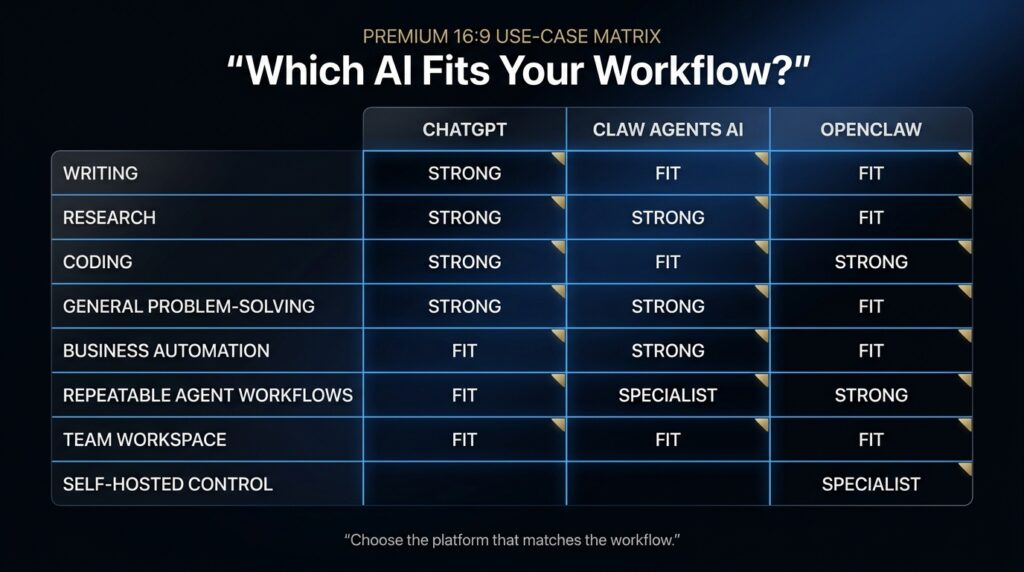
| Category | Better fit on paper | Why |
|---|---|---|
| General AI assistant | ChatGPT | Broader reasoning and general-purpose capability |
| Writing | ChatGPT | Mature general writing workflow |
| Research | ChatGPT | Broad analysis + connected business workflows |
| Coding | ChatGPT | Strong coding-oriented ecosystem |
| Specialized agent workflows | Claw Agents AI | Core product positioning |
| Business task delegation | Claw Agents AI | Built around agent roles and execution |
| Ease of starting general AI work | ChatGPT | Extremely familiar conversational workflow |
| Packaged business-agent approach | Claw Agents AI | Predefined agent/skill model |
| Self-hosted control | OpenClaw | Open-source, self-hosted architecture |
| Team workspace | ChatGPT Business | Shared workspace, admin and connected tools |
| Best for most individuals | ChatGPT | More broadly useful |
| Best for agent-focused buyers | Claw Agents AI | More specialized use case |
Each “better fit” call in this article is based on the official pages and published sources linked here. We did not run the tools side by side, so treat each call as a starting point and check the feature you care about most before you pay.
This is not a claim that Claw Agents AI is universally better at automation or that ChatGPT is universally better at every task. The more useful conclusion is: ChatGPT is the stronger general AI layer. Claw Agents AI is the more specialized execution/workflow proposition.
The Real Difference: Thinking vs Execution. The most important distinction between these products is not the model. It is the job you want the system to perform.
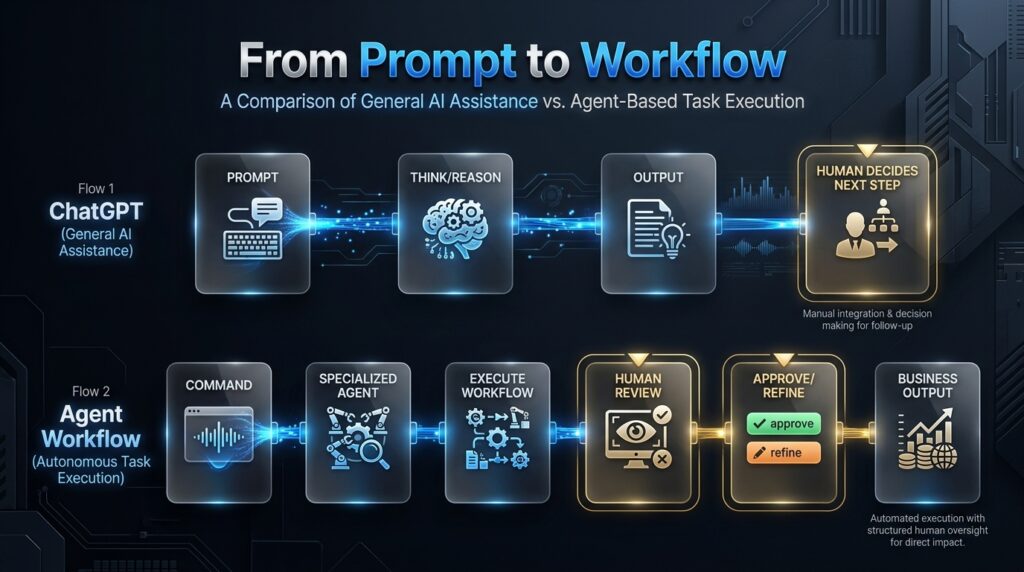
ChatGPT: Think With Me. You ask: “Analyze these competitors.” It helps you reason through the answer. You ask: Write a sales email.” It drafts one. You ask: “Review this code.” It analyzes it. You ask: “Create a strategy.” It helps formulate one. The general pattern is: Prompt → reasoning → output → human decides what happens next
Claw Agents AI: Work for Me. The current Claw Agents AI sales page positions the product around specialized AI employees that can build pages, write emails, create social posts, research niches, connect apps, organize workflows and prepare business assets. It specifically markets the ability to issue commands through Telegram, WhatsApp and Discord. The intended pattern is: Command → specialized agent/workflow → output → human reviews/approves That difference is meaningful. A general AI assistant gives you capability. An agent platform tries to give you delegation.
But Delegation Creates a New Responsibility
This is the part most sales pages under-emphasize. The more you delegate to AI, the more important your control layer becomes. You still need to decide:
- What should the agent do?
- What data can it access?
- What is it allowed to change?
- What requires approval?
- How are errors caught?
- Who is responsible for the final result?
OpenClaw’s security documentation is detailed about the risks of connected agents. It covers prompt injection, tool and agent permissions and browser-control risks, which is why access control and configuration matter once an agent can act on your behalf. That creates a powerful second-order insight: more automation does not necessarily mean less management. It changes management from doing the task to designing, monitoring and approving the system, and that matters for both Claw Agents AI and the broader agent ecosystem.
What Is Claw Agents AI?
Claw Agents AI is currently marketed as an OpenClaw-powered AI workforce. The vendor says it allows users to command AI agents through Telegram, WhatsApp and Discord, with 250+ skills. Our explainers on what an AI agent is and how AI agents use tools to complete real tasks cover the background. The skill areas the vendor lists include:
- offer research
- landing-page assets
- email campaigns
- social content
- niche/competitor research
- workflows
- app connections
- client deliverables
- automation tasks.
The official sales page also emphasizes a beginner-oriented experience, arguing that users should not need to manage the technical setup normally associated with OpenClaw-style systems.
Important distinction
These are vendor claims and product positioning. This review does not claim to have independently tested every advertised agent. So the fair interpretation is: Claw Agents AI is designed around agent-based business execution. That is different from saying: every advertised agent will reliably complete every task without supervision. Our guide to the best AI tools to create and sell digital products covers the tools around this workflow.
What Is ChatGPT?
ChatGPT is a general-purpose AI platform. For individual users, it can support: If you are comparing assistants, our list of the best ChatGPT alternatives and the guide to writing AI prompts help you judge them.
- writing
- research
- analysis
- brainstorming
- coding
- document work
- image generation
- problem-solving
For teams, OpenAI’s current ChatGPT Business plan adds a shared workspace, business administration, connected tools, company context and AI for chat, coding, analysis and workflows. The standard seat is listed at $20 per user per month when billed annually or $25 monthly. OpenAI describes Business as a secure workspace with centralized administration and connections to Google Workspace, Slack, GitHub, Microsoft 365 and more. That makes the old description of ChatGPT as simply “a chatbot for writing” outdated, and in 2026 the more accurate description is a general AI workspace that can sit across multiple business workflows.
Claw Agents AI vs ChatGPT: Core Architecture
| Claw Agents AI | ChatGPT | |
|---|---|---|
| Core idea | AI workforce / specialized agents | General AI workspace |
| Typical interaction | Command an agent | Converse with AI |
| Main strength | Task/workflow specialization | Broad reasoning |
| Flexibility | Workflow-oriented | Extremely broad |
| Business automation | Core positioning | Supported through workflows/integrations |
| Writing | Yes | Strong |
| Research | Yes | Strong |
| Coding | Possible through agent ecosystem | Strong |
| Agent roles | Central to product | Not the primary product identity |
| Team workspace | Product-specific | ChatGPT Business |
| Self-hosted | No | No |
| Open source | No | No |
| Best buyer | Agent/workflow-focused user | General AI/business user |
The comparison shows the core issue: They overlap, but they do not have identical product architecture.
1. General Intelligence
ChatGPT. This is where ChatGPT has a major advantage. If you are unsure what kind of task you will face tomorrow, a general-purpose AI system gives you more flexibility. You might use it for any of the following, and any AI output still needs checking, as we explain in understanding AI hallucinations:
- brainstorm a product
- analyze a contract
- write a proposal
- explain a technical concept
- debug code
- summarize research
- create a strategy.
Better fit on paper: ChatGPT
Claw Agents AI. Claw Agents AI is not primarily trying to win the “answer anything” category. Its differentiation is packaging AI capability around defined business jobs. That can be more useful once your workflow is repetitive. Better question. Do you need general intelligence, or do you need structured delegation?
2. Business Automation. This is where Claw Agents AI becomes more interesting. The vendor’s entire positioning is built around AI workers that can execute predefined business-oriented jobs and workflows. The current page describes one-command workflows for pages, emails, social posts, research, app connections and automation.
- Claw Agents AI advantage. Specialization and packaged workflow orientation.
- ChatGPT advantage. ChatGPT can still participate in automated workflows, particularly through its broader ecosystem, connected tools and business workspace. OpenAI currently markets Business around chat, coding, analysis and workflows plus connected applications.
- Verdict. Claw Agents AI has the clearer specialized positioning for agent-style business execution. But that does not prove it will outperform every ChatGPT workflow. The quality of the implementation matters.
Better fit on paper: Claw Agents AI for the specific agent-workflow use case
3. Writing. Writing is different. If your main task is:
- blog articles
- emails
- proposals
- reports
- scripts
- rewriting
- brainstorming
ChatGPT is already an extremely broad writing environment. Claw Agents AI also markets email, page copy, social content and sales-copy workflows. But if your primary need is simply: “Help me write.” you may not need an agent platform. Our roundup of the best AI writing tools compares the wider field.
Better fit on paper: ChatGPT for general writing
Claw Agents AI becomes more interesting when writing is part of a larger workflow, such as: research → offer → page → email → social → follow-up That’s a different use case. For writing tasks, see our roundup of the best AI tools for writing blog posts.
4. Research. ChatGPT can handle broad research and analysis, while Claw Agents AI markets niche, competitor and offer research as agent tasks. ChatGPT is more general, so you can change the question constantly, and Claw Agents AI is more structured, because its agents are meant to fit a business workflow. That is a more accurate answer than giving one product a blanket win.
Better fit on paper: ChatGPT for general research, Claw Agents AI inside an agent workflow
5. Coding. ChatGPT has a major advantage for users who need a general-purpose coding partner. OpenAI currently includes AI for coding in ChatGPT Business and also provides Codex-related capabilities within its broader ecosystem. Claw Agents AI may participate in coding or technical workflows through its underlying agent ecosystem, but coding is not the primary buyer proposition of the product. For developers, this difference is significant.
Better fit on paper: ChatGPT
6. Ease of Use. Both products aim to reduce friction. ChatGPT has an extremely low barrier, because you open it, ask and receive an answer, while Claw Agents AI is also marketed as beginner-friendly, with messaging-channel control and less technical setup than direct OpenClaw deployment. There are two kinds of simplicity here, interface simplicity and workflow simplicity. ChatGPT wins on interface simplicity, and Claw Agents AI’s potential advantage is workflow simplicity for users who want pre-packaged agent jobs rather than building those workflows themselves.
Better fit on paper: ChatGPT for starting general AI work
7. Integrations. This category needs careful handling. OpenAI’s pricing page lists ChatGPT Business connections to Google Workspace, Slack, GitHub, Microsoft 365 and more. Claw Agents AI’s sales page mentions Gmail, WordPress, Slack, Zapier, Make, n8n and webhooks in its sample prompts and workflow ideas. ChatGPT’s integrations are part of a mature managed business workspace, while Claw Agents AI’s value proposition is more explicitly agent plus app plus task. The depth and reliability of each integration should be verified before you treat them as equivalent, so there is no universal winner, and the best choice depends on the applications your business actually uses.
Check the Price Before You Compare
The offer page shows a $367 retail price, or $267 with a coupon, as a one-time payment, so weigh that against your current subscriptions.
See the Current Price →Affiliate disclosure: We may earn a commission if you subscribe through this link, at no additional cost to you.
8. Control. This is where OpenClaw becomes important. Direct OpenClaw is self-hosted and open source. Its official documentation describes it as running on your own machine or server, with you controlling the gateway and connected channels. Claw Agents AI is designed to package that style of functionality into a more accessible product. ChatGPT is a managed service. This is one of the most useful ways to understand the ecosystem. You can think of the three layers like this:
- ChatGPT: managed AI
- Claw Agents AI: packaged agent experience
- OpenClaw: self-hosted agent infrastructure
9. Pricing. Pricing is where direct comparisons can become misleading. OpenAI’s pricing page lists a ChatGPT Business standard seat at $20 per user per month billed annually or $25 billed monthly, as checked on September 25, 2026. ChatGPT also has individual plans, but the Business plan is the more relevant comparison when the buyer is evaluating a business workflow.
Claw Agents AI uses a different pricing structure. Its current front-end sales page presents the offer as a one-time payment rather than a recurring subscription, at $367 or $267 with the coupon code 100off when we checked on September 25, 2026, and it compares that with a combined $829 a month for the editions bought separately. The broader funnel also contains additional editions and upgrades. That means you should not compare a $20 monthly ChatGPT seat with a one-time Claw price without considering what each price includes.
The more useful comparison is a recurring subscription plus managed service versus a one-time commercial offer plus optional upgrades and usage considerations. This is especially important because one-time software offers can still contain paid upgrades and changing product terms.
10. Which One Offers Better Value. There is no universal answer. ChatGPT is better value when you use AI for many different tasks, and Claw Agents AI is better value when you repeatedly need the specific workflows it is designed around. Take two users. User A writes articles, researches, analyzes PDFs, brainstorms and codes, so ChatGPT makes more sense. User B runs recurring campaigns that need research, page assets, email sequences, social content, follow-ups and workflow execution, so Claw Agents AI may make more sense. The product choice follows the workload.
Claw Agents AI vs ChatGPT for Small Businesses
Small businesses feel the cost of a wrong tool choice directly, so the comparison matters most here. Our guide to the best AI tools for small business owners shows what else is on the table before you commit to a bundle.
ChatGPT is better when the business needs:
- broad knowledge work
- writing
- analysis
- coding
- strategy
- customer-response drafts
- research
- document assistance.
Claw Agents AI is more interesting when the business needs:
- repeated workflow execution
- agent-style task delegation
- packaged business roles
- multi-step campaign production
- predefined automation routines.
The current Claw Agents AI page describes its editions as “Perfect for marketers, affiliates, creators, freelancers, agencies”. That tells you something important: its value proposition is highly workflow-dependent.
What About Using Both. This is the most overlooked option. You don’t necessarily have to choose one. A possible conceptual workflow is:
- ChatGPT → strategy and reasoning
- Claw Agents AI → repeatable execution
- Human → review and approval
For example:
- Step 1. Use ChatGPT to develop the campaign strategy.
- Step 2. Use an agent-based workflow to prepare recurring assets.
- Step 3. Human reviews the output.
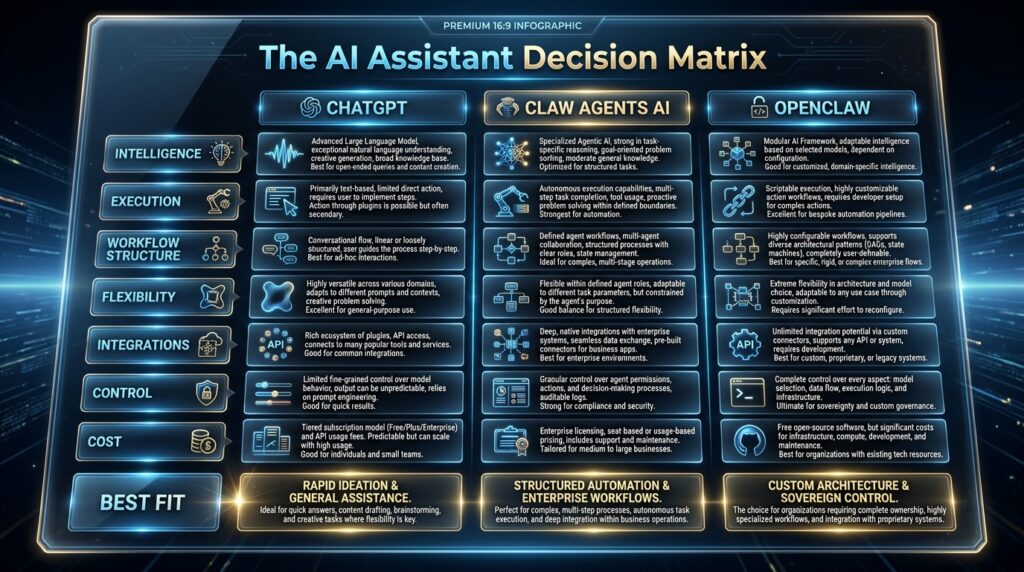
- Step 4. Publish/execute. This is not a claim that the products have a native smooth integration with one another. It is a workflow architecture. The larger lesson is: The best AI stack often combines a strong general reasoning layer with specialized execution tools.
Claw Agents AI vs OpenClaw vs ChatGPT
| Claw Agents AI | ChatGPT | OpenClaw | |
|---|---|---|---|
| Product type | Packaged agent workforce | Managed general AI platform | Open-source self-hosted gateway |
| Main focus | Business execution | General intelligence | Agent infrastructure |
| Setup | Beginner-oriented | Very low | Technical |
| Self-hosting | No | No | Yes |
| Open source | No | No | Yes |
| Custom control | Moderate | Managed | High |
| General writing/reasoning | Good potential | Strong | Depends on model/config |
| Agent workflows | Core positioning | Available, but not core identity | Core architecture |
| Best for | Business workflow delegation | Most general AI work | Developers/power users |
OpenClaw’s official documentation says it is self-hosted, open-source and designed for developers/power users who want control over their data and the infrastructure. That makes it a serious third option, not merely an implementation detail. For visuals, see the best AI image generators.
Which One Should You Choose?
Choose ChatGPT if. You want one general AI assistant. You write often. You research. You code. You analyze documents. You brainstorm. You want the broadest possible set of general-purpose capabilities. Best user. Creator, consultant, student, developer, freelancer or general business user.
Choose Claw Agents AI if…
Your main problem is repetitive business execution. You want: For distribution, see our list of the best AI tools for creating social media content.
- specialized agents
- business workflows
- task delegation
- campaign execution
- packaged automation.
You also prefer a packaged experience rather than building the underlying OpenClaw environment yourself.
Best user. Marketer, agency, entrepreneur or small business owner with repeatable digital workflows. Choose OpenClaw if. You’re comfortable with:
- setup
- configuration
- hosting
- API keys
- permissions
- infrastructure.
And you care more about control than convenience. OpenClaw’s installation documentation currently supports macOS, Linux and Windows and asks for a current Node.js version. Best user: a developer or power user.
Who Should NOT Switch From ChatGPT?
This is important. Don’t switch just because the phrase: “AI employees” sounds more advanced. Stay with ChatGPT if:
- Your work is mostly knowledge work. You ask questions, write, analyze and brainstorm.
- You already have automation. If your existing stack already handles your repetitive workflows, adding another platform may create complexity instead of reducing it.
- You value general flexibility. ChatGPT is easier to redirect from one kind of task to another.
- You do not have repeatable workflows. If every day is different, specialized agents may not deliver enough value.
Who Should Consider Claw Agents AI?
Claw Agents AI deserves consideration when:
- You repeat the same business workflows. For example: research → page → emails → social → follow-up
- You want agent-based delegation. Rather than asking AI for every individual step.
- You want a more packaged route into the OpenClaw ecosystem. Without taking on the full self-hosted setup yourself.
- The work has measurable economic value. If one workflow saves several hours per week, the product has a clearer business case.
A Simple Buyer Test
Before choosing, answer five questions. Our affiliate disclosure lists every company we have a commercial relationship with.
- 1. What do I actually do most often. Writing? Research? Coding? Sales? Customer support? Marketing?
- 2. Which tasks are repetitive. List them.
- 3. Do I want help thinking—or help executing. This is the most important question.
- 4. How much control do I need. Convenience? Or infrastructure ownership?
- 5. What would success look like. Hours saved? More leads? More content? Faster delivery? Lower tool costs? If you cannot answer question five, you’re probably not ready to optimize the stack.
Pros & Cons
Claw Agents AI
Pros
- Agent/workflow-first positioning
- Specialized business-task orientation
- Messaging-channel control
- Broad task/skill library claimed by vendor
- Beginner-oriented presentation
- Potentially useful for repetitive business workflows.
Cons
- More specialized than a general AI assistant
- Product claims are heavily marketing-led
- Exact performance across the agent library is not independently verified here
- Offer/funnel structure can be more complex
- May be unnecessary for users who simply need general AI.
ChatGPT
Pros
- Broad general-purpose capability
- Strong writing and analysis
- Strong coding capabilities
- Large ecosystem
- Business workspace option
- Connected-tool support for teams.
Cons
- A general assistant may require you to design more of the workflow yourself
- Advanced business/team usage can become a recurring software expense
- Specialized execution may require integrations or additional workflow design.
Common Mistakes When Comparing These Products
- Mistake 1: Comparing agent count. 250+ agents doesn’t automatically mean better value. Your business may need five.
- Mistake 2: Treating ChatGPT as only a chatbot. Its current Business offering is much broader than simple chat.
- Mistake 3: Treating Claw Agents AI as a replacement for every AI tool. Specialization does not mean universal replacement.
- Mistake 4: Ignoring workflow design. A powerful tool with a bad workflow is still inefficient.
- Mistake 5: Ignoring human review. More autonomy creates more need for controls.
- Mistake 6: Comparing only monthly price. Compare: total cost + workflow value + setup + usage + supervision
- Mistake 7: Switching without measuring. Changing AI platforms has a cost. Make the new platform prove its value.
The Real ROI Test. Use this simple formula: AI ROI = Value Created − Total Cost, where Value Created = time saved + additional output + faster delivery + business gains, and Total Cost = subscription or offer + setup + training + oversight + integration.
Example. Suppose a business spends: 8 hours every week on repetitive marketing execution. If an agent workflow genuinely reduces that to: 3 hours you save: 5 hours/week At a business time value of $30/hour: 5 × $30 = $150/week That is roughly: $600/month of time value A platform that creates that result can justify a meaningful cost. But the assumption must be tested. This calculation should never be treated as proof that Claw Agents AI will save a particular amount. It is simply a method to evaluate the product after adoption.
The Deeper Insight: AI Is Moving Up the Work Stack
Traditional AI: Answer Agentic AI: Act The difference is significant. When AI only answers: The human manages execution. When AI acts: The human manages the system. That changes the skill that becomes valuable. The future business advantage may move toward:
- workflow design
- quality control
- permission management
- strategic direction
- exception handling
- accountability.
In other words: Cheap execution does not eliminate management. It changes what management is worth. That is why an AI workforce does not mean the end of human work. It can mean the end of humans being paid to perform repetitive coordination.
Final Verdict: Claw Agents AI or ChatGPT?
There is no single winner. Plan data for other tools is in our AI Tool Pricing Database.
ChatGPT wins overall for general AI use. It is the better choice when your work changes constantly and you need one flexible assistant for writing, research, analysis, coding and problem-solving. OpenAI’s current Business offering also makes ChatGPT relevant for teams that need company context, connected tools and administration.
Claw Agents AI wins for the narrower job of packaged agent-style workflow execution. Its current product is explicitly designed around AI employees, specialized skills and business workflows, with messaging-based command and automation as central selling points. OpenClaw wins for maximum control. Its official architecture is self-hosted and open source, making it the stronger choice for technically capable users who want to own the infrastructure. So the decision is:
- Need a general AI brain? → ChatGPT
- Need a packaged AI workforce? → Claw Agents AI
- Need self-hosted agent infrastructure? → OpenClaw
Should You Use Both?
Potentially. A sophisticated business stack can look like:
- ChatGPT → Think
- Claw Agents AI → Execute
- Human → Approve
But only build that stack if there is a real workflow reason. The goal is not to own more AI. The goal is to create more leverage.
Decide Whether You Need a Separate Agent Bundle
Match your real workload to the bundle’s editions, and keep your current assistant if it already covers those tasks.
Review the Claw Agents AI Bundle →Affiliate disclosure: We may earn a commission if you subscribe through this link, at no additional cost to you.
Frequently Asked Questions
Is Claw Agents AI better than ChatGPT?
Not universally. Claw Agents AI is positioned around specialized agent workflows, while ChatGPT is a broader AI platform. The better choice depends on whether your priority is general AI assistance or structured business-task delegation.
Is Claw Agents AI an alternative to ChatGPT?
Yes, for some workflows—but it is not a one-for-one replacement. It competes more directly when the buyer wants agent-based execution rather than general conversational AI.
Which is better for writing?
ChatGPT is generally the stronger choice for general-purpose writing because writing is one component of its broader AI workflow. Claw Agents AI becomes more interesting when writing is one step inside a larger automated business process.
Which is better for research?
ChatGPT is the stronger general-purpose research and analysis tool. Claw Agents AI may be more useful when research is embedded inside a predefined business workflow.
Which is better for coding?
ChatGPT. Its current Business offering explicitly includes AI for coding, and OpenAI continues to support coding-focused workflows.
Which is better for business automation?
Claw Agents AI has the more specialized positioning for agent-style business automation. However, ChatGPT can also participate in workflows through integrations and connected tools, particularly in its Business environment. See also the best AI workflow automation tools.
Is Claw Agents AI free?
It is sold as a commercial product with a one-time-price positioning on its current sales page, alongside a wider funnel of editions and upgrades. On September 25, 2026 the sales page showed $367, or $267 with the coupon code 100off, and it says to check the latest price at checkout. Always verify the current checkout before purchasing.
Is ChatGPT free?
ChatGPT has free access, while paid individual and business plans provide additional capabilities and limits. For teams, OpenAI currently lists ChatGPT Business at $20/user/month annually or $25 monthly.
Is OpenClaw the same thing as Claw Agents AI?
No. OpenClaw is an open-source, self-hosted gateway for AI agents. Claw Agents AI is a separate commercial product positioned as an OpenClaw-powered packaged experience.
Should a small business switch from ChatGPT to Claw Agents AI?
Only when the business has repeatable workflows where agent-style execution creates measurable value. If the business mainly needs writing, research, analysis and general problem-solving, ChatGPT may already be enough.
Can you use ChatGPT and Claw Agents AI together?
Conceptually, yes. A business can use a general AI platform for strategy and reasoning and an agent platform for repeatable execution. The exact technical integration should be verified for the user’s workflow rather than assumed.
Should developers choose OpenClaw?
Developers and technical power users who want self-hosting and infrastructure control may find OpenClaw more attractive. Its documentation explicitly positions it for users who want to run the gateway on their own machine or server.
Which one should beginners choose?
For most beginners, ChatGPT is the safer starting point because it is broader and easier to use without first designing an automation workflow. Claw Agents AI becomes more compelling once the beginner has a clear repetitive business process to automate.
Final Thoughts
The Claw Agents AI vs ChatGPT debate becomes much easier once you stop treating them as identical products. ChatGPT is the general AI layer. Claw Agents AI is the packaged agent-workflow layer. OpenClaw is the self-hosted control layer. That gives you three different answers to three different problems. For most people, start with the general assistant. Build the workflow. Identify the repetitive work. Then decide whether a specialized agent platform can create enough additional leverage to justify the change.
Do not switch because “AI employees” sounds more advanced. Do not stay with ChatGPT simply because it is familiar. And do not buy either platform without defining the result you expect. The winning tool is the one that fits the work. Choose the AI layer that matches your bottleneck: think with ChatGPT, delegate with agent workflows, or own the infrastructure with OpenClaw.
Written by
Muntasir Ahmad Chowdhury
Founder, AI Hustle World
Muntasir Ahmad Chowdhury is the Founder of AI Hustle World, an independent publication dedicated to making Artificial Intelligence practical, trustworthy, and easy to understand. He researches AI tools, automation, customer service, productivity, and real-world business applications, helping readers make smarter technology decisions through research-driven, experience-backed content.
Expertise:
AI Tools • AI Automation • AI Customer Service • AI Productivity • Generative AI • AI Workflows
Get Smarter With AI
Enjoyed this guide? Get practical AI tools, tutorials, and honest reviews delivered to your inbox.