
Evidence: Documentation reviewed
Last checked: September 2026
What was done: Written from official documentation and the published sources linked in this article. Not hands-on tested.
Files: None
Affiliate links: No
AI Financial Planning & Analysis (FP&A): How Continuous Forecasting Works
Financial planning and analysis has traditionally operated on a rhythm that made sense when business information moved slowly: collect actuals, reconcile the numbers, update the forecast, explain the variances, and prepare management reports for the next review cycle. That process can still work well for relatively stable businesses, but the operating environment around many finance teams has changed. Customer demand can shift within days, pricing can move quickly, supply conditions can change unexpectedly, and management may need to make decisions about hiring, spending, inventory, or capital allocation before the next formal forecast is finished.
AI is beginning to change what FP&A can do between those formal planning cycles. Instead of treating the forecast as a document that gets refreshed periodically, organizations can increasingly treat it as a living model that absorbs new operational signals, tests assumptions, identifies emerging variances, and helps management evaluate possible responses. The important change is therefore not simply that AI can produce a forecast faster; it is that finance can potentially move closer to a continuous decision-support model.
That distinction matters because a more sophisticated forecasting model does not automatically create better financial decisions. If the underlying data is unreliable, business drivers are poorly defined, assumptions are stale, or management still waits weeks for information to move through reporting and approval processes, AI may simply accelerate a flawed process. Continuous FP&A works when data, drivers, forecasting, scenario analysis, human judgment, and decision-making operate as one connected system.
Quick Answer: What Is AI-Powered Continuous Forecasting?
AI-powered continuous forecasting is an FP&A approach in which financial forecasts are refreshed more frequently as financial, operational, and external business signals change, allowing finance teams to identify emerging risks, model alternative outcomes, and support decisions before the next traditional planning cycle. The AI component can help automate data preparation, identify changing drivers, generate or update forecasts, surface variances, and explore scenarios, while finance professionals remain responsible for validating assumptions and deciding what the business should actually do.
The practical difference is between asking, “What did the business report this month?” and asking, “What changed, what is likely to happen next, what could happen under different conditions, and which decisions are still available to us?” That is why continuous FP&A is better understood as an operating model rather than a single forecasting feature. The objective is to shorten the distance between a business signal and a financially informed management decision.
Why Traditional FP&A Becomes Outdated Between Forecast Cycles
Traditional FP&A is built around a necessary tension. Finance needs enough time to collect, reconcile, validate, and interpret information, but the business often changes while that work is happening. A sales team can see a slowdown in bookings before it appears in recognized revenue, a procurement team can see cost pressure before it affects the income statement, and an operations team can see production problems before their financial consequences become visible in the monthly results.
This creates a timing problem. By the time finance has incorporated the change into a formal forecast, leadership may already have made decisions based on the previous assumptions. McKinsey’s 2026 research on AI and FP&A describes this problem directly: many planning processes move more slowly than the pricing, inventory, capital allocation, and commercial decisions they are supposed to inform.
In one telecommunications example discussed by McKinsey, forecasting cycles had stretched to six weeks or more and depended on more than 1,000 Excel models, leaving substantial FP&A capacity tied up in data preparation, reconciliation, and reporting rather than decision support.
The problem is not that traditional FP&A is irrational. Its controls exist for good reasons. Financial numbers have to be reconciled, definitions have to be consistent, assumptions have to be challenged, and management needs a reliable version of the company’s financial position before committing resources. The weakness appears when the process becomes so periodic and labor-intensive that the forecast is already becoming stale by the time the organization is ready to act on it.
This is particularly important in businesses where operational drivers move faster than financial reporting. Revenue may depend on bookings, conversion rates, customer retention, pricing, sales capacity, product mix, or usage; margins may depend on freight, labor, materials, foreign exchange, or production yield; and cash requirements may depend on collections, inventory, hiring, and supplier terms.
A financial model that only sees the final accounting outcome can explain what happened, but it may not give management enough time to influence what happens next. That is the opening for continuous FP&A.
What Continuous Forecasting Actually Means
Continuous forecasting does not mean that every financial number must be recalculated every minute. That interpretation creates unnecessary complexity and misunderstands the purpose of the approach. The appropriate forecasting cadence depends on how quickly the business drivers change, how quickly management can respond, and how costly it is to refresh the underlying information.
A consumer business exposed to rapidly changing demand may benefit from daily or weekly signals, while a stable industrial company may gain more from a weekly or monthly rolling process. The objective is not maximum frequency; it is useful frequency. A forecast that refreshes every hour but does not change a meaningful decision is less valuable than a forecast that refreshes once a week and consistently gives management enough time to respond.
The most useful distinction is therefore between a periodic forecast and a continuous planning loop. In a periodic model, the forecast is refreshed because the calendar says it is time to refresh it. In a continuous model, the forecast becomes responsive to changes in the business itself, with defined drivers and triggers determining when assumptions need to be reconsidered.
That changes the role of the forecast. Instead of being primarily a financial reporting artifact, it becomes an active management instrument. The forecast is there not merely to tell leadership what the company is expected to earn, spend, or generate in cash, but to help management understand which assumptions are changing and what choices remain available.
The AI Hustle World Continuous FP&A Loop
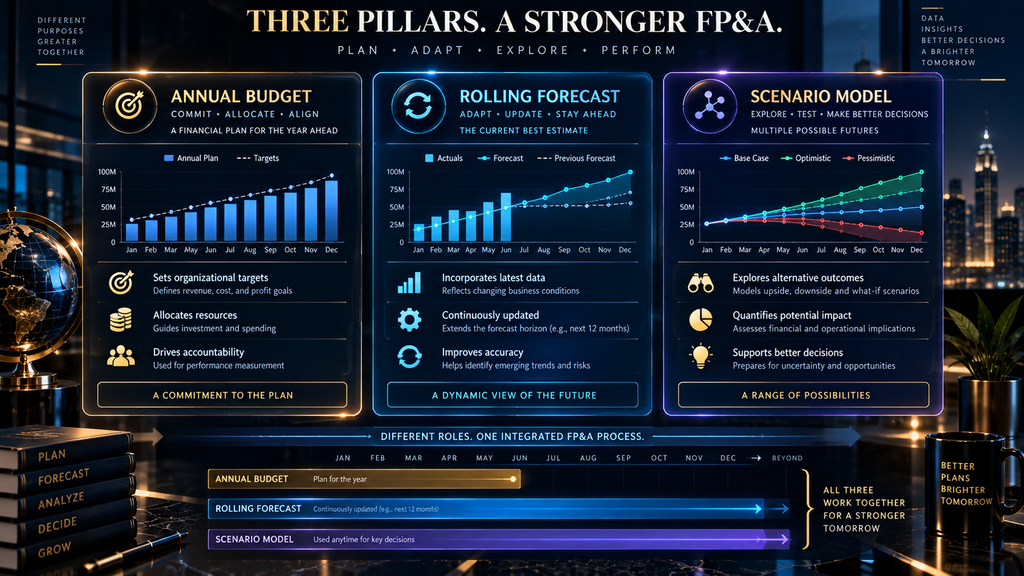
The most useful way to understand continuous AI-enabled FP&A is as a closed loop: Live Data → Business Drivers → AI Forecast → Variance Detection → Scenario Engine → Management Decision → Business Outcome → Model Update.
The first stage is the flow of information from the business. Depending on the organization, that can include accounting actuals, sales pipeline, customer behavior, pricing, headcount, payroll, inventory, procurement, production, marketing activity, collections, external market indicators, and other operational signals. The important point is that financial planning becomes more useful when it is connected to the variables that actually produce financial outcomes.
The second stage is driver identification. Instead of treating revenue, cost, or profit as isolated totals, FP&A tries to understand the relationships underneath them. Revenue may be influenced by customer count, conversion rate, average selling price, usage, retention, or sales capacity. Gross margin may depend on product mix, material costs, labor efficiency, freight, or pricing. AI can help identify patterns and relationships, but the finance team still needs to determine whether those relationships make business sense.
The third stage is forecasting. Once the relevant data and drivers are available, forecasting models can estimate future outcomes. Depending on the use case, these models can involve statistical forecasting, machine learning, time-series methods, driver-based models, probabilistic approaches, or combinations of these techniques. The important question is not which modeling technique sounds most advanced; it is whether the resulting forecast is reliable enough to support the decision being considered.
The fourth stage is variance detection. Finance should not only ask whether actual performance differs from the forecast. In a continuous system, it should also ask whether the current outlook has changed materially from the previous outlook and which drivers caused that change. That distinction can expose deterioration or improvement before it becomes a large reported variance.
The fifth stage is scenario analysis. If bookings are falling, what happens if they decline another 5%, 10%, or 15%? If a supplier raises prices, how does gross margin change? If hiring is accelerated, what happens to operating expense and cash? If management increases marketing investment, how much additional demand would be required for the decision to make financial sense?
The sixth stage is the decision itself. This is where FP&A becomes more than forecasting technology. The purpose of the system is not to generate increasingly sophisticated numbers; it is to help management understand consequences while there is still time to act.
The final stages close the loop. Actual outcomes are compared with the assumptions that produced the forecast, significant differences are investigated, and the model or business assumptions are updated. The result is a system that learns from the operating cycle rather than treating every forecast as an isolated event.
How AI Forecasting Works: From Data to Financial Outlook
The underlying mechanics are less mysterious than the marketing language sometimes suggests. AI-powered FP&A begins with data, but raw data alone is not enough. The system needs consistent definitions, appropriate historical context, relevant business drivers, and a way to distinguish normal fluctuations from meaningful structural changes.
Consider a subscription business forecasting revenue. A basic model might extrapolate historical revenue into the future. A more useful driver-based model could separate the forecast into beginning recurring revenue, new business, expansion, contraction, and churn. That allows finance to ask not only whether revenue is likely to decline, but which underlying mechanism is responsible for the change.
The same principle applies to expenses. Rather than forecasting payroll as a percentage of revenue simply because that relationship existed historically, finance might model headcount plans, compensation levels, hiring timing, attrition, and departmental allocation. AI can help process these variables and identify relationships, but the finance organization still has to establish whether the relationships remain economically valid.
This is one reason continuous forecasting depends so heavily on data architecture. AFP’s 2025 FP&A Benchmarking Survey found that 61% of respondents identified data reliability as a technology challenge and 60% identified data accessibility as a challenge. The same survey found that spreadsheets remained deeply embedded in FP&A, with 96% of respondents using them for planning and 93% using them for reporting on a daily or weekly basis.
Those numbers create an important reality check for AI adoption. An organization can purchase sophisticated planning technology, but if finance still spends substantial time manually moving data between disconnected systems, reconciling definitions, and repairing spreadsheet models, the AI layer is operating on top of an unstable foundation. Continuous forecasting therefore begins with continuous access to trustworthy information, not with the purchase of an AI feature.
Rolling Forecasts vs. Annual Budgets
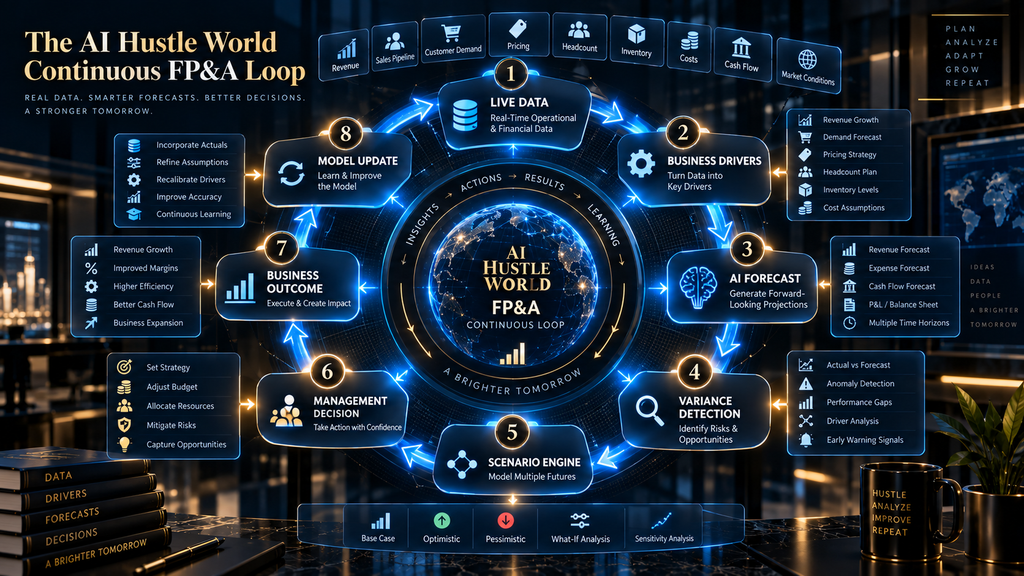
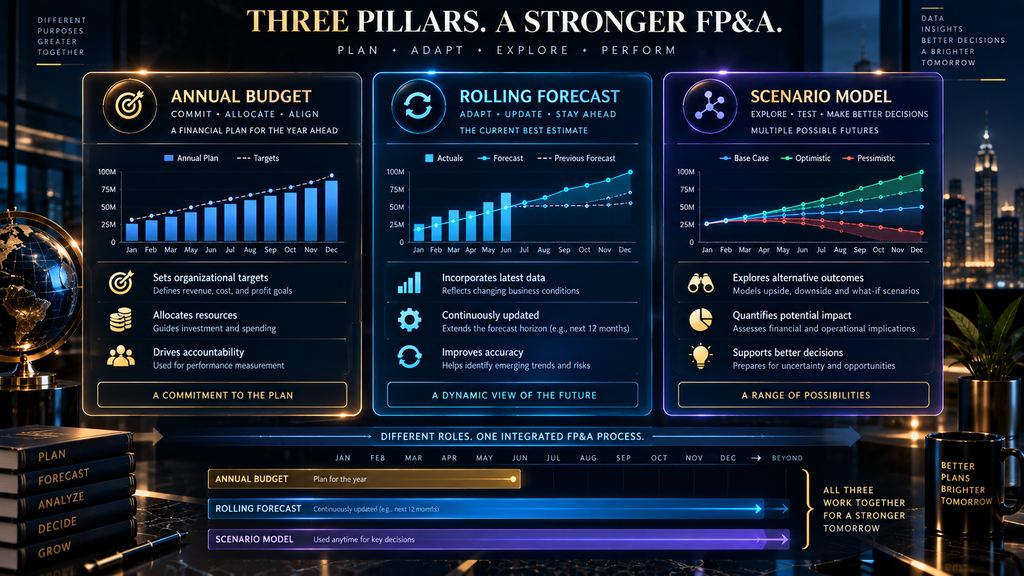
Continuous forecasting does not make the annual budget useless. The two serve different purposes, and organizations create problems when they try to force one instrument to perform the job of the other.
An annual budget is fundamentally a commitment and coordination mechanism. It can establish spending boundaries, hiring plans, targets, investment priorities, departmental expectations, and resource allocations for the year. Boards, executives, investors, and operating teams may need a stable reference point even when actual conditions change.
A rolling forecast serves a different purpose. It represents the organization’s current best view of what is likely to happen based on the latest information. It should be allowed to change without being interpreted automatically as a failure of the original budget.
Scenario planning is different again. A scenario is not necessarily the expected future. It is a structured exploration of what could happen under a particular set of assumptions and what the organization might do in response.
That gives finance three distinct instruments:
| Planning instrument | Primary question | Main purpose |
|---|---|---|
| Annual budget | What are we committing to? | Coordination and resource allocation |
| Rolling forecast | What do we currently expect? | Updated performance outlook |
| Scenario model | What could happen under different assumptions? | Decision exploration |
AI makes the relationship between these instruments more dynamic because the rolling forecast can absorb new signals more efficiently and scenario models can be generated or updated faster. But the underlying management discipline remains the same: the budget establishes a reference point, the forecast updates expectations, and scenarios help leadership evaluate choices.
Where AI Actually Helps FP&A
The strongest applications of AI in FP&A are not necessarily the most visible ones. Generating a polished financial summary is useful, but the greater opportunity lies in compressing the repetitive analytical work that prevents finance professionals from spending time on the decisions that matter.
AI can help prepare and normalize data, identify anomalies, detect changing relationships, refresh forecasts, compare scenarios, explain variances, draft management commentary, and surface information that deserves human attention. In more advanced implementations, AI agents can coordinate parts of the workflow by collecting information, validating inputs, producing preliminary forecasts, identifying gaps, and preparing outputs for finance review.
McKinsey’s 2026 research provides a useful real-world example. In the telecommunications company it studied, AI-supported workflows were used to ingest and clean data, produce a first-pass forecast for human review, and identify actions that could address emerging gaps. McKinsey reports that the redesigned process reduced forecasting cycle time threefold and shifted substantial FP&A capacity away from data gathering and manual reporting toward analysis and intervention.
That does not mean the analyst disappears. It means the analyst’s scarce time is allocated differently. Instead of spending most of the forecast cycle finding data, checking spreadsheets, and formatting reports, the finance professional can spend more time asking whether the assumptions are reasonable, understanding why performance is changing, and helping management decide what to do.
This is a much more credible way to think about AI’s role in FP&A than the idea that an algorithm simply replaces the finance team. The value comes from changing the ratio between mechanical analytical work and consequential financial judgment.
Scenario Planning: From “What Will Happen?” to “What Should We Do?”
Forecasting and scenario planning are closely related, but they answer different questions. A forecast asks: What is most likely to happen? Scenario planning asks: What could happen, and how should we respond?
That distinction becomes increasingly important as business conditions become less predictable. If a company sees a decline in enterprise bookings, an ordinary forecast might lower expected revenue. A more useful FP&A system can model the consequences across revenue, hiring, sales capacity, marketing expenditure, cash requirements, profitability, and potentially financing needs.
Suppose the base forecast assumes that quarterly bookings will remain stable. Management wants to understand what happens if bookings decline by 10%. A scenario engine can propagate that assumption through the financial model and identify the consequences. Finance can then compare possible responses such as reducing discretionary spending, delaying hiring, changing sales incentives, increasing marketing investment, adjusting pricing, or accepting a temporary margin reduction.
The value is not that AI has discovered the “correct” answer. There may be no correct answer until management chooses a strategy. The value is that the financial consequences of those alternatives can be explored much faster and more consistently.
This is also where continuous FP&A becomes a cross-functional discipline. A revenue scenario cannot be evaluated properly by looking only at the income statement. It may affect sales capacity, customer acquisition, inventory, working capital, staffing, supplier commitments, and cash. The best planning systems therefore connect financial outcomes with the operational drivers that create them.
The Real Bottleneck: AI Cannot Fix Bad Financial Data
The most important limitation in AI-powered FP&A may have little to do with artificial intelligence. It is data quality.
AFP’s benchmarking research provides unusually strong evidence for this problem. The organization found that data reliability and accessibility were among the leading technology challenges for FP&A practitioners, while spreadsheets remained deeply embedded in planning and reporting workflows. AFP also found that although 71% of respondents used enterprise performance management tools at least quarterly, spreadsheets continued to be used alongside those systems and sometimes to prepare data for them or bypass them.
That creates a paradox. Organizations may have increasingly sophisticated planning systems while still maintaining fragmented data processes underneath them. The finance team might extract information from several systems, reconcile definitions manually, modify assumptions in Excel, upload the results to a planning platform, and then export the output again for management reporting.
AI does not automatically remove that complexity.
If the source data is incomplete, the model can become confidently wrong. If revenue definitions differ between sales and finance, the forecast may identify a pattern that exists only because the underlying data is inconsistent. If operational drivers are delayed by two weeks, a “continuous” forecast may still be operating on stale information.
The resulting failure chain is straightforward: Disconnected data → unreliable inputs → incorrect drivers → misleading forecast → false confidence → poor decision.
That is why the first stage of an AI FP&A transformation should often be less glamorous than executives expect. Before asking what the AI can predict, finance should establish whether the organization has a reliable definition of what it is measuring.
Why Traditional Spreadsheet Processes Persist
It is tempting to treat spreadsheets as an embarrassing legacy that AI should eliminate. That would be too simplistic.
Spreadsheets persist because they are flexible, familiar, widely available, and easy for finance professionals to adapt when the business changes. They are also often the fastest way for an experienced analyst to test an unusual assumption without waiting for a formal systems-development process.
The problem begins when spreadsheets become the hidden infrastructure of the planning process rather than a controlled analytical tool. Multiple versions can emerge, formulas can diverge, definitions can change between models, and important institutional knowledge can become embedded in individual files rather than standardized workflows.
AFP’s research illustrates this tension clearly: despite widespread adoption of EPM tools, spreadsheets continue to support planning because teams use them to prepare data, bypass systems, or work alongside them.
The goal of AI-enabled FP&A should therefore not be “remove Excel at all costs.” A better objective is to determine which parts of the planning process require controlled shared infrastructure and which parts benefit from flexible analytical work. AI can reduce repetitive manipulation, but finance still needs environments where analysts can test assumptions, challenge models, and investigate unusual business situations.
Forecast Accuracy Is Not the Only KPI
Forecast accuracy is important, but it is not the complete definition of FP&A effectiveness.
Imagine two finance teams. Team A produces a forecast with slightly better statistical accuracy, but management receives it after a major pricing decision has already been made. Team B produces a slightly less accurate forecast two weeks earlier, identifies the key drivers behind the change, and gives management enough time to adjust pricing and spending.
Which team created more value? The answer is not automatically Team A.
This is why continuous FP&A should measure both forecast quality and decision usefulness. Accuracy tells finance how well the model estimated an outcome. It does not tell management whether the information arrived in time, whether the drivers were understood, or whether the organization acted on the insight.
A stronger scorecard therefore includes at least five dimensions.
Forecast accuracy
How close was the forecast to actual performance?
Depending on the business, finance can use measures such as MAPE, WAPE, forecast bias, or variance to actuals. The specific metric matters less than using it consistently and understanding its limitations.
Forecast freshness
How recently were the important drivers and assumptions updated? A highly accurate forecast based on information that is several weeks old may be less useful than a somewhat less accurate forecast that reflects current operating conditions.
Decision latency
How long does it take for a meaningful business signal to become an actionable financial decision? This is one of the most important metrics for continuous FP&A because it measures the actual gap the new operating model is supposed to reduce.
Scenario coverage
How quickly can finance evaluate the scenarios that management actually cares about? If leadership asks for three plausible alternatives and the finance team needs ten days to build them, the scenario capability is still limiting decision speed.
Human override rate
How often do finance leaders materially change or reject AI-generated forecasts or recommendations?
A high override rate should not automatically be interpreted as a model failure. It may reveal missing business context, structural changes, poor data, or a legitimate management judgment that the model cannot capture. The important thing is to understand why the override occurred.
The Forecast-to-Decision Gap
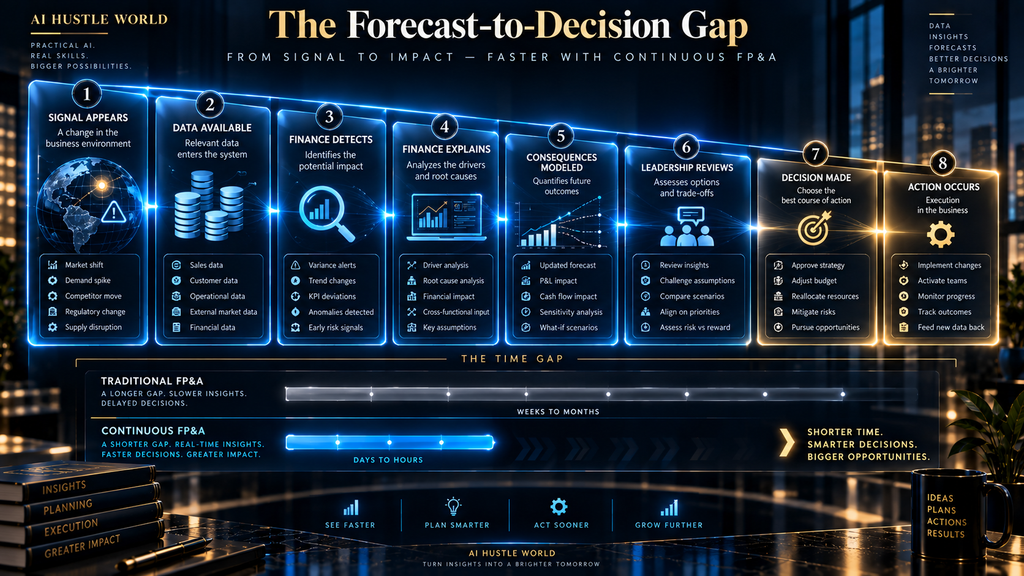
This leads to a second AI Hustle World concept: the Forecast-to-Decision Gap.
A business signal appears first. The information then has to become available, finance has to recognize it, the impact has to be modeled, management has to review the implications, and finally a decision has to be made and implemented.
Every step creates delay.
Traditional FP&A often optimizes for the accuracy and control of the financial output. Continuous FP&A adds another optimization target: how quickly can useful financial intelligence move through the organization without sacrificing the controls required for responsible decision-making?
McKinsey’s recent FP&A research makes this distinction especially clear. Its examples describe organizations redesigning forecasting workflows so that finance teams spend less time collecting and reconciling information and more time identifying emerging risks, evaluating trade-offs, and helping business leaders respond while decisions are still flexible.
This is the deeper strategic case for continuous forecasting. The objective is not to create a financial dashboard that updates more often. It is to give management more opportunities to act before a problem becomes expensive to reverse.
Where Human FP&A Judgment Still Matters
AI can identify patterns and calculate consequences, but financial planning is not purely a mathematical exercise. Management decisions often involve incomplete information, competing objectives, strategic priorities, and consequences that are difficult to encode into historical data.
Consider a company deciding whether to continue investing in a new market. The historical model may suggest that customer acquisition costs are too high and the probability of near-term profitability is low. An executive may still choose to continue investing because the market has strategic importance, because the company expects network effects, or because abandoning the market would strengthen a competitor.
The model can quantify the consequences. It cannot determine the organization’s risk appetite or strategic purpose.
The same problem appears during structural breaks. Historical relationships can become unreliable when a company launches a new product, changes pricing, enters a new geography, loses a major customer, acquires another company, experiences a regulatory change, or faces an extraordinary supply disruption. In those situations, the past may be informative without being predictive.
Human judgment is therefore most valuable when the consequences are high and the situation is ambiguous. The right operating model is not AI versus finance. It is AI handling repeatable analytical work while finance professionals challenge assumptions, interpret context, establish accountability, and make decisions that require judgment.
AI-Enabled FP&A Does Not Mean Fully Autonomous Finance
The language around AI agents can make autonomous planning sound inevitable, but responsible FP&A requires boundaries.
A system may be allowed to retrieve data automatically, refresh a forecast, identify anomalies, or prepare scenario analyses. A different level of authorization should apply when the system is making recommendations that could materially influence hiring, pricing, capital allocation, or external financial commitments.
That distinction can be expressed as a simple governance principle: The more consequential the decision, the stronger the human approval requirement should be.
McKinsey’s 2026 research describes organizations redesigning FP&A workflows around AI while retaining human validation and review. In the telecommunications example, AI-supported forecasting outputs were compared against existing processes over multiple cycles before broader adoption, allowing teams to evaluate forecast differences and refine assumptions.
This is a healthier adoption pattern than treating an AI model as trustworthy simply because it produces plausible financial language or accurate-looking numbers. Finance needs traceability: where the number came from, which assumptions changed, what the model did, what humans changed, and who ultimately approved the decision.
Common Continuous Forecasting Mistakes
Automating a broken process
If the current process involves duplicated data entry, inconsistent definitions, unclear ownership, and excessive reconciliation, adding AI on top may make the process faster without making it better. Process redesign should come before broad automation.
Confusing prediction with understanding
A model can identify that revenue is likely to fall without explaining the business reason in a way that management can confidently act upon. Finance still needs to distinguish statistical correlation from a commercially meaningful causal explanation.
Updating too frequently
Continuous forecasting can become another form of operational noise if every minor fluctuation triggers a new management discussion. The forecast should respond to changes that are material enough to influence decisions.
Creating too many scenarios
Scenario modeling is powerful, but unlimited scenarios do not produce unlimited insight. Finance should prioritize scenarios tied to real uncertainties, strategic decisions, or material risks.
Ignoring structural breaks
A model trained on historical relationships may perform poorly when those relationships change. Major product launches, acquisitions, pricing changes, regulatory events, or sudden market disruptions require explicit human review.
Treating AI-generated commentary as fact
An AI system can generate a convincing explanation for a variance that is not actually supported by the underlying evidence. Financial commentary should therefore distinguish between observed facts, model interpretation, and hypotheses requiring investigation.
Measuring only forecast accuracy
A forecast that is accurate but arrives too late can have less strategic value than a slightly less accurate forecast that arrives while management still has meaningful options.
Removing human review too early
Finance teams need time to understand where AI performs well and where it fails. Progressive adoption, parallel testing, and explicit validation are safer than immediately making AI outputs the sole basis for high-stakes decisions.
Who Should Use AI-Powered Continuous FP&A?
Continuous AI-enabled FP&A is most compelling when the business changes quickly enough that a periodic forecast regularly becomes outdated before management can act on it. SaaS businesses, consumer businesses, companies with complex sales pipelines, multi-location organizations, and businesses exposed to changing prices or supply conditions can all benefit when their operational drivers are measurable and accessible.
It can also be valuable for larger organizations where finance teams spend substantial time consolidating information from multiple business units. In these environments, the productivity opportunity may come less from producing a fundamentally different forecast and more from reducing the manual effort required to collect, reconcile, refresh, and distribute the information.
Organizations with strong data infrastructure are better positioned to capture these benefits. If financial and operational data can be accessed consistently, definitions are standardized, and important drivers are understood, AI has a much stronger foundation from which to operate.
The strongest candidates also have a management culture that actually uses forecasts to make decisions. If leadership rarely changes plans based on updated information, improving forecast frequency may not create much value.
Who Should Not Prioritize It Yet?
A small business with simple revenue and cost structures may not need an advanced continuous forecasting architecture. If the company can be managed effectively through a straightforward monthly financial review, introducing a sophisticated AI planning system could create more complexity than value.
The same applies to organizations whose data foundation is fundamentally unreliable. If finance cannot consistently determine which customer, revenue, cost, or operational numbers are correct, adding AI can increase confidence without increasing accuracy.
Companies should also be cautious when the business is too slow-moving to justify frequent forecasting. Continuous does not mean inherently superior. The appropriate system is the one whose complexity is justified by the speed and consequence of the decisions it supports.
How to Implement Continuous Forecasting Without Overengineering It
The first step is not choosing an AI tool. It is identifying the decisions that finance needs to support more effectively.
Start with a small number of high-value decisions. For example, management might need earlier visibility into revenue risk, hiring requirements, inventory exposure, or gross-margin pressure. Once the decision is defined, identify the operational drivers that influence it and determine whether those drivers can be accessed reliably.
The next step is to establish a baseline forecast using the current process. This matters because organizations need to know whether the new system actually improves forecasting or decision-making. Without a baseline, AI adoption can easily become a technology project whose success is measured by deployment rather than business impact.
Then connect the most important operational drivers to the financial model. Avoid attempting to model every possible variable. A smaller model built around the drivers that materially influence the decision is often more useful than a highly complicated system that nobody understands.
After that, introduce AI where it has a clear advantage. Data preparation, anomaly detection, forecast refreshes, variance analysis, scenario generation, and management commentary are logical starting points because they contain substantial repetitive analytical work. Human review should remain strongest around assumptions, structural changes, and high-consequence decisions.
Finally, measure both the forecast and the decision process. Track forecast error, forecast freshness, time spent preparing forecasts, scenario turnaround time, decision latency, and meaningful human overrides. The objective is to determine whether the new workflow is making finance more useful to the business, not simply whether the AI model produces impressive outputs.
The AI Hustle World Continuous FP&A Scorecard
A practical implementation can be evaluated through five questions.
| Dimension | Core question | Example KPI |
|---|---|---|
| Forecast Accuracy | How close are forecasts to actual results? | WAPE / forecast bias |
| Forecast Freshness | How current are the important drivers? | Driver update age |
| Decision Latency | How quickly does insight become action? | Signal-to-decision time |
| Scenario Coverage | How quickly can important alternatives be modeled? | Scenario turnaround time |
| Human Override | Where and why does management disagree with the model? | Material override rate |
This scorecard intentionally goes beyond accuracy. A finance team can improve statistical performance while failing to improve management decisions, particularly if the forecast still takes too long to produce or if the organization does not trust the underlying data.
The human override metric is particularly valuable because disagreement can be informative. If executives consistently override a model because it misses pricing changes, customer concentration, or strategic investments, those overrides reveal missing variables that the planning system should eventually incorporate.
Over time, the scorecard should therefore become a learning mechanism. Every material forecast error or override should raise a question about the model, the data, the assumptions, or the business itself.
The Economics of Continuous FP&A
The financial case for AI-enabled FP&A should not be reduced to headcount savings. Although automation can reduce the amount of time analysts spend gathering data, reconciling inputs, producing recurring reports, and rebuilding scenarios, the more important value may come from better timing.
Imagine that a company identifies a deteriorating sales trend three weeks earlier than it previously would have. The value does not necessarily appear as a reduction in the finance department’s payroll. It may appear because management adjusts inventory, slows discretionary hiring, changes pricing, reallocates marketing expenditure, or addresses a customer-retention problem before the financial impact becomes larger.
This is difficult to measure because the value comes partly from avoided losses and preserved options. A decision made earlier may prevent a larger intervention later. A company that sees a margin problem while it is still small has more possible responses than a company that discovers the same problem after the quarter closes.
That is why continuous FP&A should be evaluated against the economic consequences of decisions, not merely against the cost of producing the forecast.
The Future of FP&A: From Reporting Function to Decision System
The longer-term shift is not simply toward faster forecasting. It is toward a different relationship between finance and the rest of the business.
Traditional FP&A often receives information from operating teams, processes it, consolidates it, and returns analysis to management. Continuous FP&A increasingly reverses that timing. Finance becomes involved earlier, when operational decisions are still being formed, and financial models become part of the decision process rather than a retrospective explanation of its results.
McKinsey’s 2026 research describes this transition in terms of connecting operational and financial information continuously, surfacing risks earlier, and changing the role of FP&A teams from data gathering and reporting toward performance steering and business decision support.
This also changes the skills finance teams need. Traditional financial modeling remains important, but data literacy, systems understanding, AI fluency, business communication, scenario thinking, and the ability to challenge assumptions become increasingly valuable. As repetitive analytical work becomes more automated, the differentiator becomes less about who can manipulate the largest spreadsheet and more about who can translate complex information into a sound business decision.
That does not mean the future finance team becomes smaller in every organization. It means the composition of finance work changes. More capacity can move toward business partnership, strategic analysis, decision support, governance, and interpretation while machines handle more of the repetitive preparation underneath that work.
The Second-Order Effect: Forecasting Becomes a Coordination Mechanism
There is an even deeper consequence to continuous forecasting.
When finance, sales, operations, supply chain, and leadership work from continuously updated assumptions, the forecast can become a common language for coordinating decisions. Instead of each department maintaining its own version of the future, the organization can begin working from shared drivers and shared scenarios.
That can reduce a problem that has historically been difficult for FP&A to solve: different teams may agree on the current results while disagreeing about what those results mean for the future. Sales may expect demand to recover, operations may expect capacity constraints, procurement may expect higher costs, and finance may be forced to reconcile those assumptions after the fact.
A continuous planning system can make those assumptions visible earlier. The value is not that the system decides which department is correct; it is that the organization can see the financial consequences of each assumption and debate them while there is still time to respond.
This is why continuous FP&A is ultimately a coordination problem as much as a forecasting problem.
What Happens If the Business Does Nothing?
The decision to maintain a traditional forecasting process is not necessarily wrong. The risk comes when the speed of the planning process becomes materially slower than the speed of the business.
In a stable environment, that gap may be insignificant. In a volatile environment, it can become expensive. Management may repeatedly make decisions using outdated assumptions, finance may spend increasing amounts of time rebuilding forecasts, and teams may respond to problems only after the available choices have narrowed.
The organization can also accumulate a hidden cost in the form of decision latency. A delayed forecast is not merely an administrative inconvenience; it can mean that a pricing opportunity is missed, an inventory adjustment happens too late, a hiring decision is made on outdated demand expectations, or a cash problem becomes visible only after fewer options remain.
The answer is not to automate everything immediately. The answer is to identify where the current planning cycle is genuinely constraining the business and determine whether continuous information and AI-assisted analysis can close that gap.
Final Thoughts
AI is unlikely to transform FP&A simply by making financial forecasts more sophisticated. The more important transformation is operational: finance can move from a process that periodically explains what happened toward a system that continuously helps the organization understand what is changing, what may happen next, and which decisions remain available.
Continuous forecasting works when the pieces connect. Reliable data feeds meaningful business drivers; those drivers feed forecasting models; forecasts expose changes and variances; scenarios translate uncertainty into possible outcomes; finance and management evaluate the choices; and the resulting business outcomes become new information for the next planning cycle.
The technology matters, but the operating model matters more. An organization with poor data, fragmented processes, unclear ownership, and weak decision discipline will not become a high-performing continuous FP&A function simply because it adds AI. Conversely, a finance organization with strong data foundations, clear drivers, disciplined governance, and a genuine need for faster decisions can use AI to move significant analytical effort away from reconciliation and toward business steering.
The most useful way to think about the future of FP&A is therefore not as a choice between human finance and artificial intelligence. It is a shift in where each one contributes. AI can increasingly handle the repetitive work of collecting, refreshing, comparing, modeling, and surfacing information, while finance professionals focus on the harder questions: whether the assumptions make sense, what the numbers actually mean, which risks deserve attention, and what the business should do next.
The future of FP&A is not a forecast that becomes more accurate once a month. It is a financial model that stays useful between decisions.
Want to see how AI-powered FP&A tools compare?
Once you understand the continuous forecasting model, the next step is evaluating which AI FP&A platforms actually support forecasting, planning, scenario analysis, and decision-making workflows.
Compare AI FP&A Software →Editorial resource from AI Hustle World. No paid recommendation is implied by this link.
Frequently Asked Questions
What is AI in FP&A?
AI in FP&A refers to the use of artificial intelligence to support financial planning and analysis activities such as forecasting, variance analysis, scenario modeling, data preparation, driver analysis, reporting, and management decision support. The strongest applications combine AI with financial and operational data rather than treating financial statements alone as the complete forecasting input.
What is continuous forecasting?
Continuous forecasting is a planning approach in which forecasts are refreshed as meaningful financial and operational conditions change rather than being updated only according to a fixed calendar. The goal is to keep the organization’s current outlook aligned with the latest information while giving management enough time to respond to emerging risks and opportunities.
Is continuous forecasting the same as rolling forecasting?
They are closely related but not identical. A rolling forecast continuously extends the planning horizon as time moves forward, while continuous forecasting places greater emphasis on updating the outlook when meaningful business drivers or signals change. In practice, organizations can combine rolling horizons with continuously refreshed assumptions.
Does AI replace FP&A analysts?
AI can automate or accelerate substantial amounts of repetitive FP&A work, but it does not eliminate the need for financial judgment. Finance professionals remain important for validating assumptions, interpreting unusual business conditions, challenging model outputs, communicating implications to leadership, and making or governing high-consequence decisions.
How does AI improve financial forecasting?
AI can improve forecasting workflows by processing larger volumes of data, identifying patterns, monitoring drivers, detecting anomalies, refreshing models, and generating scenarios more efficiently. However, AI does not guarantee a more accurate forecast; data quality, model design, structural changes, and the quality of business assumptions still determine how useful the output is.
What data does AI-powered FP&A need?
Depending on the business, useful inputs can include accounting actuals, revenue and bookings, customer behavior, pricing, headcount, payroll, inventory, procurement, production, marketing activity, collections, and other operational or external signals. The most valuable data is not necessarily the largest dataset; it is the information that reliably explains the financial drivers management needs to understand.
Why is data quality so important for AI FP&A?
AI forecasting systems depend on the information they receive. If financial definitions are inconsistent, operational data is delayed, or source systems contain errors, the model can produce an apparently precise forecast that is based on unreliable inputs. AFP’s 2025 FP&A benchmarking research found that 61% of respondents identified data reliability as a technology challenge and 60% identified data accessibility as a challenge.
Can AI forecast revenue accurately?
AI can improve the forecasting process and may improve accuracy in suitable situations, but there is no universal level of accuracy that AI can guarantee. Revenue forecasts depend on the stability of historical relationships, the quality of current signals, the predictability of customer behavior, and whether structural changes are occurring in the market.
What is the difference between forecasting and scenario planning?
Forecasting generally attempts to estimate the most likely future based on current information and assumptions. Scenario planning explores multiple plausible futures and examines their consequences so management can decide how to respond. AI can make scenario analysis faster, but the scenarios still need to reflect meaningful business uncertainties rather than arbitrary combinations of numbers.
Should companies abandon annual budgets?
Not necessarily. Annual budgets can remain useful for resource allocation, organizational commitments, strategic targets, and governance, while rolling forecasts provide a more current view of expected performance and scenario models help management explore alternative futures. These instruments can coexist rather than competing for the same purpose.
How often should a company update its forecast?
There is no universal ideal frequency. The appropriate cadence depends on how quickly the company’s important drivers change, how quickly management can act, and the cost of producing the forecast. A stable business may benefit from monthly or periodic updates, while a volatile business may gain more from weekly or event-driven forecasting.
What are the biggest risks of AI-powered FP&A?
The major risks include unreliable data, poor assumptions, model drift, overconfidence in AI-generated explanations, insufficient human oversight, excessive scenario complexity, and failure to recognize structural changes. There is also a governance risk when organizations allow automated outputs to influence high-consequence decisions without clear accountability.
How should a company start using AI in FP&A?
Start with a specific decision problem rather than starting with an AI tool. Identify a high-value use case, establish a baseline process, map the financial and operational drivers involved, improve data reliability, introduce AI where it removes meaningful repetitive work, and measure both forecast performance and decision speed before expanding the system.
Is AI-powered continuous FP&A worth it for a small business?
It depends on the complexity and volatility of the business. A small company with simple finances may gain more from disciplined monthly forecasting than from a sophisticated continuous planning platform. AI becomes more compelling when the business has enough operational complexity, data volume, or decision frequency that delayed financial insight is creating a meaningful cost.
What is the most important KPI for continuous FP&A?
Forecast accuracy remains important, but it should not be treated as the only KPI. Forecast freshness, decision latency, scenario turnaround time, and the reasons behind human overrides can reveal whether the planning system is actually helping management make better decisions faster.
What is the biggest misconception about AI in FP&A?
The biggest misconception is that AI makes forecasting continuous simply because the model can generate predictions automatically. A genuinely continuous FP&A system requires reliable data, connected business drivers, appropriate planning cadence, scenario capability, governance, and a management process capable of acting on updated information.
Written by
Muntasir Ahmad Chowdhury
Founder, AI Hustle World
Muntasir Ahmad Chowdhury is the Founder of AI Hustle World, an independent publication dedicated to making Artificial Intelligence practical, trustworthy, and easy to understand. He researches AI tools, automation, customer service, productivity, and real-world business applications, helping readers make smarter technology decisions through research-driven, experience-backed content.
Expertise:
AI Tools • AI Automation • AI Customer Service • AI Productivity • Generative AI • AI Workflows
Get Smarter With AI
Enjoyed this guide? Get practical AI tools, tutorials, and honest reviews delivered to your inbox.