Evidence: Documentation reviewed
Last checked: August 2026
What was done: Written from official documentation and the published sources linked in this article. Not hands-on tested.
Files: None
Affiliate links: No
How AI Analyzes Malware, Vulnerabilities & Security Alerts
Security teams have never had a shortage of information. They have a shortage of time to understand it.
A modern environment can generate endpoint events, vulnerability findings, authentication anomalies, suspicious files, cloud activity, network connections, application logs, email detections, threat-intelligence indicators, and security alerts continuously. The difficult part is rarely discovering that something happened. The difficult part is determining whether the signal matters, connecting it to other evidence, understanding the likely cause, estimating the real risk, and deciding what deserves action first.
That is where AI can make a meaningful difference.
AI can analyze malware behavior, interpret suspicious code, summarize security alerts, correlate seemingly unrelated events, enrich vulnerability findings with environmental context, reconstruct incident timelines, and help analysts develop investigation hypotheses. But there is a critical boundary that cybersecurity teams cannot afford to ignore: AI can accelerate analysis without automatically making the analysis correct.
That distinction is the central idea of this article.
The strongest security architecture is not AI replaces the analyst. It is security telemetry → AI-assisted analysis → evidence correlation → verification → human decision → controlled response.
That model matters because cybersecurity is an adversarial environment. The data being analyzed may be incomplete, misleading, noisy, or deliberately manipulated. In some cases, the artifact itself may contain content designed to influence the AI examining it. NIST’s broader AI-risk work emphasizes the importance of managing AI risks across design, deployment, evaluation, and operation, while current security research is increasingly focused on the specific problem of securing AI-assisted analysis workflows.
This article explains where AI genuinely improves malware analysis, vulnerability analysis, and security-alert investigation; where traditional tools remain superior; where AI can fail; and how security teams can build an AI-assisted workflow without turning an impressive language model into an untrusted security authority.
The Core Idea: AI Is Most Valuable Between Detection and Decision
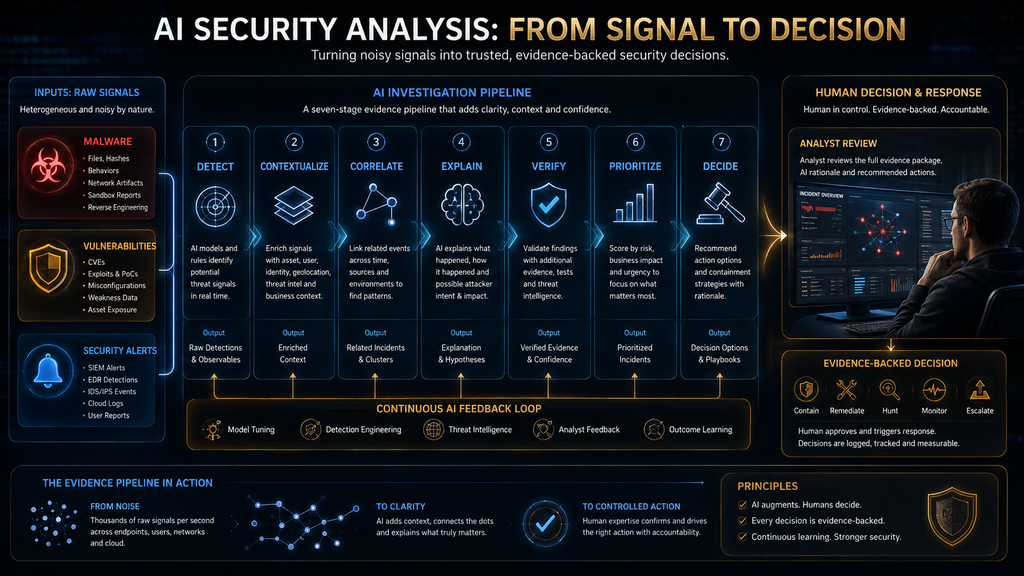
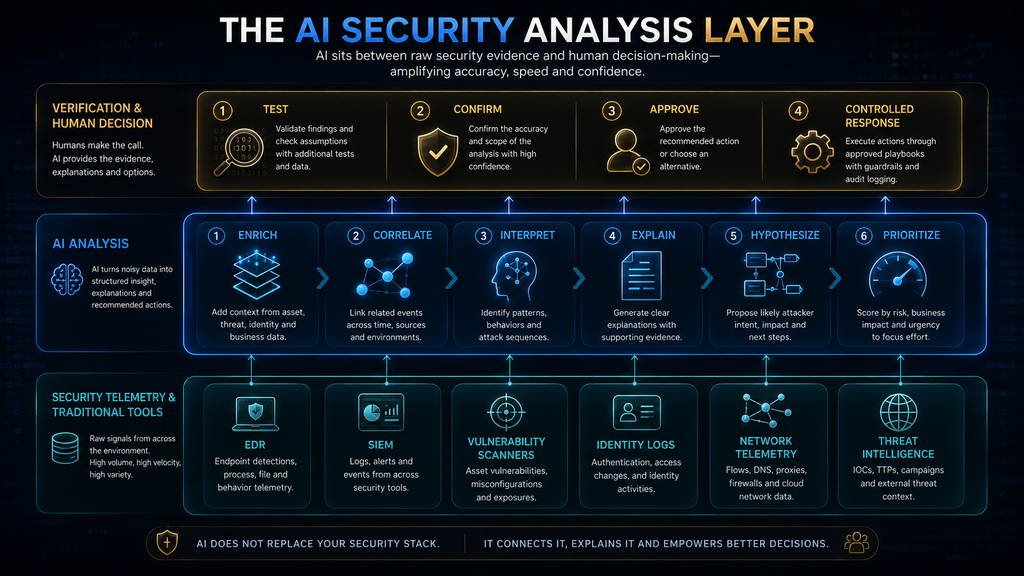
AI security analysis is best understood as the layer that helps transform raw security signals into evidence-backed investigative decisions.
Traditional cybersecurity tools remain very good at collecting and detecting. Endpoint protection can identify suspicious processes. Static-analysis tools can flag potentially dangerous code patterns. Vulnerability scanners can identify known weaknesses. SIEM platforms can collect and correlate events. Threat-intelligence systems can provide information about domains, hashes, IP addresses, malware families, and campaigns.
The problem begins after the signal appears.
An alert saying suspicious PowerShell execution detected does not tell an analyst whether the activity is malicious. A scanner reporting a critical vulnerability does not automatically tell the organization whether that vulnerability is its highest current risk. A malware classifier identifying a suspicious executable does not necessarily explain how the file entered the environment, what it attempted to do, or whether the behavior represents part of a larger intrusion.
AI can help bridge that gap by combining information that traditionally sits in different systems and presenting it as an investigation rather than a pile of disconnected findings.
The AI Hustle World Evidence-to-Decision Framework
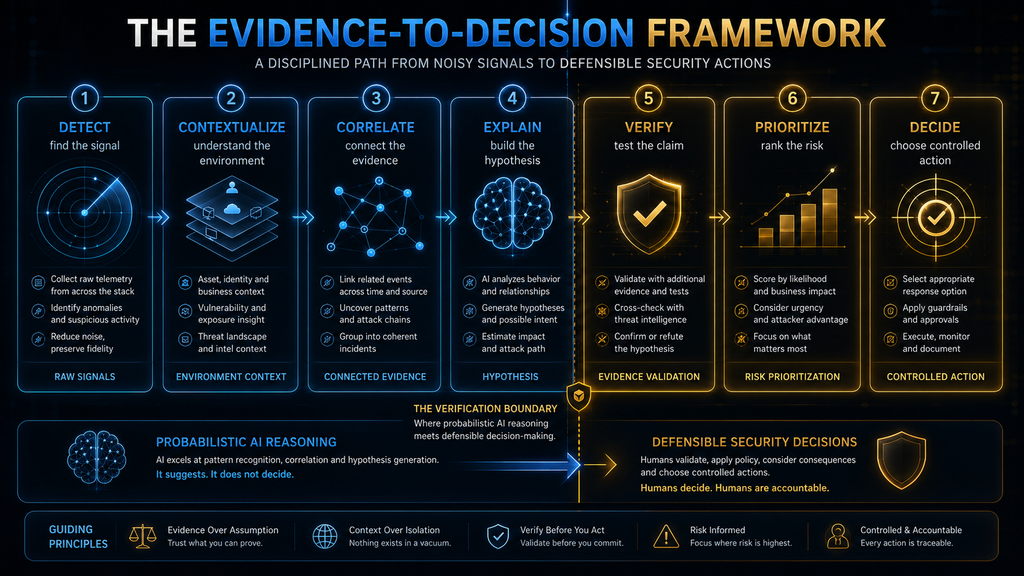
For this article, the most useful framework is: DETECT → CONTEXTUALIZE → CORRELATE → EXPLAIN → VERIFY → PRIORITIZE → DECIDE.
Detection identifies something worth investigating. Contextualization adds information about the asset, identity, environment, history, and business importance. Correlation connects related evidence across tools and time. Explanation translates technical evidence into an understandable narrative. Verification tests whether the hypothesis is actually supported. Prioritization determines what deserves attention first. The final decision remains governed by the organization’s security policies, risk tolerance, and human judgment.
This is a more realistic way to think about AI cybersecurity than simply asking whether AI can “detect threats.”
The important question is not whether a model can generate a security explanation. Modern models clearly can. The important question is whether that explanation helps an analyst reach a better, faster, and more defensible decision.
Why Security Analysis Became a Bottleneck
The traditional security workflow exists for a reason. Security analysts historically had to inspect evidence manually because context was distributed across specialized systems and because high-consequence decisions could not safely be delegated to an unverified automation layer.
That model worked reasonably well when the volume of telemetry was manageable. The environment has changed.
A single investigation may now require an analyst to examine endpoint telemetry, identity events, cloud logs, vulnerability data, DNS activity, network connections, email records, threat intelligence, asset inventories, and historical incidents. The problem is not merely that each source contains more data. The sources also interact with one another.
A vulnerability can become an exploitation path. Exploitation can produce malware execution. Malware execution can create persistence. Persistence can generate identity anomalies. Those identity anomalies can be correlated with network activity. Network activity can expose command-and-control infrastructure. Suddenly what appeared to be five unrelated alerts may actually be one attack sequence.
Human analysts can perform this reasoning, but the work is expensive.
That is why the most promising role for AI is not necessarily replacing detection engines. It is compressing the amount of human effort required to understand the evidence around a detection.
Mandiant reported in 2026 that organizations were already using AI for retrospective analysis of incident-ticket backlogs, looking across large numbers of previously closed incidents for patterns that analysts might miss when working through daily queues. That is a subtle but important shift. AI is not only being used to answer:
It can also help answer:
“What patterns have we been missing across thousands of alerts and incidents?”
AI Malware Analysis: What Changes?
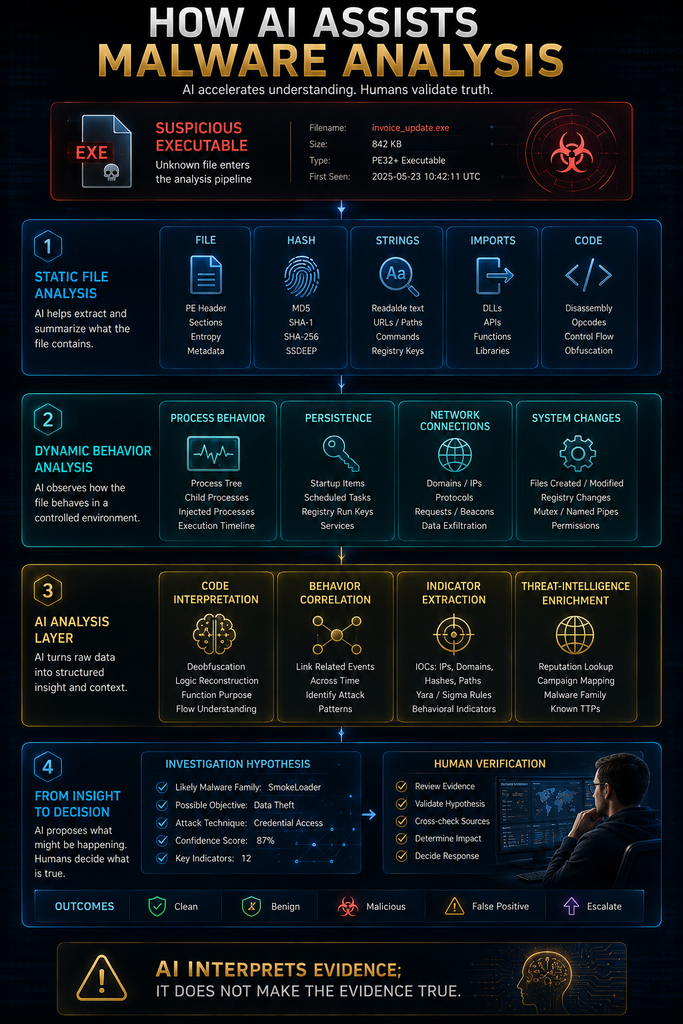
Malware analysis traditionally combines static analysis, dynamic analysis, reverse engineering, sandboxing, behavioral monitoring, threat intelligence, and analyst expertise.
AI does not eliminate these methods. Instead, it can sit on top of them and help analysts interpret their outputs.
This distinction is important because malware is not simply a classification problem. A security team may need to determine whether a file is malicious, understand what it does, identify indicators of compromise, determine whether it establishes persistence, discover what infrastructure it communicates with, and understand whether the sample belongs to a wider campaign. A binary classifier might answer the first question.
A useful AI-assisted investigation attempts to help answer the rest. Research published in 2026 reviewing LLM applications in software security identifies malware analysis, reverse engineering, code interpretation, monitoring, detection, and malware-family analysis as active areas of research. The practical opportunity is therefore much broader than simply asking an AI model:
The more valuable question is:
“What evidence suggests this file is malicious, what behavior does it exhibit, what does that behavior imply, and what should the analyst verify next?”
Static Analysis Becomes Easier to Interpret
Static analysis examines software without executing it. Analysts can inspect strings, imports, functions, executable structure, embedded URLs, registry references, encoded content, scripts, certificates, metadata, and other artifacts.
The challenge is that raw static-analysis output is often difficult to interpret quickly, especially for analysts who are not reverse-engineering specialists. AI can translate low-level artifacts into a more understandable description.
For example, a security tool may identify that a suspicious executable imports APIs associated with process creation, registry modification, network communication, and credential-related activity. Those observations do not automatically prove malicious intent. Legitimate software can use the same capabilities.
An AI system can nevertheless help organize the evidence and identify combinations that deserve deeper investigation. Instead of presenting twenty isolated technical observations, it can explain that the combination of process creation, persistence-related registry activity, suspicious outbound communication, and execution from an unusual location is worth examining as a potential intrusion sequence.
The value is therefore not that AI “knows malware.” The value is that it can reduce the cognitive cost of interpreting technical evidence.
VirusTotal demonstrated this direction with Gemini-assisted malware analysis, using decompiled and disassembled code to generate human-readable descriptions of malware behavior and indicators. Its testing showed promising results, including analysis of some samples that had no detections in VirusTotal at the time of testing. That is useful evidence of capability, but it is also a vendor-reported evaluation rather than proof that every modern malware sample can be reliably analyzed by a general-purpose model.
AI Can Turn Malware Behavior Into an Investigation Narrative
One of the biggest advantages of generative AI is its ability to synthesize multiple technical observations into a coherent explanation. Consider a hypothetical endpoint where an analyst finds:
- an unsigned executable running from a temporary directory;
- PowerShell launched shortly after execution;
- a scheduled task created;
- a connection to a newly observed external domain;
- a credential-related process accessed shortly afterward.
A traditional tool may generate five separate findings. An AI-assisted system can organize them into a possible sequence and explain why the combination is suspicious. The resulting investigation might read something like this:
The endpoint executed an unsigned binary from an unusual location, followed by PowerShell activity and creation of a scheduled task. The process subsequently contacted newly observed external infrastructure and accessed credential-related resources. The temporal relationship between these events is consistent with possible execution followed by persistence and outbound command communication.
Notice what this statement does not say. It does not claim that compromise has been proven. It identifies a hypothesis that should be investigated.
That distinction is essential. A security AI should help analysts move from events to hypotheses, not silently convert hypotheses into facts.
The Hard Part: Malware Can Manipulate the Analyst—and the AI
There is a deeper problem with AI-assisted malware analysis that many generic articles overlook. The artifact being analyzed may itself be hostile.
Traditional malware already attempts to evade detection through obfuscation, packing, anti-debugging techniques, environment checks, dynamic code generation, and other methods. When an AI model becomes part of the analysis workflow, attackers gain another potential target: the model’s reasoning process.
Recent research has specifically examined prompt-injection artifacts and the possibility of malicious content being embedded in material consumed by AI systems. The concern becomes particularly serious when an AI agent has access to security tools or privileged actions.
That creates an important architectural rule: Treat the content being analyzed as untrusted input, even when the AI is analyzing it for defensive purposes.
A malicious file should not be allowed to instruct the analysis model to ignore certain evidence. A suspicious code comment should not be treated as a trusted instruction. A retrieved document should not automatically override the system’s security policy. And an AI agent should not be given unrestricted ability to execute arbitrary commands simply because those commands appear relevant to its investigation.
The AI must analyze the evidence without allowing the evidence to redefine the AI’s authority. That is one of the major differences between a useful security copilot and a dangerous autonomous system.
Where AI Malware Analysis Works Best
AI is particularly valuable when the task requires interpretation across large amounts of technical information.
| Task | AI’s potential value | Human/tool verification |
|---|---|---|
| Malware summarization | Very high | Recommended |
| Code explanation | High | Required for consequential conclusions |
| Indicator extraction | High | Verify against source |
| Behavior correlation | High | Analyst review |
| Threat-intelligence enrichment | High | Verify intelligence |
| Timeline construction | High | Validate timestamps |
| Malware-family hypothesis | Moderate–high | Confirm with evidence |
| Reverse engineering of complex binaries | Variable | Specialist analysis |
| Autonomous remediation | High risk | Strong controls required |
The table illustrates an important principle: AI’s usefulness does not increase linearly with autonomy. The model may be excellent at organizing evidence while being unsuitable for making an irreversible decision based on that evidence.
Where AI Malware Analysis Still Breaks Down
The current generation of AI systems is not a universal replacement for reverse engineers.
A particularly important 2026 benchmark illustrates why. Researchers evaluating frontier models on realistic, contamination-free reverse-engineering tasks found that even the strongest model in their study solved only a minority of the complete instances, demonstrating that source-code security capability does not automatically transfer to difficult binary reverse engineering.
That matters because malware often arrives as a binary rather than readable source code. AI analysis can become much harder when malware uses heavy obfuscation, custom packing, dynamic code generation, anti-analysis techniques, environment-dependent behavior, encrypted configuration, or execution paths that only appear under specific conditions.
In those cases, AI should be treated as another instrument in the analyst’s toolbox rather than the final authority. The strongest workflow combines AI interpretation with sandboxing, disassembly, behavioral telemetry, threat intelligence, deterministic tooling, and human reverse-engineering expertise.
AI Vulnerability Analysis: From “What Is Vulnerable?” to “What Matters?”
Vulnerability management has a similar problem, but the decision is different. The question is not simply whether a weakness exists. The question is: How much does this weakness matter in this environment, how likely is exploitation, and what should we do about it first?
This distinction is increasingly important because AI is accelerating both vulnerability discovery and exploitation. Google’s 2026 security documentation describes AI-assisted vulnerability discovery as capable of operating at dramatically greater speed and scale, while its own work includes AI-based vulnerability scanning, prioritization, and remediation. Mandiant has also warned that organizations adopting AI agents for vulnerability management need mature integration processes and strong guardrails because AI can produce findings faster than human engineers can necessarily validate them.
That leads to an uncomfortable possibility: AI can make vulnerability discovery so efficient that discovery itself becomes the new bottleneck. Finding more vulnerabilities is not automatically progress. Finding the right vulnerabilities and acting on them is.
Severity Is Not the Same as Risk
A CVSS score is useful, but it is not a complete organizational risk assessment. FIRST’s CVSS v4 guidance explicitly distinguishes vulnerability severity from risk and explains that environmental and threat information can move an organization from a generic severity assessment toward a decision grounded in its own environment. Imagine two vulnerabilities.
| Finding | Technical severity | Environment | Likely priority |
|---|---|---|---|
| Vulnerability A | Critical | Isolated development server with limited access | May be lower |
| Vulnerability B | High | Internet-facing production system handling sensitive data | May be higher |
A conventional vulnerability-management process can produce the severity score. AI becomes useful when it can combine that score with information about exposure, exploit availability, asset importance, network position, business impact, identity relationships, and observed attack activity. The resulting question becomes much more valuable:
Which vulnerabilities represent the greatest realistic risk to this organization right now?
That is a decision problem, not merely a scanning problem.
AI Can Connect Vulnerabilities to Attack Paths
A vulnerability becomes more important when it creates a realistic path to something valuable.
Suppose an organization has a medium-severity weakness on a server. On its own, it might not look urgent.
Now add context:
The server is internet-facing. It provides access to an internal application. The application has privileged service credentials. The vulnerability has a public exploit. Threat intelligence shows active exploitation. The same asset sits on a network path toward a sensitive database.
The technical vulnerability has not changed. The risk has. AI can help reason across those relationships because it can combine information from vulnerability scanners, asset inventories, identity systems, network topology, threat intelligence, and historical activity.
Google’s current vulnerability-management guidance explicitly emphasizes moving beyond individual vulnerabilities toward attack paths and organizational risk, alongside continuous discovery, prioritization, and remediation. This is one of the strongest reasons to use AI in vulnerability management.
Not because it can produce another vulnerability report. Because it can help explain why one vulnerability matters more than another.
AI-Assisted Vulnerability Discovery Creates a New Bottleneck
There is a temptation to assume that if AI can identify vulnerabilities faster, the organization simply needs to scan more code. That is the wrong optimization.
Imagine a security team that previously generated 500 meaningful findings per month and could validate 400. An AI-assisted system might generate 2,500 potential findings.
If the team can still validate only 400, the organization has created a larger queue rather than a better security program. This is why AI vulnerability workflows need three separate stages:
Discovery → Validation → Prioritization. Discovery asks whether a potential weakness exists. Validation asks whether the finding is real and reproducible.
Prioritization asks whether it deserves action now. Those are different problems. A model that performs well at the first should not automatically be trusted with the other two.
Recent research on LLM-assisted static-analysis validation illustrates the potential of combining static-analysis outputs with structural code information and LLM reasoning to reduce false-positive findings. That hybrid approach is more defensible than asking an LLM to make an unsupported judgment from a raw scanner message.
AI-Generated Patches Are Not Automatically Safe
Another mistake is assuming that if AI can find a vulnerability, it can safely fix it. That conclusion does not follow.
A patch can remove the specific test case that triggered a vulnerability while leaving the underlying weakness intact. It can also change application behavior, break compatibility, create a new vulnerability, or introduce security regressions elsewhere.
That is why security teams should treat AI-generated remediation as a candidate change, not as proof that the vulnerability has been eliminated. The appropriate workflow is: AI proposes → deterministic tests execute → security tests validate → regression tests run → human approves → controlled deployment occurs.
This is consistent with the broader security principle of separating probabilistic reasoning from deterministic verification. Mandiant’s 2026 guidance makes this distinction particularly clearly when discussing AI-assisted vulnerability management and the need for guardrails around privileged agents.
Security Alerts Are Where AI Can Deliver Immediate Operational Value
Malware analysis and vulnerability research can require specialized expertise. Alert analysis is different because the problem appears everywhere in security operations.
A SOC analyst may receive an alert about unusual PowerShell activity, another about suspicious authentication, another about a newly observed domain, and another about a privilege change. Each alert may be individually explainable.
Together, they may represent one incident. AI is particularly useful at this point because correlation and contextual explanation are fundamentally language-and-reasoning-heavy tasks.
From Alert to Investigation
Consider a hypothetical alert: Suspicious PowerShell execution detected. A conventional workflow may show:
- host;
- user;
- process;
- command line;
- timestamp;
- detection rule.
An AI-assisted workflow can enrich that alert with:
- the endpoint’s normal behavior;
- the user’s identity and privilege level;
- recent authentication anomalies;
- related process activity;
- network connections;
- vulnerability information for the endpoint;
- previous alerts involving the same user or host;
- threat-intelligence information about contacted infrastructure;
- related events across other systems.
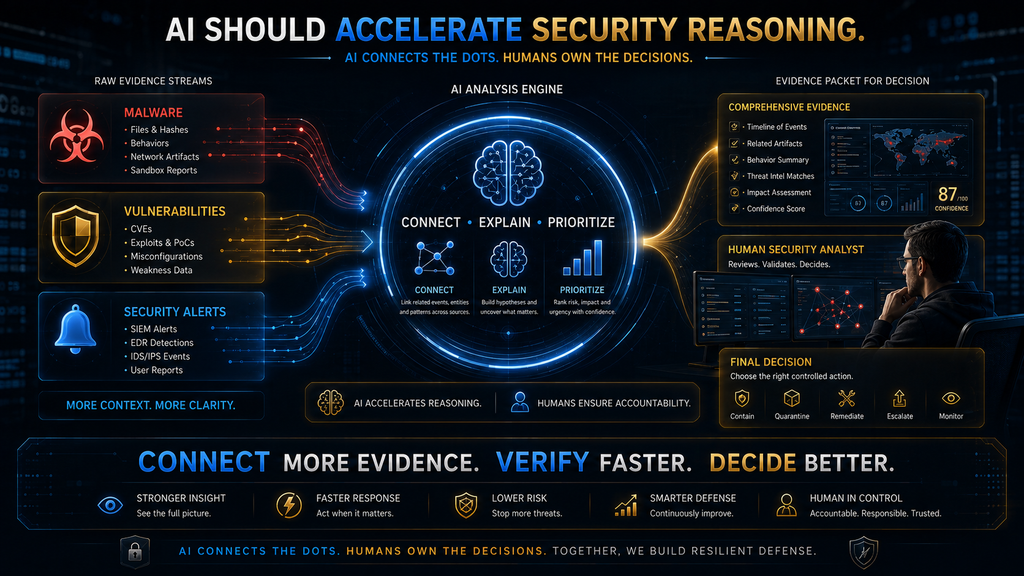
Now the analyst is not looking at one alert. The analyst is looking at an evidence packet. That is the real operational advantage.
The Evidence Packet Is More Important Than the AI Summary
This is one of the central recommendations of this article. A security AI should not merely return a paragraph. It should ideally produce a structured evidence packet containing:
| Evidence layer | What it should contain |
|---|---|
| Detection | Original alert and detection rule |
| Timeline | Related events before and after |
| Identity | User, account type and privilege |
| Asset | Endpoint/server role and criticality |
| Network | Destinations, domains and connections |
| Vulnerability | Relevant weaknesses and exposure |
| Intelligence | Known indicators or campaigns |
| AI analysis | Correlations and hypotheses |
| Uncertainty | Missing or contradictory evidence |
| Next steps | Recommended verification actions |
This is much more defensible than:
“AI says this is likely a credential-theft attack.”
The evidence packet lets the analyst inspect the reasoning. That improves both security and accountability. It also creates an audit trail that can be useful later when the organization needs to explain why an incident was escalated, closed, contained, or remediated.
AI Can Reduce Alert Fatigue—but It Can Also Make It Worse
Alert fatigue is not simply a volume problem. It is a decision-quality problem under limited attention. When analysts repeatedly investigate duplicate, low-value, or poorly contextualized alerts, they spend less attention on the incidents that matter.
AI can reduce this burden by grouping duplicates, correlating related alerts, enriching findings, summarizing evidence, and recommending priorities. But there is a trap. If AI generates additional speculative alerts without improving validation, it can increase the queue.
The objective should therefore not be: More AI-generated detections. It should be: More useful investigations per analyst hour.
A 2026 example from Deloitte Japan illustrates this direction: the organization began production validation of a security-focused open-source model for security operations, with use cases including alert analysis, prioritization, and false-positive reduction. This is a company-reported deployment example, so it should be treated as an implementation example rather than universal evidence that the same performance will occur in every SOC.
AI Can Reconstruct the Attack Timeline
Security incidents rarely appear in chronological narrative form. Instead, evidence may look like this: At 9:14, a suspicious process starts. At 9:17, an unusual authentication occurs.
At 9:20, a new network connection appears. At 9:23, a scheduled task is created. At 9:27, a privileged action occurs.
At 9:31, another endpoint contacts the same infrastructure. A human can reconstruct the sequence, but the work becomes increasingly difficult as the number of events grows. AI can help create a probable timeline by grouping related events and explaining their relationships.
The analyst should still validate the timestamps and causal assumptions. The value is that the analyst starts with a candidate attack narrative, rather than having to manually build the narrative from thousands of raw events.
The Three Security Problems Are Actually One Problem
Malware, vulnerabilities, and alerts are often discussed separately. Operationally, they are connected.
A vulnerability can provide an entry point. The attacker can exploit it. Malware or malicious scripts can execute. The endpoint generates telemetry. Security systems produce alerts. Those alerts expose indicators. The indicators reveal additional infrastructure. The investigation then discovers other vulnerable or compromised assets.
The complete chain looks more like: Vulnerability → Exploitation → Execution → Malware/Tooling → Telemetry → Alert → Correlation → Investigation → Response. This is where AI can create disproportionate value.
It can help connect information across the chain rather than treating each stage as a separate ticket. The more disconnected the organization’s security tools are, the more valuable contextual correlation becomes.
The Difference Between AI Summarization and AI Investigation
This distinction deserves explicit attention because much of the AI-security market uses the word “analysis” when it really means summarization. A summary might say:
“The endpoint generated suspicious PowerShell activity and connected to an unusual external domain.”
An investigation-oriented system should go further:
“The endpoint generated PowerShell from an unusual parent process. The associated privileged account authenticated from an atypical location shortly before execution. The process contacted an external domain first observed in the environment that day, and the endpoint contains a vulnerability associated with active exploitation. These signals are temporally correlated and justify investigation of potential initial access and post-exploitation activity.”
The second output is more useful because it connects: events + context + relationships + uncertainty + next action. That is the level of analysis security teams should aim for.
AI Should Separate Facts, Inferences and Unknowns
A security AI becomes significantly more trustworthy when it clearly distinguishes what it knows from what it believes. Consider this example:
| Statement | Classification |
|---|---|
| PowerShell was launched by an Office process | Observed fact |
| The domain has suspicious reputation | External intelligence |
| The activity may indicate post-exploitation | AI-assisted inference |
| Credentials were successfully stolen | Unknown until verified |
This distinction sounds basic, but it prevents one of the most dangerous AI failure modes: turning a plausible narrative into an apparently established fact. A useful security AI should be comfortable saying:
“The available evidence is insufficient to determine this.”
That answer is often more valuable than a confident but unsupported conclusion.
Confidence Scores Are Not Evidence
Security teams should also be careful with model confidence. If an AI system says it is “95% confident” that a file is malicious, that number should not automatically be interpreted as a 95% probability that the file is malicious in the real world. Model confidence and calibrated real-world probability are not interchangeable concepts.
A better interface would show:
- Conclusion: Possible credential-stealing malware.
- Evidence: Three observed behaviors support the hypothesis.
- Contradictory evidence: No confirmed credential access was observed.
- Missing evidence: Sandbox execution unavailable.
- Recommended next step: Analyze process behavior and outbound traffic.
That is far more useful than a single confidence percentage.
The Hybrid Security Analysis Architecture
The most defensible architecture separates AI reasoning from security controls.
Layer 1: Telemetry
Collect endpoint, network, identity, cloud, application, email, vulnerability, and threat-intelligence data.
Layer 2: Deterministic Security Tools
Use established tools for signatures, rules, vulnerability detection, policy enforcement, sandboxing, static analysis, reproducible tests, and known indicators.
Layer 3: AI Analysis
Use AI for semantic interpretation, correlation, enrichment, explanation, hypothesis generation, prioritization, and investigation guidance.
Layer 4: Verification
Use deterministic tests, sandboxing, code analysis, threat intelligence, controlled reproduction, and analyst review to validate important conclusions.
Layer 5: Controlled Response
Execute approved response workflows with authorization, logging, scope restrictions, rollback capability, and clear escalation paths. This separation matters because AI is probabilistic while many security controls need to be deterministic. NIST’s work on AI risk management emphasizes structured risk management across AI systems, while its emerging Cyber AI Profile specifically frames AI as both something organizations must secure and something they can use for cyber defense.
What Should Be Automated—and What Should Not?
The right question is not whether a task can technically be automated. The right question is whether the consequences of being wrong are acceptable.
| Task | Recommended AI role | Automation level |
|---|---|---|
| Alert summarization | Generate summary | High |
| Duplicate grouping | Group related alerts | High |
| Indicator enrichment | Gather context | High |
| Timeline construction | Draft timeline | High |
| Investigation hypothesis | Suggest possibilities | Medium |
| Vulnerability prioritization | Recommend priority | Medium |
| Malware classification | Assist classification | Medium |
| Vulnerability validation | Assist testing | Medium |
| Incident declaration | Support decision | Low |
| Account disabling | Recommend/prepare | Low |
| Production remediation | Prepare change | Low |
| Irreversible response | Human approval | Very low |
The more consequential the action, the stronger the verification requirement should become. That principle should remain true even as models become more capable.
Why Traditional Security Tools Still Matter
AI security analysis should not become an excuse to replace mature security infrastructure. Traditional tools exist because they solve problems AI models do not solve reliably. A signature can be deterministic.
A sandbox can execute code under controlled conditions. A vulnerability scanner can reproduce a known check. A SIEM can retain and query large volumes of logs.
An EDR platform can enforce endpoint controls. A policy engine can deny an action consistently. A human expert can understand business context that is absent from telemetry.
The strongest architecture therefore looks less like: AI versus traditional cybersecurity and more like: Traditional controls + AI reasoning + deterministic verification + human judgment. AI adds another capability layer. It does not invalidate everything that came before it.
A Practical AI Security Investigation Workflow
If a company wants to introduce AI into security analysis without overcomplicating the program, start with a controlled workflow.
Step 1: Capture the original evidence
Never ask the AI to work only from a manually summarized alert when the underlying telemetry is available. Preserve the original alert, timestamps, source system, process information, affected assets, and relevant logs.
Step 2: Enrich the evidence
Bring in identity, asset criticality, vulnerability information, threat intelligence, historical behavior, and related events. This is where AI can begin providing significant value.
Step 3: Ask AI to correlate, not conclude
Instead of:
“Is this an attack?”
use:
“Identify the strongest relationships between these events and explain which hypotheses are supported by the evidence.”
That encourages analytical reasoning without forcing a premature verdict.
Step 4: Require evidence references
Every important AI conclusion should point back to the telemetry, code, event, intelligence record, or test result that supports it.
Step 5: Identify uncertainty
Ask:
“What evidence would contradict this hypothesis?”
This is one of the most useful ways to reduce confirmation bias.
Step 6: Verify high-impact findings
Use deterministic security tooling, sandboxing, code analysis, reproduction, or human review depending on the situation.
Step 7: Prioritize
Evaluate technical severity alongside exploitability, exposure, asset importance, business impact, and observed activity.
Step 8: Take controlled action
Only after the evidence reaches the organization’s required threshold should a response workflow execute. This workflow is slower than blind autonomous action. It is also much safer.
What Happens If You Do Nothing?
The risk of not adopting AI should not be exaggerated. AI is not a magic requirement for every security team. But there is a real operational issue: the volume and speed of security information continue to increase while human attention remains limited.
At the same time, attackers are adopting AI-assisted workflows. Google Threat Intelligence reported in 2026 that it had identified a threat actor using a zero-day exploit it believed had been developed with AI, illustrating how AI is beginning to affect vulnerability discovery and exploitation on the offensive side as well.
If an organization continues to rely entirely on manual analysis while attackers increasingly automate reconnaissance, vulnerability discovery, code generation, and investigation-supporting tasks, the asymmetry can grow. But the answer is not to automate everything. The answer is to automate the right cognitive bottlenecks.
The Economics: Where AI Can Actually Save Money
The ROI case for AI security analysis is usually not “AI prevents every breach.” That claim would be impossible to defend.
The more realistic economic argument is that AI can reduce the amount of expensive analyst time required for repetitive investigative work. Consider a simplified example.
A SOC has 10 analysts. Each spends two hours per day on repetitive enrichment, alert correlation, timeline reconstruction, and documentation.
That represents: 20 analyst-hours per day. If an AI-assisted workflow safely reduces that repetitive workload by 30%, the organization recovers roughly: 6 analyst-hours per day. Over 250 working days, that is: 1,500 analyst-hours per year.
The exact savings depend on salaries, alert volume, model costs, integration costs, validation overhead, and the quality of the workflow. The important point is that the ROI should be measured against time recovered and decision quality improved, not against how impressive the AI demonstration looks.
The KPI Framework for AI Security Analysis
Organizations should measure AI security programs with operational metrics rather than generic AI adoption numbers.
Analyst efficiency
- Mean time to triage
- Mean time to investigate
- Analyst-hours per incident
- Percentage of repetitive investigation steps automated
Detection quality
- False-positive rate
- Duplicate-alert reduction
- Correlated-alert percentage
- Escalation precision
Vulnerability management
- Time from discovery to validation
- Time from validation to remediation
- Percentage of findings requiring manual rework
- Critical vulnerabilities remaining outside SLA
Investigation quality
- Evidence completeness
- Percentage of AI conclusions requiring correction
- Hypothesis validation rate
- Unsupported-claim rate
Business impact
- Incident containment time
- Analyst capacity recovered
- Security backlog reduction
- Risk reduction per remediation hour
The strongest KPI may ultimately be:
How much more useful security work can the team complete with the same human capacity?
Who Should Use AI Security Analysis?
AI-assisted security analysis is particularly useful for organizations with high telemetry volumes, lean security teams, multiple security products, large vulnerability backlogs, complex cloud environments, or SOC analysts spending substantial time on repetitive enrichment and investigation. It can also be useful for developers and AppSec teams that need help understanding large codebases and prioritizing security findings.
Smaller organizations can benefit too, but they should avoid buying complexity they cannot operate. A small company with limited security telemetry may gain more from improving endpoint protection, identity security, patching, backups, and basic logging than from building an elaborate autonomous AI-SOC architecture.
AI should solve a bottleneck that already exists. It should not create a new one.
Who Should Not Rely Heavily on AI Yet?
Organizations should be cautious when they lack reliable telemetry, clear security ownership, incident-response procedures, data governance, or the ability to validate AI-generated findings. AI cannot compensate for missing fundamentals. If logs are incomplete, the AI will still be missing information.
If asset inventories are inaccurate, the AI may prioritize incorrectly. If vulnerability data is stale, the AI may reason from stale information. If identity information is unreliable, correlation can become misleading.
If there is no human capable of challenging the model’s conclusions, the organization may simply automate its own blind spots. That is why AI cybersecurity maturity should follow basic security maturity rather than attempt to skip it.
Common Mistakes When Deploying AI for Security Analysis
Giving the model too much authority
An AI system that can read alerts is relatively low risk. An AI agent that can disable accounts, modify firewall rules, change production configurations, delete files, or deploy patches without approval is a very different system.
Authority should increase only when the organization has corresponding controls.
Measuring volume instead of outcomes
Generating more findings is not success. Reducing investigation time, improving prioritization, and increasing validated findings are better measures.
Ignoring data provenance
AI needs to know where evidence came from. A vendor claim, threat-intelligence feed, endpoint event, analyst note, and model inference should not all appear as equivalent facts.
Treating AI explanations as proof
A polished explanation can still be wrong. Evidence must remain visible.
Ignoring attacker-controlled content
Security artifacts can contain malicious instructions or misleading content. The analysis layer must treat untrusted content as data, not authority.
Using a general model for every security task
Different problems have different requirements. Malware reverse engineering, vulnerability discovery, alert triage, log summarization, and incident response are not identical workloads.
A specialized security tool may outperform a general model for a specific task.
The Second-Order Effect: AI Changes the Security Team Itself
There is a deeper organizational effect that is easy to miss. If AI takes over repetitive analysis, the role of the analyst changes.
Junior analysts may spend less time manually enriching alerts and more time validating hypotheses. Senior analysts may spend more time on architecture, detection engineering, threat hunting, and complex investigations.
That can be positive. But it creates a new training problem. If junior analysts no longer learn how to manually investigate alerts because AI always produces the answer, they may become less capable of recognizing when the AI is wrong.
The organization could accidentally create a generation of analysts who are excellent at operating AI systems but weaker at independent investigation. The solution is not to reject AI. It is to ensure that AI augments expertise rather than replacing the development of expertise.
The Future Is Not “Autonomous Cybersecurity” Everywhere
The direction of travel is clearly toward more capable AI agents. Google Threat Intelligence is already describing agentic systems that can assist with vulnerability discovery and security research, while Microsoft is integrating AI-assisted investigation and contextual security signals into its security ecosystem. But the future will probably not be one giant AI system that controls every security decision.
A more realistic model is a network of specialized capabilities:
- Malware analysis agent
- Vulnerability research agent
- Alert-triage agent
- Threat-intelligence agent
- Incident-analysis agent
- Detection-engineering assistant
- Human security lead
Each capability has a defined scope. The security architecture then controls how evidence moves between them. This is more reliable than giving one general-purpose agent unrestricted access to the entire environment.
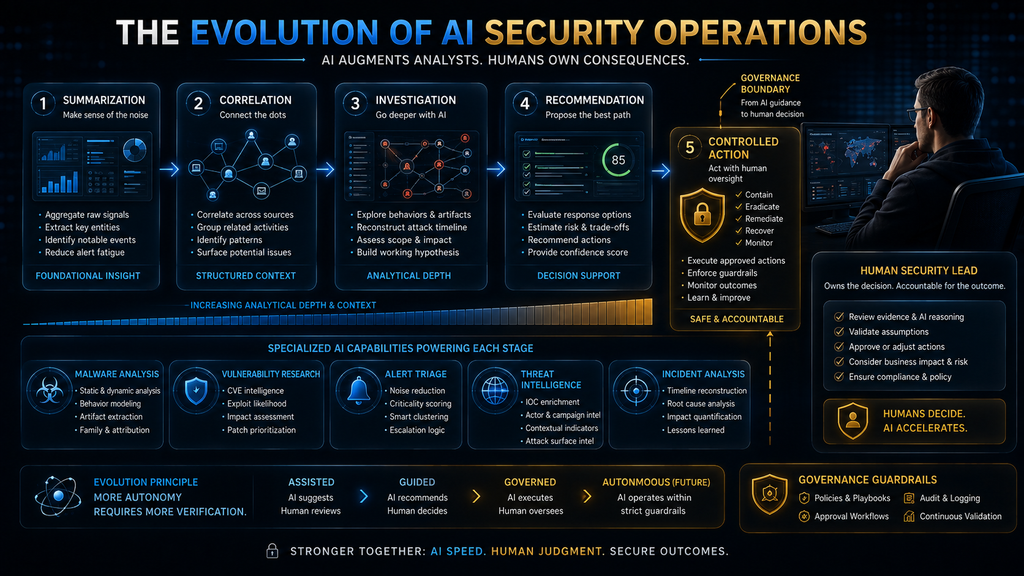
The Direction of AI Security Analysis
The evolution can be understood in five stages. Stage 1 — Summarization: AI explains what happened. Stage 2 — Correlation: AI connects related events.
Stage 3 — Investigation: AI develops and tests hypotheses. Stage 4 — Recommendation: AI proposes what should happen next. Stage 5 — Controlled action: AI executes predefined actions under explicit authorization.
Most organizations should move through these stages deliberately rather than jumping straight to Stage 5. The higher the consequence of an error, the more important evidence, validation, authorization, and rollback become. That is the central design principle.
The Real Advantage of AI Is Not Detection Speed Alone
AI cybersecurity discussions often focus on speed. Faster detection. Faster scanning.
Faster malware analysis. Faster alert triage. But speed is only valuable when the resulting decision is good.
A fast wrong decision can be worse than a slower correct one. The more meaningful advantage is analysis compression: reducing the amount of human effort required to transform a large evidence set into a validated understanding of what happened. That is why the most valuable AI security systems will not necessarily be the ones that produce the most alerts.
They will be the ones that help analysts answer difficult questions faster:
- What happened?
- Why does it matter?
- What evidence supports that conclusion?
- What is still unknown?
- What should we verify next?
- What deserves action first?
That is the real job of AI-assisted security analysis.
AI Cybersecurity Reality Check
AI is becoming a serious component of cybersecurity operations, but the industry should resist the temptation to turn every security problem into an AI problem. The evidence so far supports a more nuanced conclusion.
AI can meaningfully accelerate malware interpretation, vulnerability discovery and prioritization, security-alert correlation, threat-intelligence enrichment, incident reconstruction, and repetitive analyst workflows. Current research and industry deployments demonstrate real progress in these areas.
At the same time, AI remains vulnerable to incorrect reasoning, incomplete context, adversarial inputs, hallucinated explanations, difficult reverse-engineering problems, and unsafe automation. Current guidance from Mandiant, NIST, and other security organizations increasingly emphasizes structured workflows, verification, governance, and controlled authority rather than blind autonomy.
The winning model is therefore not: AI replaces cybersecurity expertise. It is: AI expands what cybersecurity experts can investigate within the same amount of time. That is a much more defensible—and much more useful—vision.
Final Thoughts
The most important change AI brings to cybersecurity is not that machines can now detect suspicious things. Security software has been detecting suspicious things for years.
The bigger change is that AI can help turn fragmented security evidence into a coherent investigation.
It can take a suspicious executable and help explain its behavior. It can take thousands of vulnerability findings and help identify which ones represent realistic risk. It can take disconnected security alerts and help reconstruct a probable incident timeline. It can take a large evidence set and help an analyst determine what deserves attention next.
But that capability only becomes trustworthy when the system makes its reasoning inspectable. The best AI security workflow therefore keeps three things visible: evidence, uncertainty, and authority.
Evidence tells the analyst why the system reached a conclusion. Uncertainty prevents an inference from becoming an accidental fact. Authority determines what the AI is actually allowed to do.
Put those three together and AI becomes a powerful security multiplier. Remove them, and the organization risks replacing alert fatigue with AI-generated confidence.
The goal is not to let AI make every cybersecurity decision. The goal is to let security teams make better decisions, with more evidence, in less time.
Build a Smarter AI Cybersecurity Strategy
AI is changing how security teams detect threats, investigate incidents, analyze vulnerabilities and prioritize risk. Explore our other AI cybersecurity guides to understand where AI creates real security advantages—and where human judgment still matters.
Explore AI Cybersecurity →Frequently Asked Questions
How does AI analyze malware?
AI can analyze malware by interpreting static code, strings, process behavior, network activity, indicators of compromise, execution patterns, and threat-intelligence information. It can summarize behavior, identify suspicious relationships, generate investigation hypotheses, and help analysts understand complex artifacts, but important conclusions should be validated with sandboxing, reverse engineering, deterministic tools, or human review.
Can AI detect new malware?
AI can help identify previously unseen or poorly classified malware by recognizing suspicious behavior and code patterns, but “new” does not automatically mean “detectable by AI.” Obfuscation, packing, environmental dependencies, adversarial behavior, and incomplete telemetry can still make analysis difficult.
How does AI help vulnerability management?
AI can assist with vulnerability discovery, code analysis, finding validation, contextual enrichment, risk prioritization, and remediation planning. Its biggest value is often combining technical vulnerability information with asset exposure, business importance, exploitability, threat intelligence, and attack-path context.
Is CVSS enough to prioritize vulnerabilities?
No. CVSS provides a standardized severity assessment, but FIRST explicitly explains that CVSS alone does not represent complete organizational risk. Threat and environmental factors can materially change remediation priority.
Can AI replace vulnerability scanners?
No. Vulnerability scanners provide repeatable detection and structured security checks. AI can complement those tools by explaining findings, correlating them with environmental context, reducing false positives, and helping prioritize remediation.
Can AI reduce security-alert fatigue?
Yes, when implemented correctly. AI can group related alerts, enrich findings, reconstruct timelines, identify duplicates, and recommend priorities. However, poorly designed AI workflows can generate additional low-confidence findings and make the queue worse.
Can AI automatically investigate a cyberattack?
AI can automate or accelerate many investigation steps, including enrichment, correlation, timeline construction, evidence gathering, and hypothesis generation. Fully autonomous investigation and response should be restricted by authorization, validation, auditability, and rollback controls.
What is the biggest risk of AI-assisted security analysis?
One of the biggest risks is treating a plausible AI-generated explanation as verified evidence. Other risks include hallucination, incomplete context, adversarial manipulation, prompt injection, data leakage, and excessive agent privileges.
Should small businesses use AI cybersecurity tools?
They can, but AI should solve an actual security bottleneck. Small businesses should first establish strong fundamentals such as identity protection, endpoint security, patching, backups, access controls, logging, and incident-response procedures. AI becomes more valuable as telemetry volume and security complexity increase.
What is the best role for AI in a SOC?
AI is particularly useful for alert enrichment, correlation, investigation support, threat-intelligence analysis, summarization, documentation, and prioritization. High-consequence actions should remain subject to explicit security controls and appropriate human approval.
Related Guides
- How AI Analyzes Product Usage Data, Support Tickets & User Feedback
- How AI Analyzes Customer Feedback, Calls & Interviews at Scale
- AI Conversation Analysis vs Manual Research: Where AI Actually Adds Value
Written by
Muntasir Ahmad Chowdhury
Founder, AI Hustle World
Muntasir Ahmad Chowdhury is the Founder of AI Hustle World, an independent publication dedicated to making Artificial Intelligence practical, trustworthy, and easy to understand. He researches AI tools, automation, customer service, productivity, and real-world business applications, helping readers make smarter technology decisions through research-driven, experience-backed content.
Expertise:
AI Tools • AI Automation • AI Customer Service • AI Productivity • Generative AI • AI Workflows
Get Smarter With AI
Enjoyed this guide? Get practical AI tools, tutorials, and honest reviews delivered to your inbox.