Generative Audio Explained: How AI Creates, Edits and Transforms Sound
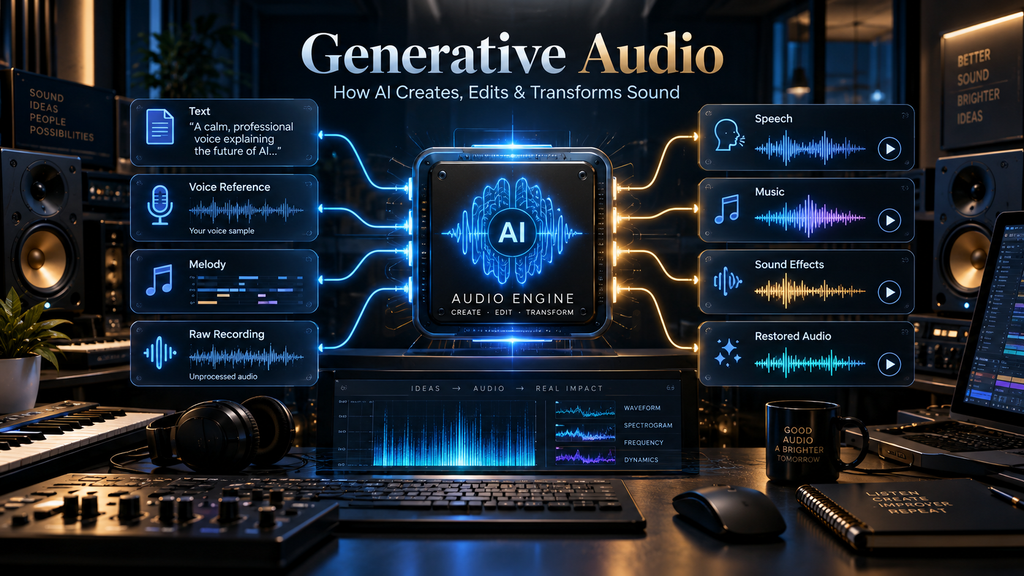
Type “AI audio” into a search bar and most people picture one thing: a synthetic voice reading a script. That’s a fair guess, but it undersells the field by a wide margin. The same underlying machinery that clones a voice also composes a pop song from a text prompt, invents the sound of a monster’s footsteps for a video game, and strips the hum out of a podcast recorded in a noisy kitchen.
These don’t feel like the same technology because the marketing around them treats speech, music, sound effects and audio cleanup as separate product categories. Underneath, they’re variations on one idea: turn sound into data, learn the patterns in that data, then generate or repair audio from a prompt. Once that idea clicks, every tool name in this space — Suno, ElevenLabs, Adobe Podcast, Descript — stops looking like a random assortment of startups and starts looking like five expressions of the same underlying playbook.
This guide lays out that playbook using a simple four-layer model we’ll call the AI Hustle World Audio Generation Stack. It walks through the two competing engines that power almost every tool on the market, and covers where the field actually stands in 2026 — including what it actually costs versus hiring a human. And it gets into the part most explainers skip entirely: where the real bottleneck has quietly shifted from audio quality to something else.
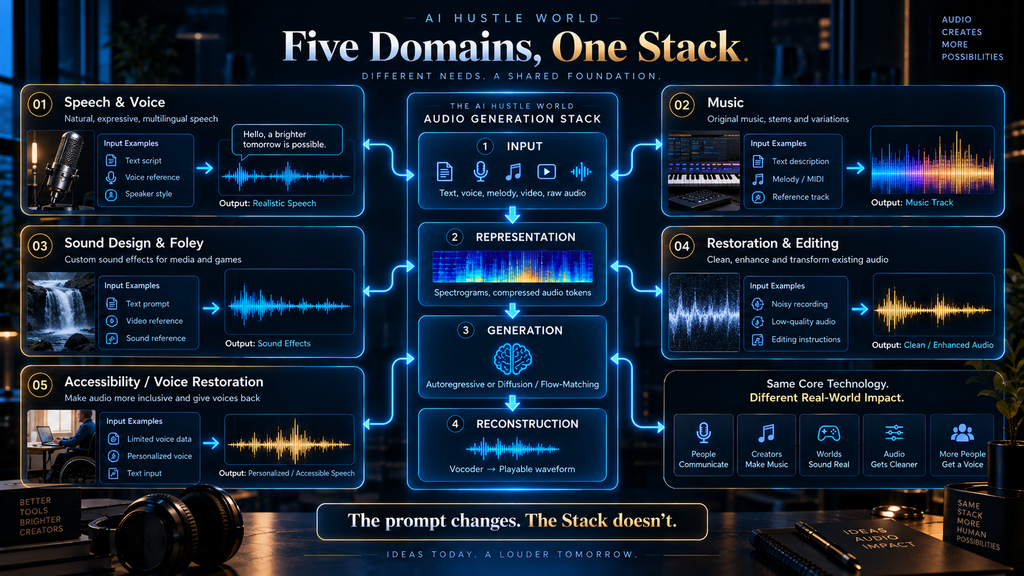
The AI Hustle World Audio Generation Stack
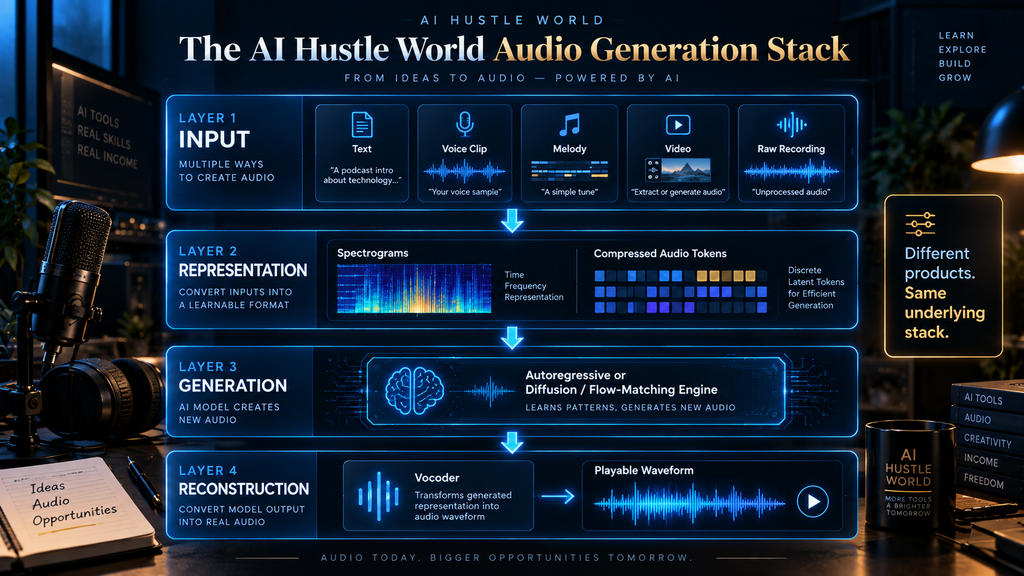
Every generative audio product, no matter which of the five domains it belongs to, can be understood through the same four-layer model. We call it the Audio Generation Stack, and once you can place a tool on it, you can predict roughly how it will behave without ever touching it.
Layer 1 is the Input Layer — what you feed the model: a line of text, a short reference clip of a voice, a silent video you want sound added to, or a MIDI melody. Layer 2 is the Representation Layer — how that input gets converted into something a model can actually learn from, typically a spectrogram or a sequence of compressed audio tokens.
Layer 3 is the Generation Layer — the engine that produces new patterns from a prompt, split between two competing approaches covered next. Layer 4 is the Reconstruction Layer — the vocoder that turns those patterns back into an actual waveform you can play through a speaker.
Every product mentioned in this article slots into that same four-layer Stack; only the input and the training data change. Keep that model in mind through the rest of this guide.
Hear the Speech Layer of the Audio Stack
Generate a short narration with ElevenLabs and listen for pacing, emphasis and pronunciation before judging where AI speech fits your production.
Generate Speech With ElevenLabs →Affiliate disclosure: We may earn a commission if you subscribe through this link, at no additional cost to you.
The One Mechanism Behind All Generative Audio
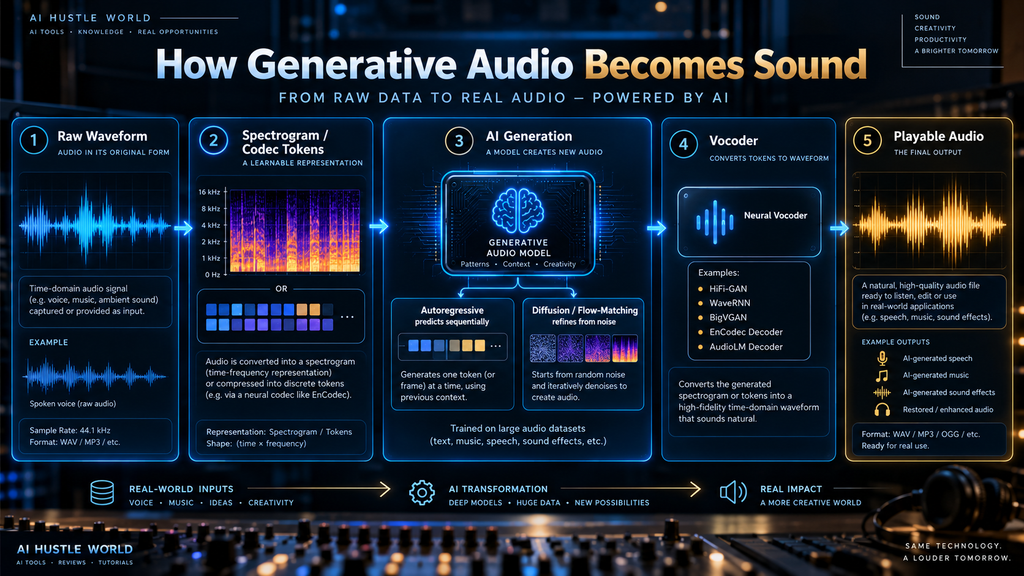
Layers 2 through 4 of the Stack are worth unpacking in more technical detail, because they explain why some tools sound better, faster or more controllable than others. Raw audio is just a long list of amplitude numbers sampled thousands of times a second, which is too dense for a model to reason about directly at the Representation Layer.
So most systems first convert that waveform into a spectrogram, which maps how loud different frequencies are at each moment in time, or into a set of discrete “codec tokens” produced by a compression network — tokens that behave more like a vocabulary a language model can predict one at a time. At the Generation Layer, some systems predict the next chunk of audio token by token, the same way a large language model predicts the next word; others start from random noise and gradually refine it into structured audio through many small denoising steps.
Both approaches are trained on the same basic wager: if a model sees enough real audio, it can learn what plausible audio looks like well enough to invent new examples that never existed.
At the Reconstruction Layer, a spectrogram or a set of tokens isn’t sound you can hear — it still has to be converted back into an actual waveform, and that job belongs to a vocoder. Early neural vocoders like WaveNet produced remarkably natural speech but were painfully slow, generating audio much slower than real time.
Later architectures like HiFi-GAN closed that gap by trading a small amount of quality for enormous speed gains, and the current generation of diffusion-based and flow-matching vocoders is closing the remaining distance between “fast” and “indistinguishable from a real recording.”
That’s the whole trick, repeated across every product category in this article. A text-to-speech engine represents phonemes and prosody, generates a mel-spectrogram, and vocodes it into a voice. A music generator represents melody, rhythm and timbre, generates a sequence of audio tokens, and vocodes it into a full mix.
A sound-design tool represents an event description, generates a short burst of audio consistent with that description, and vocodes it into a usable sound effect. The prompt changes; the Stack doesn’t.
The Two Engines: Autoregressive vs Diffusion
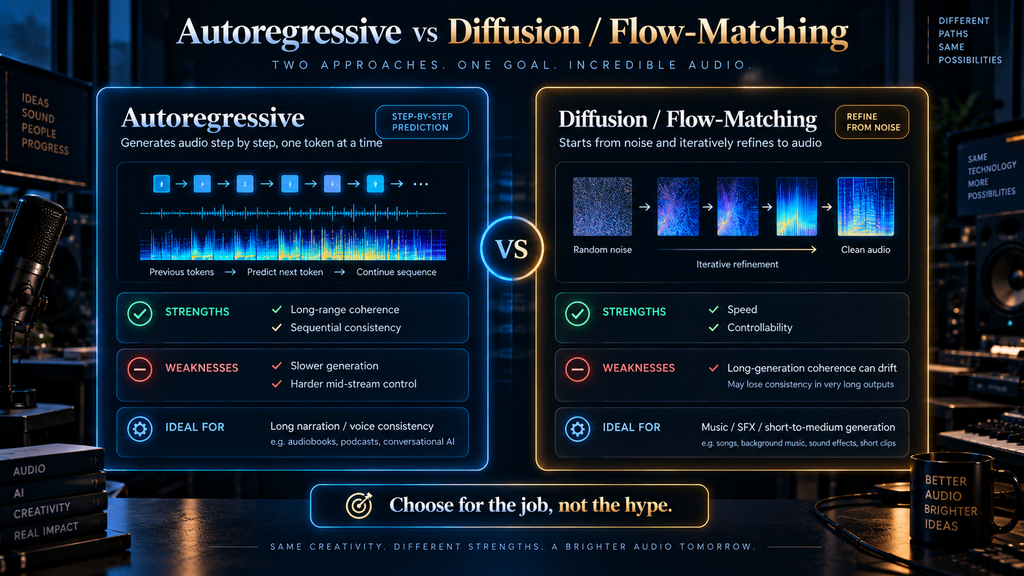
Which of the two Generation Layer engines a tool uses explains most of what you’ll notice as a user — and it’s the single most useful thing to understand before picking any generative audio product. Autoregressive models generate audio one token at a time, conditioning each new token on everything generated so far, the same way GPT-style language models write one word after another; diffusion models instead start from pure noise and iteratively remove it in a fixed number of steps until structured audio emerges.
Autoregressive systems tend to hold onto long-range coherence unusually well — a voice stays consistent across a ten-minute narration, a song keeps its key and tempo across several minutes — because every new token can look back at the entire sequence generated so far. The trade-off is speed and control: generation happens sequentially, one step depends on the last, and steering the output mid-generation is harder than most users expect.
Diffusion and flow-matching systems flip those trade-offs. Because the denoising process can run large chunks of audio in parallel rather than token by token, these models are typically faster and easier to condition on secondary inputs like a reference melody, a target loudness curve, or a specific emotional tone.
The cost shows up over very long generations, where diffusion models are more prone to losing structural coherence than their autoregressive counterparts. Neither engine is strictly better; they’re suited to different jobs, which is why the comparison below is worth keeping in mind before evaluating any specific tool, rather than trusting a vendor’s “best in class” claim at face value.
| Dimension | Autoregressive | Diffusion / Flow-Matching |
| Best at | Long-range coherence (voice, extended narration) | Fast, controllable short-to-medium generations |
| Typical weakness | Slower generation, harder mid-stream control | Coherence can drift over very long outputs |
| Where you’ll find it | Neural-codec speech models, early music LMs | Most current music, SFX and video-conditioned audio tools |
| What it means for you | Choose for consistency across long recordings | Choose for speed, iteration and creative control |
Five Domains, One Stack
Generative audio splits into five practical domains, and each one is really the same four-layer Stack pointed at a different kind of Input and a different flavor of “correct” output. This breakdown makes it easy to place any new product you encounter.
Speech synthesis and voice cloning are the most mature domain, and the one most people mean when they say “AI audio.” Modern systems can clone a voice from a short reference clip and then speak arbitrary new text in that voice, complete with the pauses, emphasis and non-verbal sounds — laughter, sighs, hesitation — needed to sound natural rather than robotic. ElevenLabs, for instance, markets its Eleven v3 model as its most expressive text-to-speech system to date, with support for inline audio tags and multi-speaker dialogue, while pitching its lighter Flash v2.5 model specifically on latency, according to the company’s own documentation.
Music generation takes the same Stack and points its Input Layer at melody, harmony and rhythm instead of phonemes. Tools like Suno and Udio generate a complete song — vocals, instrumentation and mix — from a text prompt or a short reference clip.
The pace of adoption has been startling: Deezer reported in mid-2026 that AI-generated tracks made up more than half of everything uploaded to its platform on a given day, up from roughly one in ten uploads at the start of 2025.
That statistic says less about audio quality, which is now good enough to fool casual listeners, and more about how low the barrier to producing a finished-sounding track has fallen. (Our music generation guide covers the legal implications of that shift in more depth.)
Sound design and Foley — the effects and ambient sounds layered under film, television and game audio — are the newest domain to go generative, and arguably the hardest, because timing precision matters as much as sound quality at the Reconstruction Layer.
A footstep effect that’s a few frames off the actor’s actual step reads as obviously wrong even to an untrained ear. Recent research systems built for this problem, generating sound effects directly from video, are still primarily research prototypes rather than mainstream products.
According to a 2025 Game Developers Conference industry survey, more than half of developers surveyed already work at studios using generative AI in some form, with roughly a third using it personally — a sign this domain is scaling even while the technology is younger than speech or music generation. Restoration and editing round out the five domains, and it’s the one most likely to already be part of your workflow without you thinking of it as “generative AI.” Tools like Adobe’s Enhance Speech and Descript don’t just filter out noise the way older software did.
They separate a recording into speech, background noise and music at the Representation Layer, then effectively regenerate the speech component at the Generation Layer as if it had been recorded in better conditions.
That’s a meaningfully different operation from a noise gate or an EQ curve — closer to a model repainting the missing parts of a photograph than cutting unwanted frequencies. (Our noise cleanup guide covers what this changes about how you record.)
A quick note on how this guide was researched: this guide deliberately stays at the conceptual, cross-domain level rather than running hands-on tests of specific paid products. That granular first-hand testing — actually cloning a voice, actually generating a track, actually running a noisy recording through a cleanup tool and documenting exactly what worked and what didn’t — belongs in dedicated tool guides and comparisons, where a single product can be evaluated properly. What follows draws on vendor documentation, published research and independent reporting rather than fabricated hands-on impressions.
What Generative Audio Actually Costs
Audio quality gets most of the attention in this space, but the economics are what actually drive adoption, and they’re rarely spelled out with real numbers. Two comparisons make the shift concrete: audiobook narration and music session work.
ACX, Audible’s own production marketplace, budgets professional audiobook narration at roughly $300 to $400 per finished hour — about $200 for narration and another $200 for editing, quality control and mastering — with a typical finished hour running around 9,300 words. A 10-hour audiobook at that rate lands in the $3,000 to $4,000 range before any retakes, and multiple independent production guides converge on a wider $2,000 to $5,000-plus range once studio time and revisions are factored in.
Set that against an ElevenLabs Creator plan at roughly $22 a month, which includes enough credits for well over an hour of generated speech. The arithmetic explains exactly why Spotify’s ElevenLabs partnership frames AI narration as a way to make midlist audiobooks exist at all — not as a straight swap for a narrator who was being paid $300 an hour.
Music tells a similar story from a different angle. The American Federation of Musicians’ published union scale for a basic three-hour recording session is $488.29 per musician, a rate that comes bundled with pension and health-and-welfare contributions that a freelance or AI alternative doesn’t provide.
Suno’s Pro plan, by contrast, costs $10 a month for roughly 500 songs’ worth of generation credits with commercial rights included. That gap is large enough to explain why a solo creator prototyping an idea reaches for Suno first.
But it’s also exactly why major labels pushed back hard enough to produce the Munich ruling and the UMG and Warner settlements covered later: the same economics that make AI music attractive to an independent creator make it existentially threatening to a session-musician labor market built on per-song union rates.
The sticker-price comparison undersells what’s actually being traded away, though. A human narrator or session musician carries insurance, contractual accountability, and a body of prior work a client can audition before hiring — none of which shows up in a per-minute AI pricing page.
Factor in the cost of a human QA pass most professional workflows still add on top of AI output, the legal review increasingly needed before publishing a cloned voice or a generated track commercially, and the revision cycles that come with any new tool. The real gap between “$22 a month” and “$300 an hour” narrows considerably once a project needs to ship at a professional standard rather than a prototype one.
What’s Actually New in 2026
The pace of change across generative audio has been fast enough that any explainer written more than a year ago is already describing a different landscape — and every figure below is a vendor’s own claim, not an independently verified benchmark. On the speech side, ElevenLabs moved Eleven v3 from public alpha to general availability in March 2026, positioning it as the company’s most expressive text-to-speech model, while its faster Flash v2.5 model is marketed around latency low enough for real-time conversational use.
On the music side, Suno’s v5 and v5.5 releases added studio-grade sample rates, stem separation into as many as a dozen individual tracks, and an in-browser editing environment — a shift from “generate a finished song” toward “generate a starting point you can still produce.” Adobe’s Enhance Speech has moved in a similar direction, adding source separation into distinct speech, noise and music stems along with a “room modeling” feature aimed at matching the acoustic character of a target space rather than simply removing everything that isn’t a voice.
None of these claims should be taken as independent benchmarks, but taken together they point at a consistent direction: 2026’s models aren’t chasing raw audio quality nearly as hard as the 2023–2024 generation did, because quality stopped being the limiting factor for most everyday use cases. What they’re chasing instead is control, editability and integration into an existing production workflow.
Try Current AI Voice Models on Your Own Script
Generate the same script with ElevenLabs’ current voice models and compare naturalness, pacing and credit cost with the audio you use today.
Try ElevenLabs Voice Models →Affiliate disclosure: We may earn a commission if you subscribe through this link, at no additional cost to you.
The Real 2026 Bottleneck Isn’t Quality — It’s Provenance
Here’s the part most generative-audio explainers skip, and it’s the most consequential development in the field this year: the hard problem in 2026 isn’t making AI audio sound convincing. That problem is largely solved for speech and increasingly solved for music.
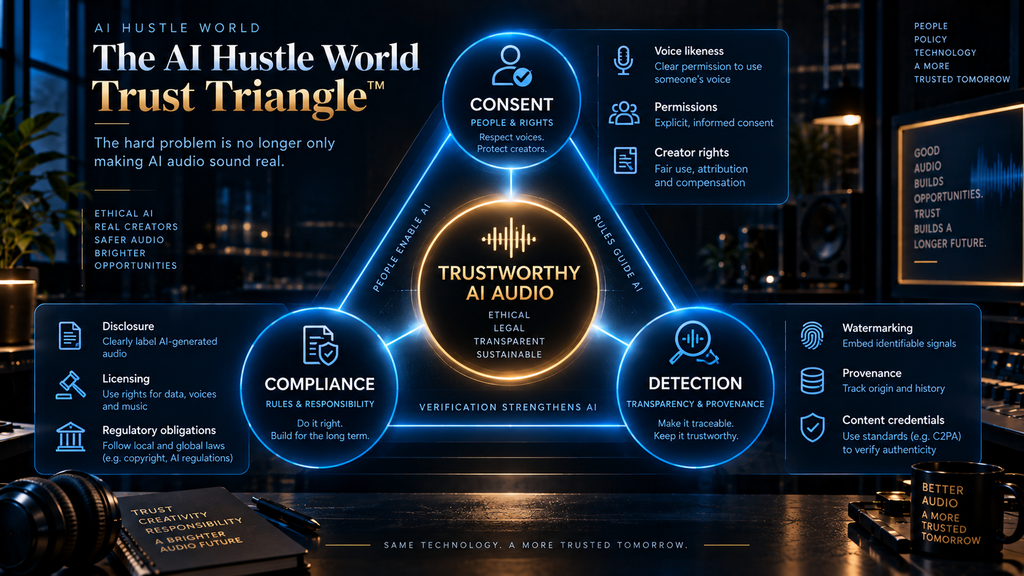
The hard problem is knowing what’s AI-generated at all, who’s allowed to generate it, and what happens when the two questions collide in court. We’ll call the three pieces of that problem the AI Hustle World Trust Triangle: Consent, Compliance and Detection.
Consent is the oldest and most intuitive piece. Cloning a real, identifiable voice without that person’s permission raises right-of-publicity and likeness questions that predate AI by decades, which is why reputable voice-cloning platforms increasingly require verified consent before generating a named individual’s clone.
Compliance is newer and moving fastest: starting in August 2026, the EU AI Act requires deployers of systems that generate or manipulate audio, image or video content to disclose that machine-readable fact, converting labeling from an ethical nicety into a legal obligation. Detection is the piece the industry is still building in real time — watermarking standards like Google DeepMind’s SynthID, adopted across platforms including OpenAI and ElevenLabs according to public statements, and the C2PA content-credentials standard both aim to make “was this AI-generated?” answerable without relying on a listener’s ear.
The legal side of Compliance moved fastest of the three. Universal Music Group settled its lawsuit against Udio in October 2025, and Warner Music reached a similar settlement — paired with a licensing partnership — with Suno the following month.
Sony’s litigation against the same companies was still active as of this writing. Then, in July 2026, a Munich regional court delivered a ruling with sharper teeth than either settlement: it held that Suno had infringed copyright by both storing protected songs during training and by generating outputs that made those works available. The court ordered the company to disclose revenue and pay damages — and explicitly rejected the argument that training conducted outside the EU puts a platform beyond the reach of EU copyright law.
Deezer’s own upload data makes the Detection gap concrete in a way abstract policy discussion doesn’t. The platform reported that fully AI-generated tracks made up more than half its daily uploads by mid-2026.
More troubling for anyone monetizing music, a striking share of the streams attributed to those AI tracks in 2025 showed patterns consistent with fraud. Quality was never the obstacle to that outcome — a still-maturing detection infrastructure is.
None of this means generative audio is dangerous or that businesses should avoid it — the accessibility and production examples later in this guide make the opposite case clearly. It means the operating question has quietly changed from “does this sound real enough?” to “can I satisfy all three corners of the Trust Triangle before I publish this?” That’s a genuinely different problem, worth budgeting legal review for.
What Happens If You Ignore This
It’s worth stating plainly what’s actually at stake if a business treats the Trust Triangle as optional rather than load-bearing, because the risk isn’t hypothetical anymore on either side of the adoption decision. Publishing AI-generated or AI-cloned audio without proper disclosure now carries real regulatory exposure in the EU once the AI Act’s labeling requirement takes effect in August 2026, on top of the reputational cost of a listener discovering an undisclosed synthetic voice after the fact.
On the music side, the Munich ruling shows that “we didn’t license the training data” is no longer a defense a court will accept quietly, and a platform’s damages exposure can follow a single infringement finding well past the original release.
The opposite failure mode is just as real and gets far less attention: doing nothing at all. Competitors moving faster on audiobook backlists, music prototyping, voice agents or podcast production compound a cost and speed advantage every month a business sits out.
“Wait until the legal picture is fully settled” is not a neutral choice when the legal picture is settling in favor of clear licensing and disclosure practices that can be built in now rather than retrofitted later.
Real-World Examples: Where This Already Works
The clearest way to see how these five domains actually play out is through what’s already shipped, rather than what’s demoed at a product launch. Spotify’s partnership with ElevenLabs, launched in February 2025, distributes AI-narrated audiobooks through the platform’s existing Findaway Voices pipeline, with titles explicitly labeled as narrated by a synthetic voice rather than a human performer.
Set against the $300–$400-per-finished-hour economics covered earlier, the real story is which books get to exist at all: a synthetic-narration option lets a publisher greenlight a title that would never have justified a $3,000 human narration budget. Music producer and songwriter Timbaland’s “TaTa,” a fully AI-generated artist built on Suno and unveiled through his Stage Zero venture in mid-2025, illustrates both the creative promise and the public backlash in one case study.
The project generated real commercial and press interest and, just as quickly, drew criticism from musicians and fans uneasy about a synthetic “artist” competing for attention and revenue with human ones — the same tension the earlier cost comparison predicts, playing out in public. In game development, the 2025 GDC State of the Industry survey found that a majority of developers work at studios that have already implemented generative AI in some form, with a third using these tools personally.
That’s evidence sound design and asset generation are moving from novelty to standard tooling faster than public conversation suggests, even though the underlying Foley-generation research is still younger and less polished than speech or music models.
The most genuinely moving example sits furthest from marketing altogether. Researchers at UC Berkeley and UCSF published results in 2025 describing a streaming brain-to-voice neuroprosthesis that reconstructs a paralyzed patient’s own pre-injury voice from neural signals.
It uses a text-to-speech model trained on recordings made before the patient lost the ability to speak — paired with the University of Illinois’s Speech Accessibility Project, which had gathered recordings from roughly 2,000 participants with speech disabilities by late 2025.
Microsoft reported recognition accuracy gains of 18 to 60 percent using that data. In this domain, the technology is restoring something that was taken away, not replacing something that already existed.
What Generative Audio Still Can’t Do
None of the above should read as generative audio having solved every problem, and the honest limitations are worth stating plainly rather than burying in a footnote.
Long-form coherence remains fragile. Autoregressive systems hold a voice or a melody together well over minutes, but even the strongest models can drift in tone, key or vocal identity over a full album side or an hour-long narration.
Catching that drift still requires a human listening pass rather than trusting the output blind. Precise timing is a related weak spot, most visible in Foley, where an effect convincing in isolation can still land a few frames off the on-screen action triggering it.
There’s also a real trade-off between expressiveness and reliability that vendors rarely lead with in their own marketing. ElevenLabs’ own positioning of Eleven v3 as its most expressive model, alongside a separate, faster Flash model built for latency-sensitive use, is itself an admission that no single model wins on both expressiveness and consistency.
And then there’s the arms race between generation and detection. Watermarking standards like SynthID are spreading, but they only work if every generation tool adopts them and no adversarial actor strips them out before distribution.
Assuming a piece of audio is “safe” simply because it sounds convincing, or assuming a lack of an obvious watermark means it’s human-made, are both bets the current technology doesn’t actually support.
Why Human Production Still Exists
Given how far the Stack has come, it’s worth asking directly why studios, session musicians and voice actors haven’t simply been priced out already — and the honest answer isn’t nostalgia. A model trained to produce statistically plausible audio has no equivalent of a director’s actual creative intent, a brand’s legal accountability for what its voice says, or a musician’s lived point of view.
It can execute a well-specified brief remarkably well, but someone still has to specify that brief and take responsibility for the result. Union session and narration rates also bundle protections — health and pension contributions on AFM scale, contractual usage rights on SAG-AFTRA jobs — that a generation platform’s per-minute pricing simply doesn’t include.
And for high-stakes, brand-facing work, the ability to audition a specific person’s prior body of work before hiring them is itself a form of risk management a freshly generated voice or track can’t offer. That’s why the realistic pattern emerging across 2026 isn’t full replacement in either direction — it’s a split by stakes and volume: AI absorbing high-volume, cost-sensitive work, human production holding the high-accountability, brand-defining work.
Who Should Use This Now — and Who Should Wait
Generative audio is genuinely ready for some jobs and genuinely premature for others, and mixing up which is which is the most common mistake teams make when adopting it. It’s a strong fit right now for podcasters and independent creators who need reliable cleanup on inconsistent recording setups, for narration work where a labeled synthetic voice is an acceptable trade against cost, and for musicians prototyping an idea before a human arrangement pass.
It’s also a strong fit for developers building voice-driven customer support where consistency matters more than expressive range, and for accessibility applications where the alternative isn’t a human recording at all but no voice whatsoever. It’s a weaker fit for anyone who needs guaranteed broadcast-grade consistency across a long production run without a human QA pass in the loop, or for teams that haven’t budgeted time for a legal review of voice-cloning consent and licensing exposure. It’s also a weaker fit for anyone treating a vendor’s demo reel as a reliable preview of production output — demos are, by definition, the best examples a company chose to show you.
Common Mistakes to Avoid
Skipping the disclosure step is the single most common and most avoidable mistake. Treating an AI-narrated audiobook, an AI-composed jingle or a cloned voice in an ad as though it doesn’t need labeling, given where EU regulation and platform policy are heading in 2026, is a decision that’s gotten measurably riskier over the past twelve months.
Trusting a demo reel as a production benchmark is a close second. A vendor’s showcase samples are selected precisely because they’re the best the model can produce under ideal conditions.
Cloning a voice without documented consent is a mistake that’s shifted from an ethical gray area to a concrete legal exposure; “the platform let me do it” is not the same as “I had permission.” Assuming a piece of published music or audio is safely royalty-free simply because an AI generated it is a related error — the platform’s terms of service and the licensing status of its training data both matter.
Budgeting only the subscription price, and ignoring the human QA pass, legal review and revision cycles a professional deployment actually needs, is how the earlier economics comparison gets misapplied — $22 a month and $300 an hour aren’t apples-to-apples at professional standard. And picking an engine by hype rather than by the Autoregressive-versus-Diffusion trade-off — choosing a diffusion tool for a task that actually needs long-form voice consistency — is avoidable once you know which layer of the Stack is causing the problem.
A Simple Starting Point, By Priority
There’s no single “best” generative audio tool, because the right starting point depends entirely on what you’re actually optimizing for.
| If your priority is… | Start with… |
| Consistency across a long recording | Autoregressive speech models (voice cloning, narration) |
| Speed and creative iteration | Diffusion / flow-matching music and SFX tools |
| Cleaning up what you already recorded | Restoration/editing tools (source separation, room modeling) |
| Accessibility or voice restoration | Speech models fine-tuned on the individual’s own voice |
| Minimizing legal exposure | Platforms with clear training-data licensing and built-in provenance/watermarking |
How to Tell If It’s Actually Working
“Does it sound good?” is the wrong first question once generative audio moves from experiment to actual workflow, because sound quality is rarely the thing that fails first. A small, practical measurement framework catches the failures that actually happen in production.
Cost per finished minute is the most direct comparison to the human-production economics covered earlier, and it should be measured all-in — subscription cost plus the time spent prompting, regenerating and reviewing — not just the platform’s advertised per-credit price. Revision or override rate, meaning how often a generated take needs a full re-generation rather than a light edit, is the earliest warning sign that a tool is a poor fit for a specific voice, genre or use case.
Compliance-labeling completion rate — the share of published pieces that actually carry the required disclosure — is a metric most teams don’t track until an audit or complaint forces the question, and it’s cheap to track from day one. Listener or user complaint rate, tracked separately from raw engagement, catches the authenticity and trust problems that pure streaming or download counts can mask, since a mislabeled piece can perform well on volume metrics right up until it doesn’t.
None of these four numbers requires sophisticated tooling to start tracking — a shared spreadsheet logging finished-minute cost, revision counts, disclosure status and complaint flags is enough to catch these failure modes before they become expensive.
What Happens Next
Two things are worth watching over the next year on the regulatory and legal side. The Munich ruling and the EU AI Act’s labeling requirement both point toward more disclosure obligations, not fewer.
Platforms that build clean licensing and watermarking in now will have a real advantage over ones scrambling to retrofit it later. Sony’s still-active litigation against Suno and Udio is the remaining major unresolved case worth tracking.
The labor question raised by cases like “TaTa” and by the AFM-scale-versus-Suno-Pro cost gap isn’t going to resolve cleanly either way. Session musicians, voice actors and audiobook narrators are already adjusting their rates and contracts around AI competition, the same way stock photographers did a decade earlier when generative image tools arrived. The split-by-stakes pattern described earlier — AI absorbing high-volume work, humans holding high-accountability work — is likely to keep sharpening rather than blurring.
A second-order effect worth watching alongside the labor question is what happens to the streaming economy itself: Deezer’s fraud findings suggest AI-generated volume is already straining royalty-distribution systems built for a much smaller, mostly-human catalog. Other platforms are likely to face the same strain as generation volume keeps climbing industry-wide.
Final Thoughts
Generative audio looks like five separate industries from the outside — speech, cloning, music, sound design, restoration — because that’s how the products are marketed, not because that’s how the technology actually works. Run any of them through the AI Hustle World Audio Generation Stack — Input, Representation, Generation, Reconstruction — and the differences collapse into one shared mechanism with a different prompt at the front end. That single model is enough to make sense of almost any new tool that launches in this space, including ones that don’t exist yet.
What it won’t do is answer the harder questions the field has arrived at in 2026 — who owns a cloned voice, who’s liable when a generated track infringes a real one, and how a listener is supposed to tell the difference at all. Audio quality got solved faster than anyone expected.
Everything downstream of that — the Trust Triangle of consent, compliance and detection — is still being worked out in real time, and that’s the part worth paying closer attention to over the next year, not the next model release.
Decide Where AI Audio Fits Your Workflow
Use ElevenLabs on one low-risk project first, keep a human review step, and expand only if listeners and editors accept the result.
Start a Test Project With ElevenLabs →Affiliate disclosure: We may earn a commission if you subscribe through this link, at no additional cost to you.
Frequently Asked Questions
What is generative audio?
Generative audio is audio — speech, music, sound effects or a cleaned-up recording — created or substantially altered by an AI model rather than recorded and edited entirely by hand. It covers five overlapping domains that all run through the same Input-Representation-Generation-Reconstruction Stack.
How does AI generate realistic speech?
AI text-to-speech systems convert written text into a compact representation of pronunciation, rhythm and tone, generate an audio pattern that matches it, then reconstruct that pattern into an audible waveform with a vocoder. Modern vocoders do this fast enough for real-time conversation while sounding close to a natural human voice.
Can people tell if a song is AI-generated?
Increasingly, no — not reliably by ear alone. Platforms like Deezer report that a majority of daily music uploads are now fully AI-generated, which is exactly why provenance tools like SynthID and disclosure regulation have become the more pressing issue than audio quality itself.
Is it illegal to use AI to make music?
Generating original music with AI isn’t illegal on its own, but the risk rises sharply if the model was trained on copyrighted songs without a license. A German court’s July 2026 ruling against Suno, plus separate settlements Universal Music and Warner Music reached with Udio and Suno, shows courts now treating unlicensed training data as real legal exposure.
Is AI music generation cheaper than hiring musicians?
On sticker price alone, dramatically so — Suno’s Pro plan runs about $10 a month against a $488.29 AFM union scale rate per musician for a single three-hour session. That comparison leaves out what the union rate includes, like pension contributions and contractual accountability, so the real gap narrows for projects needing professional-grade reliability.
Do I need permission to clone someone’s voice with AI?
Ethically — and, in a growing number of jurisdictions, legally — yes: cloning a real, identifiable person’s voice without consent exposes you to right-of-publicity and likeness claims. Most reputable voice-cloning platforms now require some form of verified consent before generating a named individual’s clone.
How can you tell if audio is AI-generated?
The most reliable methods aren’t listening-based at all — they rely on embedded watermarks like Google DeepMind’s SynthID or content-provenance metadata following the C2PA standard. Without a watermark or a platform’s own disclosure label, telling AI audio from a real recording by ear alone is becoming unreliable even for trained listeners.
Is AI-generated audio royalty-free?
Not automatically. Whether you can use AI-generated audio commercially without further licensing depends on the specific platform’s terms of service and on whether the model was trained on properly licensed data — a question several ongoing lawsuits and settlements are actively working out.
Will AI replace voice actors and musicians?
It’s already changing the economics of both professions rather than eliminating them outright — session musicians and voice actors are adjusting rates and contracts around AI competition, similar to how stock photographers responded to generative image tools. Full replacement looks unlikely in high-stakes, high-judgment work.
Written by
Muntasir Ahmad Chowdhury
Founder, AI Hustle World
Muntasir Ahmad Chowdhury is the Founder of AI Hustle World, an independent publication dedicated to making Artificial Intelligence practical, trustworthy, and easy to understand. He researches AI tools, automation, customer service, productivity, and real-world business applications, helping readers make smarter technology decisions through research-driven, experience-backed content.
Expertise:
AI Tools • AI Automation • AI Customer Service • AI Productivity • Generative AI • AI Workflows
Get Smarter With AI
Enjoyed this guide? Get practical AI tools, tutorials, and honest reviews delivered to your inbox.
6 thoughts on “Generative Audio Explained: How AI Creates, Edits and Transforms Sound”