Weav Pricing Explained: Is the Per-Resolution Model Cheaper Than Hiring Support Staff?
The easiest way to decide whether an AI customer-support platform is affordable is to look at its monthly subscription and compare it with the salary of a support employee. Unfortunately, that is also one of the easiest ways to get the calculation wrong. A support employee gives you a block of human capacity, while an AI support platform gives you a metered layer of automated support that may still require people for escalations, exceptions, quality control, and maintenance.
There is also an important pricing detail to clear up before doing any math. Weav’s current public pricing page is structured around AI-message allowances rather than a simple per-resolution charge, with plans at $0, $29, $119, and $359 per month and different message limits; at the same time, Weav’s broader product positioning and some of its published material use outcome- and resolution-oriented language. That makes the real question more interesting than the title suggests: what does Weav actually cost today, what does that cost translate into per useful resolution, and when does that economics make more sense than buying additional human support capacity?
Affiliate Disclosure: Some links in this article are affiliate links. If you sign up through one of them, AI Hustle World may earn a commission at no additional cost to you. Our recommendations are based on pricing, product fit, capabilities, limitations, and practical value—not commission rates.
Quick Answer
Weav can be considerably cheaper than adding human support capacity when a business has enough repetitive support volume, reliable documentation, and a high enough rate of successful AI resolutions to reduce meaningful human workload. However, the current public Weav pricing model is not simply “pay $X for every resolved ticket”; it is primarily organized around monthly AI-message allowances, with additional AI credits and other add-ons available as usage grows. The full Weav review has the complete verdict.
The current public plans are Lite at $0 per month for 20 AI messages, Plus at $29 for 500, Pro at $119 for 5,000, and Max at $359 for 20,000. Weav also lists additional AI credits at $49 per 1,000, while some other capabilities and resources carry their own add-on or plan-level costs. The important part is that none of those figures, by themselves, tells you the cost of actually solving a customer’s problem, because one support issue may consume multiple AI messages and some conversations will still need a human.
That is why this article uses a different lens: the cost of resolution rather than the cost of software. The goal is not to prove that AI always beats employees. It is to work out when Weav improves the economics of support, when it does not, and what you should calculate before choosing a plan.
Weav Pricing in 2026: What You Actually Pay
Weav’s current public pricing page offers four main plans. Lite is free and includes 20 AI messages per month; Plus costs $29 and includes 500 AI messages; Pro costs $119 and includes 5,000; and Max costs $359 and includes 20,000. The plans also differ in teammates, custom emails, training-data capacity, enabled AI actions, helpdesk capabilities, reporting, retraining, and integrations, so the price difference is not simply buying a larger bucket of messages. You can check current plans on the Weav pricing page, Chatbase pricing and Intercom pricing.
| Plan | Monthly Price | Included AI Messages | Best Interpretation |
|---|---|---|---|
| Lite | $0 | 20 | Testing and evaluation |
| Plus | $29 | 500 | Small support workload |
| Pro | $119 | 5,000 | Growing support operation |
| Max | $359 | 20,000 | Higher-volume operation |
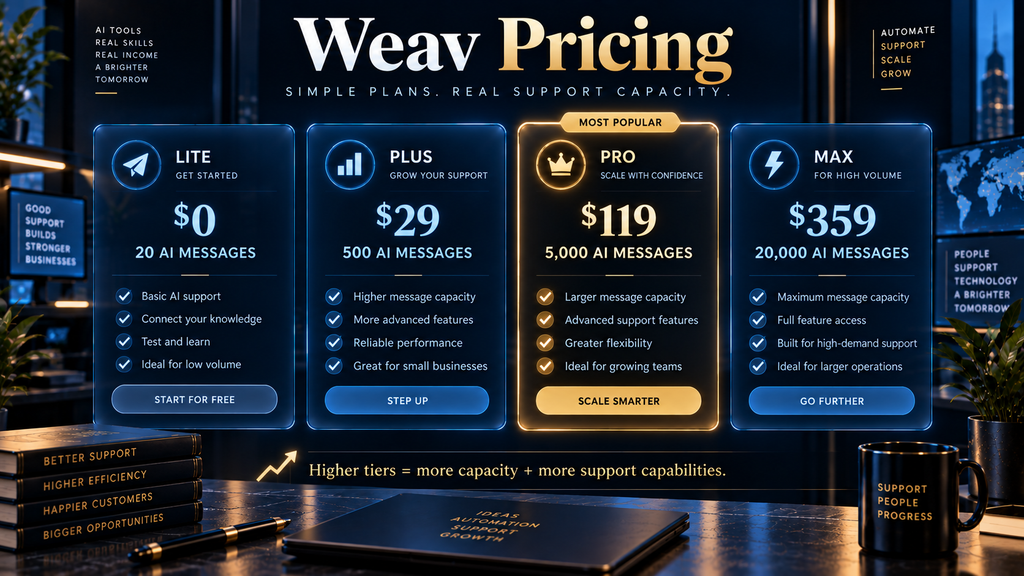
Annual billing is currently advertised with a 20% discount, although the public page’s pricing and plan details should always be checked at the time of purchase because SaaS packaging can change.
The raw mathematics are attractive. Plus works out to about 5.8 cents per included AI message, Pro to about 2.4 cents, and Max to about 1.8 cents. Those are AI Hustle World calculations from the published list prices, not Weav’s quoted cost per resolution, and they should never be presented as though an AI support ticket necessarily costs that amount.
That distinction is central to understanding Weav. If a typical customer issue requires one AI message, your economics look one way. If it takes four or five messages to resolve the same issue, or if half of the conversations ultimately require human intervention, the effective economics look very different.
Estimate Your Cost Per Resolution
Take one month of your tickets, estimate how many Weav could resolve, and compare that number with what support costs you today.
Estimate With Weav →Affiliate disclosure: We may earn a commission if you subscribe through this link, at no additional cost to you.
The Important Question: Is Weav Actually Per-Resolution?
This is where the pricing conversation needs a little more nuance than the title suggests. Weav’s current pricing page clearly presents the public paid tiers in terms of AI messages per month, while Weav’s product positioning and some of its published comparisons emphasize paying for outcomes and resolutions. (Weav) For the difference between the two approaches, read AI chatbots vs AI agents.
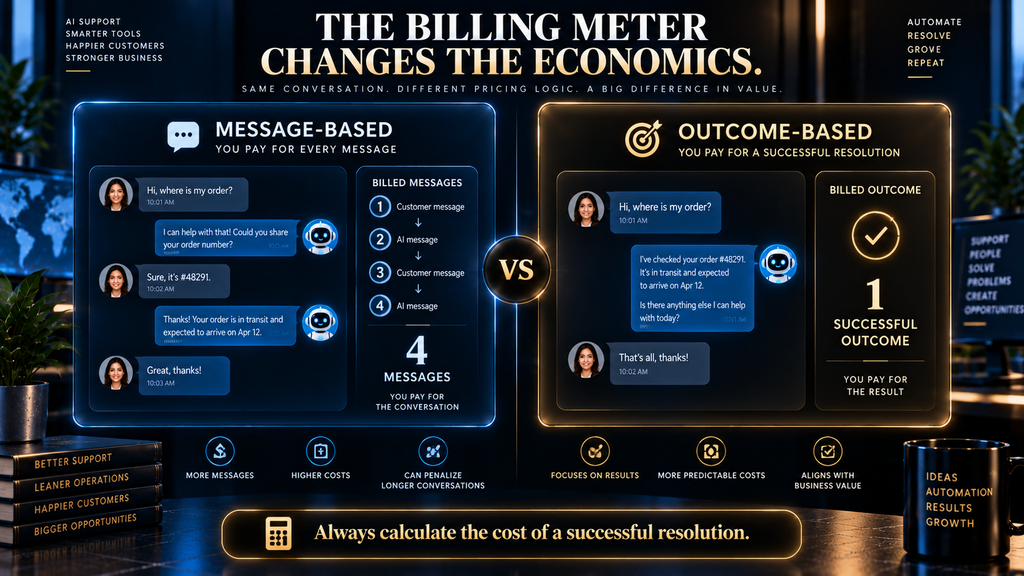
That distinction matters because “per message” and “per resolution” are fundamentally different pricing meters. If an AI agent uses three messages to successfully resolve one customer request, a message-based system charges against three messages while an outcome-based system may charge once for the resulting resolution. The latter can be much easier to model around business outcomes, but it can also carry a higher nominal price per successful event.
Intercom Fin currently provides a clean example of a genuinely outcome-based model. Intercom says Fin costs $0.99 per outcome, and customers are charged only once per conversation even when Fin takes multiple actions; Help Scout similarly charges $0.75 per AI resolution under its current AI Answers model. (Intercom) Zendesk has also moved toward resolution-based AI-agent billing, using automated-resolution tiers and allowances as its measurement and billing mechanism. (Zendesk Support)
So when evaluating Weav, do not assume that “outcome-oriented” marketing language means every current public plan is billed on a strict one-resolution-one-charge basis. For the public pricing available today, the defensible way to model Weav is around its AI-message allowance and then translate that usage into successful resolutions using your own support data. That makes the analysis more honest and, in practice, more useful.
Why the Pricing Meter Matters More Than the Sticker Price
Suppose one platform costs $0.99 per successful outcome and another costs $119 per month for 5,000 AI messages. Which one is cheaper? There is no answer until you know the workload.
The first platform may be excellent for a business where each conversation can be evaluated cleanly as one outcome. The second can be extremely economical for a business that has large volumes of short, repeatable interactions that fit comfortably inside a fixed message allowance. But the second could become less attractive if customer conversations are unusually long, if the AI requires several turns to solve routine questions, or if significant human follow-up remains necessary.
This is why unit economics should always be tied to the actual work being purchased. A pricing model that looks expensive at the message level can be inexpensive at the resolution level, while a low message price can become surprisingly expensive when the AI needs repeated interactions to complete the job. For AI support, the most useful denominator is usually not “message.” It is successfully resolved customer problem.
Weav’s Current Plans: Who Actually Needs Each One?
Lite: A Test Environment More Than an Operating Plan
Lite costs $0 and includes 20 AI messages per month. It also includes one teammate, one custom email, 100 KB of training data, five enabled AI actions, basic helpdesk functionality, and basic reports.
Twenty AI messages is enough to evaluate whether the concept works for a small set of test conversations, but it is too small to think of as serious production support for most active businesses. The useful question here is not whether Lite can replace a human employee; it obviously cannot at that usage level. The useful question is whether the free tier gives you enough room to determine whether your documentation, support use cases, and agent behavior are promising enough to justify moving forward.
That makes Lite primarily an evaluation tier. It can be valuable before spending money because AI support economics are meaningless if the agent cannot reliably answer your actual customer questions.
Plus: The Small-Business Starting Point
Plus costs $29 per month for 500 AI messages and includes two teammates, two custom emails, 1 MB of training data, five enabled AI actions, and basic helpdesk/reporting capabilities.
At this level, the subscription cost itself is unlikely to be the major issue for a business with meaningful support volume. The bigger question is whether the 500-message allowance maps sensibly onto your customer workload. If a business receives a few hundred genuinely repetitive support interactions and the agent resolves a meaningful percentage of them efficiently, $29 can be a relatively small cost for an additional layer of automated capacity.
But businesses should avoid dividing $29 by 500 and calling the result “cost per resolved ticket.” That calculation only describes the economics of the included message capacity, not the economic outcome.
Pro: Where the Economics Become More Interesting
Pro currently costs $119 per month and includes 5,000 AI messages, three teammates, three custom emails, 10 MB of training data, 10 enabled AI actions, advanced helpdesk and reporting, automatic agent retraining, and standard integrations. Plan data for other tools is in our AI Tool Pricing Database.
This is where the pricing starts to make sense for a growing support operation rather than a simple experiment. The raw included-message cost falls dramatically compared with Plus, so a business with enough demand can get considerably more automated capacity without a proportional increase in subscription cost.
The trap is underutilization. Paying $119 for capacity your business does not need is not efficient simply because the unit price looks better. A company handling 600 suitable AI conversations a month may get more economic value from a smaller plan than a company that buys Pro because the per-message number looks attractive.
Max: High Capacity, Not Automatic ROI
Max costs $359 per month and includes 20,000 AI messages, along with expanded capabilities and limits. At approximately 1.8 cents per included message, the raw message economics are the strongest of the public tiers. That still does not mean Max is automatically the most economical choice. The business needs enough support demand to consume the capacity productively, and the AI needs to resolve an appropriate share of that demand without generating substantial human cleanup.
A high-volume business should therefore model Max against its actual projected workload rather than choosing it because it has the lowest nominal message cost. Capacity is only valuable when it is used.
The Hidden Costs Inside a “Cheap” AI Support System
A monthly subscription is only one layer of the economic equation. Weav currently lists additional AI credits at $49 per 1,000, additional teammates at $29 per month, additional custom emails at $29 per month, and branding removal at $99 per month. The public plans also differ in training capacity, actions, reporting, helpdesk functionality, retraining, and integrations. None of that is necessarily a problem. Every SaaS platform has limits and optional capabilities. The mistake is ignoring them while building an ROI model that assumes the advertised plan price represents the entire cost of operating the system.
There is another cost that rarely appears in pricing tables: human oversight. Someone has to maintain the knowledge base, inspect escalations, review poor answers, monitor changing policies, and decide when a workflow is safe to automate. If the agent handles hundreds of conversations while a support manager spends several hours each week cleaning up bad outcomes, the software is still providing value—but not as much value as the subscription price alone would suggest.
The real economic model is therefore larger than: Weav subscription = support cost. It is closer to: Weav subscription + usage + remaining human workload + operational friction = AI-assisted support cost. That is the number worth comparing with traditional staffing.
The Support Cost Stack
To make that calculation easier, AI Hustle World uses a simple framework called the Support Cost Stack.
| Layer | What It Includes |
|---|---|
| Platform Cost | Weav subscription |
| Usage Cost | Included messages, additional AI credits, relevant add-ons |
| Human Residual Cost | Support work still handled by people |
| Friction Cost | Rework, repeat contacts, unnecessary escalations, QA overhead |
| True Resolution Cost | The combined cost of delivering successful outcomes |
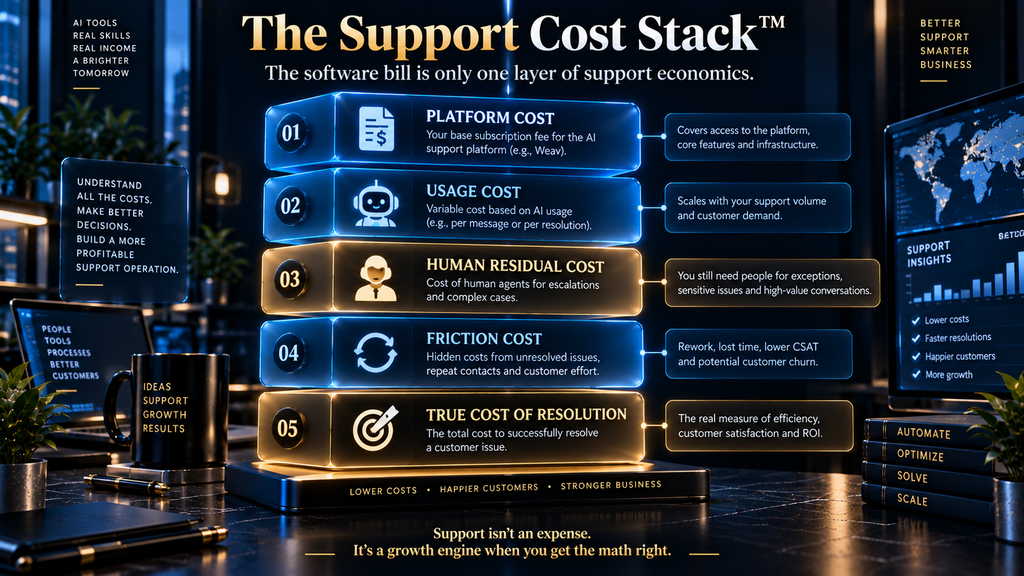
The reason for adding the final two layers is simple: automation can reduce one kind of work while quietly creating another. If an AI answer causes a customer to contact support again, the first interaction was not actually free. If the AI generates a response that a human has to rewrite, the software did not eliminate that labor; it moved it downstream. This does not mean AI support has to be perfect to be economical. Human support is not free from errors, rework, or inefficiency either. The point is that both systems need to be compared on the same economic basis.
How to Calculate the Real Cost Per Resolution
The first useful calculation is not difficult. Start with the monthly cost of your AI support system. Add any predictable usage and operational costs. Then divide that figure by the number of customer problems that were successfully resolved by the AI without unnecessary human intervention. The simplified formula is: AI Cost Per Resolution = Total AI Support Cost ÷ Successful AI Resolutions The difficult part is deciding what counts as a successful resolution. Weav describes its product on its own site.
A conversation where the AI answers a basic question and the customer leaves may qualify. A conversation where the customer receives an answer and immediately returns because the answer was incomplete should not be treated as an equivalent success. Likewise, a conversation escalated to a human may be valuable operationally, but it should not automatically be counted as a fully automated resolution. That is why your definition should be based on customer outcome, not merely conversation status.
Why Resolution Rate Changes the Economics
Weav currently cites an average resolution rate of around 71% in its public product material, while also reporting higher rates for some organizations. Those figures are vendor-reported, not independent benchmark results, and they should not be treated as a prediction for every business. Still, resolution rate is economically important because the subscription price only becomes meaningful when you know how much useful work the system performs.
Imagine a business with 1,000 monthly support conversations that buys a $119 Weav plan. If the system eventually resolves 600 of those conversations appropriately without requiring human follow-up, the business has purchased a different amount of value than if it resolves only 150. The subscription hasn’t changed, but the cost per successful automated resolution has. That is why resolution rate and support volume need to be analyzed together. Neither number means much in isolation.
The Human Support Benchmark
For a meaningful comparison, we also need a baseline for the cost of human support. The U.S. Bureau of Labor Statistics currently reports a median hourly wage of $21.53 for customer service representatives in May 2025. (Bureau of Labor Statistics) Our comparison of AI customer support vs human support and the guide to human-in-the-loop AI cover when people should stay involved.
Assuming 2,080 paid hours in a year, that equates to approximately $44,782 in annual base wages, or roughly $3,732 per month, before employer-side benefits, payroll costs, equipment, recruiting, training, management, leave, and other overhead. This is an AI Hustle World calculation based on the BLS median wage, not a claim that every employer incurs the same total employment cost. That immediately explains why AI support can look so cheap next to human labor. A $119 monthly software subscription is only a small fraction of one full-time employee’s base wages.
But there is a major catch. You are not really comparing $119 of software with $3,732 of human support. You are comparing $119 of software plus the humans who remain necessary with the cost of providing the same level of customer support through people alone. That is a much more serious calculation.
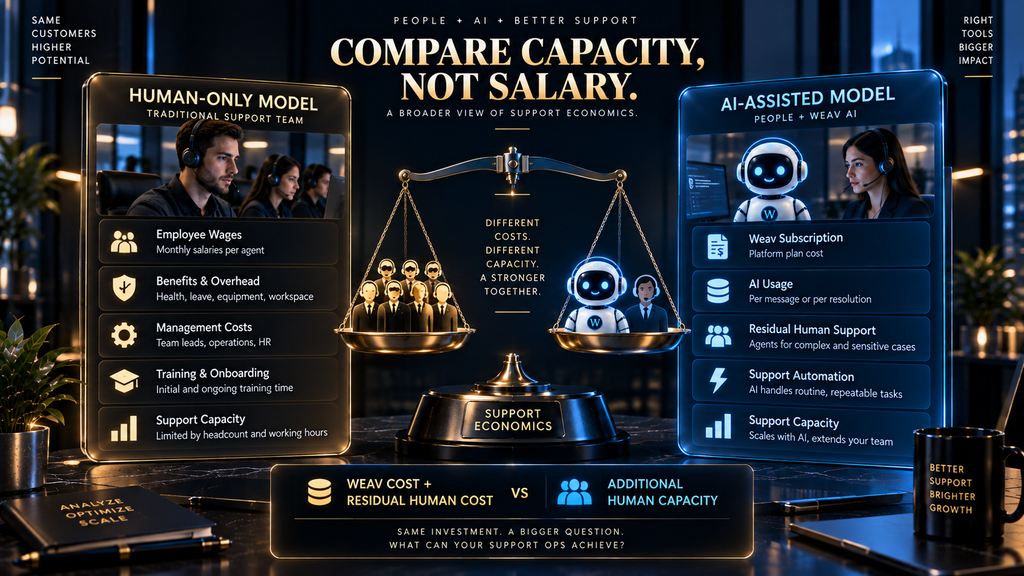
Don’t Compare Weav With a Salary
A human support representative is not simply a very expensive chatbot. A person can handle ambiguous situations, negotiate exceptions, investigate unfamiliar problems, read emotional cues, make judgment calls, and coordinate across systems without being explicitly programmed for every scenario. An AI agent can be much cheaper per interaction for the work it handles well, but its usefulness depends on the boundaries you give it and the systems it can access. See where it sits among the best AI customer service tools.
That means the economic comparison should really be: Additional human capacity required without AI versus – Weav cost + residual human capacity required with AI
This is why a company does not necessarily need to eliminate an employee for AI support to produce a financial return. If the AI allows an existing team to handle substantially more customer volume without adding another support hire, the economic benefit can come from avoiding future headcount growth rather than immediately replacing current staff. That distinction is especially important for smaller businesses.
The More Useful Question: What Human Capacity Does Weav Remove?
Imagine a support team receives 2,000 monthly conversations. Without AI, two employees may comfortably handle that workload. As volume grows to 3,000 or 4,000, the company might need another person.
Now suppose Weav is introduced and successfully absorbs a substantial share of routine questions. The company may still need two people, but the third hire is delayed. That can create a meaningful financial benefit even though zero employees were technically replaced. This is often the more realistic business case for AI support. The value comes from decoupling some support growth from headcount growth.
For a fast-growing company, that can matter more than a simple salary comparison because the relevant question is not “Can AI replace my current employee?” It is “Can AI reduce how quickly my support payroll has to grow as customer volume increases?”
A Simple Break-Even Model
Suppose a business currently spends $4,000 per month on the base wages of one full-time support employee. Now assume the business introduces Weav Pro at $119 per month. A simplistic comparison would claim: $4,000 − $119 = $3,881 saved. That is not a valid savings calculation because the human employee may still be needed. Instead, suppose the AI reduces enough repetitive work that the business can avoid hiring another employee who would otherwise cost $4,000 per month. In that situation, the $119 subscription could be associated with a large avoided staffing cost. For the basics, see how AI chatbots work and AI customer service explained.
But suppose the AI is frequently wrong and creates $1,000 of additional human cleanup each month. The economics become: $119 Weav + $1,000 extra human work = $1,119 incremental support cost. It is still potentially attractive compared with hiring another $4,000 employee, but the return is very different from what the sticker price initially suggested. This is why an honest ROI analysis needs to measure both savings and friction.
Three Scenarios That Show the Difference
Scenario 1: Low Volume
Imagine a small business with only 150 support conversations per month, most of which are unique. In this environment, the absolute cost of human support may be low enough that introducing AI produces limited financial benefit. Even though a $29 subscription sounds inexpensive, the business may spend more time maintaining the system than it saves through automation. Verdict: human support may remain simpler and economically rational.
Scenario 2: High Repetition
Now imagine a growing ecommerce business receiving 2,000 conversations per month, with a large portion involving shipping questions, product information, return policies, and order status.
This is much more favorable for automation because a significant share of the workload follows repeatable patterns. If Weav resolves a meaningful percentage of those conversations and the remaining cases reach humans with useful context, the software can provide a substantial amount of support capacity for a relatively small subscription cost. Weav’s Shopify integration is specifically designed to connect product, policy, and live order information for this kind of support workflow. Verdict: strong candidate for AI-assisted support.
Scenario 3: High Complexity
Consider a business where customers frequently dispute charges, negotiate exceptions, report security incidents, or require individualized decisions. The business may still benefit from AI for documentation lookup and routine triage, but the percentage of cases that should remain human-owned will be much higher. That means the economics cannot be modeled as though the AI replaces most support labor. Verdict: hybrid support is more realistic than aggressive automation.
Why a $29 Plan Can Be More Expensive Than a $119 Plan
This seems counterintuitive until you think in terms of utilization. Suppose a business buys Plus for $29 but consistently hits its 500-message limit and then needs additional credits. Another business buys Pro for $119 and comfortably handles its workload within the 5,000-message allowance. For a step-by-step build, see how to set up an AI customer support agent with Weav.
The second business pays more in absolute terms but may have a lower cost per useful AI interaction and far less operational friction. Weav’s current public pricing makes this volume effect particularly visible because the included message allowance increases much faster than the subscription price as you move up the tiers. But there is another side to the equation: if the first business only uses 200 messages, Plus could be the better choice even though Pro offers a much lower raw cost per included message. The cheapest plan is not the same thing as the cheapest operating model.
Test the Free Plan on Real Questions
Start on the free plan, run your most common questions through Weav and see how resolutions and usage add up.
Start With the Free Plan →Affiliate disclosure: We may earn a commission if you subscribe through this link, at no additional cost to you.
Weav Versus Other AI Pricing Models
Weav becomes easier to evaluate when you place its current public pricing beside other AI-support models.
| Platform | Current AI Charging Approach | Key Economic Question |
|---|---|---|
| Weav | Tiered AI-message allowances | How many messages does one successful resolution consume? |
| Intercom Fin | $0.99 per outcome | How many genuine outcomes will occur? |
| Help Scout AI Answers | $0.75 per resolution | How many sessions qualify as billable resolutions? |
| Zendesk AI | Resolution allowances / tiers | What level of automated resolution usage will the business consume? |
| Gorgias | Helpdesk fees + AI automation usage | How do ticket and AI costs interact? |
Intercom currently defines an outcome as a successful resolution, procedure handoff, or other qualifying result and charges $0.99 per outcome, with only one outcome charged per conversation even when Fin takes multiple actions. Help Scout charges $0.75 per AI resolution and similarly charges once per session even if multiple AI responses occur. (Help Scout) Zendesk has shifted its model toward resolution allowances tied to automated-resolution usage.
These models are not inherently better or worse than Weav’s message-based public structure. They simply move the economic risk to different parts of the support equation. Message-based pricing puts more emphasis on conversation efficiency; resolution-based pricing puts more emphasis on the definition and frequency of successful outcomes.
Why Weav Can Still Be Economically Attractive
Weav’s pricing becomes particularly compelling when your support conversations are relatively efficient and your documentation is strong. Suppose a routine customer question can be answered in one or two AI messages. A large message allowance can then represent a meaningful number of customer interactions. Add a good escalation process and useful integrations, and the AI may remove a significant amount of repetitive workload without requiring a proportional increase in staffing.
That is especially relevant for businesses where customer volume is growing faster than support capacity. Weav’s current product is built around AI support agents, a unified support environment, actions, integrations, and channel support rather than a simple FAQ bot, which means the potential economic value extends beyond answering static questions. But the economics only improve if the agent actually works. A cheap system that produces expensive mistakes is not cheap.
Why Weav May Not Be the Cheapest Choice
There are several situations where the apparent economics break down. The first is low volume. If the business does not have enough repetitive work, the subscription and operational effort may not be justified. The second is poor documentation. If employees themselves struggle to find the correct answer, the AI will have a weak foundation and require more supervision. The third is high human cleanup. An AI agent that answers 60% of questions but causes frequent rework may be less valuable than its automation percentage suggests.
There is also the issue of conversation complexity. A message-metered system becomes less attractive when resolving one customer issue regularly requires many messages. If one simple resolution consumes six or eight AI messages because the conversation is inefficient, the raw cost per message tells you very little about the real economics. That is why businesses should measure messages per successful resolution after deployment. It is one of the most revealing numbers for a platform whose public plans are metered in AI messages.
The Metric Weav Buyers Should Track: Messages Per Resolution
This is perhaps the most useful metric to add to your support dashboard. Calculate: AI Messages Used ÷ Successful AI Resolutions Suppose 5,000 AI messages produce 2,000 successful resolutions. That means the system used: 2.5 AI messages per successful resolution. Now imagine another month where the same 5,000 messages produce only 1,000 successful resolutions. The message allowance has not changed, but the economics have deteriorated to: 5 AI messages per successful resolution.
The difference could come from longer conversations, poorer knowledge retrieval, more complicated support questions, or more frequent escalation. This metric turns Weav’s message-based pricing into something much closer to an outcome-based economic model.
The Second Metric: Human Cleanup Per AI Resolution
Messages per resolution are only half the picture. Suppose the AI successfully resolves 1,000 conversations, but human agents spend 20 seconds reviewing or correcting the output of each one. That represents more than five and a half hours of human work. At small scale, that may be trivial. At large scale, it becomes meaningful. So the second calculation should be: Human Cleanup Hours ÷ Successful AI Resolutions A good AI support system should ideally reduce this number over time as knowledge, configuration, and workflows improve. If your automation rate increases while human cleanup rises faster, the economics are moving in the wrong direction.
The Third Metric: Avoided Hiring Cost
This is often the most strategically important number for growing businesses. Suppose support volume is expected to increase by 60% over the next year. Without automation, the business believes that growth would require an additional support hire. With Weav handling an appropriate portion of routine demand, the team believes it can absorb that growth without adding the position. The value of the AI is then partly represented by the cost of the avoided or delayed hire.
That is fundamentally different from saying, “Weav replaced an employee.” The business may instead have achieved something more practical: more support capacity without proportional payroll growth. For a startup or small ecommerce operation, that can be one of the strongest arguments for AI support.
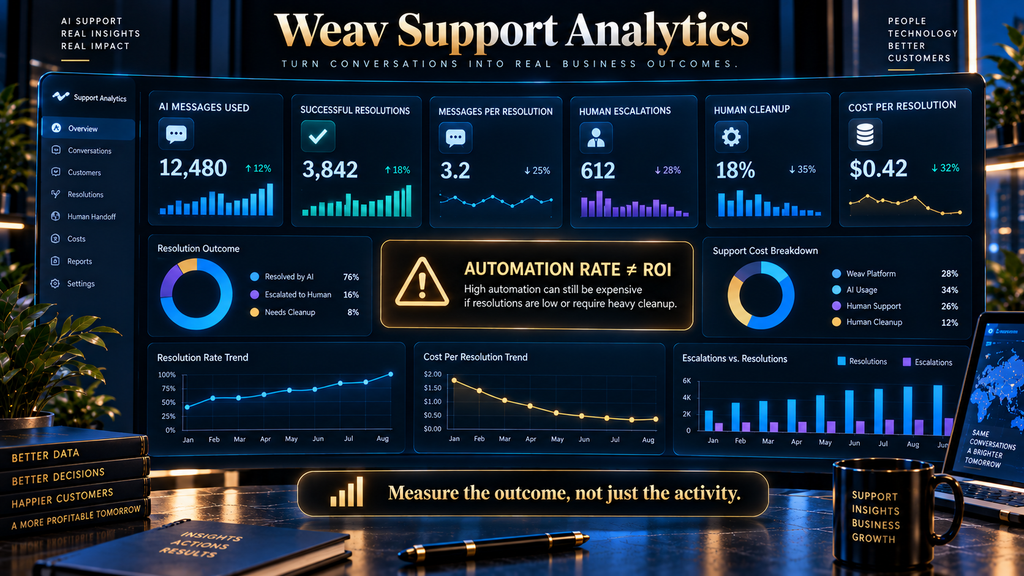
Build Your Own Weav ROI Model
Before choosing a plan, gather six numbers from your current support operation:
- Monthly support conversations
- Current human support cost
- Percentage of conversations that are repetitive
- Current human cost per successful resolution
- Expected AI resolution rate
- Expected human cleanup or escalation workload
Then estimate the AI-assisted model. A simple version is:
- Human-only model. Monthly support cost = current human labor cost
- AI-assisted model. Monthly support cost = Weav cost + additional usage + residual human labor + cleanup
- Monthly benefit. Benefit = Human-only support cost − AI-assisted support cost
Simple ROI. ROI = Monthly Benefit ÷ AI-assisted support cost × 100 These formulas are intentionally simple. A larger organization may need to incorporate occupancy, payroll taxes, benefits, management, software licenses, training, quality assurance, opportunity cost, and customer-lifetime-value effects. But even the simple version is far more useful than comparing a SaaS subscription with a salary.
How to Define “Fully Loaded” Human Support Cost
The BLS wage figure gives us a useful starting point, but it is not the employer’s complete cost. A support representative earning the median wage does not work in isolation. The organization may also provide benefits, payroll contributions, equipment, software, office infrastructure, management, training, recruiting, scheduling, paid leave, and quality assurance. BLS’s wage statistics therefore should be treated as a labor benchmark, not as a complete employer-cost model. For your own business, a better calculation is: Annual base pay + employer payroll costs + benefits + support software + equipment + management allocation + recruitment/training Our Weav vs Intercom Fin comparison covers the enterprise-scale option.
Then divide by the number of successfully handled support cases. That gives you a more realistic cost per human resolution. This number can be surprisingly different from salary divided by tickets because not every paid hour is spent actively resolving customer conversations.
The Hybrid Model Is Usually the Real Winner
The most realistic economic comparison for many businesses is not: Weav vs humans. It is: Weav + humans vs humans alone. The AI handles repeatable, low-complexity work. People handle exceptions, sensitive issues, complex troubleshooting, negotiations, and situations where judgment matters. That lets the company keep human expertise where it creates the most value while reducing the amount of human time consumed by repetitive questions. This model also reduces the pressure to make aggressive automation decisions.
You do not need the AI to handle everything. You need it to handle enough of the right work to materially improve the economics.
Where the Traditional Human Model Still Wins
There are situations where hiring or retaining human support remains the rational choice. If your support volume is low, a human may simply be easier. There is no knowledge-ingestion project, no agent-monitoring process, no AI-message allowance to manage, and no question about whether a particular interaction should have been automated.
Humans also remain valuable when the support environment involves high emotional complexity or significant judgment. A customer disputing a serious charge, reporting suspected fraud, negotiating a business-critical contract, or dealing with an unusual service failure may need a human even if the AI could technically produce a plausible response. In those situations, the economic comparison should not be framed as “AI is cheaper.” It should be framed as: AI can reduce the routine layer while humans continue to own the consequential layer.
Don’t Let a High Automation Rate Fool You
Suppose one support platform claims it can automate 80% of your conversations. At first glance, that sounds extraordinary. But what if 15% of those conversations later return because customers did not get the answer they needed? What if another 10% generate human cleanup? What if the remaining escalations are the most difficult cases and therefore require more agent time than before? The apparent 80% automation rate may not represent 80% cost reduction.
That is why resolution quality, repeat contact, escalation quality, and human rework belong alongside the automation percentage. In support operations, a smaller number of genuinely resolved conversations can be economically better than a larger number of superficially deflected ones.
A Reality Check on Weav’s 71% Resolution Claim
Weav currently promotes an average resolution rate of around 71% across its Resolution Engine and cites higher percentages for some customer organizations. These figures come from Weav’s own materials and therefore belong in the vendor-claim category rather than the independent-research category. That does not make the numbers useless. They can help you understand what Weav believes its platform can achieve and give you a benchmark to investigate during your own evaluation.
But do not put “71%” into an ROI spreadsheet as though your business will automatically achieve it. A much better process is: Start with Weav’s published claim as a hypothesis → test your real support workload → measure your actual resolution rate → calculate your actual cost per successful resolution. That converts marketing evidence into business evidence.
What Weav’s Pricing Means for a Small Business
For a small business, the attractive part of Weav is that the entry cost is low enough to experiment without making a major capital commitment. Plus is $29 per month, while Lite is free, so a business can test whether AI support actually works for its documentation and customer questions before scaling into a larger operation.
But small businesses should be particularly careful about over-automation. If the owner already receives only a handful of support questions each day, introducing a sophisticated system may not save enough time to justify the monitoring and maintenance required. In that situation, the best use of Weav may be to handle specific repetitive categories rather than becoming the front line for everything.
The strongest small-business case is usually a founder or tiny support team drowning in repetitive questions while customer volume is growing. In that situation, even a modest reduction in routine workload can create disproportionate value because the saved human time can be redirected toward sales, product development, operations, or higher-value customer conversations.
What Weav’s Pricing Means for a Growing Business
The economics become more compelling when the business has enough volume to make automation meaningful but is not large enough to justify a large enterprise support infrastructure.
This is the range where Pro’s current 5,000-message allowance can become interesting. A growing team can gain a substantial amount of automated capacity while still maintaining a human layer for exceptions and escalations. The product also adds automatic retraining, standard integrations, advanced helpdesk functionality, and advanced reporting at that tier.
The correct decision, however, depends on actual utilization. A business should compare expected monthly AI messages with historical support conversations and then test how many messages are consumed per successful resolution. That produces a much clearer picture of whether Pro is genuinely a better economic fit than Plus.
What Weav’s Pricing Means for High-Volume Support
At high volume, the issue changes again. The business is no longer deciding whether $29 or $119 feels affordable. It is deciding whether the selected architecture can support a large enough share of customer demand without creating unacceptable usage costs or human cleanup.
Max provides 20,000 AI messages for $359 per month, which is very strong raw message economics. But a high-volume organization should still stress-test the model against peak periods, longer conversations, unusual ticket types, and human escalations rather than calculating average monthly usage alone.
This is also where vendor pricing should be compared carefully with alternatives such as Fin, Help Scout, Zendesk, or Gorgias. A true outcome-based model may have more predictable economics when conversations vary greatly in length, while a message allowance may be more attractive when the support workload consists of many short, repeatable interactions.
The Hidden Variable: Support Complexity
Support volume gets most of the attention, but support complexity may matter even more. Imagine two businesses handling 5,000 conversations a month. Business A receives simple questions about shipping, product specifications, account settings, and order status. Business B receives complex technical troubleshooting, sensitive billing disputes, and highly individualized service problems. Both businesses have identical volume. Their AI economics will probably be very different. The first business has a large pool of repeatable work that can potentially be standardized. The second has a much smaller pool of conversations that can be safely automated without human judgment. That means a support-volume forecast is incomplete without a support-complexity forecast.
The Best Weav Buyers Don’t Maximize Automation
There is a common assumption that the economic winner is the business that automates the highest percentage of support. That is not necessarily true. A company might automate 75% of support conversations and create considerable friction. Another might automate only 45% but resolve those conversations cleanly while sending complex cases to highly prepared human agents. The second operation could have lower total support cost and better customer satisfaction. This is why the correct optimization target is not: Maximum AI coverage.
It is: Maximum useful resolution per dollar of total support cost. That is a much harder metric to game and a much better metric for management decisions.
A Practical Decision Matrix
| Your Situation | Likely Best Direction |
|---|---|
| Very low support volume | Human support may be simplest |
| Moderate repetitive volume | Test Weav Plus |
| Growing repetitive workload | Evaluate Pro |
| High support volume with strong AI performance | Model Pro vs Max |
| Complex support requiring frequent judgment | Hybrid model |
| Poor documentation | Fix knowledge before scaling AI |
| High repeat contacts after AI answers | Improve workflow before expanding |
| High human cleanup | Reassess AI scope |
| Rapidly growing support volume | Model avoided future hiring |
| Nearly every case is unique | Human-led support may remain better |
This is not a universal pricing recommendation. It is a decision framework based on workload, complexity, resolution quality, and staffing requirements.
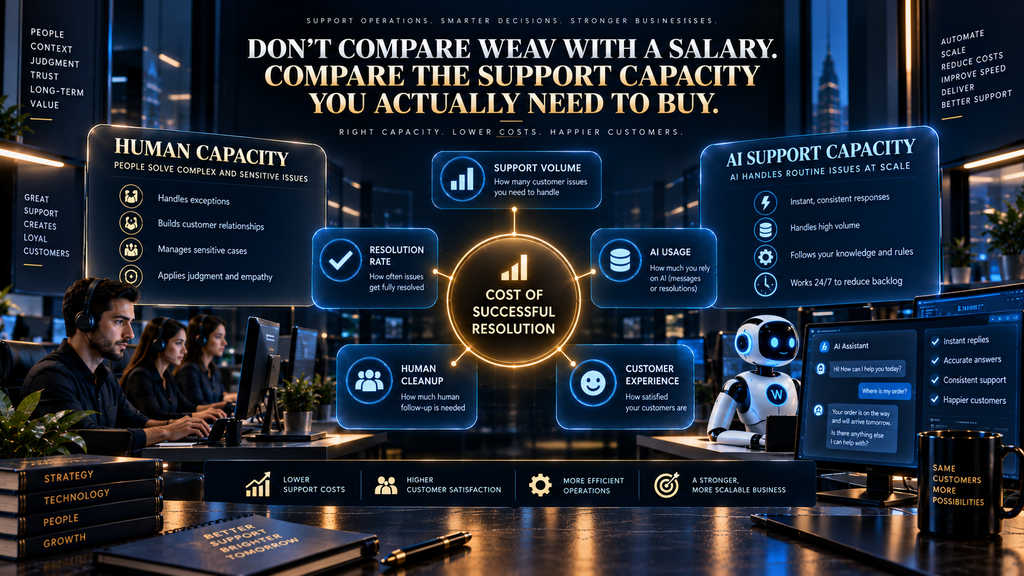
The Contrarian Answer: Don’t Compare Weav With a Salary
The most misleading AI-support ROI calculation is: We compare it with a leading chatbot builder in Weav vs Chatbase.
- Human = $4,000/month
- AI = $119/month
- Therefore AI saves $3,881/month.
That calculation assumes a false equivalence. The better model asks what the business actually needs to deliver its support workload. If the business needs one full-time human regardless of what the AI does, then the AI’s value may come from increasing that employee’s capacity rather than eliminating the position. If the business expects to hire another person as support volume grows, AI may delay that hire. If the AI allows the existing team to focus on high-value cases while it handles routine ones, the benefit may appear as productivity rather than headcount reduction.
This is why the strongest business case for Weav is often capacity expansion without proportional labor expansion. That is a far more defensible claim than saying AI simply replaces an employee.
How to Know Whether Weav Is Actually Saving You Money
After deployment, track the system for at least several weeks rather than deciding from the first few conversations. Start with:
- AI messages consumed
- Successful AI resolutions
- Messages per successful resolution
- Human escalations
- Repeat contacts
- Human cleanup time
- Customer satisfaction
- Total monthly support labor
Then compare the new support economics with the baseline you recorded before automation. If the AI handles more conversations while total support labor remains flat and customer experience stays healthy, that can represent meaningful productivity improvement. If AI usage increases while customer repeat contacts and human cleanup also increase, the system may need better knowledge, a narrower workload, better escalation rules, or a different plan before the business scales it further.
What Happens If You Do Nothing?
Continuing with a human-only support model is not inherently inefficient. For some businesses, it remains the simplest and most appropriate operating model, especially when support volume is low or conversations are highly individualized.
The problem appears when support demand increases while the business remains dependent on people answering more and more repetitive questions. At that point, the company often has three choices: accept slower service, add more human capacity, or find a way to automate part of the workload. AI introduces a fourth possibility: increase support capacity without making every additional customer create an equivalent amount of additional human work. The financial advantage, when it exists, is therefore not necessarily visible as “one employee disappeared.” It may appear as a support team handling significantly more customers before the next staffing threshold is reached.
The Second-Order Effect: AI Changes the Human Job
There is another economic effect that pricing tables rarely capture. When an AI agent handles routine questions, human support staff increasingly see the conversations that are unusual, emotionally difficult, commercially important, or operationally complex. Their average conversation can become harder even while the total number of conversations they handle declines. That means staffing models may need to change after automation. Employees may need better escalation context, stronger troubleshooting skills, greater decision-making authority, and more sophisticated tools. In some organizations, the result is not fewer people but more valuable human work per person.
That is one reason the hybrid model is so important. The AI handles what is predictable; the human team becomes more concentrated around the work where judgment actually adds value.
A Better Way to Think About Weav’s Price
The most useful interpretation of Weav’s current public pricing is not that it is “cheap” or “expensive.” It is that the platform gives you a bounded amount of automated support capacity for a predictable subscription price, with additional usage and capability costs as your operation grows. The economics are then determined by how efficiently you turn that capacity into successful customer resolutions. That makes Weav especially interesting for businesses where the support workload is repetitive enough to automate but varied enough that a human-only model becomes expensive as volume grows.
It also explains why pricing should be evaluated alongside knowledge quality, resolution rate, human handoff, support complexity, and customer experience rather than in isolation.
So, Is Weav Cheaper Than Hiring Support Staff?
It can be, but that is not the right universal promise to make. For a business with substantial repetitive support volume, Weav’s current public subscription prices are small compared with U.S. customer-service wage benchmarks, and the economic opportunity can be significant when automation reduces the need for additional human support capacity. But a fair comparison requires more than putting $119 next to a salary. You need to account for AI-message consumption, successful resolutions, residual human work, escalation, cleanup, customer experience, and any additional usage or capability costs.
That is why Weav can be an excellent economic choice for one business and a poor one for another even when both pay exactly the same subscription price. The real answer lives in your workload.
Who Should Choose Weav for Cost Reasons?
Weav deserves serious consideration when a business has high enough support volume to create meaningful automation opportunities, a reasonably reliable knowledge base, repetitive customer questions, and a human team that can handle the exceptions the AI should not own.
The case becomes stronger when the alternative is not merely “continue with one employee,” but “hire another employee as customer volume grows.” In that situation, the value of AI can come from slowing the relationship between support volume and headcount. Businesses using ecommerce integrations or other connected workflows can potentially gain even more value because some support questions require current customer or operational data rather than static documentation. Weav’s current Shopify integration is one example of this model.
Who Should Not Choose Weav Primarily to Save Money?
Businesses with very low support volume should be cautious. If a founder or small team can answer the occasional support request without meaningful disruption, automation may add more operational overhead than financial value.
Businesses with highly complex or high-risk support should also be cautious about assuming AI can replace human capacity. The right outcome may be a hybrid model where AI handles documentation and routine triage while humans remain firmly responsible for sensitive decisions. And businesses with poor documentation should not expect pricing to solve a process problem. If the company has no reliable source of truth, adding AI may expose that weakness rather than eliminate it.
Final Thoughts
Weav’s current pricing makes one thing clear: the subscription price is only the beginning of the economic calculation. The public plans range from free to $359 per month and provide increasingly large AI-message allowances, but the true value depends on how those messages translate into successful customer resolutions.
That is also why the “per-resolution” question needs a little care. Weav’s positioning is strongly centered on AI support outcomes, but its current public pricing is better modeled as message-based capacity. Rather than forcing that into a simplistic label, a business should measure its own messages per resolution, resolution quality, human cleanup, and residual support workload.
The comparison with human support becomes much more useful once you frame it around capacity rather than replacement. A support employee may cost thousands of dollars in monthly base wages before additional employment costs are considered, while a Weav subscription can cost a fraction of that; but the AI does not eliminate the need for humans, and pretending otherwise produces bad ROI math.
The businesses most likely to benefit are the ones with repetitive support demand, reliable information, clear boundaries, and enough volume for automation to create meaningful leverage. For those businesses, the strongest economic argument may not be that Weav replaces a person today. It may be that the next thousand customers do not require the next thousand units of human support capacity. That is the number worth calculating. Don’t compare Weav’s price with a salary. Compare it with the support capacity you actually need to buy.
Decide Whether Weav Costs Less Than Staffing
Compare the plan price with the loaded cost of the support hours it would replace before you commit.
Review Weav Plans →Affiliate disclosure: We may earn a commission if you subscribe through this link, at no additional cost to you.
Frequently Asked Questions
1. How much does Weav cost?
Weav’s current public pricing lists Lite at $0 per month, Plus at $29, Pro at $119, and Max at $359. The paid tiers include different AI-message allowances, with Plus offering 500, Pro 5,000, and Max 20,000 AI messages per month.
2. Is Weav priced per resolution?
Weav’s current public pricing page is primarily structured around monthly AI-message allowances rather than a simple per-resolution fee. Weav’s broader product positioning and some of its published material use outcome- and resolution-oriented language, so it is important not to confuse that positioning with the current public plan meter.
3. What is the cheapest paid Weav plan?
The cheapest paid plan currently listed is Plus at $29 per month, with 500 AI messages. Lite is free but includes only 20 AI messages per month, making it more suitable for evaluation than substantial production support.
4. Which Weav plan is best for a growing business?
Pro is designed for fast-growing teams and currently includes 5,000 AI messages per month, three teammates, more training capacity, more enabled actions, advanced helpdesk/reporting capabilities, automatic agent retraining, and standard integrations. Whether Pro is actually the best economic choice depends on your support volume and how efficiently the AI turns those messages into successful resolutions.
5. Does Weav charge for extra AI usage?
Yes. Weav’s current public pricing lists additional AI credits at $49 per 1,000. Other add-ons, such as extra teammates and custom emails, also have published pricing. That means your ROI model should account for the possibility that your actual usage exceeds the included plan allowance.
6. Is Weav cheaper than hiring a customer-support employee?
Potentially, but the comparison should be made against the human support capacity the AI can replace or defer, not against an entire salary in isolation. The U.S. BLS reports a median customer-service-representative wage of $21.53 per hour in May 2025, but actual employer cost is higher once benefits and other expenses are included.
7. What is the best way to calculate Weav’s ROI?
Track your monthly Weav cost, AI usage, successful AI resolutions, human escalations, repeat contacts, and human cleanup time. Then compare the resulting AI-assisted support cost with the equivalent human-only support cost. The most useful unit metric is often cost per successful resolution, not cost per AI message.
8. Is a lower cost per AI message always better?
No. A low message cost is useful only when those messages produce successful outcomes efficiently. If customers require many messages to resolve a routine problem or frequently need human follow-up, the effective cost per successful resolution can be much higher than the raw message price suggests.
9. How does Weav compare with outcome-based AI support pricing?
Intercom Fin currently charges $0.99 per outcome, while Help Scout charges $0.75 per AI resolution, so those systems use a different billing denominator from Weav’s public message-based tiers. The best model depends on the support workload. Message-based pricing can work well when conversations are efficient and predictable, while outcome-based pricing can be easier to model when conversations vary considerably in length.
10. Should a business replace its support team with Weav?
That is rarely the right starting assumption. A stronger model is to use AI for repeatable support work while keeping humans responsible for exceptions, sensitive issues, complex troubleshooting, and situations requiring judgment. The economic goal should be more useful support capacity per dollar, not the lowest possible employee count.
Written by
Muntasir Ahmad Chowdhury
Founder, AI Hustle World
Muntasir Ahmad Chowdhury is the Founder of AI Hustle World, an independent publication dedicated to making Artificial Intelligence practical, trustworthy, and easy to understand. He researches AI tools, automation, customer service, productivity, and real-world business applications, helping readers make smarter technology decisions through research-driven, experience-backed content.
Expertise:
AI Tools • AI Automation • AI Customer Service • AI Productivity • Generative AI • AI Workflows
Get Smarter With AI
Enjoyed this guide? Get practical AI tools, tutorials, and honest reviews delivered to your inbox.
4 thoughts on “Weav Pricing Explained: Cost Per Resolution vs Hiring Support Staff”