
AI Data Retention Explained: What Happens to Your Prompts and Uploaded Files?
You upload a confidential contract to an AI assistant, ask it to identify the renewal clause, receive a useful answer, and then delete the conversation. From a user’s perspective, the sequence feels complete: the file went in, the answer came out, and the conversation is gone. But modern AI systems rarely work as simply as that interface makes them appear. Your prompt may become part of a conversation record, an uploaded document may have its own storage lifecycle, connected applications may retain their original data independently, and business systems may preserve AI interactions for security, compliance, or audit purposes.
That is why the question “Does AI keep my data?” is too broad to be useful. The more important questions are: What data was created? Where can it persist? Who can access it? Is it used to improve models? How long is it retained? What happens when you delete it? And what other systems may still have a copy? Those questions reveal the real data lifecycle behind an AI interaction.
This distinction matters because data retention, model training, access, and deletion are different concepts. An AI provider can retain a conversation without using it to train a model. A user can turn off model improvement while keeping conversations in their account history. A company can configure its enterprise environment to retain AI interactions for compliance even when the underlying model provider does not use those interactions for training. And deleting a chat does not necessarily mean every related file, connected application record, organizational archive, or legally retained copy disappears at exactly the same moment.
The practical principle for individuals and businesses is therefore simple: never evaluate AI privacy from a single sentence such as “your data is not used for training.” That statement may answer one important question, but it does not answer the larger question of what happens to the information throughout the AI workflow.
The Real Meaning of AI Data Retention
AI data retention is the period and conditions under which information associated with an AI interaction remains stored or otherwise available within an AI provider’s systems, a customer’s systems, or connected services. The information involved can include prompts, responses, uploaded files, images, audio, feedback, account information, usage records, security-related records, and information retrieved from other applications.
The first mistake is treating all of this as one thing called “the chat.” Modern AI applications increasingly behave more like software platforms than simple chat windows. A conversation may be stored in one system, an uploaded file in another, a generated artifact somewhere else, and an enterprise compliance record in yet another system. If the AI is connected to Google Drive, Microsoft 365, a CRM, a support platform, or another data source, the original information may remain under that system’s own retention rules even after the AI interaction has ended.
This means that AI retention is best understood as a data-lifecycle problem. The relevant question is not merely whether the AI remembers what you said. The question is what information is generated by the interaction, where that information travels, what purpose each copy serves, and which policy governs each stage.
Consider a business employee who uploads a customer agreement and asks an AI system to summarize its obligations. At minimum, there may be a prompt, a response, and an uploaded document involved. If the product saves uploaded files separately from chats, the document can have a different lifecycle from the conversation. If the employee uses an organization-managed AI environment, the interaction may also be subject to administrative or compliance controls. If the AI retrieves information from a connected document repository rather than from a manually uploaded file, the underlying source document remains governed by that repository.
That is why the right mental model is not “AI sees my prompt.” It is “AI participates in a data flow.”
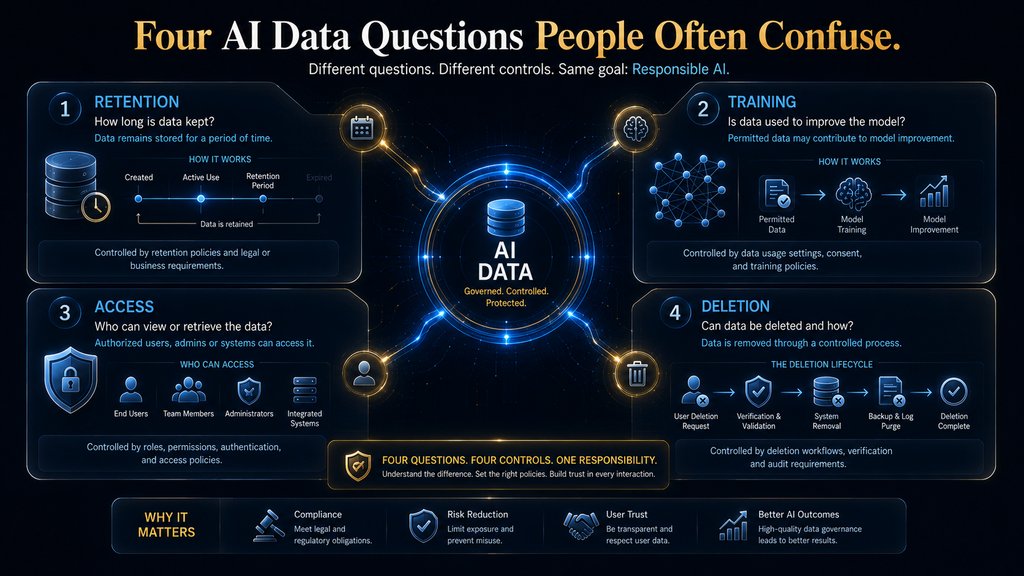
Retention, Training, Access, and Deletion Are Four Different Questions
The most important distinction in AI privacy is between retention and model training. They are related, but they are not interchangeable.
Retention asks how long information remains stored or available. Training asks whether information can be used to improve or develop AI models. Access asks which people, systems, administrators, or providers can potentially retrieve the information. Deletion asks what happens when the user, administrator, or retention policy requests that information be removed.
A useful example is ChatGPT. OpenAI’s current Data Controls documentation says that when a user turns off “Improve the model for everyone,” new conversations can remain in chat history while not being used to improve ChatGPT. In other words, turning off model improvement does not equal deleting the conversation.
The same distinction appears in temporary-chat systems. OpenAI says Temporary Chats do not appear in history and are not used to improve models, but they can still be retained for up to 30 days for safety purposes.
This is why statements such as “your data is not used to train AI” should never be interpreted as “your data is never stored.” The first statement concerns model improvement. The second concerns retention. They answer different questions.
The distinction becomes even more important in business environments. A company may deliberately retain AI prompts and responses because they form part of an audit trail, while simultaneously using an AI product whose customer content is excluded from model training by default. Microsoft Purview, for example, provides retention controls for supported AI interactions, including prompts and responses, so organizations can apply their broader information-governance requirements to AI activity.
This leads to the first major takeaway for anyone evaluating an AI service:
“Not used for training” tells you what may happen to the data for model improvement. It does not, by itself, tell you how long the data is stored or who can access it.
What Actually Happens After You Press Send?
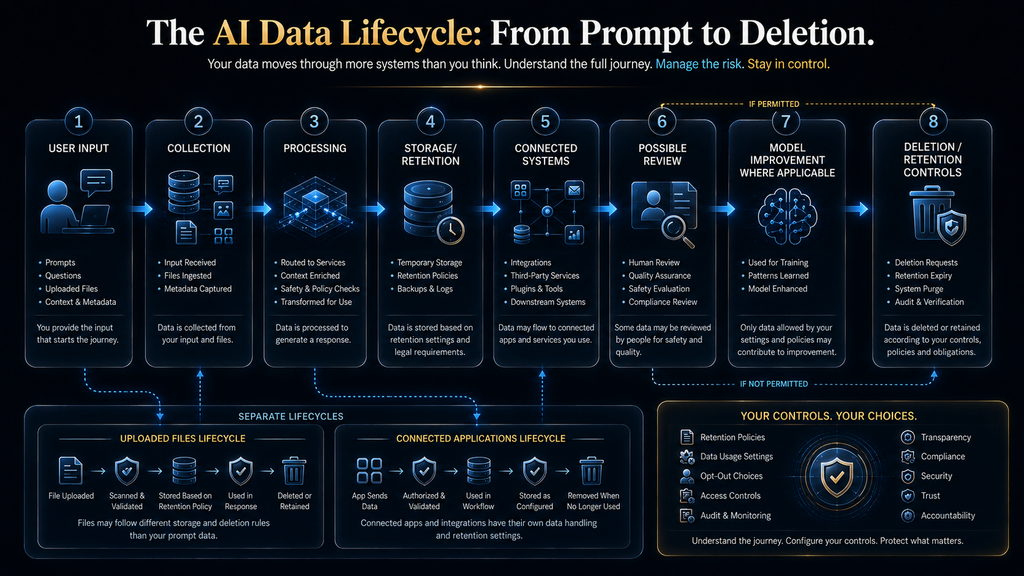
The visible interaction is simple: you type a prompt, the system processes it, and an answer appears. The underlying workflow can be considerably more complicated.
Your request first has to reach the AI service. The system then processes the prompt and any associated information, which may include uploaded documents, images, retrieved information, conversation context, or data from connected applications. Depending on the product, some or all of that interaction may then be stored so that features such as conversation history, personalization, projects, knowledge bases, auditing, or administrative controls can function.
The response itself can also become part of the stored interaction. If you continue the conversation, later prompts may depend on earlier context. If you provide feedback, that feedback can create another data-handling pathway. If the system invokes external tools or connected applications, those services can introduce additional data boundaries.
This is one reason modern AI privacy cannot be evaluated solely by reading the model provider’s marketing page. You need to understand the whole workflow.
Imagine a support manager asking an AI assistant, “What are the most common complaints about our cancellation process?” The AI might answer from a manually uploaded spreadsheet, a connected customer-support database, an internal document repository, or a combination of those sources. In each scenario, the AI interaction is only one component of the larger information flow.
The retention question therefore changes depending on how the answer was produced. If the manager uploaded a spreadsheet, the file’s storage policy matters. If the AI retrieved information from a CRM, the CRM’s own access and retention controls matter. If an API application processed the request, the application’s logging policy matters. If the interaction was captured by an enterprise compliance system, that policy matters as well.
The more capable AI becomes, the less useful it is to think of privacy as a property of the chatbot alone.
Uploaded Files Deserve Separate Attention
Uploaded files are one of the biggest sources of confusion because users often assume that a document attached to a conversation is temporary. In many AI systems, that assumption is no longer safe.
Some products maintain separate file storage so users can reuse documents across conversations, projects, custom assistants, or knowledge bases. OpenAI’s current ChatGPT documentation is a clear example: uploaded and created files can be automatically saved to a dedicated Library, and that file storage is separate from ordinary chat history. Files deleted from Library are scheduled for permanent deletion within 30 days, subject to stated exceptions such as de-identification or legal and security obligations.
This architecture creates an important difference between deleting the conversation and deleting the underlying file. If a document is stored independently in a Library, deleting the conversation where you first uploaded it may not necessarily remove the file from that separate storage area. OpenAI explicitly documents separate file management for Library files.
Temporary workflows can behave differently. OpenAI currently says files uploaded during Temporary Chat are not saved to the user’s account or Library. That is a useful example of why retention must be evaluated at the feature level, not merely at the brand level.
The same principle applies outside ChatGPT. Enterprise AI products can store files in organizational repositories, while AI-powered applications may maintain uploaded documents in their own cloud infrastructure. A knowledge-base platform may intentionally retain documents because persistent retrieval is the entire purpose of the product. In those cases, deleting the chat that led to the upload may have little or no effect on the underlying knowledge source.
For businesses, the implication is significant: a file uploaded to AI should be treated as a data asset, not merely as an attachment. The organization should know where it is stored, what systems can access it, how long it remains there, and how it is ultimately deleted.
Why Deleting a Chat Is Not the Same as Instant Physical Erasure
Users naturally interpret a Delete button as an immediate command to destroy every copy of the information. Cloud systems generally do not work that way.
Deletion often involves multiple stages. The item can disappear from the user interface first, become unavailable through ordinary account access, enter a deletion workflow, and later be permanently removed from applicable production systems. Certain records may also be subject to security, legal, regulatory, or compliance requirements that affect when permanent deletion can occur.
OpenAI currently explains that Temporary Chats are deleted from its systems after 30 days, while deleted files are scheduled for permanent deletion within 30 days subject to stated exceptions.
Microsoft’s enterprise retention architecture demonstrates the same general principle from a different direction. When retention policies apply to Copilot interactions, messages can enter retention or hold mechanisms and may remain discoverable under applicable compliance processes even after they are no longer visible in the ordinary AI interface. Microsoft’s documentation explains that retention can continue through mechanisms such as retention policies and eDiscovery holds.
This is not an argument against deletion. It is an argument for understanding what deletion actually means.
A useful way to think about it is that “delete” is an instruction to begin a lifecycle transition, not necessarily a guarantee that every physical copy disappears at the exact instant you click the button.
That distinction matters particularly when an organization needs to establish defensible retention policies. If a legal investigation requires certain records to be preserved, an organization may intentionally prevent their immediate deletion. Conversely, if information no longer has a legitimate business purpose, retaining it indefinitely creates unnecessary exposure.
The objective should therefore be neither “delete everything immediately” nor “keep everything forever.” The objective is purpose-based retention.
Why AI Providers Retain Data in the First Place
Retention is not automatically evidence of poor privacy practices. Many useful AI features depend on some degree of persistence.
Conversation history requires stored conversations. Persistent projects require stored project data. Reusable knowledge bases require stored documents. Security systems may need enough information to investigate abuse. Enterprise compliance systems may need records to demonstrate how AI was used. Customer-support workflows may require historical context to function correctly.
The real governance question is therefore not whether a provider retains anything. It is whether the type, duration, purpose, and access level of retention are proportionate to the service being provided.
A consumer AI assistant designed around conversation history has a different reason to retain information from an API endpoint designed to process a transaction and return a result. An enterprise compliance environment may have a legitimate reason to preserve prompts and responses that would be unnecessary to retain in a casual personal brainstorming workflow.
This is where data minimization and retention management need to work together. Data minimization asks, “Does the AI need this information at all?” Retention management asks, “Once the AI receives it, how long should it remain available?” Solving only one of those problems leaves the other exposed.
Suppose an employee wants an AI assistant to analyze customer complaints. The employee could upload a complete database containing names, addresses, phone numbers, account identifiers, transaction information, and complaint text. But if the analytical task only requires complaint categories, dates, anonymized identifiers, and message content, most of that personal information is unnecessary.
Removing unnecessary information before the AI receives the dataset reduces the potential impact of any later retention. This is a stronger strategy than relying entirely on a provider’s deletion policy.
Consumer AI, Business AI, and API Workloads Follow Different Logic
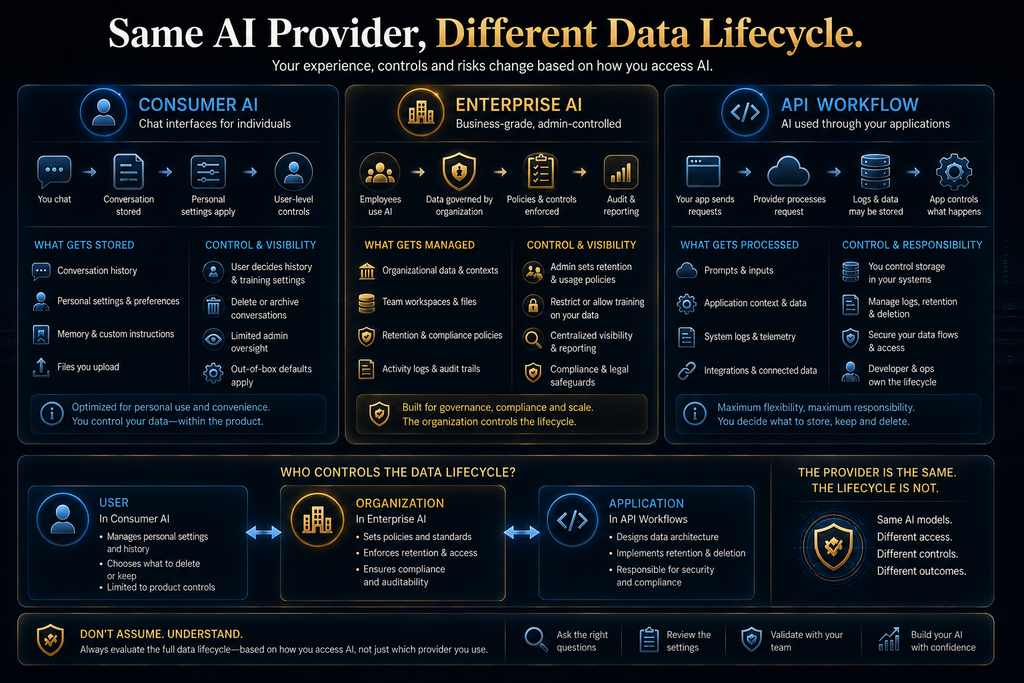
One of the most important procurement mistakes is assuming that a company’s consumer AI experience and its enterprise or API experience have identical data controls. They usually do not.
Consumer AI products are commonly designed around individual conversation history, personalization, product features, and user-level settings. Business products can introduce organizational administration, contractual controls, enterprise security, retention policies, audit capabilities, and different defaults for model training. API products can shift even more responsibility toward the developer because the customer’s own application may store prompts, files, outputs, and logs.
The provider’s name therefore tells you surprisingly little about the actual retention model. The useful question is not “Does Company X keep data?” It is “What happens to data in the exact Company X product, account type, feature, and configuration we are using?” This distinction is visible across the major AI ecosystems.
OpenAI says consumer users can turn off model improvement while conversations remain in history, and its Temporary Chat feature follows a separate retention model. OpenAI also documents separate handling for uploaded files in Library.
Google’s Gemini ecosystem provides another clear example. For personal Gemini Apps accounts, Google says that when Keep Activity is enabled, Gemini activity is saved to the user’s Google Account, with an 18-month auto-delete setting by default that can be changed to 3 or 36 months or disabled. When Keep Activity is turned off, future chats are not saved to Gemini Apps Activity, but Google says they can still be retained for 72 hours for service operation, feedback processing, and safety purposes.
Google also warns that data associated with connected services can have separate behavior. Deleting Gemini Apps activity does not necessarily delete information that has already been saved by another Google service under that service’s own policies.
Microsoft’s enterprise environment demonstrates yet another model. Microsoft Purview can apply retention policies to prompts and responses from supported Copilot and AI applications, allowing organizations to retain or delete interactions according to their compliance requirements.
The lesson is not that one provider is automatically safer than another. The lesson is that retention is a product-and-configuration question, not a brand-level question.
What Happens to Data in Connected AI Workflows?
The traditional privacy model assumes that you give information directly to a company. AI agents are changing that model because the AI may retrieve information from systems you have already authorized.
Consider an employee who asks an AI assistant to “find the latest customer complaints about delayed deliveries.” The employee may not upload anything. The AI could retrieve relevant information from a CRM, customer-support platform, email system, or cloud document repository.
From the employee’s perspective, it may feel as though the AI simply answered a question. From a data-governance perspective, the AI has crossed an information boundary.
That makes permissions almost as important as retention.
If the AI can access a repository, it may be able to process information contained there. If the AI can call an external action, information may be transmitted to that external service. If the AI uses a third-party connector, that recipient may apply its own retention policy.
OpenAI’s Temporary Chat documentation provides a particularly important example: if a GPT has actions, data sent to third parties through those actions is governed by the recipient’s privacy policy and may be retained longer than the temporary chat itself. Google likewise warns that information used through connected applications can introduce additional data considerations and says deleting Gemini Apps activity does not delete data that other Google services may have saved under their own policies. This produces a crucial governance principle:
The retention policy of the AI interface does not necessarily control the retention policy of every system the AI can reach.
That becomes increasingly important as AI agents move from answering questions toward taking actions.
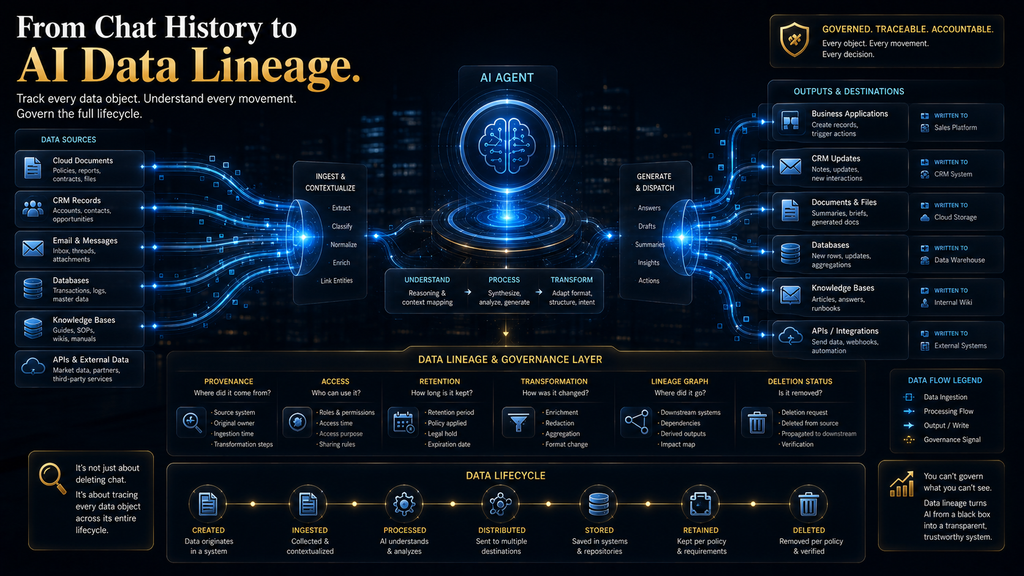
A Better Mental Model: The AI Data Chain
A practical way to understand retention is to follow the information through a chain rather than looking at the chatbot as a single storage location.
The chain can begin with the source data: a contract, spreadsheet, email, database record, image, or internal document. The next stage is the AI request, where the user provides instructions and possibly attaches or references that information. The system then performs processing and retrieval, which may involve a model, a search index, a vector database, an external tool, or a connected application. The system produces an output, which may itself be stored. Finally, the information enters a retention and deletion lifecycle governed by the relevant product, organization, or application.
This model is useful because it exposes a problem that ordinary privacy statements can hide: there may be multiple legitimate owners and retention policies within one AI workflow.
A company might own the original customer database. The AI provider might process the prompt. A third-party application might provide a connected action. The organization’s compliance platform might preserve a record of the interaction. Each layer can have a different reason for retaining information.
The result is not necessarily uncontrolled duplication. In a well-designed system, each component can have a clearly defined role and retention policy. But if the organization has never mapped the workflow, it may have no idea where the information persists.
That is the governance gap businesses should focus on.
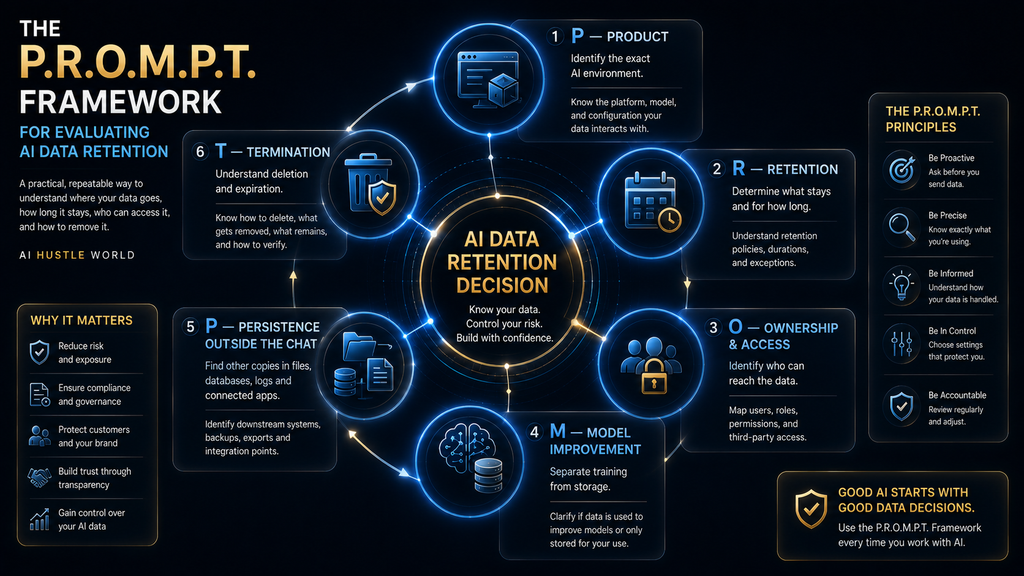
The P.R.O.M.P.T. Framework for Evaluating AI Retention
AI Hustle World’s practical framework for evaluating retention is P.R.O.M.P.T.: Product, Retention, Ownership and Access, Model Improvement, Persistence Outside the Chat, and Termination.
Product: Identify the Exact AI Environment
Start with the exact product rather than the provider’s brand. Determine whether the user is working in a consumer chatbot, business workspace, enterprise deployment, API application, AI-powered SaaS product, or agent connected to other systems.
This first step matters because the same provider can operate several different data models. A privacy control available in an enterprise product may not exist in a consumer product, while an API may offer a retention configuration that has no equivalent in the standard chat interface.
Retention: Determine What Stays and for How Long
Next, identify the retention period for each important data type. Do not ask only how long “chats” are stored. Check prompts, responses, uploaded files, projects, knowledge bases, feedback, logs, and compliance records separately when the documentation distinguishes them.
Google’s Gemini documentation illustrates why this matters: personal Gemini activity has configurable auto-delete periods, while chats handled with Keep Activity off can still be retained temporarily for service and safety purposes.
Ownership and Access: Identify Who Can Reach the Data
Retention becomes more consequential when you understand access.
A personal account may give the individual primary control over their history. A company-managed account may give administrators additional control. An enterprise compliance system may preserve interactions for authorized investigation or legal purposes.
The important question is not simply “Is the data encrypted?” Encryption is valuable, but it does not answer who is authorized to access retained information.
Model Improvement: Separate Training from Storage
Determine whether prompts, files, and outputs can be used for model improvement. Read the policy for the exact product, because the answer can vary between consumer and commercial offerings.
OpenAI’s Data Controls documentation makes the distinction explicit: turning off model improvement leaves conversations in history while preventing their use for improving ChatGPT.
Persistence Outside the Chat: Find the Other Copies
This is where sophisticated retention reviews become much more useful.
Ask whether the file exists in a separate Library, project, knowledge base, cloud drive, CRM, support system, API database, application log, or compliance archive. If the AI can access external systems, determine whether those systems retain the information independently.
This step is particularly important for agents. An agent may have no long-term copy of a document itself while the source system continues to retain the document indefinitely. That is not necessarily a problem; it simply means the retention responsibility sits somewhere else.
Termination: Understand Deletion and Expiration
Finally, determine what happens when the user deletes a chat or file, when an automatic retention period expires, or when an administrator requests deletion.
Look for deletion timelines, separate file deletion, legal exceptions, security exceptions, retention holds, and eDiscovery mechanisms. A mature AI governance program should know not only how data enters the system but also how it exits.
What Does Zero Data Retention Really Mean?
Zero Data Retention, commonly abbreviated as ZDR, sounds absolute, but it should be interpreted within the scope of the specific service and agreement.
In an API context, a zero-retention arrangement generally means that qualifying customer content is not retained by the provider beyond the processing permitted under that arrangement. It does not mean that the data ceases to exist everywhere in the customer’s technology environment.
Suppose a company’s application receives a customer’s confidential document, stores the original document in its own database, sends information to a model under a zero-retention arrangement, and then saves the model’s output in its application database. Provider-side retention may be minimal or zero, but the company’s own system still retains the source and result.
That distinction matters because organizations sometimes make a dangerous assumption: “We use an API with zero retention, therefore our AI workflow has zero data retention.” That conclusion does not follow.
Zero retention can be an excellent control for reducing provider-side persistence, particularly for sensitive API workflows. But it does not replace application-level data governance.
The organization still needs to determine what it stores, why it stores it, how long it stores it, who can access it, and when it should be deleted.
Feedback Can Change the Data Lifecycle
Another overlooked issue is feedback.
Users often assume that clicking a thumbs-up or thumbs-down button is merely a quality signal attached to the current answer. In some AI systems, submitting feedback can cause additional data to be collected or retained so the provider can investigate the problem.
Anthropic’s commercial and consumer documentation, for example, distinguishes ordinary product interactions from feedback-related processing. This illustrates a broader principle: optional feedback can create a different retention pathway from ordinary use.
That does not mean users should never provide feedback. Feedback is essential to improving AI systems. The important point is that employees should understand that a feedback submission can involve the associated conversation or contextual information.
For businesses, a simple internal rule is useful: employees should not paste confidential information into feedback fields unless the organization has confirmed that the relevant workflow is approved for that category of data.
Security and Legal Exceptions Are Part of the Retention Model
Deletion policies almost always need some form of exception mechanism.
A provider may need to retain limited information for security investigations, abuse prevention, fraud detection, legal obligations, or compliance requirements. Enterprise customers may also place records under retention policies or legal holds that override ordinary deletion behavior.
Microsoft Purview makes this especially clear because AI interactions can be governed by retention policies and eDiscovery holds. Microsoft’s documentation explains that if an interaction is subject to another retention requirement or hold, permanent deletion can be suspended.
Google similarly states that some Gemini data may be retained longer for legitimate business or legal purposes, including security, fraud and abuse prevention, or financial record-keeping.
These exceptions should not automatically be treated as loopholes. The important questions are whether the exceptions are clearly documented, appropriately limited, and connected to legitimate purposes.
The mistake is expecting cloud AI deletion to behave like deleting a file from a local hard drive. Modern services operate through distributed infrastructure, compliance systems, backups, security processes, and organizational controls. Retention therefore has to be understood as a managed lifecycle, not a single physical erase event.
The Business Case for Data Minimization
Retention becomes less risky when organizations reduce unnecessary data before it enters the AI system.
Imagine a company wants to analyze 50,000 customer-support tickets. The business objective is to understand complaint categories, recurring problems, resolution times, and sentiment. The AI does not necessarily need every customer’s full name, phone number, home address, payment details, or account credentials.
A more disciplined workflow can remove unnecessary identifiers before analysis. It can also aggregate information where individual-level detail is unnecessary, restrict access to the dataset, and use an approved enterprise environment with documented retention controls.
This creates multiple layers of protection. Even if the AI system retains the data for a defined period, the retained information is less sensitive than the original dataset.
This is a sturdier approach than relying on a provider to solve the entire privacy problem.
Data minimization also improves AI performance in some workflows. Removing irrelevant information can reduce noise, simplify retrieval, and make it easier for the model to focus on the information necessary for the task. Privacy and quality are not always opposing goals.
How Businesses Should Design an AI Retention Policy
A useful AI retention policy should begin with data classification, not with a universal number of days.
Public information, internal business material, confidential customer information, employee records, legal documents, financial data, security information, and highly sensitive personal information should not automatically receive identical treatment. The organization’s existing information-security and records-management policies should provide the foundation, with AI-specific controls layered on top.
The second step is to define approved AI environments. Employees should know which products are authorized for business information and which are prohibited. This is much more effective than telling employees to “be careful with AI” because it gives them a concrete decision rule.
The third step is to map workflow-specific retention. A public marketing brainstorm may require little or no long-term business retention. A customer complaint investigation may need a defined audit trail. An AI-assisted legal workflow may have different retention obligations again.
The fourth step is to separate provider retention from organizational retention. If a company uses an API with limited provider-side retention but stores every prompt in its own application logs indefinitely, the organization still has an AI retention problem. Conversely, if a provider retains certain records for security while the organization itself retains nothing beyond the transaction, the overall risk profile may be very different.
The fifth step is to establish deletion ownership. Someone should be responsible for answering the question: Who actually deletes the data when the retention period ends? If the answer is unclear, the policy is incomplete.
A Practical AI Data Retention Decision Matrix
| AI Workflow | Typical Sensitivity | Appropriate Retention Approach | Primary Control |
|---|---|---|---|
| Public content brainstorming | Low | Normal product retention may be acceptable | Approved tool and account |
| Internal document summarization | Medium | Defined business retention | Business/enterprise environment |
| Customer-support analysis | Medium–High | Controlled retention with access restrictions | Enterprise governance |
| Contract analysis | High | Minimized data and defined retention | File controls + approved AI |
| HR document processing | High | Strict retention and access controls | Data minimization + restricted access |
| Sensitive API processing | High | Evaluate short or zero provider retention | API configuration + application controls |
| AI agent connected to business systems | High | Retain necessary audit evidence while limiting unnecessary copies | Permission, logging, retention controls |
| Regulatory or legal workflow | High | Retention based on applicable legal and business requirements | Compliance and legal hold processes |
The table should not be interpreted as a universal retention schedule. It is a decision framework. The correct period depends on the purpose of the workflow, the sensitivity of the information, applicable obligations, and the controls available in the AI environment.
The key principle is proportionality. Retaining everything forever creates unnecessary exposure, but deleting everything immediately can destroy information the organization legitimately needs.
Why “Delete Everything Immediately” Is Not Always the Right Answer
Privacy discussions sometimes assume that the safest possible AI system is one that deletes everything as soon as the answer is generated. That sounds attractive, but it can create serious operational problems.
Imagine an AI system used to support financial investigations. If the organization automatically deletes every prompt and response immediately, it may lose the ability to investigate how a suspicious transaction was analyzed. If an AI system helps customer-support agents resolve disputes, deleting every interaction may make it impossible to reconstruct what information the system used.
This is why mature information governance does not simply maximize deletion. It asks whether retention has a legitimate purpose.
The better principle is:
Retain information for as long as there is a justified purpose, protect it while it exists, and delete it when that purpose ends.
That principle works across AI and traditional information systems.
What Happens If a Business Ignores AI Retention?
The biggest risk is not necessarily one catastrophic privacy event. It is fragmentation.
One employee uses a personal AI account. Another uses an enterprise chatbot. A developer sends information through an API. A marketing team uses an AI-powered SaaS platform. Customer support connects an agent to its CRM. HR uses another AI service for document analysis.
Each system can have a different retention policy. Eventually, the organization may be unable to answer a basic governance question: Where does our business information go when employees use AI?
That uncertainty makes incident response harder. It makes deletion requests harder to execute. It makes vendor assessments harder. It makes employee training less precise. It can also make compliance teams dependent on assumptions rather than evidence.
Shadow AI therefore creates a retention problem as much as a security problem.
The organization does not necessarily need to ban every unsanctioned tool overnight. A more effective approach is to provide approved alternatives, classify prohibited data categories, explain why certain AI environments are restricted, and periodically review actual usage.
Governance works better when employees have a safe path to accomplish legitimate work.
AI Conversations Are Becoming Potential Business Records
There is a deeper issue beneath retention: AI conversations are becoming part of operational work. Employees increasingly use AI to investigate customer problems, draft business documents, analyze financial information, write software, interpret internal policies, evaluate candidates, prepare marketing materials, and support decisions. As AI becomes embedded in these processes, some interactions can contain evidence about how a business decision was made.
That does not mean every prompt should become a permanent record. A request such as “rewrite this public announcement in a friendlier tone” is very different from an AI-assisted analysis that influences a high-stakes customer, employment, financial, or compliance decision.
The important question is therefore not whether AI conversations are inherently records. It is when an AI interaction becomes sufficiently connected to a business process that retaining some evidence becomes useful or necessary.
This is an emerging governance problem, but the underlying principle is familiar. Organizations already classify emails, documents, financial records, audit logs, and customer records according to business purpose. AI interactions increasingly need to fit into that same information-governance model.
How to Evaluate an AI Tool Before Approving It
Before approving an AI system for business use, procurement and security teams should be able to answer a consistent set of questions.
First, identify exactly what the system collects. Does it retain prompts and outputs? Does it store uploaded files separately? Does it collect feedback? Does it capture metadata or usage information?
Next, determine the default retention period and whether administrators can change it. A provider-controlled fixed period creates a different governance model from a system where the customer can define retention according to business requirements.
Then investigate access. Can users delete their own information? Can workspace administrators export or delete it? Can compliance teams search it? Can provider personnel access it under defined circumstances?
After that, determine the model-improvement policy. Do customer prompts, uploaded files, and outputs contribute to model training or service improvement? Is the answer different between consumer and business accounts?
Then inspect connected systems. Can the AI access Google Drive, Microsoft 365, email, CRM records, code repositories, or third-party tools? If so, what happens to information retrieved through those connections?
Finally, examine deletion. What happens when a user deletes a chat? What happens to an uploaded file? Are there separate storage systems? Are there security, legal, or compliance exceptions? Can retention holds prevent deletion?
A tool that cannot provide clear answers to these questions may still be useful, but it should not be treated as a fully understood enterprise data environment.
AI Data Retention KPIs Worth Measuring
Organizations that want AI governance to become operational rather than theoretical should measure a small set of practical indicators.
One useful measure is approved AI coverage: the percentage of known business AI workflows running through approved environments. A second is retention-policy coverage, which measures how many approved AI systems have documented retention behavior.
A third is sensitive-workflow coverage, which asks what percentage of high-sensitivity AI use cases operate under explicit retention and access controls. This is more valuable than measuring every AI interaction equally because the risk profile is not uniform.
Organizations can also measure shadow-AI usage, particularly where employees process confidential business information outside approved environments. Another useful metric is deletion-response time, which measures how quickly the organization can fulfill an approved deletion request across the relevant AI systems and connected repositories.
For mature programs, an even more useful KPI is retention exception rate: how often teams discover that a system retains information differently from the organization’s documented policy.
The purpose of these metrics is not to create bureaucratic overhead. It is to expose whether the organization actually understands its AI data lifecycle.
Common AI Data Retention Mistakes
One common mistake is assuming that turning off model training deletes the conversation. It does not necessarily do so, as OpenAI’s Data Controls documentation demonstrates.
Another is assuming that deleting a chat automatically deletes every uploaded file. Separate file storage can make that assumption wrong, as OpenAI’s current Library documentation demonstrates.
A third mistake is evaluating a consumer AI product and assuming the same rules apply to its enterprise version. Product, account, and administrative context can materially change retention and training controls.
A fourth mistake is treating zero provider retention as zero retention across the entire application. Your own software, databases, logs, cloud storage, and connected applications can still retain the information.
A fifth mistake is focusing only on the AI provider and ignoring the systems the AI can access. An agent connected to a CRM creates a broader data-governance problem than a standalone chatbot.
A sixth mistake is trying to solve retention without solving data minimization. If the AI receives ten times more personal information than it needs, even a well-designed deletion policy is managing unnecessary exposure.
The final mistake is assuming that the safest policy is always the shortest possible retention period. In some workflows, evidence of AI-assisted activity is valuable or necessary. The correct target is justified retention, not minimum retention at any cost.
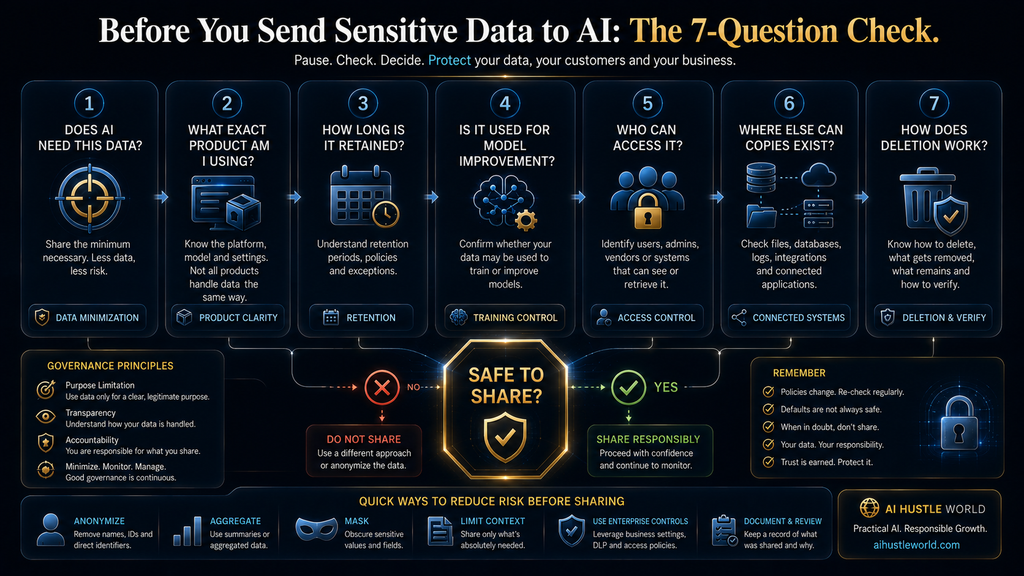
A Practical Checklist Before Uploading Sensitive Information
Before sending confidential information to an AI system, first identify whether the AI actually needs the complete dataset. If not, remove unnecessary personal identifiers, confidential fields, credentials, financial details, or unrelated records before uploading it.
Then verify the exact AI product and account type. Do not rely on the provider’s general reputation. Check the product-specific retention and model-improvement policy, especially if the same provider offers both consumer and enterprise services.
Next, determine whether the file will be stored separately from the conversation. If the product has a Library, project area, knowledge base, or reusable document store, find out whether deleting the chat also removes the file.
If you are using an organization-managed system, determine whether administrators or compliance systems can access, retain, export, or delete the interaction. Treat business AI accounts as organizational systems rather than private spaces.
Finally, if the AI is connected to other applications, trace the information beyond the AI interface. Ask which systems receive the data, which system owns the original information, and which retention policy governs each copy.
The most important habit is to ask “Where will this information exist after I finish using the AI?” before asking whether the AI itself remembers it.
The Future of AI Retention Will Be About Data Lineage, Not Just Chat History
The next stage of AI governance will become increasingly difficult to manage through simple chat-history controls because AI systems are evolving from passive assistants into agents that retrieve information, reason across sources, create artifacts, and take actions.
An agent might read a document from a cloud repository, extract relevant information, send part of it to a model, create a recommendation, write the result into a CRM, and trigger an action in another application. At that point, asking “How long does the chatbot keep my prompt?” tells you very little about the actual data lifecycle.
The more useful concept is data lineage: being able to understand where information originated, which systems processed it, where derivative information was created, who could access it, and when each copy should expire.
This will also change how organizations think about AI logging. Logs are valuable for debugging, security, and accountability, but logging everything indefinitely creates its own privacy and security risk. The future architecture will therefore need to distinguish between operational telemetry, sensitive content, audit evidence, and temporary processing data.
That distinction will become increasingly important as AI systems begin making or influencing business decisions. The organization may need enough information to understand what happened without retaining every piece of source content forever.
The strongest AI governance systems will therefore not simply ask, “How long should we keep the chat?” They will ask, “What evidence do we need to preserve, what information do we not need, and what should disappear when the purpose ends?”
Who Should Use Shorter AI Retention?
Shorter retention is particularly attractive when the AI workflow processes sensitive information that does not need to remain available after the task is complete. Examples can include temporary document analysis, sensitive API transactions, one-time transformations, or workflows where the organization already maintains the authoritative source elsewhere.
Shorter retention is less obviously appropriate when the AI interaction itself forms part of a business record, investigation, regulated process, customer dispute, or audit trail. The decision should therefore be driven by purpose, sensitivity, and accountability rather than by a universal preference for shorter storage.
Who Should Avoid Uncontrolled AI Retention?
Organizations should be particularly cautious about uncontrolled retention when AI is processing customer records, employee information, financial information, confidential intellectual property, legal material, security information, or other sensitive business data.
Small businesses should not assume that retention governance is only an enterprise problem. In fact, smaller organizations can be more exposed because they may have fewer security and compliance resources, making uncontrolled AI usage harder to discover and manage.
At the same time, small businesses do not necessarily need expensive governance software to start. A documented approved-tool list, a basic data-classification policy, clear prohibited-data rules, and a simple retention review can eliminate a large portion of the risk.
The objective is not to make AI impossible to use. It is to make AI use predictable and controllable.
Final Thoughts
AI data retention is not really a question of whether an AI system “remembers you.” It is a question of data lifecycle.
Your prompt, response, uploaded file, connected source, application log, and compliance record can each have different purposes and therefore different retention rules. Turning off model training does not necessarily delete a conversation. Deleting a conversation does not necessarily delete a separately stored file. Using an API with limited provider retention does not necessarily prevent your own application from storing the same information indefinitely.
The most reliable approach is to stop treating the AI interface as the entire system. Use the P.R.O.M.P.T. framework to examine the actual workflow: identify the Product, understand Retention, determine Ownership and Access, separate Model Improvement from storage, trace Persistence Outside the Chat, and understand Termination and deletion.
For individuals, that means thinking before uploading sensitive documents and using the privacy controls available in the exact AI product. For businesses, it means going one step further: classify data, approve AI environments, minimize sensitive information, map connected systems, define retention by business purpose, and make deletion responsibilities explicit.
The biggest mistake is not necessarily retaining data for too long. It is not knowing where the data is retained at all.
As AI evolves from chatbots into connected assistants and autonomous agents, that distinction will become even more important. The future of responsible AI governance will depend less on asking whether a chatbot “keeps your prompts” and more on whether an organization can trace, control, and eventually dispose of the information moving through its entire AI workflow.
Want to Build Safer AI Workflows?
Understanding AI data retention is only one part of responsible AI adoption. Learn how to identify, assess, and manage AI risks across real business workflows.
Explore the AI Risk Framework →Frequently Asked Questions
1. Do AI tools keep your prompts?
Many AI tools can retain prompts, but the exact behavior depends on the product, account type, settings, and feature. A consumer chatbot, enterprise workspace, and API endpoint from the same provider can have materially different retention policies.
2. Are uploaded files retained separately from AI chats?
Sometimes. Some AI products maintain separate file libraries, project storage, or knowledge bases. OpenAI’s current ChatGPT documentation, for example, says uploaded and created files can be saved to a separate Library with its own retention and deletion behavior.
3. Does turning off AI training delete my conversations?
No. Turning off model improvement and deleting stored conversations are separate controls. OpenAI states that conversations can remain in ChatGPT history after the user turns off “Improve the model for everyone,” while those new conversations are not used to improve ChatGPT.
4. What happens when you delete an AI conversation?
Deletion usually begins a lifecycle process rather than guaranteeing instantaneous physical erasure from every underlying system. Depending on the provider and account type, information may be removed from the interface first and permanently deleted later, with security, legal, or compliance exceptions potentially affecting the timeline.
5. Is Temporary Chat completely private?
No feature should be treated as completely private without checking its specific policy. OpenAI says Temporary Chats do not appear in history and are not used to improve models, but copies may still be retained for up to 30 days for safety purposes.
6. Can employers access AI prompts?
Potentially. Organization-managed AI environments can provide administrators and compliance teams with controls for retaining, searching, exporting, or managing AI interactions. Microsoft, for example, provides enterprise retention capabilities for supported Copilot and AI interactions.
7. Does zero data retention mean no AI data is stored anywhere?
No. Zero-data-retention arrangements generally concern specified provider-side retention. Your own application, database, logs, cloud storage, connected services, or compliance systems may still retain the information.
8. How long does Google Gemini retain conversations?
For personal Gemini Apps accounts, Google currently states that Gemini activity is auto-deleted after 18 months by default, with options to change the period to 3 or 36 months or turn off auto-delete. When Keep Activity is off, future chats can still be retained for 72 hours for service operation, feedback processing, and safety purposes.
9. Should businesses delete all AI conversations as quickly as possible?
Not necessarily. Some AI interactions may need to be retained for security, compliance, investigation, auditability, or legitimate business purposes. The stronger policy is to retain information for a justified purpose, protect it while retained, and delete it when that purpose ends.
10. What is the most important thing to check before uploading confidential information to AI?
Check the complete data lifecycle: the exact product, retention period, file-storage behavior, model-training policy, administrator access, connected applications, deletion process, and your own organization’s logging or storage. If the AI does not need the complete dataset, minimize the data before sending it.
Related Guides
- Understanding AI Privacy Risks Before Sharing Personal Information
- AI Compliance Tools Compared: Features, Privacy Controls & Use Cases
- How to Use AI for Employee Onboarding, HR Helpdesks & Policy Questions
- AI Conversation Intelligence Explained: How AI Turns Conversations Into Business Insights
- How to Cancel an AdCreative.ai Subscription (Avoid Surprise Renewal Charges)
- AI Copyright Explained: What Businesses Need to Check Before Publishing
Written by
Muntasir Ahmad Chowdhury
Founder, AI Hustle World
Muntasir Ahmad Chowdhury is the Founder of AI Hustle World, an independent publication dedicated to making Artificial Intelligence practical, trustworthy, and easy to understand. He researches AI tools, automation, customer service, productivity, and real-world business applications, helping readers make smarter technology decisions through research-driven, experience-backed content.
Expertise:
AI Tools • AI Automation • AI Customer Service • AI Productivity • Generative AI • AI Workflows
Get Smarter With AI
Enjoyed this guide? Get practical AI tools, tutorials, and honest reviews delivered to your inbox.
4 thoughts on “AI Data Retention Explained: What Happens to Your Prompts and Files?”