Best AI Governance and Compliance Platforms in 2026
The hardest part of AI governance is no longer writing the policy. It is keeping the policy connected to what the organization is actually doing with AI.
A company can have an excellent responsible-AI policy and still have little idea which employees are using unapproved AI tools, which vendors are processing sensitive information, which models are embedded inside business applications, which AI systems influence important decisions, or which newly deployed agents can take actions without a person reviewing every step. Once AI spreads across departments, vendors, models, applications and agents, governance stops looking like a document-management problem and starts looking like an operational-control problem.
That is the reason AI governance platforms have become a distinct enterprise software category. Gartner’s 2026 research defines AI governance platforms around the ability to centrally define, approve and enforce responsible-AI policies across AI use cases, applications and agents. Its Critical Capabilities research evaluates areas including AI discovery and registries, compliance risk management, policy enforcement, dynamic risk scoring, evidence collection, workflow and approvals, audit trails, interoperability, AI usage reporting, data-usage mapping, AI value tracking, AI security and AI agent governance. (Gartner)
But that does not mean every organization needs an AI governance platform, and it certainly does not mean the platform with the longest feature list is automatically the best choice. The right question is more practical: what governance problem has become too complex, too fast-moving or too consequential to manage reliably with the organization’s existing tools and people?
That question changes the buying decision completely. A large bank with thousands of AI assets, formal model-risk management and a heavily regulated operating environment may need a very different platform from a 200-person technology company trying to govern a few dozen generative-AI applications. A company deeply invested in ServiceNow may get more value from extending its existing workflow infrastructure than adding a standalone governance system. A privacy-heavy organization already using OneTrust may have a similar advantage. A technically sophisticated AI team may care more about continuous evaluation and technical evidence than about another executive compliance dashboard.
This guide is therefore not a simplistic “top eight AI governance tools” list. It is a decision framework for understanding what these platforms actually govern, where their strengths sit, where their boundaries appear, and which type of organization should seriously consider each one.
What This Article Covers — and What It Does Not
This article owns the enterprise platform-selection question: which AI governance platforms are worth evaluating, what governance layer they emphasize, how they differ, and what conditions should determine the buying decision.
It does not attempt to replace our broader explanation of AI governance, AI risk management, AI privacy, bias, copyright or human oversight. Those subjects are covered in our AI governance guide and related articles, and they are the conceptual foundation for this comparison. Read them first if you are still deciding what your organization needs; this article assumes you are ready for practical tool selection.
It also does not claim that any platform makes an organization automatically “AI compliant.” That distinction matters. NIST AI RMF is a voluntary risk-management framework, while ISO/IEC 42001 is a management-system standard requiring organizations to establish, implement, maintain and continually improve an AI management system. Software can help operationalize those activities, but software alone cannot substitute for organizational accountability, legal interpretation, risk decisions or control implementation.
Finally, we are not presenting vendor marketing statements as independently verified product performance. Where a capability comes from a vendor’s own documentation, it should be understood as a company or vendor claim unless independently supported.
That distinction becomes particularly important in this market because many platforms use similar language—“AI inventory,” “continuous monitoring,” “policy enforcement,” “agent governance,” “compliance”—while implementing those concepts at very different technical and operational depths.
Why AI Governance Platforms Became Necessary
The traditional approach to governance was designed around a slower environment.
A team proposes a system. A risk or compliance group reviews it. The organization records the decision. The system is deployed. Periodically, someone reassesses it.
That model works reasonably well when the number of systems is small and the rate of change is low. Generative AI and agentic systems disrupt both assumptions.
Consider a company that has adopted an enterprise chatbot, an AI coding assistant, an AI customer-service system, an internal document assistant, a recruiting application with AI features and several experimental agents. The organization may technically have only six “AI systems,” but those systems can involve dozens of models, vendors, datasets, APIs, applications and business processes.
Now change one variable. The company replaces the underlying model behind one application. Another vendor adds a new AI feature. An employee connects an agent to an internal database. A previously experimental workflow moves into production. A new regulation or internal policy changes the required control.
The governance record is now stale even though the AI system itself is still operating. This is the central problem governance platforms attempt to solve: keeping organizational knowledge about AI synchronized with the AI estate itself.
That is why modern platforms increasingly emphasize discovery, inventory, ownership, lifecycle records, risk classification, policy mapping, evidence, monitoring and change management. Gartner’s 2026 research explicitly reflects this broader scope, including AI agent governance alongside traditional compliance, workflow and evidence capabilities.
There is also evidence that the governance gap is becoming an operational issue rather than merely a theoretical concern. Credo AI’s 2026 survey of 371 senior leaders reports that 60% of organizations are scaling AI while only 4% say their governance is mature enough to keep pace. Because this is vendor-sponsored research, it should be treated as a company-reported research finding, not as a universal industry statistic. Still, the underlying direction is consistent with the market: AI adoption is expanding faster than many organizations’ ability to inventory, assess and control it. (Credo AI)
IBM similarly cited a 2026 Grant Thornton AI Impact Survey in which 78% of business executives were unsure whether their organization could pass an independent AI-governance audit within 90 days. Again, that is a reported external survey referenced by IBM, not an AI Hustle World primary study, but it illustrates the same operational gap. (IBM)
The “so what?” is straightforward: if an organization cannot reliably answer what AI it has, who owns it, what risk it creates, what controls apply and what evidence supports those controls, it does not have a mature governance system regardless of how polished its policy documents look.
What an AI Governance Platform Actually Does
An AI governance platform sits between organizational policy and the operational AI estate.
At the simplest level, it creates a structured inventory of AI systems and connects each system to an owner, purpose, risk assessment and set of controls. More mature platforms add regulatory mapping, workflow, evidence collection, monitoring and policy enforcement. The newest generation increasingly adds agent governance, runtime controls and technical evaluation.
The easiest way to understand the category is to follow an AI system through its lifecycle.
A business team first proposes an AI use case. Governance needs to know what the system is intended to do, which data it will use, who owns it, which vendor or model supports it and what decisions it may influence. That information creates the initial governance record.
The system is then assessed. The organization determines its risk level, applicable policies and required controls. A low-impact productivity assistant may receive a relatively lightweight review, while an AI system used in a consequential business process may require substantially more scrutiny.
If the use case is approved, the governance process does not necessarily end. Evidence needs to be retained, ownership needs to remain clear and material changes may trigger reassessment. In a mature environment, production monitoring can also feed information back into the governance process.
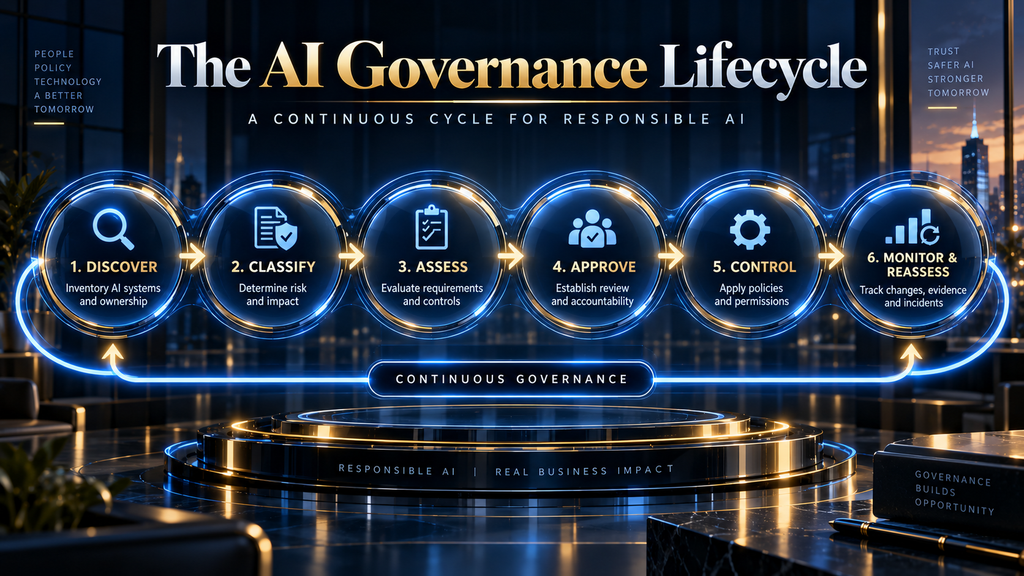
This is why the strongest platforms are not simply “AI policy management tools.” They attempt to create a closed governance loop: Discover → classify → assess → approve → control → monitor → collect evidence → reassess when conditions change. The platform is valuable when it makes that loop easier to operate at scale.
The AI Hustle World G-O-V-E-R-N Framework
To compare these platforms without reducing the article to feature checkboxes, AI Hustle World uses a six-part framework: G-O-V-E-R-N. The framework evaluates whether a platform can move an organization from knowing that governance matters to actually operating governance continuously.
G — Get Visibility
The organization must know what AI exists.
This includes models and applications, but increasingly also agents, vendors, datasets, APIs and AI embedded inside other enterprise software. Shadow AI matters because an inventory containing only officially registered systems can create a false sense of control.
O — Organize Risk
Visibility is useless without prioritization.
The platform should help the organization distinguish between low-risk experimentation and AI that can materially affect customers, employees, finances, security, privacy or regulated processes. The important capability is not merely assigning a label but making the risk classification influence what happens next.
V — Validate Against Requirements
Governance requires translating policies and frameworks into operational requirements.
NIST AI RMF, ISO/IEC 42001 and applicable regulations can provide useful structures, but organizations still need to determine which requirements apply to specific systems. NIST’s AI RMF is explicitly voluntary and designed to support risk management across the design, development, use and evaluation of AI systems. (NIST)
E — Execute the Workflow
Governance must change behavior. That means intake, assessment, approvals, remediation, exceptions, evidence and escalation need to happen through repeatable workflows rather than through disconnected email threads and spreadsheets.
R — Runtime Control
A governance platform becomes significantly more powerful when it can observe or influence AI while it operates.
That might mean monitoring, policy evaluation, security controls, data-loss prevention, access restrictions, guardrails or other runtime mechanisms. Not every platform needs to provide all of these, but buyers need to understand exactly where the platform’s boundary lies.
N — Navigate Change
AI systems change constantly.
Models are updated, vendors add features, data sources change, agents gain tools and policies evolve. Mature governance therefore cannot depend entirely on annual or quarterly assessments. The platform should help the organization identify when something has changed enough to warrant another governance decision.
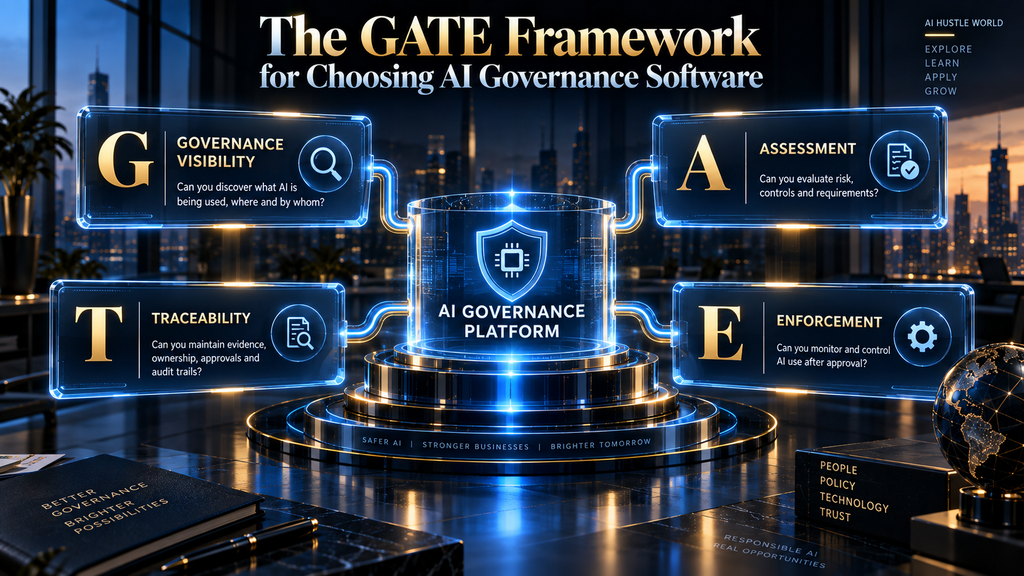
This framework creates a more useful buying question than “How many features does the platform have?” The better question is how much of the governance loop can this platform make reliable, repeatable and measurable?
The Best AI Governance Platforms in 2026
The current market is broader than a traditional “GRC software” category. Gartner’s 2026 Magic Quadrant includes vendors such as Credo AI, Holistic AI, IBM, ModelOp, OneTrust, Saidot and ServiceNow, among others. Its Critical Capabilities research also evaluates the market through a wide set of functions rather than a single score.
For practical comparison, the following platforms are particularly useful to evaluate because they represent meaningfully different approaches to the problem.
1. ServiceNow AI Control Tower — Best for Enterprise Workflow Integration
ServiceNow is particularly compelling when AI governance needs to become part of the organization’s existing operational workflow rather than another isolated compliance system.
The company’s AI Control Tower is positioned as a central hub for discovering, securing, governing, observing and measuring AI across the enterprise. ServiceNow says it can automatically inventory AI agents, models and MCP servers from first- and third-party sources, while also providing controls around AI identity, access, exposure and runtime security. (ServiceNow)
The strategic advantage is not simply the feature list. It is the fact that ServiceNow already occupies an important position in many enterprises’ IT, risk, security and operational workflows.
Imagine an enterprise that already uses ServiceNow to manage configuration items, incidents, approvals and operational changes. Adding AI governance into that environment can make AI governance part of an existing operating model instead of creating a parallel process.
That becomes particularly useful when AI systems are changing frequently. An AI application can be treated as an operational asset rather than merely a compliance record, which creates a stronger connection between governance and the rest of enterprise operations.
AI Hustle World analysis: ServiceNow is strongest when the organization’s problem is workflow fragmentation. If the enterprise already has strong ServiceNow adoption, the platform can potentially reduce the organizational friction of governance because teams do not need to learn an entirely separate operating environment.
The boundary is equally important. A company that does not already depend heavily on ServiceNow should not assume that its enterprise workflow advantage automatically justifies adopting the platform. The implementation and ecosystem implications need to be evaluated alongside the governance capabilities.
Best fit: large enterprises with significant ServiceNow investment, complex approval workflows and a need to connect AI governance with broader IT, security and operational processes. Less compelling for: smaller organizations looking primarily for a lightweight AI inventory and risk-assessment system.
2. IBM watsonx.governance — Best for Enterprise AI Lifecycle and Model Governance
IBM’s strength is particularly clear in organizations where AI governance is closely connected to model lifecycle management, enterprise AI development and established risk-management practices.
IBM describes watsonx.governance as part of an enterprise governance approach covering AI assets through their lifecycle, with capabilities around tracking, evaluation and compliance. IBM’s 2026 direction is also moving toward an “AI assurance” layer designed to provide continuous visibility, enforceable controls and accountability across models, agents, third-party integrations and automated decisions. (IBM)
The distinction from a purely policy-oriented platform matters.
In a large organization, governance often needs to answer technical questions about where a model came from, how it was evaluated, which version is operating, what controls apply and what evidence supports the decision to deploy it. Organizations with established model-risk or AI-lifecycle processes may find this approach more natural than starting with a generic compliance dashboard.
The strongest case for IBM is therefore not “IBM has lots of AI governance features.” It is that IBM can fit governance into an existing enterprise AI operating model, particularly where hybrid infrastructure and model lifecycle management are already important.
The trade-off is complexity. A sophisticated enterprise governance platform can create significant value when the organization needs that sophistication, but it can become expensive organizational machinery when the underlying AI estate is small.
Best fit: large enterprises, regulated organizations and companies with substantial AI/model lifecycle governance requirements. Less compelling for: organizations that mainly need lightweight governance of a small number of third-party generative-AI tools.
3. Credo AI — Best Purpose-Built AI Governance Platform
Credo AI represents the dedicated AI-governance approach.
The company positions its platform around discovery, policy enforcement, AI risk management and governance across agents, applications, models and AI vendors. It describes a knowledge graph that combines regulatory intelligence with business context and provides policy packs covering frameworks such as the EU AI Act, NIST AI RMF and ISO/IEC 42001. These are vendor-reported capabilities, so buyers should validate the exact implementation against their own requirements. (Credo AI)
The advantage of a purpose-built platform is specialization.
A governance team does not have to reinterpret a generic enterprise-risk system for AI. The platform is designed around AI entities and their relationships, making it easier to think in terms of AI use cases, models, applications, agents, vendors, risks and controls.
Credo’s current emphasis on agent governance is also strategically important. Traditional model governance assumes that a model produces an output. Agents complicate that model because the system may decide what tool to call, what information to retrieve and what action to take.
Credo is therefore an interesting choice for organizations whose governance challenge is fundamentally AI-specific rather than merely another extension of enterprise GRC.
The boundary is integration. A dedicated AI governance platform still has to coexist with security, privacy, identity, data governance and existing enterprise workflows. Buyers should therefore test whether the platform becomes the system of record, an orchestration layer or another governance database sitting alongside several others.
Best fit: enterprises building a dedicated AI governance program across multiple models, applications, agents and vendors. Less compelling for: organizations that already have strong governance infrastructure and cannot identify a meaningful AI-specific capability gap.
4. OneTrust AI Governance — Best for Privacy-Centric Governance
OneTrust becomes particularly interesting when AI governance is already intertwined with privacy, data governance and third-party risk.
The company describes its AI governance platform as covering automated intake, risk scoring, approvals, continuous discovery, inventory, monitoring and policy-driven controls across models, data, agents and vendors. It also positions the platform around runtime enforcement and audit-ready evidence. (OneTrust)
That matters because AI risk frequently begins with data.
An AI application may be technically impressive but unacceptable because it processes sensitive information in a way the organization cannot adequately control. When privacy governance and AI governance operate separately, teams can end up performing overlapping assessments and maintaining separate records about the same system.
OneTrust’s advantage is therefore organizational as much as technical: it can potentially connect AI governance with an established trust and privacy operating model.
The downside is breadth. A large trust platform can be excessive for an organization that has only a narrow AI governance requirement.
Best fit: enterprises already using OneTrust or organizations where privacy, data governance and AI risk are tightly connected. Less compelling for: smaller companies seeking only AI inventory, risk classification and basic approval workflows.
5. ModelOp — Best for AI Portfolio and Lifecycle Governance
ModelOp approaches the problem through the idea of governing the enterprise AI portfolio from intake through deployment and ongoing control.
Its platform describes a lifecycle beginning with AI use-case submission and registration, followed by risk assessment, business and risk reviews, and governance throughout the lifecycle. (ModelOp)
This is especially relevant to organizations that have moved beyond a handful of experiments and now have a significant number of AI projects competing for approval, infrastructure and operational support. The important idea is portfolio control.
A mature enterprise does not want every AI system governed as an isolated project. It wants to understand the total portfolio: which systems are high risk, which are duplicated, which are approaching production, which vendors create concentration risk and where governance effort is being consumed.
That portfolio view can improve decision-making because governance becomes connected to resource allocation and enterprise AI strategy. The buyer should nevertheless examine how the platform handles newer agentic workflows rather than assuming that strong model lifecycle governance automatically translates into complete agent governance.
Best fit: organizations with large AI portfolios, formal model governance and lifecycle-management requirements. Less compelling for: organizations with a small AI footprint and mostly third-party productivity applications.
6. Holistic AI — Best for Broad Discovery, Testing and Enforcement
Holistic AI takes an end-to-end approach that spans discovery, risk assessment, testing, governance and enforcement.
The company describes continuous discovery across cloud platforms, code repositories, data and ML tools, LLM providers, agent frameworks and SaaS applications. It also emphasizes shadow-AI discovery and centralized inventory across models, agents, datasets and endpoints. These are vendor-described capabilities and should be validated through a proof of concept. (Holistic AI)
The strategic attraction is the attempt to connect what exists with how risky it is and what should happen about that risk.
That sounds obvious, but governance programs often fail because those functions live in different places. Security discovers one set of systems. Legal knows about another. Engineering has a third inventory. Compliance has a spreadsheet. Nobody has a complete picture.
A platform that genuinely connects those views can create more value than a platform that simply produces better assessment forms.
The risk is scope. End-to-end platforms can be powerful, but organizations need enough governance maturity to operationalize the information they produce.
Best fit: enterprises with complex AI estates, shadow-AI concerns and a desire to connect discovery, testing and compliance. Less compelling for: organizations that already have strong discovery and technical-assurance infrastructure and only need governance workflow.
7. LatticeFlow AI — Best for Technical AI Risk Evidence
LatticeFlow is particularly differentiated by its emphasis on technical evidence.
The company describes its 2026 platform as connecting governance frameworks to technical controls and continuously generating technical evidence for AI risk. Its platform includes discovery, evaluation, security and governance capabilities, with emphasis on evaluating AI systems and agents against real use cases. (LatticeFlow AI)
This addresses an important weakness in traditional governance. A risk register can say that an AI application is “low risk,” but that statement becomes much less useful if nobody has tested whether the system behaves reliably in its actual operating environment. Technical evidence helps close that gap.
The important boundary is that technical assurance is not the same thing as governance. An organization still needs ownership, policy, accountability, approvals and regulatory interpretation. LatticeFlow is therefore most compelling when technical evidence is one of the missing pieces in an otherwise mature governance program.
Best fit: technically sophisticated enterprises that need continuous AI evaluation, security evidence and stronger links between governance decisions and system behavior. Less compelling for: organizations whose main problem is policy workflow, inventory and compliance documentation rather than technical evaluation.
8. Saidot — Best for Knowledge-Graph-Based Governance and Agent Context
Saidot takes one of the more distinctive architectural approaches in the category.
The company describes a knowledge graph connecting AI systems, models, agents, datasets, risks, policies and controls. It also emphasizes automatic inheritance of relevant risks and controls as connected systems change. (Saidot)
The underlying idea is valuable because AI governance is fundamentally relational.
A system uses a model. The model may introduce certain risks. The system may process a dataset. That dataset may introduce privacy requirements. An agent may have access to tools, and those tools introduce another layer of risk.
A flat spreadsheet struggles with those relationships. A graph-based architecture is conceptually better suited to representing them.
That becomes particularly interesting as agentic systems become more complex. Instead of asking only “What model does this agent use?” governance can ask “What model, data, tools, permissions and policies surround this agent?”
Saidot’s main differentiation is therefore not simply its inventory. It is the attempt to create a connected governance knowledge layer.
The trade-off is that graph-based governance requires organizations to understand and maintain the relationships represented in the graph. The platform may reduce manual work, but it does not eliminate the need for good governance data.
Best fit: organizations interested in structured AI knowledge graphs, continuous governance and agent-aware risk relationships. Less compelling for: buyers looking primarily for traditional GRC workflow and reporting.
The Platforms Are Not Really Competing for the Same Buyer
This is where most “best AI governance software” lists become misleading. ServiceNow, IBM, Credo AI, OneTrust, ModelOp, Holistic AI, LatticeFlow and Saidot may all appear under the same category, but they do not necessarily occupy the same strategic position.
A ServiceNow-centric enterprise may prioritize integration with existing workflows. An IBM-heavy enterprise may care more about model lifecycle and hybrid AI operations. A privacy-led organization may prefer OneTrust. A dedicated AI governance function may prefer Credo AI. A technical AI-risk organization may value LatticeFlow’s emphasis on evidence. A company thinking deeply about agent relationships may find Saidot’s graph architecture more relevant.
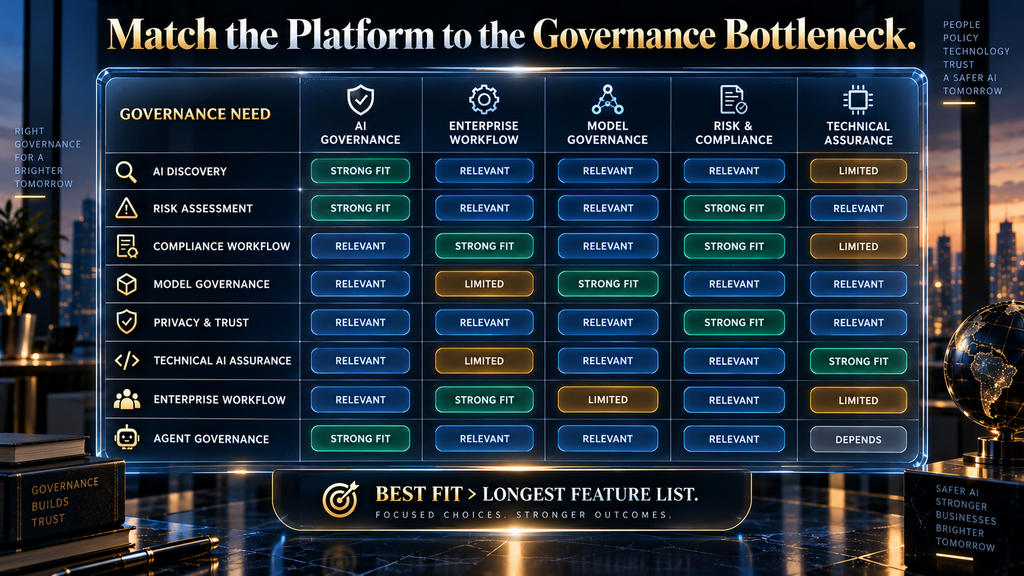
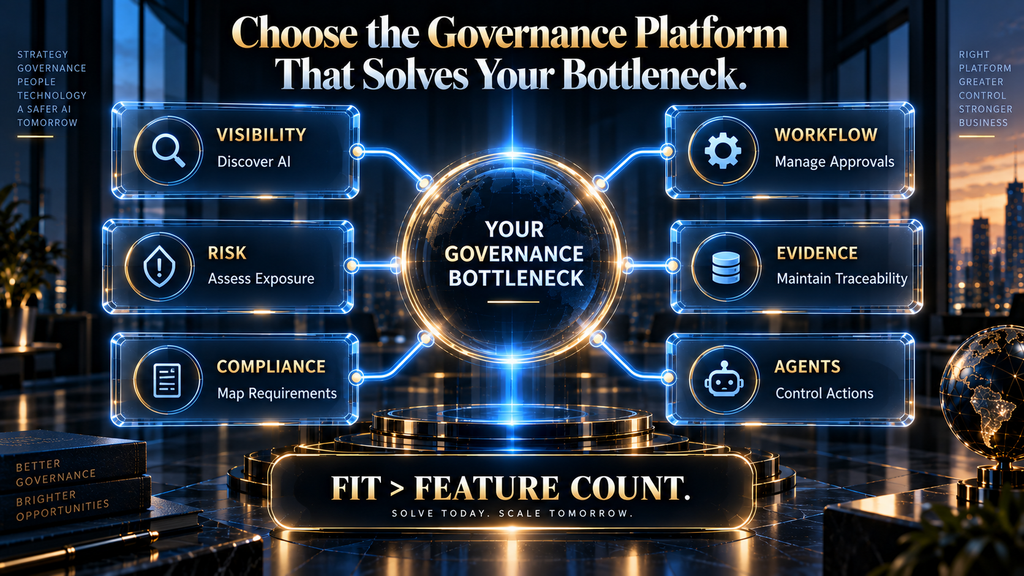
The difference is best understood through the governance bottleneck, not the product category.
| If your biggest problem is… | Start by evaluating… | Why |
|---|---|---|
| Fragmented enterprise workflows | ServiceNow | Governance can connect to existing operational workflows |
| Large model portfolio and lifecycle | IBM / ModelOp | Strong alignment with enterprise AI lifecycle governance |
| Dedicated AI governance program | Credo AI | Purpose-built AI governance orientation |
| Privacy + AI risk together | OneTrust | Strong trust/privacy governance context |
| Shadow AI + broad discovery | Holistic AI | Strong emphasis on discovery and enterprise AI surface area |
| Technical AI evidence | LatticeFlow AI | Governance linked to technical evaluation and controls |
| AI relationships and agent context | Saidot | Knowledge-graph-oriented governance |
| Mixed requirements | Shortlist 2–3 | Governance architecture should match existing enterprise stack |
This is AI Hustle World analysis, not a claim that one vendor universally “wins” each category.
The Most Important Buying Decision: Governance Layer or Governance Stack?
One of the biggest mistakes an enterprise can make is assuming that one platform should replace every existing governance technology.
That sounds efficient. It often is not.
AI governance overlaps with privacy, cybersecurity, identity and access management, data governance, model-risk management, cloud security, observability, legal review and enterprise GRC. Those systems already exist for good reasons.
The better architecture may therefore look like a stack: AI inventory and governance layer → GRC and compliance → data governance → security and identity → technical evaluation → runtime controls. The AI governance platform becomes the connective layer rather than the replacement for everything underneath it.
This matters commercially because a platform’s value depends heavily on interoperability. Gartner explicitly includes interoperability among the capabilities it evaluates in AI governance platforms.
A platform that works beautifully in isolation but cannot connect to the organization’s identity, cloud, data and workflow infrastructure may create a new silo. That produces the central procurement test: Does this platform remove a governance bottleneck, or does it create another system that someone has to maintain?
What Governance Platforms Can and Cannot Automate
Governance software is excellent at repetitive coordination.
It can standardize intake forms, route approvals, maintain inventories, assign owners, trigger assessments, map controls, collect evidence and create reports. Those activities are structured enough for software to handle consistently.
The harder question is judgment.
Should this AI system be approved for a particular purpose? Is the risk acceptable? Does the proposed human-review process actually reduce the consequence of error? Is the vendor’s documentation sufficient? Is the organization’s interpretation of a regulatory requirement correct?
Those are not merely workflow questions. This is where the AI Hustle World editorial position matters: automation should remove administrative friction, not automate away consequential judgment simply because the software makes it possible.
A platform that automatically assigns a risk score can be useful. A platform that encourages the organization to treat that score as the final decision can be dangerous.
The strongest governance model therefore uses automation for repeatable work and human judgment where consequence, ambiguity or context is high.
Why the Traditional Spreadsheet Still Exists
It is tempting to mock spreadsheets once a governance platform enters the discussion. That would be a mistake.
Spreadsheets remain useful because they are flexible, cheap, understandable and easy to modify. For a small AI estate, those characteristics can outweigh the benefits of enterprise governance software.
The problem emerges when the spreadsheet becomes a de facto system of record for a rapidly changing environment.
Imagine a spreadsheet with 300 AI systems. Each row contains an owner, risk rating, vendor, model, purpose, review date and regulatory status. It may look organized.
Now ask what happens when one model is shared by 40 applications, a vendor changes its model, five applications use the same sensitive dataset, two agents gain new tools and one policy changes.
The spreadsheet has not necessarily failed because spreadsheets are bad. It has failed because the relationships and change events have become more complex than the tool was designed to represent.
That is the real economic justification for moving to a governance platform.
When You Actually Need an AI Governance Platform
A dedicated platform starts becoming rational when several of the following conditions appear simultaneously:
The organization has a growing AI portfolio that no single team can reliably inventory. AI is being used across multiple departments. There are multiple AI vendors. Some systems process sensitive or regulated data. AI systems influence consequential decisions. Formal approvals are becoming bottlenecks. Audits require evidence that is difficult to reconstruct. Shadow AI is a known concern. Agents are beginning to interact with enterprise systems.
The key is that scale alone is not enough. A 50-person company with one high-impact AI system could have a more serious governance problem than a 1,000-person company using 20 low-risk productivity tools. Risk, complexity and change velocity matter more than headcount.
When You Should Not Buy One Yet
A governance platform can become a form of governance theatre if the organization has not yet established basic governance practices. If a company has five AI tools, no formal AI policy, no assigned AI owner and no clear definition of which use cases require review, buying enterprise governance software may simply digitize confusion. The organization should first establish the fundamentals:
- approved and prohibited AI use;
- data-handling rules;
- ownership;
- basic risk categories;
- human-review expectations;
- vendor-review requirements; and
- a simple inventory.
Once those processes become difficult to maintain manually, software becomes more valuable.
This is one of the most important contrarian points in this article: governance software does not create governance maturity. It amplifies the operating model you already have.
If the operating model is good, automation can make it scalable. If the operating model is bad, automation can make bad governance happen faster.
A Practical Buying Process
The smartest procurement process begins before any vendor demonstration.
Start by creating a representative sample of your actual AI estate. Do not let vendors demonstrate only a clean hypothetical chatbot. Include at least one third-party AI application, one internal AI system, one sensitive-data use case and, if relevant, one agent.
Then document the governance journey those systems currently follow.
How are they discovered? Who registers them? Who performs the risk assessment? Who approves them? Where is evidence stored? How are exceptions handled? What triggers reassessment? Who knows when the underlying model changes?
The resulting map exposes the real bottleneck.
If discovery is the problem, prioritize inventory and integrations. If approvals are the problem, prioritize workflow. If risk classification is inconsistent, prioritize assessment and policy mapping. If audits are painful, prioritize evidence and traceability. If production behavior is poorly understood, prioritize technical evaluation and monitoring. If agents are the strategic priority, prioritize agent identity, tool access, autonomy, lineage and runtime controls.
That is a much stronger procurement methodology than starting with a list of vendor features.
The Proof-of-Concept Test That Actually Matters
Vendor demonstrations can make almost every platform look impressive. The better test is to give every shortlisted vendor the same fictional-but-realistic enterprise scenario.
For example, imagine a customer-service agent that can retrieve customer records, summarize account information, draft responses and trigger certain internal workflows. The agent uses a third-party foundation model and accesses a sensitive dataset.
Ask every platform to demonstrate the entire governance lifecycle.
Can the system discover or register the application? Can it capture the model, vendor, dataset and owner? Can it classify the risk? Can it identify applicable policies? Can it route the right approvals? Can it document required controls? Can it show evidence? What happens when the agent gains a new tool? Can the platform detect that change? What happens when the model is replaced? Can a risk or policy change trigger reassessment?
The important part is not whether the vendor can perform each task individually. It is whether the relationships remain connected as the system changes. That is where the difference between a governance database and a governance platform becomes visible.
How Much Does AI Governance Software Really Cost?
Most enterprise AI governance platforms do not publish standardized public pricing, which makes simple “cost per user” comparisons unreliable. That means buyers should model total cost of ownership rather than focusing only on licensing.
A useful framework is: Total Governance Cost = software + implementation + integrations + internal administration + ongoing assessments + training + maintenance − avoided manual effort − avoided duplication − faster governance decisions. The last two terms are easy to overlook.
Suppose an organization spends several days coordinating every AI approval across legal, security, compliance and engineering. Reducing that cycle from days to hours has economic value even if no regulatory incident occurs.
Likewise, if three departments independently assess the same vendor’s AI capabilities, centralized governance can eliminate duplicated effort.
The ROI argument therefore should not be framed only around avoiding fines or incidents. It should also consider governance throughput.
A mature organization should be able to ask:
- How many AI use cases can we assess per month?
- How long does approval take?
- How much manual work is involved?
- How often do assessments need to be repeated?
- How quickly can we produce evidence?
- How many AI assets are currently invisible?
- How much duplication exists across governance teams?
Those measurements turn governance from an abstract compliance expense into an operating capability.
A KPI Framework for Measuring Governance Performance
Buying a platform without measuring its impact is another common failure. The organization should track at least four dimensions: visibility, risk, operational efficiency and control effectiveness.
| KPI | What to Measure | Why It Matters |
|---|---|---|
| AI inventory coverage | % of known AI assets registered | Shows visibility |
| Ownership coverage | % of assets with accountable owners | Measures accountability |
| Pre-deployment assessment rate | % of relevant systems assessed before production | Tests governance timing |
| Approval cycle time | Median time from intake to decision | Measures friction |
| Evidence completeness | % of governed systems with required evidence | Supports auditability |
| High-risk reassessment rate | % reassessed after material changes | Tests continuous governance |
| Shadow-AI discovery rate | Newly discovered unmanaged AI | Reveals blind spots |
| Policy exception rate | Exceptions by category | Shows where policies may be unrealistic |
| Remediation time | Time from finding to closure | Measures response |
| Runtime coverage | % of relevant production AI under monitoring/control | Measures operational oversight |
| Governance cost per use case | Total governance cost / governed use cases | Tests scalability |
One particularly useful executive metric is risk-adjusted governance velocity: how quickly the organization can approve useful AI while maintaining the controls appropriate to its risk. That is a better objective than simply maximizing the number of assessments completed.
Common AI Governance Platform Mistakes
Treating a Dashboard as Governance
A dashboard showing 400 AI systems does not mean those systems are governed. The organization still needs ownership, decisions, controls and evidence. Visibility is the beginning of governance, not the outcome.
Buying Before Defining the Operating Model
If nobody knows who owns AI governance, software will not solve that organizational problem. Define accountability first, then automate the workflow.
Treating Vendor Claims as Independent Evidence
A vendor may say its platform provides “continuous compliance,” “real-time governance” or “complete visibility.” Those phrases require operational definitions. Ask what the platform actually discovers, how often it updates, what signals trigger reassessment and which controls it can enforce.
Confusing Framework Mapping with Compliance
Mapping a system to NIST AI RMF or ISO/IEC 42001 is useful, but it does not prove that every required organizational process is working.
NIST describes AI RMF as a voluntary framework, while ISO/IEC 42001 defines requirements for an AI management system. Neither should be reduced to a software badge. (NIST)
Ignoring Shadow AI
Officially registered AI is only the visible portion of the estate. If employees can adopt AI tools faster than governance can approve them, shadow usage will emerge. Discovery therefore needs to extend beyond the formal registry.
Governing Models but Not Agents
An agent can use a model that is perfectly acceptable while the overall agent is still unacceptable because of its permissions or tools. The risk is increasingly in the system around the model.
Automating Judgment
Risk scores and policy recommendations are useful. They should support human decision-making, not become an excuse to eliminate it where consequences are high.
AI Governance and the Agentic Shift
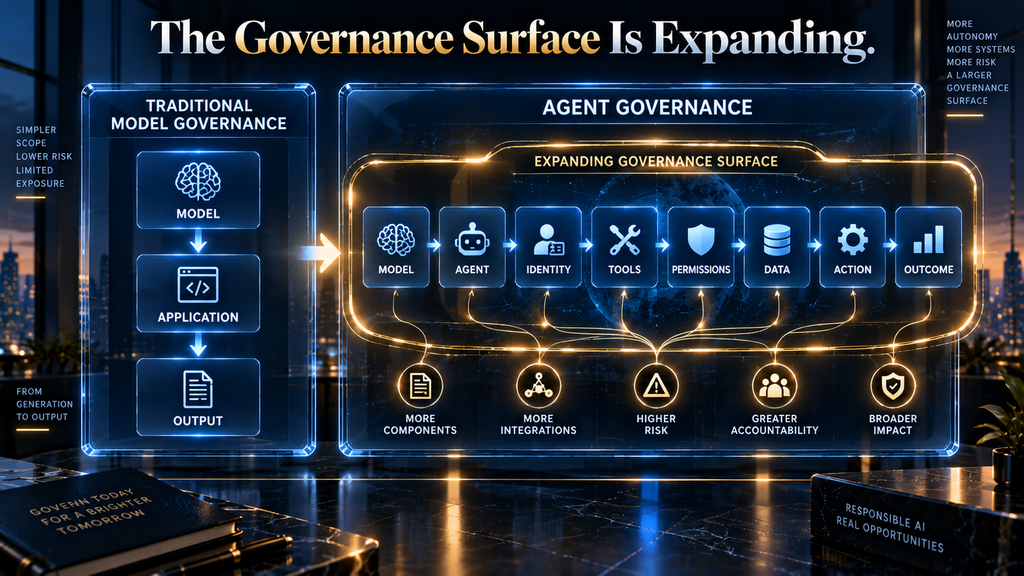
The next major governance problem is not simply “more AI.” It is AI that can act.
A traditional generative-AI application might answer a question. An agent can retrieve information, call a tool, modify a record, send a message or trigger another workflow.
That changes the control model. The organization now needs to understand not only which model an AI system uses, but what the system is permitted to do. That introduces a new governance chain: Model → application → identity → tools → permissions → data → action → outcome.
A governance platform that understands only the model layer may therefore miss important risk. This is why agent governance appears explicitly in Gartner’s 2026 AI governance capability framework, and why vendors such as Credo AI, ServiceNow and Saidot are increasingly positioning agent governance as a core capability. The second-order effect is significant.
As agents become more capable, governance itself may need to become more machine-readable. Policies cannot remain trapped inside PDFs if autonomous systems are expected to operate against those policies.
That could push governance toward policy-as-code, machine-readable controls, identity-aware runtime enforcement and continuous evidence generation. In other words, the long-term direction is not simply better compliance software. It is governance infrastructure for machine-operated work.
The Second-Order Effect Most Buyers Miss
There is a deeper consequence to implementing AI governance well: it can change how an organization adopts AI.
Without governance, teams often move in one of two directions. They either experiment freely until security or compliance intervenes, or they create so much approval friction that employees avoid official channels.
A mature governance platform can potentially create a third path: fast approval for low-risk AI and proportionate scrutiny for high-risk AI. That is strategically important.
The objective is not to make every AI project pass through the same process. The objective is to make the process proportional to risk.
A low-risk internal summarization tool should not consume the same governance effort as an AI system making decisions about customers or employees.
This is one of the strongest arguments for risk-based governance platforms. They can help organizations spend governance effort where it creates the most value.
The second-order effect is therefore operational: better governance can actually increase AI adoption when it reduces uncertainty instead of merely adding restrictions.
What Happens If You Do Nothing?
The answer depends on the organization’s AI footprint. For a small company with a few low-risk tools, doing nothing beyond basic policies may not create immediate problems.
For an enterprise with hundreds of AI applications, vendors and agents, the risk is different. The organization gradually loses visibility.
Teams create independent inventories. Vendors change models. New applications appear. Employees use unapproved systems. Assessments become inconsistent. Audit evidence becomes difficult to reconstruct. High-risk AI can receive the same governance treatment as low-risk experimentation because the organization lacks a scalable classification mechanism.
Nothing necessarily breaks on day one. The more dangerous outcome is that the organization stops knowing whether it is in control. That is when governance becomes an infrastructure problem rather than a policy problem.
A Simple AI Governance Platform Maturity Model
The decision to buy software should correspond to organizational maturity.
Level 1: Basic Control
The organization has a small AI footprint and needs policies, approved tools, employee guidance and basic ownership. A dedicated platform is usually unnecessary.
Level 2: Structured Inventory
The organization has enough AI systems and vendors that spreadsheets and manual coordination are becoming unreliable. Inventory and standardized risk assessments begin to provide meaningful value.
Level 3: Formal Governance
The organization operates higher-risk AI and needs consistent intake, approvals, evidence and policy mapping. A dedicated platform becomes increasingly valuable.
Level 4: Continuous Governance
AI systems are embedded into important business processes and change after deployment. Monitoring, reassessment and evidence automation become essential.
Level 5: Agentic Governance
Agents can take actions across enterprise systems. Governance now has to include identity, permissions, tools, autonomy, runtime behavior and escalation. The mistake is buying Level 5 infrastructure while operating at Level 1 maturity.
That is not future-proofing. It is overengineering.
Which Platform Should You Choose?
There is no universal winner, but there is a logical way to narrow the field. If your enterprise already runs deeply on ServiceNow and the biggest governance problem is workflow fragmentation, ServiceNow AI Control Tower deserves serious evaluation. If you have a large model estate, established AI lifecycle governance and an IBM-oriented enterprise environment, IBM watsonx.governance is a natural candidate.
If you are building a dedicated enterprise AI governance function and want a platform designed specifically around AI entities, policies, risks and agents, Credo AI is worth putting near the top of the shortlist. If privacy, data governance and AI risk are already managed through OneTrust, OneTrust AI Governance may offer the strongest organizational fit. If your biggest challenge is managing a large AI portfolio through standardized lifecycle workflows, ModelOp deserves evaluation.
If discovery, shadow AI and broad end-to-end AI governance are the dominant concerns, Holistic AI is a strong candidate to investigate. If your governance program needs deeper technical evidence and continuous AI evaluation, LatticeFlow AI is especially relevant. If your organization is interested in graph-based governance and maintaining connected relationships between systems, models, datasets, policies and agents, Saidot offers a differentiated approach.
The key phrase is organizational fit. A technically excellent platform can still be the wrong choice if it duplicates existing systems, creates excessive implementation work or does not match how the organization makes governance decisions.
Final Buying Checklist
Before selecting an AI governance platform, the procurement team should be able to answer these questions clearly.
- Can the platform discover or connect to the AI systems we actually operate?
- Can it represent models, applications, agents, vendors, datasets and owners?
- Can risk classification influence the governance workflow?
- Can low-risk and high-risk AI follow proportionate processes?
- Can policies be connected to specific AI systems?
- Can the platform map requirements to recognized frameworks without pretending that mapping equals compliance?
- Can it preserve evidence showing who made each governance decision?
- Can it detect or accommodate material changes after approval?
- Can it integrate with our existing GRC, security, data and identity systems?
- Can it govern AI agents and their tools, permissions and actions?
- What can it actually enforce at runtime?
- What technical evidence does it collect?
- How much manual administration remains after implementation?
- What happens when we add another model provider?
- What happens when an existing system changes?
- Can governance records be exported if we change platforms?
- How quickly can a real AI use case move through the complete workflow?
- What will the platform cost us beyond the software license?
- Which governance problems will it eliminate?
- Which governance responsibilities will still require human judgment?
The last question is arguably the most important. A governance platform should make the organization more capable of making good decisions, not merely more capable of documenting decisions.
Final Thoughts
The AI governance platform market has reached an important transition point. Gartner’s first 2026 research on the category treats AI governance platforms as enterprise infrastructure for defining, approving and enforcing responsible-AI policies across applications and agents, while its capability framework recognizes that governance now spans discovery, risk, evidence, workflow, interoperability, security and agent governance.
That does not mean every enterprise should immediately buy one.
The real dividing line is whether the organization’s AI environment has become too complex to govern reliably through manual processes. Once AI systems multiply across teams, vendors and workflows, the cost of fragmented governance starts rising. At that point, a platform can provide something more valuable than compliance paperwork: a continuously updated operating picture of the organization’s AI estate.
The strongest buying strategy is therefore not to ask which vendor has the most impressive feature list. Start with the governance bottleneck. If discovery is failing, solve discovery. If approvals are slow, solve workflow. If model lifecycle is the challenge, prioritize lifecycle governance. If technical evidence is missing, prioritize evaluation. If agents are becoming operationally important, make agent identity, tools, permissions and runtime controls part of the selection criteria.
There is also a limit that no software vendor can remove: governance remains an organizational responsibility. A platform can automate evidence, route decisions and enforce controls, but it cannot decide what risk the business should accept, what accountability means in a particular context or whether a consequential AI decision is ethically and commercially appropriate.
That is the reality check worth remembering.
The best AI governance platform is not the one that automates the most governance. It is the one that makes the right governance decisions easier to make, easier to enforce and easier to prove—without slowing responsible AI adoption to a crawl.
Ready to Choose an AI Governance Platform?
The right platform is rarely the one with the longest feature list. Start with your biggest governance gap—visibility, risk assessment, compliance workflow, monitoring or oversight—and choose the platform that addresses that need most effectively.
Map Your AI Risks First →Frequently Asked Questions
What is an AI governance platform?
An AI governance platform is software that helps organizations discover, inventory, assess, approve, monitor and control AI systems while maintaining evidence of governance decisions. Modern platforms increasingly extend these capabilities to AI agents, vendors, datasets and runtime controls.
What is the best AI governance platform in 2026?
There is no universal winner. ServiceNow is particularly relevant to ServiceNow-centric enterprises, IBM to large AI/model-governance environments, Credo AI to dedicated AI governance programs, OneTrust to privacy-centric organizations, ModelOp to AI portfolio governance, Holistic AI to broad discovery and enforcement, LatticeFlow AI to technical AI evidence, and Saidot to graph-based governance.
Do small businesses need an AI governance platform?
Usually not at the beginning. If the AI estate is small and low risk, policies, approved-tool lists, data-handling rules, employee training and human review may be sufficient. A dedicated platform becomes more attractive as AI usage, risk, vendors and governance workload increase.
Does an AI governance platform make a company compliant?
No. A platform can help operationalize governance processes, maintain evidence and map requirements, but compliance remains an organizational responsibility. NIST AI RMF is a voluntary risk-management framework, while ISO/IEC 42001 specifies requirements for an AI management system.
What is the difference between AI governance and AI compliance?
AI compliance focuses on meeting applicable legal and regulatory obligations. AI governance is broader and includes organizational policies, risk management, accountability, human oversight, lifecycle controls, monitoring and responsible-use decisions.
Why does AI agent governance matter?
Agents can take actions, use tools and interact with enterprise systems. That means governance must consider identity, permissions, data access, tools, autonomy, actions and runtime behavior in addition to the underlying model.
Can AI governance platforms detect shadow AI?
Some platforms specifically market discovery capabilities for identifying AI systems and applications outside formal governance processes. The exact coverage varies significantly, so buyers should test discovery against their own cloud, SaaS, code and identity environments rather than accepting “shadow AI discovery” as a generic feature label. Holistic AI, for example, explicitly describes shadow-AI discovery across cloud, code and SaaS, while ServiceNow describes automated inventory of AI agents, models and MCP servers. (Holistic AI)
Is NIST AI RMF a compliance standard?
No. NIST describes the AI RMF as a voluntary framework intended to help organizations manage AI risks and incorporate trustworthiness considerations throughout AI design, development, use and evaluation.
What is ISO/IEC 42001?
ISO/IEC 42001:2023 is an international standard specifying requirements for establishing, implementing, maintaining and continually improving an Artificial Intelligence Management System. It is broader than a software product and focuses on organizational management of AI-related risks and opportunities. (ISO)
Should AI governance be automated?
The repetitive parts should be automated where practical, including inventory updates, workflow routing, evidence collection and monitoring. High-consequence decisions should retain appropriate human judgment because automation can accelerate a flawed governance decision just as easily as a good one.
What is the most important feature of an AI governance platform?
There is no single feature. The most important capability is the platform’s ability to connect AI discovery, risk, policy, ownership, workflow, evidence and ongoing change into a coherent governance process.
Should an AI governance platform replace existing GRC software?
Usually not automatically. AI governance often works best as a layer connected to existing GRC, security, privacy, identity, data and AI infrastructure. The goal should be to close a governance capability gap rather than create unnecessary platform duplication.
Related Guides
- Best AI Product Management Tools in 2026: Research, Roadmaps & Product Ops
- Best AEO & GEO Tools for AI Search Visibility in 2026
- Best AI Workflow Automation Tools (Free & Paid)
Written by
Muntasir Ahmad Chowdhury
Founder, AI Hustle World
Muntasir Ahmad Chowdhury is the Founder of AI Hustle World, an independent publication dedicated to making Artificial Intelligence practical, trustworthy, and easy to understand. He researches AI tools, automation, customer service, productivity, and real-world business applications, helping readers make smarter technology decisions through research-driven, experience-backed content.
Expertise:
AI Tools • AI Automation • AI Customer Service • AI Productivity • Generative AI • AI Workflows
Get Smarter With AI
Enjoyed this guide? Get practical AI tools, tutorials, and honest reviews delivered to your inbox.
2 thoughts on “Best AI Governance and Compliance Platforms in 2026”