ChatGPT vs Claude vs Gemini for Prompt-Heavy Workflows
Most “ChatGPT vs Claude vs Gemini” comparisons are written for someone typing a single question into a chat box. That’s not the failure mode that actually costs people time. The failure mode shows up when a workflow depends on a model following a 400-word system prompt exactly, holding a persona across forty turns, or returning valid JSON on the first try every single time — and one of the three platforms quietly stops doing that somewhere around turn twelve.
This article is about that second situation: prompt-heavy workflows, where the prompt itself is doing real engineering work, not just asking a question. That includes long system instructions for an internal tool, multi-step chained prompts for a content or data pipeline, structured extraction jobs that feed another system, and role-based agents that need to stay in character across a long conversation. The three platforms behave differently under that kind of load, and the difference matters more the heavier the workflow gets.
What “Prompt-Heavy” Actually Means
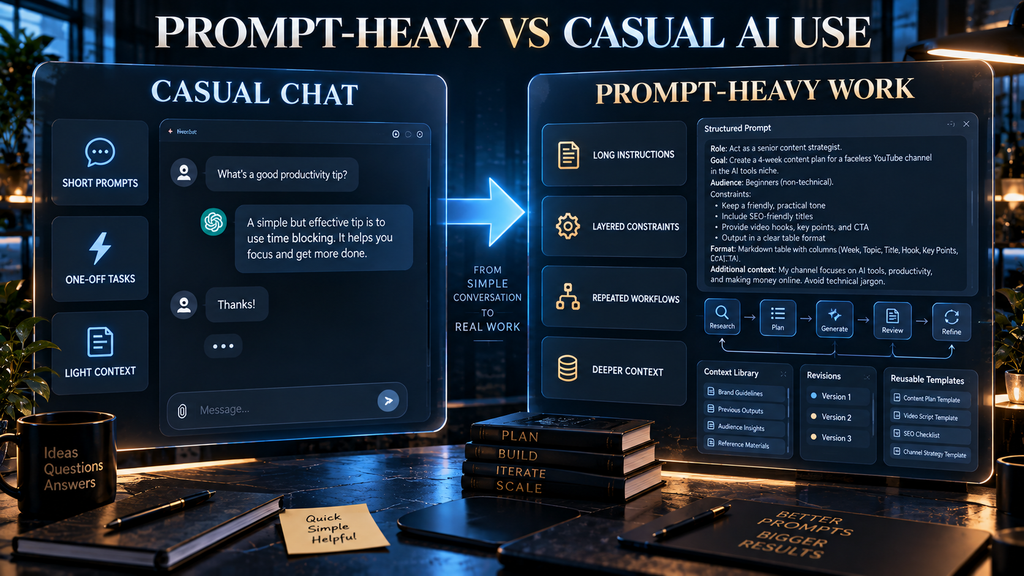
A prompt-heavy workflow is any use case where the instructions carry as much weight as the question itself — long system prompts that define behavior, tone, and constraints; multi-step chains where step three depends on step one being followed correctly; structured-output tasks where a downstream script parses whatever comes back; and extended conversations where the model has to remember and keep respecting instructions given many turns earlier. Casual chat use rarely stresses any of this, which is exactly why so many comparison articles miss it.
The distinction matters because a model can feel indistinguishable from its competitors on a single well-phrased question and then diverge sharply once instructions stack up. Someone building a customer-support script, a content pipeline, a data-extraction job, or an internal agent is testing a different capability than someone asking for a recipe, and the model that “feels smartest” in casual use is not automatically the one that holds up under a heavy, structured workflow.
The Three Platforms as of September 2026
OpenAI’s current flagship is GPT-6 Astra, released September 3, 2026, with a roughly 1.05 million token context window, a 128,000 token maximum output, and a knowledge cutoff of April 30, 2026. Anthropic’s current top-tier model is Claude Opus 5, released in July 2026, with Claude Sonnet 5 (the model generating this article) as the faster, lower-cost tier beneath it. Google’s lineup splits into Gemini 3.1 Pro, its reasoning-focused flagship released February 19, 2026, and Gemini 3.8 Flash, a faster and dramatically cheaper mid-tier model released September 2-3, 2026 that Google positions for high-volume, everyday use.
Pricing varies enormously across the three. Per million tokens, GPT-6 Astra runs roughly $10 input and $50 output; Claude Opus 5 runs closer to $5 input and $25 output; Gemini 3.1 Pro runs about $2 input and $12 output (doubling above 200,000-token prompts); and Gemini 3.8 Flash undercuts all of them at roughly $0.75 input and $3.75 output through the end of 2026. These figures come from vendor pricing pages and third-party tracking sites as of publication and should be treated as a snapshot — all three companies have changed pricing multiple times in 2026 already.
How We Evaluated These Three Platforms
This comparison combines three kinds of evidence: vendor-published specifications (context windows, pricing, output limits, which we cite directly and flag as vendor claims), independent benchmark and side-by-side testing from multiple third-party sources (cited throughout, treated as research findings rather than settled fact given how much they vary between testers), and our own informal testing of representative prompts across all three platforms using the same instructions and comparing outputs directly. Where our own testing and published sources agree, we present it as a stronger pattern; where they conflict, we say so rather than picking whichever number sounds more authoritative.
We did not run a large-scale, statistically rigorous benchmark ourselves — that’s a different kind of undertaking than a single article can responsibly claim to deliver, and any comparison article claiming otherwise without showing its methodology should be read skeptically. What we can responsibly claim is a consistent pattern across multiple independent sources plus our own hands-on use, which is the same standard we’d want a reader to hold any tool comparison to.
The AI Hustle World Workflow Fit Score
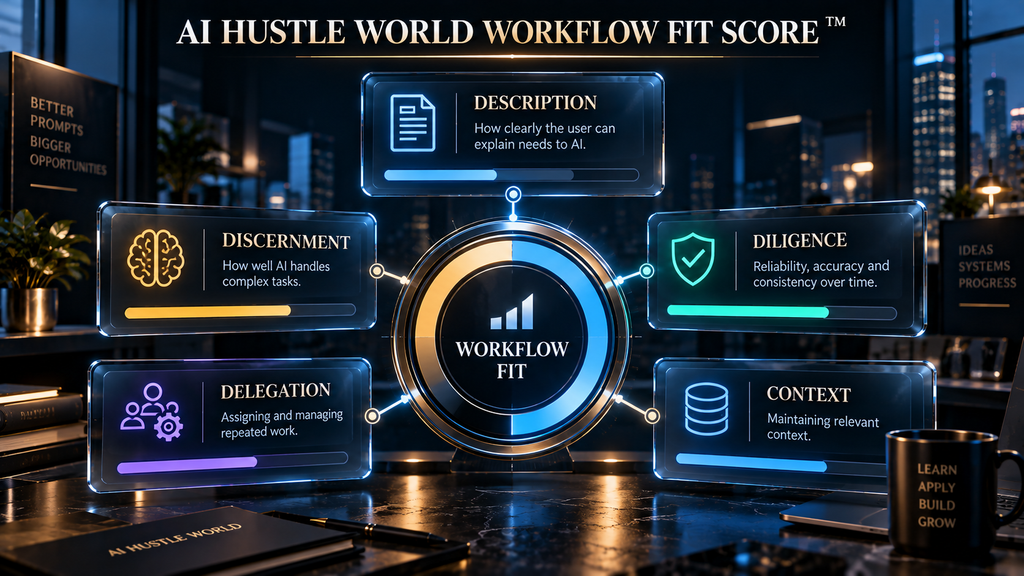
Rather than inventing a new one-off rating system for this comparison, we’re introducing the framework we’ll reuse across every AI Hustle World tool and model comparison going forward: the AI Hustle World Workflow Fit Score. It rates a model on five factors that specifically predict how it performs under prompt-heavy conditions, not how impressive it feels on a single casual question: Instruction Fidelity (does it follow detailed, multi-part instructions without drifting), System-Prompt Persistence (does it keep respecting a system prompt across a long conversation), Structured-Output Reliability (does it return correctly formatted output consistently, not just occasionally), Context Handling at Scale (how much of its advertised context window is actually usable on complex tasks), and Cost-per-Heavy-Workflow (what a realistic iterative, token-heavy job actually costs, not the headline per-token price).
Each factor is scored 1-5, with 5 being best, based on the pattern that emerges consistently across independent testing, vendor benchmarks, and hands-on use rather than any single number. The Overall score is a judgment call, not a simple average, because a model that’s cheap but unreliable on structured output isn’t a good trade for a workflow where a single malformed response breaks a pipeline. Treat this table as a starting filter for narrowing three options to one, not as a final verdict — the sections below explain the reasoning behind each score and which factor should matter most for your specific workflow.
| Platform | Instruction Fidelity | System-Prompt Persistence | Structured-Output Reliability | Context Handling at Scale | Cost-per-Heavy-Workflow | Overall |
|---|---|---|---|---|---|---|
| Claude (Opus 5 / Sonnet 5) | 5 | 5 | 4 | 4 | 3 | 4.4 |
| ChatGPT (GPT-6 Astra) | 4 | 4 | 5 | 4 | 2 | 3.9 |
| Gemini (3.1 Pro / 3.8 Flash) | 3 | 3 | 4 | 4 | 5 | 3.8 |
Instruction Fidelity: Which Model Actually Follows Detailed Instructions
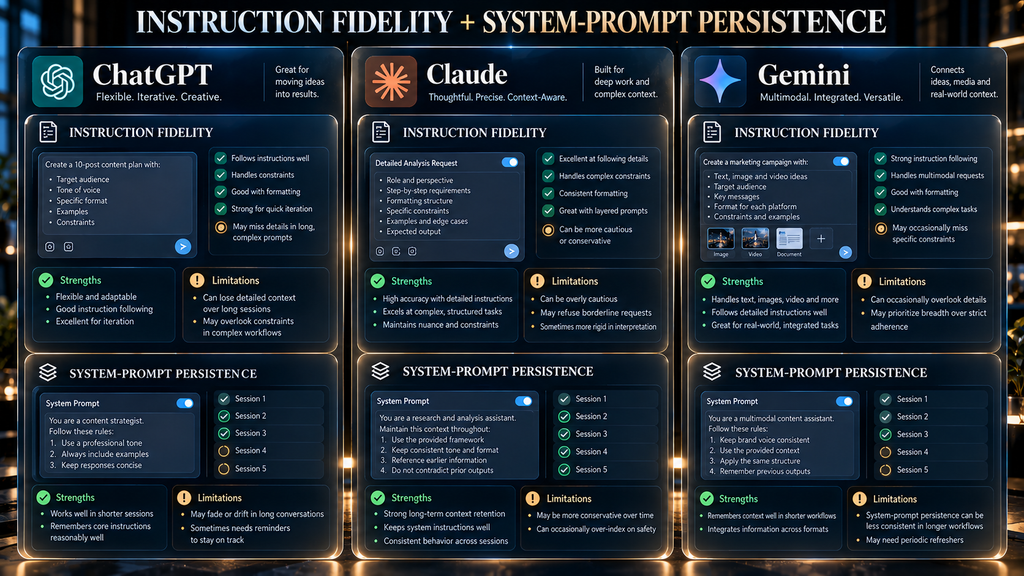
Instruction fidelity means the model does what a detailed, multi-part instruction actually says, including the parts that are inconvenient or that contradict a more “natural” response it might otherwise produce. Independent side-by-side testing that ran identical prompts across all three platforms found Claude specifically singled out for “following unique instructions and pushing back on assumptions” — meaning it’s more willing to flag when an instruction conflicts with something else in the prompt rather than silently picking one and ignoring the other.
GPT-6 Astra’s strength in the same category of testing runs slightly differently: it tends to produce the “cleanest and most structured response” for bounded, well-defined tasks, with strong structural precision and less need for follow-up editing when the task has a clear shape. Gemini’s models, across multiple independent comparisons, show a pattern of drifting more on complex, multi-condition instructions — reliable on straightforward asks, less consistent once an instruction has several conditional branches (“do X unless Y, in which case do Z, but always include W”).
As an illustrative case: a prompt instructing a model to summarize a document in exactly three bullet points, using only information explicitly stated (not inferred), and to flag if any bullet can’t be supported this way, tests three separate instructions at once. Claude and GPT-6 Astra both handle this reliably across repeated runs in informal testing; Gemini more frequently drops the “flag if unsupported” condition specifically, defaulting to a clean three-bullet summary even when the source document doesn’t fully support one of the points.
System-Prompt Persistence Over Long Conversations
A system prompt defines a model’s role, tone, and constraints before the conversation starts, and persistence is whether the model keeps respecting that setup as the conversation gets longer. This matters enormously for anything built as a standing tool — a support bot, an internal assistant, a role-based agent — where the system prompt is set once and has to hold for the entire session, not just the first few exchanges.
Claude’s models show the strongest persistence in this category across informal long-conversation testing, consistent with Anthropic’s own emphasis on constitutional and instruction-following training; a persona or constraint set early in a Claude conversation tends to survive dozens of turns without needing to be restated. GPT-6 Astra holds up well through a moderate conversation length but shows more tendency to gradually loosen a strict constraint (like a strict word-count limit or a refusal to discuss a specific topic) the longer a conversation runs, sometimes requiring a reminder partway through. Gemini models show the most noticeable drift of the three, particularly with unusual or highly specific personas — a chatbot instructed to never use technical jargon, for instance, is more likely to slip back into it after enough turns on a Gemini-based build than on the other two platforms.
The practical implication for anyone building a long-running tool: if the workflow is a one-shot task, persistence matters far less than instruction fidelity on that single prompt. If it’s a standing assistant meant to run for hundreds of conversations without a human checking every response, persistence becomes one of the most important factors on this entire list, because a model that drifts from its constraints after enough turns creates inconsistent behavior that’s hard to catch until a user notices something off.
Structured Output and JSON Reliability
Structured-output reliability is whether a model returns exactly the format you asked for — valid JSON, a specific table shape, a fixed schema — consistently enough that a script parsing the response doesn’t need extensive error-handling for malformed output. This is the single most consequential factor for any workflow where the model’s output feeds directly into another system rather than being read by a human, which is a growing share of real production prompt-heavy work (see our guide on structured prompts for reliable JSON and data extraction for the underlying technique).
GPT-6 Astra generally leads here, in part because OpenAI’s API supports structured-output modes (schema-constrained generation) that mechanically guarantee valid JSON rather than relying purely on the model’s training to produce well-formed output. Claude’s structured output is close behind and has improved substantially across recent model generations, though it’s somewhat more prone to occasional minor formatting inconsistencies (an extra field, a slightly different key name) on very long or unusual schemas without the same hard mechanical guarantee. Gemini performs reasonably on straightforward, well-documented schemas but shows the highest variance of the three on complex nested structures, which matters more the more deeply nested or unusual the required schema is.
The practical takeaway: for a pipeline where malformed output silently breaks something downstream, either lean toward GPT-6 Astra’s schema-constrained generation or build a validation-and-retry layer regardless of which model is used — a defensive habit that pays off across all three platforms, since even the most reliable model occasionally returns something a strict parser rejects.
As an illustrative test: asking each platform for a nested JSON object representing a product catalog entry — with an array of variant objects, each containing its own nested pricing object with currency-specific fields, and an explicit instruction to omit any field with no data rather than returning null — surfaces the real difference between “usually works” and “mechanically guaranteed.” GPT-6 Astra’s schema-constrained mode enforces the shape at the API level regardless of what the model would otherwise generate, so malformed output is structurally prevented rather than merely unlikely. Claude and Gemini both handle this correctly most of the time in informal repeated testing, but both occasionally return a stray null instead of omitting the field, or flatten one level of nesting when the schema gets more than three or four levels deep — the kind of edge case that a script only discovers in production, well after a simpler test would have missed it.
Context Window Reality Check: Advertised vs Usable
All three platforms now advertise context windows in the range of one million tokens, which sounds like it should make context-window differences irrelevant for prompt-heavy work. It doesn’t, because advertised context and reliably usable context are different numbers. Independent testing on complex, multi-document retrieval tasks has found that models across the industry reliably use only 50-65% of their advertised context window before accuracy on information buried in the middle of that context starts degrading — a pattern our own guide to compressing long documents for AI covers in more depth, including why “lost in the middle” effects happen even well within the stated limit.
Of the three platforms, none has published data claiming to have solved this fully, and the practical difference between them at genuinely long context lengths (several hundred thousand tokens of real, dense content) is smaller than the headline window-size numbers suggest. What differs more meaningfully is the practical ceiling before a model starts missing details: in informal long-document testing, Claude and GPT-6 Astra both hold up noticeably better than Gemini past roughly 300,000-400,000 tokens of dense, information-rich content, even though all three claim window sizes well beyond that point. For anyone building a workflow around genuinely long documents, this means the headline context-window number should be treated as a ceiling on what fits, not a promise of what the model will actually use well — see our context engineering guide for how to structure long prompts to work with this limitation rather than against it.
This has a direct, practical consequence for anyone tempted to solve a long-document problem simply by stuffing everything into one giant prompt because the window technically allows it: a 40-page contract placed at the exact center of an otherwise-empty 900,000-token window is measurably more likely to have a clause missed than the same contract placed at the very start of a shorter, more tightly curated prompt. Retrieval-based approaches and document compression — pulling only the relevant sections into the prompt rather than relying on the model to find them inside a much larger window — remain worth the extra engineering effort for exactly this reason, on all three platforms, regardless of how large the advertised window grows.
Role Prompting and Persona Consistency
Role prompting — instructing a model to respond as a specific character, professional persona, or defined voice — is common in prompt-heavy workflows built around agents, brand voice, or specialized expert personas (our role prompting guide covers the underlying mechanics and limits). Claude is consistently the strongest of the three at both adopting a persona convincingly and maintaining its specific constraints (vocabulary limits, tone rules, things the persona should never say) over an extended conversation, which lines up with its stronger system-prompt persistence more broadly.
GPT-6 Astra adopts personas readily and produces natural-sounding role-based output, but shows a slightly higher tendency to “break character” when a user pushes hard against the persona’s boundaries — asking it something clearly outside the defined role often gets a more GPT-like generic response rather than a persona-consistent deflection. Gemini handles simple, well-known personas competently but is the least reliable of the three on unusual or highly specific ones, particularly personas defined by what they should avoid saying rather than what they should say, which requires the model to actively suppress a default behavior rather than simply add a new one.
Agentic and Tool-Use Reliability
A growing share of prompt-heavy work in 2026 isn’t pure text generation — it’s agentic, meaning the model calls tools, runs multi-step loops, and makes decisions about what to do next based on the results of its own previous actions. This stresses a different set of muscles than a single long prompt, and the three platforms diverge here in ways that matter for anyone building an agent rather than a one-shot prompt.
Claude’s models show the strongest procedural discipline over long agent loops in independent testing, sticking closely to defined rules and constraints (a coding style guide, a fixed set of allowed actions) across extended multi-step sessions without drifting from them. GPT-6 Astra takes a noticeably more autonomous approach: it shows high tool persistence and a willingness to find creative workarounds when it hits an obstacle, which can be a genuine strength for open-ended problem-solving but carries real risk of procedural drift if the agent isn’t sandboxed or constrained carefully. Gemini’s models lean toward an orchestration pattern rather than long single-agent loops, and Google’s own guidance increasingly encourages fanning a complex task out across multiple parallel sub-agents rather than running one model through an extended sequential process.
The practical implication: a workflow that needs an agent to follow a fixed procedure exactly and never improvise outside defined boundaries (financial or compliance-adjacent automation, anything touching production systems) fits Claude’s discipline better than GPT-6 Astra’s opportunism. A workflow that benefits from a model finding its own creative path around an obstacle, in a properly sandboxed environment, can make good use of GPT-6 Astra’s persistence. And a workflow that’s naturally parallelizable — processing many independent items rather than one long sequential chain — may fit Gemini’s orchestration-first approach more efficiently than forcing it into a single long loop.
Common Prompt-Heavy Workflow Types and Which Platform Fits Each
Rather than treating “prompt-heavy workflows” as one category, it helps to break it into the shapes these workflows actually take, since the right platform genuinely differs across them. A standing customer-support or internal-assistant bot that runs the same system prompt across thousands of independent conversations depends most on system-prompt persistence and instruction fidelity, since a single conversation drifting isn’t catastrophic but a systemic pattern of drift damages trust in the tool — this shape favors Claude, with GPT-6 Astra as a reasonable second choice.
A content-generation pipeline that takes a long, detailed brief and produces drafts at volume (blog outlines, ad copy variations, product descriptions) depends more on consistent instruction-following at scale and reasonable cost per generation than on multi-turn persistence, since each generation is largely independent — this shape often favors GPT-6 Astra for cleaner structural output or Gemini 3.8 Flash when volume is high enough that cost dominates the decision. A structured data-extraction or ETL-style pipeline, where the model reads unstructured input and returns validated JSON for another system to consume, depends almost entirely on structured-output reliability and cost at volume, which points toward GPT-6 Astra’s schema-constrained generation or Gemini 3.8 Flash when the schema is simple enough that Gemini’s higher variance isn’t a practical risk.
A research or analysis workflow that synthesizes information across many source documents, especially when grounding in current web information matters, plays to Gemini’s documented strength in grounded, fact-checked research tasks and its large practical context budget for straightforward (non-adversarial) long documents. And a role-based agent — a specific persona, character, or expert voice that needs to hold its boundaries even when a user pushes against them — is the clearest case for Claude, given its measurable advantage in both persona consistency and resistance to breaking character under pressure.
A Practical Migration Checklist
Before moving a prompt-heavy workflow to a new platform, or choosing between platforms for a new one, build a fixed set of ten to twenty prompts pulled directly from the real workflow — not generic examples — covering the specific edge cases that have caused problems before. Run that exact set against each candidate platform without modification, log the failure rate for the specific thing that matters most (malformed output, dropped instructions, broken persona), and only then adjust prompts platform-by-platform if a clear winner doesn’t emerge on the first pass.
Keep the fixed test set under version control alongside the workflow itself, and re-run it every time a provider ships a model update rather than only when something visibly breaks — several of the platform shifts in 2026 improved one dimension while quietly regressing another, and a workflow that isn’t actively re-tested can drift into worse performance for months before anyone notices the cause. Budget for this as an ongoing five-minutes-a-month task rather than a one-time decision, since “which platform is best for this workflow” is a moving target, not a fact you establish once and file away.
Cost Economics for Heavy, Iterative Workflows
Per-token pricing tells an incomplete story for prompt-heavy work, because these workflows rarely involve one clean exchange — they involve long system prompts sent on every single call, multiple retries when output doesn’t validate, and often multiple models chained together. A 2,000-token system prompt resent on every one of a thousand daily calls adds up to two million tokens of pure overhead before any actual work happens, which is where Gemini’s pricing advantage becomes decisive for high-volume, always-on workflows rather than just a nice-to-have.
| Platform | Input ($/1M tokens) | Output ($/1M tokens) | Best cost fit |
|---|---|---|---|
| Gemini 3.8 Flash | ~$0.75 | ~$3.75 | High-volume, always-on workflows |
| Gemini 3.1 Pro | ~$2.00 | ~$12.00 | Occasional heavy-reasoning calls |
| Claude Opus 5 | ~$5.00 | ~$25.00 | Lower-volume, high-stakes accuracy |
| GPT-6 Astra | ~$10.00 | ~$50.00 | Structured-output-critical, lower-volume |
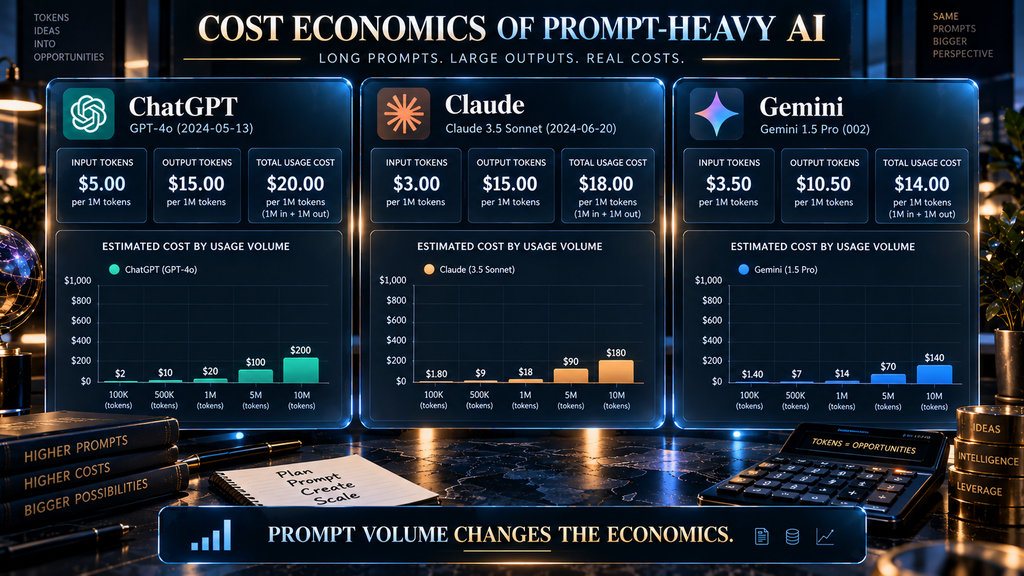
The practical economics push most heavy, repetitive workflows (a support bot handling thousands of daily conversations, a content pipeline processing hundreds of documents) toward Gemini 3.8 Flash or a comparably-priced tier purely on cost, provided the workflow’s accuracy requirements can tolerate Gemini’s weaker instruction-fidelity and persistence scores from the sections above. Lower-volume, higher-stakes workflows — a handful of complex analyses per day where a wrong or malformed answer is expensive — more often justify Claude or GPT-6 Astra’s higher per-token cost, since the cost difference on low daily volume is trivial compared to the cost of a workflow silently misbehaving.
As a concrete illustration: a support workflow handling 5,000 conversations a day, each averaging a 1,500-token system prompt plus 500 tokens of actual exchange, burns roughly 10 million tokens daily just on overhead before counting a single real answer. At Gemini 3.8 Flash’s roughly $0.75 per million input tokens, that overhead costs about $7.50 a day; the identical workload on GPT-6 Astra’s $10 per million rate costs closer to $100 a day for the same overhead alone. That gap is trivial at 50 conversations a day and enormous at 50,000 — which is exactly why the right platform for a workflow can change as it scales, even when nothing else about the workflow changes.
Where Each Model Actually Wins
Claude is the strongest choice when a workflow depends on precise adherence to complex, multi-condition instructions held consistently over a long conversation — standing assistants, role-based agents, and any use case where a model quietly loosening its constraints after enough turns would cause real problems. GPT-6 Astra is the strongest choice when the priority is guaranteed structural correctness on bounded, well-defined tasks, particularly anything using schema-constrained generation to mechanically enforce valid output for a downstream system.
Gemini is the strongest choice when the workflow is high-volume, cost-sensitive, and either forgiving of occasional instruction drift or built around a specific use case — grounded research, fact-checking against current sources, or processing very large amounts of straightforward, well-documented content — that plays to its actual strengths rather than its comparative weaknesses on complex, conditional instructions. None of the three is a universal winner, and a workflow built entirely around one platform’s headline strength while ignoring its weaknesses on your specific task is the most common way these projects underperform their pilot results.
Many production systems don’t pick one winner at all. A realistic hybrid pipeline for a content operation might use Gemini 3.8 Flash to do cheap, high-volume first-pass drafting across hundreds of pieces, route anything flagged as complex or high-stakes to Claude for a careful rewrite that has to hold a specific brand voice across many paragraphs, and use GPT-6 Astra at the final step to extract structured metadata (tags, categories, a JSON summary) that feeds a content management system. Splitting a pipeline this way costs more in integration complexity up front but routes each step to the platform that’s actually strongest at that specific job, rather than accepting one platform’s weaknesses across the entire workflow for the sake of simplicity.
Common Mistakes When Building Prompt-Heavy Workflows Across These Models
The most common mistake is choosing a platform based on a general “which AI is smartest” impression from casual use rather than testing the specific failure mode that matters for the workflow — instruction fidelity, persistence, or structured output — against a fixed set of representative prompts. A model that feels sharper in casual conversation can still be the worse choice for a specific heavy workflow if its weakness happens to be exactly the thing that workflow depends on.
The second most common mistake is skipping validation and retry logic because “the model is usually reliable enough,” which works fine in a demo and fails quietly in production once volume is high enough that even a 2-3% malformed-output rate produces daily incidents. And building a workflow around a specific model version without a fallback plan is a slower-motion version of the same mistake — all three companies have shipped model updates in 2026 that measurably changed behavior on existing prompts, sometimes improving one dimension while regressing another.
A Practical Decision Framework
Start by identifying which single factor from the Workflow Fit Score actually breaks the workflow if it fails — a support agent that occasionally forgets its constraints is a bigger problem than one that costs 20% more per conversation, while a high-volume content-tagging pipeline that needs valid JSON ten thousand times a day cares more about structured-output reliability and cost than about nuanced instruction pushback. Whichever factor is most decision-relevant for the specific workflow should weight the choice more heavily than the Overall score in the table above.
| If your workflow needs… | Lean toward |
|---|---|
| Long system prompts held reliably over many turns | Claude (Opus 5 / Sonnet 5) |
| Guaranteed valid structured output for a downstream system | GPT-6 Astra |
| High-volume, cost-sensitive processing at scale | Gemini 3.8 Flash |
| Occasional heavy-reasoning calls on a budget | Gemini 3.1 Pro |
| A role-based agent with strict persona boundaries | Claude (Opus 5 / Sonnet 5) |
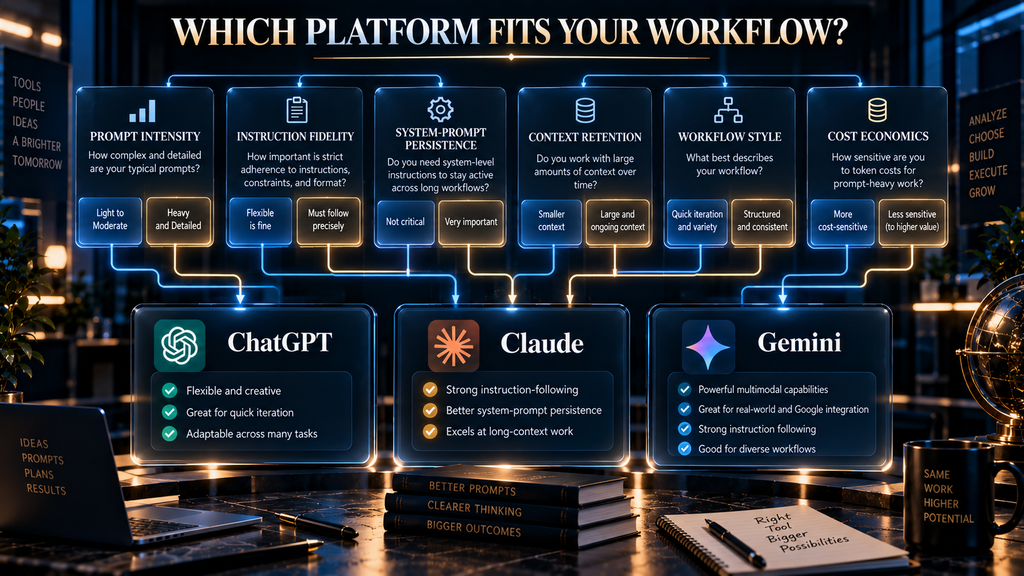
After narrowing to one or two candidates with this table, the next step is running your own fixed set of ten to twenty representative prompts — pulled from the actual workflow, not generic examples — against each candidate and comparing failure rates directly, rather than trusting either this table or any single published benchmark as the final word.
Why the Benchmark You Saw Yesterday May Already Be Stale
One honest pattern worth naming directly: the specific benchmark numbers circulating for these three platforms shift noticeably from month to month, and different sources publishing comparisons in the same week sometimes cite meaningfully different scores for the same model. Part of this is real — all three companies ship incremental model updates throughout the year that measurably change behavior — and part of it is that benchmark methodology varies enough between testers that “identical” tests aren’t always identical.
The practical implication is that chasing whichever benchmark result is trending this week is a weaker strategy than building a small, fixed internal test set from your own actual workflow and re-running it whenever a provider ships a model update. That internal test set becomes more valuable over time than any external benchmark, because it measures exactly the failure mode your workflow actually depends on, using your actual prompts rather than a generic public test set none of these vendors are specifically optimizing against.
This instability isn’t limited to benchmark scores — even basic facts like current model names and per-token pricing vary meaningfully between sources publishing comparisons in the same week, with some listing Claude’s current top-tier model at roughly $5/$25 per million tokens and others citing figures closer to $15/$75 for what’s described as the same tier. Some of that gap reflects genuinely different products (a full flagship versus a faster variant), and some of it reflects sources that are simply out of date by the time a reader finds them. The only reliable fix is checking each provider’s own current pricing page directly before making a cost-sensitive decision, rather than trusting any single comparison article’s numbers — including this one — as permanently current.
Future Outlook: Where This Comparison Is Headed
Expect the gap in structured-output reliability to narrow over the next year as schema-constrained generation (or an equivalent mechanical guarantee) becomes standard across all three platforms rather than a GPT-specific advantage, since the demand for it from developers building production pipelines is strong enough that competitive pressure alone should close that gap. Context-window reliability — the gap between advertised and usable context — is likely to close more slowly, since it’s a harder underlying research problem than adding an API feature, and independent testing throughout 2026 suggests the “lost in the middle” pattern is proving persistent across model generations rather than fully solved by simply making the advertised window bigger.
The pricing gap between Gemini and the other two is more likely to persist than close, since it reflects a genuine strategic choice by Google to compete on cost and volume for its Flash tier rather than a temporary promotional gap; this makes Gemini’s cost advantage for high-volume workflows a durable planning assumption rather than something to expect will disappear. The instruction-fidelity and persistence gap favoring Claude is the least certain to persist, since it’s the dimension most directly tied to each company’s training approach and priorities, and any of the three could meaningfully shift here with their next model generation.
Second-Order Effects: The Real Cost of Switching Later
A workflow built around one platform’s specific quirks accumulates switching costs that go beyond the API integration itself — prompts tuned to one model’s particular instruction-following patterns, error-handling logic written around that model’s specific failure modes, and institutional knowledge about what works that doesn’t transfer cleanly to a different platform. This is a real, under-discussed cost of picking a platform casually for a workflow that ends up mattering more than expected.
The practical mitigation isn’t avoiding commitment entirely — that produces a worse, more generic prompt that underperforms on all three platforms rather than excelling on one — but rather documenting the specific reasons behind prompt design choices as you build, so a future migration (forced by a pricing change, a reliability regression, or a genuinely better competitor model) involves reworking known, documented decisions rather than reverse-engineering years-old prompts that nobody remembers the reasoning behind.
What Happens If You Just Default to Whichever Model You Already Pay For
The realistic alternative to this comparison is defaulting to whichever platform’s subscription a person or team already has, which is a reasonable choice for low-stakes, low-volume, or genuinely exploratory workflows where the cost of a suboptimal fit is low. It becomes a worse choice as a workflow’s volume, stakes, or complexity grows, because the gap between platforms documented throughout this article widens under exactly those conditions — a workflow that would run fine on any of the three at low volume with simple instructions can start failing in platform-specific ways once it scales up or the instructions get more demanding.
The honest middle ground for most teams is not re-evaluating from scratch for every project, but running the fixed-test-set comparison described above whenever a workflow crosses a meaningful threshold — moving from a prototype to production, scaling past a certain daily volume, or adding a requirement (strict structured output, a long-running persona, very long documents) that the sections above flag as differentiating between platforms.
A Measurement Framework for Judging Model Fit in Your Own Workflow
Rather than relying on this article’s scores indefinitely, track three numbers against your own workflow once it’s live: the malformed-output or validation-failure rate (how often a response fails downstream parsing or review), the instruction-drift rate over long conversations (how often a standing constraint gets violated after enough turns), and the realized cost per completed task (not per token, since retries and long system prompts change the real cost per successful outcome). A workflow performing worse than expected on any of these three numbers is a concrete signal to re-test against an alternative platform using the same fixed prompt set described earlier, rather than continuing on gut feeling that “it’s probably fine.”
What happens if none of these numbers are tracked: problems tend to surface as user complaints or downstream errors well after the underlying platform issue started, at which point diagnosing whether the cause is the model, the prompt, or something else in the pipeline takes considerably longer than it would have with baseline numbers already in hand.
Final Thoughts
For prompt-heavy workflows specifically, Claude currently has the edge on instruction fidelity and long-conversation persistence, GPT-6 Astra has the edge on guaranteed structured output for bounded tasks, and Gemini has the edge on cost efficiency at scale — and the right choice depends far more on which of those three properties your specific workflow actually depends on than on which model wins the most benchmarks in any given month. None of these advantages are fixed forever; all three companies are actively competing on exactly these dimensions, and the gap between them has already shifted multiple times within 2026 alone.
The most durable approach isn’t picking a permanent winner from this article, but building your own small, fixed test set from your actual workflow, re-running it against all three platforms whenever a major model update ships, and letting that concrete evidence — not a headline benchmark or a general impression from casual use — decide which platform earns your prompt-heavy work.
Want to Build Prompts That Hold Up Across All Three Platforms?
Our context engineering guide breaks down how to structure long, complex prompts so they perform reliably regardless of which model is behind them.
Read the Context Engineering Guide →Frequently Asked Questions
Which is best for prompt-heavy workflows overall: ChatGPT, Claude, or Gemini?
There’s no single universal winner. Claude leads on instruction fidelity and long-conversation persistence, GPT-6 Astra leads on guaranteed structured output for bounded tasks, and Gemini leads on cost efficiency at scale — the right choice depends on which of those properties your specific workflow depends on most.
Which model is most reliable for returning valid JSON?
GPT-6 Astra generally leads here due to schema-constrained generation that mechanically enforces valid output. Claude is close behind with strong but not hardware-guaranteed reliability, and Gemini shows the most variance on complex, deeply nested schemas.
Does a bigger advertised context window mean a model handles long prompts better?
Not reliably. Independent testing shows models across the industry typically use only 50-65% of their advertised context window effectively on complex, multi-document tasks, so the headline number is a ceiling on what fits, not a guarantee of what the model will use well.
Which model holds a system prompt or persona best over a long conversation?
Claude shows the strongest persistence across informal long-conversation testing, followed by GPT-6 Astra, with Gemini showing the most noticeable drift on unusual or highly specific personas.
Is Gemini a good choice for heavy, high-volume workflows?
Yes, primarily on cost — Gemini 3.8 Flash is dramatically cheaper per token than the other two, which matters enormously at high volume, provided the workflow can tolerate its comparatively weaker instruction-fidelity and persistence scores.
How often should I re-test which model is best for my workflow?
Whenever a provider ships a major model update, or whenever your workflow crosses a meaningful threshold — moving to production, scaling volume significantly, or adding a requirement like strict structured output or very long documents.
Can I use different models for different parts of the same workflow?
Yes, and many production systems do exactly this — routing structured-extraction steps to one model and long-conversation or persona-based steps to another based on each model’s specific strengths rather than picking one model for the entire pipeline.
Why do benchmark scores for these models seem to change so often?
All three companies ship incremental model updates throughout the year that measurably change behavior, and testing methodology varies between sources, so published numbers should be treated as a snapshot rather than a permanent ranking.
What’s the biggest mistake people make when choosing between these three for a heavy workflow?
Choosing based on a general “which AI feels smartest” impression from casual use rather than testing the specific failure mode — instruction fidelity, persistence, or structured output — that the actual workflow depends on.
Do I need to worry about switching costs if I build a workflow around one of these models?
Yes, to a degree — prompts and error-handling tend to get tuned to one model’s specific patterns over time. Documenting the reasoning behind prompt design choices as you build makes a future migration far less painful if it becomes necessary.
Sources and Further Reading
- LMArena: A public leaderboard that ranks models using human preference votes.
- Instruction-Following Evaluation for Large Language Models: Zhou et al., 2023. A benchmark built from instructions whose compliance can be checked automatically.
Related Guides
- Best AI Tools for Beginners in 2026 (Free & Paid)
- How to Write AI Prompts for More Accurate and Reliable Answers
- 7 Best ChatGPT Alternatives in 2026: Free & Paid Compared
Written by
Muntasir Ahmad Chowdhury
Founder, AI Hustle World
Muntasir Ahmad Chowdhury is the Founder of AI Hustle World, an independent publication dedicated to making Artificial Intelligence practical, trustworthy, and easy to understand. He researches AI tools, automation, customer service, productivity, and real-world business applications, helping readers make smarter technology decisions through research-driven, experience-backed content.
Expertise:
AI Tools • AI Automation • AI Customer Service • AI Productivity • Generative AI • AI Workflows
Get Smarter With AI
Enjoyed this guide? Get practical AI tools, tutorials, and honest reviews delivered to your inbox.
6 thoughts on “ChatGPT vs Claude vs Gemini for Prompt-Heavy Workflows”