
Evidence: Documentation reviewed
Last checked: September 2026
What was done: Written from official documentation and the published sources linked in this article. Not hands-on tested.
Files: None
Affiliate links: No
AI B2B Lead Generation vs Traditional Prospecting: What Actually Works in 2026?
The Prospecting Problem Nobody Has Fully Solved
B2B prospecting has become dramatically easier to automate, but that has not made it dramatically easier to get right. An AI system can now identify companies, enrich contact records, monitor business changes, summarize account research, detect potential buying signals, prioritize accounts, and prepare personalized outreach in a fraction of the time required by a traditional sales team. The problem is that none of those capabilities automatically answer the question that matters most to a revenue leader: does the prospecting system create better opportunities and more revenue, or does it simply create more sales activity?
That distinction is becoming increasingly important in 2026 because the market is changing on both sides of the transaction. Sales organizations have access to more data and automation than ever, while buyers are using AI themselves to research vendors, compare alternatives, and gather information before speaking with a salesperson. Forrester’s 2026 research found that 94% of business buyers use AI during their buying process, while the typical B2B purchase involves 13 internal stakeholders and nine external influencers. Buyers are also increasingly validating AI-generated information through trusted people and other sources, which means that faster information does not eliminate the need for credibility, context, and human judgment.
This makes the familiar question—“Is AI better than traditional prospecting?”—too simplistic. AI and traditional prospecting are not really two competing systems in which one must eventually eliminate the other. They are different ways of allocating scarce sales capacity. AI is exceptionally good at processing information, monitoring large markets, finding patterns, and removing repetitive work, while humans remain valuable when information is incomplete, relationships matter, the cost of being wrong is high, or a situation requires interpretation rather than pattern recognition.
The real question for a B2B company in 2026 is therefore more practical: which parts of prospecting should AI handle, which parts should AI assist, and which parts should remain deliberately human?
Quick Answer
AI B2B lead generation is generally stronger than traditional prospecting when the job involves scale, data processing, account discovery, enrichment, research, signal monitoring, repetitive qualification, and other activities where speed and coverage matter. Traditional prospecting remains stronger when success depends on contextual judgment, relationship building, complex buying situations, ambiguous information, new-market exploration, or high-value strategic accounts.
For most B2B organizations, the strongest model is therefore neither fully automated nor completely manual; it is a hybrid system in which AI expands the amount of useful intelligence available to salespeople while humans remain responsible for important commercial decisions and customer relationships.
The important qualification is that AI efficiency does not automatically equal sales effectiveness. A company can identify ten times as many prospects and still make its sales organization worse if those prospects are poorly matched, the data is inaccurate, the prioritization model is weak, or the resulting outreach becomes repetitive and irrelevant.
The objective should not be to maximize the number of prospects that enter the system. It should be to maximize the amount of qualified commercial opportunity created from the time, data, and money invested in prospecting.
The Real Comparison Is Not AI vs. Humans
The phrase “traditional prospecting” hides a wide range of activities. A salesperson manually searching LinkedIn, checking company websites, identifying decision-makers, researching recent developments, writing an email, and updating a CRM is performing a very different job from an experienced enterprise seller using industry relationships to open a conversation with a strategic account. Both may be called traditional prospecting, but the economics and value of their work are completely different.
AI prospecting is equally broad. At one end, it can simply help a salesperson find companies and enrich contact information. At the other, an AI-enabled commercial system can continuously monitor market signals, combine internal and external data, identify potential opportunities, score accounts, recommend next actions, and route those opportunities to the right seller. McKinsey’s 2026 B2B research describes this broader shift as the rewiring of commercial workflows around data, decision logic, human judgment, and AI agents rather than simply adding isolated AI tools to existing processes. (McKinsey & Company)
That means comparing “AI prospecting” with “traditional prospecting” as if each were a single technique produces a misleading answer. The meaningful comparison is task by task, economic value by economic value, and outcome by outcome.
An AI system does not need to be better at selling than a salesperson to create enormous value. It only needs to be better at the parts of the job where machines have a structural advantage. Likewise, a salesperson does not need to compete with AI at processing thousands of records to justify human involvement. Human judgment becomes valuable precisely because there are parts of the commercial process where scale is not the primary objective.
What Changed About B2B Prospecting in 2026?
The most important change is not that AI became better at writing sales emails. It is that the amount of information available around every potential account has expanded, while the cost of processing that information has fallen.
A modern prospecting system can potentially combine firmographic data, CRM history, company news, hiring activity, technology changes, website behavior, intent signals, executive changes, product launches, funding events, public filings, and previous sales interactions. The challenge for a human team is not necessarily accessing those sources individually; it is maintaining the attention required to monitor them continuously and determine which changes actually matter.
AI changes that equation. It can monitor large numbers of accounts continuously, identify changes, consolidate information, summarize context, and bring potentially important developments to the attention of a salesperson. McKinsey’s 2026 research describes AI-enabled opportunity mapping in similar terms: systems can scan sources such as news, filings, hiring trends, procurement activity, product launches, and regulatory signals, enrich account profiles, evaluate fit and timing, and recommend opportunities and next actions.
But this increased information-processing capacity creates a second problem. If every sales organization can generate more account intelligence, more personalized messages, and more outbound activity, the basic mechanics of prospecting become less differentiated. The advantage increasingly moves toward which accounts a company chooses, how accurately it interprets their situation, how well it understands their priorities, and what value the salesperson adds when contact actually occurs.
That is why AI is changing prospecting without making the human side of selling irrelevant.
Where Traditional Prospecting Still Wins
Traditional prospecting survives because the difficult part of selling has never been purely about finding people. It is about understanding whether an opportunity is real, why it matters, what is preventing action, who influences the decision, and how to create enough trust for a buyer to move forward.
Consider a company selling a $1,500 annual software subscription to thousands of small businesses. If a salesperson spends 30 minutes researching every account manually, the economics quickly become unattractive. The company needs broad coverage, and AI can dramatically reduce the cost of identifying and evaluating potential prospects.
Now consider a consulting company pursuing a $500,000 transformation project with a multinational organization. The seller may need to understand the executive structure, existing vendors, strategic priorities, procurement process, internal politics, previous initiatives, and the relationships between multiple stakeholders. Spending significant human time on the account is not necessarily inefficiency. It may be exactly what the economics of the opportunity justify.
The difference is not that one company is “old-fashioned” and the other is “modern.” The difference is that the value of human attention changes according to the value, complexity, and uncertainty of the opportunity.
Human involvement also becomes more important when a company enters a market where it lacks historical data. AI can research the market and identify patterns, but it cannot automatically know whether the assumptions underlying those patterns are commercially correct. A salesperson speaking with industry participants may discover a problem, objection, procurement practice, or competitive dynamic that does not exist in the organization’s historical dataset.
This is one of the most important boundaries in AI prospecting: AI is excellent at processing available information; humans remain particularly valuable when the important information has not yet been structured or discovered.
Where AI Has a Structural Advantage
AI’s strongest advantage is not that it “thinks like a salesperson.” Its structural advantage is that it can process information at a scale, speed, and frequency that human teams cannot economically match.
A salesperson can research dozens of accounts carefully. An AI system can monitor thousands of accounts continuously and identify the subset that changed in a potentially meaningful way. A salesperson can check a company’s hiring activity before contacting it. An AI system can monitor those changes across an entire territory and surface only the accounts that meet the organization’s criteria.
This makes AI particularly valuable for work that is repetitive, data-heavy, high-volume, and relatively easy to verify. Account discovery, enrichment, research collection, signal monitoring, CRM updates, initial segmentation, basic qualification, and first-draft preparation are all areas where automation can remove substantial workload without necessarily removing important human judgment.
The distinction matters because AI does not need to replace the salesperson’s entire workflow to create a major productivity gain. If a salesperson currently spends half the day searching for information and maintaining records, moving much of that work to an AI-enabled system can create additional capacity for customer conversations, account strategy, follow-up, and opportunity development.
McKinsey’s current research makes this point directly: AI agents can take on more searching, synthesizing, drafting, and administrative work while sellers spend more time on relationship building, problem solving, and judgment-rich customer conversations. The research also stresses that this only works when companies redesign the underlying commercial workflow rather than simply adding AI tools to an unchanged process.
The Prospecting Automation Spectrum
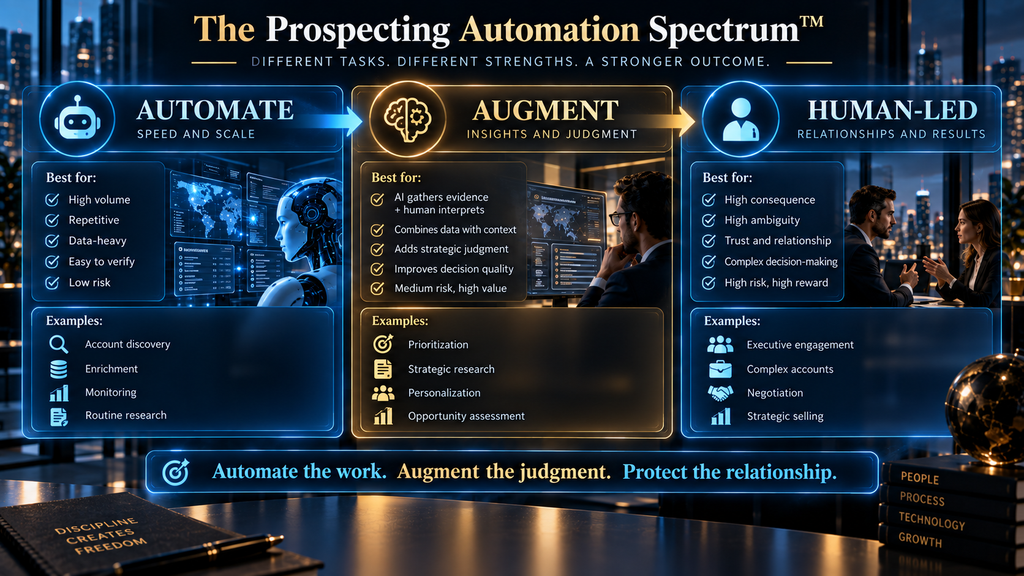
The most useful way to decide where AI belongs is not to divide prospecting into “automated” and “manual.” A better approach is to think about three operating modes: automate, augment, and human-led.
Tasks should be automated when they are repetitive, high-volume, data-heavy, relatively easy to verify, and low-risk when an individual output is imperfect. Account discovery, enrichment, routine monitoring, data normalization, CRM administration, and research collection often fit this category. The purpose is not to remove humans because humans are unnecessary; it is to stop expensive human attention from being consumed by work that machines can perform adequately.
Tasks should be augmented when AI can gather and organize the evidence but human interpretation materially improves the decision. Account prioritization, strategic research, personalized messaging, opportunity assessment, territory planning, and multi-signal interpretation often belong here. AI prepares the evidence and reduces the cognitive workload, while the salesperson remains responsible for determining whether the recommendation actually makes sense.
Tasks should remain human-led when the cost of being wrong is high, information is ambiguous, trust is central, or the commercial situation depends heavily on relationships. Strategic enterprise accounts, executive outreach, complex negotiations, new-market development, sensitive communication, and major account decisions are obvious examples. AI can still provide intelligence in these situations, but it should operate as a decision-support layer rather than quietly becoming the final authority.
The underlying principle is straightforward: the more expensive it is to be wrong, the stronger the case for keeping a human in the decision loop.
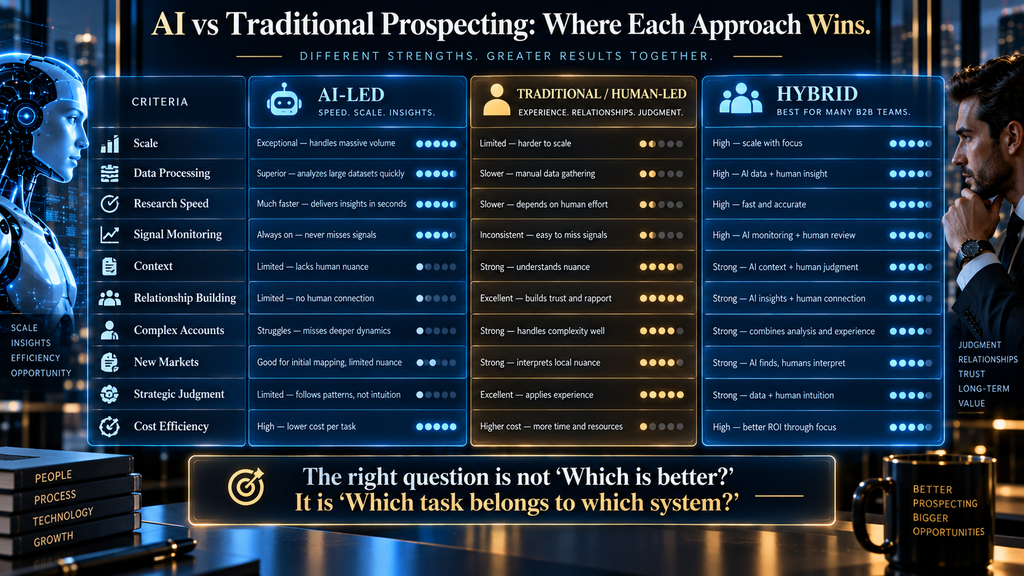
AI vs. Traditional Prospecting: The Capability-by-Capability Reality
| Prospecting activity | AI advantage | Human advantage | Best model |
|---|---|---|---|
| Large-scale account discovery | Very high | Low | AI-heavy |
| Data enrichment | Very high | Low | AI-heavy |
| Continuous signal monitoring | Very high | Low | AI-heavy |
| High-volume account research | Very high | Moderate | AI + review |
| Pattern detection | Very high | Moderate | AI-heavy |
| Standard account prioritization | High | Moderate | AI + human oversight |
| Unusual account interpretation | Moderate | High | Human-led |
| Personalized messaging | High at scale | High for depth | AI-assisted |
| Executive engagement | Limited | Very high | Human-led |
| Relationship development | Low | Very high | Human-led |
| Complex objection handling | Limited | Very high | Human-led |
| New-market discovery | Moderate | High | Hybrid |
| Strategic enterprise selling | High for intelligence | Very high for judgment | Hybrid |
| Routine follow-up | Very high | Low | AI-heavy |
| Complex negotiation | Low | Very high | Human-led |
| CRM administration | Very high | Low | AI-heavy |
| Final strategic account decision | Moderate | Very high | Human-led |
The table reveals why the debate becomes confused when people ask which approach is “better.” There is no single winner because prospecting is not a single activity. AI has an overwhelming advantage in some parts of the process and a much weaker position in others.
The objective should therefore be allocation rather than replacement. The organization should give each type of work to the system that can perform it most effectively at an acceptable cost and risk.
The Biggest Mistake: Confusing Efficiency With Effectiveness
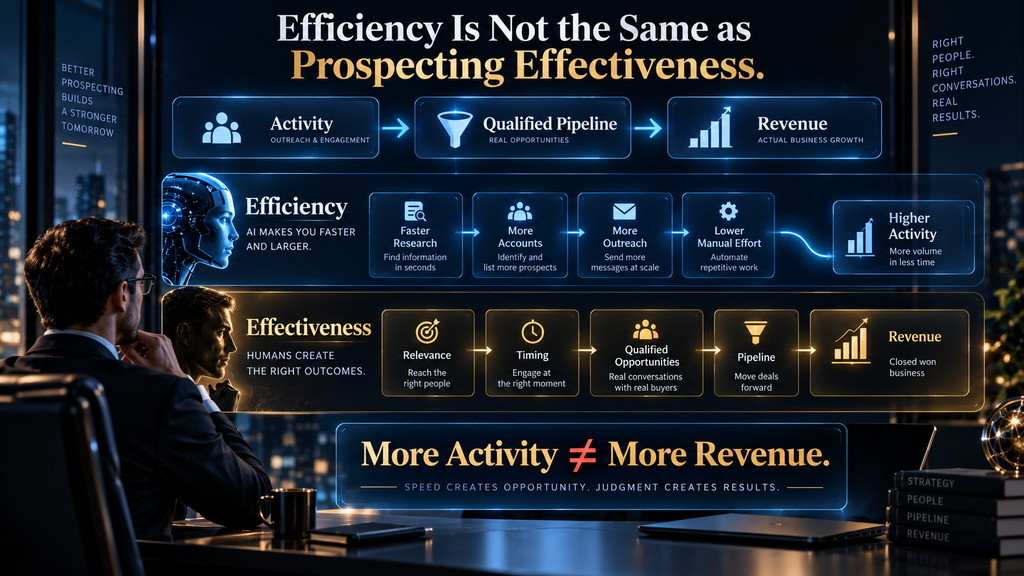
One of the strongest claims made for AI prospecting is that it saves salespeople time. That claim can be true and still produce a disappointing business result.
Imagine a salesperson who currently spends 20 minutes researching an account before deciding whether it deserves outreach. An AI system reduces that process to three minutes. The organization has recovered 17 minutes, but it has not yet created 17 minutes of economic value.
If the salesperson uses those 17 minutes to research additional low-quality accounts and send more generic messages, the company may simply produce more activity. If the salesperson instead uses the time to understand a high-value opportunity, prepare for an important conversation, investigate stakeholders, or follow up with an existing opportunity, the same efficiency gain can become commercially meaningful.
This distinction is essential because AI can optimize the wrong objective extremely well.
McKinsey’s 2026 research found that many companies are already experimenting with AI, but relatively few are capturing material value from it. Fragmented data, weak insights, manual processes, disconnected teams, and limited organizational change can prevent AI from improving performance; adding AI on top of those problems can simply automate complexity.
So the business case for AI prospecting should never be reduced to “How much time can we save?” The better question is: “What higher-value work will the organization perform with the capacity that AI creates?”
The AI Prospecting Value Equation
This leads to a second AI Hustle World framework:
Prospecting Value = Coverage × Relevance × Timing × Conversion Quality ÷ Cost
This is an analytical model rather than a scientifically validated industry equation. Its purpose is to show why prospect volume by itself is a weak measure of prospecting performance.
AI can dramatically increase coverage. It can also improve timing by continuously monitoring account changes and potentially improve relevance by combining more contextual information. But if conversion quality falls because the system targets poor-fit accounts, misunderstands signals, or produces increasingly generic outreach, the overall value of the prospecting system can decline even while activity metrics improve.
Imagine one sales process generating 500 prospects per month, with 50 becoming genuinely qualified accounts. Another generates 5,000 prospects but only 100 qualified accounts. The second system produced ten times the volume but only twice the qualified opportunities. If it also consumes significantly more sales capacity through follow-up and review, its apparent scale advantage may be economically weak.
This is why mature teams should move away from measuring AI prospecting primarily through lead counts. The more meaningful question is how much qualified pipeline the system creates for every unit of sales capacity and prospecting cost invested.
Why AI Can Make a Bad Prospecting System Worse
The most dangerous AI prospecting systems are not necessarily those that fail visibly. They are the systems that look successful because they produce impressive activity numbers while quietly degrading quality.
If the ICP is wrong, AI can find the wrong accounts faster. If the data is inaccurate, AI can distribute inaccurate intelligence faster. If the messaging is weak, AI can generate and send more weak messages. If the scoring model is flawed, AI can prioritize thousands of accounts according to flawed assumptions.
That is the central risk of automation: it amplifies the quality of the system it enters.
This is why companies should be cautious about false precision. An AI platform may assign an account a high score and make the result appear objective, but a score is only as reliable as the data, assumptions, weighting, and validation behind it. A number that looks precise can still represent a weak inference.
The same problem appears with personalization. AI can generate a message that mentions a company’s recent hiring, funding, product launch, or technology change. That makes the message technically customized, but customization is not the same as relevance. If the event has no meaningful connection to the prospect’s current problem, the personalization simply makes an irrelevant message look more sophisticated.
There is also a growing risk of automation bias. Once sales teams become accustomed to AI-generated recommendations, they may begin trusting the ranking itself instead of investigating the evidence behind it. That reverses the intended relationship between human and machine. The AI system should reduce the salesperson’s information burden, not remove the salesperson’s responsibility to think.
AI Does Not Eliminate Qualification
A company can be an excellent fit and still have no reason to buy.
That sounds obvious, but it is one of the most common conceptual mistakes in AI prospecting. A prospect may match the ideal customer profile on industry, company size, geography, technology, revenue, and job titles while having no current problem that justifies purchasing anything.
The reverse can also happen. A company that looks slightly outside the standard ICP may suddenly become highly attractive because something changed: a new executive arrived, a major initiative launched, a technology migration began, a regulatory requirement appeared, or the company entered a period of rapid expansion.
This is why prospecting should distinguish between fit and opportunity.
Fit answers whether the company resembles the type of organization that can benefit from the product. Opportunity requires additional evidence about why the account might have a reason to act.
AI can be extremely useful for gathering that evidence, but the organization should avoid treating a high fit score as equivalent to purchase readiness.
Why Traditional Prospecting Still Matters in Complex Sales
The strongest case for traditional prospecting appears when the information environment is incomplete and the commercial consequences are significant.
Suppose a company is pursuing a large enterprise account that is currently restructuring its technology organization. Public information might reveal a new executive, several job openings, a product announcement, and an office expansion. An AI system could connect those events and suggest that the account deserves attention.
That is valuable.
But the salesperson still needs to determine what the changes actually mean. Perhaps the company is expanding aggressively, or perhaps it is consolidating vendors. Perhaps the new executive is responsible for the exact problem the seller solves, or perhaps that responsibility sits elsewhere. Perhaps the hiring activity indicates a project that will be handled internally rather than purchased externally.
The machine can surface the clues. The human has to investigate the story.
That distinction becomes even more important as buying groups become larger. Forrester’s 2026 research found that the typical B2B decision involves 13 internal stakeholders and nine external influencers, with broader groups associated with more complex purchases. Buyers are also using AI but validating information through trusted sources, which means that sellers still have an important role in helping organizations interpret and de-risk a purchase. (Forrester)
The result is not the disappearance of human selling. It is a shift toward higher-value human selling.
The Hybrid Model: AI Does the Searching, Humans Do the Deciding
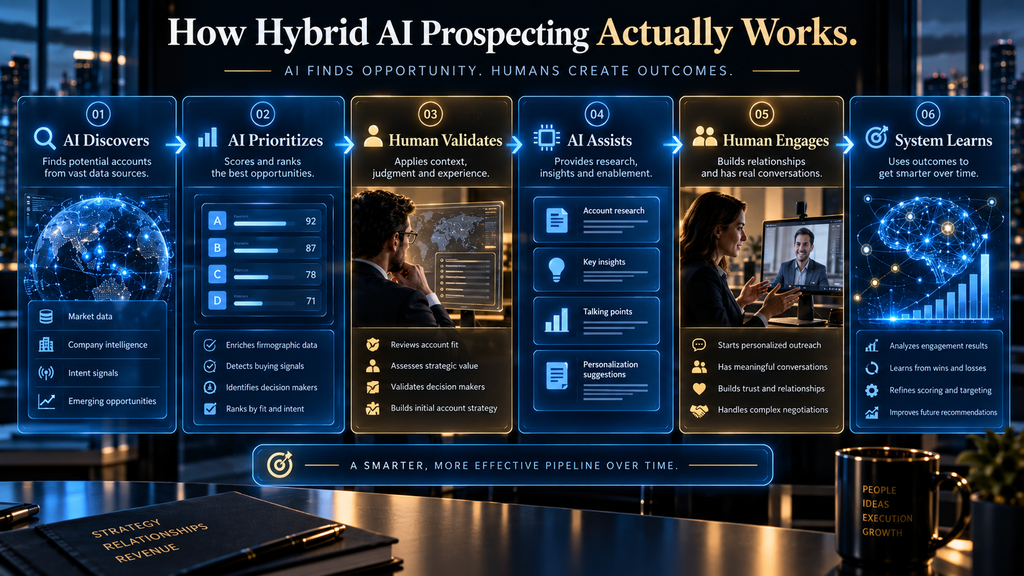
The strongest prospecting model for most organizations can be expressed as a continuous operating loop: AI discovers and organizes information, AI identifies potential priorities, humans validate the important decisions, AI assists with preparation and execution, humans handle consequential interactions, and the resulting outcomes improve the system.
The first part of that loop is where AI has the greatest advantage. It can search markets, enrich records, monitor changes, summarize accounts, and identify patterns without requiring every salesperson to repeat the same research manually.
The second part introduces human judgment. A salesperson should be able to reject an AI recommendation because they know something about the account that the system does not. That is not a failure of AI. It is an important feature of a properly designed human-AI workflow.
The third part is collaborative. AI can prepare account briefs, identify relevant stakeholders, suggest questions, summarize previous interactions, and draft possible messaging. The salesperson then decides what is appropriate for the particular customer.
The final part is learning. Outcomes from meetings, replies, opportunities, losses, and closed deals should eventually influence the assumptions behind the prospecting system. A mature AI prospecting process is therefore not a static automation layer; it is a commercial learning system.
The Feedback Loop That Separates Mature AI Prospecting From Simple Automation
A mature system can be represented as: Signals → Interpretation → Priority → Sales Action → Outcome → Model Improvement.
This distinction matters because prospecting models should not be judged only by whether their predictions look reasonable. They should be judged by what happens after those predictions enter the sales process.
If an AI model consistently identifies accounts that generate meetings but rarely become opportunities, the model needs investigation. If a particular signal repeatedly precedes strong opportunities, that signal may deserve greater weight. If salespeople repeatedly reject recommendations from a particular category, the organization should investigate whether the model is missing important context.
The feedback loop also protects the company from assuming that the first version of its scoring model is correct. Commercial markets change, buyer behavior changes, products change, and competitive conditions change. A prospecting system that never learns from its outcomes will gradually become less useful even if its technology continues improving.
Where AI Should Be Used Heavily
AI-heavy prospecting makes the most sense when the market is large, the ICP is relatively standardized, the sales motion is repeatable, and the cost of manual research is significant relative to the value of an individual prospect.
A company selling a standardized B2B product to thousands of potential customers can benefit enormously from automated account discovery, enrichment, research, monitoring, prioritization, and routine follow-up. The organization can use AI to create a much broader field of visibility while reserving human attention for the accounts most likely to justify it.
The same logic applies to mature sales organizations with strong historical data. If the company has years of CRM records, clear qualification criteria, established customer segments, and enough outcomes to learn from, AI has a stronger foundation for prioritization and prediction.
But even in these environments, AI-heavy does not mean AI-only. High-volume systems still require quality control because the cost of a small error becomes significant when multiplied across thousands of accounts.
Where Human-Led Prospecting Makes More Sense
Human-heavy prospecting becomes more rational when the addressable market is small, each account is highly valuable, the sales cycle is complex, or relationships strongly influence the outcome.
It also makes sense when the company is entering a new market and lacks enough historical data to trust automated assumptions. In that situation, human conversations can become a source of market intelligence rather than merely a method of generating leads.
The important point is that human-led does not mean technology-free. An enterprise salesperson can still use AI to research the company, map stakeholders, monitor business developments, summarize previous interactions, and prepare for a meeting.
The difference is that the human remains responsible for interpretation and engagement.
The Decision Depends on the Economics of the Account
The easiest way to understand the difference is to compare the value of human attention with the value of the opportunity.
For a low-value, high-volume product, spending an hour researching a single prospect may destroy the economics of the sales process. AI can perform enough research to identify whether the account deserves attention, and the salesperson can focus on the subset that shows meaningful potential.
For a high-value enterprise opportunity, the opposite may be true. Spending several hours understanding the account can be rational because the potential value of getting the opportunity right is much larger than the cost of the research.
This means there is no universal percentage of a sales process that “should” be automated. The appropriate level of automation changes with deal value, volume, complexity, uncertainty, data quality, and the cost of a bad decision.
| Business situation | Better operating model | Primary reason |
|---|---|---|
| Thousands of similar SMB prospects | AI-heavy | Scale and cost efficiency |
| Low average contract value | AI-heavy | Manual research is expensive relative to deal value |
| Mature and standardized ICP | AI-heavy with human review | Strong historical patterns support automation |
| High-volume outbound | AI-heavy | Research and monitoring create major bottlenecks |
| Mid-market sales | Hybrid | Scale matters, but context still affects conversion |
| Strategic enterprise accounts | Hybrid or human-led | Complexity and account value justify human attention |
| Very high-value deals | Human-led with AI intelligence | Cost of being wrong is high |
| New market | Hybrid | AI researches while humans validate assumptions |
| Poor-quality CRM data | Human-led until data improves | Automation would amplify unreliable inputs |
| Relationship-driven industry | Human-heavy | Trust is central to the sale |
| Highly standardized sales process | AI-heavy | Repetition creates strong automation economics |
How to Measure Whether AI Actually Works
The easiest mistake is to measure what the technology produces rather than what the business gains from it.
An AI prospecting dashboard might report thousands of accounts researched, contacts enriched, messages generated, and prospects contacted. Those numbers can demonstrate system activity, but they do not establish that the company has become better at generating revenue.
A stronger measurement framework begins with efficiency. How much time does a salesperson spend researching an account? How many qualified accounts can the team process? How much administrative work has been removed? How much seller capacity has actually been recovered?
The next layer is quality. Are the accounts being selected more accurately? Is the percentage of qualified accounts increasing? Are positive responses improving? Are meetings converting into genuine opportunities at a higher rate?
The final layer is commercial outcome. Is qualified pipeline increasing? Is the cost per qualified opportunity falling? Is pipeline velocity improving? Are win rates changing? Is revenue being generated more efficiently?
This produces a simple rule that should govern every AI prospecting project: If AI increases activity but does not improve qualified pipeline economics, the organization has probably automated the wrong problem.
The ROI Question: What Happens to the Time AI Saves?
Suppose an SDR team spends 1,000 hours every month on research and administrative prospecting work. An AI system reduces that workload by 40%, apparently creating 400 hours of recovered capacity.
Those 400 hours are not automatically worth anything.
If the organization simply asks the team to generate more lists and send more messages, the recovered capacity may produce little incremental revenue. If the same capacity is redirected toward better account research, stronger conversations, faster opportunity follow-up, or strategic account development, the value can be substantial.
The economic calculation should therefore include more than software cost. A useful internal model is to estimate the productive value of recovered capacity, then subtract the costs required to create it: software, data, implementation, governance, training, human review, maintenance, and the costs associated with false positives or poor-quality outreach. That calculation is much more meaningful than saying that an AI tool “saves 40% of research time.”
Common Mistakes When Implementing AI Prospecting
The first mistake is automating before defining the ICP. If the company does not have a reasonably clear understanding of which customers are valuable and why, AI cannot solve the strategic problem. It can only apply vague assumptions more efficiently.
The second mistake is measuring leads instead of qualified pipeline. Lead volume is easy to increase with automation, which is precisely why it is a dangerous optimization target. A system rewarded for producing more prospects will eventually learn to produce more prospects, regardless of whether those prospects create revenue.
The third mistake is confusing personalization with relevance. A message containing the prospect’s company name, recent hiring event, and industry reference may appear highly customized while still failing to address a real business problem.
The fourth mistake is treating AI scores as objective truth. Scores should be interpreted as model outputs supported by evidence, not as facts about the account.
The fifth mistake is buying technology before redesigning the workflow. McKinsey’s 2026 research is particularly relevant here: companies capturing value from AI are increasingly redesigning commercial workflows around specific outcomes rather than simply placing new tools into existing processes.
The sixth mistake is removing humans from high-value decisions. Automation should reduce unnecessary workload; it should not eliminate accountability where the consequences of being wrong are significant.
What Happens If You Do Nothing?
There is a third option in the AI-versus-traditional debate that is often ignored: continuing with the existing prospecting process without meaningful change.
That can remain viable for some companies. A small sales organization with a narrow market, strong relationships, and experienced sellers may not need sophisticated automation immediately.
But the opportunity cost becomes more significant as competitors improve their ability to process information.
If one sales organization can continuously monitor thousands of accounts while another relies on occasional manual research, the first organization may identify important changes earlier. It might recognize an executive move, expansion, hiring pattern, product launch, technology shift, or other commercial event while competitors are still working from static account lists.
The advantage therefore may not come from sending more messages. It may come from knowing where to look before everyone else does.
The Buyer Is Changing Too
The AI prospecting debate becomes even more interesting when the buyer is considered.
B2B buyers increasingly have access to AI-powered research tools themselves. They can investigate categories, compare vendors, summarize product information, explore alternatives, and prepare questions before engaging a salesperson.
That changes the value of a generic sales conversation.
If the buyer can obtain basic product information independently, the salesperson must contribute something more valuable than information that is already available everywhere. That may mean helping the buyer diagnose a problem, understand implementation risk, evaluate trade-offs, navigate internal stakeholders, or build a business case.
Forrester’s 2026 research describes precisely this shift: buyers are using AI for speed and breadth but increasingly validating the information through trusted voices and broader buying networks. The implication for prospecting is significant. AI should make salespeople better prepared for the conversation, not simply better at producing the conversation.
The Second-Order Effect: Prospecting Becomes Less Differentiated
There is a deeper consequence of widespread AI adoption that sales leaders should consider.
As account discovery, enrichment, research, personalization, and automated outreach become easier for everyone, those capabilities become less distinctive. If every serious sales organization can find prospects quickly and generate reasonably personalized messages, simply possessing those capabilities will not create much competitive advantage.
The advantage moves upward. It moves toward better market selection, better account interpretation, better timing, stronger offers, better evidence, deeper customer understanding, and more effective human interactions.
That means the future competitive advantage is unlikely to come from simply owning a better prospecting tool. It will come from designing a better commercial system around the tools.
The companies that win will not necessarily be the companies with the most automation. They will be the companies that know where automation creates leverage and where human judgment creates value.
The Future: From AI Lead Generation to Revenue Intelligence
The long-term direction of B2B prospecting is larger than automated lead generation.
A mature commercial system will increasingly ask continuous questions: Which parts of the market are changing? Which accounts fit our strategy? Which accounts are showing meaningful change? Why might that change matter? Who should investigate it? What should the salesperson know before making contact? What happened after the interaction? What did the organization learn?
That is closer to revenue intelligence than conventional lead generation.
McKinsey’s 2026 research describes this broader transition as the integration of data, decision logic, human judgment, and AI agents across commercial workflows ranging from opportunity identification and account planning to pricing, execution, and post-sale growth. Its central argument is not that AI eliminates the human side of B2B sales, but that AI can take more of the searching, synthesizing, drafting, and administrative workload while sellers spend more time on relationships, problem solving, and judgment.
That is a much more useful way to think about the future. The goal is not an organization in which humans disappear from prospecting. The goal is an organization in which human attention is reserved for the work that actually deserves it.
The Reality Check
AI B2B lead generation is not a magic replacement for traditional prospecting. It is a force multiplier, and force multipliers can improve a strong system or accelerate a weak one.
A company with a poor ICP can use AI to find the wrong prospects faster. A company with unreliable data can automate unreliable recommendations. A company with weak messaging can generate more weak messages. A company with strong sales fundamentals, reliable data, and clear qualification logic can use the same technology to dramatically increase the amount of useful intelligence available to its sellers.
That is why the right starting point is not, “Where can we add AI?” It is, “Where are our salespeople spending time that does not require human judgment?” The next question is, “Where would better information materially improve their decisions?”
And the final question is, “Where would automation create unacceptable consequences if it were wrong?” Those questions lead to a more durable automation strategy than simply purchasing an AI prospecting platform and turning every available feature on.
Final Thoughts: What Actually Works in 2026?
AI B2B lead generation wins when prospecting is constrained by scale, repetitive research, data processing, account monitoring, enrichment, and the sheer amount of information that a human sales team cannot continuously process. Traditional prospecting wins when success depends heavily on context, trust, relationship development, ambiguous information, strategic account knowledge, or decisions where the cost of being wrong is high.
But the strongest answer for most organizations is neither extreme.
AI should handle more of the searching, organizing, monitoring, synthesizing, and repetitive execution. Humans should spend more of their time interpreting the information, validating important opportunities, building relationships, solving customer problems, and influencing complex buying decisions.
That is not a compromise between two competing approaches. It is a more rational allocation of work.
The best prospecting organization in 2026 will not necessarily be the one that generates the largest number of leads or sends the largest number of messages. It will be the organization that can turn market information into better commercial decisions faster than its competitors while preserving the human judgment that buyers still value.
Use AI where scale matters. Use humans where judgment matters. Use both where revenue is at stake.
Build the Data Layer Behind Your Prospecting Workflow
An AI prospecting workflow is only as reliable as the account, contact, enrichment, and verification data feeding it.
Compare Lead Data Tools →FAQ
Is AI B2B lead generation better than traditional prospecting?
AI is generally better for high-volume, data-intensive prospecting activities such as account discovery, enrichment, research, monitoring, and repetitive qualification. Traditional prospecting remains valuable when the sale depends on relationships, strategic context, ambiguous information, or high-consequence decisions, which is why a hybrid approach is usually more practical than choosing one method exclusively.
Can AI replace traditional SDR prospecting?
AI can replace or substantially reduce many repetitive SDR activities, but replacing the entire prospecting role is a different proposition. Research, enrichment, monitoring, prioritization, and administrative work are increasingly suitable for automation, while relationship building, complex conversations, strategic account interpretation, and judgment remain areas where human involvement can materially affect the outcome.
Is AI prospecting worth the investment?
AI prospecting can be worth the investment when the organization has enough prospecting volume and sufficiently valuable seller capacity to justify automation. The business case should be based on qualified pipeline, conversion quality, recovered seller capacity, and revenue efficiency rather than software adoption or lead volume alone.
What is the biggest advantage of AI lead generation?
The biggest structural advantage is machine-scale information processing. AI can continuously analyze large numbers of accounts and data sources, identify changes, organize information, and surface potential opportunities at a frequency that would be difficult and expensive for human teams to maintain manually.
What is the biggest risk of AI prospecting?
The biggest risk is scaling flawed assumptions. Poor data, weak ICP definitions, inaccurate scoring models, irrelevant signals, and generic messaging can all be amplified when an automated system operates across thousands of accounts.
Is traditional prospecting still effective in 2026?
Yes. Traditional prospecting remains particularly valuable for strategic accounts, relationship-led selling, complex products, new markets, and situations where information is incomplete or trust strongly influences the buying decision.
What should sales teams automate first?
Sales teams should generally start with repetitive, measurable tasks where errors are relatively easy to identify and correct. Account discovery, enrichment, research collection, monitoring, CRM administration, and routine preparation are usually better starting points than immediately automating high-consequence customer interactions.
Should AI decide which prospects salespeople contact?
AI can provide valuable prioritization, but it should not automatically become the final authority for important accounts. The strongest systems give sellers evidence, context, and recommendations while preserving the ability for experienced salespeople to challenge or override an AI recommendation when they have information the system does not.
How should AI prospecting be measured?
Lead volume is a weak primary metric because automation can increase it very easily. Better measures include qualified-account rate, positive response rate, meeting-to-opportunity conversion, qualified pipeline per representative, cost per qualified opportunity, pipeline velocity, win rate, revenue per prospecting hour, and the amount of productive seller capacity recovered.
Does AI-generated personalization improve prospecting?
It can, but personalization should not be confused with relevance. AI can efficiently incorporate account-specific information into an outreach message, but the message still needs a credible connection between the prospect’s circumstances and the problem the seller can solve.
What is the best prospecting model for most B2B companies?
A hybrid model is usually the strongest starting point. AI can provide scale in discovery, research, enrichment, monitoring, and prioritization, while humans validate important opportunities and handle the relationship-driven, ambiguous, and high-consequence parts of the commercial process.
What will B2B prospecting look like in the future?
B2B prospecting is likely to move from static lead generation toward continuous revenue intelligence, where AI monitors markets and accounts, synthesizes changes, recommends priorities and actions, and learns from outcomes while human sellers concentrate on judgment, relationships, problem solving, and complex commercial decisions. McKinsey’s 2026 research points toward this broader model of integrating AI agents with data, decision logic, and human judgment across the commercial workflow.
Sources and Further Reading
- The Short Life of Online Sales Leads: Harvard Business Review. Research on how quickly firms contact web leads and how that affects qualification.
- CAN-SPAM Act: A Compliance Guide for Business: US Federal Trade Commission guide to commercial email rules.
- Legitimate interests: UK Information Commissioner’s Office guidance on relying on legitimate interests as a lawful basis.
Related Guides
- How to Build an AI B2B Prospecting Workflow
- AI Lead Qualification: How to Identify High-Intent B2B Prospects
- Best AI Lead Generation Tools in 2026: 8 Platforms Compared by Use Case
Written by
Muntasir Ahmad Chowdhury
Founder, AI Hustle World
Muntasir Ahmad Chowdhury is the Founder of AI Hustle World, an independent publication dedicated to making Artificial Intelligence practical, trustworthy, and easy to understand. He researches AI tools, automation, customer service, productivity, and real-world business applications, helping readers make smarter technology decisions through research-driven, experience-backed content.
Expertise:
AI Tools • AI Automation • AI Customer Service • AI Productivity • Generative AI • AI Workflows
Get Smarter With AI
Enjoyed this guide? Get practical AI tools, tutorials, and honest reviews delivered to your inbox.