
Evidence: Documentation reviewed, plus one hands-on test (12 November 2026)
Last checked: September 2026 (documentation); 12 November 2026 (test)
What was done: Written from official documentation and the published sources linked in this article. One hands-on test was added on 12 November 2026: ChatGPT (Plus), Gemini (free) and Microsoft Copilot (free) doing four governance tasks (hallucination traps, a bias check, anonymising a complaint and EU AI Act risk categories), shared with ten other governance and safety articles. See Our test.
Files: Governance test files (data, prompts, answer key, AI answers, score sheet and screenshots)
Affiliate links: No
When teams compare AI content provenance & detection tools, the hardest part is not finding one that says “AI detected.” The hard part is working out what that result proves. A probability score, a watermark match and a signed provenance record can all appear on the same dashboard, yet they are very different kinds of evidence, and treating them as interchangeable is how organizations make confident decisions on weak grounds.
Suppose a company receives a product image from an outside agency. The agency says it was generated with AI, the designer says it was heavily edited, the marketing manager says the final version differs substantially from the original, and the platform where it was published has stripped the file’s metadata. Six months later, the legal or compliance team must establish how that image was created, with little left to work from.
A conventional AI detector might analyse the finished image and return a probability. A watermark detector might find a signal from a supported generator. A provenance system might reveal a signed record of where the asset came from and which transformations were recorded. All three can examine the same file while answering three different questions, and that distinction is the foundation of this category.
AI detection asks what the content appears to be. Watermarking asks whether a recognizable embedded signal exists. Provenance asks what verifiable information was recorded about the content’s origin and history. The best solution is therefore rarely the tool with the highest advertised accuracy; it is the system that produces the most useful evidence for the decision the organization needs to make.
This guide explains how the three technologies work, where each one fails, how to layer them and how to build a workflow around them. It then compares nine current tools across provenance, watermark verification and detection, with prices checked in October 2026 and W.O.R.T.H. scores, so you can match a tool to the decision rather than to a marketing claim.
The AI Hustle World Framework: TRACE
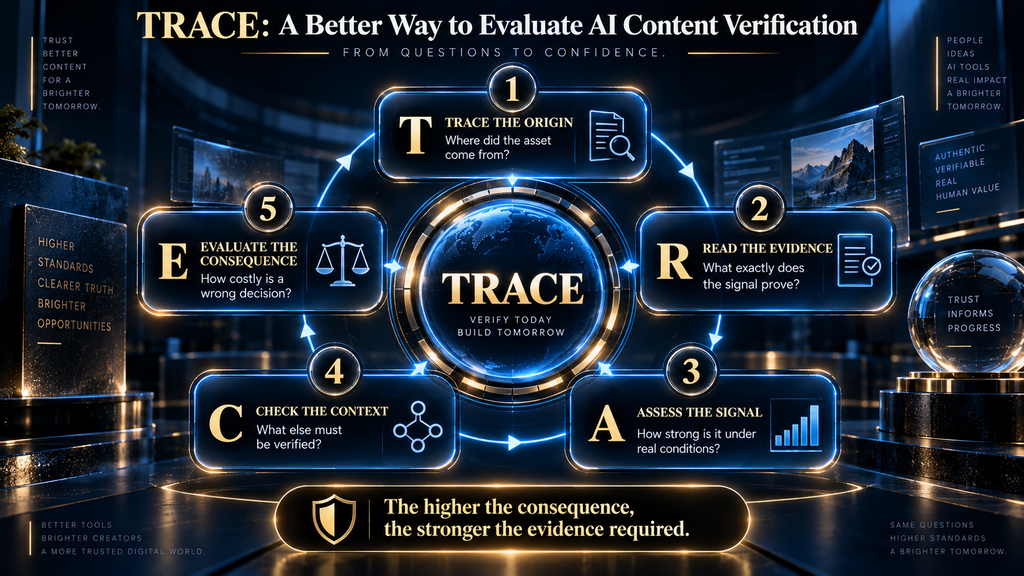
We evaluate AI content verification systems with a simple framework called TRACE: Trace the origin, Read the evidence, Assess the signal, Check the context and Evaluate the consequence. It changes how you look at the whole market, because it forces you to ask whether a verification technology produces evidence suited to the decision being made, which is a governance question as much as a technical one, as our comparison of AI compliance tools also shows.
T: Trace the origin
Start with the strongest question available: where did this asset come from? If the organization knows the source, creator, application, generation system, editing workflow and timestamps, it already holds evidence that no detector can rebuild from the final file. This is where provenance becomes strategically important, because C2PA’s Content Credentials preserve signed assertions about origin and history.
R: Read the evidence
Next, ask what kind of evidence lies behind a result, because the existence of a result says little on its own. A detector probability is an inference. A watermark match is evidence of a supported embedded signal. A cryptographically signed provenance record shows that a particular assertion was created and signed by a participating system. These are not equivalent, even when a dashboard places them side by side.
A: Assess the signal
Every signal has boundaries. A detector may perform differently across languages, content lengths, writing styles, image types, compression levels or manipulated material. A watermark may be detectable only when the originating system uses that technology, and metadata can vanish during ordinary file processing. TRACE therefore asks how strong the signal is under the conditions in which the asset exists.
C: Check the context
A verification result without context can mislead. Text might contain AI-assisted editing without being machine-generated, an image might be AI-generated and then heavily edited by a person, and a photograph might carry valid provenance while depicting an event the publisher describes incorrectly. Context determines what the evidence means, so it must be checked before any conclusion is drawn.
E: Evaluate the consequence
Finally, ask what happens if the decision is wrong. A marketing team deciding whether to review a social image can reasonably use a probabilistic detector as a screen. An employer deciding whether to discipline someone, or a publisher deciding whether to accuse a contributor, needs a far higher evidentiary threshold. The higher the cost of being wrong, the less acceptable a single probabilistic signal becomes.
Why AI Content Verification Became Necessary
Before generative AI became widely available, content verification focused on authorship, source authenticity, plagiarism, manipulation, copyright and editorial credibility. Traditional methods worked reasonably well because production left recognizable human and institutional traces: the photographer behind an image, the designer of a campaign graphic, the editor who handled a manuscript or the RAW file a photographer could produce.
Generative AI blurs the line between creator, tool, editor and publisher. One person may generate an image, modify it in Photoshop, place it in a presentation, export a PDF, screenshot a page, crop the screenshot and upload it to a social network. By the end of that chain the final asset may carry almost no technical evidence of how it was made, and reconstructing the chain by hand becomes slow and uncertain.
Manual reconstruction still matters, and it is one reason provenance technology exists, but it does not scale. A large publisher, marketplace, platform, university, agency or enterprise may handle thousands or millions of assets and cannot run a forensic investigation for each one. Automation fills that gap, yet it can estimate, classify and verify signals without ever turning uncertainty into certainty.
AI Detection, Watermarking and Provenance Are Different Technologies
The market becomes far easier to understand once the three technologies are separated. The table below compares the question each one answers, the evidence it produces, its main strength and its main weakness. Reading across a row shows why a tool from one column cannot simply replace a tool from another, even when vendors describe them with similar language.
| Technology | Primary question | Evidence type | Main strength | Main weakness |
|---|---|---|---|---|
| AI detection | Does this content resemble AI-generated output? | Statistical/model inference | Can analyze existing content without prior provenance | Can produce false positives and false negatives |
| Watermark detection | Does the content contain a known embedded AI signal? | Embedded signal | Can identify supported AI-generated content even after some transformations | Usually ecosystem-specific |
| Provenance | What recorded information exists about the asset’s origin and history? | Signed metadata/credentials | Provides traceable creation and modification information | Depends on participating systems and preservation |
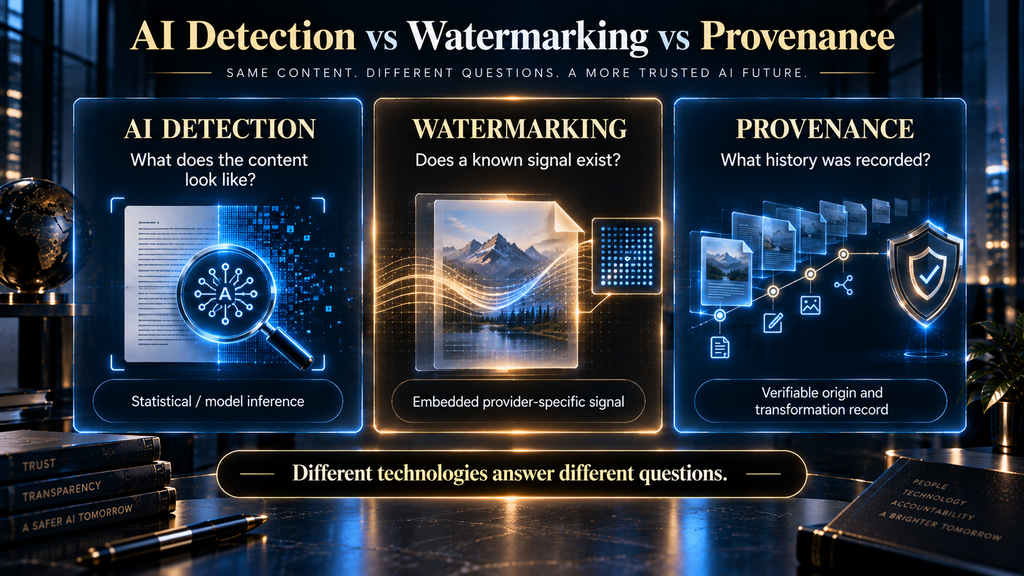
The distinction is more than terminology. If a detector says an article has an 80% probability of being AI-generated, that does not reveal which system produced it, when, whether a human rewrote it or whether the detector is misreading a writer’s style. A provenance record showing that a supported system created the asset is a different kind of evidence, establishing a recorded event without proving the content’s claims.
A watermark sits between the two. A positive result can indicate that the relevant generation system embedded a detectable signal, but it does not provide the full production history. The technologies overlap, and the strongest workflows use them together, yet they should never be treated as interchangeable inputs that can stand in for one another when a decision is on the line.
How AI Detection Works
AI detection is fundamentally a classification problem. The system receives existing content and estimates whether its characteristics resemble patterns associated with AI-generated material. Depending on the detector, those characteristics may involve linguistic structure, statistical patterns, model-derived representations, token behaviour or stylistic consistency, and each detector weighs them differently.
The key point is that a detector looks backward. It sees the finished product and tries to infer the process that produced it, whereas provenance records information during production. That explains both the appeal and the weakness of detectors: they work after the fact on content with no metadata or credentials, but the original generation process is no longer directly observable.
Academic studies of detectors have repeatedly found that paraphrasing and “humanizing” tools can sharply reduce detection rates, and that some human-written text is flagged as machine-generated. A detector can therefore be useful without being definitive, much as a model can sound confident while hallucinating. That sounds like a small distinction, but it changes how the technology should be deployed and how much weight any single score deserves.
Why AI Detectors Can Flag Human Content
A detector has no special sensor for AI. It identifies patterns, so human writing can sometimes resemble what it associates with machines. Highly structured prose, repetitive syntax, predictable phrasing, formulaic business language, short sentences, standardized academic writing and heavily edited text can all push an inference-based system into uncertainty, especially for writers working in a second language.
The danger is greatest when detector output becomes disciplinary evidence. If an employee writes polished reports in a standard corporate style and a detector flags several passages, management may treat the score as proof. The employee is then forced to prove a negative, that a machine did not write the text, which reverses the evidentiary burden and is very hard to do.
A more responsible approach treats the result as a trigger for review. The organization can examine document history, drafts, source notes, revision records and collaboration logs before reaching a conclusion. This is a logical response to uncertainty as much as an ethical preference, and it mirrors the principles in our guide to human-in-the-loop AI.
Why AI Detectors Can Miss AI-Generated Content
The opposite problem matters just as much. AI-generated material can be rewritten by hand, paraphrased with another model, translated, restructured, mixed with human writing or combined from several sources. Once the output changes, the detector is no longer analysing the original generation pattern, which is one reason a universal AI detector is so difficult to build or sustain.
The same principle applies to images, video and audio. An AI-generated image or video can be cropped, resized, filtered, screenshotted, compressed or placed inside another composition. Some watermarks are designed to survive selected transformations, but no signal should be assumed to survive every change indefinitely. The resulting asymmetry is simple: detection starts with the artifact and infers the past, while provenance records events and preserves the past.
What Content Provenance Does
Content provenance is best understood as a chain-of-custody system for digital media, although the analogy should not be pushed too far. A provenance system records assertions about how an asset was created or modified and binds them to the asset in a verifiable form. C2PA is the leading open standard for this approach, and the C2PA resources library explains the specification and its implementation guidance.
Ordinary metadata might say a file was created with application X, but nothing stops someone editing that field. C2PA uses signed manifests and cryptography to establish a tamper-evident link between provenance information and the content. That does not make the content truthful; it gives stronger evidence about what was asserted to have happened to the asset, which is a narrower and more precise claim.
The Difference Between Authenticity and Truth
This is one of the most important ideas in the guide: content can be authentic in provenance terms while false in its claims. A genuine photograph with valid provenance showing it came from a camera and was later edited tells you useful things about the asset, yet it does not prove the attached caption is accurate. An AI-generated image can likewise carry perfectly valid provenance.
That provenance may accurately show that an AI system generated the image without making the depicted scene real. OpenAI’s help article on provenance signals says such signals do not guarantee that content is accurate, unedited, legally owned or presented in the correct context. Organizations should therefore keep four questions separate rather than collapsing them into one.
Those questions are where the content originated, whether and how it was altered, whether the provenance evidence is valid, and whether the claims or context around the content are true. A mature verification system answers the first three far better than a generic detector, while the fourth still needs contextual checks of the kind covered in our guide to verifying AI information.
How C2PA and Content Credentials Fit Into the Workflow
C2PA matters because provenance is far more useful when different tools share a common framework. Without a standard, each vendor would keep its own proprietary record of content history, leaving provenance fragmented and hard to interpret across organizations. C2PA defines an interoperable model in which creation, modifications and other actions are packaged as assertions inside signed manifests.
That makes provenance especially useful across a content supply chain. In a commercial campaign, an AI generator produces the first image, a designer modifies it, a marketing team adds typography and the final asset is approved and distributed. In a provenance-aware workflow those steps can form an auditable history instead of disappearing into disconnected applications, which makes production history observable.
Watermarking: The Layer Between Detection and Provenance
Watermarking occupies a middle ground. Instead of storing a signal only in external metadata, it embeds information in the content itself. Google DeepMind describes SynthID as embedding imperceptible watermarks in AI-generated content, and its SynthID Detector portal, launched in 2025, checks images, video and audio from Google and partners including OpenAI, NVIDIA and Kakao.
This brings an important advantage. Metadata can disappear without any deliberate attack: a platform resizes an image, a user converts a PNG to JPEG or a workflow exports a document to another format. An embedded signal can survive some of those transformations, so it remains useful exactly when provenance has been stripped away by ordinary handling.
Watermarking is not a universal AI detector, though. If an image came from a system that does not use SynthID, the absence of a SynthID signal says little about whether another AI system was involved. The correct reading is that a positive provider-specific watermark can be strong evidence of that system’s involvement, while a negative result never proves human creation.
Why Provenance and Watermarking Work Better Together
The greatest strength appears when the technologies are layered. When an organization receives an image, it first checks for Content Credentials, which may reveal creation and editing history. It then checks supported watermark signals, which add an independent indication of AI involvement. If neither exists, a detector can still provide an inference, and a person interprets the evidence against the context.
OpenAI follows the same logic in its own products. Its help article says images from ChatGPT, Codex and the API carry both Content Credentials and SynthID watermarks, audio carries SynthID watermarks, and ChatGPT text in the EU carries a textGrain watermark. OpenAI explains that combining metadata and watermarks lets each address the other’s limitations, which is the case for layering in a sentence.
The layers should not be treated as equally authoritative. A cryptographically verifiable provenance record answers a more concrete question than a probability estimate. A watermark gives a strong provider-specific signal without the full history, and a generic detector offers useful screening where nothing stronger exists. That is why TRACE starts with origin and evidence before moving to inference.
The AI Content Verification Stack
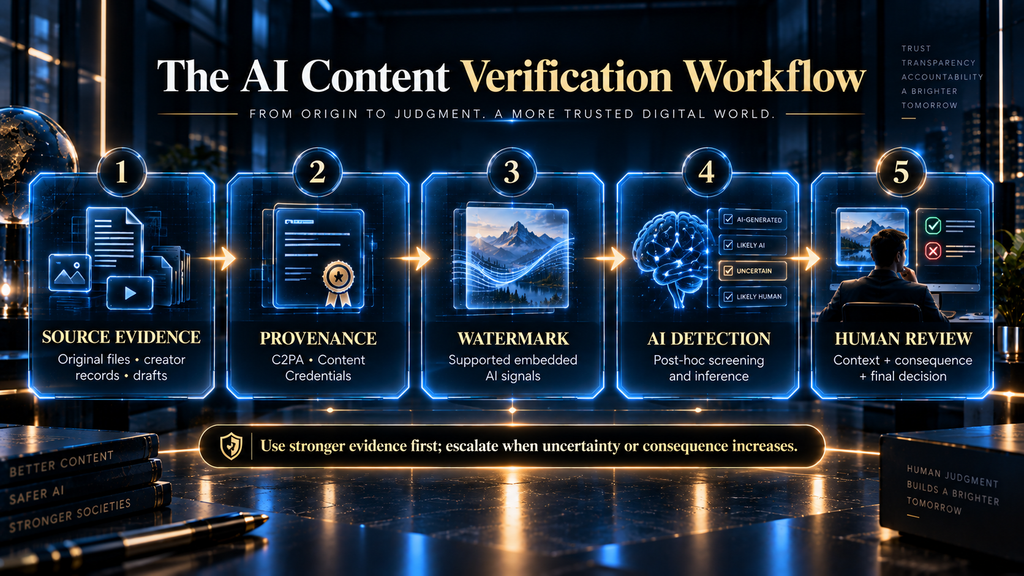
A practical organization can think of verification as a stack rather than a single product. The five layers below run from the strongest and most specific evidence to the most general, and each one fills gaps left by the layer above. Most real workflows use several layers, and the skill lies in knowing which layer should carry the most weight for a given decision.
Layer 1: Source evidence
The strongest starting point is often the organization’s own records: original files, project records, creator information, drafts, production logs and documented workflows. It is easy to overlook because nobody sells it as an AI tool, yet a well-kept production record can be more informative than any detector score and costs little to maintain once the habit exists.
Layer 2: Provenance
Next comes C2PA or another provenance mechanism that provides verifiable information about creation and modification. This layer is especially valuable when content moves between trusted systems that preserve credentials, such as camera apps, editing software and content management platforms that read and write Content Credentials.
Layer 3: Watermarking
Watermark verification identifies embedded signals from supported AI systems. It complements provenance when metadata has been removed, or when a provider-specific signal is particularly useful, for example when most of an organization’s AI imagery comes from one or two generators that watermark their output.
Layer 4: AI detection
Generic AI detection fills an important gap when provenance and watermarks are unavailable, which is common for content arriving from outside the organization. Its role should be screening and escalation rather than final judgment, so its output should route content to review instead of deciding outcomes on its own.
Layer 5: Human review
Human review remains the final interpretive layer whenever consequences are meaningful. That is a recognition that verification and judgment are different tasks rather than a sign that the technology failed. Reviewers combine every available signal with context, which no single tool can supply, and they document the reasoning behind each decision.
A Real-World Example: A Marketing Agency
Suppose a marketing agency produces 500 social assets for a client. Some are traditional photographs, some are AI-generated, others are hybrid compositions and several are modified by hand. The client needs to know which assets contain AI-generated material because its policy requires disclosure for certain campaign content, so the agency must classify every file reliably.
Running all 500 images through a detector sounds efficient but creates problems. It may flag some traditional photos, miss heavily edited AI assets, give no information about which system was involved and fail to reconstruct editing history. A TRACE-based workflow instead preserves originals and links each asset to its project record, then checks provenance, watermarks where relevant and detection only where stronger evidence is missing.
Exceptions then go to a person. The result is not necessarily more automated, but it is far more defensible. The client’s requirement was to establish whether the disclosure policy applies rather than to “detect AI,” so the decision determined the right tool rather than the technology category. Our guide to AI copyright covers related disclosure questions.
Another Example: A Publisher Investigating a Suspicious Image
Now take a newsroom that receives a dramatic photograph allegedly showing a major event. The image has no obvious provenance, and a generic detector returns a high probability that it is AI-generated. Publishing an accusation on that basis would be a mistake, because the detector has produced a lead rather than a finding, and a wrong call could damage the outlet’s credibility.
The newsroom should investigate the source, contact the contributor, examine file history, search for earlier versions, compare the image with known sources, inspect any provenance, check supported watermarks and evaluate the surrounding claims. A detector is most valuable when it helps people investigate efficiently, and dangerous when an organization pretends it has already completed the investigation.
How the Tools Should Be Compared
Because the market mixes fundamentally different technologies, a conventional feature comparison falls short. A better comparison scores each solution across six dimensions, shown in the table below. The final dimension, decision fit, matters most, because a technically impressive tool can still be operationally wrong when its evidence does not match the consequences of the decision it informs.
| Dimension | What matters |
|---|---|
| Evidence | Does the tool provide inference, provenance, watermark evidence, or multiple signals? |
| Coverage | What content types and AI ecosystems can it evaluate? |
| Resilience | What happens after editing, compression, cropping, paraphrasing, or conversion? |
| Integration | Can it work inside the organization’s existing content workflow? |
| Governance | Can results be logged, reviewed, challenged, and audited? |
| Decision fit | Is the evidence appropriate for the consequence of the decision? |
A lightweight detector may be excellent for triaging thousands of low-risk submissions yet inappropriate for employment decisions. A provenance platform may be overkill for a small creator who only wants to check one image for a supported watermark. The best tool is contextual, which is why the next sections compare specific products by role rather than declaring a single winner.
The 9 Best AI Content Provenance and Detection Tools at a Glance
The table below groups nine current tools by the evidence they produce. Prices come from vendor pages in October 2026 and change often, so confirm them before buying. Provenance and watermark tools are mostly free to check, because their value depends on wide adoption, while detection tools charge by volume because each scan costs the vendor compute.
| Tool | Evidence type | Best for | Price (Oct 2026) |
|---|---|---|---|
| Content Credentials Verify | Provenance (C2PA) | Inspecting credentials on any file | Free |
| Adobe Content Authenticity | Provenance (C2PA) | Signing your own work | Free beta |
| Truepic | Provenance at capture | Insurance, lending, inspections | Demo / enterprise |
| Google SynthID Detector | Watermark | Google and partner AI media | Free portal |
| OpenAI Verify | Provenance + watermark | Images and audio from OpenAI tools | Free |
| GPTZero | Text detection | Education and editorial screening | Free 10,000 words; paid from $12.99/mo |
| Originality.ai | Text detection | Publishers and content agencies | Free 10,000 words once; Pro $12.95/mo annual |
| Resemble Detect | Deepfake detection | Audio, video and image deepfakes | Free trial; enterprise |
| Sightengine | Image and video detection API | Platforms moderating uploads | Free tier; $29 and $99/mo |
W.O.R.T.H. Scores for All 9 Tools
Each tool receives a W.O.R.T.H. score out of 100, our standard editorial assessment across roundups. It weighs Workflow fit (25), Output quality (25), Risk and rights (15), Total cost (20) and Human effort saved (15). Here, output reflects the strength of the evidence a tool produces, and risk covers false positives, privacy of uploaded files and coverage gaps.
| Tool | Workflow (25) | Output (25) | Risk (15) | Cost (20) | Effort (15) | Total |
|---|---|---|---|---|---|---|
| Google SynthID Detector | 19 | 20 | 13 | 19 | 13 | 84 |
| Content Credentials Verify | 20 | 17 | 14 | 20 | 12 | 83 |
| OpenAI Verify | 18 | 18 | 13 | 20 | 13 | 82 |
| Adobe Content Authenticity | 19 | 18 | 13 | 19 | 12 | 81 |
| GPTZero | 21 | 16 | 10 | 17 | 14 | 78 |
| Truepic | 18 | 21 | 13 | 12 | 12 | 76 |
| Originality.ai | 20 | 16 | 10 | 17 | 13 | 76 |
| Resemble Detect | 17 | 20 | 12 | 13 | 12 | 74 |
| Sightengine | 17 | 17 | 12 | 16 | 11 | 73 |
These are editorial judgments based on documentation, pricing and published capabilities; we did not run a controlled accuracy test across all nine. Re-weight the columns for your situation. A newsroom will weight output and risk, which favours provenance and watermark tools, while a high-volume platform will weight workflow and effort, which lifts detection APIs such as Sightengine.
Provenance Tools: Content Credentials Verify, Adobe and Truepic
Content Credentials Verify is the simplest starting point. You drag in a file and it shows any C2PA credentials, including how the asset changed over time. It accepts formats such as JPEG, PNG, WebP, HEIC, PDF, MP4, MOV, MP3 and WAV, and it warns that credentials are still rolling out, so many files will have none to show.
Adobe Content Authenticity, currently a free beta, works from the other side. It lets creators sign finished work with Content Credentials linked to a verified name and social accounts, and to request that AI developers do not use the content for training. It suits agencies, photographers and brands that want their own output to carry provenance from the moment it leaves their hands.
Truepic focuses on capture-time authentication for photos and video. Its platform checks location, time and device integrity at the point of capture, which suits insurance claims, lending, inspections and other workflows where a business must trust images submitted by customers. Pricing is through demos and enterprise contracts, which is why it scores lower on cost despite strong evidence.
Watermark Tools: Google SynthID Detector and OpenAI Verify
Google’s SynthID Detector is a verification portal that checks whether an image, video or audio file carries a SynthID watermark. Because partners including OpenAI, NVIDIA and Kakao use SynthID, with Apple described as coming soon, one check now covers a meaningful share of mainstream generators. It scores highest here thanks to strong, free, provider-backed evidence.
OpenAI Verify checks whether an uploaded image or audio file contains provenance signals associated with OpenAI tools, including C2PA metadata and SynthID. It accepts formats such as PNG, JPG, WebP, MP3 and WAV. Like every watermark tool, it can confirm involvement from supported systems but cannot prove that a file without signals was made by a person.
Detection Tools: GPTZero, Originality.ai, Resemble Detect and Sightengine
GPTZero is a text detector widely used in education. On 26 October 2026 its pricing page listed a free plan with 10,000 words a month, paid plans from $12.99 a month for 300,000 words and $24.99 for 500,000 words, plus team seats. It suits screening essays and submissions, provided results trigger review rather than penalties.
Originality.ai targets publishers and content agencies, combining AI detection with plagiarism, readability and grammar checks. Its free option gives 10,000 words once, and Pro costs $12.95 a month billed annually or $14.95 monthly. It fits editorial teams checking freelance submissions at volume, again as a screen within a documented review process.
Resemble AI, which has stopped selling voice generation, now focuses on detection. Resemble Detect returns a verdict and an explanation for audio, video and images, and runs on-premises or in the cloud through an API, with a free trial and enterprise contracts. It suits security, fraud and trust teams worried about deepfake impersonation, a risk that grows as voice cloning tools improve, as our guide to AI phishing detection explains.
Sightengine is a moderation API that detects AI-generated images from generators such as Midjourney, Stable Diffusion, Flux, Ideogram, Imagen and GPT image models. Its pricing page lists a free tier, Starter at $29 a month and Pro at $99 a month, plus $0.002 per extra operation. It suits platforms that must screen large volumes of uploads automatically.
Who Should Use AI Detection Tools?
AI detection is most useful when an organization needs rapid screening at scale. Universities may use it as one input when reviewing unusual submissions, publishers to flag content for editorial investigation, platforms as part of trust-and-safety systems and businesses to prioritize assets for manual review. In each case the detector narrows the field rather than delivering a verdict on its own.
Organizations should set a policy before deployment. It should state what a detector result means and does not mean, when human review is required, which evidence can override the result and how people can challenge a decision. Without those rules, a screening mechanism can quietly become an automated authority, which is a governance failure covered in our guide to AI governance.
Who Should Prioritize Provenance?
Provenance is particularly valuable for organizations that control or influence the content-production pipeline. Large publishers, creative agencies, media organizations, brands, camera makers, software vendors and enterprise content teams can capture provenance before assets leave their systems, which is the central economic advantage of the approach and the reason adoption is growing fastest among producers.
If your workflow records important events as they happen, you spend far less effort reconstructing the past later. For organizations producing large volumes of content, that can become more efficient than repeated forensic investigation, and it produces evidence that is easier to explain to clients, regulators or courts than a probability score from a third-party model.
Who Should Care Most About Watermarking?
Watermarking is most useful for organizations that work heavily with AI systems that embed recognizable signals. If a company relies on Google or OpenAI image tools, checking their watermarks adds a valuable verification layer at almost no cost. Organizations should still avoid policies such as “no watermark means no AI,” because that rule cannot be defended technically.
Watermark coverage depends on the ecosystem, and later transformations can weaken signals. A better policy states that a detected supported watermark is evidence of involvement from the relevant system, while an absent watermark is inconclusive. That wording is accurate, easy to explain to staff and much harder to challenge if a decision is ever disputed.
The Economics of Verification
Verification has a cost, and so does going without it. A company processing 100,000 assets a year cannot afford manual review of each one. A fully automated system can cut review costs sharply, but if it produces many false positives, the savings may disappear into disputes, escalations, reputational damage and wrong decisions that take time and money to unwind.
Return on investment should therefore be measured by how much risk the verification system removes per unit of operating cost rather than how many assets it can scan. For low-risk content, automated detection provides cheap triage. For high-risk content, provenance and documented human review cost more per asset but sharply reduce the expected cost of a wrong call, so the best design is usually tiered.
A Practical Risk-Based Verification Model
A useful implementation model assigns content to three risk levels, each with its own verification approach, as the table below shows. The exact classification should be tailored to the organization, but the principle should not change: verification intensity should rise with the consequence of error, which is the most economically rational way to deploy these technologies.
| Risk level | Typical content | Recommended verification |
|---|---|---|
| Low | Internal drafts, brainstorming, low-impact social content | Automated screening where useful |
| Medium | Published marketing assets, customer-facing content, external submissions | Provenance/watermark checks + automated screening + review for exceptions |
| High | Legal evidence, major news claims, employment decisions, sensitive public communications | Provenance + source verification + multiple signals + documented human review |
The Failure Modes You Need to Design Around
Seven failure modes appear repeatedly. False certainty treats a detector percentage as fact. Coverage illusion assumes one provider’s watermark test represents the whole AI ecosystem. Provenance loss sets up Content Credentials at creation but ignores platforms and transformations that later strip them. Workflow fragmentation runs verification separately from production, so staff rarely use it.
Decision mismatch uses a cheap screening tool for a high-consequence decision simply because it is available. Evidence destruction happens when teams overwrite originals, discard drafts or convert assets before verification. Vendor dependency ties the organization to one proprietary detector without a plan for model, coverage or price changes. These are implementation problems as much as technical ones.
Why the Traditional Method Still Matters
It is tempting to assume that mature AI verification tools will remove the need for human source checking. That would be a mistake, because authenticity has always been contextual. Journalists verify sources because an image alone does not tell the story, editors examine drafts because authorship involves process and businesses keep project records because disputes require reconstruction of events.
Legal teams preserve documentation because evidence must be explainable. AI does not remove those needs; it increases the scale and complexity of the problem. The best modern approach combines traditional verification with machine-assisted signals, using AI verification to make the traditional methods faster and more systematic rather than replacing them outright.
What Happens If You Do Nothing?
For organizations that publish little digital content, doing nothing may look reasonable, but verification costs usually become visible only after an incident. A disputed image can trigger a reputational crisis, a false accusation based on a detector can damage employee trust, an undocumented AI asset can create contractual problems and a publisher may spend heavily reconstructing an image’s origin after publication.
There is an opportunity cost too. Without provenance, organizations depend on forensic reconstruction, and without standard processes every investigation becomes a new project. Not every organization needs enterprise provenance infrastructure now, but each should know which content needs traceability and preserve evidence accordingly, because discovering after an incident that no evidence trail exists is the worst outcome.
Common Mistakes When Choosing an AI Content Verification Tool
One of the biggest mistakes is buying the product with the most impressive accuracy claim. Accuracy means little without context: you need to know what content was tested, which languages were included, how samples were generated, what transformations were applied and how the evaluation was run. A 99% figure on clean, unedited samples says little about performance on real submissions.
Another mistake is comparing a detector with a provenance system as if they were direct competitors, when one estimates characteristics of existing content and the other preserves content history. A third is treating “AI-generated” as one category, although text, images, video, audio, AI-assisted editing and hybrid workflows create very different verification problems that need different tools.
A fourth mistake is ignoring privacy, and a fifth is failing to define what action follows a result. If staff upload confidential documents to a detection service, the organization must know whether files are retained or used for training. If nobody knows what an 87% score should trigger, the organization has bought a number rather than a process. Our guide to AI data retention covers the privacy side.
Privacy Should Be Part of the Product Decision
AI verification can involve sensitive material, from unpublished product designs and legal documents to employee writing, confidential presentations and customer files. Uploading those to an external detection service creates a separate information-governance risk, which can undermine the very trust the organization is trying to protect by verifying content in the first place.
Tool selection should therefore weigh data retention policies, training or model-improvement use, encryption, access controls, data residency, deletion mechanisms, API security, enterprise administration and audit logging alongside detection quality. Our guide to AI privacy risks explains how to assess those terms before uploading anything sensitive.
How to Build a Verification Workflow From Scratch
Start with asset categories rather than vendors. List the content the organization produces and receives, such as text, images, audio, video, documents and presentations, then classify each by risk. Identify which assets you control at creation time, since those are the best candidates for provenance, and which arrive from outside without it, where detection and watermark checks matter most.
Next, set review thresholds. A low-risk asset may clear automatically when no suspicious signal appears, a medium-risk asset may escalate when detection conflicts with provenance and a high-risk asset may need human verification whatever the automated result. Preserve original assets before transformation whenever practical, so later checks still have something reliable to examine.
Finally, document each decision. A good process lets someone answer months later what was checked, what was found, what the evidence was believed to mean and why the final decision was made. That record is what turns a collection of AI tools into a governance system, and it is usually the first thing an auditor, client or court asks to see.
How to Measure Whether the System Is Working
Verification systems need operating KPIs, and detection accuracy is only one of them. The table below lists ten measures and what each reveals. Tracking them over time shows whether the system is catching what matters, how much human effort it consumes and whether its decisions hold up when people review them, which is the true measure of a verification program.
| KPI | What it tells you |
|---|---|
| False-positive rate | How often legitimate content is incorrectly escalated |
| False-negative rate | How often relevant AI-generated content is missed |
| Review escalation rate | How much content requires human investigation |
| Mean verification time | How quickly a case can be resolved |
| Provenance coverage | What percentage of assets carry usable provenance information |
| Signal conflict rate | How often detector, watermark, provenance, and contextual evidence disagree |
| Evidence retention rate | Whether original verification evidence remains available |
| Decision reversal rate | How often human review overturns automated classification |
| Cost per verified asset | Operational economics of the program |
| Incident reduction | Whether verification reduces real-world problems |

The most important KPI may be the decision reversal rate. If human reviewers keep overturning automated classifications, the automation threshold is too aggressive. If review rarely changes outcomes in a well-controlled low-risk workflow, automation may be well calibrated. The goal is the maximum useful automation at an acceptable error cost rather than maximum automation for its own sake.
The Contrarian View: Provenance May Matter More Than Detection
Here is an uncomfortable prediction: the long-term winners in this market may not be the companies with the smartest detector. They may be the ones that make it easiest for the content ecosystem to preserve trustworthy production history from the start, because detection is always fighting information loss once the original process has disappeared.
Provenance takes the opposite approach by preserving evidence before it disappears. Detection will not become obsolete, since content will always arrive without provenance and legacy material will still need investigation. As adoption grows, though, the market may shift from asking whether AI made something toward asking whether the content can provide verifiable evidence of how it was made.
The Second-Order Effect: Provenance Could Change How Content Is Produced
A deeper consequence of provenance is that it could change production behaviour. If creators know that generation and editing events can enter an auditable record, organizations may design workflows around traceability from the start. Procurement may favour software that preserves provenance, and clients may ask agencies to deliver credentials alongside campaign assets.
Newsrooms and platforms may increasingly show origin information to audiences, and AI vendors may compete on how transparently their systems take part in the authenticity ecosystem as well as on model quality. Better traceability encourages more transparent workflows, which produce more usable evidence and make provenance more valuable, so the category is best seen as digital infrastructure.
What the Best AI Content Verification Strategy Looks Like
No single tool suits every organization. A publisher with millions of incoming images faces a different problem from a small agency producing marketing graphics, a university reviewing assignments has a different risk profile from a platform moderating billions of uploads, and an enterprise managing internal documents has stricter privacy needs than a public media brand.
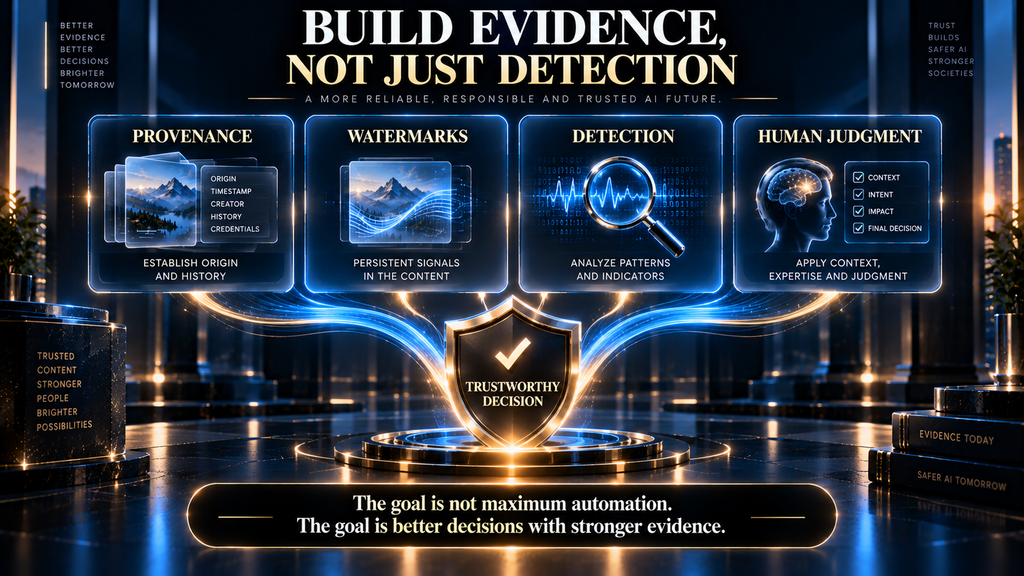
The strongest strategy is layered. Use provenance when you can establish history at the source, watermark verification when the relevant ecosystem supports it, AI detection for post-hoc screening when nothing stronger exists and human judgment when evidence is ambiguous or the stakes are high. Start with the decision, determine the evidence required, then choose the technology that produces it.
Decision Matrix: Which Approach Should You Choose?
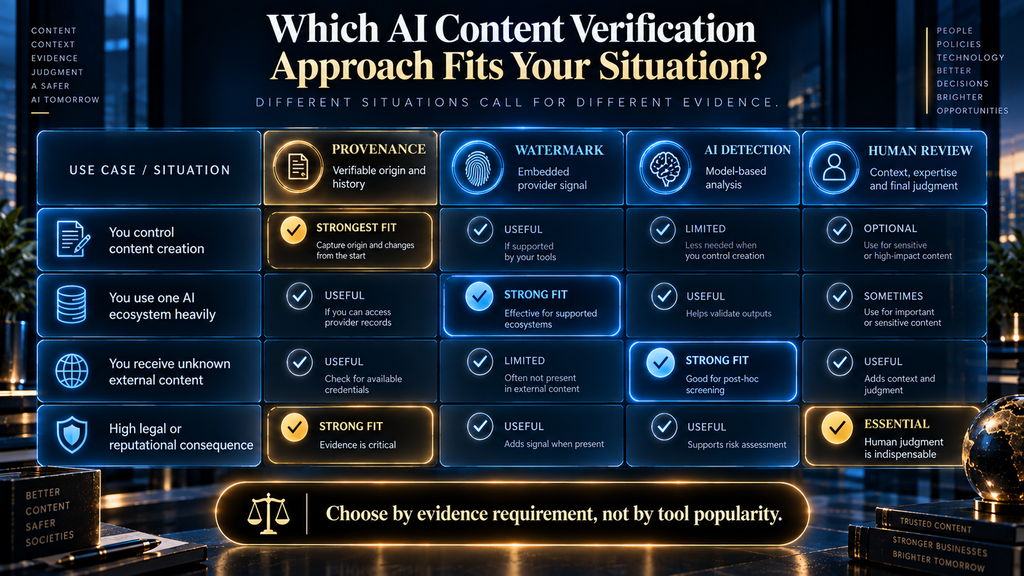
The matrix below pairs common situations with a starting approach and the reason it fits. Notice that it has no universal winner, which is intentional. A mature buying decision is about fitness for evidence rather than popularity, and the right answer changes with how much control you have over content creation and how serious the consequences of a mistake would be.
| Your situation | Best starting point | Why |
|---|---|---|
| You control content creation | Provenance | You can preserve origin and history before information is lost |
| You use one major AI ecosystem heavily | Provenance + provider watermark | Multiple signals can reinforce each other |
| You receive unknown external content | Detection + source investigation | Provenance may not be available |
| You process huge content volumes | Automated detection + escalation | Screening reduces manual workload |
| Content has high reputational or legal consequences | Provenance + multiple signals + human review | A single classifier is too weak |
| You need an audit trail | Provenance and evidence retention | Historical reconstruction becomes easier |
| You mainly need quick low-risk screening | AI detection | Lower implementation complexity |
| You need to verify AI involvement across many ecosystems | Layered approach | No single provider-specific signal has universal coverage |
What to Ask Commercial Vendors
When evaluating vendors, ask questions that expose the capability beneath the marketing. What exactly does the product detect: text generation, synthetic images, AI editing, specific watermarks, provenance credentials or a combination? What happens when content is compressed, cropped, screenshotted, paraphrased, translated, edited or converted? Does the system explain its result, or only return a percentage?
Ask too whether the tool integrates with your workflow through an API, batch processing, CMS connectors, cloud storage and enterprise controls, what happens to submitted data, whether verification evidence can be retained for later review and how the vendor communicates uncertainty. Vendors that state limitations clearly are usually more useful than those implying a certainty the technology cannot deliver.
When You Should Avoid AI Detection Entirely
In some situations a detector should not be the primary mechanism. If strong provenance already exists, using a generic detector to override it adds needless uncertainty. If the content is very short, there may be too little evidence for meaningful statistical inference. If the decision is highly consequential, a detector should never be the sole basis for the outcome.
If the organization cannot explain how a detector’s result will affect a decision, it should not automate that decision yet. And if a tool requires sensitive material to be uploaded without acceptable privacy controls, the verification benefit may not justify the data-governance risk. Not every verification problem needs a detector; sometimes the better answer is better documentation.
The Future of AI Content Verification
AI-generated content will increasingly be impossible to spot by appearance, because generation quality keeps improving and visual or linguistic tells keep disappearing. That raises the value of machine-readable provenance. C2PA’s continued development and the spread of watermarking across Google, OpenAI and partners show the ecosystem moving toward signals attached at creation rather than guessed afterwards.
The likely future is an ecosystem rather than one universal detector. Creation systems attach provenance, AI systems embed detectable signals, editing software preserves content history, platforms verify credentials, organizations retain evidence and people interpret ambiguous cases. The winning infrastructure will be whatever makes these layers work together smoothly, from camera to platform to reviewer.
The Bigger Shift: From AI Detection to Content Transparency
The phrase “AI detection” makes the problem sound binary: human or AI, real or fake, authentic or synthetic. Real production workflows are rarely binary. A photograph can be real but AI-enhanced, a marketing article human-written but AI-edited, a video a mix of real footage and synthetic scenes, and an illustration AI-generated and then heavily reworked by an artist.
Forcing every asset into two categories discards useful information. Provenance offers a better model because it can describe a sequence, telling us more about what happened rather than making us guess which category the final artifact belongs to. That is the deeper reason this technology matters, and why our guides to AI image generators note which tools add credentials.
A Practical Buying Checklist
Before buying a provenance or detection platform, an organization should be able to answer a short list of questions. Which content types must we verify? Which AI ecosystems do our creators and suppliers use? Do we control creation or mostly receive external assets? Do we need detection, provenance, watermark checks or a combination, and what happens when metadata is removed?
Ask also what happens after compression, cropping, paraphrasing or editing, how automated results will trigger review and which decisions are too consequential for automation. Then confirm what data you will upload, how long it is kept, whether results can be exported and audited, how the tool fits your workflow, what evidence it gives beyond a score, how you will track errors, the cost per asset and the plan if the vendor changes its method.
Final Recommendation: Build Evidence First, Then Add Detection
The strongest AI content verification strategy is to build a system that preserves the best available evidence and uses automation in proportion, rather than hunting for the tool that claims to catch the most AI. For controlled workflows, prioritize provenance, because it records information at the point where history is created and costs little once built into your tools.
For supported AI ecosystems, add watermark verification through tools such as SynthID Detector and OpenAI Verify. For unknown or legacy content, use AI detection as a screen. For consequential decisions, combine those signals with source investigation and human review. TRACE gives a practical way to decide: trace the origin, read the evidence, assess the signal, check the context and evaluate the consequence.
How We Researched This Guide
In October 2026 we reviewed the C2PA resources library, Google DeepMind’s SynthID page, OpenAI’s provenance help article and verification tool, and the product and pricing pages for Content Credentials Verify, Adobe Content Authenticity, Truepic, GPTZero, Originality.ai, Resemble Detect and Sightengine. Prices were recorded as displayed and may vary by region and billing period.
We did not run a controlled accuracy test across the nine tools, so W.O.R.T.H. scores are editorial judgments based on documentation, pricing and published capabilities. The TRACE framework, verification stack and risk model are our own teaching tools. Earlier versions of this guide referenced detector studies without links; we replaced those with a general summary of what the research consistently shows.
Our Test: Three Chatbots on Fake Sources and Real Citations
The detection and provenance tools in this list weren’t part of this test. As related context, on 12 November 2026 I tested whether ChatGPT (Plus plan, effort High), Google Gemini (free, Auto) and Microsoft Copilot (free, Auto) invent sources when asked about a report that doesn’t exist.
The tasks: three trap questions (a report that doesn’t exist, a false claim about GDPR and a request for study DOIs), a bias check on 520 loan decisions, anonymising a customer complaint, and sorting eight uses of AI into EU AI Act risk categories. This one test is shared by eleven governance and safety articles on this site; the files, prompts, answer key, every AI answer in full and the score sheet are on the governance test files page.
| Task | ChatGPT | Gemini | Copilot |
|---|---|---|---|
| Hallucination traps (5) | 5 | 5 | 3 |
| Bias check on loan data (8) | 8 | 7 | 7 |
| Anonymise a complaint (10) | 10 | 10 | 10 |
| EU AI Act risk categories (8) | 8 | 8 | 8 |
| Total (31) | 31 | 30 | 28 |

No tool invented a source: every DOI was real. All three found the planted bias without false alarms, removed every personal detail, and classified all eight EU AI Act cases correctly.
The points were lost on precision and honesty. Gemini overstated what two real papers show and exaggerated one bias figure. Copilot gave only one DOI out of three and missed the proxy risk in the loan data. None asked about consent before publishing a customer’s story.
Detection tools judge whether text was written by AI; this test checked whether AI text is accurate. The two are different: every answer here was AI-written, and most of it was correct.
Limits: one run per tool; made-up data and documents with traps planted on purpose; consumer chatbots, not specialist compliance or fairness software; results can change when models are updated. Nothing here is legal advice.
Final Thoughts
The AI content verification market is often framed as a race to build a detector that can finally tell humans and machines apart. That framing is too narrow. Modern content mixes human direction, machine generation, automated editing, manual refinement and platform transformation, and reducing that whole process to one probability score throws away the information organizations need.
The more durable model is evidence. Provenance preserves information about origin and transformation, watermarking provides embedded signals from supported systems, detection flags content worth investigating when nothing stronger exists, and human reviewers interpret those signals in context. The best verification system helps an organization make better decisions with stronger evidence rather than simply detecting the most.
The central lesson of TRACE is to stop asking whether a tool can say content is AI-generated. Ask what the tool can prove, what it cannot prove and whether that level of evidence is strong enough for the decision you are about to make. That is the difference between buying an AI detector and building a trustworthy content-verification system that holds up under scrutiny.
The future of AI verification belongs to better evidence rather than better guessing. Start with the records you already keep, add provenance where you control creation, check the watermarks that cover your main generators and use detectors only as a screen, and you will be ready for whatever the next wave of generative tools produces.
Build a More Reliable AI Content Verification Process
AI detection alone cannot tell the whole story. A stronger approach combines provenance, watermarking, detection signals, source evidence, and human judgment according to the consequences of getting the decision wrong.
Use the AI Accuracy Framework →Frequently Asked Questions
What is the difference between AI detection and content provenance?
Detection estimates whether content resembles AI output. Provenance records verifiable information about where an asset came from and what happened to it, so detection infers while provenance documents.
Are AI content detectors reliable?
They are useful for screening but not proof. Paraphrasing and editing can defeat them, and they sometimes flag human writing, so results should trigger review rather than penalties.
What is C2PA?
C2PA is an open technical standard for content provenance. It binds digital assets to signed, tamper-evident records of their creation and later edits, so tools from different vendors can read them.
What are Content Credentials?
Content Credentials are the provenance records created by tools that implement C2PA. They show an asset’s creation and edit history when participating software records those events.
What is AI watermarking?
It embeds a hidden, detectable signal in AI-generated content. Google’s SynthID marks images, video, audio and text, and partners such as OpenAI and NVIDIA also use it for their outputs.
Does the absence of a watermark prove content was made by a human?
No. It only shows that a supported watermark was not found. Another AI system may have made the content, or later edits may have weakened the signal beyond detection.
Can provenance prove that an image is real?
No. Provenance documents an asset’s origin and recorded history, but it cannot show that the image depicts a real event or that the caption and claims around it are accurate.
Should businesses use AI detectors for employee or hiring decisions?
Only with great caution. Detector scores are probabilistic and produce false positives, so they should never be the sole basis for a decision that affects someone’s job or reputation.
Which is better: AI detection or provenance?
Neither, because they solve different problems. Detection analyses content after the fact, while provenance preserves history from the start. Mature workflows use both together.
What is the best AI content verification strategy for a business?
Layer it: keep original files and records, use provenance where available, check supported watermarks, screen with detectors when nothing stronger exists and add human review for high stakes.
Related Guides
- How AI Detects Phishing, Social Engineering & Suspicious Messages
- How AI Analyzes Malware, Vulnerabilities & Security Alerts
- Best AI Image Generators in 2026: Free & Paid Tools Compared
Written by
Muntasir Ahmad Chowdhury
Founder, AI Hustle World
Muntasir Ahmad Chowdhury is the Founder of AI Hustle World, an independent publication dedicated to making Artificial Intelligence practical, trustworthy, and easy to understand. He researches AI tools, automation, customer service, productivity, and real-world business applications, helping readers make smarter technology decisions through research-driven, experience-backed content.
Expertise:
AI Tools • AI Automation • AI Customer Service • AI Productivity • Generative AI • AI Workflows
Join the AHW Test Log
One email when a new test or guide is published. It says what was checked and links to the sources. Plus Apex Daily OS, a free planner, in your welcome email.