Evidence: Documentation reviewed
Last checked: August 2026
What was done: Written from official documentation and the published sources linked in this article. Not hands-on tested.
Files: None
Affiliate links: No
AI in HR & Recruiting Explained: How AI Is Changing Talent Operations
A recruiter receives 800 applications for one position. The old workflow is familiar: open resume, scan experience, search for keywords, reject, open the next one, schedule interviews, send emails, repeat. Then the same company hires 20 people and discovers another problem — the recruiting team can fill positions, but onboarding is inconsistent, managers don’t know which new hires need support, employees ask HR the same questions repeatedly, training isn’t personalized, and workforce planning happens only after hiring needs become urgent.
And the organization still struggles to answer a much bigger question: what skills will it actually need 12 months from now? This is where the definition of AI in HR needs to expand. AI isn’t simply a recruiting shortcut — it is becoming a layer across the entire employee and workforce lifecycle.
SHRM’s 2026 State of AI in HR research found that 39% of HR professionals said AI was already adopted in their HR function, with another 7% planning to launch AI during 2026 — meaning just over half of organizations had no AI adoption and no plans to change that. Recruiting was the most common HR application area, followed by HR technology and learning and development. SHRM also found that 87% of respondents reported improved efficiency and 75% reported improved work quality. Yet 56% said they did not formally measure the success of their AI investments.
That last number may matter more than the adoption rate, because it exposes the real challenge: HR is adopting AI faster than many organizations are learning how to govern and measure it. And recruiting is only the beginning. This article explains where AI is changing HR today, where it is likely to create the most value, where the risks increase, and where human judgment should remain firmly in control.
What Is AI in HR?
AI in HR is the use of artificial intelligence to automate, analyze, or support people-related workflows across the employee lifecycle — recruiting, candidate sourcing, resume screening, interview support, scheduling, onboarding, employee support, learning, performance analysis, workforce analytics, and workforce planning. But “AI in HR” is not one technology; it spans several distinct capabilities that behave very differently in practice.
Generative AI creates or summarizes text, policies, communications, and reports. Machine learning identifies patterns and predicts outcomes. Natural language processing interprets resumes, job descriptions, employee questions, and feedback. Recommendation systems suggest candidates, learning resources, or workforce actions. Predictive analytics estimates outcomes such as attrition or hiring demand. And AI agents perform multi-step tasks across connected HR systems under defined rules and controls.
The important question isn’t whether AI can touch a given HR process — it almost always can. The important question is whether AI should automate it, assist it, or leave the final decision to a human. That distinction becomes more important as the consequences increase.
The AI HR Value Chain
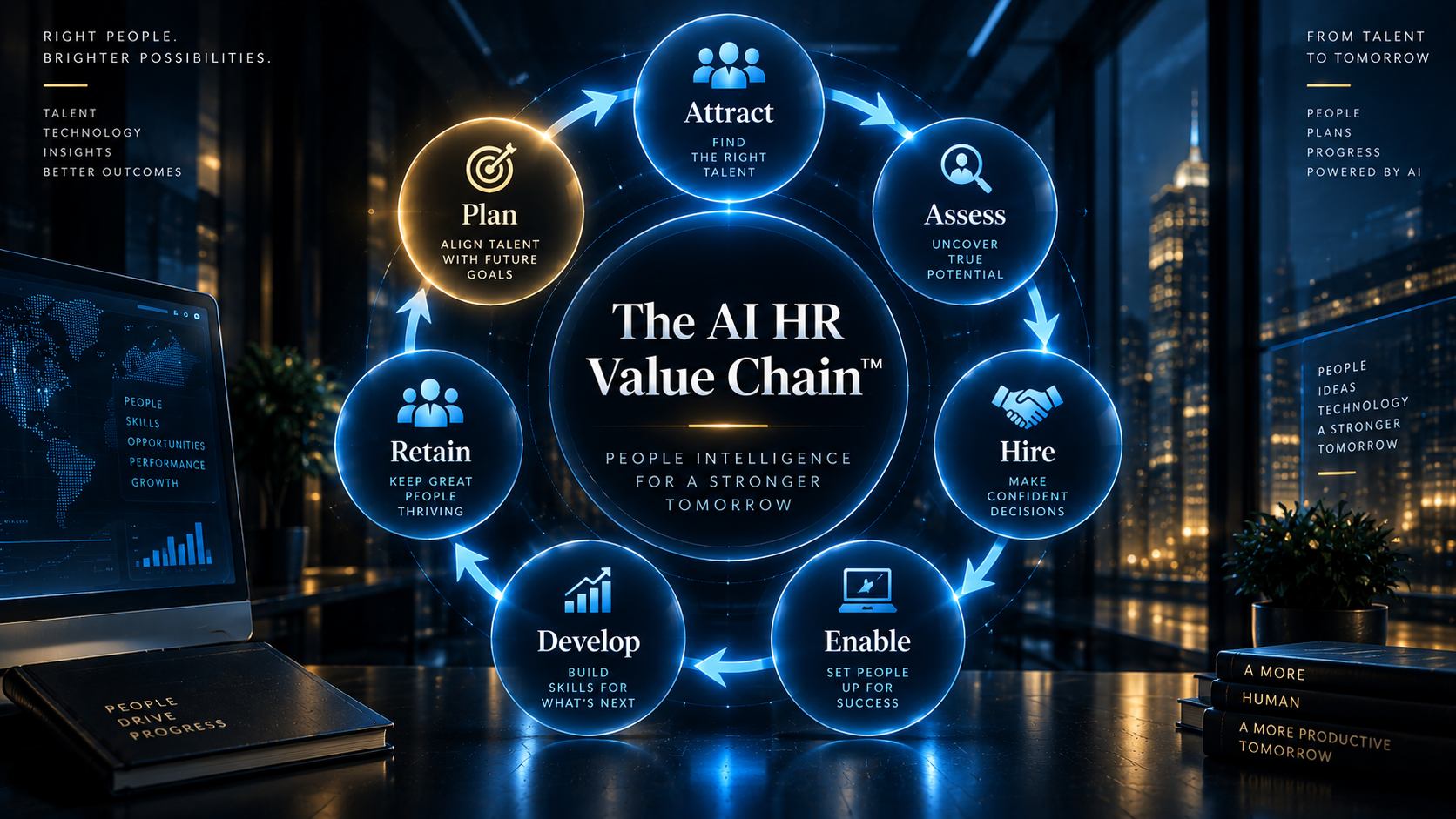
Human resources is often divided into separate functions — recruiting, onboarding, learning, performance, retention, workforce planning — but from an organizational perspective, these are connected. The employee lifecycle looks more like a continuous loop: workforce need leads to job design, which leads to attract, source, assess, hire, onboard, develop, retain, and workforce plan, before feeding back into the next workforce need.
This creates our first AI Hustle World framework, the AI HR Value Chain, in seven stages: Attract (improve job content and candidate reach), Assess (support screening, matching, and structured evaluation), Hire (coordinate communication and decision support), Enable (improve onboarding and employee access to information), Develop (personalize learning and development), Retain (identify workforce patterns and engagement risks), and Plan (connect workforce demand to business strategy).
This is the bigger opportunity. AI isn’t just helping HR process more candidates — it can gradually turn HR into a more continuous talent intelligence function. If AI is only used to screen resumes faster, HR captures an efficiency gain. If AI connects hiring, skills, onboarding, development, retention, and workforce planning, the organization gets something much bigger: a more responsive workforce operating system.
Why Recruiting Became the Starting Point
Recruiting is the easiest entry point for HR AI because it contains high-volume, repetitive, and relatively measurable workflows. A recruiter may handle hundreds of resumes, dozens of interviews, repeated scheduling, recurring candidate questions, job-description creation, and status communication — a natural automation environment. SHRM’s 2026 research found recruiting was the most common HR practice area for AI use, with 27% of respondents reporting adoption there.
The current recruiting workflow already contains many tasks that can be structured as document → classification → matching → scheduling → communication, which makes AI easier to deploy here than in areas where context is highly subjective.
What AI Is Actually Doing in Recruiting
AI can support almost every stage of the recruiting funnel, though the value and the risk look different at each stage. Our companion article, How AI Finds and Screens Candidates Without Replacing Recruiters, goes deeper into the sourcing and screening mechanics — this section focuses on where each task actually sits on the value map.
Job Description Creation
AI can draft role descriptions, competency summaries, required skills, and candidate-facing content. The benefit is speed; the risk is generic or distorted requirements, since a poorly designed prompt can produce a polished job description that attracts the wrong candidates. Human review still matters here.
Candidate Sourcing
AI can help identify candidates whose skills, experience, titles, and qualifications appear relevant to an open role. The value isn’t simply finding more people — it’s reducing the time required to narrow a large candidate population into a meaningful shortlist.
Resume Parsing
AI can extract skills, employment history, education, certifications, and experience from resumes. This is one of the strongest automation candidates because the underlying task is highly repetitive and low-ambiguity.
Candidate Matching
AI can compare a candidate profile against role requirements and generate a relevance estimate. Our related guide, AI Job Matching Explained: How Skills-Based Hiring Works, breaks down how these matching systems actually work. But matching becomes dangerous when the organization confuses “similar to historically successful candidates” with “actually qualified for the job” — historical hiring data can contain historical bias, and a model trained on it will happily repeat it.
Interview Scheduling
This is among the safest AI use cases. AI can coordinate candidate availability, interviewer calendars, reminders, rescheduling, and status updates — there is little reason for a recruiter to manually exchange eight emails just to find a 45-minute slot.
The Candidate Is Using AI Too
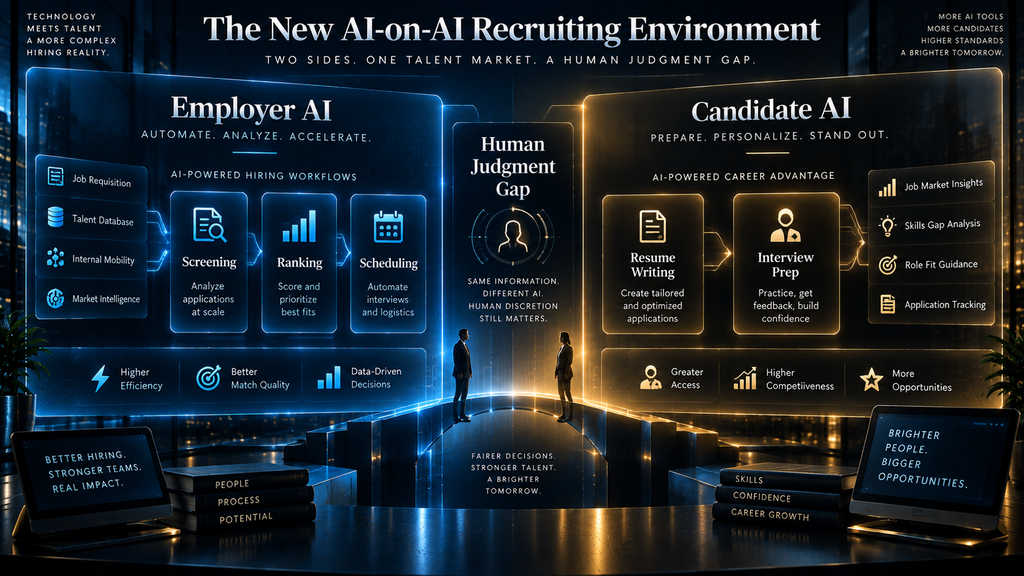
Modern recruiting is increasingly an AI-on-AI environment: employers use AI to evaluate candidates while candidates use AI to prepare and present themselves. Candidates increasingly use AI for resumes, cover letters, application answers, interview preparation, and potentially interview assistance itself.
SHRM’s 2026 recruiting research found 85% of recruiting executives expect candidates to increasingly use AI in applications, while 74% expect increased AI use during interviews. HireVue’s 2026 Global AI in Hiring Report found that 71% of candidates use AI for resumes and 77% of HR teams report regular AI use on their side — yet only 41% of hiring teams said they fully trust AI.
This creates a new recruiting problem: a candidate’s resume may now tell an employer that this person knows how to produce a strong AI-assisted resume, and rather less about whether this person can actually perform the job. That should accelerate a move from pure document evaluation toward skills evidence, structured assessment, work samples, and human judgment working together.
AI Screening Is Powerful — and Potentially Dangerous
AI screening is useful for reducing administrative workload, but it should not become an invisible decision-maker for who gets an opportunity. Consider a company that historically hired engineers from a narrow group of universities, salespeople with specific prior titles, and managers from a small set of companies. An AI model trained on that history may learn that these patterns correlate with successful employees, and it may therefore favor similar candidates going forward.
But correlation isn’t necessarily the same as job-related qualification. The organization could unknowingly turn historical hiring behavior into future hiring criteria. That’s why HR AI needs a different standard from a marketing recommendation engine — the cost of a bad recommendation is someone’s livelihood, not a missed upsell.
The AI Hustle World HR Automation Boundary
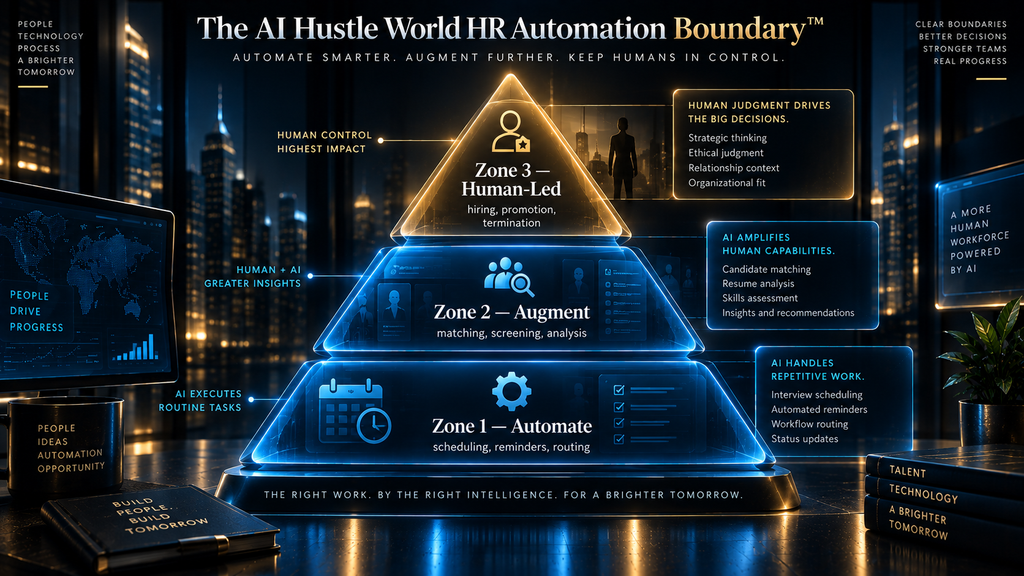
This is our second core framework. Every HR task should fall into one of three zones.
Zone 1 — Automate covers low-risk, repetitive administrative work: interview scheduling, reminders, candidate status messages, document routing, HR FAQ responses, and job-description formatting. Zone 2 — Augment is where AI analyzes, recommends, or prepares while human professionals remain responsible — candidate matching, resume screening, interview summaries, workforce analysis, learning recommendations, and attrition analysis.
Zone 3 — Human-Led covers high-consequence decisions that remain under meaningful human control: final hiring decisions, termination, promotion, compensation, disciplinary action, and sensitive employee-relations decisions. The rule that ties it together: the closer a decision gets to a person’s livelihood, rights, or career, the stronger the human control should be.
Candidate Matching Should Support Judgment, Not Replace It
Suppose an AI recruiting system ranks one candidate 94/100 and another 72/100. The obvious temptation is to interview the 94. But the recruiter needs to know why — maybe the first candidate simply has more matching keywords, more years of experience, or a similar previous job title, while the second candidate has stronger practical skills, a better work sample, and transferable experience that the score doesn’t capture. A score isn’t a decision; it’s one piece of evidence, and that distinction should hold throughout AI-assisted hiring.
Interviews Are Becoming an AI Design Problem
AI can assist interview scheduling, preparation, transcription, and structured analysis, but the organization still needs to decide what evidence actually matters. An AI-assisted interview workflow runs from candidate to interview, to transcript and notes, to AI-structured skills evidence, to recruiter review, to decision. Our dedicated guide, How AI Interviewing Works: Screening, Scheduling and Structured Evaluation, walks through that pipeline in detail.
The useful part isn’t simply transcription — it’s turning a long conversation into structured evidence. But there are risks: a candidate with a polished speaking style may be rated more favorably than someone with stronger technical ability but less polished communication, and AI can reproduce that problem just as easily as a human interviewer can. That’s why structured interviews and job-relevant scoring criteria still matter.
Candidate Experience Becomes a Competitive Variable
AI can improve recruiting speed while simultaneously damaging candidate trust if the process feels opaque or impersonal. HireVue’s 2026 report found that only 41% of hiring teams fully trust AI despite widespread adoption, and industry surveys on AI transparency have found a majority of companies consider explainability important while a significant share still lack a formal AI governance framework. Recent reporting citing Greenhouse survey data found that a meaningful share of U.S. candidates had abandoned an AI-led hiring process altogether.
This creates an important trade-off: AI can make hiring faster but potentially less human. A candidate may prefer immediate AI scheduling but dislike being evaluated by an unexplained AI system — which is exactly why candidate experience has to be part of the automation decision, not an afterthought bolted on later.
AI in Onboarding
AI can transform onboarding from a fixed checklist into a more adaptive employee-enablement experience. Traditional onboarding might look like completing HR forms, watching a compliance video, receiving the handbook, attending orientation, and meeting the manager. AI can add role-specific onboarding paths, personalized learning, policy Q&A, automated reminders, document assistance, knowledge retrieval, and early support. Our companion guide, How to Use AI for Employee Onboarding, HR Helpdesks & Policy Questions, covers this in more depth.
Imagine a new sales employee asks which CRM reports they need to understand during their first month. Instead of searching the intranet, the employee receives a contextual answer linked to company resources. That’s where AI starts improving the employee experience beyond recruitment.
Why Onboarding May Be More Valuable Than Another Recruiting Automation
Hiring someone isn’t the objective — getting the person productive is. Suppose AI saves a recruiter three hours per hire; that’s valuable. But suppose better onboarding reduces time-to-productivity by two weeks across hundreds of employees — that can have a much larger economic impact. This is one reason the long-term HR AI opportunity extends well beyond recruiting: recruiting has been the initial beachhead, while onboarding, performance, and development remain comparatively less transformed, and that gap is strategically important.
AI in Learning & Development
AI can personalize learning by connecting development recommendations to individual skills, roles, and career goals, rather than giving every employee in a job family the same training. One employee might have strong technical skills but weak communication, while another has strong communication but weak data analysis — the training path can differ accordingly. SHRM’s 2026 research found learning and development was already one of the major HR areas using AI, with 17% of respondents reporting adoption. The strategic shift is from training delivery toward continuous skill development.
AI in Performance Management
AI can summarize performance evidence and identify patterns, but performance decisions should remain strongly human-led. Potential uses include summarizing feedback, identifying recurring strengths, detecting missing feedback, recommending development areas, preparing review drafts, and identifying skill gaps. But the moment AI starts influencing promotions, compensation, disciplinary action, or termination, the consequence becomes much higher.
A performance model can be wrong because some work is harder to measure, managers document differently, certain employees receive more feedback than others, and qualitative contributions are difficult to quantify. AI can organize evidence; it should not quietly become the manager.
AI in Employee Experience
AI can act as a 24/7 HR service layer for routine employee questions and requests — how many vacation days someone has, how to add a dependent to benefits, where the expense policy lives, how to request parental leave. An AI HR assistant can answer routine questions and route sensitive cases to the right HR professional, creating faster answers, lower administrative workload, and more scalable HR support. But HR systems contain sensitive information, so access controls, data permissions, and escalation paths are essential from day one.
AI in Workforce Analytics
AI workforce analytics turns HR from historical reporting toward pattern detection and predictive decision support. HR teams can analyze headcount, turnover, absenteeism, skills, hiring pipelines, workforce costs, internal mobility, and learning activity. A traditional dashboard may simply tell you turnover was 14%; AI can instead ask which departments are showing unusual retention risk, what signals explain it, and what changed compared with previous periods — a far more actionable question.
But prediction introduces its own issue: what happens when employees get labeled “high risk”? A prediction can become self-fulfilling, since managers may treat someone differently simply because a model says they’re likely to leave. That’s another reason predictive HR should be treated as decision support rather than destiny.
AI in Workforce Planning
AI workforce planning connects business demand to future skills, capacity, and labor requirements. Consider revenue expected to grow 25% — HR may need to determine how many people, which roles, which skills, which locations, how quickly, and whether to hire or upskill. AI can model alternative approaches: Option A might be hire 50 people, Option B might be upskill 30 employees plus hire 20, and Option C might be automate part of the workflow plus hire 15. Now HR is no longer simply reacting to vacancies — it’s helping design organizational capacity.
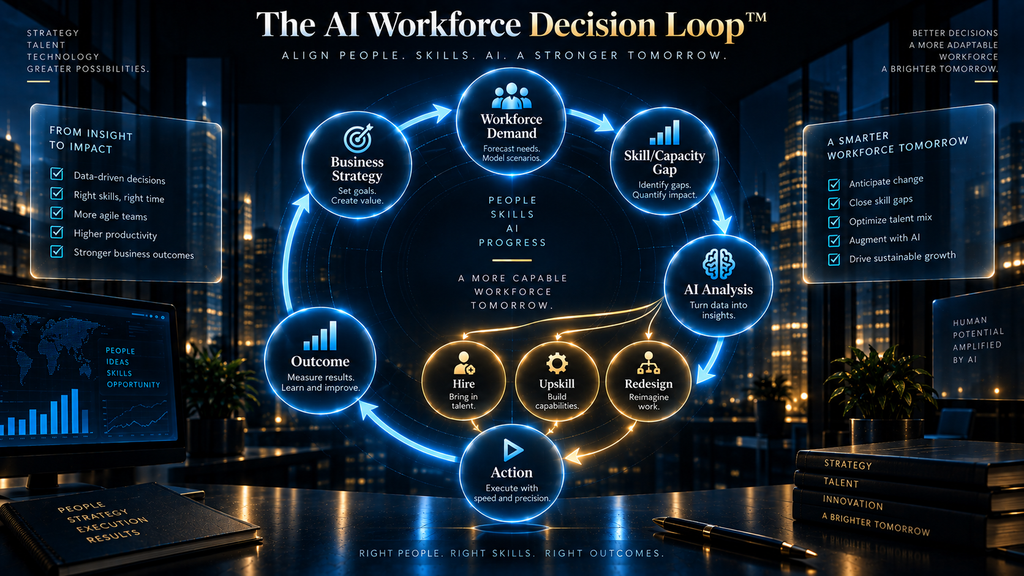
The AI Workforce Decision Loop
Our third framework runs business strategy into workforce demand, into skill and capacity gaps, into AI analysis, branching into hire, upskill, or redesign options, into action, into outcome, and back into strategy again.
This is where AI in HR starts becoming strategically important. The question becomes “what workforce configuration best supports the business strategy?” rather than “how can HR process applications faster?”
AI Should Not Make Every HR Decision
The appropriate level of human involvement should rise as the financial, personal, and legal consequences of a decision increase. Interview scheduling is low consequence and can run at very high automation. Resume parsing is moderate consequence and can run at high automation with controls. Candidate ranking is higher consequence and should stay AI-assisted.
Hiring recommendations are high consequence and need AI plus human review. Promotion and termination are high to very high consequence and should stay human-led. This is the HR equivalent of a financial-control hierarchy — the closer to a livelihood decision, the tighter the human grip needs to be.
The Human Oversight Gradient
A useful way to think about it: lower consequence plus higher repetition points toward more automation; higher consequence plus higher ambiguity points toward human-led decisions, with AI-assisted work sitting in between. This principle should be applied consistently to recruiting, performance, compensation, employee relations, and workforce planning — it prevents the common mistake of “the AI can do it, so the AI should decide it.”
The Biggest HR AI Risk Is Not Just Bias
HR AI risk includes bias, but also opacity, automation bias, data misuse, poor candidate experience, weak governance, and inappropriate delegation of decisions. Bias means historical patterns can reproduce historical inequality.
Opacity means candidates and employees may not understand how decisions are made. Automation bias means managers may over-trust AI recommendations simply because a system produced them. Data privacy and security matter because HR systems contain highly sensitive employee information that unauthorized access can expose.
Candidate experience can suffer even as speed improves. And governance and accountability gaps mean organizations may deploy tools without clear ownership — so when AI makes a harmful recommendation, someone still has to own the result. HR AI is as much a governance problem as a technology problem.
Employment Regulation Is Part of the Product Decision
In the United States, employers using algorithmic or AI-driven systems in employment decisions still have to consider existing anti-discrimination laws and accommodation obligations — the EEOC has specifically warned about algorithmic hiring tools and disability-related discrimination risks.
In the European Union, certain AI systems used in employment and worker management are classified as high-risk under the EU AI Act, including systems involved in recruiting, filtering applications, and evaluating candidates. New York City’s Local Law 144 adds another layer specifically for automated employment decision tools, and recent legal analysis has flagged rising audit and enforcement risk for employers who treat compliance as optional.
That means a global company can’t simply say “the vendor handles compliance.” The employer still needs legal review, governance, documented controls, appropriate human oversight, and jurisdiction-specific assessment. This article is not legal advice — the practical lesson is that HR AI should be evaluated as both technology and employment-process infrastructure at the same time.
Human-in-the-Loop Is Not a Checkbox
Human oversight is meaningful only when humans receive sufficient evidence, understand the limitations, and have genuine authority to challenge or override AI outputs. Imagine an AI hiring system recommends “Candidate A — 92% fit” and the recruiter simply clicks accept.
That’s technically human-in-the-loop. But if the recruiter doesn’t know why the score is high, which factors mattered, whether a known bias exists, or what the system can’t evaluate, the human isn’t exercising meaningful judgment — they’re just acting as the AI’s approval button. That’s not responsible automation.
The AI HR Value Score
Our fourth proprietary framework asks a simple question: did the AI actually improve HR? Measure it across seven dimensions: efficiency (did time or process cost fall?), quality (did output quality improve?), experience (did candidate or employee experience improve?), decision quality (are decisions demonstrably better?), fairness (are relevant outcomes monitored?), compliance (can the process be governed and explained?), and business outcome (did hiring, retention, productivity, or capability improve?). That’s a far better standard than simply saying “we deployed an HR chatbot.”
AI Adoption Is Outpacing Measurement
SHRM’s 2026 research found that while 39% of HR professionals reported AI adoption, 56% did not formally measure their AI investment’s success, and only 16% used their own ROI metric. That exposes one of the biggest problems in enterprise AI adoption: the organization knows it is using AI, but doesn’t necessarily know whether it is creating economic value. That’s backwards.
Before deployment, define a baseline (what does the process cost today?), a target (what should improve?), a measurement (how will improvement be calculated?), and a guardrail (what must not deteriorate?). For recruiting, that typically means time-to-fill should fall while quality of hire holds steady or rises and candidate abandonment falls. For HR service, response time should fall while answer accuracy holds steady or rises. For workforce analytics, decision lead time should fall while fairness and control standards remain acceptable.
AI ROI in HR Is Not Just Recruiter Hours Saved
The strongest HR AI business cases measure downstream workforce outcomes, not just administrative efficiency. A weak ROI metric says recruiters save 10 hours per week. A stronger model says time-to-fill decreases. An even stronger one says time-to-productivity decreases. The strongest says quality of hire and retention improve while recruiting cost falls. That’s the hierarchy HR should be climbing — connecting AI investment to hiring outcomes, workforce capability, employee experience, retention, and productivity, not just hours saved.
Why AI Entered Recruiting First but May Grow Beyond It
Recruiting is easy to automate, but the business value of HR isn’t limited to hiring. A bad onboarding experience can destroy part of the value of a good hire. Poor learning can create skill gaps. Weak workforce planning can create hiring emergencies. Bad performance management can create unnecessary attrition. So the strategic value of AI in HR may shift from “faster hiring” to “better workforce decisions” — that is where the long-term opportunity actually lies.
The Adoption-to-Transformation Gap
Current research suggests a significant gap between using AI and transforming HR with AI. SHRM reports substantial current adoption and efficiency gains, but Deloitte’s 2026 Human Capital Trends research reports that only 6% of leaders say their organizations are making progress in designing how humans and AI work together, while 85% say workforce adaptability is very or extremely important.
This creates the central challenge: the software may be available before the organization has redesigned the work around it. Buying AI doesn’t automatically transform HR — job roles, processes, metrics, skills, and governance all need to change alongside it.
AI Should Change HR Jobs, Not Just HR Software
A recruiter who previously spent half their week screening resumes could spend more time on hiring-manager alignment, candidate relationship building, difficult searches, employer branding, and interview quality. An HR business partner who spent hours searching HR policies could spend more time on workforce planning, manager coaching, and organizational design.
An HR analyst who spent days preparing reports could spend more time on workforce scenarios, root-cause analysis, and decision support. The objective isn’t simply to reduce HR headcount — it’s to make HR professionals more valuable per hour.
What AI Should Automate First
Strong candidates include administrative scheduling (extremely repetitive), candidate status communications (high volume and predictable), HR knowledge retrieval (policies and FAQs), document routing (low judgment), job-description drafting (human review remains appropriate), routine reporting (standardized data), and basic data normalization (structured workflow). These are relatively low-risk starting points precisely because they carry little consequence if something goes slightly wrong.
What AI Should Assist
Good augmentation candidates include candidate sourcing (AI finds, recruiters decide), candidate matching (AI ranks, humans evaluate), interview summaries (AI structures, humans interpret), workforce analytics (AI identifies patterns, HR investigates), learning recommendations (AI suggests, employees and managers decide), attrition risk (AI flags, managers determine appropriate action), and performance insights (AI organizes evidence, managers own judgment). This is the practical middle ground where most of the near-term value sits.
What AI Should Not Own Alone
For most organizations, strong human ownership should remain around final hiring decisions, termination, compensation, promotion, disciplinary action, sensitive employee relations, and legally consequential decisions. AI can support the evidence behind these calls; it shouldn’t quietly become the authority making them.
Current Market Reality — AI Is Already Normalizing
The HR conversation is no longer “will AI enter HR?” — it already has. The better question is what kind of HR operating model organizations will build around it. SHRM’s data shows recruiting and other process-driven HR applications already have significant adoption, but the low level of formal ROI measurement shows many organizations haven’t yet matured from experimentation to disciplined AI operations. That gap creates a real opportunity for companies that build the governance and measurement layer early, rather than treating it as an afterthought.
A Practical HR AI Architecture
A mature architecture connects HR data, the ATS, HRIS, LMS, performance data, and workforce data into a data-and-governance layer, which feeds AI and analytics, which produces recommendations, which pass through human review before becoming HR action and, ultimately, outcome — with that outcome feeding back into the system as a learning loop.
The feedback loop is what matters most: the organization should compare the AI recommendation, the human decision, and the actual outcome side by side. That comparison is what tells you whether the system is actually useful, rather than just busy.
How to Implement AI in HR Without Creating Chaos
Step 1 is to start with the bottleneck — not “where can we put AI?” but “where is HR spending too much time or making too-slow decisions?” Step 2 is to separate task types into administrative, analytical, and judgment-heavy work. Step 3 is to automate low-risk repetitive work first: scheduling, communication, document processing, and knowledge retrieval.
Step 4 is to introduce AI assistance and test matching, analytics, summaries, and recommendations. Step 5 is to establish governance — human ownership, data access, documentation, monitoring, and escalation.
Step 6 is to measure outcomes across efficiency, quality, experience, fairness, and business results. Step 7 is to expand gradually, increasing autonomy only after results prove reliable.
90-Day HR AI Implementation Roadmap
Days 1–30 are for diagnosis: choose one workflow, such as interview scheduling, candidate communication, or HR knowledge support, and map the current process, time, cost, errors, and employee or candidate experience around it. Days 31–60 are for piloting: introduce AI with humans in the loop and measure completion time, accuracy, exception rate, and user satisfaction.
Days 61–90 are for evaluation: ask whether efficiency improved, whether quality improved, whether experience improved, whether risk increased, and whether you can actually prove ROI — then decide to expand, redesign, or stop. That last option should always remain legitimate; a pilot that doesn’t work is a successful pilot if it stops you from scaling something broken.
Common Mistakes
The first mistake is starting with a tool instead of a problem — technology isn’t strategy. The second is automating high-consequence decisions too early, since HR is not a low-risk back-office function. The third is treating every anomaly as bias; not every model variation is evidence of discrimination, but relevant fairness risks must still be tested.
The fourth is ignoring candidate AI, since candidates are adapting just as fast as employers are. The fifth is assuming human-in-the-loop solves everything, when humans need evidence and real authority to challenge the system, not just a button to click.
The sixth mistake is measuring hours saved only, when downstream workforce outcomes matter more. The seventh is ignoring data privacy, since HR data is uniquely sensitive. The eighth is buying AI without governance — the tool isn’t the governance framework.
The ninth is assuming AI-native means better, when maturity and controls matter more than how new the vendor is. And the tenth is scaling before proving value; pilot first, then expand.
AI Hustle World’s Honest Take
The hype says AI will eliminate repetitive HR work and transform talent management. That’s partly true, but the evidence points to a more complicated reality. AI adoption is rising, recruiting is the leading entry point, and organizations report efficiency and quality gains.
But many organizations don’t formally measure ROI, many lack mature governance, candidate trust is not universal, post-hire HR transformation is lagging, and consequential HR decisions remain difficult to automate responsibly.
SHRM found 56% of respondents weren’t formally measuring AI investment success, while industry research on AI governance has found a significant share of organizations still lack a formal AI governance framework despite high concern around transparency. The difficult part of HR AI isn’t buying the technology — it’s redesigning the work around it.
AI Hustle World Honest Opinion
I would not build an HR AI strategy around “let’s automate as many HR tasks as possible.” I’d build it around removing low-value administrative work and using AI to give HR professionals better information, while protecting human responsibility for consequential people decisions.
That produces a much cleaner strategy: automate scheduling, document handling, and routine communications; assist matching, analysis, research, and recommendations; and protect hiring, promotion, compensation, termination, and employee relations. This is where AI can become genuinely useful without turning HR into an algorithmic black box.
The Future of AI in HR
The first generation of HR AI is mostly automation. The next generation is intelligence. The third may be orchestration — imagine an HR agent that can detect a hiring need, analyze workforce capacity, draft the role, coordinate sourcing, schedule interviews, prepare onboarding, monitor early productivity, recommend learning, and update workforce forecasts.
That sounds powerful, and it also creates a major governance problem, because the system isn’t answering one question anymore — it’s influencing an entire employee lifecycle. That makes the principles in this article even more important, not less.
The Long-Term Shift — From Recruiting Automation to Talent Intelligence
The strategic progression runs from automation, to AI-assisted HR, to predictive HR, to continuous talent intelligence, to AI-assisted workforce design.
At the beginning, the goal is simply to save recruiter time. At the end, the goal is to help the organization continuously understand and design its own workforce capabilities — a much bigger ambition than faster hiring.
The AI Workforce Decision Loop in Practice
Suppose a company plans to expand into a new market. The old HR process is linear: leadership decides, then HR receives a hiring request. A more intelligent model runs market strategy into required capabilities, into current workforce, into skill gap, into AI-generated scenarios branching across hire, upskill, or redesign, into cost/time/risk analysis, into a management decision, into execution. Now HR is participating before the hiring request even exists — that’s strategic workforce intelligence rather than reactive hiring.
Who Should Use AI in HR?
Strong candidates include large enterprises (large employee populations create significant automation opportunity), high-growth companies (hiring and workforce planning change quickly), recruiting-heavy organizations (high application volume makes automation valuable), global employers (many policies, locations, and employee questions create operational complexity), companies with mature HR data (AI performs better when systems are connected), and organizations with measurable HR processes (clear baselines make ROI easier to establish). Our comparison piece, AI Recruiting vs Traditional Recruiting: What Actually Works?, breaks down exactly where the line sits for recruiting specifically.
Who Should Avoid Full HR Automation?
Be cautious when HR processes aren’t standardized, employee data is fragmented, governance is immature, legal review is unavailable, no one owns AI decisions, or the organization cannot explain how AI is being used. You can still use AI in these conditions — just keep it administrative and assistive until the governance foundation is actually ready for more.
The Most Important HR AI Metric May Be Decision Quality
Revisit the AI HR Value Score introduced earlier before scaling any HR AI initiative — if a system only improves speed while damaging trust, the project isn’t necessarily a success. This is a subtle but important point: a recruiting AI can reduce time-to-screen by 70%, which sounds fantastic, but what happens to quality of hire?
If quality falls, the company may have optimized the wrong metric entirely. Similarly, an HR chatbot can reduce support tickets by 50%, but if employees receive incorrect answers, the organization simply shifted work from HR to employee confusion.
Every HR AI project should have an efficiency metric, a quality metric, and a risk metric together — never just one of the three in isolation.
The Three-Metric Rule
For every HR AI deployment, define at least three things: efficiency (did the process improve?), quality (did the outcome remain accurate or improve?), and risk (did fairness, trust, privacy, or compliance deteriorate?). For strategic use cases, add a fourth — business outcome: did the organization actually perform better? This simple framework can prevent a lot of AI theater dressed up as transformation.
What HR Should Become
The future HR organization doesn’t need to become “the department that manages AI.” It should become the function that designs how people and intelligent systems work together responsibly.
That means HR will increasingly own questions like which work should humans do, which work should machines do, which skills employees need, how jobs should be redesigned, how AI decisions should be governed, how to preserve trust, and how to measure workforce outcomes. That’s a substantially more strategic role than the administrative function HR is often reduced to today.
The Complete AI HR Operating Model
Putting everything together: business strategy defines workforce need, which flows into an AI HR system that splits into recruit, enable, and analyze streams — feeding hire, develop, and plan respectively — before converging back into human judgment, HR action, and outcome, with that outcome looping back into strategy. That is the direction AI in HR is heading: AI as a connective intelligence layer across talent operations, not a replacement for the people running it.
Final Thoughts: AI Should Reduce HR Administration — Not Human Responsibility
AI entered HR through recruiting because recruiting contains something technology understands very well: a high-volume, repetitive process. Applications can be parsed, interviews can be scheduled, job descriptions can be drafted, and candidate communication can be automated. That’s the easy part. The more interesting transformation is what happens after the hire — AI can help employees navigate HR, personalize learning, analyze workforce patterns, support managers, identify capability gaps, and help finance and HR connect workforce cost with business strategy. It can model hiring versus upskilling and become a connective intelligence layer across the employee lifecycle.
But the risks increase as the decisions become more consequential. A scheduling mistake is inconvenient; a bad hiring recommendation can deny someone an opportunity; a poor performance model can affect a career; a flawed compensation recommendation can create unfairness; a bad termination decision can carry real legal and human consequences. That is why the correct HR AI model isn’t “automate everything” or “don’t use AI” — it’s automate the administrative, augment the analytical, and protect the human decision.
The evidence is increasingly clear that AI adoption in HR is accelerating. SHRM’s 2026 research found nearly four in ten HR professionals already reported AI adoption, with recruiting leading the way — but adoption is not transformation, and the same research found 56% weren’t formally measuring AI investment success. Deloitte’s 2026 Human Capital Trends research reports that 85% of leaders consider workforce adaptability highly important, yet only 6% say their organizations are making progress in designing how humans and AI actually work together.
That gap is the real opportunity. The organizations that win won’t simply be those that buy the most HR AI — they’ll be the ones that redesign work intelligently, asking what humans should stop doing, what AI should start doing, what AI should recommend but humans decide, how they’ll know the system is actually improving outcomes, and how they’ll protect trust, fairness, and accountability along the way. That’s a much more durable definition of AI in HR: not HR with a chatbot bolted on, but a workforce operating model where humans and intelligent systems are designed to do the work each is actually best suited for.
Want to See This Framework Applied to Actual Screening?
See exactly how AI sources, screens and ranks candidates in practice — and where recruiters still need to stay in control.
Explore AI Candidate Sourcing & Screening →FAQ
What is AI in HR?
AI in HR is the use of artificial intelligence to automate, analyze, or assist people-related workflows across recruiting, onboarding, learning, performance, employee support, workforce analytics, and workforce planning.
How is AI changing recruiting?
AI is automating and assisting tasks such as job-description creation, sourcing, resume parsing, candidate matching, scheduling, candidate communication, and interview support. Recruiting is currently the most common HR AI application area according to SHRM’s 2026 research.
Will AI replace recruiters?
AI can automate significant administrative recruiting work, but recruiters remain valuable for difficult searches, candidate relationships, hiring-manager alignment, structured assessment, judgment, and employer branding. The job is more likely to change than to simply disappear.
Can AI screen resumes?
Yes — AI can extract information, compare skills, and identify potentially relevant candidates. However, screening systems need careful evaluation for accuracy, bias, explainability, job relevance, and human oversight before they’re trusted at scale.
Can AI make hiring decisions?
It can support hiring decisions, but final hiring decisions should generally retain meaningful human involvement, particularly where employment consequences are significant.
Is AI in HR biased?
AI can reproduce or amplify patterns present in historical data. Bias risk depends on the data, features, labels, model design, workflow, human use, and monitoring involved — AI doesn’t automatically create bias, but it can scale existing problems quickly if left unchecked.
What is AI talent operations?
AI talent operations refers to using AI across the broader employee lifecycle rather than only recruiting — hiring, onboarding, learning, performance, employee support, retention, and workforce planning.
Can AI help with onboarding?
Yes. Potential applications include personalized onboarding, HR policy assistance, learning recommendations, reminders, role-specific guidance, and knowledge retrieval.
Can AI improve performance management?
AI can organize feedback, summarize evidence, and identify patterns, but performance decisions affecting compensation, promotion, or employment should retain appropriate human judgment.
Can AI predict employee attrition?
AI can identify patterns associated with higher turnover risk, but a prediction is not a fact. Managers should not treat “high attrition risk” as “this employee will leave” — the system should support investigation and appropriate action rather than predetermine outcomes.
What are the biggest risks of AI in HR?
Key risks include bias, privacy, security, opacity, automation bias, candidate distrust, poor governance, and legal or compliance risk.
What does the EU AI Act say about AI in employment?
Certain employment-related AI systems, including some used for recruiting and candidate evaluation, are classified as high-risk under the EU AI Act. Organizations should assess the specific system and applicable obligations rather than assuming all HR AI is regulated identically.
What should HR automate first?
Start with repetitive, lower-consequence tasks such as scheduling, routine communication, document processing, knowledge retrieval, and reporting preparation, then move toward AI-assisted analysis.
What should HR not automate fully?
Be particularly cautious with hiring decisions, termination, promotion, compensation, disciplinary decisions, and sensitive employee relations — these areas involve substantial human, ethical, and sometimes legal consequences.
Related Guides
- Best AI Recruiting Tools in 2026: Sourcing, Screening & Interviewing Compared
- AI Product Management Explained: How AI Is Changing the Product Lifecycle
- AI in Finance & Accounting Explained: Where AI Actually Creates Value
Written by
Muntasir Ahmad Chowdhury
Founder, AI Hustle World
Muntasir Ahmad Chowdhury is the Founder of AI Hustle World, an independent publication dedicated to making Artificial Intelligence practical, trustworthy, and easy to understand. He researches AI tools, automation, customer service, productivity, and real-world business applications, helping readers make smarter technology decisions through research-driven, experience-backed content.
Expertise:
AI Tools • AI Automation • AI Customer Service • AI Productivity • Generative AI • AI Workflows
Get Smarter With AI
Enjoyed this guide? Get practical AI tools, tutorials, and honest reviews delivered to your inbox.