How Role Prompting Changes AI Responses: Benefits, Limits and Best Practices
You’ve probably typed “You are an expert marketer” or “Act as a senior developer” into ChatGPT or Claude at some point, expecting the answer that follows to be sharper because of it. This is role prompting, and it is one of the most widely repeated pieces of prompt engineering advice on the internet.
It is also, according to a growing body of research from 2023 through 2025, far more complicated than the advice usually admits.
Some studies show role prompting nearly doubling accuracy on certain reasoning tasks. Other studies, using larger sample sizes and more rigorous controls, found that the same technique does nothing for accuracy at all, and in some cases makes a model’s answers worse or less safe. Both sets of findings are real. The difference comes down to what you’re using role prompting for, which model you’re using, and how the role is written.
This article works through the actual mechanism behind role prompting, what the research says about when it helps and when it fails, the bias and safety risk almost no beginner guide mentions, and a decision framework you can use to figure out whether a role belongs in your next prompt at all. We also ran our own quick side-by-side tests on a current flagship model to see where the research findings hold up in practice.
What Role Prompting Actually Is
Role prompting means opening a prompt by assigning the AI a character, profession, or perspective before giving it the actual task, as in “You are a tax accountant with 15 years of experience” or “You are a blunt editor who hates filler words.” The instruction can sit in the system prompt, the first line of a chat message, or both. It goes by several names depending on who is writing about it: role prompting, persona prompting, and role-play prompting are used almost interchangeably across the prompt engineering literature, though role-play prompting sometimes refers specifically to the two-stage technique covered later in this article.
All three describe the same core move: telling the model who to be before telling it what to do, and if you haven’t worked through the fundamentals yet, our beginner’s guide to writing AI prompts covers the basics this article builds on.
Roles generally fall into a few recognizable categories. Occupational roles (“you are a cybersecurity analyst”) are the most common. Character or historical roles (“respond as Marcus Aurelius would”) show up in creative and philosophical use cases. Relational roles (“you are my writing mentor”) are common in coaching-style prompts. Abstract or non-human roles (“you are a skeptical fact-checker”) are increasingly used specifically to shape a model’s stance rather than its vocabulary.
The Mechanism: Why Assigning a Role Changes Anything at All
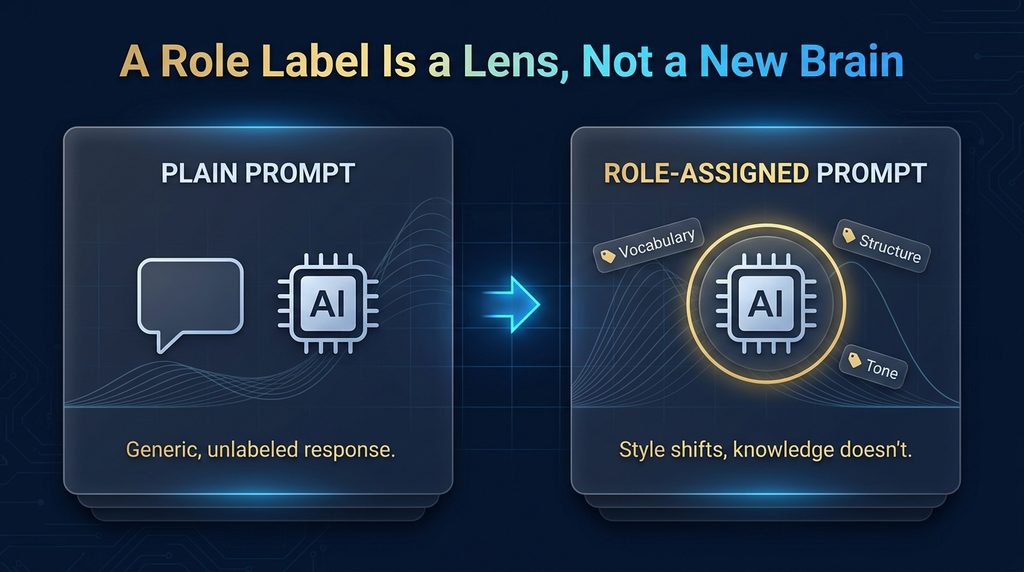
A language model does not “become” a tax accountant when you tell it to act like one. It has no professional memory to draw on and no license to lose. What actually happens is statistical: the role text shifts the probability distribution the model uses to pick its next words, pulling the response toward patterns that co-occurred with that label across its training data.
When you write “you are a tax accountant,” the model leans toward vocabulary, structure, caveats, and tone that appeared near accountant-labeled text during training: numbered clarifications, references to deductions and filing deadlines, a more formal register.
It is not retrieving accountant knowledge from a separate vault, and how a large language model actually predicts text explains why. It is re-weighting toward accountant-flavored language, and any accurate tax information that shows up was already reachable without the role, just phrased differently.
This distinction matters because it explains both why role prompting works reliably for some things and unreliably for others. Style, tone, vocabulary, and framing are exactly the kind of surface-level pattern a role label can shift with precision. Correctness on a math problem or a legal fact is not a surface pattern. It depends on the model’s underlying reasoning process, which a role label touches only indirectly, if at all.
There’s a second-order reason role labels have any pull at all: modern chat models go through an extra instruction-tuning stage after their initial training, where they’re specifically taught to follow role and persona instructions well, because early users asked for that behavior constantly. That means part of what you’re triggering with a role prompt isn’t a naturally occurring pattern from the open internet, it’s a deliberately trained-in responsiveness to exactly this kind of instruction, which is also why role prompting tends to work more predictably for tone than the earlier, purely statistical explanation alone would suggest.
What the Research Actually Shows: Where Role Prompting Helps
Role prompting has a real, replicated benefit: controlling tone, register, and audience fit. This is the one place the research and the popular advice agree.
We tested this ourselves on September 14, 2026, using Claude Sonnet 5. We asked the model to explain why solving 2x + 3 = 11 gives x = 4, once with no role at all and once after assigning it the role of “a patient 5th-grade math teacher who loves using pizza and allowance examples.”
The baseline response was a clean, formal algebra walkthrough: isolate the variable, subtract 3 from both sides, divide by 2. The role-prompted response opened with “let’s imagine a story,” reframed the equation as buying boxes of pizza plus breadsticks, and solved it entirely through that narrative before restating the formal steps.
Both answers were mathematically correct. The difference was entirely in framing, vocabulary, and what a 10-year-old would actually find easier to follow. That is role prompting doing exactly what it is best at: reshaping how correct information gets delivered, not whether it’s correct.
The Reasoning-Boost Studies
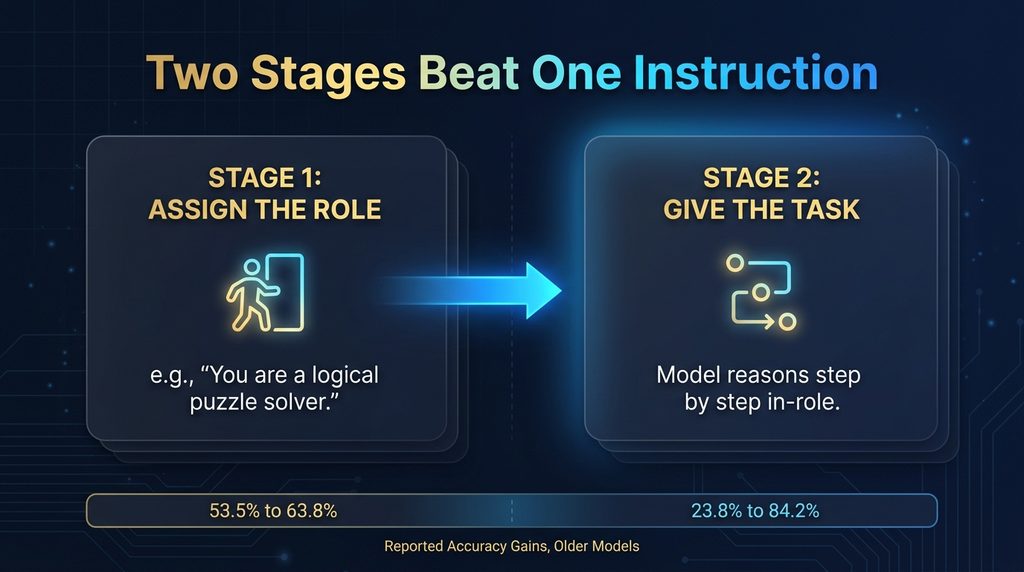
Beyond tone, a smaller set of studies found role prompting can improve accuracy on certain reasoning tasks, though the effect is narrower than it’s often presented. A 2023 paper titled “Better Zero-Shot Reasoning with Role-Play Prompting” tested a two-stage technique on GPT-3.5 across twelve reasoning benchmarks.
In the first stage, the model is prompted to adopt a role. In the second stage, it is given the actual task while still in that role, functioning as a trigger for step-by-step reasoning rather than a jump to conclusions.
The reported gains were substantial on specific tasks: accuracy on the AQuA math dataset rose from 53.5% to 63.8%, and accuracy on the Last Letter Concatenation task jumped from 23.8% to 84.2%. The authors found role-play prompting consistently outperformed a plain zero-shot approach across most of the twelve benchmarks tested, functioning as a more effective trigger for chain-of-thought reasoning than the standard “think step by step” instruction.
A separate 2023 paper on “ExpertPrompting” found that not all personas are equal. Personas the researchers generated to be specific and richly detailed substantially outperformed vanilla, one-line role assignments, and personas the model itself generated tended to outperform ones a human quickly typed out.
The pattern across both studies points the same direction: role prompting’s reasoning benefit, where it exists, comes from detail and structure, not from the mere presence of a role label.
Where Role Prompting Breaks Down
Set against those results is a larger, more recent, and more rigorously controlled body of research showing the opposite: on factual and objective tasks, role prompting frequently does nothing, and sometimes hurts. The most direct rebuttal is a paper bluntly titled “When ‘A Helpful Assistant’ Is Not Really Helpful: Personas in System Prompts Do Not Improve Performances of Large Language Models.” The researchers tested 162 distinct personas across nine open-source language models on 2,410 factual questions drawn from the MMLU benchmark. Their finding: most personas had no effect on performance, or a negative one, and no single persona consistently improved accuracy across the models tested.
Even the most intuitive version of role prompting, giving a domain-matched persona for a domain-matched question (a lawyer persona for a legal question, for instance), produced only a small effect size. When the researchers tried to automatically select the best persona for each question, that approach performed no better than picking a persona at random. Gender-neutral roles slightly outperformed gendered ones, though the gap was minor.
A follow-up study, “Persona is a Double-Edged Sword,” found a mixed middle ground: certain structured persona frameworks produced a meaningful average improvement (just under 10%) on a GPT-4 backbone, but a plain, persona-free prompt sometimes outperformed the persona version on the same questions, and the overall gap between persona and non-persona prompting narrowed sharply on GPT-4 compared to older, weaker models. That narrowing gap is worth pairing with a broader point about AI accuracy: even a well-reasoned answer can still be a confident, fluent hallucination, and no role label changes that risk.
That pattern on more capable models lines up with what we saw in our own test. We gave Claude Sonnet 5 a classic age-comparison word problem (Sarah is twice as old as Tom was when Sarah was as old as Tom is now; Sarah is 24, how old is Tom) with no role assigned at all.
It solved it correctly on the first attempt, showing full algebraic work and a self-check. There was no accuracy gap to close with a role, because the baseline model was already reasoning correctly without one. On a strong, current model, a role label had nothing to add on a task like this.
An older, separate experiment covered by PromptHub tested 12 different personas against 2,000 questions from the MMLU benchmark using GPT-4-turbo and found the personas performed with minimal variation from one another. One counterintuitive result stood out: a persona described as an “idiot” performed no worse, and in their results slightly better, than a persona described as a “genius.” If persona-driven accuracy gains were reliable and intuitive, that result should not be possible.
There’s a quieter economic cost to this that rarely gets mentioned: a detailed, multi-sentence persona adds real tokens to every single call, and at API scale, across thousands or millions of requests, that overhead adds up in latency and cost. Paying that cost for a technique that isn’t reliably improving accuracy on your specific task is a bad trade twice over, once in output quality and once in your bill.
The Risk Almost Nobody Mentions: Bias and Safety
Most articles about role prompting stop at “it might not boost accuracy.” A 2024 paper called “Role-Play Paradox in Large Language Models: Reasoning Performance Gains and Ethical Dilemmas” goes further, and its findings are the single most important reason to treat role prompting carefully in anything customer-facing or production-grade. The researchers tested 18 different roles, ranging from “Professor” to abstract, non-human concepts like “Object” and “Date,” against three established bias and toxicity benchmarks: CrowS-Pairs (1,508 sentence pairs measuring stereotypes across nine social dimensions), StereoSet (17,000 stereotype and anti-stereotype instances), and HarmfulQ (200 explicitly toxic prompts designed to test whether a model will refuse harmful requests).
Their headline finding: assigning a role consistently increased toxicity relative to baseline, regardless of which role was assigned, including roles with no social or demographic dimension at all. Simply asking a model to “be” something, even something as neutral as an object, measurably weakened its usual safety behavior.
When the researchers used an automated method to find the single most performance-optimized version of a role for each benchmark, the safety cost got worse, not better. CrowS-Pairs accuracy (a measure of resisting stereotyped completions) dropped from a 75% baseline to 58%.
StereoSet accuracy fell from 57% to 28%. On HarmfulQ, the rate at which models correctly refused a toxic request fell from 92.5% to 74.5% on GPT-3.5, and from 97% to 95% on GPT-4o.
Demographic roles carried their own distortion. On StereoSet with GPT-3.5, non-binary roles scored around 34% accuracy against stereotype resistance, while male and female roles scored around 23%, both compared to an unassigned baseline of roughly 27%.
The researchers concluded that role-play does not simply reveal biases already present in a model’s training data; it actively degrades the model’s alignment, pushing it further from its default safety behavior than the training data alone would predict.
If you are building anything a real customer, patient, or applicant will interact with, this is the finding to sit with before reaching for a persona to make a chatbot sound friendlier. A role that measurably raises toxicity and lowers refusal rates on harmful requests is not a cosmetic choice.
It is a safety decision, whether you’re treating it as one or not, and it belongs in the same review process you’d use to detect and reduce bias anywhere else in an AI-assisted workflow.
The AI Hustle World Role-Fit Framework
Given how split the evidence is, the useful question isn’t “does role prompting work?” It’s “does role prompting work for this specific task?” We built a simple two-axis framework to answer that before you write the prompt, rather than after you’re disappointed by the output.
The first axis is task objectivity: is there a single correct answer you could check against a fact or a calculation, or is the task inherently subjective, like tone, style, or persuasion? The second axis is stakes: is this a low-stakes draft you’ll review yourself, or a high-stakes output going straight to a real user, customer, or decision?
| Quadrant | What This Looks Like | Role Prompting Recommendation |
|---|---|---|
| Objective + Low Stakes | Personal research, quick fact lookups, solo brainstorming on a factual topic | Optional. A role can add flavor but verify the facts yourself either way. |
| Objective + High Stakes | Financial calculations, legal summaries, medical information, production code correctness | Skip it as an accuracy strategy. Use structured prompts, step-by-step verification, and a human or automated check instead. |
| Subjective + Low Stakes | Drafting social captions, brainstorming headlines, exploring a creative angle | Use it freely. This is where role prompting delivers its most reliable, repeatable value. |
| Subjective + High Stakes | Customer-facing chatbot tone, brand voice in published content, public-facing explainer copy | Use it, but pair it with an explicit bias and tone review given the safety research above. |
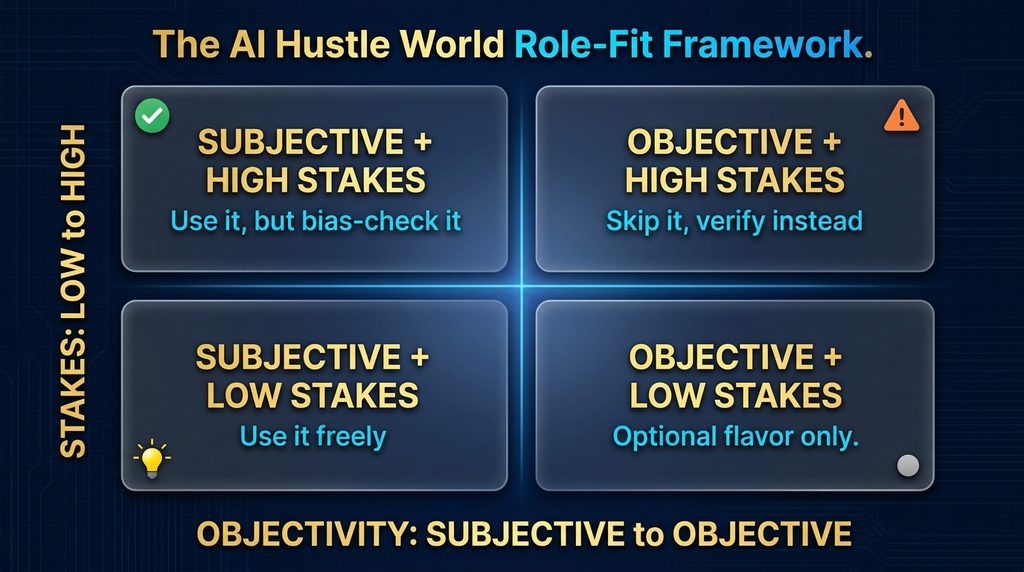
The framework’s main job is stopping the most common misuse of role prompting: reaching for a persona to try to fix an accuracy problem. If your output is wrong, a role change almost never fixes it, because the role shifts style, not the model’s underlying reasoning process. If your output is flat, generic, or tonally wrong for your audience, a role is often the fastest fix available.
How to Write a Role Prompt That Actually Works
The research on what makes a role prompt effective is more specific than most guides suggest. Three properties show up repeatedly across the studies that found real benefits.
First, specificity beats vagueness. “You are an expert” adds almost nothing measurable. “You are a senior tax accountant who specializes in small-business deductions and always flags when a client should talk to a lawyer instead” gives the model actual constraints and a defined lane to reason within.
Second, detail beats brevity, but only useful detail. The ExpertPrompting research found that richly described personas outperformed one-line ones, and that model-generated personas (where you ask the AI itself to write a detailed persona for the task, then use that persona) tended to outperform quickly hand-typed ones.
If you’re not sure how to flesh out a role, asking the model to write its own detailed persona first is a legitimate technique, not a shortcut.
Third, for reasoning tasks specifically, structure the prompt in two stages rather than one. Establish the role first, in its own message or its own sentence, then present the task as a separate, clear instruction. The role-play reasoning research found this two-stage pattern outperformed cramming the role and the task into a single run-on instruction.
A few additional guardrails come directly out of the research above. Favor non-intimate, non-relational roles over deeply personal ones (“a copywriting mentor” rather than “my best friend”) since interpersonal roles introduce more unpredictable tonal drift. Favor gender-neutral role descriptions where gender isn’t relevant to the task, since the bias research found gendered roles performed slightly worse.
And avoid dramatic, imaginative framing like “imagine you are” in favor of direct assignment like “you are,” since direct role assignment has tested more reliably than fictional framing.
Anthropic’s own guidance for Claude keeps this simple: setting a role in the system prompt focuses the model’s behavior and tone for your use case, and even a single clear sentence makes a measurable difference. Their documented example is plain and direct: “You are a helpful coding assistant specializing in Python,” paired with a specific, concrete task.
That’s consistent with everything above: specific beats vague, and a role earns its place by shaping tone and focus, not by manufacturing expertise that wasn’t already reachable.
Weak, Better, and Strong Role Prompts, Side by Side
The gap between a role prompt that does nothing and one that changes the output is usually a matter of three or four extra sentences, not a completely different idea. Seeing the progression side by side makes the earlier advice concrete instead of abstract.
| Version | Example | Why It Falls Short or Works |
|---|---|---|
| Weak | “You are an expert. Explain email marketing.” | No domain detail, no audience, no constraint. The model has nothing concrete to shift toward. |
| Better | “You are an email marketing specialist. Explain email marketing to a small business owner.” | Adds a domain and an audience, which measurably narrows vocabulary and framing, but still leaves tone and depth undefined. |
| Strong | “You are an email marketing specialist who has run campaigns for small local businesses with under $500/month ad budgets. Explain email marketing to a small business owner who has never sent a newsletter, using one concrete example from a low-budget business, and flag the one mistake beginners make most often.” | Specific domain, specific audience, a real constraint (budget), and an explicit task shape. This is the level of detail the ExpertPrompting research found actually moves output quality. |
Notice what doesn’t change across the three versions: none of them make email marketing facts more or less correct. What changes is depth, audience-fit, and concreteness, which is exactly the tone and framing lever this article keeps coming back to.
Role Prompting vs. Few-Shot Examples and Chain-of-Thought
Role prompting is one tool in a small family of prompt engineering techniques, and it’s worth knowing where it sits relative to the other two you’ll run into most: few-shot examples and chain-of-thought instructions.
Few-shot prompting shows the model two or three worked examples of the exact input-output pattern you want before giving it the real task. It constrains output format and reasoning style through demonstration rather than description, and for structured or repetitive tasks, like extracting data into a consistent format, it tends to outperform a role label by a wide margin, because it removes ambiguity a role can only gesture at.
Chain-of-thought prompting asks the model to reason step by step before answering, typically with a direct instruction like “think through this step by step before giving your final answer,” which is really just one version of learning to ask AI better questions in the first place. This is a more direct and more thoroughly validated way to improve reasoning accuracy than a role label, which is exactly why the role-play reasoning research found its technique worked by triggering chain-of-thought-style reasoning, not by adding expertise.
In practice, these techniques stack rather than compete. A detailed role sets the tone and framing, a chain-of-thought instruction handles the reasoning quality, and a few-shot example locks in the output format, and using all three together on a task that needs all three tends to outperform any single one used alone.
Why This Advice Spread So Widely, Long After the Evidence Got Complicated
It’s worth asking why “give the AI a role” became one of the most repeated pieces of prompting advice on the internet, given how mixed the actual evidence turned out to be. Part of the answer is that it worked, visibly, in the earliest wave of GPT-3 era testing, when the models being tested were considerably weaker at following plain instructions than what’s available today.
Early users noticed real, dramatic differences when they added a role, wrote it up, and that advice spread fast because it was simple, felt intuitive (of course an “expert” gives a better answer), and was genuinely true often enough to stick. What didn’t travel with the advice was the fact that it was tested on specific, now-outdated models, on a narrow set of tasks, and that its benefit was concentrated almost entirely in reasoning tasks on weaker models and tone control on every model.
The advice kept circulating largely unchanged while the models underneath it kept improving, which is exactly how a genuinely useful 2023 technique for GPT-3.5 became a partially outdated accuracy claim by 2026, even though the tone and framing part of it never stopped being true. This is a common pattern in fast-moving AI advice: the tip survives, the caveat that made it accurate at the time quietly gets dropped.
Practical Implementation Across Common Use Cases
Content Writing and Brand Voice
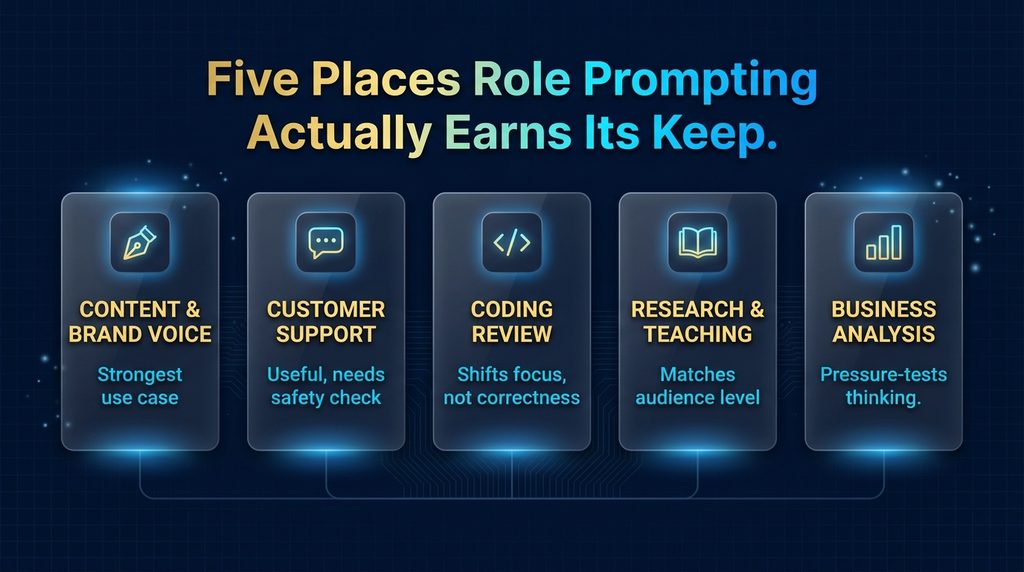
This is role prompting’s strongest use case. A detailed brand-voice persona (“you write like a direct, slightly irreverent product marketer who never uses corporate jargon and always leads with a concrete number”) gives every draft a consistent register without you having to rewrite the same tone instructions each time.
Because tone is exactly the surface-level pattern role labels shift well, the gains here are real and repeatable, not the mixed bag seen in the accuracy research. The time savings compound quickly once a persona is saved and reused across dozens of drafts instead of rewritten from scratch each time, which is the real economic case for investing five minutes in a detailed persona rather than typing “make it sound professional” over and over.
Customer Support and Chatbots
Roles here shape warmth, formality, and escalation behavior, and that’s genuinely useful for matching a brand’s voice. But this is also the exact context the Role-Play Paradox research warns about: a support persona meant to sound “friendly” or “empathetic” can measurably lower a model’s refusal rate on inappropriate requests compared to no persona at all.
Any customer-facing persona deployed in production should be paired with its own safety and refusal testing, not assumed safe because the underlying model is. A practical middle ground many teams land on is keeping the persona narrow and functional, “you are a support assistant for a software company, friendly but concise, and you always escalate billing disputes to a human,” rather than an elaborate character, since the research suggests narrower, more constrained roles introduce less unpredictable drift than richly imagined ones.
Coding and Technical Review
A “senior code reviewer” persona can usefully shift what a model chooses to flag, nudging it toward security and maintainability comments it might otherwise skip. It will not reliably make buggy code correct, and treating a reviewer persona as a substitute for tests, linters, or a second human review is exactly the objective-task misuse the framework above warns against.
A useful version looks like “you are a senior backend engineer reviewing this for a production deploy; flag security issues, race conditions, and anything that would fail silently under load,” which points the model’s attention at specific failure categories instead of hoping a vague “review this” surfaces them on its own.
Research, Teaching, and Explanation
This is where role prompting shines for a different reason: audience-matching. A “patient teacher explaining to a beginner” persona and a “technical peer reviewer” persona will produce two genuinely different, both-correct explanations of the same concept, and picking the right one for your actual reader is a real, measurable improvement in usefulness, exactly like the pizza-and-algebra example earlier in this article.
For a research assistant use case, a role like “you are a research analyst who always states your confidence level and flags when a claim needs a source” pairs the tone benefit with a genuine accuracy habit, since the confidence-flagging instruction (not the role label itself) is what actually improves how trustworthy the output is.
Business Analysis and Decision Support
An underused version of role prompting is assigning an adversarial or skeptical role to pressure-test your own thinking: “you are a skeptical CFO who thinks this plan is too optimistic, find every weak assumption.” This isn’t asking for more accurate facts.
It’s asking the model to sample a different region of its reasoning space, surfacing objections a single straightforward answer would likely skip. Used this way, the role is a lens for exploring an idea, not a claim of retrieved expertise.
Running the same plan past two or three opposing roles in sequence, a skeptical CFO, then an optimistic growth lead, then a risk-averse operations manager, tends to surface a wider spread of objections than asking one neutral “what do you think of this plan” question ever will, simply because each role anchors the model toward a different, internally consistent set of priorities.
Role Prompts in Long Conversations: Why They Fade
A role assigned at the start of a long conversation doesn’t hold its grip forever. As a conversation grows and more back-and-forth accumulates, the original role instruction becomes a smaller and smaller fraction of the total context the model is weighing, and its influence on tone and framing measurably fades, even though the instruction is technically still there.
This shows up as a persona that felt strong for the first few replies gradually drifting back toward a generic, default voice by message twenty. It isn’t a bug so much as a direct consequence of how these models weigh context: everything in the conversation competes for influence, and a role stated once early on has to compete against everything said since.
The practical fix is restating the role periodically in long sessions, or keeping it in a system prompt that persists across the conversation rather than a one-time message, so it never has to compete on equal footing with the rest of the accumulating context. For any task where consistent voice matters across a long project, this is worth building into your workflow from the start rather than noticing the drift after the fact.
The single biggest mistake is using role prompting as an accuracy fix for a factual or reasoning task. If a model got a calculation or a fact wrong, the fix is a better-structured prompt, a request to show its work, or a verification step, not a costume change.
The second is writing roles too vaguely to do anything. “You are an expert” or “act as a professional” carries almost no information the model can actually use to shift its output, which is why the research consistently finds detailed personas outperforming one-line ones.
The third is stacking multiple, conflicting roles in one prompt, like asking for “a formal legal expert who is also casual and funny.” Conflicting instructions don’t average out gracefully; they tend to produce an inconsistent response that partially satisfies neither.
The fourth is never testing a role against a no-role baseline before trusting it, which means you have no idea whether the persona you’re relying on is actually helping or just making you feel better about the output. The measurement framework below fixes that in about five minutes.
The fifth, and the one with the highest real-world cost, is deploying a persona into a customer-facing or production system without a bias and safety pass, given the clear evidence that role assignment can quietly lower a model’s refusal rate and raise its toxicity relative to no persona at all.
The sixth is assuming a persona that worked well on one model, or one version of a model, carries over unchanged to another. Effectiveness depends on how that specific model was trained and instruction-tuned, which is exactly why a role that felt powerful on an older model can quietly stop doing anything useful after an upgrade, without any obvious signal that it happened.
How to Actually Test Whether a Role Is Helping: The 3-Sample Role Test
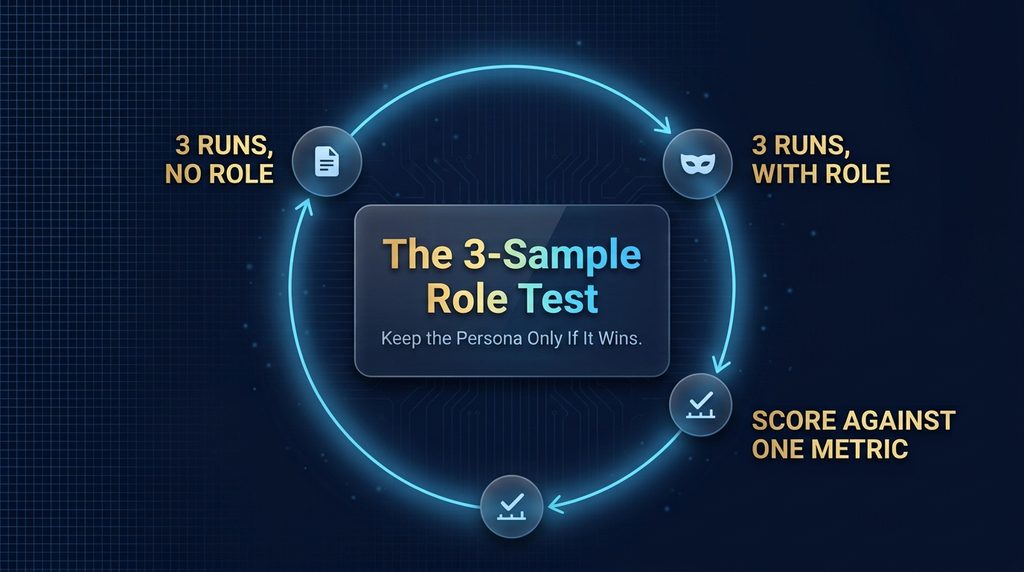
Most people adopt a persona because it felt like it helped once and never check again. A short, repeatable test fixes that, and it’s the same basic method the research above used, scaled down to something you can run in a few minutes. Call it the 3-Sample Role Test: three runs without the role, three runs with it, one clear metric decides the winner.
Run your actual task three times with no role at all, and three times with the candidate role, keeping everything else about the prompt identical. For a task with a checkable answer, like a calculation, a data extraction, or a factual lookup, score each run against the correct answer and compare the two hit rates directly.
For a subjective task, like tone or explanation quality, have the intended audience (or a consistent rubric you apply yourself) rate each output on clarity, audience fit, and whether it achieves the actual goal, on a simple 1-to-5 scale.
A worked example: testing a “friendly onboarding guide” persona against a plain baseline for a welcome-email draft, scored by three team members on a 1-to-5 clarity-and-warmth scale. If the baseline averages 3.2 and the persona version averages 4.4 across three independent drafts each, that’s a real, measurable win worth keeping.
If both land around 3.5 with overlapping results, the persona isn’t earning the extra prompt length and can be dropped without losing anything.
Keep the persona only if it wins on the metric that actually matters for that task. This sounds almost too basic to write down, but it is the single step almost every popular guide to role prompting skips, and it’s the difference between a persona backed by evidence and one backed by a hunch.
Second-Order Effects and Where This Is Heading
The clearest pattern across the research, and in our own small test, is that role prompting’s accuracy benefit shrinks as the underlying model gets more capable. The papers that found the largest reasoning gains tested older, weaker models like GPT-3.5.
The papers using newer, stronger models found the gap between persona and no-persona narrowing, and our own baseline test on a current flagship model needed no role at all to solve a multi-step reasoning problem correctly. That has a practical implication worth sitting with: if you learned role prompting as an accuracy trick a few years ago, that trick has likely already lost most of its power on the model you’re using today, while the tone and framing benefit hasn’t gone anywhere.
At the same time, “role” is not disappearing from AI systems, it’s changing shape. In multi-agent and agentic workflows, assigning an agent a role, researcher, critic, executor, verifier, is becoming a structural design choice that determines what tools an agent can call and what part of a pipeline it owns, not a stylistic flourish layered on top of a chat message.
The word is the same. The function is closer to a job description in a system architecture than to a costume.
Seen this way, role assignment is really one lever inside the broader discipline of context engineering, giving a model the right information, structure, and constraints at the right time, rather than a standalone trick. A role tells a system who it’s acting as; context engineering covers everything else it needs to act well.
That shift is worth watching closely if you build with AI regularly, because it means the skill of writing a good role description isn’t becoming obsolete, it’s moving up a level, from flavoring a single chat reply to defining what an autonomous system is actually allowed and expected to do.
It’s also worth asking what happens if you simply ignore all of this and never write a role prompt again. For factual and reasoning tasks, the honest answer is: very little, since the research suggests you weren’t gaining much accuracy from it anyway on a capable model.
For tone-sensitive and audience-facing writing, you’d be giving up one of the cheapest, fastest levers available for matching an output to the person actually meant to read it.
Who Should Use Role Prompting, and Who Should Skip It
Content creators, educators, marketers, and anyone drafting for a specific audience should use role prompting often. It’s one of the fastest ways to match tone, reading level, and framing to a reader, and the evidence for that specific benefit is consistent across every source examined here.
Teams building customer-facing AI products should use it carefully, with a bias and refusal-rate test run specifically on the persona they plan to ship, not just on the base model. The research is direct about the fact that a friendly-sounding persona can quietly weaken a model’s safety behavior.
Anyone relying on AI for accuracy-critical, compliance-sensitive, or high-stakes factual work, legal, medical, financial, or safety-related, should treat role prompting as, at best, a tone adjustment and never as a substitute for verification, structured prompting, or a qualified human review.
Final Thoughts
Role prompting isn’t a myth, and it isn’t the universal upgrade the average listicle makes it out to be either. It’s a real, specific tool: reliable for tone, framing, and audience fit, unreliable for accuracy on anything with a checkable answer, and genuinely risky when deployed into a customer-facing system without a safety check first.
The mistake worth dropping isn’t role prompting itself. It’s using a single technique for every kind of problem without ever asking which kind of problem you’re actually solving, or checking whether the persona you reached for is helping the thing you’re measuring, rather than just making the output feel more authoritative.
Your Prompt Might Be the Real Bottleneck
Role prompting is one piece of a much bigger system. If your AI answers still feel vague or unreliable, the fix usually starts with how the whole prompt is built, not just who it’s pretending to be.
See the Full Prompting Framework →Frequently Asked Questions
What is role prompting in AI?
Role prompting is the practice of instructing an AI model to adopt a specific character, profession, or perspective, such as “you are a nutritionist,” before giving it a task. It shifts the model’s tone, vocabulary, and framing by pulling its response toward patterns associated with that role in its training data.
Does role prompting actually improve accuracy?
Sometimes, but not reliably. Some studies on older models found meaningful accuracy gains on specific reasoning tasks, while larger, more recent studies found most personas have no effect, or a negative one, on factual accuracy, especially on newer, more capable models.
What’s the difference between role prompting and persona prompting?
In practice, the terms are used interchangeably. Some writers use “persona prompting” specifically for detailed, multi-sentence character descriptions and “role prompting” for shorter occupational labels, but there’s no strict technical boundary between them.
Does giving ChatGPT a role work the same way as giving Claude a role?
The underlying mechanism, shifting output style through the role label, is the same across major chat models. Effectiveness varies by model and version, since it depends on training data and alignment behavior, which is exactly why testing a role against a no-role baseline on your specific model matters more than following generic advice.
Can role prompting introduce bias or safety issues?
Yes. Research testing 18 different roles against bias and toxicity benchmarks found that assigning almost any role, including neutral, non-human ones, increased toxicity and lowered refusal rates on harmful requests compared to no role at all. This risk is highest in customer-facing or production systems.
What’s the best way to write a role prompt?
Be specific rather than generic, include real detail about the role’s domain and constraints, use direct assignment (“you are”) rather than imaginative framing (“imagine you are”), and for reasoning tasks, state the role in its own sentence before presenting the task separately.
Should I use role prompting for coding tasks?
A reviewer or specialist persona can usefully shift what a model chooses to flag or explain, but it won’t reliably make incorrect code correct. Treat it as a framing tool alongside tests and human review, not a substitute for either.
Does role prompting still matter with newer, more capable AI models?
For accuracy, its effect appears to shrink as models get more capable, based on both the research comparing older and newer models and our own test showing no accuracy gap for a flagship model to close. For tone, audience fit, and style, the benefit hasn’t diminished at all.
How do I test whether a persona is actually helping?
Run the same task several times with and without the role, keeping everything else identical, then compare results against a real metric: correctness for factual tasks, or a simple clarity and audience-fit rating for subjective ones. Keep the persona only if it wins on that specific metric.
What’s an example of a bad role prompt?
“You are an expert, be very accurate” is a common but weak example. It gives the model no real domain detail to shift toward, and it asks a stylistic instruction to do the job of a verification step, which is exactly the kind of task role prompting is least equipped to handle.
Written by
Muntasir Ahmad Chowdhury
Founder, AI Hustle World
Muntasir Ahmad Chowdhury is the Founder of AI Hustle World, an independent publication dedicated to making Artificial Intelligence practical, trustworthy, and easy to understand. He researches AI tools, automation, customer service, productivity, and real-world business applications, helping readers make smarter technology decisions through research-driven, experience-backed content.
Expertise:
AI Tools • AI Automation • AI Customer Service • AI Productivity • Generative AI • AI Workflows
Get Smarter With AI
Enjoyed this guide? Get practical AI tools, tutorials, and honest reviews delivered to your inbox.
6 thoughts on “How Role Prompting Changes AI Responses: Benefits, Limits and Best Practices”