Evidence: Documentation reviewed
Last checked: August 2026
What was done: Written from official documentation and the published sources linked in this article. Not hands-on tested.
Files: None
Affiliate links: No
Best AI Lead Generation Tools in 2026: 8 Platforms Compared by Use Case
Generating more B2B leads is rarely the real problem. Most sales teams already have more names than their representatives can research, qualify, personalize, and contact properly; the harder problem is turning that large pool of potential prospects into a smaller set of accounts and people who are actually worth sales attention.
That distinction matters because today’s AI lead generation tools are no longer simply databases with a search box. Some help you discover contacts, others enrich incomplete records, identify buying intent, research accounts, automate prospecting, execute outbound campaigns, or connect prospect intelligence directly to a CRM. Treating all of them as interchangeable “lead generation tools” makes comparison easier, but it makes the buying decision worse.
The right question, therefore, is not “Which AI lead generation platform is the best?” It is “Which platform solves the part of my lead-generation system that is currently limiting growth?” A small outbound team may need an all-in-one prospecting platform, while an enterprise ABM team may get considerably more value from intent intelligence. A RevOps team may prefer a flexible enrichment and research layer, while a company already operating entirely inside a CRM may benefit more from native AI prospecting.
This guide compares eight leading platforms through that lens. Rather than pretending there is one universal winner, it examines what each platform is designed to do, where it creates the most leverage, where its trade-offs become visible, and which type of sales organization should—or should not—make it the center of its lead-generation stack.
Quick Answer: Which AI Lead Generation Tool Is Best?
Apollo is the strongest starting point for most small and mid-sized B2B teams that want prospect discovery and sales engagement in one platform. However, it is not automatically the best choice for every organization. Clay is more compelling when custom enrichment and AI research matter most; ZoomInfo is better suited to enterprise sales intelligence; 6sense is designed around predictive intent and account prioritization; HubSpot makes the most sense for teams already operating inside its CRM; Cognism is particularly relevant for global and compliance-sensitive prospecting; Instantly is strongest when outbound email execution is the bottleneck; and LeadIQ fits teams that capture prospects directly from browser-based research.
The practical shortlist looks like this:
| Platform | Best suited for | Primary strength | Main trade-off |
|---|---|---|---|
| Apollo | SMB and mid-market outbound teams | All-in-one prospecting and engagement | Data quality can vary by record and market |
| Clay | RevOps and sophisticated GTM teams | Enrichment, research, and workflow flexibility | Higher complexity and usage-based economics |
| ZoomInfo | Enterprise sales organizations | Sales intelligence and account data | Enterprise-oriented cost and complexity |
| 6sense | ABM and enterprise demand teams | Predictive intent and in-market account identification | More valuable when the organization has mature GTM processes |
| HubSpot Prospecting Agent | HubSpot-centered sales teams | CRM-native AI prospecting | Strongest when HubSpot is already the operating system |
| Cognism | Global and compliance-focused teams | B2B data, phone coverage, and compliance | Less attractive if you only need inexpensive self-serve prospecting |
| Instantly | High-volume outbound teams | Cold-email infrastructure and execution | Not a complete replacement for a sales intelligence platform |
| LeadIQ | Rep-led browser prospecting | Prospect capture and enrichment | Better as part of a workflow than as a complete GTM stack |
The key takeaway is that “best” depends on the job. A platform should earn its place in your stack by improving a measurable stage of the prospecting process rather than by accumulating the largest number of AI features.
What AI Lead Generation Tools Actually Do
AI lead generation is best understood as a system rather than a single feature. At the simplest level, the system begins by identifying companies or people who could potentially become customers. It then adds information that helps determine whether those prospects are relevant, looks for evidence that they may have a current problem or buying need, and gives salespeople enough context to decide what to do next.
Traditional prospecting often required a representative to perform much of this work manually. A salesperson might define an ICP, search LinkedIn, open company websites, look up employee information, verify contact details, research recent company developments, write notes, and finally decide whether an account deserved an outreach attempt. AI can compress portions of that process by combining structured databases with search, enrichment, language models, signals, scoring, and workflow automation.
That does not mean every platform performs the same job. A contact database answers “Who exists?” An enrichment system answers “What else do we know about this company or person?” An intent platform asks “Who appears to be entering a buying cycle?” An AI prospecting agent may ask “Which accounts fit the target profile, what is happening around them, and what should we do next?” These are related questions, but they are not identical problems.
This is why a feature checklist can be misleading. Two platforms may both advertise AI-powered prospecting while one primarily helps a representative find contacts and another analyzes account behavior, researches companies, identifies buying signals, and recommends action. The label is the same; the underlying job is different.
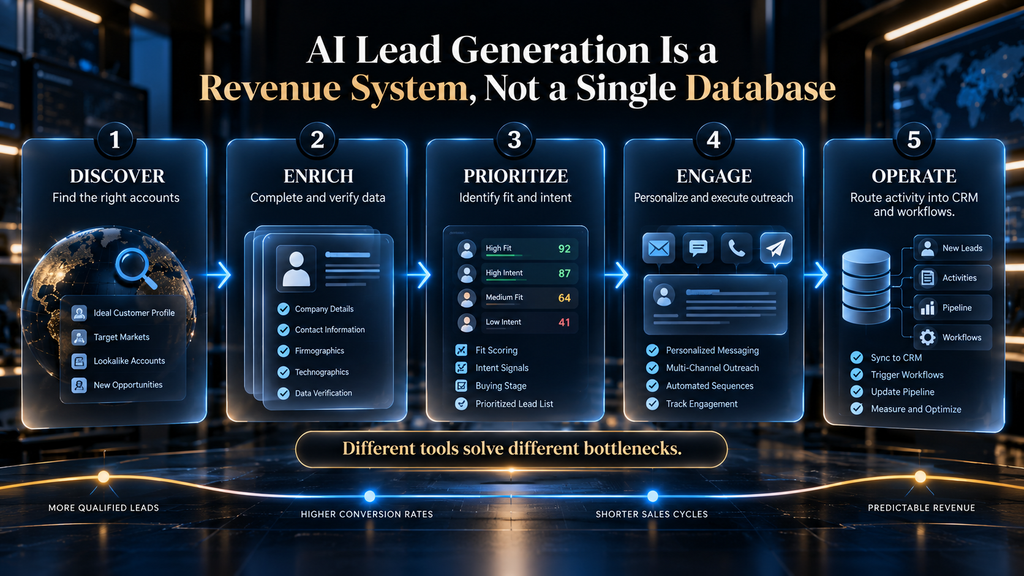
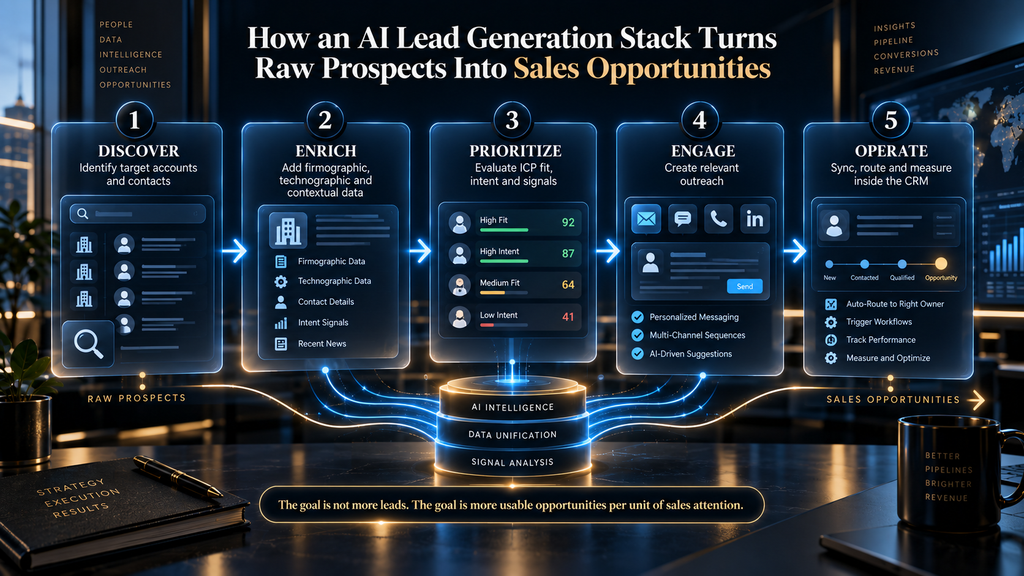
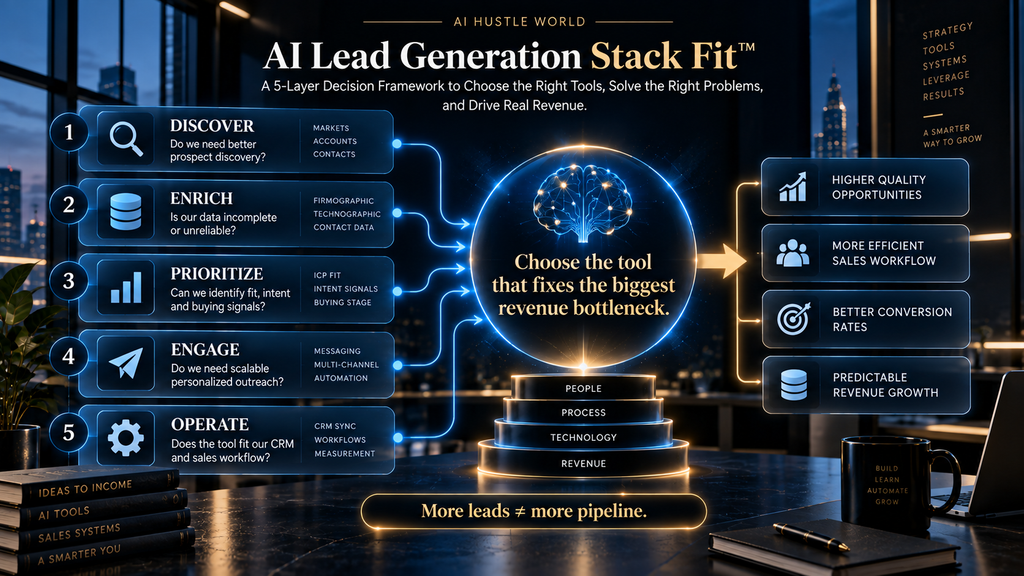
A useful way to compare the market is therefore to separate the lead-generation stack into five stages: Discover → Enrich → Prioritize → Engage → Operate.
Discovery finds potential accounts and contacts. Enrichment improves the information available about them. Prioritization determines which prospects deserve attention based on fit, need, intent, timing, or other evidence. Engagement turns that priority into outreach. Operations connects everything to the CRM, routing, reporting, and broader revenue process.
Some platforms span almost the entire stack. Others deliberately specialize in one or two layers. Neither model is automatically better.
The AI Lead Generation Stack Fit
To make the comparison more useful, AI Hustle World uses a simple decision framework: AI Lead Generation Stack Fit.
The framework evaluates a platform according to the role it plays in the revenue system rather than simply counting features. A strong platform should solve a meaningful bottleneck without creating unnecessary complexity elsewhere.
Discover
The first layer is prospect discovery: finding companies, contacts, or accounts that match a defined market.
This is where conventional B2B databases and prospecting platforms remain valuable. If a sales team cannot reliably identify its addressable market, sophisticated intent modeling or personalization will not solve the underlying problem. The quality of the downstream system is constrained by the quality and relevance of the prospects entering it.
But discovery should not be confused with qualification. Finding a CFO at a company that matches your employee range does not establish that the company has a problem your product solves, that the CFO is involved in the purchase, or that the company intends to buy soon.
Enrich
The second layer adds context.
A basic prospect record might contain a name, job title, company, and email address. A useful enriched record could include company size, technology usage, industry, location, funding information, hiring activity, organizational changes, or other attributes relevant to the sales motion.
Enrichment becomes particularly valuable when the information required for targeting does not exist in one reliable source. This is one reason platforms such as Clay are fundamentally different from a conventional lead database: the value comes from orchestrating multiple data sources and transforming their outputs into a usable research workflow.
Prioritize
The third layer is where lead generation begins to become genuinely intelligent.
A sales team does not benefit equally from every lead that matches an ICP. One account might have excellent firmographic fit but no evidence of an active problem. Another may have slightly weaker fit but a clear trigger indicating that the company is evaluating solutions now.
Prioritization therefore requires more than a static score. It requires evidence about fit, need, intent, timing, and confidence. This layer connects naturally to the broader AI lead-qualification process, but the purpose here is to determine how different platforms contribute evidence to that decision.
Engage
Once prospects have been prioritized, the system has to turn information into action.
Some platforms provide sequencing, email, calling, personalization, or AI-generated messaging. Others are deliberately focused on the intelligence side and expect another system to handle outreach.
This distinction matters because a company may already have excellent sales intelligence but weak outbound execution. In that situation, buying another intelligence platform may not solve the real problem.
Operate
The final layer is the operating system around prospecting.
CRM synchronization, routing, workflows, reporting, attribution, enrichment updates, and handoffs determine whether the intelligence generated by a platform actually becomes part of the sales process. A tool that produces excellent prospect recommendations but leaves representatives manually transferring information between systems can create a different bottleneck.
The best technology choice is therefore not necessarily the platform with the broadest feature list. It is the platform—or combination of platforms—that closes the largest gap in your current system without introducing disproportionate cost or operational complexity.
The 8 Best AI Lead Generation Tools in 2026
1. Apollo — Best All-in-One AI Lead Generation Platform
Apollo is the most straightforward recommendation for teams that want to bring prospect discovery and sales engagement into one environment. Its appeal comes less from having one spectacular capability and more from combining several important functions: prospect and account search, contact data, enrichment, sales engagement, sequencing, and AI-assisted prospecting.
That combination is especially useful for smaller sales organizations. A five-person sales team usually does not want to assemble a separate database, enrichment provider, sequencing platform, research layer, and workflow engine before it can begin prospecting. Apollo can reduce that initial architectural burden by putting much of the process in one place.
Its AI capabilities also move the platform beyond simple database search. Apollo’s AI functionality can assist with identifying relevant prospects, scoring and qualifying them, researching prospects, and building lists based on natural-language requirements. The important point is not that Apollo has “AI”; it is that the AI can reduce some of the manual work between defining a target market and creating an actionable prospect list.
The trade-off is data quality and breadth across different markets. B2B contact data is never static, and a database that looks excellent for one geography, industry, or job category can perform differently in another. That means Apollo should not be evaluated by its headline database size alone. Teams should validate the fields that actually matter to their ICP—especially direct contact information, geography, seniority, industry, and the specific segments they intend to target.
Apollo is therefore best viewed as a high-utility starting point, not an automatic answer for every mature enterprise sales organization.
- Best for: Small and mid-sized B2B sales teams that want prospecting and engagement in one platform.
- Choose it when: You want to reduce the number of systems your team has to operate and need a practical all-in-one outbound foundation.
- Think twice when: Your primary requirement is deep predictive intent, highly specialized enterprise intelligence, or complex multi-source data orchestration.
2. Clay — Best for Custom Enrichment and AI-Powered Research
Clay occupies a very different position in the market. Rather than simply asking users to search one database, it allows teams to build sophisticated data and research workflows using multiple providers, enrichment actions, AI research, signals, and downstream automation.
That distinction becomes important when the standard prospect record is not enough. Suppose a company wants to identify SaaS businesses above a certain size, determine which CRM they use, detect recent hiring activity in sales, research whether the company recently launched a new product, identify the appropriate decision-maker, and then score each account according to several custom conditions. A conventional database may provide pieces of that information, but a flexible orchestration platform can connect those pieces into a repeatable process.
Clay’s strength is therefore customizability. It is attractive to RevOps teams and sophisticated GTM operators who care less about having a single prepackaged workflow and more about controlling how data is gathered, transformed, evaluated, and routed.
The cost of that flexibility is complexity. Clay requires a greater understanding of data sources, workflow construction, enrichment logic, and usage economics than a simpler prospecting platform. Teams that only need a list of qualified contacts may end up paying for sophistication they never use.
Its economics also require a different mindset. Usage-based systems can look inexpensive when workflows are small and become substantially more consequential when enrichment, AI research, and large-scale prospecting are executed repeatedly. The correct question is not simply whether the subscription price looks reasonable; it is whether the value created by each workflow run exceeds its total data and operational cost.
- Best for: RevOps, growth, and GTM teams building sophisticated prospecting and enrichment workflows.
- Choose it when: Your competitive advantage comes from combining multiple data sources and applying custom research or qualification logic.
- Think twice when: Your team wants a simple prospecting database with minimal setup and predictable operational behavior.
3. ZoomInfo — Best for Enterprise Sales Intelligence
ZoomInfo represents the enterprise end of the B2B sales intelligence market. Its importance in this comparison comes from the depth of information and intelligence surrounding companies, contacts, organizational structures, and buying activity rather than simply the ability to produce a list of email addresses.
For large sales organizations, the prospecting problem is often more complicated than contact discovery. Enterprise sellers may need to understand subsidiaries, organizational changes, technology environments, decision-maker relationships, account activity, and other signals before deciding whether an account deserves significant sales resources.
This is where enterprise intelligence platforms can create leverage. When the average deal is large and the cost of a poorly prioritized account is substantial, spending more on intelligence can make economic sense if it improves account selection and rep productivity.
The downside is that enterprise-grade intelligence brings enterprise-grade complexity. The platform may be excessive for a small company whose sales motion consists of a narrowly defined list of prospects and a simple outbound sequence. There is little value in buying a sophisticated intelligence environment if the organization does not have the sales process, deal economics, or operational discipline to use the information.
Pricing should also be approached carefully. Enterprise sales intelligence platforms frequently use custom pricing, and third-party websites may provide estimates that are not equivalent to current vendor quotations. The right evaluation should therefore focus on the total business case rather than treating an estimated subscription number as a definitive market price.
- Best for: Enterprise B2B organizations with complex account-based sales motions.
- Choose it when: Account intelligence, organizational information, and broader sales intelligence materially affect deal economics.
- Think twice when: Your team mainly needs affordable self-serve prospect discovery and basic outreach.
4. 6sense — Best for Predictive Intent and Account Prioritization
6sense is particularly valuable because it approaches lead generation from a different direction. Instead of beginning with the question “Who can we contact?”, its model is much closer to “Which accounts appear to be entering a buying cycle?”
That distinction is significant for account-based marketing and enterprise sales. A company can contain hundreds of potential prospects, but the sales organization may have the capacity to pursue only a fraction of them seriously. Predictive intent and account-level signals can help narrow that field by identifying accounts exhibiting behavior associated with active research or buying activity.
The platform combines intent data, predictive modeling, account intelligence, and AI-assisted sales capabilities to help teams prioritize accounts. That makes it less comparable to a basic contact database and more comparable to an intelligence and prioritization layer.
The trade-off is organizational maturity. Intent data becomes much more useful when a company has a clear ICP, meaningful account segmentation, enough historical or behavioral data to interpret signals, and a sales process capable of acting on prioritized accounts. If the underlying targeting strategy is weak, sophisticated intent technology can simply make a poorly defined process more complicated.
This is also why 6sense should not be evaluated on the same terms as Apollo. Apollo can help answer “Who should I contact?” 6sense is particularly useful for answering “Which accounts should receive disproportionate attention right now?”
- Best for: Enterprise sales and ABM teams focused on identifying in-market accounts.
- Choose it when: Your biggest problem is account prioritization rather than a lack of contact records.
- Think twice when: Your team has not yet established a reliable ICP, segmentation strategy, or process for acting on intent signals.
5. HubSpot Prospecting Agent — Best for CRM-Native AI Prospecting
HubSpot’s position is different again because prospecting can happen directly inside the broader CRM environment.
Its current AI prospecting capabilities are designed to research accounts, identify potential contacts, monitor relevant signals, and support personalized outreach while remaining connected to the organization’s existing customer and sales data. For companies already using HubSpot extensively, that integration can be more valuable than adding another standalone prospecting system.
The strategic advantage is context. A standalone database may know that a company exists and provide information about its employees. A CRM-native system can potentially combine external prospect intelligence with the information already held inside the company’s own revenue system. That makes prospecting part of a larger customer lifecycle rather than a disconnected activity.
However, the benefit depends heavily on the environment. If your sales team does not use HubSpot as its central CRM and operating platform, the value proposition becomes less compelling. Buying a CRM-native capability primarily because its AI sounds impressive can create unnecessary duplication if another system already performs the job better.
This makes HubSpot a classic example of why “best tool” rankings can be misleading. A HubSpot-centered team may reasonably prefer its native prospecting capabilities over a technically stronger standalone tool because integration reduces friction. A company operating on another CRM may reach the opposite conclusion.
- Best for: Sales organizations already deeply invested in HubSpot.
- Choose it when: CRM context, workflow integration, and native automation are more important than maintaining a separate prospecting stack.
- Think twice when: HubSpot is not central to your sales operation or you need specialized intelligence that another platform provides more deeply.
6. Cognism — Best for Global and Compliance-Focused Prospecting
Cognism is particularly relevant for teams that care about international B2B data, phone coverage, and compliance. Those considerations are easy to underestimate when comparing lead-generation platforms because database size is a much simpler marketing message than geographic coverage or data governance.
In practice, however, the ability to contact the right person in the right market can matter far more than the number of records in a database. A platform that performs strongly in one geography may not provide equivalent coverage or reliability in another, especially when phone data, local regulations, and business structures differ.
Cognism emphasizes verified phone data, compliance, and international coverage, making it a natural candidate for organizations where those characteristics are central to the sales motion. Its value is therefore less about being the cheapest way to generate a list and more about reducing risk and improving the usability of contact information across markets.
The main limitation is fit. If a small team only needs a modest number of prospects in one familiar market, the additional capabilities may not justify the cost or evaluation effort. Conversely, for a global organization where compliance and reliable international contact data are business requirements, choosing solely on price could prove far more expensive later.
- Best for: Global B2B sales teams and organizations with demanding data-compliance requirements.
- Choose it when: International coverage, phone data, and compliance are meaningful constraints on your prospecting process.
- Think twice when: Your prospecting is small-scale, geographically narrow, and primarily focused on inexpensive self-serve discovery.
7. Instantly — Best for Cold-Email Execution
Instantly belongs in this comparison for a different reason: it demonstrates why lead generation and outreach execution are not the same thing.
A team can have an excellent prospect list and still perform poorly if its email infrastructure, sending process, sequencing, or campaign management is weak. Instantly is designed around that execution layer, with capabilities focused on cold-email campaigns, sending infrastructure, automation, and related outbound workflows.
That makes it especially relevant for teams that already know who they want to contact. If the bottleneck is not discovering prospects but reaching a large number of them consistently, investing in execution can produce more value than purchasing another database.
This distinction also means Instantly should not be compared directly with every other platform in the same way. A company might use one system to identify and enrich prospects, another to verify or research them, and Instantly to execute the outbound campaign. That is not necessarily redundant technology; it can be a deliberate division of labor.
The danger is using high-volume outreach to compensate for weak targeting. Increasing the number of emails sent does not repair an incorrect ICP, poor data, weak personalization, or an offer that does not match the prospect’s needs. Automation makes a good outbound process more scalable, but it can make a bad process fail faster.
- Best for: Teams whose main bottleneck is cold-email execution at scale.
- Choose it when: You already have a reliable prospect source and need solid outbound email infrastructure.
- Think twice when: You still struggle to identify the right accounts or contacts in the first place.
8. LeadIQ — Best for Browser-Based Prospect Capture
LeadIQ occupies a useful middle ground for sales representatives who discover prospects during active research rather than starting from a centralized database.
A representative might encounter a company on LinkedIn, research its leadership team, identify a relevant executive, and want to capture that information directly into the sales workflow. Browser-based prospecting tools reduce the friction between discovery and CRM entry by allowing reps to capture and enrich prospect information while they research.
That workflow can be particularly valuable for teams whose representatives perform a large amount of manual account research. Instead of copying information between browser tabs, spreadsheets, and CRM fields, the prospect can move more directly into the organization’s sales system.
LeadIQ also extends beyond basic contact capture through signals, enrichment, and AI-assisted outbound capabilities. But the core strategic value remains workflow efficiency: reduce the distance between “I found a prospect” and “this prospect is now usable by the sales organization.”
It is less compelling as a complete replacement for a major sales-intelligence platform when the organization needs deep enterprise account intelligence or sophisticated predictive intent. Its strength is narrower and, for the right sales team, that can be an advantage rather than a weakness.
- Best for: Sales reps and teams that prospect heavily through LinkedIn and browser research.
- Choose it when: Manual prospect capture and enrichment are consuming meaningful representative time.
- Think twice when: Your primary requirement is enterprise-level predictive intelligence or an all-in-one sales platform.
How the Eight Platforms Actually Differ
The easiest way to understand these tools is to stop asking which one has the longest feature list and instead ask where each platform creates the most leverage.
| Platform | Discovery | Enrichment | Prioritization / Intent | Engagement | CRM / Workflow | Best strategic role |
|---|---|---|---|---|---|---|
| Apollo | Strong | Strong | Moderate | Strong | Strong | All-in-one outbound |
| Clay | Strong through workflows | Excellent | Strong/custom | Moderate | Excellent | GTM data orchestration |
| ZoomInfo | Excellent | Excellent | Strong | Moderate | Strong | Enterprise intelligence |
| 6sense | Strong | Strong | Excellent | Strong | Strong | Predictive ABM |
| HubSpot | Strong | Strong | Strong | Excellent | Excellent | CRM-native prospecting |
| Cognism | Excellent | Strong | Moderate/Strong | Moderate | Strong | Global B2B data |
| Instantly | Moderate | Limited relative to specialists | Limited | Excellent | Strong | Outbound execution |
| LeadIQ | Strong | Strong | Moderate | Strong | Strong | Browser-led prospecting |
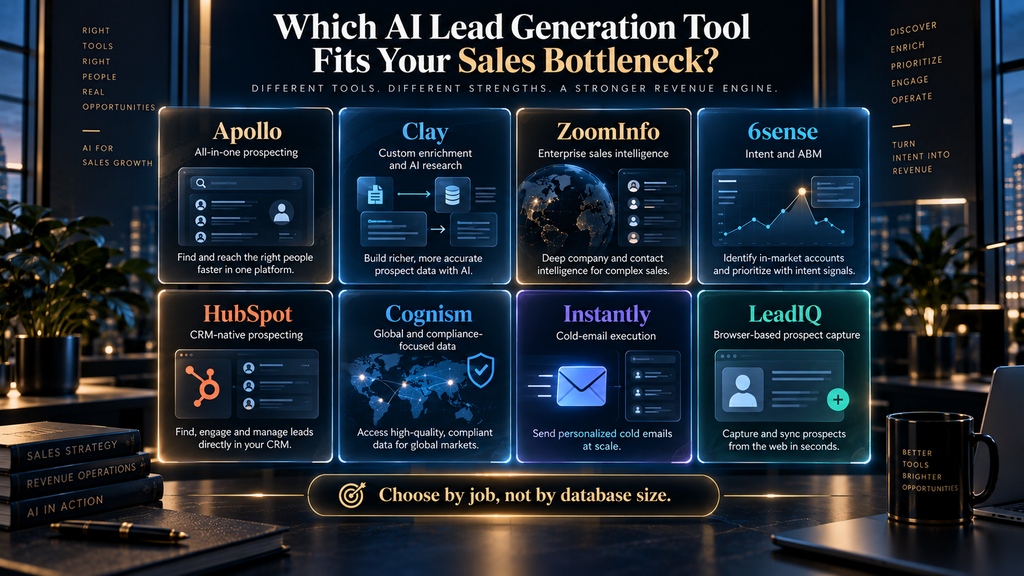
These labels are intentionally directional rather than pretending to be laboratory measurements. A platform’s performance depends on geography, ICP, data source, configuration, workflow design, and use case. The table is useful for positioning, not for manufacturing false precision.
That distinction is particularly important for data accuracy. Comparing vendors using one percentage such as “95% accurate” can create an impression of scientific certainty that the underlying methodologies do not justify. Data freshness, verification standards, sample selection, geography, job categories, and the definition of “accurate” can all change the result.
A better buying process is to test the data that matters to your sales motion.
Which AI Lead Generation Tool Should You Choose?
The selection becomes much easier when you start with the bottleneck rather than the brand.
If you need an all-in-one outbound foundation
Start with Apollo.
This is the most sensible choice for many smaller and mid-sized teams because it reduces the number of moving pieces. If your current process involves manually finding contacts, maintaining spreadsheets, importing lists, and separately managing outreach, consolidation alone can create meaningful operational value.
If your prospecting requires sophisticated research
Start with Clay.
Clay becomes more attractive when your ICP requires information that cannot be represented by a handful of standard database filters. Complex enrichment, custom research, multi-source validation, and AI-generated account intelligence are where its flexibility becomes valuable.
If enterprise account intelligence is critical
Consider ZoomInfo. The economics make more sense when each account is valuable enough that additional intelligence can influence large opportunities, territory planning, account selection, and sales productivity.
If the central question is “who is ready?”
Consider 6sense. This is particularly relevant for mature ABM teams that need to focus sales resources on accounts demonstrating meaningful buying activity rather than simply producing larger prospect lists.
If HubSpot already runs your sales operation
Start by evaluating HubSpot’s native prospecting capabilities. The integration advantage can outweigh the theoretical superiority of another standalone product because the goal is not to win a software comparison; it is to create a functioning sales process.
If global coverage and compliance are major requirements
Evaluate Cognism. The platform becomes especially relevant when geography, phone coverage, and compliance are not optional considerations but core operating requirements.
If prospecting is working but outbound execution is weak
Consider Instantly.
There is little reason to replace a functioning prospect-discovery process if the real problem is campaign execution. Fix the bottleneck rather than rebuilding the entire stack.
If sales reps spend too much time capturing prospects manually
Consider LeadIQ. A browser-based workflow can be valuable when representatives already know where they find prospects but waste time moving information from research into the CRM.
When You Should Combine Tools Instead of Choosing One
The premise that every company needs one “best” platform is itself questionable.
A mature revenue operation may deliberately use several systems because different layers require different capabilities. For example, a company could use 6sense to identify accounts displaying meaningful intent, ZoomInfo or Apollo to identify relevant contacts, Clay to enrich and research those records, HubSpot or another CRM to manage the sales process, and an outbound platform to execute campaigns.
That sounds more complicated—and it is. Complexity is not free. Every additional system introduces integration requirements, data synchronization problems, user training, duplicate records, additional billing, and more opportunities for conflicting information.
The point is not to build the largest possible stack. It is to separate tools only when specialization creates enough additional value to justify the operational cost.
For a five-person sales team selling a straightforward product, Apollo may eliminate enough friction that a one-platform approach is clearly better. For an enterprise sales organization managing thousands of target accounts and large deal values, the economics can reverse. Spending more on specialized intelligence may be rational if a small improvement in account prioritization creates substantial revenue impact.
This is the central trade-off between integration and specialization.
An integrated platform reduces friction. A specialized stack can increase capability. Your choice should depend on which constraint is currently more expensive.
Cost, Data Quality, and Operational Trade-Offs
Price is one of the easiest variables to compare and one of the easiest to misuse.
A platform’s subscription fee does not tell you its true cost. You also need to consider credits, enrichment consumption, seats, data verification, sending infrastructure, CRM integration, implementation time, training, and the sales representatives’ time spent operating the system.
Clay illustrates this particularly well because usage can depend on enrichment and AI activity. A workflow that looks efficient at a small scale may behave differently when applied to tens of thousands of records. Likewise, an enterprise intelligence platform can appear expensive until you compare its cost with the value of one additional enterprise opportunity.
The right calculation is therefore closer to: Total platform cost ÷ incremental usable sales opportunities created. That is more informative than: Monthly subscription ÷ number of contacts available.
The second number rewards cheap volume. The first rewards useful output.
Data quality is not a single number
B2B data decays.
People change jobs, companies restructure, domains change, employees leave, phone numbers change, and organizational information becomes outdated. Even a strong provider therefore needs ongoing validation.
Instead of asking a vendor, “How accurate is your database?” ask:
- How accurately does it cover my target geography?
- How fresh are the fields I actually depend on?
- How often do contacts change jobs in my market?
- How well does it represent my target seniority?
- Can I verify the records before expensive outreach?
- What happens when information is missing?
- How does the platform handle duplicate or conflicting records?
- What is the cost of repeated enrichment?
Those questions turn an abstract accuracy claim into an operational evaluation.
A Better Way to Test an AI Lead Generation Tool
Before committing to a platform, create a representative test set.
Take a sample of companies that genuinely resemble your ICP. Do not choose an artificially easy list containing only famous companies with abundant public information. Include the awkward middle of your market: smaller companies, less-visible companies, international accounts, unusual industries, and prospects with incomplete information.
Then evaluate the tool against the fields that actually influence your sales process.
For example, if your sales team needs to identify technology companies with 50–500 employees and reach VP-level decision-makers, test whether the platform consistently finds those companies and people. If recent hiring activity matters, test whether the relevant signals appear. If direct-dial availability is essential, measure usable phone coverage rather than counting total phone records.
Finally, run a small real-world workflow from discovery through outreach. Measure how many records survive each stage.
This produces a much more useful metric than “database size.”
Imagine that a platform returns 10,000 contacts. After removing poor-fit companies, outdated records, irrelevant job titles, unverifiable contact details, and prospects without a meaningful reason to engage, perhaps only 700 remain. Another platform might return 3,000 records but produce 500 genuinely usable prospects.
The second system may be more valuable even though its database is dramatically smaller.
Common Mistakes When Buying AI Lead Generation Software
Mistake 1: Buying the biggest database
A large database is useful only when it contains the prospects you actually need. Database size is a supply metric, not a revenue metric.
The more important question is whether the platform can reliably identify your ICP in the markets where you sell. Ten million irrelevant records do not compensate for weak coverage of the five thousand accounts that actually matter.
Mistake 2: Treating AI as a product category
“AI-powered” is now attached to almost every modern sales platform.
That label tells you very little. Ask what the AI actually does. Does it search? Summarize? Enrich? Predict? Detect intent? Research accounts? Generate messaging? Route leads? Execute outreach? Or simply provide a natural-language interface over an existing database?
The difference matters.
Mistake 3: Automating before defining the ICP
Automation cannot rescue vague targeting. If your sales team cannot clearly describe its best customers, the conditions that make an account attractive, the roles involved in purchasing, and the evidence that indicates a genuine opportunity, adding AI usually creates more activity rather than better activity. The correct sequence is strategy → data → decision logic → automation, not automation first.
Mistake 4: Confusing fit with intent
A company can be a perfect customer and still have no reason to buy today.
This is one of the most important distinctions in modern B2B prospecting. Firmographic fit tells you that an account belongs in your market. Intent and behavioral evidence can tell you whether the account deserves attention now.
A strong lead-generation system should preserve both pieces of information instead of collapsing them into one simplistic score.
Mistake 5: Ignoring the cost of sales attention
Sales capacity is finite.
Every low-quality lead consumes some combination of research time, CRM space, personalization effort, email capacity, and representative attention. If AI increases the number of prospects entering the system without improving prioritization, it can actually make sales less efficient.
The goal is not maximum lead production. The goal is maximum useful opportunity creation per unit of sales attention.
Mistake 6: Buying a sophisticated tool that the team will not use
A technically powerful platform can have negative ROI if representatives find it difficult to operate.
Adoption is part of product value. A slightly less capable tool that the entire team uses consistently can outperform a theoretically superior system that requires specialists to maintain.
This is particularly relevant when comparing flexible systems such as Clay with more packaged platforms such as Apollo.
Who Should Use AI Lead Generation Tools?
AI lead-generation platforms are most valuable when prospecting involves enough volume, complexity, or data movement that manual research has become a measurable constraint.
They are particularly useful for B2B companies with defined ICPs, repeatable sales motions, meaningful prospect volume, and enough deal value to justify systematic research and prioritization. They can also create substantial value for RevOps teams that spend large amounts of time maintaining data quality or building repetitive prospecting workflows.
The technology becomes less useful when the business is still searching for product-market fit, has an extremely small addressable market, relies almost entirely on founder-led relationships, or has not yet established a clear definition of its ideal customer. In those cases, more automation can hide the underlying problem.
A founder who personally needs to identify 30 highly specific prospects may gain more from careful research and direct relationship building than from implementing an elaborate AI prospecting stack. Technology becomes more compelling as the process becomes repeatable enough to automate.
What Happens If You Do Nothing?
It is tempting to think of AI lead generation as an optional productivity upgrade. For some organizations, that is true. For others, the cost of maintaining an entirely manual prospecting process grows quietly over time.
Manual research creates opportunity cost. Representatives spend time finding information rather than interpreting it. Lists become outdated. Prospecting quality varies by salesperson. Valuable signals remain buried in public information. Follow-up becomes inconsistent because the process depends too heavily on individual discipline.
The alternative is not necessarily full autonomy.
A well-designed AI system can handle repetitive research and data operations while leaving high-consequence decisions to people. That division of labor is often more practical than trying to build a completely autonomous sales machine.
The question is not whether AI can replace every prospecting task. It is whether AI can remove enough low-value work that human salespeople spend more of their limited time on conversations, judgment, relationships, and opportunities that actually matter.
The Future of AI Lead Generation
The direction of the market is moving from database search toward agentic prospecting.
Early systems primarily helped salespeople search structured records. Predictive systems then added scoring based on historical outcomes and behavioral patterns. Modern platforms are increasingly combining structured data with unstructured research, web information, buying signals, language models, and automated workflows.
The next step is not simply better search. It is systems that can continuously research accounts, recognize changes, interpret signals, identify relevant people, build a business case for why an account matters, recommend an action, and potentially execute parts of the outreach process.
That shift changes the role of the salesperson. Instead of spending the first hour researching whether an account is worth pursuing, the representative may receive a contextualized recommendation containing the relevant evidence and uncertainty.
But greater autonomy creates a corresponding governance problem.
If an AI system can automatically decide which prospects receive attention, send outreach, update CRM records, and deprioritize accounts, errors can propagate much faster than they would in a manual workflow. A wrong assumption about an ICP, a misleading data point, or an outdated signal can affect thousands of records rather than one salesperson’s spreadsheet.
The future therefore belongs less to maximum automation than to useful automation with controlled boundaries. Human judgment remains particularly important when evidence is ambiguous, the cost of a mistake is high, the account is strategically important, or the system is operating outside the conditions in which it was validated.
How to Measure Whether Your AI Lead Generation Tool Is Working
A lead-generation platform should ultimately be evaluated through business outcomes, not activity metrics alone.
Start by measuring the conversion from raw prospects to usable prospects. Then track the percentage of those prospects that become qualified opportunities, the response rate of relevant outreach, the meeting rate, opportunity creation, pipeline value, and ultimately revenue.
A useful measurement chain is: Prospects found → Usable prospects → Qualified prospects → Meetings → Opportunities → Revenue. The exact stages will vary by business, but the principle remains the same.
You should also track efficiency. If AI reduces the average research time per account from 15 minutes to three minutes, that is a meaningful operational improvement even before revenue changes. If it increases the number of qualified opportunities per salesperson without increasing headcount, that can be even more valuable.
The most revealing KPI may be sales-qualified opportunities per 1,000 discovered prospects.
Why? Because it forces the system to prove that it is improving quality rather than merely increasing volume.
A platform that doubles discovered leads while cutting the qualified-opportunity rate in half has not necessarily improved the sales process. It may simply have created more work.
A Practical AI Lead Generation Selection Framework
Before purchasing any platform, answer five questions.
First: What is actually broken? If the team cannot find enough relevant prospects, prioritize discovery. If records are incomplete, prioritize enrichment. If reps are overwhelmed by too many possible accounts, prioritize intent and qualification. If the list is strong but outreach is inconsistent, prioritize engagement infrastructure.
Second: Where does the data need to come from? A narrow domestic sales motion may have very different requirements from a global enterprise operation. Identify the geographies, industries, job functions, company sizes, and contact fields that matter before comparing database claims.
Third: How much complexity can the team absorb? A powerful platform that requires a dedicated RevOps specialist is not equivalent to a simple tool that a sales representative can operate immediately. Complexity should be treated as a cost.
Fourth: What evidence would prove the purchase worked? Define the KPI before buying. It might be qualified opportunities, research hours saved, meeting rate, usable-contact rate, pipeline created, or revenue influenced.
Fifth: What should remain human-controlled? Decide in advance which actions can be automated and which require review. This becomes increasingly important as AI moves from recommendations toward autonomous execution.
If you can answer those five questions, the shortlist usually becomes much smaller.
The Bottom Line
The market for AI lead-generation software has outgrown the idea that every platform is simply competing to provide the largest list of B2B contacts.
Apollo is the strongest all-around starting point for many small and mid-sized outbound teams. Clay stands out when custom enrichment and AI research are the priority. ZoomInfo is positioned for enterprise sales intelligence, while 6sense is particularly powerful when identifying in-market accounts is more important than generating another large contact list. HubSpot makes sense when the CRM itself should become the prospecting operating system, Cognism is compelling for global and compliance-sensitive data requirements, Instantly is built around outbound email execution, and LeadIQ is particularly useful for browser-led prospect capture.
There is no universal winner because these platforms solve different problems. The better buying decision is to identify the weakest layer in your current lead-generation system, select the technology that improves that layer, and then measure whether the improvement creates more usable sales opportunities per unit of human attention. That is the standard an AI lead-generation platform should have to meet.
Choosing the Tool Is Only Half the Job
Once you know which platform fits your bottleneck, the next challenge is connecting discovery, enrichment, qualification, and outreach into one repeatable system. See how to build an AI-powered B2B prospecting workflow from end to end.
Build the B2B Prospecting Workflow →FAQ
1. What are AI lead generation tools?
AI lead generation tools use artificial intelligence, automation, databases, enrichment, behavioral signals, or AI research to help businesses identify and develop potential customers. Depending on the platform, they may find prospects, enrich contact records, identify buying intent, prioritize accounts, research companies, or automate parts of outbound sales.
2. What is the best AI lead generation tool in 2026?
There is no single best platform for every business. Apollo is the strongest general-purpose option for many small and mid-sized B2B teams because it combines prospect discovery and sales engagement, while Clay, ZoomInfo, 6sense, HubSpot, Cognism, Instantly, and LeadIQ become more attractive when a specific requirement—such as enrichment, enterprise intelligence, intent data, CRM integration, global coverage, cold-email execution, or browser-based prospecting—is the primary need.
3. Is Apollo better than Clay for lead generation?
Neither is universally better because they solve different problems. Apollo is generally easier for teams that want an integrated prospecting and engagement platform, whereas Clay is more powerful for teams that want to build customized enrichment, research, and multi-source data workflows.
4. Are AI lead generation tools worth it for small businesses?
They can be, particularly when salespeople spend substantial time manually finding prospects, researching companies, maintaining lists, or preparing repetitive outreach. For a very small business with a narrow market and only a handful of high-value prospects, however, manual research may still provide better economics than implementing a sophisticated prospecting stack.
5. Can AI lead generation tools find high-intent prospects?
Some can, but this depends on the platform and the signals available to it. Intent-focused platforms such as 6sense are designed specifically around identifying accounts that show behavioral evidence associated with active buying, while conventional prospecting databases are generally better at identifying who fits a target market than proving who is ready to buy.
6. Do AI lead generation tools replace salespeople?
No. They can automate research, data collection, prioritization, personalization, and parts of outreach, but important decisions still benefit from human judgment. AI is most useful when it removes repetitive work and gives salespeople better evidence for deciding where to spend their time rather than attempting to eliminate human involvement altogether.
7. How accurate are AI lead generation databases?
Accuracy varies significantly by provider, geography, industry, job function, and the specific data field being evaluated. Rather than trusting a universal accuracy percentage, businesses should test representative records from their own ICP and measure factors such as valid contact information, correct job titles, company fit, geographic coverage, and data freshness.
8. Should I use one AI lead generation tool or several?
Start with one platform when it can adequately solve your main bottleneck without creating unnecessary complexity. Multiple tools make sense when specialization produces enough additional value—for example, using an intent platform to identify in-market accounts, an enrichment system to improve their records, and a separate outreach platform to execute campaigns.
9. What should I look for when choosing an AI lead generation platform?
Start with the problem you need to solve rather than the number of features a vendor advertises. Evaluate prospect discovery, data quality, enrichment, intent and prioritization, AI capabilities, outreach, CRM integration, workflow complexity, pricing model, and measurable business outcomes against your actual sales process.
10. How do I measure the ROI of an AI lead generation tool?
Measure what happens from discovery through revenue rather than focusing only on the number of leads generated. Useful metrics include usable-prospect rate, qualified-prospect rate, meeting rate, opportunity creation, pipeline generated, revenue influenced, research time saved, and—particularly—how many qualified opportunities the system produces per 1,000 prospects discovered.
Related Guides
- What Is an AI SDR? How AI Agents Automate B2B Prospecting, Outreach & Qualification
- Best AI Workflow Automation Tools (Free & Paid)
- Best AI Cold Email Software in 2026: Instantly vs. Smartlead vs. Lemlist
Written by
Muntasir Ahmad Chowdhury
Founder, AI Hustle World
Muntasir Ahmad Chowdhury is the Founder of AI Hustle World, an independent publication dedicated to making Artificial Intelligence practical, trustworthy, and easy to understand. He researches AI tools, automation, customer service, productivity, and real-world business applications, helping readers make smarter technology decisions through research-driven, experience-backed content.
Expertise:
AI Tools • AI Automation • AI Customer Service • AI Productivity • Generative AI • AI Workflows
Get Smarter With AI
Enjoyed this guide? Get practical AI tools, tutorials, and honest reviews delivered to your inbox.