Evidence: Documentation reviewed
Last checked: August 2026. Resemble AI and Cartesia entries checked 13 October 2026. ElevenLabs model line-up checked 14 October 2026
What was done: Written from official documentation and the published sources linked in this article. Not hands-on tested, except the Cartesia entry, which cites our own 12-line test of 11 October 2026.
Files: None
Affiliate links: Yes
Last updated: October 14, 2026. What changed: Resemble AI was removed because it has stopped selling voice generation. Cartesia, which we tested on 11 October 2026, takes its place in the list.
Best AI Voice Generators in 2026: 10 Tools Compared for Quality, Realism & Value
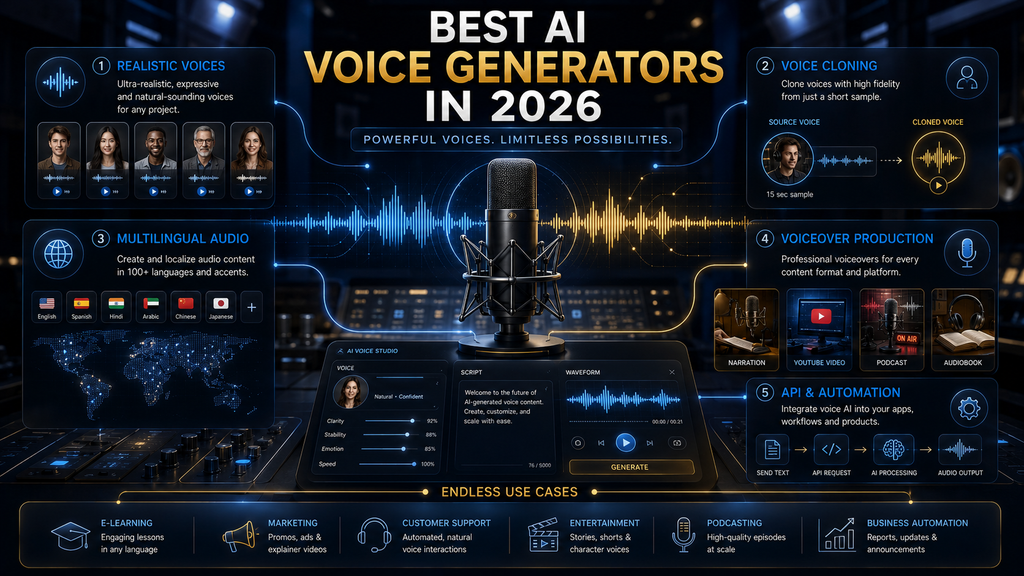
Updated: August 2026 Choosing an AI voice generator used to be simple: find the voice that sounds least robotic, paste in your script, and export the audio. That decision is much harder now.
The best platforms are no longer competing only on whether a sentence sounds human. They are competing on expressiveness, voice cloning, multilingual delivery, editing workflows, commercial rights, APIs, production speed, pricing models, and how much control you get over the final performance. And there is another problem: many “best AI voice generator” lists are now outdated.
Some still recommend tools that have changed substantially. Others compare products that solve completely different problems. Some rank platforms using unexplained scores. And a surprising number continue recommending PlayHT even though the service was permanently shut down at the end of 2025. So this guide takes a different approach. Instead of asking: Which AI voice generator has the most features? we ask: Which platform gives you the right combination of voice quality, control, workflow, economics, and reliability for the job you actually need to accomplish?
After reviewing current product documentation, pricing, model capabilities, product materials, competitor positioning, and the major decision criteria appearing across current 2026 comparisons, ElevenLabs is our strongest overall recommendation for creators who care primarily about natural, expressive voice generation and advanced voice workflows. But that does not mean ElevenLabs is automatically the best choice for everyone.
Murf can make more sense for structured business voiceover workflows. Google Cloud and other developer platforms can make more sense when usage economics and API infrastructure matter more than a creator-friendly interface. Speechify is particularly relevant when reading and accessibility are central. Enterprise teams may value platforms such as WellSaid for a different set of requirements. The goal of this article is to show you where each tool actually fits—and where it doesn’t.
Affiliate disclosure: AI Hustle World may earn a commission if you subscribe to a product through an affiliate link in this article, at no additional cost to you. Our recommendations are based on product capabilities, fit, pricing, limitations, and available evidence—not commission rates.
Quick Answer: What Is the Best AI Voice Generator in 2026?
For most creators who want highly natural, expressive voices, voice customization, cloning, multilingual production, and a broader audio-production ecosystem, ElevenLabs is the strongest overall choice. That recommendation is not based on one impressive demo.
It comes from the combination of several things that matter in real production: expressive synthesis, a large voice ecosystem, voice cloning, multilingual support, multiple generation models, Studio-based editing, dubbing, sound effects, music, and API access. ElevenLabs’ current platform has expanded well beyond its original text-to-speech identity. Its current Voice Library advertises more than 10,000 voices, while Eleven v3 supports 70+ languages and introduces much more expressive control through audio tags and multi-speaker dialogue.
Hear ElevenLabs on Your Own Script
Paste a real paragraph from your next project and judge the voice for clarity, emotion and pronunciation before you compare it with any other tool on this list.
Test ElevenLabs on Your Script →Affiliate disclosure: We may earn a commission if you subscribe through this link, at no additional cost to you.
But there is a catch. The best voice generator is not necessarily the platform with the most realistic demo. If you’re producing thousands of API-generated minutes, building a real-time application, creating corporate training, or simply need a tool that fits an existing enterprise workflow, another platform may be a better economic or operational choice. That distinction is the foundation of this comparison.
The 10 Best AI Voice Generators in 2026
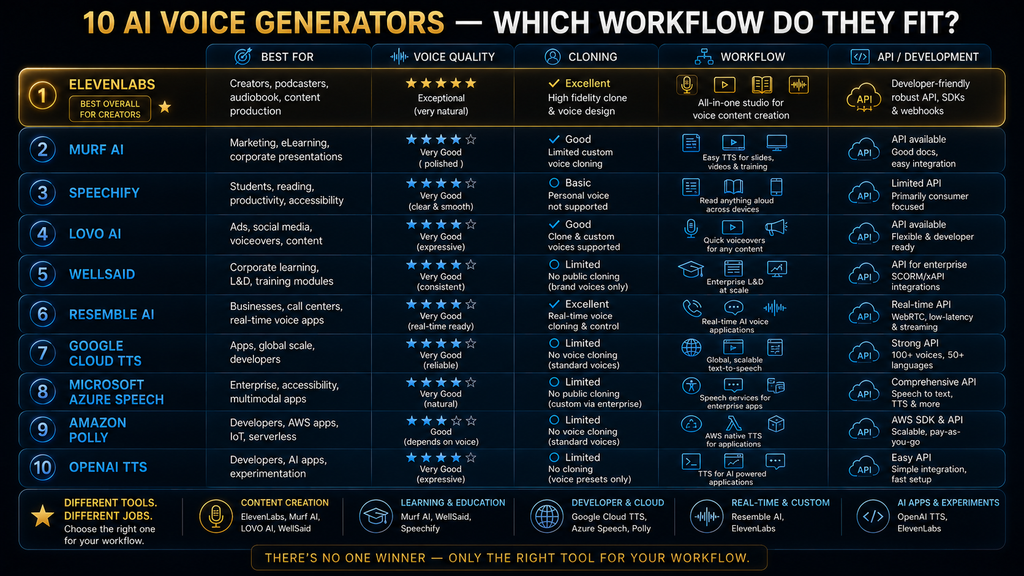
| Tool | Best for | Biggest strength | Main limitation |
|---|---|---|---|
| ElevenLabs | Overall creators & advanced voice production | Expressive voices, cloning, multilingual audio | Credit-based economics can become expensive at scale |
| Murf AI | Business voiceovers & structured narration | Creator-friendly studio workflow | Less centered on advanced voice experimentation |
| Speechify | Reading, accessibility & creator workflows | Broad consumer + voice capabilities | Not the same type of deep voice-production platform as ElevenLabs |
| LOVO AI | Voiceover + content production | Voice generation combined with creative workflow | Platform breadth can matter less if you only need TTS |
| WellSaid Labs | Enterprise/L&D voice production | Professional voice workflows | Less attractive for casual creators |
| Cartesia | Developers & real-time voice | Developer API for real-time speech. Read all 12 of our test lines correctly | English and Bengali needed separate voices in our test |
| Google Cloud Text-to-Speech | Developers & high-volume infrastructure | Large-scale API economics and ecosystem | Requires a cloud/developer mindset |
| Microsoft Azure AI Speech | Enterprise applications | Enterprise speech infrastructure | Overkill for simple creator workflows |
| Amazon Polly | AWS developers & cost-sensitive API workloads | Mature cloud infrastructure | Not designed as a premium creator studio |
| OpenAI GPT-4o mini TTS | Developers building AI applications | Simple integration and low API pricing | Not a full creator-oriented voice studio |
The key insight is that these products should not be treated as ten identical competitors. They occupy different parts of the market. That is why a simple 1–10 ranking can be misleading.
How We Evaluated the Best AI Voice Generators
A voice generator has at least two products hidden inside it. The first is the voice model. The second is the workflow surrounding the model. A fantastic model inside a frustrating workflow may still be a poor choice. Likewise, an inexpensive API may be perfect for a developer while being completely unsuitable for a YouTuber who wants to produce narration without writing code. So our evaluation uses the AI Hustle World Voice Selection Framework:
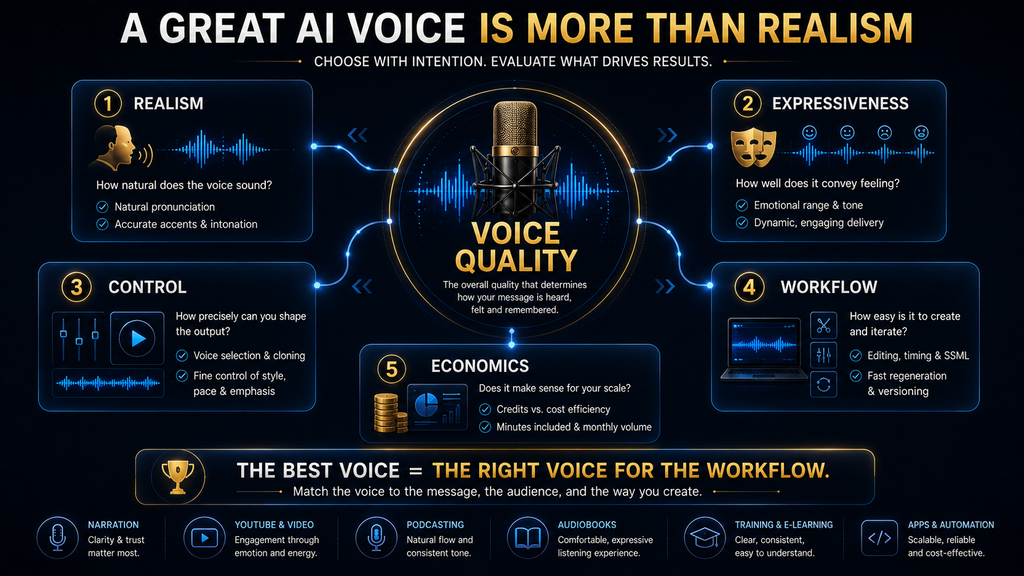
- 1. Realism. Does the output sound natural when spoken for more than a short demonstration?
- 2. Expressiveness. Can the system handle emotion, pacing, emphasis, pauses, dialogue and performance direction?
- 3. Voice control. Can you select, customize, design or clone voices?
- 4. Language coverage. How useful is the platform for multilingual content rather than simply advertising a large language count?
- 5. Production workflow. Can you go from script → voice → edit → refine → export without constantly moving between tools?
- 6. Commercial usability. Can creators and businesses actually use generated audio in commercial projects under the relevant plan terms?
- 7. API and automation. Can developers integrate the system into applications, workflows or automated content pipelines?
- 8. Economics. What are you actually paying for—characters, credits, minutes, API usage, seats or bundled features?
- 9. Failure modes. Where does the platform stop being the right tool?
- 10. Long-term fit. Does the platform make sense for the workflow you are likely to have six or twelve months from now? This last criterion is easy to ignore. It is also one of the most important.
What Actually Makes an AI Voice Generator Good?
The biggest mistake buyers make is treating “sounds human” as the complete definition of quality. It isn’t. Imagine two systems. System A produces a beautiful 20-second narration sample. System B produces slightly less impressive samples, but lets you control pacing, create consistent character voices, fix individual lines without rerecording, translate your content, manage long-form projects, and integrate the voice into your production pipeline. For a professional creator, System B may be more valuable.
The real product is therefore: Voice quality × control × workflow × economics × reliability not simply: Voice quality This is why modern AI voice selection has become a workflow decision rather than a microphone-quality decision.
Part 1 — The Best AI Voice Generators
1. ElevenLabs — Best Overall for Natural, Expressive AI Voices
Best for: YouTube creators, narration, podcasts, audiobooks, character dialogue, multilingual content, voice cloning and creators who want a sophisticated voice-production ecosystem. Our verdict: Best overall for most serious creators. ElevenLabs is the platform I would put at the top of the shortlist if the voice itself is an important part of the finished product. The reason is not simply that ElevenLabs produces realistic speech. Its current ecosystem gives creators several layers of control: a large Voice Library, voice cloning, Voice Design, multiple speech models, Studio, dubbing, sound effects, music, transcription and API access.
That breadth matters because voice production rarely ends when the first audio file is generated.
Eleven v3 changes the equation
Eleven v3 was the platform’s flagship expressive speech model when this guide was first written. On 14 October 2026, ElevenLabs’ documentation described a newer model, Eleven v4, as its state-of-the-art speech model and Eleven v3 as the previous generation, still available. Eleven v4 lists 90+ languages. Eleven v3 supports 70+ languages, multi-speaker dialogue and audio tags that can influence emotion, delivery and non-verbal reactions. The documentation also makes an important distinction: v3 is highly expressive but can be more variable and higher-latency than the faster models, so it is not the universal answer for every real-time application. That distinction is important. A creator producing an audiobook may value emotional range more than latency.
A developer building an interactive voice application may make the opposite trade-off. ElevenLabs offers other models for those different requirements, including Flash v2.5 for lower-latency generation.
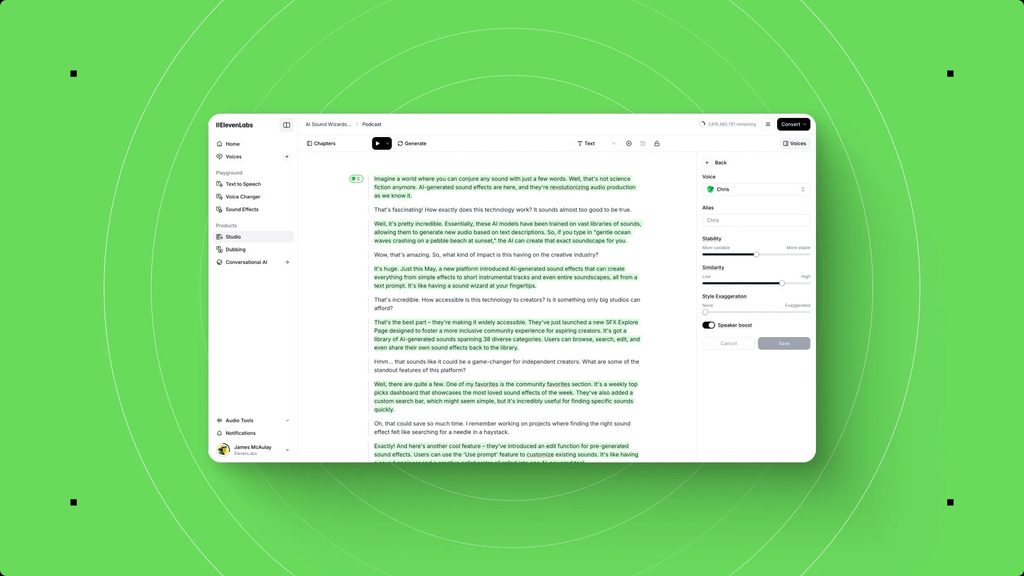
The Voice Library is another major advantage. ElevenLabs’ current Voice Library advertises more than 10,000 voices, with categories covering narration, characters, advertising, education, conversational applications and entertainment. That changes the creative process. Instead of starting with: “What voice can this software generate?” you can start with: “What kind of voice does this project need?” Warm narrator? Documentary voice? Character? Commercial voice? Educational presenter? Conversational personality? That is a much better creative workflow.
Voice cloning is one of ElevenLabs’ strongest differentiators
ElevenLabs separates Instant Voice Cloning from Professional Voice Cloning. Instant Voice Cloning works from short samples and is designed for rapid creation. Professional Voice Cloning uses substantially more audio and a dedicated training process to produce a higher-fidelity representation. ElevenLabs says PVC is available from the Creator tier upward. This distinction matters because “voice cloning” is often treated as a single feature. It isn’t. A quick clone for experimentation and a carefully trained professional voice model are fundamentally different workflows.
ElevenLabs also states that Professional Voice Clones are restricted to the user’s own voice and require verification. That is an important safety boundary.
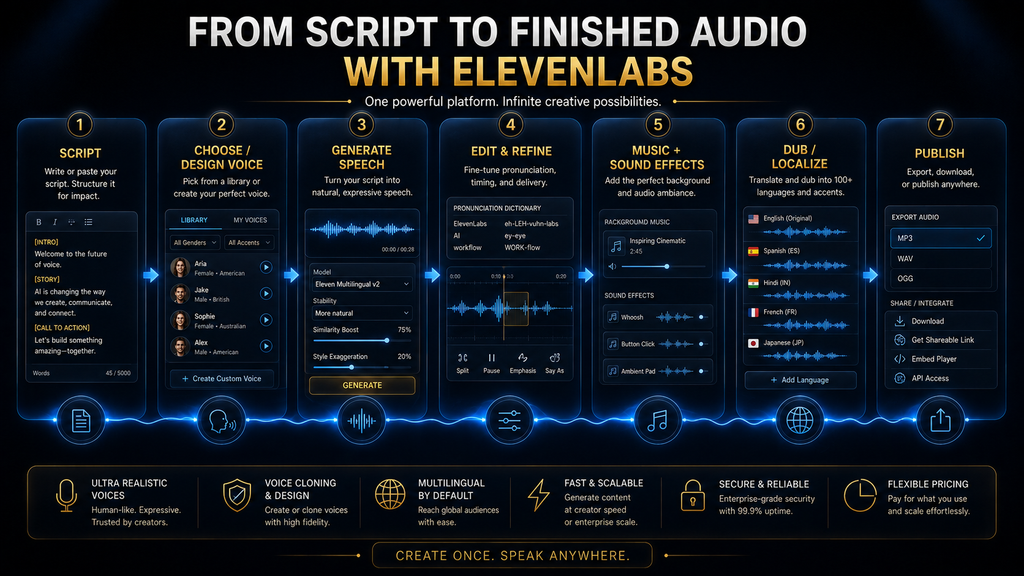
Studio makes ElevenLabs more than a voice generator
Studio 3.0 is where the platform’s broader strategy becomes obvious. The current Studio combines AI voiceovers, music, sound effects, captions, transcription, voice isolation, video editing and other production functions in one timeline. It also includes a Studio Agent that can draft scripts, select voices, place sound effects and arrange clips while still allowing manual control. This is strategically important. The future of AI audio isn’t simply: text → voice It is increasingly:
idea → script → voice → correction → music → SFX → captions → localization → finished media The more of that chain one platform can handle well, the less friction exists between generation and publication.
Current ElevenLabs pricing
- Free: $0, 10,000 credits/month
- Starter: $6/month, 30,000 credits
- Creator: $22/month, 121,000 credits
- Pro: $99/month, 600,000 credits
- Scale: $299/month, 1.8 million credits
- Business: $990/month, 6 million credits
- Enterprise: custom pricing
The Creator page currently displays a first-month promotional price of $11 against the listed $22 monthly price; promotional pricing can change, so verify the live pricing page before subscribing. There is another detail many comparisons miss: credits are shared across ElevenLabs products. Text-to-speech, dubbing, music, sound effects, voice changing and other capabilities draw from the same overall credit system, with different consumption rates. So a buyer shouldn’t ask only: “How many characters do I get?” For plan data on other tools, see our AI Tool Pricing Database.
The better question is: “How many different AI audio operations will I perform every month?”
Where ElevenLabs can lose
ElevenLabs isn’t automatically the best choice for every workload. If your main priority is extremely low-cost, high-volume API generation, cloud platforms can offer radically different economics. If you need an enterprise-specific governance environment, another vendor may fit better. And if you only need basic narration once a month, paying for a sophisticated audio ecosystem may be unnecessary. Bottom line: if voice quality, expressive delivery, cloning and creator-oriented production are central to your work, ElevenLabs is the strongest place to start. Our ElevenLabs review covers pricing, limits and the verdict in more detail.
2. Murf AI — Best for Structured Business Voiceovers
Murf is a strong alternative when the job looks less like experimental voice design and more like professional business narration. Think:
- training videos
- presentations
- marketing videos
- explainers
- e-learning
- corporate narration
Current 2026 comparisons consistently position Murf around business and structured voiceover workflows rather than treating it as a direct one-for-one replacement for every ElevenLabs capability. That distinction matters. Murf’s appeal is not necessarily “beat ElevenLabs at everything.” Its appeal is: Make professional voiceover production easier for a business user. If your team already works around scripts, presentations, marketing assets and structured production, that workflow can be more valuable than having the most experimental voice technology.
Best for. Choose Murf if: you are producing business-oriented narration and want a relatively structured creator/editor workflow.
Watch out for. If your main reason for buying an AI voice platform is advanced cloning, experimental character performance or deep voice customization, ElevenLabs may be the more natural first choice.
3. Speechify — Best for Reading, Accessibility and Broader Consumer Voice Workflows
Speechify occupies an interesting position because it is not simply another creator-first TTS platform. Its ecosystem has a strong relationship with reading content aloud, accessibility and consumer audio. That makes it particularly relevant for:
- reading documents
- listening to articles
- educational material
- accessibility workflows
- narration
- voice-based content consumption
Current 2026 comparisons also distinguish Speechify’s consumer reading experience from its developer/voice-generation offerings, which is important because “Speechify” can mean different products depending on what you’re trying to accomplish.
Best for. People who want AI voice technology connected to reading, accessibility and content consumption, rather than only professional voice production.
Watch out for. If your entire business depends on expressive character narration or highly controlled voice performance, evaluate it against ElevenLabs using your own script.
4. LOVO AI — Best for Voiceover Plus Broader Content Creation
LOVO/Genny has historically positioned itself around a broader creative workflow rather than pure text-to-speech. That can make it attractive to creators who want voice generation to sit alongside other content-production functions. The advantage is obvious: You reduce the number of separate tools involved in the production process. But there is a trade-off. A platform that does many things can be useful, but breadth doesn’t automatically equal depth. If your highest-priority requirement is the best possible expressive voice performance, compare the specific voices and controls you need rather than choosing based on feature count alone.
Best for. Creators who want a broader voice + content production workflow.
Watch out for. If you already have a strong video-editing stack and only need exceptional TTS, a dedicated voice platform may be a better fit.
5. WellSaid Labs — Best for Enterprise and Learning Content
WellSaid is especially relevant for organizations producing:
- training
- internal communications
- e-learning
- professional instructional material
- branded narration
Its positioning is different from the creator-first ecosystem of ElevenLabs. That can be a strength. A company producing thousands of training assets doesn’t necessarily need the same creative freedom as a YouTube creator making cinematic storytelling videos. Current pricing information published by WellSaid indicates a structured plan model aimed at professional users, with its Starter plan listed at $10/month when billed annually and higher tiers for expanded workflows.
Best for. Organizations that prioritize professional voice production and structured learning/business workflows.
Watch out for. Casual creators may find the enterprise-oriented value proposition less compelling than a creator-first platform.
Part 2 — Developer and Infrastructure-Focused AI Voice Generators
6. Cartesia — Best for Developers and Real-Time Voice
Cartesia becomes interesting when you stop thinking like a content creator and start thinking like a product builder. It is a developer platform for real-time voice, and its current model, Sonic 3.6, lists 44 languages, Bengali among them. A developer might need:
- API access
- voice cloning
- application integration
- custom voice infrastructure
- programmatic generation
- real-time experiences
In that environment, the user interface matters less than the underlying architecture. That’s why comparing a developer platform directly against a creator-oriented tool using only “which voice sounds better?” misses the point.
Cartesia is also the one tool in Part 2 that we have tested ourselves. On 11 October 2026 we ran our 12-line script pack through its playground on the free plan, six lines in English and six in mixed Bengali and English. All 12 were read correctly on the first take, at a worked-out cost of about $0.05 per finished minute on the $5 Pro plan. The catch was voices: none of the English voices covered Bengali, so the mixed lines needed a second voice. The full log is in our three-tool comparison.
Cartesia’s pricing page listed a free tier with 20,000 credits a month on 10 October 2026, then Pro at $5, Startup at $49 and Scale at $299, with one credit per character.
Best for. Developers and teams building voice-enabled or real-time applications.
Watch out for. If you’re a non-technical YouTuber who simply wants to turn scripts into narration, the additional infrastructure may not provide enough value. Check, too, that one voice covers every language you publish in.
What used to be here. This slot was held by Resemble AI. When we checked on 13 October 2026, Resemble’s site said it had stopped offering voice generation as a commercial product and now focuses on AI detection, watermarking and security, so we removed it from the list. Its notice says the voice models it built remain open for research and development.
7. Google Cloud Text-to-Speech — Best for Developers and High-Volume API Workloads
Google Cloud Text-to-Speech is a completely different type of product. It is infrastructure. Google currently advertises 380+ voices across 75+ languages and variants, with REST and gRPC APIs, SSML support and controls for pitch, speaking rate and volume. Its economics can also look very different from creator subscriptions. Google’s current pricing is usage-based. For example, Standard voices are priced at $4 per million characters after the applicable free allowance, while newer voice models can cost substantially more.
That can make Google attractive when you’re generating huge amounts of speech programmatically. But here’s the trade-off: cheap infrastructure is not the same thing as a great creator workflow. You may have to build or manage more of the experience yourself.
Best for. Developers, SaaS products, applications and high-volume automated speech generation.
Watch out for. If you just want to make a YouTube voiceover, Google Cloud can feel like bringing a cloud infrastructure platform to a simple creative problem.
8. Microsoft Azure AI Speech — Best for Enterprise Speech Infrastructure
Azure Speech belongs in the same broad category. It becomes compelling when speech is part of a larger enterprise technology stack rather than a standalone creative task. Think:
- applications
- accessibility
- enterprise communication
- speech-enabled products
- large-scale automation
- cloud infrastructure
The advantage is integration. The disadvantage is complexity. For a creator, that complexity is often unnecessary. For an enterprise already operating inside Azure, it can be exactly what they want.
Best for. Organizations already invested in Microsoft/Azure infrastructure.
Watch out for. Don’t choose an enterprise speech API simply because its technical specifications look impressive. Match the platform to the job.
9. Amazon Polly — Best for AWS-Based Applications. Amazon Polly remains relevant because it is part of the AWS ecosystem. For developers already using AWS, that can be a significant advantage. The calculation is simple: If your application already runs inside AWS and needs speech synthesis, adding a native AWS speech service may be operationally simpler than introducing a completely separate creator platform. But again, this is infrastructure-first thinking. Amazon Polly is not trying to be your cinematic audiobook studio.
Best for. AWS-native applications and developers who need scalable text-to-speech infrastructure.
Watch out for. Creators who want advanced voice experimentation, cloning and editorial production should look elsewhere first.
10. OpenAI GPT-4o mini TTS — Best for Developers Building AI Applications. OpenAI’s GPT-4o mini TTS is another example of why the AI voice market is splitting into different categories. The model is designed to convert text into spoken audio through the API, with current pricing of $0.60 per million input text tokens and $12 per million output audio tokens. That’s a very different purchasing model from a creator subscription. For developers already building AI applications with OpenAI, having speech generation in the same ecosystem can simplify architecture.
Best for. Developers who are already building AI products and want speech generation integrated into their application stack.
Watch out for. It isn’t a replacement for a complete voice-production environment. If your workflow is: script → choose character → clone voice → edit narration → add music → create captions → produce video then a creator-focused platform such as ElevenLabs Studio offers a broader workflow.
Turn One Script Into a Full Audio Workflow
Try voice selection, generation and Studio editing in one place, then see whether it removes steps from the way you produce audio today.
Try the ElevenLabs Workflow →Affiliate disclosure: We may earn a commission if you subscribe through this link, at no additional cost to you.
The Real Comparison: Which AI Voice Generator Should You Choose?
This is where most comparison articles become less useful. They show a table. Then they declare one winner. But your decision should begin with the job. For a deeper head-to-head, read ElevenLabs vs alternatives.
If you’re a YouTube creator
Start with ElevenLabs. Why? Because YouTube narration rewards:
- natural delivery
- emotional variation
- consistent voice identity
- easy regeneration
- multilingual expansion
- character voices
- production speed
ElevenLabs’ Studio also allows voiceover, captions, music, sound effects and video editing in the same environment. If you’re also researching AI video production, our comparison of the best AI video generators can help you evaluate the visual side of the workflow alongside the voice layer.
If you’re building faceless YouTube channels
Again, ElevenLabs is one of the strongest options. But the important word is workflow. A faceless channel isn’t just: script → voice It is: research → script → voice → visual generation → editing → captions → thumbnail → publishing The voice needs to fit the channel’s identity. If you change voices every five videos, the audience may experience the channel as a collection of unrelated pieces rather than a recognizable media brand.
That makes voice consistency strategically important.
If you’re producing audiobooks
ElevenLabs deserves serious consideration because its ecosystem is explicitly built around long-form narration and Studio supports audiobook workflows. Eleven v3 is positioned for emotionally rich narration, while other models are available when consistency and generation speed matter more. But don’t assume the most expressive model is automatically the best audiobook model. Long-form narration has different requirements:
- consistency
- pronunciation
- character continuity
- pacing
- chapter management
- revision speed
- audio quality
- production economics
The best audiobook workflow may use different models for different parts of the process.
If you’re making podcasts
ElevenLabs Studio is particularly interesting because the platform now combines narration, transcription, voice correction, voice isolation, music and sound effects. That creates a useful production loop: Record → transcribe → identify mistakes → correct → clean → enhance → publish The traditional alternative would often require several specialized applications. The advantage isn’t just saving money. It’s reducing workflow fragmentation.
If you need voice cloning
ElevenLabs is one of the strongest options to investigate first. But understand what you are buying. A clone is not a perfect digital copy of the original recording. ElevenLabs explains that voice cloning captures characteristics of the speaker and uses them to guide new speech synthesis. The quality depends heavily on the quality and consistency of the source recordings. For Instant Voice Cloning, ElevenLabs recommends roughly 1–2 minutes of good audio.
For Professional Voice Cloning, it recommends roughly 30–180 minutes of high-quality speech. That leads to an important principle: Better source material usually produces a better clone. A noisy room, inconsistent microphone, multiple speakers or poor recording conditions can limit the result before the model even gets involved.
Voice Cloning Is Powerful — and That’s Exactly Why You Should Be Careful
Voice cloning creates a new category of responsibility. If you’re cloning your own voice, the use case is straightforward. You can create narration without repeatedly recording every sentence. You can revise a script without scheduling another recording session. You can create multilingual versions. You can correct small mistakes. But cloning someone else’s voice creates legal, ethical and consent questions. ElevenLabs’ current Professional Voice Cloning system requires verification and does not allow you to create a Professional Voice Clone of someone else’s voice.
That is a useful boundary. The broader principle is even more important: Having the technical ability to reproduce a voice does not automatically give you the right to use it. Creators should maintain records of consent and rights whenever voice identity is commercially significant. ElevenLabs’ own Prohibited Use Policy bars replicating another person’s voice without consent.
Eleven v3 vs Older AI Voice Models: What Actually Changed?
The major shift isn’t simply “the voices got better.” The interaction model is changing. Older text-to-speech workflows often looked like: “Write sentence → generate → accept/reject.” Eleven v3 introduces more expressive control through audio tags, including emotional directions, delivery instructions and non-verbal reactions. It also supports multi-speaker dialogue. That means the prompt becomes part of the performance direction. For example, a creator can conceptually think in terms of: text + character + emotion + delivery + interaction instead of only: text + voice That is a meaningful shift in how creators work with synthetic speech. But there is a reality check. ElevenLabs itself notes that v3 can be more variable and higher latency than other models, so the most expressive model isn’t necessarily the best choice for every production scenario. More expressive does not always mean more appropriate.
What About Languages?
Language count is one of the most abused metrics in AI voice marketing. A vendor can say it supports dozens of languages. That does not tell you:
- how natural the accent sounds
- whether emotional control transfers well
- whether pronunciation is reliable
- whether your specific regional dialect works
- whether voice cloning performs consistently
- whether the same voice identity can travel across languages
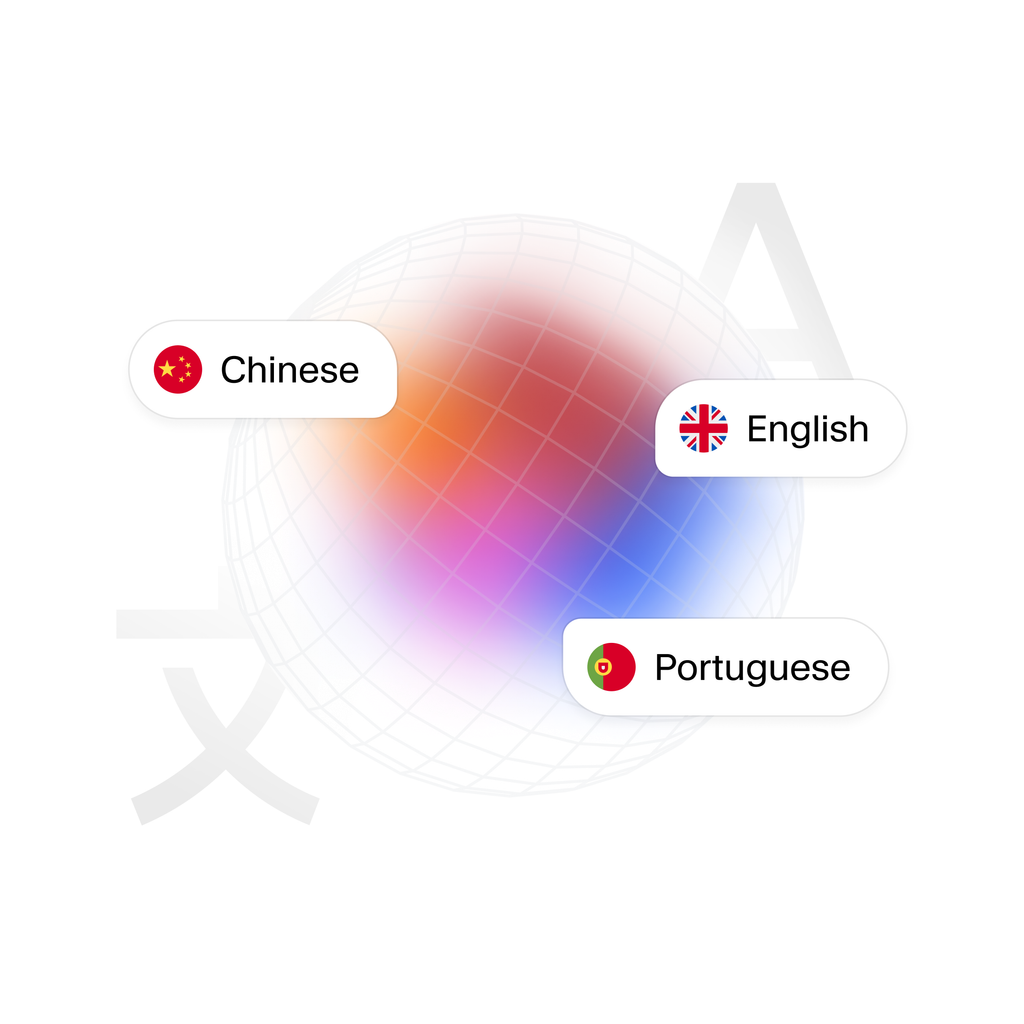
Eleven v3 currently supports 70+ languages, including Bengali, Hindi, Urdu, Arabic, English, Spanish, French, Japanese, Korean and many others. That makes it especially interesting for creators targeting multilingual audiences. But don’t choose based on the number alone. Always test the actual language, accent and script you intend to publish.
The Hidden Economics of AI Voice Generators
This is one of the most important sections in this entire guide. Two platforms can advertise: “$20 per month” and be radically different in real-world cost. Why? Because the billing unit matters. You may pay by:
- characters
- credits
- minutes
- tokens
- API requests
- seats
- projects
- bundled usage
ElevenLabs currently uses a shared credit system across its product ecosystem. One credit pool can be consumed by TTS, dubbing, music, sound effects and other operations. Google Cloud, by contrast, uses usage-based character billing for many TTS models. OpenAI’s GPT-4o mini TTS uses token-based pricing. So the cheapest headline price is often irrelevant.
Use this simple calculation. Before choosing a platform, estimate: Monthly text volume × regeneration rate × number of languages × number of projects Then add: editing + music + SFX + dubbing + storage + human review That gives you something much closer to your real production cost.
A Practical AI Voice Generator Cost Model
Suppose you produce 20 videos per month. Each video requires:
- 8 minutes of narration
- 2 regeneration passes on average
- one final export
That’s not simply: 20 × 8 = 160 minutes Your actual generation demand could be significantly higher because rejected generations still consume time or usage depending on the platform. Now imagine you translate those videos into three additional languages. The production workload has multiplied again. This is why creators should estimate finished minutes and generated minutes separately.
Finished minutes. The amount of audio you actually publish. Generated minutes. The amount of audio you create while experimenting, regenerating, correcting and testing. The second number is the one your budget often forgets.
What If You Only Need Free AI Voice Generation?
You have several options. ElevenLabs currently offers a free tier with 10,000 credits per month. Google Cloud also offers free usage allowances on several TTS categories, while new Google Cloud customers can receive promotional credits. But “free” should not automatically mean “best.” A free tool can become expensive indirectly if:
- you spend hours fixing pronunciation
- the voice sounds inconsistent
- commercial rights are limited
- you need to move files between several platforms
- you outgrow the quota quickly
The right question is: What is the cheapest tool that produces an acceptable finished result for my workflow? That is much more useful than: “Which tool is free?”
Why Some AI Voice Generators Sound Better Than Others
Voice realism comes from more than one component. At a high level, modern systems must model relationships between: text → pronunciation → rhythm → emphasis → pitch → timing → speaker characteristics → context The difficult part is context. Humans naturally understand that the same sentence can be spoken differently depending on the situation. Consider: “You actually did that?” It could express:
- surprise
- anger
- admiration
- disbelief
- sarcasm
- amusement
The words are identical. The performance is not. This is why expressive models are becoming increasingly important. The future competition isn’t simply about generating speech. It is about generating intentional performance.
The Biggest Mistakes People Make When Choosing an AI Voice Generator
Mistake 1: Choosing from the demo instead of your script. A polished demo is designed to make the system sound good. Your script is not. Always test the platform with the exact type of writing you plan to publish.
Mistake 2: Assuming one model is best for everything. It isn’t. A cinematic narration model may be inappropriate for real-time conversation. A fast model may be better for interactive applications. A stable long-form model may be better for an audiobook. ElevenLabs itself distinguishes between expressive v3 and faster models for different workloads.
Mistake 3: Comparing prices without comparing billing units. $10/month does not tell you enough. You need to know: How much usable output do I actually get?
Mistake 4: Ignoring commercial rights. A voice that is technically usable may not be commercially usable under every plan. ElevenLabs, for example, currently lists a commercial license as part of its Starter tier and above, while the Free tier has different limitations. Always verify the current plan terms before publishing monetized content.
Mistake 5: Assuming voice cloning fixes everything. It doesn’t. A poor recording produces a poor foundation. ElevenLabs specifically emphasizes clean, consistent recordings and recommends quality source audio for both IVC and PVC.
Mistake 6: Building your entire business around one vendor without backups. This is one of the most important lessons from the PlayHT shutdown. PlayHT was once a major name in AI voice generation. It was subsequently shut down, leaving users and developers needing alternatives. The lesson isn’t: “Never trust AI companies.” The lesson is: Don’t let your production assets become permanently dependent on a single platform. Keep:
- original scripts
- downloaded final audio
- original voice recordings
- voice settings
- API configuration
- project files
- important prompts
A voice platform is part of your infrastructure. Treat it that way.
The AI Hustle World Voice Selection Matrix
Here is the decision framework I’d actually use.
| If your priority is… | Start with | Why |
|---|---|---|
| Best overall creator voice quality | ElevenLabs | Strong expressive models + broad voice ecosystem |
| Voice cloning | ElevenLabs | Instant + Professional Voice Cloning |
| YouTube narration | ElevenLabs | Natural narration + production workflow |
| Faceless channels | ElevenLabs | Voice identity + scalable narration |
| Business voiceovers | Murf | Structured business-oriented workflow |
| Reading/accessibility | Speechify | Strong reading-focused ecosystem |
| Enterprise learning | WellSaid | Professional enterprise-oriented voice workflow |
| Developer voice infrastructure | Cartesia | API-first, real-time orientation |
| Google Cloud applications | Google Cloud TTS | Large cloud ecosystem + usage pricing |
| AWS applications | Amazon Polly | Native AWS infrastructure |
| OpenAI-based AI apps | GPT-4o mini TTS | Simple API integration |
| Real-time application development | Specialized low-latency model/API | Latency becomes more important than creator UI |
The important word is start. You don’t need to marry the first platform you test.
Our Recommended Buying Process
If you’re serious about choosing an AI voice generator, don’t subscribe immediately. Run this five-step test.
Step 1: Write one representative script. Use something you genuinely publish. Not a vendor demo.
Step 2: Generate the same script on three platforms. For example: ElevenLabs vs Murf vs Speechify Use the same text.
Step 3: Test difficult sentences. Don’t only test: “Welcome to today’s video.” Test:
- numbers
- abbreviations
- names
- foreign words
- emotional dialogue
- questions
- long sentences
- punctuation
- technical terminology
This is where differences become obvious.
Step 4: Calculate the economics. Measure: minutes produced → regenerations → monthly volume → total cost
Step 5: Evaluate the workflow. Ask: “Can I still imagine using this platform after making 100 videos?” That’s a better question than: “Did the demo sound impressive?”
The Contrarian Insight: The Best Voice Isn’t Always the Most Human One
This sounds strange, but it matters. Suppose you’re producing a serious financial education channel. The most emotionally expressive voice available might actually reduce trust. You may want:
- measured pacing
- consistent pronunciation
- restrained emotion
- professional tone
- clear articulation
Now imagine a horror storytelling channel. The requirements change completely. You may want:
- dramatic pauses
- whispers
- emotional shifts
- character differentiation
- tension
- unpredictable delivery
Therefore: Voice quality is contextual. A voice is “good” only relative to the job it is performing. That is why AI Hustle World does not recommend choosing a platform simply because it wins a generic “most realistic voice” ranking.
What Should You Actually Look for in 2026?
The category is moving toward five major capabilities.
- 1. Expressive generation. The system understands not just what words to say, but how they should be performed.
- 2. Persistent voice identity. Creators can establish recognizable voices for brands, characters and channels.
- 3. Multilingual production. The same content can be adapted for multiple audiences.
- 4. Agentic production. Instead of manually performing every step, AI can increasingly help with scripts, voice selection, editing, sound design and arrangement. Studio 3.0 is an example of this direction, with its Studio Agent able to draft scripts, select voices, place effects and arrange clips.
- 5. API-native deployment. Voice generation is becoming infrastructure for applications, not just a website feature. That is why platforms such as Google Cloud, OpenAI, Cartesia and ElevenLabs all matter even though their products feel very different.
Where the AI Voice Market Is Going
The next stage of AI voice generation is not simply “even more realistic voices.” That milestone is already becoming less meaningful. The more important question is: Can AI understand the role the voice is supposed to play? A future production workflow might look like this:
- Script
- AI understands character + audience + context
- Selects or designs voice
- Generates expressive performance
- Detects pronunciation problems
- Corrects lines
- Creates music and SFX
- Produces translated versions
- Creates captions
- Exports platform-specific versions
That is much bigger than text-to-speech. And ElevenLabs’ current product direction already points toward that broader system: Studio, voice generation, cloning, dubbing, music, sound effects, transcription and API capabilities increasingly sit within the same ecosystem.
Who Should Use ElevenLabs?
You should seriously consider ElevenLabs if you are:
- a YouTube creator
- a faceless-channel operator
- a podcaster
- an audiobook creator
- a video marketer
- a game or character creator
- building multilingual content
- interested in voice cloning
- producing commercial narration
- developing voice-enabled applications
- looking for one ecosystem covering multiple audio workflows
The strongest fit is someone who sees voice as part of the product, not merely as background narration.
Who Should Avoid ElevenLabs?
You may not need ElevenLabs if:
- you generate very little audio
- basic TTS is enough
- your only priority is minimum API cost
- your company is already deeply standardized on another cloud ecosystem
- you don’t need expressive voices or cloning
- you only need occasional accessibility/read-aloud features
- you’re paying for advanced capabilities you never use
This is important because affiliate content becomes untrustworthy when every reader is pushed toward the same product. Sometimes the correct recommendation is not to buy.
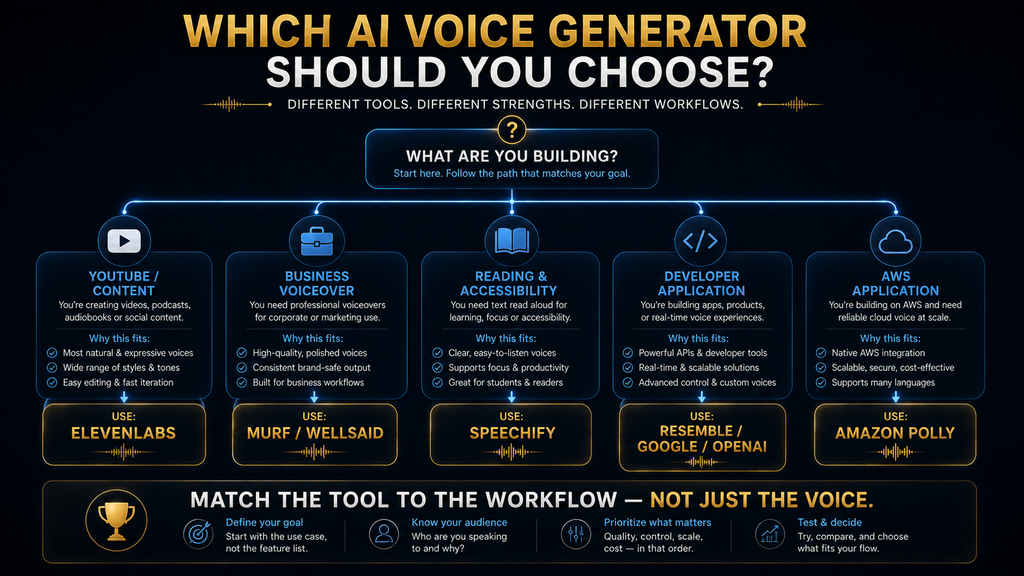
A Simple Decision Tree
- Do you primarily need natural, expressive narration. Yes → Start with ElevenLabs.
- Do you mainly produce corporate/e-learning voiceovers. Yes → Compare Murf and WellSaid.
- Do you mainly need reading/accessibility. Yes → Look closely at Speechify.
- Are you building a software product. Yes → Compare ElevenLabs, Cartesia, Google Cloud, Azure and OpenAI at the API level.
- Do you generate enormous amounts of basic speech. Yes → Model your costs against usage-based cloud TTS before choosing a creator subscription.
- Do you need your own voice. Yes → Evaluate voice-cloning quality, consent requirements, source-audio requirements and long-term portability—not just whether “voice cloning” exists.
What Happens If You Choose the Wrong Tool?
Usually, nothing catastrophic happens immediately. That’s why this mistake is so common. You subscribe. You make a few videos. You notice small problems. The voice needs more editing. The pricing becomes uncomfortable at higher volume. You discover a feature is locked behind another plan. Your workflow requires three additional tools. Then six months later, switching becomes painful because you’ve built a production system around the platform. That’s the real switching cost.
The cost of an AI voice generator isn’t only the subscription. It is: subscription + learning curve + workflow friction + migration cost + lost production time That is why choosing the right platform early matters.
Our Final Ranking
If we reduce the entire market to practical recommendations:
- Best Overall — ElevenLabs. Best combination of expressive voice generation, voice selection, cloning, multilingual capability and broader creator workflow.
- Best Business Voiceover Workflow — Murf. A strong choice when structured professional narration is more important than experimental voice production.
- Best Reading & Accessibility Ecosystem — Speechify. Especially relevant when listening and accessibility are central to the workflow.
- Best Enterprise Training Focus — WellSaid. Strong fit for organizations producing professional learning and training content.
- Best Developer-Oriented Alternative — Cartesia. Worth evaluating when voice technology is becoming part of an application or product.
- Best Cloud Infrastructure Option — Google Cloud TTS. Strong choice for developers who care about cloud integration and usage-based economics.
- Best AWS-Native Option — Amazon Polly. Logical for applications already built around AWS.
- Best OpenAI-Stack Option — GPT-4o mini TTS. Interesting for developers already building AI applications with OpenAI APIs.
Final Thoughts
The AI voice generator market has changed. The question is no longer: “Which tool makes the most realistic AI voice?” That question is too small. The better question is: “Which voice system gives me the right combination of realism, control, workflow, economics and reliability for what I am actually building?” For most serious creators, ElevenLabs is the strongest overall starting point in 2026. Its combination of expressive speech models, a large voice ecosystem, voice cloning, multilingual generation, Studio, dubbing and broader audio capabilities gives it an unusually complete creator workflow.
But its biggest advantage is not any single feature. It is the connection between the features. You can move from voice selection to generation, cloning, correction, editing, sound design, localization and API deployment without treating every stage as an entirely separate product. That’s where the category is heading. Still, don’t subscribe because a comparison article told you to. Write your real script. Test the voices. Try difficult sentences. Measure your generation volume.
Calculate your actual monthly cost. Check the commercial terms. And compare the result against at least one serious alternative. The best AI voice generator is the one that disappears into your workflow—because the audience notices the content, not the software behind the voice.
Check ElevenLabs Against Your Own Requirements
Compare its current credit limits, licensing terms and language support with the other tools above before you pay for a plan.
Review ElevenLabs Plans →Affiliate disclosure: We may earn a commission if you subscribe through this link, at no additional cost to you.
Frequently Asked Questions
What is the best AI voice generator in 2026?
For most creators, ElevenLabs is the strongest overall choice because it combines expressive speech generation, a large voice ecosystem, voice cloning, multilingual support and broader audio-production capabilities. However, developers, enterprises and high-volume API users may find other platforms better suited to their requirements.
Is ElevenLabs better than Murf?
Neither is universally better. ElevenLabs is particularly strong when voice realism, expressive delivery, cloning and advanced voice workflows are central. Murf can be more attractive for structured business and professional voiceover workflows. The correct choice depends on what you’re producing.
Is ElevenLabs free?
Yes. ElevenLabs currently has a free plan with 10,000 credits per month. Paid plans begin at $6/month for Starter. The Free plan has different commercial and feature limitations, so check the current plan details before using generated audio commercially.
Can ElevenLabs clone my voice?
Yes. ElevenLabs provides Instant Voice Cloning and Professional Voice Cloning. Instant Voice Cloning is designed for rapid creation from shorter samples, while Professional Voice Cloning uses more audio and a dedicated training process for higher fidelity.
How much audio do I need to clone my voice?
ElevenLabs recommends roughly 1–2 minutes of good-quality audio for Instant Voice Cloning and 30–180 minutes for Professional Voice Cloning. Quality and consistency of the recordings matter more than simply uploading as much audio as possible.
Does ElevenLabs support multiple languages?
Yes. Eleven v3 currently supports more than 70 languages, including English, Bengali, Hindi, Urdu, Arabic, Spanish, French, Japanese and many others. Actual quality can vary by language, accent and voice, so test your target language before building a production workflow around it.
What happened to PlayHT?
PlayHT is no longer a live option for new users. The platform was shut down at the end of 2025 following Meta’s acquisition of the PlayAI team. Current 2026 sources confirm that PlayHT is no longer available. If you see an old “best AI voice generators” article recommending PlayHT as a current platform, treat that information as outdated.
Is AI voice cloning legal?
The answer depends on the voice, consent, jurisdiction and intended use. Cloning your own voice is materially different from reproducing another person’s identity without permission. ElevenLabs requires verification for Professional Voice Cloning and restricts PVC creation to the user’s own voice. For commercial projects, maintain appropriate consent and rights documentation.
Which AI voice generator is best for YouTube?
ElevenLabs is our strongest overall recommendation for YouTube creators who prioritize natural narration, expressive delivery and voice consistency. However, the best choice depends on the channel. A business training channel may benefit more from a structured business voiceover platform, while a developer creating an automated video pipeline may prefer an API-first solution.
Which AI voice generator is best for developers?
There is no single answer. ElevenLabs, Cartesia, Google Cloud Text-to-Speech, Microsoft Azure Speech, Amazon Polly and OpenAI’s TTS models are all worth evaluating depending on whether you prioritize voice quality, API design, latency, cloud integration, cost or application architecture. Google Cloud, for example, offers REST and gRPC APIs and usage-based pricing, while OpenAI’s GPT-4o mini TTS is priced through token-based API usage.
Should I choose an AI voice generator based on voice realism alone?
No. Realism is important, but the better evaluation is: realism + control + workflow + commercial rights + economics + reliability. A slightly less realistic voice that integrates perfectly into your production system can create more value than a spectacular voice that becomes expensive or difficult to manage at scale.
Written by
Muntasir Ahmad Chowdhury
Founder, AI Hustle World
Muntasir Ahmad Chowdhury is the Founder of AI Hustle World, an independent publication dedicated to making Artificial Intelligence practical, trustworthy, and easy to understand. He researches AI tools, automation, customer service, productivity, and real-world business applications, helping readers make smarter technology decisions through research-driven, experience-backed content.
Expertise:
AI Tools • AI Automation • AI Customer Service • AI Productivity • Generative AI • AI Workflows
Get Smarter With AI
Enjoyed this guide? Get practical AI tools, tutorials, and honest reviews delivered to your inbox.