Evidence: Documentation reviewed
Last checked: September 2026
What was done: Written from official documentation and the published sources linked in this article. Not hands-on tested.
Files: None
Affiliate links: No
How Embeddings Work in RAG and Semantic Search
The Hidden Layer That Makes Meaning-Based Search Possible
Imagine you have a company knowledge base containing thousands of documents: product manuals, support articles, internal policies, meeting notes, technical documentation, and customer-facing FAQs. A user asks, “Can I get my money back if I cancel after a month?” The knowledge base might never contain that exact sentence. Instead, the relevant policy could say that “customers are eligible for a refund within thirty calendar days of the original purchase.”
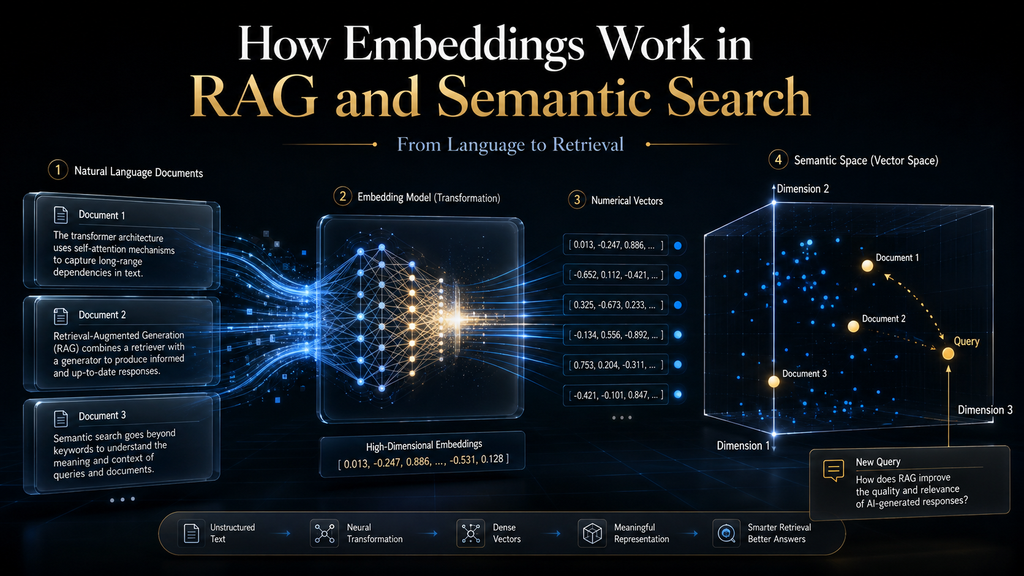
A traditional keyword search can struggle with that mismatch because the question and the document use different words. A semantic search system approaches the problem differently. Instead of relying only on whether the same words appear in both places, it represents the text numerically and compares those representations for relationships in meaning. Modern semantic-search systems commonly create embeddings for the documents being searched, create another embedding for the user’s query, and then compare those representations to retrieve the most similar candidates. (Cohere Documentation)
That is where embeddings enter the picture.
An embedding is not an answer, a database, or a miniature copy of a document. It is a learned numerical representation that allows an AI system to perform mathematical comparisons between pieces of information. In a RAG system, that capability becomes especially important because the model needs a practical way to locate potentially relevant information before it generates a response. Google Cloud describes vector databases as storing documents as embeddings in a high-dimensional space so systems can retrieve information based on semantic similarity, while current RAG workflows use those retrieval results to provide external context to the language model. (Google Cloud)
The important idea is therefore not simply that text becomes numbers. The real value is that those numbers create a representation in which certain relationships between pieces of information can be measured.
That distinction matters because embeddings are powerful, but they are not magic. A semantically similar passage can still be the wrong passage. A strong embedding model cannot repair badly constructed chunks, missing metadata, stale documents, poor filtering, or an evaluation process that never checks whether retrieval actually works. The quality of a RAG system depends on the entire retrieval pipeline, with embeddings acting as one of its most important layers.
This guide explains that layer from first principles. We will look at what embeddings are, how embedding models represent text, how query and document embeddings interact, how similarity is calculated, where embeddings fit inside RAG, why chunking and embedding quality are connected, when semantic search should be combined with keyword search, how embedding models should be evaluated, and where the technology can still fail.
What Is an Embedding?
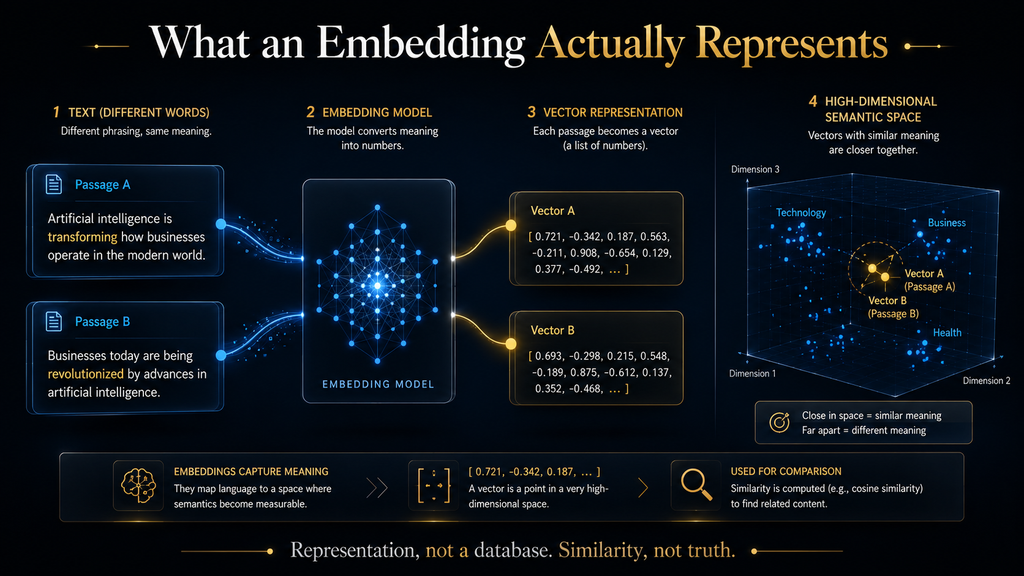
An embedding is a numerical representation of information that places the information into a mathematical space where relationships between representations can be measured.
That sounds abstract because it is. The easiest mistake is to imagine that an embedding is simply a list of numbers assigned to individual words. Modern embeddings are more sophisticated than that. Depending on the model and input, an embedding can represent a broader piece of text or other information in a way that reflects patterns learned during model training. Semantic-search systems use these representations to compare queries and stored content based on relationships that may extend beyond exact word matches. Cohere, for example, describes text embeddings as lists of numbers representing the context or meaning of text and demonstrates their use for semantic search.
Consider two sentences:
“The customer can request a refund within 30 days.”
and:
“How long do I have to get my money back?”
The words are substantially different, but the underlying subject is closely related. A useful embedding system can place their representations relatively close together because the model has learned patterns connecting the concepts involved: customer, purchase, refund, time limit, and reimbursement.
That does not mean that every individual number inside the vector corresponds to something simple such as “refund,” “time,” or “customer.” It is better to think about the vector as a coordinated representation. The useful information emerges from the pattern of relationships across many dimensions rather than from interpreting one coordinate at a time.
This is an important conceptual boundary. When people say that embeddings “capture meaning,” they are using a useful shorthand, but they should not be understood as literally encoding human-readable definitions into a transparent mathematical dictionary. The model learns a representation that can support useful comparisons, and the geometry of that representation becomes valuable for retrieval.
Why numbers are useful
Computers are exceptionally good at mathematical operations. They can compare vectors, calculate distances, rank candidates, and search large collections efficiently. They are much less naturally suited to answering the question, “Which paragraph means something similar to this sentence?” using raw text alone.
Embeddings provide a bridge between those two worlds.
The original content remains language that humans can read. The embedding becomes a numerical representation that machines can efficiently compare.
That is the fundamental reason embeddings matter to semantic search.
Why Keyword Search Is Not Enough
Keyword search remains extremely useful, and it would be a mistake to treat semantic search as a universal replacement for it. Suppose a company’s documentation contains the phrase:
“Requests submitted without a valid authentication token return HTTP 401.”
A developer searches for:
“Why am I getting a 401?”
A keyword-based system can perform extremely well because the exact identifier “401” is highly informative. The same is true for product codes, invoice numbers, SKU identifiers, legal references, names, dates, and other precise strings.
The problem appears when the wording changes substantially. Consider a support knowledge base containing:
“Customers may request reimbursement within thirty days of the original transaction.”
A user might ask:
“How long do I have to get my money back?”
The searcher did not use “reimbursement,” “original transaction,” or even the word “purchase.” A purely lexical system has fewer direct signals to work with.
Semantic search is designed for this kind of situation. It attempts to represent the meaning or contextual relationships in the query and documents so that differently worded but related content can still become retrievable. Cohere’s semantic-search documentation explicitly contrasts semantic search with lexical search and demonstrates the process of embedding both documents and the query before ranking results by similarity.
This is why the strongest modern retrieval systems often do not ask, “Should we use keyword search or semantic search?” They ask a more useful question: “Which retrieval signals does this query require?”
For an exact product code, lexical matching may be the stronger signal. For a natural-language question, semantic similarity may contribute more. For a real business system containing both natural-language questions and precise identifiers, combining the two can produce a more resilient retrieval layer.
That is one reason hybrid search exists.
How an Embedding Model Turns Text Into a Vector
The process begins with text, but the embedding model does not simply count the words and assign arbitrary numbers to them.
The text is processed by a trained model that has learned patterns from large amounts of data. Depending on the model architecture and task, the input is tokenized and transformed through neural network layers that produce contextual representations. The final embedding is a fixed-length numerical representation chosen by the model’s design.
The details vary considerably between embedding models, so it is dangerous to describe one universal internal mechanism as though every provider uses exactly the same architecture. What matters for a retrieval system is the resulting representation: text that has useful relationships for the target task should become representations that allow those relationships to be detected during search.
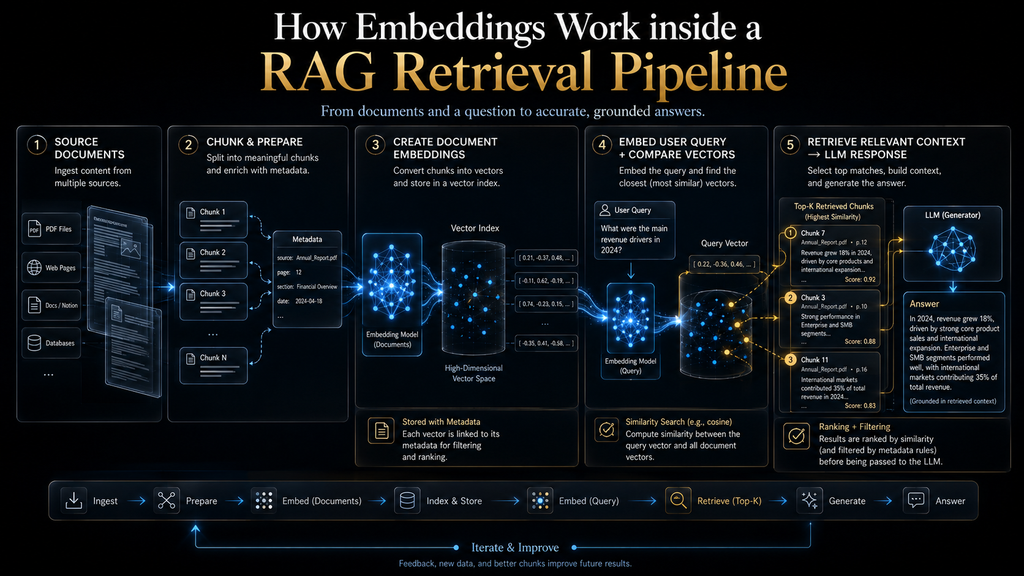
Imagine a technical knowledge base containing thousands of chunks. Each chunk is passed through the selected embedding model, producing a vector for each chunk. Those vectors can then be stored alongside the original text and metadata in a retrieval system. When a user later asks a question, the question is embedded as well, and the resulting query vector becomes the mathematical representation used to search the stored vectors.
Google Cloud’s current documentation describes this general workflow for semantic search and RAG: generate text embeddings, index those embeddings, perform vector search to find similar text, and then use the retrieved results as context for generation. (Google Cloud Documentation)
The embedding therefore becomes a kind of retrieval fingerprint for the content. It is not a fingerprint in the cryptographic sense, because similar content can have related representations and the representation is learned rather than uniquely identifying the text. The analogy is useful only because it emphasizes that the vector gives the retrieval system a compact numerical representation with which to work.
What Does “Meaning” Actually Mean Inside an Embedding?
This is where explanations often become too simplistic.
When an embedding model produces a vector, we should not imagine that it has discovered one clean numerical coordinate for every human concept. Instead, the representation reflects patterns learned across language and the relationships among concepts, phrases, contexts, and examples.
For instance, the phrases “employee compensation,” “staff salary,” and “worker pay” may be related in a retrieval space even though their vocabulary differs. But that relationship is not necessarily universal. In a specialized financial, medical, legal, or technical environment, the same words can carry different meanings depending on surrounding context.
Context is therefore critical.
Consider the word “bank.” A sentence about depositing money and a sentence about the side of a river both contain the same word, but their meanings are entirely different. A useful language representation needs to account for the surrounding context rather than treating the word as a single fixed object.
This is one reason embeddings generated from meaningful chunks are so important. A chunk containing enough context gives the model more information about what the passage is actually discussing. If a document is divided so aggressively that important qualifiers are separated from the statement they qualify, the resulting representation may no longer support the retrieval task as effectively.
This is also why embedding quality cannot be separated completely from document preparation. A sophisticated embedding model cannot infer context that has already been removed from its input.
The RAG Connection: Where Embeddings Fit
Embeddings are one component of RAG, not another name for RAG itself.
A typical RAG workflow begins with a collection of external information. That information may include documents, web pages, manuals, internal knowledge bases, databases, or other sources. Before the system can retrieve useful passages, the information usually needs to be cleaned, divided into suitable retrieval units, enriched with metadata, embedded, and indexed.
Microsoft’s RAG guidance describes a workflow in which source content is prepared and chunked before embeddings are generated and used in retrieval. Its Fabric documentation similarly describes creating embeddings from chunks, creating a vector index, and retrieving relevant chunks before generating an answer with an LLM. (Microsoft Learn)
At query time, the process works in the opposite direction.
The user supplies a question. The system processes that question and generates a query embedding. It then compares the query representation with stored document or chunk representations. The highest-ranked candidates are passed into subsequent retrieval or ranking stages, and selected context is eventually supplied to the language model.
The language model’s role comes later. This distinction is fundamental:
The embedding helps locate relevant information. The language model uses the retrieved information to generate the response.
That is why an embedding model can be excellent while the final answer is still poor. If retrieval returns the wrong evidence, the LLM has limited ability to correct the underlying retrieval failure.
Document Embeddings and Query Embeddings Are Two Sides of the Same Search Problem
A semantic search system needs compatible representations for the things it wants to search and the thing it wants to find.
During indexing, the system creates embeddings for its searchable content. If a knowledge base contains 100,000 chunks, it may create an embedding for each chunk and store those representations in a vector index or vector database.
During search, the user’s question is embedded as well.
Cohere’s current semantic-search documentation makes this separation explicit by using a document-oriented input type when embedding stored content and a query-oriented input type when embedding the user’s search query. The resulting query representation is then compared with document representations and ranked according to similarity.
This creates a simple mental model:
| Stage | Input | Purpose |
|---|---|---|
| Indexing | Document or chunk | Create searchable representation |
| Storage | Embedding + content + metadata | Preserve retrieval information |
| Query | User question | Create comparable search representation |
| Similarity | Query vector + stored vectors | Rank candidate content |
| Retrieval | Top candidates | Supply potential evidence |
| Generation | Query + selected context | Produce the final answer |
The important operational consequence is that the embedding space has to be compatible.
If you build an index using one embedding model and later generate queries using an incompatible model or representation scheme, the mathematical comparison may no longer be meaningful. Changing embedding models can therefore require more than changing one setting in the application. Existing content may need to be re-embedded and the index rebuilt.
That is one reason embedding-model selection should be treated as an architectural decision rather than a cosmetic model swap.
What Is a Vector?
A vector is simply an ordered collection of numbers. You can think of a two-dimensional vector as a coordinate such as: [3, 5] and a higher-dimensional vector as something like: [0.14, -0.72, 0.31, 0.08, …] Real embedding vectors can contain many dimensions, depending on the model and configuration.
The useful part is not the fact that the vector contains numbers. The useful part is that mathematical operations can compare vectors.
In a simple two-dimensional space, you could plot points on a graph and measure how close they are. Embedding spaces can have far more dimensions, so we cannot visually draw the entire space, but the mathematical principle remains useful: representations can be compared according to a chosen similarity or distance measure.
Google Cloud describes vector databases as storing embeddings in a high-dimensional space for retrieval based on semantic similarity.
The phrase “high-dimensional space” can sound intimidating, but the practical idea is straightforward. Instead of representing a piece of text as only a string of words, the system represents it as a numerical point in a space where relationships between points can be calculated.
How Similarity Between Embeddings Is Calculated
Once the system has a query vector and a collection of document vectors, it needs a way to determine which vectors are most relevant to the query.
There is no single universal similarity calculation that every system must use. Common approaches include cosine similarity, dot product, and distance-based measures. The appropriate choice depends on the embedding model, normalization behavior, vector index and implementation.
Cosine similarity
Cosine similarity compares the angle between two vectors rather than simply comparing their raw magnitudes. If two vectors point in similar directions, their cosine similarity can be high.
That makes cosine similarity intuitive for semantic retrieval because the direction of a representation can matter more than its absolute length in many embedding setups.
Dot product
The dot product multiplies corresponding dimensions and sums the results. Depending on how the vectors are normalized and how the model was designed, it can serve as an effective similarity measure.
Cohere’s current semantic-search examples use a dot-product approach to calculate similarity between a query embedding and document embeddings, then sort the results by score.
Distance measures
Another approach is to calculate how far apart vectors are under a chosen distance function. In such systems, smaller distance can indicate greater similarity, although the exact interpretation depends on the metric and implementation.
The important lesson is not to memorize one formula and assume it explains every vector search system.
Similarity is a scoring mechanism. It is not a universal measure of truth, relevance, or correctness.
That distinction becomes critical when we start looking at failure modes.
Why the Closest Vector Is Not Always the Right Answer
This is the reality check that every serious RAG builder needs to understand. Suppose a company has two policies:
- a general refund policy;
- a special refund policy for enterprise contracts.
A user asks:
“Can our enterprise customer receive a refund after 45 days?”
The general refund policy may contain many semantically related concepts: refunds, customers, purchase dates, eligibility, and time limits. It may therefore score highly against the query.
But that does not make it the correct source. The enterprise policy could contain a different rule. This is the difference between semantic similarity and contextual correctness.
A vector search system can identify a passage that is conceptually related to the question while missing a crucial distinction such as customer type, geographic region, product version, effective date, permission level, or policy exception. Google has specifically discussed the “question is not the answer” problem in RAG retrieval, noting that conventional similarity approaches can degrade search quality because a user’s question and the text containing its answer are not necessarily linguistically similar.
That observation has a major practical consequence: a good embedding system should not be evaluated only by whether related text appears near the query in vector space. The real question is whether the retrieval system consistently surfaces the evidence required to answer real user questions.
Embeddings and Chunking Are More Connected Than They Look
An embedding model can only represent the content it receives. That sounds obvious, but it has major implications for RAG. Suppose a policy contains this passage:
“Customers may cancel within 30 days without penalty. Enterprise contracts are subject to the terms specified in the master service agreement.”
If the document is chunked carelessly, the general cancellation rule could become one chunk while the enterprise exception becomes another. A query about an enterprise customer might retrieve the first chunk because it contains strong semantic signals around cancellation and penalties while missing the exception in the adjacent chunk.
The embedding model did not necessarily fail. The retrieval unit was poorly constructed.
Microsoft’s RAG documentation emphasizes chunking because large documents are often split into smaller chunks before embedding and indexing. The purpose is not simply to make documents shorter; the chunks become the units that retrieval searches.
This is why chunking gets its own guide, How to Chunk Documents for RAG. Embeddings and chunking should be considered connected design decisions. A strong representation of an incomplete passage is still an incomplete representation.
The practical lesson is simple: embedding quality cannot compensate for information that was removed before embedding.
Embedding Dimensions: What Do They Actually Mean?
Embedding dimensions describe the length of the vector representation.
A model might produce vectors with hundreds or thousands of dimensions, depending on the model and configuration. Those dimensions collectively provide the numerical space in which the representation lives.
It is tempting to assume that more dimensions automatically mean better semantic understanding. That is not a safe assumption. A larger vector can increase storage requirements and may affect computational cost and indexing characteristics, but retrieval quality depends on the model, training, task, data, preprocessing, similarity method and evaluation—not merely the number of coordinates.
Consider a knowledge base containing ten million chunks. If each embedding is larger, the storage and indexing requirements can become significant. At that scale, the engineering trade-off is not simply “choose the largest vector.” The system needs to balance retrieval quality against latency, storage, infrastructure and operational cost.
Some embedding systems also provide options for output dimensions or compression. Cohere’s current documentation, for example, exposes output-dimension and embedding-type choices in its semantic-search workflows.
This is another place where benchmark chasing can mislead. A dimension count is a specification, not a quality score.
How to Choose an Embedding Model for RAG
There is no universally best embedding model for every RAG application. The correct choice depends on the retrieval task, the content being searched, the languages involved, the query patterns, infrastructure constraints, latency requirements and evaluation results. A useful decision process begins with the data rather than the model leaderboard.
Start with the retrieval problem
Ask what users are actually searching for.
Are they asking broad natural-language questions? Searching technical documentation? Looking for exact product identifiers? Combining natural language with structured filters? Searching across multiple languages?
These questions change the requirements.
Examine the domain
A general-purpose embedding model may perform well on ordinary language while struggling with highly specialized terminology, internal abbreviations, product names, or technical concepts.
That does not automatically mean a specialized model is required. It means the system should be tested using the language that actually appears in production.
Consider language requirements
If the knowledge base serves users across multiple languages, multilingual retrieval becomes an important evaluation criterion. Current semantic-search systems support multilingual embedding workflows, but multilingual capability should still be validated against the actual languages, terminology and queries used by the application. Cohere documents multilingual semantic-search use cases as part of its embedding capabilities.
Consider operational constraints
Embedding quality is only one variable. A production system also cares about:
- indexing cost;
- storage requirements;
- query latency;
- throughput;
- model availability;
- infrastructure compatibility;
- update frequency;
- and the cost of re-embedding when content or models change.
The best model is therefore not necessarily the one with the strongest benchmark score in isolation. It is the one that produces sufficiently strong retrieval quality under the constraints of the actual system.
The Embedding Model Is Only as Good as the Evaluation Set
This is where many RAG projects become less rigorous than they appear. A team chooses an embedding model, tests five or ten questions, sees reasonable results, and assumes the retrieval layer is working. That is not enough.
A useful evaluation set should represent the actual questions users will ask. If your application is an internal HR assistant, the evaluation set should include realistic questions about leave, benefits, payroll, policies, onboarding and exceptions. If it is a technical support assistant, the set should contain troubleshooting questions, product versions, error codes, configuration issues and ambiguous requests.
The evaluation should also contain difficult cases rather than only obvious ones. For example, test questions where:
- the answer uses different wording from the question;
- two documents contain similar terminology;
- the correct answer depends on metadata;
- the answer is in a specific version of a document;
- the question contains an exact identifier;
- the relevant information is split across related passages;
- or the correct result should be “no relevant document found.”
That last case is especially important. A retrieval system that confidently returns something vaguely related to every question may look productive while actually increasing the risk of downstream hallucination.
A Practical Embedding Evaluation Framework
The evaluation process should measure retrieval behavior rather than simply inspecting vectors.
| Evaluation Area | What to Ask | Why It Matters |
|---|---|---|
| Relevance | Did the retrieved chunk actually address the question? | Measures usefulness |
| Recall | Was the correct evidence retrieved at all? | Detects missed information |
| Precision | How much of the retrieved set was useful? | Detects noisy retrieval |
| Ranking | Did the best evidence appear near the top? | Matters when only a few chunks reach the LLM |
| Context completeness | Did the result include necessary qualifiers or exceptions? | Prevents partial answers |
| Robustness | Does retrieval survive paraphrasing? | Tests semantic capability |
| Exact-match behavior | Can the system find codes, IDs and names? | Protects against overreliance on semantics |
| Latency | How quickly can results be returned? | Affects user experience |
| Cost | What does indexing and querying cost at scale? | Determines viability |
The goal is not to produce one impressive benchmark number. The goal is to understand where the retrieval system succeeds and where it fails.
That failure analysis should then inform changes to chunking, metadata, embedding models, filters, query processing, reranking, or the retrieval strategy itself.
Semantic Search vs Keyword Search vs Hybrid Search
The strongest retrieval architecture is often not the one that chooses one method and rejects the others.
| Search Approach | Strongest Use Cases | Common Weakness |
|---|---|---|
| Keyword / lexical search | Exact phrases, names, IDs, codes, technical identifiers | Can miss paraphrased meaning |
| Semantic search | Natural-language questions, concepts, paraphrases | Can retrieve related but incorrect content |
| Hybrid search | Systems containing both semantic and exact-match needs | More tuning and implementation complexity |
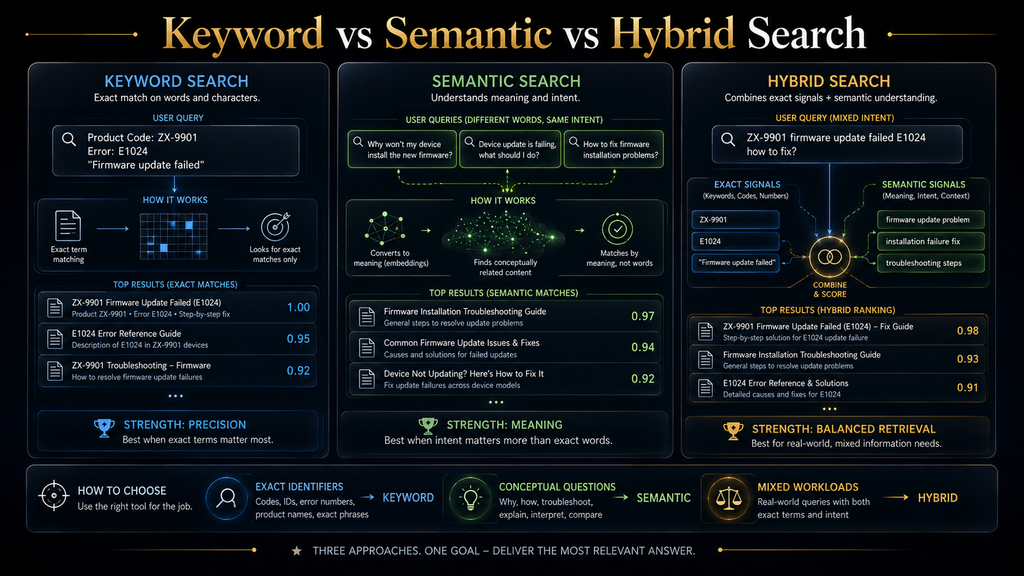
Keyword search is not outdated simply because embeddings exist.
If a customer searches for INV-94821, semantic similarity is not necessarily the most useful signal. The exact identifier is highly informative. If a developer searches for HTTP 429, exact matching may be essential.
Semantic search becomes more valuable when the query is conceptual:
“Why is the API refusing my requests after I make several calls quickly?”
The source documentation may explain rate limiting without using the same wording.
Hybrid retrieval becomes attractive when the application needs both behaviors. Google Cloud’s current retrieval documentation describes combining vector-based semantic retrieval with other search and reranking mechanisms, while its RAG materials emphasize retrieving the most relevant facts rather than assuming one search signal is sufficient.
The practical principle is: Use semantic search where meaning matters, lexical search where exactness matters, and combine them when the real workload demands both.
Why Metadata Still Matters in an Embedding-Based System
One of the most common mistakes is assuming that semantic similarity makes metadata unnecessary. It does not.
Imagine a knowledge base containing product manuals for three versions of the same software. A user asks:
“How do I configure authentication in version 7?”
A semantic search may retrieve passages about authentication from versions 5, 6, and 7 because all three discuss similar concepts. Metadata can narrow the search to:
product = X
version = 7
document type = technical documentation
Now semantic similarity operates inside a more appropriate candidate set. The same principle applies to:
- customer permissions;
- geographic regions;
- publication dates;
- departments;
- document status;
- product categories;
- language;
- account type.
This is why a serious retrieval architecture often combines semantic representations with structured filtering. The vector answers:
“What content appears conceptually relevant?”
Metadata can answer:
“Which of those conceptually relevant documents are actually eligible?”
That combination is far more powerful than asking embeddings to solve every retrieval problem alone.
Common Embedding Mistakes That Hurt RAG
Choosing a model before defining the retrieval problem
A model should not be selected simply because it is popular or has a strong public benchmark. The correct question is whether it performs well on your content and queries under your operational constraints.
Embedding entire documents without considering retrieval units
If a document contains fifty unrelated topics, its single representation can become a poor retrieval unit. The system may know that the document is broadly relevant while failing to identify the precise passage needed for the question.
That is why chunking exists.
Changing embedding models without rebuilding the index
Stored vectors belong to the representation space produced by the model that created them. If you switch models, you generally need to think about re-embedding the indexed content rather than mixing incompatible representations casually.
Assuming similarity means correctness
A related paragraph is not necessarily the right paragraph. Similarity should be treated as evidence for candidate selection, not proof that the candidate contains the correct answer.
Ignoring exact-match requirements
A semantic system may be excellent at paraphrases while being less appropriate for exact product IDs, codes or identifiers.
Evaluating with only easy questions
A retrieval system can appear excellent when tested against questions whose answers contain the same obvious vocabulary. Real users rarely behave so consistently.
Ignoring stale or conflicting information
Two documents can both be semantically relevant while one is outdated. Retrieval therefore needs freshness, document status and other metadata where the domain requires it.
Measuring only the final answer
A poor answer can originate in retrieval, ranking, context selection or generation. If the team evaluates only the final response, it becomes difficult to identify which layer actually failed.
What Happens When Embeddings Fail?
Embedding failures are not always dramatic.
Sometimes the system retrieves nothing useful. That is easy to notice.
More dangerous are the cases where it retrieves something that looks right. Consider a financial knowledge base containing a policy that says:
“Customers receive a 10% discount for annual subscriptions.”
A different policy might say:
“Enterprise customers receive a 20% discount under negotiated agreements.”
A query about enterprise annual pricing could retrieve the first passage because the vocabulary is highly related. The language model may then produce a confident answer based on the wrong policy.
This is why semantic retrieval can create a subtle failure mode: the wrong context can look convincingly relevant. The solution is not simply “use a better embedding model.” Depending on the problem, the correct fix might be:
- better chunking;
- metadata filtering;
- better query processing;
- hybrid retrieval;
- reranking;
- document versioning;
- stronger permissions;
- better evaluation;
- or a different retrieval architecture.
The expert move is to diagnose the failed layer before changing the model.
A First-Principles View of Embedding Quality
If we strip away vendor names, vector databases and model branding, the retrieval problem becomes surprisingly simple.
- You have: Information you want to find.
- You have: A question describing what you want.
- And you need: A representation that allows the system to compare the two effectively.
Everything else exists to make that comparison useful at scale.
Chunking determines what the searchable units contain. Embedding determines how those units are represented. The vector index makes large-scale comparison efficient. Metadata constrains the candidate set. Ranking determines which candidates deserve attention. Context selection determines what reaches the language model.
That means embedding quality should be evaluated as part of the retrieval system rather than in isolation. A theoretically excellent embedding model can still produce poor application results if the rest of the pipeline is badly designed.
A Practical Workflow for Building Embeddings Into RAG
A production-oriented embedding workflow can be organized around the following sequence.
1. Prepare the source content
Collect the documents and identify which information should actually be searchable. Remove irrelevant content, resolve obvious duplication, preserve useful structure, and capture metadata that may matter during retrieval.
2. Define retrieval units
Determine how the documents should be divided into chunks or other searchable units. The objective is to create units that contain enough context to answer realistic questions without becoming so broad that retrieval loses precision.
3. Select an embedding model
Choose a model based on the language, domain, retrieval task, performance requirements and operational constraints.
4. Generate document embeddings
Convert each retrieval unit into its numerical representation. Store the vector alongside the original content and the metadata needed for later filtering and interpretation.
5. Build the vector index
Index the embeddings so the system can efficiently search a large collection without comparing every query against every stored vector in a naive brute-force process.
6. Generate query embeddings
When a user submits a question, generate a compatible representation of that query.
7. Retrieve candidates
Compare the query representation with stored representations and retrieve the strongest candidates according to the selected similarity mechanism.
8. Apply filters or additional ranking
Use metadata constraints, keyword signals or reranking where the workload requires more precision than raw vector similarity can provide.
9. Select context
Choose the passages that should actually reach the language model. More retrieved text is not automatically better; irrelevant context can make downstream generation harder.
10. Evaluate and improve
Track retrieval failures, identify their causes and adjust the appropriate layer rather than changing everything at once. Google Cloud’s current BigQuery documentation demonstrates this overall pattern by generating embeddings, creating a vector index, using vector search to retrieve similar text and then using those results as input to a RAG generation step.
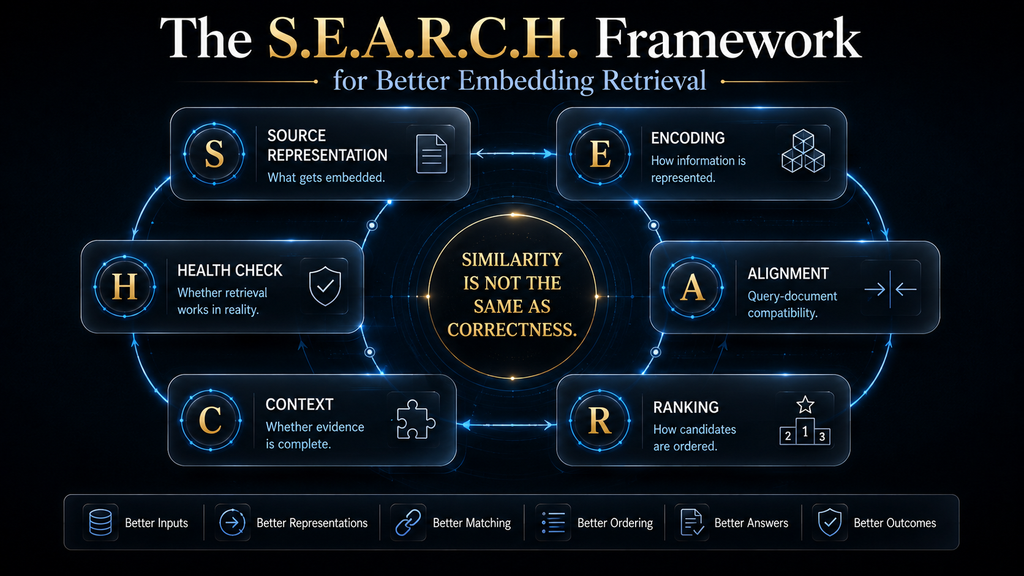
The S.E.A.R.C.H. Framework for Better Embedding-Based Retrieval
To make the entire concept easier to apply, AI Hustle World can frame the embedding layer through the S.E.A.R.C.H. framework:
| Principle | Question to Ask | Practical Meaning |
|---|---|---|
| S — Source Representation | What exactly are we embedding? | Poor source preparation creates poor retrieval units |
| E — Encoding | How does the model represent that information? | Model choice affects retrieval behavior |
| A — Alignment | Are queries and documents represented compatibly? | Query/document compatibility matters |
| R — Ranking | How are candidates compared and ordered? | Similarity is a ranking signal, not truth |
| C — Context | Does the retrieved content contain enough evidence? | Relevant-looking text may still be incomplete |
| H — Health Check | Does retrieval work on real questions? | Evaluation determines whether the system is actually useful |
The value of this framework is that it prevents a common engineering mistake: treating the embedding model as the entire retrieval system.
Suppose a RAG application performs poorly. Under this framework, you can ask whether the source was prepared correctly, whether the representation fits the task, whether queries and documents are aligned, whether ranking is appropriate, whether the retrieved context is complete, and whether the evaluation set actually reflects production use.
That is a much better diagnostic process than simply asking which embedding model has the highest benchmark score.
When Should You Use Embeddings?
Embeddings are particularly useful when the retrieval problem involves meaning, concepts, paraphrases or natural-language questions. They are a strong candidate when users might express the same underlying need in many different ways, especially when exact keyword matching would miss relevant information. Typical use cases include:
- internal knowledge search;
- customer-support systems;
- technical documentation retrieval;
- enterprise knowledge bases;
- semantic website search;
- recommendation systems;
- document discovery;
- RAG applications;
- multilingual information retrieval;
- multimodal retrieval where compatible embedding systems support images, audio or other media.
Google Cloud notes that embeddings can extend beyond text into multimodal retrieval, including images, audio and video, depending on the embedding system. But “useful for semantic relationships” does not mean “use embeddings for everything.”
When Embeddings Are Not the Best Tool
Some retrieval problems are inherently exact. If the user asks for a specific invoice number, tracking number, product code, legal citation, account identifier or error code, exact matching may be more appropriate than semantic similarity. Structured data also deserves careful treatment.
Suppose the user asks:
“Show me all orders above $500 placed in the last 30 days.”
That is not purely a semantic retrieval problem. It contains structured constraints around amount and date. An embedding might help understand the natural-language request, but a database query is better suited to enforcing exact numerical and temporal conditions.
Likewise, if a company needs strict authorization boundaries, embeddings should not be treated as the security layer. Permissions and access controls should be enforced through appropriate system mechanisms.
The broader principle is that embeddings are a representation technology, not a replacement for every other form of information retrieval.
Multilingual Embeddings and Cross-Language Search
Global knowledge systems create another challenge: the user and the source material may not always use the same language.
A multilingual embedding model can represent content from multiple languages in a way that supports cross-language retrieval, depending on the model and task. Cohere’s semantic-search documentation includes multilingual retrieval examples, demonstrating how multilingual content can participate in the same semantic-search workflow.
But multilingual support should not be interpreted as a guarantee of identical performance across every language.
Language coverage, terminology, domain-specific expressions, spelling variations and query behavior can all affect retrieval quality. A company serving Bengali, English and Arabic customers, for example, should evaluate the actual questions users ask in those languages rather than assuming a model’s multilingual label guarantees equivalent results.
The evaluation set should therefore reflect the real language distribution of the application.
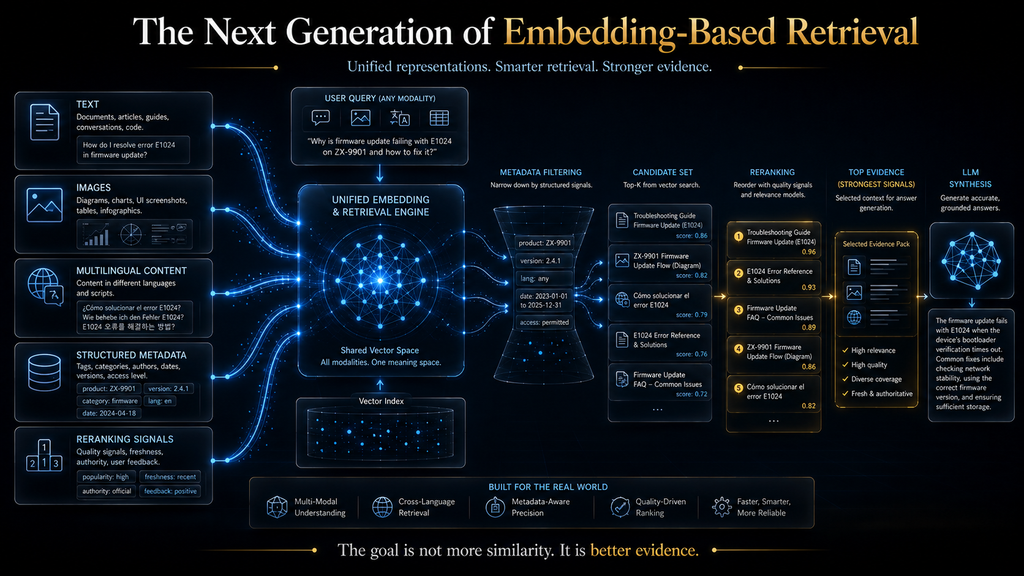
Embeddings and Multimodal Retrieval
The same general idea is expanding beyond text.
An embedding system can represent different forms of information in a mathematical space where compatible representations can be compared. Depending on the model, that can include images, audio, video and text.
This creates interesting possibilities for knowledge systems. A user might search a technical library using a textual description and retrieve an image, diagram or other multimodal source that is semantically relevant. Google Cloud describes multimodal embeddings as part of modern vector-based retrieval systems, where different media types can participate in retrieval alongside text.
The important caveat is that multimodal retrieval increases the complexity of the retrieval problem. Different media types have different information structures, and successful systems still require careful evaluation, metadata and context handling.
The underlying idea remains the same: create useful representations, compare them appropriately, and retrieve evidence that actually helps answer the user’s need.
The Cost of Getting Embeddings Wrong
A weak embedding decision does not necessarily fail at the moment the system is launched. The consequences can accumulate quietly.
A poor representation may reduce retrieval recall, which means the correct information is less likely to appear in the candidate set. Developers may then compensate by increasing the number of retrieved chunks, which can increase latency and introduce more irrelevant context. The team may add reranking to compensate, increase model context to compensate again, or modify prompts to compensate for the noisy retrieval.
Eventually, the architecture becomes more expensive and complicated because the original retrieval layer was never diagnosed properly. This is a classic second-order effect.
Poor retrieval quality can create downstream complexity that looks like an LLM problem. That is why embeddings deserve serious engineering attention even though users rarely see them directly.
Why the Traditional Method Still Matters
Keyword search exists for a reason.
It is predictable, transparent and excellent at exact identifiers. If a user enters a unique part number, a lexical system can exploit that exact signal directly. In many business applications, that behavior is more valuable than trying to infer semantic intent.
Embeddings became important because human questions are not always expressed using the same vocabulary as the underlying documents. The best modern search architecture therefore does not need to declare one side obsolete.
Instead, it recognizes that different retrieval signals solve different parts of the information problem. This is one of the reasons hybrid retrieval is becoming a practical design pattern rather than an admission that semantic search “failed.” The two methods are complementary because they answer different questions: lexical search asks whether the relevant terms appear, while semantic retrieval asks whether the underlying representations are related.
What Happens If You Ignore Embedding Quality?
If the embedding layer is weak, the most immediate consequence is lower-quality retrieval. But the damage can spread.
A missed passage means the context selector has fewer good candidates. Poor candidates mean the language model receives weaker evidence. The model may then produce a less useful response, and because the final answer can still sound fluent, the original retrieval failure may be difficult to identify.
In high-stakes or business-critical applications, that can become more than a technical inconvenience.
A customer-support assistant that retrieves the wrong policy can give the wrong guidance. An internal enterprise assistant that retrieves outdated documentation can create operational confusion. A technical assistant that retrieves the wrong version of an API guide can recommend an invalid configuration.
The practical lesson is not to fear embeddings. It is to measure them where they matter: in the retrieval outcomes that affect the actual application.
How to Improve an Embedding-Based Retrieval System
When retrieval quality is weak, resist the temptation to immediately replace the embedding model. Start by examining the failure.
If the correct information is not represented
Improve the source preparation and chunking process.
If the correct information exists but is filtered out
Inspect metadata, permissions and query filters.
If semantically related but wrong passages rank too highly
Test hybrid retrieval, better ranking, reranking or more precise metadata.
If paraphrased queries fail
Evaluate the embedding model and query-processing strategy.
If exact identifiers fail
Strengthen lexical retrieval rather than forcing semantic search to do a job it was not designed to handle.
If results vary by language
Build language-specific evaluation cases and test multilingual behavior.
If the final answer is wrong despite strong retrieval
Inspect context selection and generation rather than blaming the embedding layer. This diagnostic approach is far more efficient than repeatedly changing models without knowing which layer is responsible.
A Decision Checklist for Embedding-Based RAG
Before deploying a RAG system that depends on embeddings, ask: Source.
- Are the documents clean and current?
- Are important sections preserved?
- Is obsolete content identified?
Chunking
- Are retrieval units meaningful?
- Do they preserve important context and exceptions?
- Are they appropriately sized for the queries?
Embedding
- Does the model fit the domain?
- Does it support the required languages?
- Are query and document representations compatible?
- Have real production-style queries been tested?
Retrieval
- Are vector similarity and lexical signals used appropriately?
- Are metadata filters available?
- Is reranking necessary?
Evaluation
- Do you have representative queries?
- Are recall and precision measured?
- Are difficult edge cases included?
- Do you analyze retrieval failures separately from generation failures?
Operations
- Can the system meet latency requirements?
- Is the storage and indexing cost acceptable?
- What happens when the embedding model changes?
- How will the index be rebuilt?
If these questions have good answers, the embedding layer is being treated as an engineering component rather than a marketing feature.
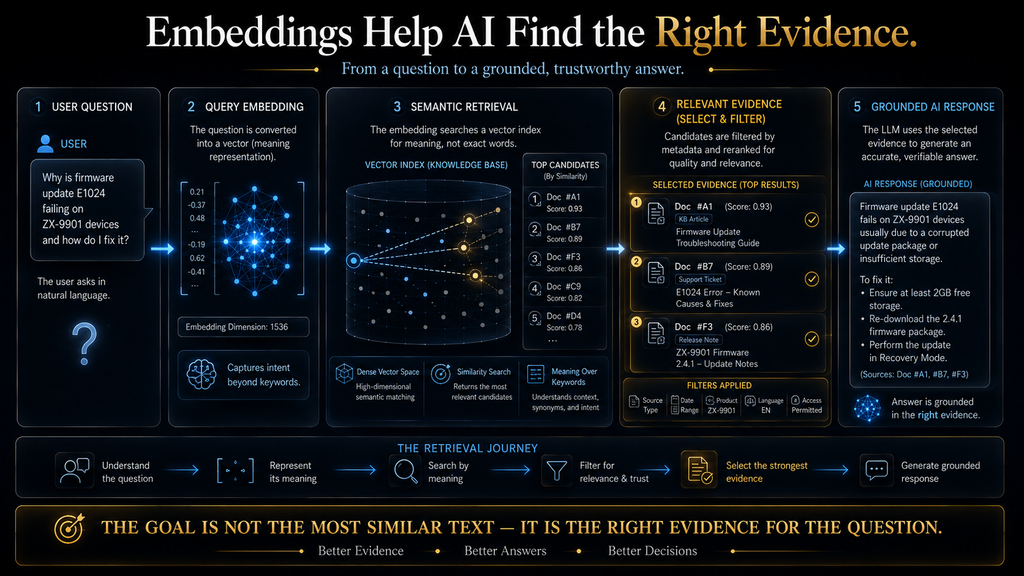
The Future of Embeddings in AI Search and RAG
Embeddings are likely to remain an important part of AI retrieval even as retrieval architectures become more sophisticated.
The direction is not simply toward bigger vectors or larger models. It is toward better task alignment.
Embedding systems are becoming more capable across languages and modalities, while retrieval systems are combining vector similarity with lexical search, structured filtering and reranking. Google Cloud’s current materials show embeddings being used in semantic search, RAG and multimodal retrieval, while current enterprise workflows increasingly treat retrieval as a multi-stage system rather than a single vector lookup.
One important trend is the movement from generic similarity toward task-aware retrieval. A search query is not always trying to find text that “sounds similar.” Sometimes it is trying to find an answer, a supporting passage, a particular entity, a recent policy, or a document satisfying multiple structured conditions.
That means future retrieval systems will likely become better at combining different signals rather than expecting embeddings to solve every problem by themselves.
Another important development is multimodal retrieval. As AI systems work with text, images, audio, video and structured data together, embeddings provide one possible mechanism for representing those different forms of information in ways that can participate in retrieval. But the engineering challenge will increasingly shift from “Can we retrieve something related?” toward “Can we retrieve the right evidence under the right constraints?”
That is a much harder problem, and it is where evaluation, metadata, ranking and system design become increasingly important.
Final Thoughts: Embeddings Are the Retrieval Layer, Not the Intelligence Layer
Embeddings can seem mysterious because they turn something as messy as human language into lists of numbers, but the underlying purpose is surprisingly practical. They give a retrieval system a mathematical representation that can be compared, indexed and ranked, allowing search to move beyond exact word matching toward relationships in meaning.
In RAG, that capability is extremely valuable because the language model needs relevant external information before it can produce a grounded response. Document chunks are represented as embeddings, user questions are represented in a compatible way, and the retrieval system uses those representations to identify candidate evidence. Modern implementations can then combine vector search with lexical retrieval, metadata filters and reranking to improve the quality of what reaches the model.
But the most important lesson is what embeddings cannot do. They do not prove that a passage is correct, current, authorized, complete or applicable to the user’s situation. They provide a representation that helps the system search. The rest of the retrieval architecture determines whether that search becomes genuinely useful.
That is why the best RAG systems do not obsess over embedding models in isolation. They treat embeddings as one part of a larger chain that begins with trustworthy source material and ends with carefully selected context.
The goal is not to find the most similar text. The goal is to retrieve the right evidence for the question.
Once that distinction is clear, embeddings stop looking like an obscure machine-learning concept and start making sense as what they really are: the mathematical representation layer that helps modern AI systems search by meaning.
Go Deeper Into AI, RAG & Modern AI Systems
Embeddings work on the chunks you give them, so learn how chunking strategies change what retrieval can find.
Learn How to Chunk Documents →FAQ
1. What are embeddings in AI?
Embeddings are numerical representations of information that allow AI systems to compare relationships between pieces of content mathematically. In semantic search and RAG, text such as documents, chunks and queries can be converted into vectors so that the system can identify potentially related information based on similarity rather than relying only on exact word matches.
2. How do embeddings work in RAG?
In RAG, documents are typically divided into retrieval units and converted into embeddings before being indexed. When a user asks a question, the query is also converted into a compatible embedding, and the system compares it with stored representations to retrieve potentially relevant context that can later be supplied to the language model.
3. What is semantic search?
Semantic search is a retrieval approach that attempts to find information based on contextual or conceptual relationships rather than relying solely on matching the exact words in a query. Embeddings provide a common way to represent queries and documents so their similarity can be measured mathematically.
4. What is the difference between an embedding and a vector database?
An embedding is the numerical representation of information, while a vector database or vector-search system is infrastructure used to store, index and retrieve those representations efficiently. The embedding provides the representation; the database or index provides a way to search a large collection of those representations.
5. Are embeddings the same as tokens?
No. Tokens are units used to process text, while embeddings are numerical representations generated from information by an embedding model. A text can be tokenized as part of processing and then transformed into an embedding, but the two concepts serve different purposes.
6. What is cosine similarity in embeddings?
Cosine similarity measures the relationship between two vectors by comparing their direction in vector space. It is commonly used to estimate how similar two representations are, although other similarity or distance measures such as dot product can also be used depending on the embedding model and retrieval implementation.
7. Does a higher embedding dimension mean better quality?
Not necessarily. A higher-dimensional vector provides more coordinates in the representation, but retrieval quality depends on the embedding model, task, data, language, preprocessing and evaluation. Larger representations can also affect storage and computational requirements, so dimension should be treated as an engineering trade-off rather than a simple quality ranking.
8. Can embeddings understand different languages?
Some embedding models support multilingual representations and can be used for multilingual semantic search. However, multilingual support does not guarantee identical retrieval quality across languages, so systems should be evaluated using the actual languages, terminology and queries that their users will produce.
9. Why can semantic search return the wrong answer?
Semantic similarity identifies content that appears related to a query, but related content is not necessarily the correct content. The retrieved passage may be outdated, belong to the wrong product or customer type, omit an important exception, or require metadata constraints that similarity alone cannot enforce.
10. Are embeddings enough to build a good RAG system?
No. Embeddings are an important part of RAG retrieval, but good performance also depends on source quality, chunking, metadata, query processing, indexing, retrieval strategy, ranking, context selection and evaluation. A strong embedding model cannot compensate for a retrieval pipeline that consistently selects the wrong evidence.
Related Guides
- Best RAG Platforms and Tools for Building AI Knowledge Bases in 2026
- How to Reduce Hallucinations with RAG: A Practical Guide
- How AI Search Engines Find and Rank Information: A Beginner’s Guide
Written by
Muntasir Ahmad Chowdhury
Founder, AI Hustle World
Muntasir Ahmad Chowdhury is the Founder of AI Hustle World, an independent publication dedicated to making Artificial Intelligence practical, trustworthy, and easy to understand. He researches AI tools, automation, customer service, productivity, and real-world business applications, helping readers make smarter technology decisions through research-driven, experience-backed content.
Expertise:
AI Tools • AI Automation • AI Customer Service • AI Productivity • Generative AI • AI Workflows
Get Smarter With AI
Enjoyed this guide? Get practical AI tools, tutorials, and honest reviews delivered to your inbox.