
Evidence: Documentation reviewed, plus one hands-on test (10 November 2026)
Last checked: September 2026 (documentation); 10 November 2026 (test)
What was done: Written from official documentation and the published sources linked in this article. One hands-on test was added on 10 November 2026: ChatGPT (Plus), Gemini (free) and Microsoft Copilot (free) cleaning and categorising a made-up shop’s product feed, shared with eight other e-commerce articles. See Our test.
Files: E-commerce test files (shop files, prompts, answer key, AI answers, score sheet and screenshots)
Affiliate links: No
How AI automates product catalog tagging and categorization is easiest to see in a retailer with 30,000 products and a simple operational problem: the products are already in the system, but the catalog does not understand them. One supplier calls an item a “Men’s Performance Runner,” another calls a nearly identical product a “Lightweight Sport Sneaker” and a third uses an internal SKU name that tells merchandisers almost nothing.
Some products arrive with detailed descriptions and dozens of attributes, while others come with a title, an image and a spreadsheet row holding little more than a model number. The products can still be sold, but every downstream system now has to work around inconsistent information. Search filters miss items, marketplace feeds get rejected and merchandising teams spend hours fixing records by hand instead of building collections.
That problem grows expensive as the catalog grows. Someone has to decide which categories each product belongs to, which attributes to extract, which tags to attach and how products map into the external taxonomies used by marketplaces and advertising platforms. At a few hundred products a merchandiser can handle much of that manually, but at tens or hundreds of thousands it becomes a permanent data-maintenance operation.
AI changes the economics, though not quite as “AI product categorization” suggests. Asking a model to pick a category from a title works for simple cases but misses the larger opportunity, which is turning inconsistent product information into structured product knowledge that other systems can use. This guide covers categorization, tagging, attribute extraction, taxonomy mapping, confidence gates, validation and the feedback loops that make automation reliable.
The Catalog Problem AI Is Solving
Product categorization exists because ecommerce systems need structure. A customer may think of a product as “that black waterproof trail shoe,” but a store, marketplace, search engine, recommendation system, inventory platform and advertising system all need more formal representations of the same item. One system needs a category hierarchy, another needs attributes such as material or size and a third needs a specific external taxonomy value.
That is why catalog work has traditionally been manual. Someone has to translate messy commercial information into a structure software can interpret consistently. The job involves more than typing labels into a spreadsheet: it means deciding what the product is, which distinctions matter, what belongs in an attribute rather than a category and which external taxonomy node represents the item best.
The difficulty is that product data is usually written for commercial purposes before machine understanding. Suppliers write titles to identify products, merchandisers write descriptions to sell them, manufacturers use their own terminology and marketplaces impose their own classification systems. Our guide to AI product data for search explains why that gap matters more as AI search grows.
Take a hypothetical entry: “ProFlex X7 Men’s Outdoor Performance Shoe, Black/Red.” Someone who knows the brand may recognize a trail-running shoe at once, but the title does not establish that. “Outdoor performance” could mean hiking, trail running or general training. If the description mentions a lugged outsole for uneven terrain, the case strengthens, and if the image shows trail construction, another signal appears.
The classification problem is therefore about combining evidence rather than finding the right keyword. That is the first principle behind useful catalog automation, and it shapes every design choice that follows, from the inputs a model receives to the way its output is checked before it reaches the live catalog that customers and partner channels depend on.
Categories, Tags, Attributes and Taxonomy Mapping Are Different
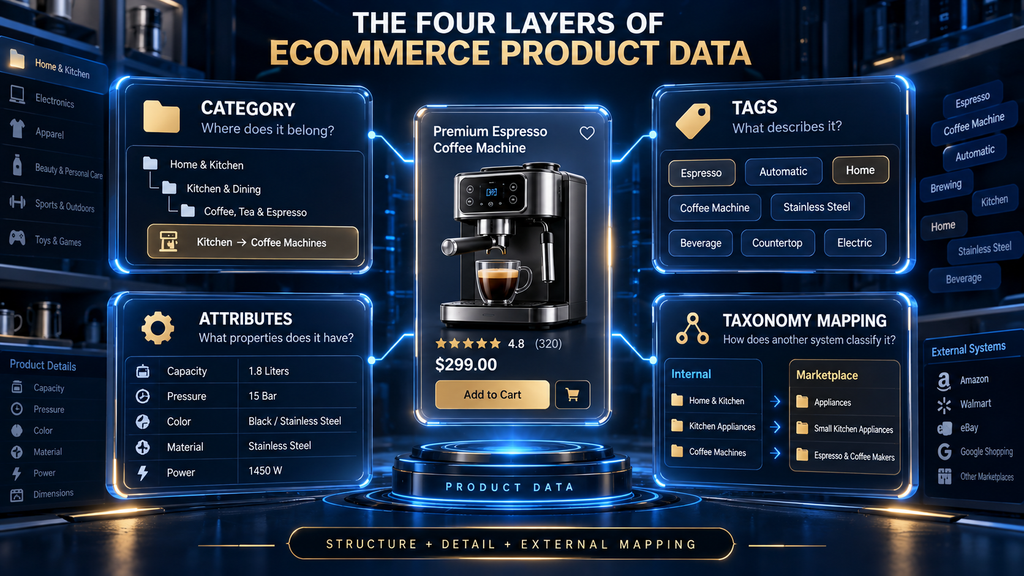
Catalog projects often become messy because teams use “category,” “tag,” “attribute” and “product type” as if they meant the same thing. A category answers where a product belongs in a hierarchy. A tag adds descriptive information that helps organize or retrieve it. An attribute is a structured property such as material, colour, size, compatibility or capacity, and taxonomy mapping links your classification to another organization’s system.
Take a hypothetical coffee machine. Its category might run from Home Appliances to Kitchen Appliances to Coffee Machines. Its attributes might include type (espresso machine), capacity (1.8 litres), pressure (15 bar), milk system (automatic) and colour (stainless steel). Its tags might be espresso, automatic, home barista and stainless steel, and a marketplace feed needs a mapping to that marketplace’s taxonomy.
Each layer serves a different purpose. Turning every attribute into a category makes the taxonomy deep and hard to maintain, while turning everything into free-form tags strips out the consistent structure downstream systems need for filtering, reporting and integration. Keeping the layers distinct is what lets one product record serve search, filters, feeds and recommendations without contradictions.
Google Merchant Center shows the distinction clearly. Its google_product_category attribute uses Google’s own predefined taxonomy, and Google says all products are automatically assigned a category from that taxonomy. Its separate product_type attribute lets merchants describe their own internal categorization, which may differ.
The lesson for AI is that the model must be told what kind of decision it is making. Asking it to “categorize this product” without saying whether you want an internal category, an external taxonomy node, a tag or an attribute creates ambiguity before the model starts. Clear task definitions are the cheapest accuracy improvement available, and they cost nothing but a few minutes of planning.
Our Test: Can ChatGPT, Gemini and Copilot Clean and Categorise a Product Feed?
On 10 November 2026 I gave ChatGPT (Plus plan, effort High), Google Gemini (free, Auto) and Microsoft Copilot (free, Auto) a 14-row product feed from Fernwick & Pell, an outdoor-gear shop that does not exist, and asked each to clean it for Google Shopping and put every product into one of eight categories.
The feed had the usual mess: colours written four ways (navy blue, GRY, blk, Rd), sizes as Large, lrg and Med, weights in grams and kilograms, and a keyword-stuffed title in capitals. It also had four harder problems planted on purpose.
One product ID appeared twice with two prices (GBP 39 and GBP 42). Two rows had no barcode (GTIN). One barcode had a wrong check digit. And a gift card, with no colour, size or weight, sat among the physical products. This one test is shared by nine e-commerce articles on this site; the files, prompts, answer key, every AI answer in full and the score sheet are on the e-commerce test files page.
| Check | ChatGPT | Gemini | Copilot |
|---|---|---|---|
| Colours, sizes, weights, titles | All fixed | All fixed | All fixed |
| 12 physical products categorised | All correct | All correct | All correct |
| Duplicate ID with two prices | Removed, kept GBP 39 and asked to confirm | Called GBP 42 “incorrect” with no evidence and left both rows | Removed, kept GBP 42 and asked to verify |
| Missing barcodes | Left blank | Copied the size S barcode onto the size M top | Left blank |
| Barcode with a wrong check digit | Flagged | Missed | Missed |
| Gift card | Left out of the categories, with a note | Put in Accessories, no note | Put in Accessories as “the closest available category” |
| Score | 8/8 | 4/8 | 7/8 |

The routine clean-up was easy for all three. Every tool turned the four colour spellings into one name, converted 0.43kg to 430 g, rewrote the keyword-stuffed title and put the 12 physical products in the right categories.
The differences were in the problems that need a person to decide. Gemini picked one of the two prices on its own, said the other was wrong, and still left the duplicate row in its “cleaned” table. Then it filled a missing barcode by copying the barcode of a different size.
A shared barcode is worse than a blank one: a GTIN identifies one exact product, so two sizes sharing one look like the same item to Google. ChatGPT was the only tool to check the barcodes themselves: it caught the bad check digit and warned that codes starting with 2 are for in-store use and won’t be accepted by Google Merchant Center.
Limits: one run per tool; a small made-up shop with problems planted on purpose; general chatbots, not e-commerce platforms or forecasting software; results can change when models are updated.
Let AI do the colour, size and unit clean-up, then check every row where it says it “filled in” or “corrected” a value. Those were the rows where the tools made decisions that should have been yours.
Why Manual Categorization Eventually Breaks
Manual categorization persists because people are often better than simple rules at interpreting incomplete information, not because ecommerce teams never discovered automation. A merchandiser can recognize “UltraFlex 2.0” from knowledge of the brand and supplier, notice that “trainer,” “sneaker” and “athletic footwear” mean the same thing and stop when a description contradicts the title.
The problem is that human judgment does not scale cheaply. As the catalog grows, the organization trades consistency against speed. New products wait in intake queues for classification, supplier updates require thousands of records to be reviewed and marketplace taxonomy changes force new mapping exercises. Meanwhile, different employees make slightly different decisions about the same product, and nobody notices until reports disagree.
That inconsistency compounds. Search filters depend on attributes that may be missing, merchandising reports depend on categories applied unevenly, product feeds depend on correct mappings and recommendation systems receive weaker product representations. Manual classification becomes expensive because inconsistent decisions accumulate into infrastructure debt, on top of the cost of slow human review.
AI is attractive because it can apply one classification policy consistently across large volumes. That only works if the policy itself is clear. A model will faithfully reproduce whatever ambiguity exists in the rules it is given, so the work of defining categories, attributes and boundaries has to happen before automation, not after the first wave of bad data reaches the store.
How AI Classifies a Product
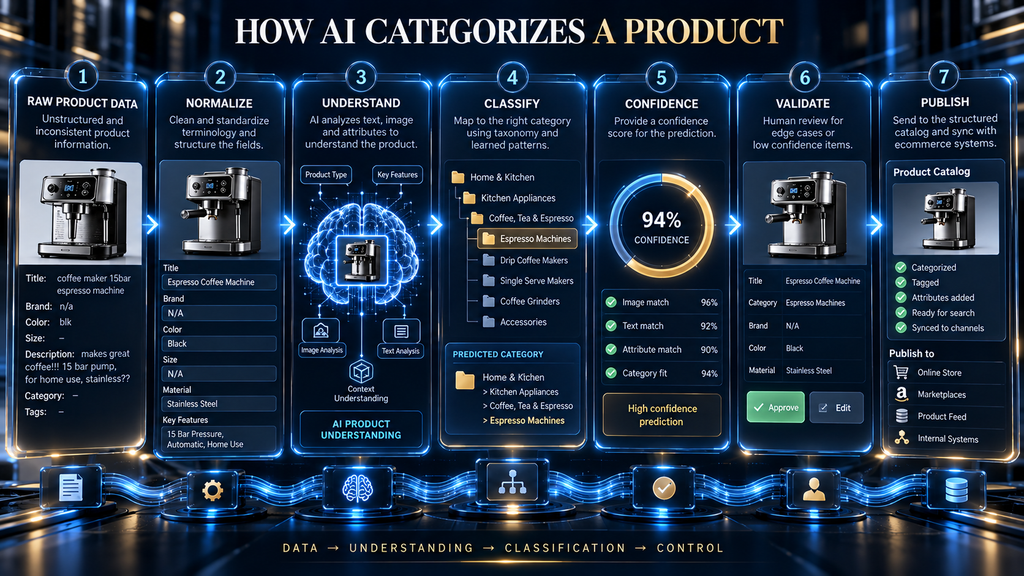
Technically, AI product categorization is best understood as a sequence of transformations rather than one prompt. Raw product data is normalized, relevant signals are extracted, the product is compared against a taxonomy, a prediction is generated and the result is evaluated before it reaches the live catalog. Each step can fail independently, so each needs its own checks and logging.
The model may receive only a title and description, but a stronger system adds structured attributes, brand information, existing classifications, identifiers and images. Vision-language models add visual evidence alongside text, which helps when an image shows details the written data omits. Our guide to how embeddings work in semantic search explains the representations behind many of these systems, and our explainer on vector databases covers how they are stored.
Shopify has described this evolution in its post on the evolution of product classification. Its system moved from basic categorization to an AI framework built on Vision Language Models and the Shopify Product Taxonomy, which classifies products, extracts attributes and processes more than 30 million predictions a day to improve search, discovery and trust.
That scale shows what changes when classification becomes infrastructure rather than an occasional admin task. The AI is building structured representations of products that support search, discovery and recommendations, not just producing a label. Shopify merchants see the result directly, because the Standard Product Taxonomy asks every product to be assigned a specific category.
The same principle works at much smaller scale. A retailer with 20,000 products does not need Shopify’s volume to benefit from the architecture. It needs a reliable way to turn its own product information into consistent decisions, with clear rules for what happens when the evidence is strong, what happens when it is weak and who reviews the cases in between.
Input Quality Still Matters More Than AI Hype Suggests
AI does not remove the need for good product data. In many cases it makes data quality more visible. Suppose a model receives a title, a two-word description, no attributes and a generic image, and the business expects it to choose between “Outdoor Equipment,” “Camping Equipment” and “Hiking Accessories.” A capable model can guess, but there may not be enough evidence for a defensible decision.
Compare that with a record holding a title, detailed description, manufacturer category, material, intended use, dimensions, compatibility information and a clear image. Now the model has several independent signals that can reinforce or contradict each other. That is why a classification pipeline should treat product information as evidence to weigh rather than text to summarize, and should record which evidence drove each decision.
A useful input hierarchy usually starts with the title and description, then adds structured attributes and metadata, then visual information where relevant. Existing category assignments can serve as context, but they should not be trusted automatically, because the purpose of the project may be to repair exactly those historical classifications. Weight each source by how reliable it has proved in your own catalog.
Google’s guidance makes a similar point, saying that high-quality, on-topic titles and descriptions, along with accurate pricing, brand and GTIN information, help ensure products are categorized correctly. When a classifier produces poor results, the first question should often be what evidence the model was not given, before anyone starts shopping for a more expensive model.
From Classification to Product Understanding
More useful systems go beyond assigning a single category. Take the input “Women’s waterproof trail running shoe, breathable mesh upper, Vibram outsole, 8 mm drop.” A simple classifier might return “Women’s Running Shoes.” A product-understanding workflow can return a full record: category Women’s, Athletic Footwear, Trail Running Shoes, material mesh, water resistance waterproof, outsole Vibram, drop 8 mm, activity trail running and audience women.
Each of those outputs can then serve a different system. Search can use activity and product type, filters can use waterproofing and material, merchandising can group by activity, marketplace feeds can map the category to their taxonomies and recommendation systems can use attributes to judge similarity. The category is the skeleton, while attributes and tags provide the detail that makes the catalog useful.
Structured attributes also help AI-facing channels. Schema.org’s Product vocabulary defines properties such as brand, GTIN, material and colour that sites use in structured data, and consistent catalog attributes make that markup far easier to generate accurately. Our guide to optimizing for Google AI Overviews and AI search covers the search side.
The Hardest Part Is Often the Taxonomy
One less obvious reality of catalog automation is that poor classifications do not always mean the model needs upgrading. Sometimes the problem is that the organization’s own taxonomy is poorly defined. Picture a retailer with four categories called Running Shoes, Sports Shoes, Training Shoes and Performance Shoes. If merchandisers cannot agree what separates them, no model can learn a clean boundary.
That is not primarily a machine learning problem. The organization has created overlapping concepts and expects a model to discover boundaries people have never defined consistently. AI cannot remove ambiguity that exists in the business structure. It will reproduce it, often confidently, which makes the resulting errors look authoritative and harder to spot during a quick review.
The issue grows when mapping between taxonomies. Google requires google_product_category values to match its predefined taxonomy, while a merchant’s product_type structure can differ, so the business needs a deliberate, maintained relationship between internal and external categories rather than assuming they are interchangeable. Define the classification system before automating it, because a taxonomy you cannot explain to a reviewer is not ready for automation.
The Confidence Problem: AI Should Know When to Stop
A classification system becomes much safer when it can express uncertainty. Take three records. The first says “Men’s waterproof trail running shoes,” and the category is fairly clear. The second says “Men’s outdoor performance footwear,” and several categories could apply. The third says only “X-Pro 4000,” and without more information the system has no reliable basis for a decision.
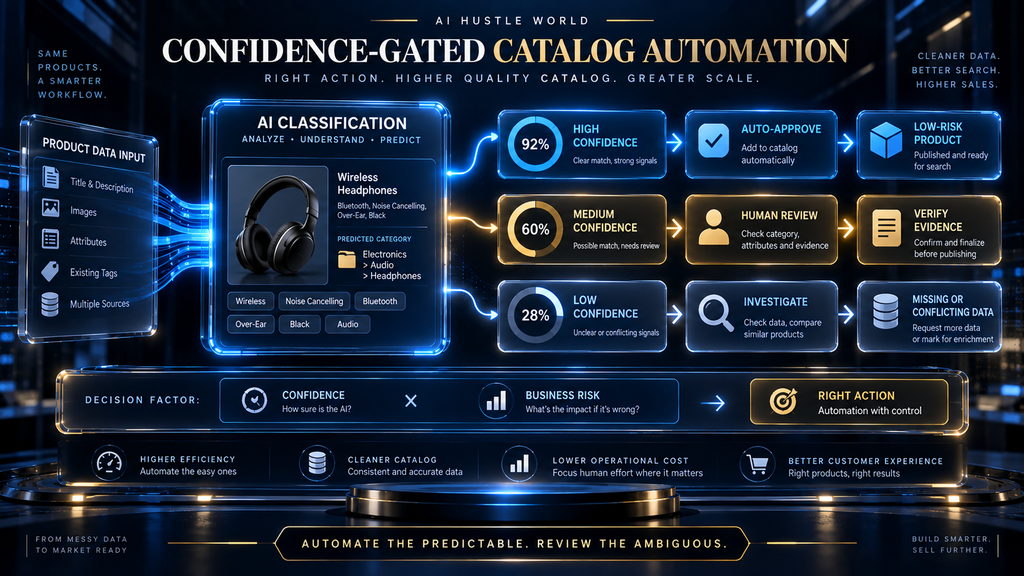
Treating all three predictions equally is a mistake. A useful workflow places a confidence gate between the AI prediction and the live catalog. High-confidence classifications can move automatically when the category is low-risk. Medium-confidence ones go to a human review queue with the AI’s suggestion and evidence, and low-confidence cases are held for investigation or data enrichment rather than forced into a category.
Amazon Business described this principle in its post on enhanced product categorization. In 2024 it deployed a multi-class hierarchical model with a classification decision threshold above 95%, and reported 91.6% accuracy at the family-code level, the third most granular of four tiers. Those figures describe Amazon Business’s own system, not a general benchmark.
The broader lesson matters more than the numbers: confidence thresholds are part of system design. The model produces a prediction, and the business decides what confidence level is sufficient for that prediction to become an automated action. Our guide to human-in-the-loop AI explains how to set those thresholds and design review queues that people use carefully.
The Confidence-Gated Automation Model
A practical way to design the workflow is to split classification into three operating zones. In the high-confidence zone, the product has strong supporting evidence, the predicted category is clearly defined and a mistake would be acceptable, so the system can approve automatically. In the review zone, the prediction is plausible but another category remains credible or important information is missing.
Items in the review zone go to a reviewer with the AI’s suggested classification and the evidence behind it, so the reviewer validates rather than starting from scratch. In the low-confidence zone, the model cannot reach a defensible classification. Instead of forcing an answer, the workflow flags the record for investigation, enrichment or manual classification, and logs why it stopped.
The model becomes stronger when confidence is combined with business risk. A high-confidence prediction for a low-consequence internal category may be safe to automate. A high-confidence prediction for a product where a wrong taxonomy could cause regulatory, operational or commercial harm, such as age-restricted or hazardous goods, may still deserve review before it goes live.
The decision rule is therefore not “approve when confidence exceeds X.” It is whether the evidence is strong enough and the consequence of being wrong acceptable enough to automate that decision. That two-part rule is a more durable way to design any AI workflow, because it keeps automation tied to business risk rather than to a single number that looks reassuring on a dashboard.
The Automation Ladder: From Assistance to Infrastructure
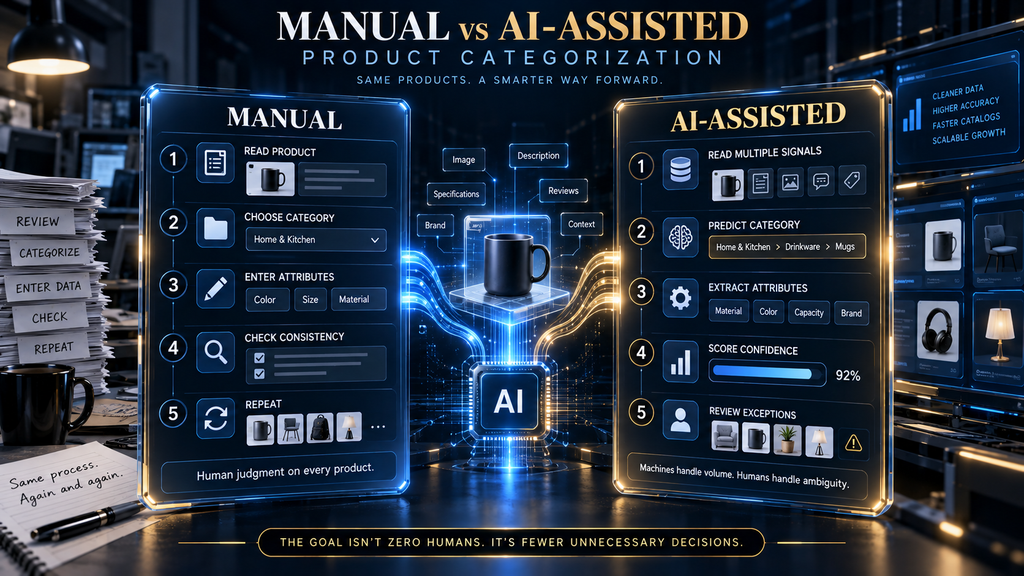
Businesses also make a strategic mistake when they treat automation as binary. A catalog does not need to be either fully manual or fully autonomous, because there is a progression between the two. At the first level, AI acts as an assistant that suggests categories and tags while a person approves every result, which already cuts repetitive work because reviewers validate instead of typing.
At the next level, the business identifies predictable categories where AI performs consistently. High-confidence predictions in those areas are approved automatically, while uncertain cases still reach reviewers. Eventually some product groups run with very little manual intervention. People have not disappeared. Their role shifts from classifying every product to managing taxonomy definitions, reviewing exceptions and monitoring quality.
The goal of automation is to reduce unnecessary human decisions rather than eliminate human judgment. For a catalog with many obvious products and a smaller number of difficult ones, that approach changes where the team spends its time. Instead of confirming predictable classifications for hours, merchandisers focus on the records where their expertise changes the outcome and on improving the rules themselves.
Where AI Classification Fails
Failure cases separate a serious implementation from an impressive demo. Models perform best when descriptions use the same language as the taxonomy and struggle when source data is vague, contradictory, incomplete or written in unfamiliar terms. Supplier language is a common culprit, because manufacturers describe products in engineering terms while retail taxonomies are organized around customer use.
Ambiguous products create another problem. A cross-training shoe may suit gym work, light running and general sport, and if the taxonomy requires one primary category, the business needs a rule for choosing. The model cannot invent that policy reliably when the organization has never defined it. Missing information is riskier still, because a model asked for an answer may produce a plausible guess that is hard to detect.
Conflicting information is subtler. If the title says “Hiking Backpack,” the description says “designed for overnight trekking” and an existing attribute says “Travel Bag,” a strong system should notice the conflict and either resolve it using a defined hierarchy of evidence or route the product for review. The worst system produces a clean-looking catalog by hiding uncertainty, while a trustworthy one makes uncertainty visible.
Attribute Extraction in Practice
Attribute extraction is often where AI earns the most value, because attributes power filters, comparisons and feeds. A model reads the title, description and image, then fills structured fields such as material, colour, size range, capacity or compatibility. The key is defining each attribute with allowed values in advance, so the model chooses “stainless steel” from a list rather than inventing “steel finish” or “inox.”
Controlled vocabularies matter as much as the model. If colour can be “navy,” “dark blue” or “midnight,” filters split one colour into three and shoppers miss products. Normalizing values to a fixed list, with synonyms mapped behind the scenes, keeps filters clean. The same rule applies to units: capacity in litres, weight in kilograms and dimensions in a single, consistent format across every product.
Extraction also needs an “unknown” option. If a description never mentions waterproofing, the model should leave that field empty rather than guess “not waterproof.” Silent negatives are a quiet source of bad data, because an empty filter value hides the product from shoppers who would have bought it. Track the share of each attribute left unknown, since a high rate often points to a supplier data gap worth fixing at source.
Variants, Bundles and Multi-Category Products
Variants raise their own questions. A shoe sold in ten sizes and four colours should usually share one category, with size and colour held as variant attributes rather than separate products. If the system classifies each variant independently, small wording differences between supplier rows can scatter one product across several categories and split its reviews, stock reporting and recommendations.
Bundles and kits are harder. A camping set containing a tent, sleeping bag and stove could sit under tents, camping kits or outdoor equipment, and the right answer depends on how customers shop for it. Decide a policy, such as classifying by the primary item or using a dedicated bundles category, and give the model that policy explicitly rather than leaving it to choose a different answer each time.
Some products belong in more than one place, such as a waterproof jacket suited to both hiking and cycling. Many platforms allow one primary category plus secondary collections or tags. Let the AI propose the primary category under clear rules and suggest secondary placements as tags or collections, so navigation stays flexible without breaking reporting that depends on each product having exactly one home.
Why Accuracy Alone Is Not Enough
Suppose a classifier processes 100,000 products and gets 98,000 right. A 98% accuracy rate sounds impressive, but it does not say whether the remaining 2,000 errors are harmless or disastrous. If most errors fall in one high-value category, affect products exported to a marketplace, leave required attributes empty or break the product groups used in advertising, the headline figure hides a serious problem.
A useful measurement system goes further. Category-level precision shows how often assignments to a category are correct, recall shows how many products that belong to a category are captured and calibration shows whether high-confidence predictions deserve more trust than low-confidence ones. Operational metrics matter too: how many products need review, how often reviewers change the AI’s answer and how long each correction takes.
The metric many projects neglect is business consequence. An error with no downstream impact differs from one that sends a product into the wrong marketplace category or hides a key attribute from shoppers. The best systems measure quality at two levels, model quality and business impact, and set stricter thresholds for the categories where errors cost the most money or carry compliance risk.
The Economics of a Wrong Classification
The cost of automation is more than the cost of the model. It includes errors, review, correction, monitoring, taxonomy maintenance and downstream problems. If a reviewer needs two minutes per product, classifying 50,000 products takes roughly 1,667 hours. AI can cut the number of products needing attention substantially, but if its errors are expensive to correct, the apparent saving can vanish.
Now picture AI handling 80% of the catalog reliably while 20% goes to review. Human work remains, but it is concentrated on the difficult cases, and that can be far more valuable than pushing automation to 95% because the figure looks better on a slide. The right target is maximum useful automation at an acceptable error cost rather than maximum automation, which is one of the most important decisions to make before deployment.
The cheapest classification is the one that produces enough reliable structure to lower total operating cost without creating a new layer of catalog problems, not necessarily the one with the least human involvement. Model that trade-off with your own review times and error costs before setting thresholds, and revisit it once real correction data starts arriving from the review queue.
How Structured Product Data Creates a Flywheel
Once a catalog has consistent categories, tags and attributes, the benefits spread beyond classification. Search becomes easier to structure because products share consistent terminology, filters work because attributes are populated predictably and merchandisers can build collections from structured traits instead of hand-picking products one by one. Our overview of AI in ecommerce shows where catalog data feeds other automation.
Marketplace feeds also become easier to maintain, because products have a consistent internal form before mapping to external taxonomies. Recommendation systems benefit too. A recommendation engine gains from knowing that one product is a trail-running shoe, another a road shoe, one waterproof and another lightweight. Our guide to how AI product recommendations work explains why, and our review of AI product recommendation platforms compares the tools.
Better categorization does not automatically improve recommendations, but better structured information gives downstream systems better raw material. The result is a Catalog Quality Flywheel: better taxonomy leads to better classification, cleaner attributes, better product discovery, better product intelligence and better catalog decisions. The flywheel starts with taxonomy and data quality rather than with the model.
What a Practical Implementation Looks Like
The safest way to start is with a controlled sample rather than the whole production catalog. Take a representative group of products across suppliers, categories, data-quality levels and complexity, including obvious items, ambiguous ones, incomplete records and products where current human classifications disagree. That mix shows how the system behaves on the cases that will cause trouble later.
Next, build a reference set in which human reviewers record the expected category and key attributes for each sampled product. That set becomes the benchmark for evaluating the AI. Then review the taxonomy itself before measuring the model. If reviewers regularly disagree between two categories, resolve that ambiguity first, or the AI will simply scale the confusion across the catalog.
After that, normalize the inputs by standardizing obvious terminology, cleaning malformed fields, flagging missing attributes and deciding which fields carry more authority when information conflicts. Only then should AI classification become the centre of the workflow. The system should output more than a category where possible: extracted attributes, tags, a confidence level, supporting evidence and a flag when review is needed.
The final stage is the confidence gate, where products meeting the automation rules move forward and the rest enter review. Once the system runs, human corrections become one of the most valuable data sources available. If reviewers keep correcting the same category, the cause may be a weak model, poor source data, unclear definitions or a boundary that needs redesigning, so treat implementation as a feedback system.
A Simple Architecture for an AI Catalog Pipeline
A practical system can be organized into seven layers. The source layer holds titles, descriptions, images, supplier data, SKUs, identifiers, existing categories and attributes. The normalization layer cleans terminology, standardizes fields, handles duplicates, detects missing data and applies supplier-specific transformations. The understanding layer lets AI interpret each product across text, structured data and images.
The classification layer selects the best category or taxonomy node and extracts tags and attributes. The confidence layer judges how strongly the evidence supports each decision. The governance layer applies business rules that decide whether a result is approved, reviewed or rejected, and the monitoring layer tracks accuracy, correction rates, exceptions, taxonomy changes and downstream effects over time.
The key design choice is that the AI model sits inside this architecture rather than becoming the architecture. That makes the workflow easier to audit and change. If the taxonomy changes, the whole process does not need rebuilding. If a supplier starts sending better data, the normalization layer adapts, and if a category becomes high-risk, the governance layer can require human approval for it alone.
Many teams assemble these layers from existing tools rather than building everything from scratch themselves. Our roundup of the best AI ecommerce tools covers platforms with catalog features, and our guide to AI workflow automation tools covers the orchestration that connects sources, models, review queues and feeds.
Keeping Supplier Feeds Consistent
Most catalog chaos enters through supplier feeds, so the cheapest fix is often upstream. Build supplier-specific mappings that translate each supplier’s categories and terms into your taxonomy before AI sees the record, and update them whenever a supplier changes its format. A mapping table that converts “trainer” and “sneaker” to “athletic shoe” removes a whole class of ambiguity at almost no cost.
Score suppliers on data quality, measuring how often their records arrive with missing attributes, conflicting fields or images that do not match the title. Sharing those scores with suppliers, along with a clear data template, can improve inputs faster than any model upgrade. AI then spends its effort on genuinely ambiguous products rather than repairing the same predictable gaps from the same sources every week.
Governance, Audit Trails and Regulated Products
Every automated classification should leave a trail: the inputs used, the predicted category and attributes, the confidence score, whether it was auto-approved or reviewed and who changed it afterwards. That record makes errors traceable and lets the team roll back a bad batch quickly. Without it, a single faulty update can silently overwrite thousands of good classifications with no easy way to undo them.
Some categories carry legal or platform consequences. Age-restricted items, hazardous goods, medical devices, children’s products and items with specific labelling rules can trigger marketplace suspensions or compliance problems if misclassified. Mark those categories as high-risk in the governance layer so that every prediction touching them goes to a trained reviewer, however confident the model appears.
Taxonomy changes need governance too. When you add, merge or retire a category, record the change, update the model’s instructions and reference set and reclassify the affected products in a controlled batch. Marketplaces revise their own taxonomies periodically, so schedule a regular check of external mappings rather than discovering a change when feeds start failing or products disappear from listings.
A 90-Day Rollout Plan
In the first 30 days, clean up the foundations. Audit the taxonomy for overlapping categories, define attributes and allowed values, build supplier mappings and assemble a reference set of a few hundred representative products with agreed answers. Record baseline metrics such as time per classification, correction rates and the share of products with missing key attributes.
In days 31 to 60, run the AI in suggestion-only mode on new products and on the reference set. Compare its output against the agreed answers by category, tune instructions and thresholds and measure how often reviewers accept suggestions unchanged. This phase shows which categories are ready for automation and which need taxonomy work or better data before they can be trusted.
In days 61 to 90, switch on automatic approval for the categories that met your thresholds, keep review for the rest and monitor correction rates weekly. Expand automation category by category as evidence accumulates rather than all at once. By the end of the quarter you should know your automation rate, error cost and review workload with real numbers rather than vendor estimates.
Choosing a Model or Tool
Most teams do not need to train a classifier from scratch. Built-in platform tools, such as those tied to Shopify’s Standard Product Taxonomy, cover many simple catalogs. General-purpose language and vision models, prompted with your taxonomy, attribute lists and examples, handle many mid-sized catalogs well. Dedicated product-data platforms add supplier mapping, review queues and feed management for larger or multi-channel operations.
Whichever route you choose, test it on your own reference set before committing. Compare accuracy by category, the share of products it can classify confidently, cost per thousand products and how easily reviewers can see and correct its reasoning. A cheaper option that explains its evidence clearly often beats a more accurate one that hides why it chose a category, because reviewers fix errors faster when they can see the cause.
Who Should Automate Aggressively?
AI categorization is most useful for businesses with large catalogs, frequent new products, many suppliers, marketplace feeds, inconsistent metadata or high manual catalog-maintenance costs. It also works best when the business already has a reasonably mature taxonomy and enough historical data to show what correct classification looks like, because that history becomes the reference for testing.
Smaller stores can benefit too, but the economics differ. A merchant with 300 products adding five a week may find that a sophisticated pipeline creates more complexity than it removes, and a lightweight AI-assisted workflow may be enough. The strongest candidate is the catalog where classification volume, repetition and consistency requirements justify the cost of building the workflow, which is not always the biggest catalog.
Who Should Not Fully Automate?
A business should be cautious about full automation when products are highly ambiguous, source information is poor, category boundaries are unstable or wrong classifications carry substantial consequences. In those environments AI can still speed up research and pre-classification, but human review should remain a required step rather than an optional one that disappears when the team is busy.
The same caution applies when the organization has not agreed its taxonomy, because automating a poorly defined system only spreads ambiguity faster. If experienced merchandisers repeatedly classify the same products differently, taxonomy clarification should come before AI deployment. Human roles change rather than disappear: people define rules, review exceptions, interpret edge cases, monitor quality and decide how the catalog evolves.
Common Mistakes That Undermine Catalog Automation
One of the most common mistakes is starting with the model instead of the catalog structure. Teams get excited about what a model can classify and only later discover overlapping categories, inconsistent attributes and suppliers using incompatible terms. Another is forcing an answer for every product, when a review queue is part of responsible automation rather than a sign of failure.
Relying only on titles is a frequent weakness, because titles are written for people, suppliers or internal systems rather than classification. Descriptions, attributes, images, brand data, identifiers and product relationships all add evidence. Judging success by a single accuracy figure is another trap, since overall accuracy can hide category-specific weaknesses and expensive mistakes concentrated where the business feels them most.
Finally, teams often assume the project is finished once accuracy looks acceptable. Catalogs change, suppliers change, taxonomies evolve and assortments expand, so AI classification needs monitoring like any production data system rather than treatment as a one-time migration tool. Schedule regular reviews of correction rates by category, and retest the reference set whenever the model, prompts or taxonomy change.
What Happens If You Do Nothing?
For a small catalog, possibly nothing significant. For a growing one, the cost starts small and becomes hard to reverse. Inconsistent classifications accumulate, employees develop workarounds, spreadsheet fixes multiply and channels drift into slightly different product structures. Nobody sees the full cost because it is spread across merchandising, operations, marketing and technology teams who each absorb a share.
Eventually, improving search, filters, recommendations, marketplace feeds or analytics requires fixing the catalog first. That is the second-order effect worth watching: poor classification does not stay inside the catalog but becomes a dependency problem for every system that consumes it. The earlier a business establishes consistent product structure, the less cleanup it faces later when new channels and AI tools arrive.
That pressure is rising as conversational shopping grows. AI shopping assistants depend on accurate attributes to answer questions such as which jackets are waterproof under a certain price. Our guide to building an AI shopping assistant explains why catalog structure decides answer quality more than the assistant’s model does.

The Future: From Classification to Product Intelligence
The next stage of ecommerce AI is unlikely to be defined by whether a model can assign a product to one category or another. The more interesting direction is continuous product understanding, combining text, images, attributes, historical classifications, supplier information, external taxonomies and behavioural signals, with the product record updated as new evidence appears rather than fixed at intake.
The workflow then shifts from “new product, assign category, finish” to understanding the product, classifying it, extracting attributes, mapping taxonomies, detecting inconsistencies, monitoring changes and updating the representation over time. Shopify’s move toward broader product understanding and Amazon Business’s use of hierarchical models with confidence thresholds both point in that direction from different angles.
The long-term advantage will belong to businesses that built a clean system around the model, not those using the newest model alone: a clear taxonomy, useful product signals, measurable confidence, controlled automation, human review and continuous feedback. Those foundations also prepare a catalog for AI shopping assistants and other channels that rely on structured product knowledge.
Final Thoughts
The most useful way to think about AI product categorization is as a method for turning messy commercial information into a structured product representation the rest of an ecommerce operation can understand, rather than as a feature that fills in a category field. That shift changes the implementation strategy, from which model to buy toward which taxonomy, evidence and rules to define.
The strongest workflow uses AI for predictable volume and people for ambiguity and governance. High-confidence products move through automatically, uncertain ones are reviewed and human corrections continually reveal where the catalog, taxonomy or model needs improving. Thresholds should reflect business risk, and measurement should cover both model quality and downstream impact.
The deeper payoff comes later. Once categories, tags and attributes are consistent, they stop being isolated admin tasks and become infrastructure for search, filters, merchandising, marketplace feeds, recommendations, analytics and other AI systems. Getting AI to label products is the easy part. Getting the whole ecommerce system to understand those products consistently is where the value lies.
Build a Smarter Ecommerce AI Workflow
Product categorization is only one part of ecommerce automation. See how AI can connect product data, recommendations, customer support, inventory, and other store operations into a broader workflow.
Explore the Ecommerce AI Workflow →Frequently Asked Questions
What is AI product categorization?
It uses AI to assign products to predefined categories or taxonomy nodes from titles, descriptions, attributes, images and brands, creating consistent structure at a scale manual work cannot match.
What is the difference between AI product tagging and categorization?
Categorization places an item in a structured hierarchy, while tagging adds descriptive labels. A shoe might be categorized as Trail Running Shoes and tagged waterproof, women’s, mesh and lightweight.
Can AI automatically categorize an entire ecommerce catalog?
It can automate much of many catalogs, but full automation is not always wise. A confidence-gated workflow automates clear, low-risk items and sends ambiguous or risky ones to reviewers.
What information does AI need to categorize products?
Titles, descriptions, structured attributes, brand, identifiers such as GTINs, existing data and images. Accuracy improves when the system combines several signals rather than relying on a title.
Can AI categorize products from images?
Yes. Vision-language models such as those Shopify uses can read visual details as evidence, which helps when text is thin. Images work best combined with descriptions and attributes.
How accurate is AI product categorization?
There is no universal figure. Results depend on taxonomy, data quality, model and thresholds. Amazon Business reported 91.6% at one level for its own system, which is not a general benchmark.
Should every AI classification be reviewed by a person?
No. High-confidence, low-risk classifications can often be automated, while uncertain or consequential ones go to review. The split depends on evidence strength and the cost of errors.
What should I measure when evaluating an AI categorization system?
Category-level precision and recall, confidence calibration, correction rate, review rate, auto-approval rate, processing time and the business impact of errors, not just overall accuracy.
Can AI map products between different taxonomies?
Yes, but govern mappings with explicit rules, because taxonomies define categories differently. Google, for example, separates its own product category from a merchant’s product type.
Does AI product categorization improve SEO?
Not automatically. Better structure supports clearer pages and accurate structured data, but rankings still depend on page quality, content, technical setup and relevance to searchers.
What should a small ecommerce business automate first?
Start with repetitive classification where data is fairly consistent and categories are clear. For small catalogs, AI-assisted suggestions with human approval usually beat a full pipeline.
Related Guides
- AdCreative.ai for E-Commerce: Does the Shopify Integration Actually Work?
- AI Accounting vs Traditional Accounting: What Should You Automate?
- What Is a Large Language Model (LLM)? How LLMs Really Work
- What Is an AI Agent? A Beginner’s Guide to How Autonomous AI Works
Written by
Muntasir Ahmad Chowdhury
Founder, AI Hustle World
Muntasir Ahmad Chowdhury is the Founder of AI Hustle World, an independent publication dedicated to making Artificial Intelligence practical, trustworthy, and easy to understand. He researches AI tools, automation, customer service, productivity, and real-world business applications, helping readers make smarter technology decisions through research-driven, experience-backed content.
Expertise:
AI Tools • AI Automation • AI Customer Service • AI Productivity • Generative AI • AI Workflows
Join the AHW Test Log
One email when a new test or guide is published. It says what was checked and links to the sources. Plus Apex Daily OS, a free planner, in your welcome email.