Evidence: Documentation reviewed
Last checked: August 2026
What was done: Written from official documentation and the published sources linked in this article. Not hands-on tested.
Files: None
Affiliate links: No
AI Recruiting vs Traditional Recruiting: What Actually Works?
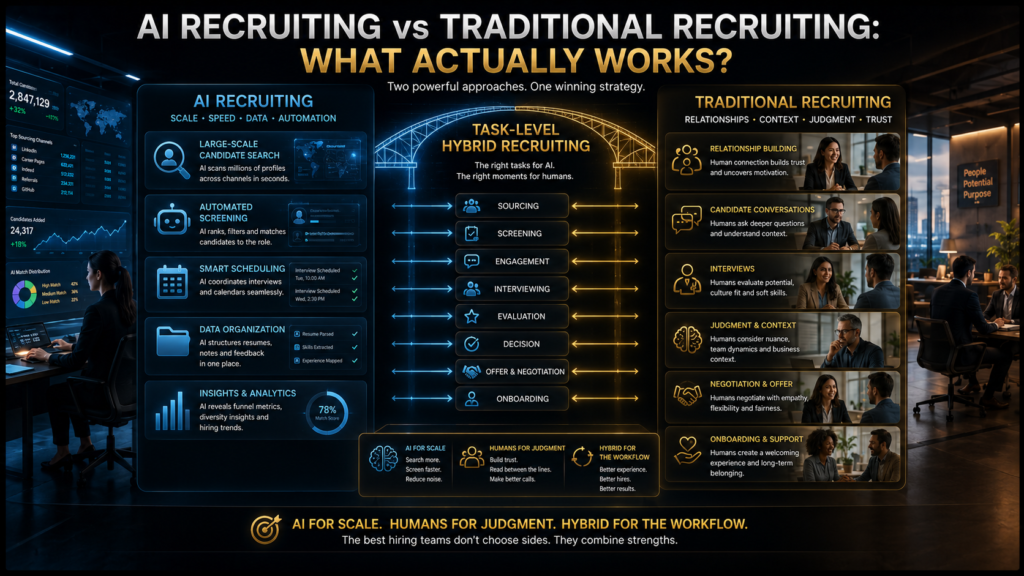
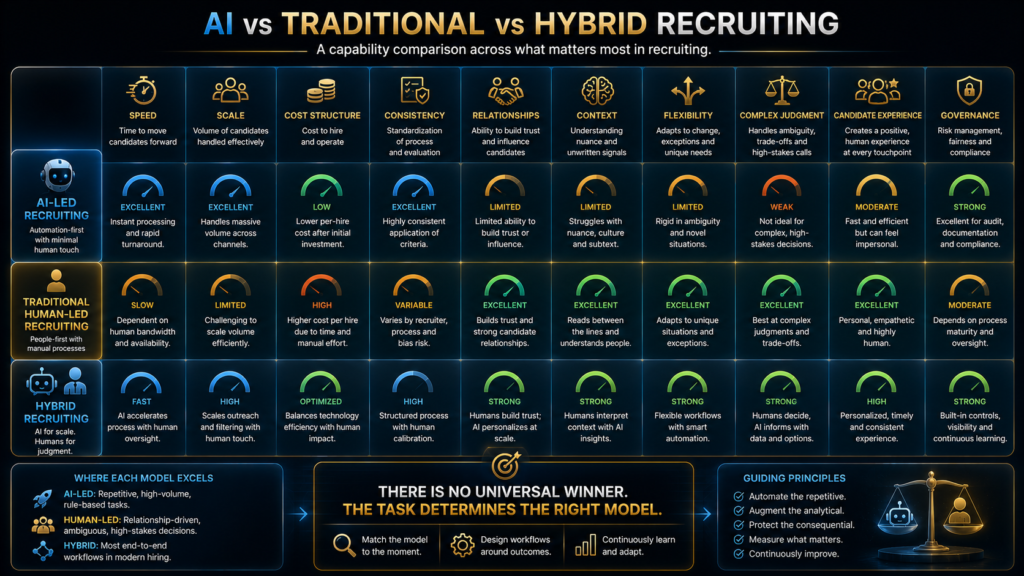
Neither AI recruiting nor traditional recruiting wins on its own. What works best is a hybrid model in which AI leads high-volume, structured, low-risk tasks such as scheduling and resume organization, AI assists with sourcing and matching, and people lead the ambiguous, relationship-heavy and high-consequence work such as interviews, negotiations and final hiring decisions.
Picture a recruiting team facing 5,000 applications for 100 open roles. The traditional approach is clear: recruiters search, screen, call, interview and coordinate. The AI approach is also clear: software searches, ranks, schedules and summarizes at scale. So executives ask which one is better, and that sounds like a sensible question until you look at what recruiting involves.
Recruiting is a chain of different jobs that happen to sit under the same function. A recruiter may spend an hour calibrating a role with a hiring manager, three hours reviewing applications, an hour scheduling interviews, several hours talking with candidates and more time negotiating offers. Some of that work is repetitive; some depends on trust and judgment.
This guide shows how to decide which tasks AI should lead, which it should assist and which should stay human. You will get the Recruiting Automation Allocation Matrix, a task-by-task comparison, the latest evidence on efficiency, bias and candidate experience, a cost model, a 90-day transition plan and the mistakes that cause AI recruiting projects to disappoint.
What AI Recruiting and Traditional Recruiting Mean
AI recruiting uses artificial intelligence to automate or assist recruiting tasks, such as sourcing, screening, matching, scheduling, communication, transcription and evaluation. Traditional recruiting relies mainly on human recruiters and hiring managers, supported by conventional software such as applicant tracking systems, job boards, spreadsheets and email.
That distinction matters because traditional recruiting was never purely manual. Recruiters have used databases, Boolean search, assessment tests and tracking systems for years. AI is being added to an existing technology stack rather than replacing a manual process. Our guide to AI in HR and recruiting explains how that stack is changing.
The real shift is that software can now interpret unstructured language, draft content, find semantic links between skills and roles, summarize conversations and coordinate multi-step workflows. That changes the economics of human attention. A recruiter who spent 40 minutes searching a database may now spend five minutes reviewing an AI-generated shortlist.
The recruiter still has to decide whether that shortlist is right, and that is where the comparison becomes interesting. Faster search is only valuable if the people it surfaces are the right people, and checking that still takes human judgment, context about the role and an understanding of what the hiring manager needs.
Why Traditional Recruiting Exists
Traditional recruiting exists because hiring involves relationships, context and uncertainty that are hard to reduce to fixed rules. A candidate might say, “I have not held this exact title, but I built the function from scratch at my last company.” On paper, that person looks weaker than someone with the exact title. In conversation, the picture can change completely.
The recruiter may learn that the role was broader than the title suggested, that the candidate managed a larger team, that the company was at the same growth stage and that the candidate already solved the problem the new employer faces. That kind of reinterpretation is a major reason human recruiters remain valuable, and it rarely shows up in a ranking dashboard.
Recruiters also do work that software does not see: persuading passive candidates, reading hesitation in a phone call, managing a hiring manager’s expectations, smoothing a difficult offer conversation and protecting the employer’s reputation in a small professional community. These activities depend on trust built over many interactions.
So traditional recruiting is not simply an inefficient version of AI recruiting. It grew around a real problem: people are hard to represent fully with structured data. AI attacks some of the operational limits of that model, such as slow search and manual scheduling, but it does not make the underlying human complexity disappear.
Where AI Recruiting Clearly Wins
AI has its strongest advantage when recruiting work is high-volume, repetitive, structured and relatively low in consequence. Consider scheduling. A recruiter adds little strategic value by checking whether Tuesday at 2 p.m. works across six calendars. Software can coordinate that faster, at any hour, without errors from copying times between emails.
The same applies to document parsing, candidate organization, search across large databases, routine status messages and interview transcription. SHRM’s research on the state of AI in HR in 2026, drawing on 1,908 HR professionals, examines which HR functions AI is shaping most, and recruiting comes out on top.
SHRM’s summary of five critical insights for CHROs reports that AI adoption in HR is concentrated in a few areas, led by recruiting at 27%, then HR technology at 21% and learning and development at 17%. In other words, recruiting is where organizations are experimenting most. That makes it the natural place to study what works and what does not.
AI also has a clear scale advantage. A recruiter can deeply review a few dozen candidates in a day, while software can process thousands of profiles quickly. That does not mean the software understands each profile correctly. It means the search and organization layer can expand dramatically, giving recruiters more computational attention for every hour of human attention.
The strongest early use cases are rarely the most impressive demos. They are the tasks where a company spends expensive human time on work that can be defined clearly enough for software to handle reliably. Our guide to AI interviewing, screening and scheduling covers these tasks in more detail. Start there before moving to anything that affects hiring decisions.
Where Traditional Recruiting Still Wins
People remain strongest when a recruiting task depends on ambiguity, relationships, negotiation, context or consequential judgment. Imagine an executive candidate who has changed industries, run a turnaround and never followed a standard career path. An algorithm may struggle to map that profile to a conventional job description, while an experienced recruiter may recognize the pattern immediately.
Offer negotiation shows the same limit. AI can prepare compensation benchmarks, summarize the candidate’s priorities and draft an offer letter. But if the candidate says, “I am interested, but I do not trust the company’s growth strategy,” the problem is no longer data matching. It is a relationship problem that needs honesty, context and credibility.
The recruiter has to understand what the candidate fears, what the company can credibly promise and how to bridge the gap without overselling. That kind of conversation depends on reading people and building trust, which is exactly where human recruiters add the most value and where errors are most costly.
None of this is an argument against AI. It is an argument for putting AI in the right place. The best results come when software clears away the administrative load so recruiters have more time for the conversations and decisions that only people can handle well, rather than less. The two strengths complement each other when the workflow is designed well.
The Recruiting Automation Allocation Matrix
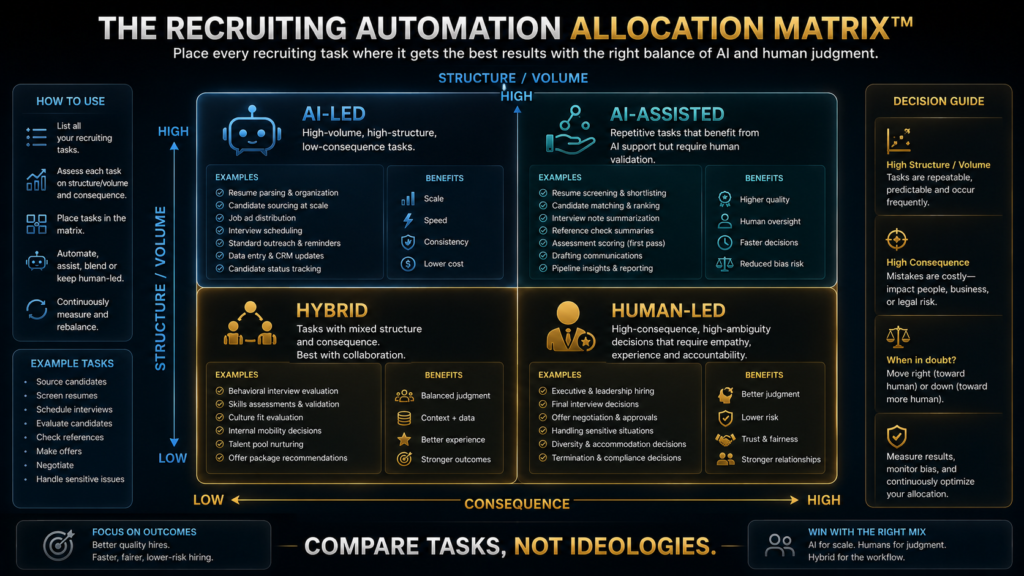
Instead of asking whether a company should “use AI,” evaluate each recruiting task on four dimensions: volume (how often it happens), structure (whether it can be defined consistently), consequence (what happens if it goes wrong) and ambiguity (how much context and interpretation it needs). This is AI Hustle World’s editorial framework.
Those four dimensions produce four practical zones. High volume, high structure and low consequence point to AI-led work. High volume with moderate ambiguity points to AI-assisted work. Mixed structure with meaningful judgment points to a hybrid approach. High consequence and high ambiguity point to human-led work.
| Recruiting condition | Best approach | Typical examples |
|---|---|---|
| High volume, high structure, low consequence | AI-led | Scheduling, reminders, document organization |
| High volume, moderate ambiguity | AI-assisted | Sourcing, matching, initial screening |
| Mixed structure, meaningful judgment | Hybrid | Interview evaluation, shortlist review |
| High consequence, high ambiguity | Human-led | Executive hiring, sensitive decisions, negotiation |
The important insight is that the boundary does not run between AI and humans. It runs between different types of work. That is a far more useful way to design a recruiting operation, because it lets you automate confidently where the risk is low and keep people in charge where the stakes are high. It also makes conversations with leadership far more concrete.
AI vs Human Across the Recruiting Workflow
Once recruiting is broken into tasks, the comparison becomes much clearer. The table below applies the matrix to a typical workflow, from writing the job description to the final decision. Your own allocation may differ, but the pattern holds for most organizations that hire at any scale. Use it as a starting point for your own audit.
| Recruiting task | Best model | Why |
|---|---|---|
| Job description drafting | AI-assisted | Fast and structured; humans set requirements |
| Candidate sourcing | Hybrid | AI widens search; humans define the target |
| Resume organization | AI-led | High volume, low consequence |
| Candidate matching | Hybrid | AI finds patterns; humans validate them |
| Interview scheduling | AI-led | Repetitive and low risk |
| Interview question drafting | Hybrid | AI drafts; humans define competencies |
| Transcription | AI-led | Administrative |
| Interview evidence analysis | Hybrid | AI structures; humans interpret |
| Candidate relationships | Human-led or hybrid | Trust and context matter |
| Offer negotiation | Human-led | High interpersonal consequence |
| Final hiring decision | Human-led | Accountability must stay with people |
This is the central argument of the article in operational form. AI does not need to win the whole workflow. It needs to win the parts where it has a genuine advantage, and recruiters need to keep the parts where their judgment changes the outcome. Winning the right tasks is enough to transform how a recruiting team spends its week.
Speed vs Quality: The Key Trade-Off
AI is usually easier to prove as a speed improvement than as a quality improvement. If an AI system cuts initial screening from 100 hours to 10, that is easy to measure. Whether the company hired better people is much harder to answer, because quality of hire can take months to observe and depends on many factors beyond screening.
Role design, onboarding, management, team fit and market conditions all affect how a new hire performs. That is why an AI system can produce impressive productivity numbers without producing equally impressive hiring outcomes. Speed and quality are related, but they are not the same thing, and one can improve while the other stays flat.
SHRM’s 2026 summary reports that 87% of HR professionals using AI saw improved efficiency and 75% saw improved work quality. Those are encouraging figures, but they are self-reported perceptions, and they do not tell you whether each organization’s hiring decisions improved. Efficiency is the easier benefit to notice and the easier one to claim.
The practical lesson is never to use time saved as a substitute for hiring quality. Track both. If AI frees up recruiter time, check whether that time goes into better candidate conversations and calibration, and whether new hires perform and stay at least as well as before. Our guide to AI job matching and skills-based hiring discusses quality measures.
Why More Screening Capacity Can Create More Noise
A common assumption is that processing more candidates means better recruiting. Not necessarily. Suppose the old process found 100 candidates worth reviewing and AI raises that to 1,000. The team still has the same limited attention, so it now faces ten times more recommendations without ten times more decision capacity.
The result can be worse decisions, not better ones. Recruiters skim instead of read, rely more heavily on the AI ranking and spend less time on each conversation. If the ranking has blind spots, those blind spots now shape far more decisions, because there is no time to check them. More output can mean less scrutiny for each decision.
The goal should not be to maximize AI output. It should be to maximize the qualified signal that reaches human attention. That means tuning tools to produce shorter, better shortlists, setting clear thresholds and measuring how many AI-recommended candidates progress, not just how many the system surfaces.
This is the difference between automation and productive automation. Productive automation reduces low-value work and improves the quality of what reaches people. Unproductive automation simply moves the bottleneck, swapping slow manual search for an overwhelming flood of recommendations that nobody has time to check properly.
Cost: AI Changes the Economics Rather Than Removing Them
AI recruiting can reduce some labor costs while adding software, integration, governance and monitoring costs. Traditional recruiting costs include recruiter time, agency fees, job advertising, coordination effort and the cost of slow hiring. AI introduces licenses, implementation work, data integration, training, testing, audits and ongoing oversight.
So the right comparison is not an AI subscription against a recruiter’s salary. A more useful formula is capacity gained plus avoided cost plus quality improvement, minus technology, integration and governance costs. That last category is easy to ignore in a sales demo and impossible to ignore once a system affects real hiring decisions.
Governance can be a legal requirement, not just good practice. New York City’s rules on automated employment decision tools prohibit employers from using such a tool unless it has had a bias audit within the past year, the audit information is public and required notices have been given to candidates. Similar rules are emerging in other places, so check where you hire.
Testing, documentation, audits and human review are essential. They belong to the cost of operating an AI recruiting system responsibly, and they should be in the budget from the start. Our guide to building an AI risk management framework explains how to plan for them. Budgeting for them early avoids unpleasant surprises after launch.
Vendor ROI Claims Need a Reality Check
The market is full of impressive numbers, such as 40% faster hiring, 50% lower cost per hire or three times more recruiter productivity. These figures are not necessarily false, but they are usually specific to one vendor and context. A vendor may measure a subset of customers, a particular role type or a period with unusual hiring conditions.
That does not make the numbers useless. It means they should be labeled as vendor-reported results rather than industry benchmarks. Ask how the figure was measured, which customers were included, what the baseline was and whether quality of hire was tracked as well as speed. A credible vendor will be able to answer.
The safest approach is to run your own pilot with your own baseline. Measure time-to-screen, time-to-hire, candidate satisfaction, quality signals and recruiter workload before and after, on a defined set of roles. Your data will tell you more about your situation than any marketing figure, however impressive it sounds.
When comparing tools, our roundup of the best AI recruiting tools separates vendor claims from documented features. Use it as a starting shortlist, then test the top two or three options against your own workflow before signing a long contract. A short, structured pilot protects you from buying the wrong system and saves money in the long run.
The Hidden Costs of AI Recruiting
AI can create operational costs that traditional teams did not have to manage in the same way. False positives waste recruiter time on weak candidates the system ranked highly. False negatives are worse, because good candidates quietly disappear from consideration and nobody notices they were ever there.
Candidate distrust can reduce application and acceptance rates when automation feels opaque or impersonal. Integration work is often underestimated, because AI tools rarely operate in isolation from the applicant tracking system and HR platform. Every connection needs setup, testing and maintenance as systems change.
Governance adds monitoring and review duties for any system that influences employment decisions. Vendor dependency can make switching costly once workflows and data are built around one product. Model changes mean a system can behave differently over time as its underlying models, data or settings are updated.
So the right question is not “how much does the software cost?” but “what is the total operating cost of this new recruiting setup?” Include these hidden costs in any business case. They do not make AI a bad investment, but ignoring them makes an investment look better on paper than it turns out to be. A realistic business case also makes the project easier to defend later.
What Happens If You Keep Recruiting Fully Manual?
The status quo has a cost too, and it is often missing from AI-versus-human discussions. If candidate volumes keep rising while the process stays manual, recruiter workload grows, administrative tasks crowd out strategic work, response times slow and candidate follow-up becomes inconsistent. These effects build gradually, which makes them easy to overlook.
Those problems have consequences. Slow processes lose strong candidates to faster competitors. Inconsistent follow-up damages the employer brand. Overloaded recruiters have less time for the calibration and relationship work that improves hiring quality, which is the very work that makes human recruiting valuable.
Manual recruiting also does not automatically solve bias. Human decisions can be influenced by affinity, first impressions, inconsistent interview standards and personal networks. So the real choice is which decision process produces the best combination of quality, efficiency, fairness and accountability.
Doing nothing is therefore a decision, and it is not free. The question is not whether to change, but which changes remove the most low-value work with the least risk. For most teams, that starts with scheduling, communication and document handling, as our guide to AI onboarding and HR helpdesks shows in a related area.
Human Recruiting Is Not Bias-Free
Replacing algorithms with people changes where bias enters rather than removing it. A human recruiter can unconsciously favor familiar backgrounds, schools, accents or career paths. An algorithm can reproduce historical hiring patterns, use proxies for protected characteristics and apply flawed rules consistently across thousands of candidates.
Stanford researchers provide a useful warning. As reported by Stanford, they analyzed a dataset of 4 million applications from an AI-based screening tool and found bias against Black and Asian candidates. In some cases, the tools rejected a candidate across several jobs at a higher rate than expected if each company assessed them separately.
The researchers called that outcome “systemic rejection.” They also said they do not yet know why the tools were biased. So the responsible conclusion is that AI hiring systems must be tested and audited with real outcome data rather than assumed to be neutral because they are software. Testing is the only way to know.
Our guide to detecting and reducing AI bias explains practical audit methods. For recruiting, the key steps are monitoring outcomes by group, comparing AI recommendations with human decisions and acting quickly when patterns appear that cannot be justified by job-related criteria. Document every audit so you can show what you checked and what you changed.
Traditional Bias vs Algorithmic Bias
The two kinds of bias look different, which is why each system needs its own checks. Human bias tends to be inconsistent and hard to measure at scale. Algorithmic bias tends to be consistent and repeated across every decision, which makes it more damaging when present but also more measurable in principle.
| Traditional recruiting | AI recruiting |
|---|---|
| Affinity bias | Data and model bias |
| First-impression effects | Automated proxy effects |
| Inconsistent interviewer standards | Consistent but possibly flawed rules |
| Network effects | Training-data effects |
| Hard to audit at scale | More auditable in principle |
| Reasoning visible in conversation | Model logic may be opaque |
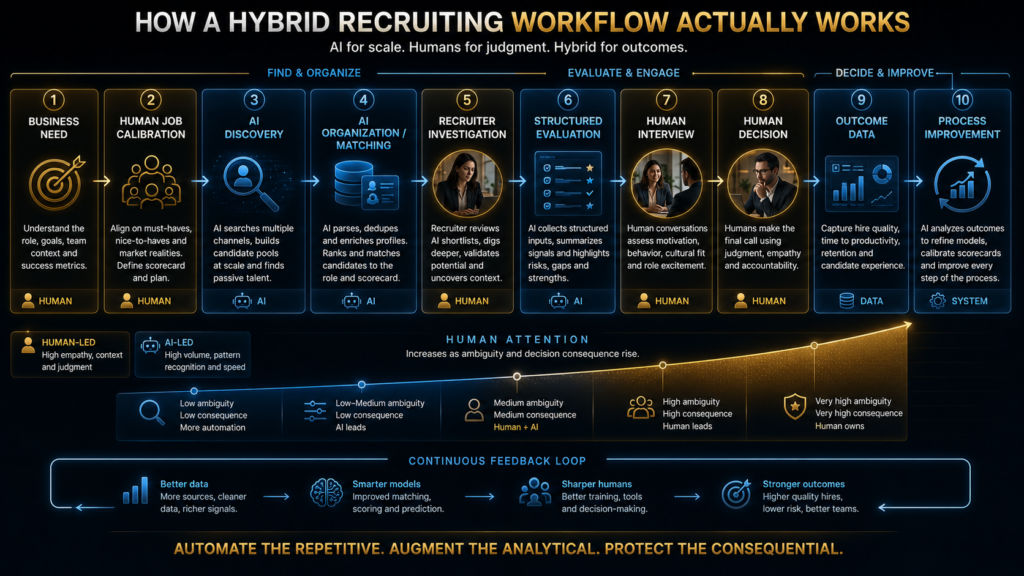
The hybrid opportunity is not to pretend either side is unbiased. It is to create multiple checks on important decisions. AI identifies candidates, recruiters review the evidence, hiring managers evaluate functional fit and the organization audits outcomes. That chain is stronger than any single person or algorithm acting as the final authority.
Candidate Experience Changes the Equation
Recruiting technology can improve efficiency while making the candidate experience worse if automation becomes opaque or impersonal. Greenhouse’s 2026 candidate AI interview report gives useful detail. Among US candidates who experienced AI evaluation, 70% said AI was not clearly disclosed before their most recent AI interview.
The same report found that 38% of US candidates had withdrawn from a hiring process because it included an AI interview. Of those who completed an AI interview, 51% never received an outcome and 38% never heard back at all. These are survey findings from one vendor, not universal industry rates, but the direction is hard to ignore.
The strategic implication is clear. AI can improve company-side efficiency while damaging candidate-side trust. That is not a successful recruiting system, because strong candidates have choices and talk to each other. A good process has to work for both the employer and the people applying. Efficiency gains mean little if the best candidates walk away.
Fixing this is mostly about design, not technology. Tell candidates when AI is used and how, give them a clear outcome at every stage, offer a human contact for questions and make sure automated messages are timely and accurate. These steps cost little and protect the employer brand. Most of them can be put in place within weeks.
Candidates Are Not Simply Anti-AI
There is an important nuance in the same research. Greenhouse found that only 19% of US candidates want less AI involvement than there is today. The more common preferences were the same level of AI with more transparency (21%) and more AI with stronger human oversight at key decision points (22%). In total, more candidates want better AI than less AI.
That changes the design question. Do not ask whether to hide AI because candidates might dislike it. Ask how to make AI understandable, transparent and accountable. Candidates mainly resist unclear and fully automated processes, not AI itself, which is good news for teams willing to design carefully. Transparency is a competitive advantage in a crowded hiring market.
In practice, that means explaining what the AI does, what it does not do and where a person makes the decision. It means giving candidates a way to ask questions or request a human review. Those commitments build trust and make the employer stand out in a market where many processes still feel like black boxes.
Candidates are also using AI themselves, to improve resumes, prepare for interviews and draft cover letters, as our guide to AI resume builders shows. Recruiting is becoming AI on both sides, which makes transparency and verified evidence even more valuable. Plan your process with that reality in mind. It also raises the value of work samples.
AI Is Changing the Recruiter’s Job
The strongest case for AI is not replacing recruiters but changing what they spend time on. The American Staffing Association’s staffing productivity report found recruiter call time reached 286 minutes per week in the first quarter of 2026, the highest on record and double the level of early 2024. That is a striking change in a short period.
The same report found recruiters used an average of 1.36 AI tools in the first quarter of 2026, up from one tool in early 2024. The association links this to relationship-building as a cornerstone of modern staffing. It is an observed association, not proof that AI caused the rise in call time. Other factors, such as market conditions, may also play a role.
Even so, it points toward a compelling operating model: AI handles more administrative work while recruiters spend relatively more time in conversation with candidates and clients. That is a very different future from one in which AI eliminates recruiters, and it is the future most worth designing for. It keeps recruiters at the center of hiring.
To track whether that shift is happening, we suggest a simple metric we call the Recruiter Judgment Ratio: high-value human recruiting time divided by total recruiter work time. High-value time includes candidate conversations, hiring manager calibration, evaluation and negotiation. If AI is working, the ratio should rise.
The Research Supports a Hybrid Model, With Caveats
A 2026 peer-reviewed study on human-AI collaboration in recruitment proposes a hybrid model in which AI supports person-job fit, while structured human evaluation handles person-organization fit. It emphasizes explainability, bias mitigation and ethical oversight. It also calls for strategic human intervention at key points.
That direction is consistent with what SHRM and the staffing data suggest: AI is most active in process-driven work, while relationships and judgment remain human strengths. But it would be wrong to claim that science proves hybrid recruiting is always best. The research is still developing, and studies vary in setting and method.
The defensible conclusion is narrower. Evidence increasingly supports task-level collaboration between people and AI as a promising operating model, while the specific allocation should be tested for each organization and workflow. Our guide to human-in-the-loop AI explains how to design that collaboration well.
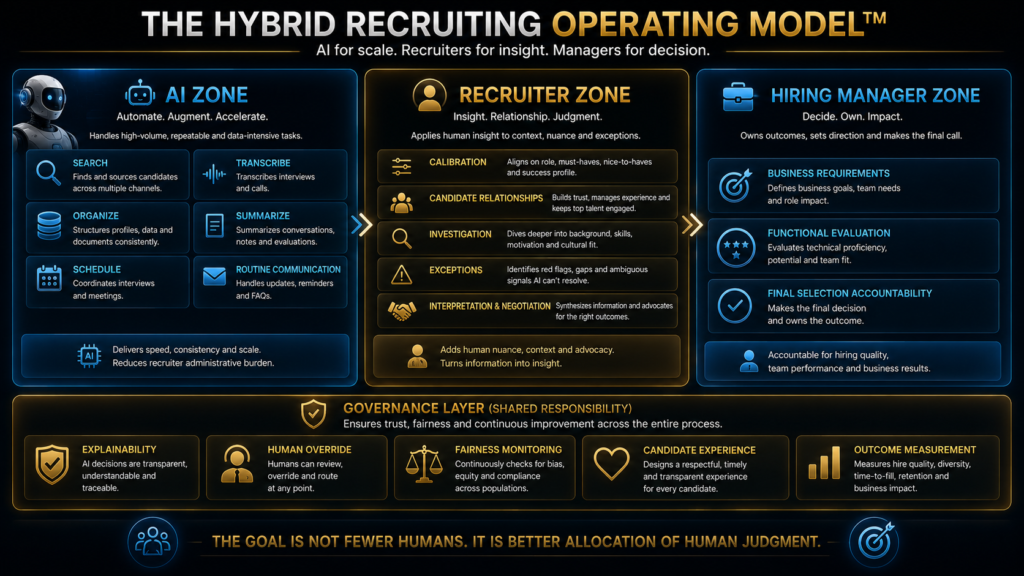
The Hybrid Recruiting Operating Model
A practical division of responsibility looks like this. AI owns high-volume search, resume parsing, scheduling, reminders, transcription and first-draft content such as job descriptions and outreach messages. These tasks benefit from speed and consistency and carry relatively low risk when errors occur. Recruiters review the output instead of producing it by hand.
Recruiters own role calibration, candidate relationships, shortlist review, interview design, evidence interpretation and offer conversations. They also own the quality check on everything the AI produces, which is where their judgment protects both candidates and the employer from automated mistakes. This is where most of their time should go.
Hiring managers own functional requirements, final interviews, team fit assessment and the hiring decision, with clear accountability. The objective is not to remove people from the process. It is to make sure each layer does the work where it has an advantage, and that every decision has a named person responsible.
The Task Is the Real Unit of Automation
Do not ask whether to automate recruiting. Ask which recruiting tasks create low-value workload and can be automated without reducing decision quality. That question leads to a simple sequence: audit each task, assess its volume, structure, consequence and ambiguity, assign it to a zone and measure the outcome after the change.
Four questions make the assignment quick. Is the task repetitive? If not, keep human involvement high. Is it clearly structured? If not, do not automate aggressively. What happens if the system is wrong? Low consequence allows more automation; high consequence needs stronger human control. Mistakes in low-risk tasks are easy to catch and fix.
Finally, does the task depend on relationships or context? If yes, use human-led or hybrid execution. Together these questions create a simple rule: the higher the ambiguity and the consequence, the more human the process should become. The lower they are, the more confidently you can automate. Apply the rule task by task, not to recruiting as a whole.
Using this approach, strong AI-led candidates include interview scheduling, reminders, status updates, document organization and transcription. Good AI-assisted candidates include sourcing, matching, screening support and interview question drafts. Human-led work includes executive hiring, sensitive cases, negotiation and final decisions.
What If You Automate Too Much or Too Little?
Automating too much creates new problems when systems move from administrative efficiency into high-consequence decisions. Outcomes can include false negatives that remove good candidates, disparate impact on particular groups, candidate distrust and recruiters who rubber-stamp recommendations they no longer have time to question.
The Stanford findings show why averages can mislead. A system can look efficient overall while producing unacceptable outcomes for a subset of candidates. That is why monitoring has to look at outcomes by group and by role, not just at overall speed or volume, and why human review must be meaningful rather than ceremonial.
Automating too little has its own costs. Recruiters spend hours copying information between systems, chasing calendars, writing routine messages and searching databases by hand. Every hour spent on that work is an hour not spent on candidate relationships, hiring manager calibration or difficult decisions where people add the most value.
The balance point differs for every organization, which is why measurement matters. Start with the safest automations, measure their effect on both efficiency and quality and expand only where the evidence supports it. That steady approach avoids both extremes and builds confidence across the hiring team.
How to Measure the Hybrid Model
A serious AI recruiting program needs more evidence than “recruiters say they like it.” SHRM’s summary reports that 56% of HR functions do not formally measure the success of their AI investments and only 16% use ROI as a metric. If you cannot measure whether AI improved recruiting, you do not know whether it worked.
Measure five areas. Efficiency: time-to-screen, time-to-schedule and time-to-hire. Quality: qualified-candidate yield, interview-to-offer ratio, new-hire performance and retention. Candidate experience: completion rates, response times, satisfaction and withdrawal reasons. Each area tells you something the others cannot.
Risk: false positive and false negative patterns, outcome differences between groups and audit findings. Recruiter experience: workload, the Recruiter Judgment Ratio and how much recruiters trust the tools. Review these measures monthly during a pilot and quarterly once a system is established. Share the results with hiring managers so everyone sees the same picture.
A useful ROI view sets value created, such as recruiter capacity, avoided agency fees and faster fills for revenue-critical roles, against technology, integration, training and governance costs. A cheap tool can still have poor ROI, and an expensive one can be rational if it removes a costly bottleneck. The question is always what valuable outcome changed.
A 90-Day Hybrid Recruiting Transition
Days 1 to 30: audit the workflow. Document every major recruiting task and rate each one for volume, time spent, variability, consequence and the value of human involvement. Do not buy software yet. The audit often reveals that the biggest time sinks are simpler than expected, such as scheduling and status updates.
Days 31 to 60: automate the safest bottlenecks. Start with scheduling, reminders, transcription and document organization. Then test whether recruiter time moved toward higher-value activities, using the Recruiter Judgment Ratio and simple time logs. If it did not, find out why before adding more automation.
Days 61 to 90: add AI-assisted decisions carefully. Introduce candidate matching, screening support or interview summaries, but run human review in parallel. Compare AI-assisted results with the previous process on the same roles, check outcomes by group and scale only where the evidence supports it. Keep notes on every disagreement between AI and reviewers.
At the end of 90 days, you should know which automations save time without harming quality, which need adjustment and which should be removed. That evidence is far more valuable than any vendor case study, because it reflects your roles, your candidates and your recruiters. Use it to plan the next quarter with confidence.
Who Should Use More AI?
High-Volume Employers and Staffing Agencies
If you hire large numbers of people for similar roles or run a staffing agency with big candidate pipelines, AI can remove a large share of repetitive coordination and search work. Your challenge is keeping quality and fairness high at scale, so invest early in monitoring and in clear human review points.
Fast-Growing and Distributed Companies
If you are growing quickly or hiring across time zones, AI scheduling and communication tools can add capacity without a matching rise in administrative staff. Use the time saved for calibration with hiring managers, which tends to slip when teams grow fast and roles change often. Clear calibration prevents costly mis-hires during rapid growth.
Organizations With Large Talent Databases
If you have years of past applicants in your systems, AI-powered rediscovery can surface strong candidates you already know. This is often one of the highest-value, lowest-risk uses of AI search, because candidates have already shown interest. Our guide to how AI finds and screens candidates explains the methods.
Who Should Stay More Human?
If you hire executives, fill highly specialized roles, run small teams with few hires a year or operate in sensitive settings such as healthcare or education, human-led recruiting deserves more weight. Each hire carries high stakes, volumes are low and relationships matter more than throughput. In these settings, a single wrong decision can cost far more than any time saved.
That does not mean zero AI. It means AI should assist rather than decide. Use it for research, scheduling, note-taking and drafting, and keep evaluation and decisions firmly with experienced people. Even in small teams, removing admin work frees time for better candidate conversations. Our comparison of AI meeting assistants covers note-taking tools that suit interviews.
Be careful with candidate data in every case. Recruiting involves personal information, and AI tools may store or process it in ways you need to understand. Our guides to AI privacy risks and AI data retention explain what to check before you upload applicant information. Candidates trust you with personal details, and that trust deserves protection.
Common Mistakes
Treating AI and Recruiters as Competitors
AI and recruiters are better understood as different capabilities. Framing them as rivals leads to poor design, either over-automating to cut headcount or rejecting useful tools to protect roles. Design the workflow around tasks, and both become more valuable. The same lesson applies in AI versus human customer support.
Automating Before Defining the Task
You can automate a bad process very efficiently. Before adding any tool, define what the task is for, what good output looks like and how you will know if it fails. Otherwise you simply produce poor results faster and at a larger scale. Fix the process first, then automate it. A clear process makes any tool work better.
Measuring Only Time Saved
Time saved is easy to measure and easy to celebrate, but hiring quality and candidate experience matter more. Track quality of hire, candidate satisfaction and fairness alongside speed, so efficiency gains do not hide declining outcomes. A balanced scorecard keeps everyone honest about what improved. Review it every quarter.
Assuming Either Side Is Objective
Human recruiters have systematic biases, and algorithms can reproduce or create disparate outcomes. Neither is neutral by default. Build checks on both, and audit outcomes by group regularly rather than trusting either side to be fair automatically. Checks on both sides make the whole system fairer. Review results by group every quarter.
Letting Recruiters Rubber-Stamp AI Output
Human review must be meaningful. If recruiters have too many recommendations and too little time, they will approve whatever the system suggests. Give reviewers manageable volumes, clear criteria and the authority to override the AI when the evidence supports it. Overrides should be recorded so you can learn from them.
Treating Candidate Experience as Secondary
Hiring is also employer branding. Candidates remember silence, confusing automation and undisclosed AI. Clear disclosure, timely outcomes and a human contact protect your reputation and help you keep strong candidates in the process. Every candidate interaction shapes how people talk about your company. Treat it with care.
Our Honest Opinion
We would reject two common strategies. “Automate recruiting” is too broad and invites risky shortcuts in high-consequence decisions. “Keep recruiting human” is too defensive and leaves recruiters buried in administrative work that software handles well. Both treat recruiting as one thing when it is many.
Instead, break the workflow into tasks, measure the volume, estimate the consequence of failure and decide where human context adds value. Then assign each task to AI-led, AI-assisted, hybrid or human-led execution, and measure the results. That is how a serious recruiting organization should adopt AI. It is slower to start but far safer to scale.
The goal is not fewer recruiters, and it is not even more AI. The goal is more high-quality human judgment per recruiter. If AI lets recruiters spend less time moving information between systems and more time talking to candidates and challenging weak recommendations, the whole organization hires better.
The Future: Recruiting Is Becoming AI on Both Sides
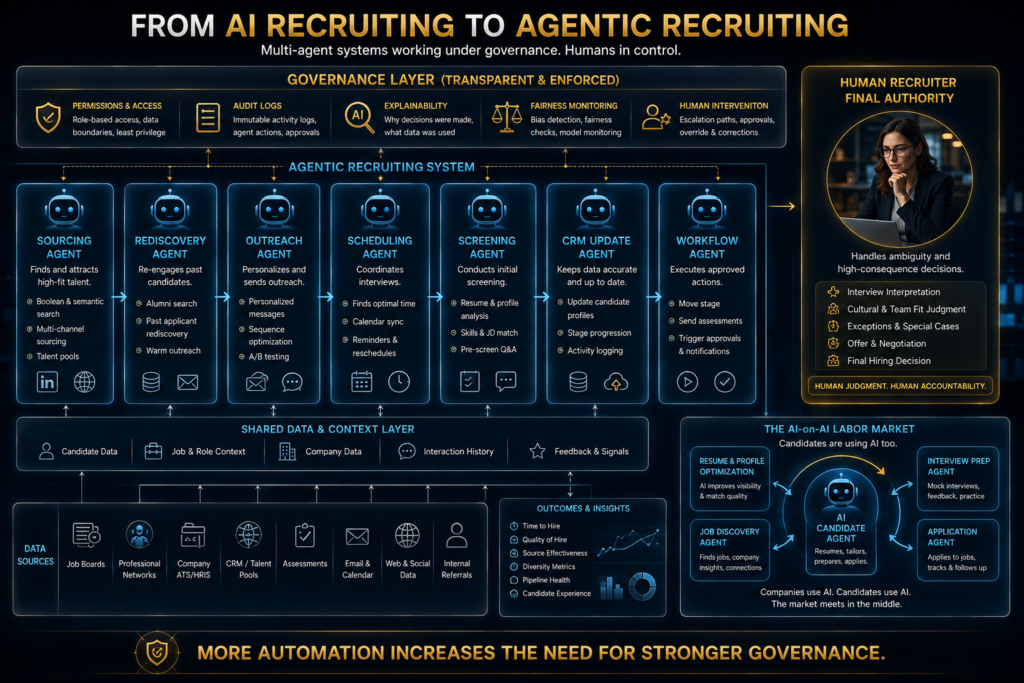
Candidates are using AI to polish resumes, tailor applications and prepare for interviews, while recruiters use AI to parse, match, schedule and summarize. As both sides adopt AI, a polished application becomes easier to produce and therefore less informative on its own. Recruiters need other signals to judge real ability.
That shifts value toward verified evidence, work samples, structured interviews and real conversations. Recruiter judgment becomes less about reading documents and more about challenging recommendations and interpreting evidence. The key question moves from “who looks qualified?” to “what does the system believe, why, and what would prove it wrong?”
Agent-based recruiting systems that coordinate several steps on their own are also emerging. Our guides to AI chatbots versus AI agents and how AI agents use tools explain how these systems work and why human checkpoints matter. Treat any autonomous recruiting step with extra caution until it has been tested on your own roles.
How We Researched This Guide
This guide is based on published research and documentation, not on hands-on testing of recruiting tools. We reviewed SHRM’s State of AI in HR 2026 materials, the American Staffing Association’s 2026 staffing productivity report, Stanford’s reporting on AI hiring bias research, Greenhouse’s 2026 candidate AI interview report, a 2026 peer-reviewed study on human-AI collaboration in recruitment and New York City’s rules on automated employment decision tools.
Survey figures are reported as their sources describe them and reflect those surveys’ samples, not the whole market. The Recruiting Automation Allocation Matrix, the Recruiter Judgment Ratio and the 90-day plan are AI Hustle World’s editorial frameworks. This article is not legal advice; check the rules that apply where you hire.
Final Thoughts
The biggest mistake in the AI recruiting debate is treating technology as the unit of analysis. The task is the unit of analysis. A recruiting organization contains dozens of activities, some needing scale, some needing structure and some needing human judgment, trust and accountability. Each needs a different mix of software and people.
The evidence reflects that reality. Recruiting is where HR uses AI most, and HR professionals report clear efficiency gains, yet most organizations do not formally measure results. Recruiter AI use is rising alongside record call time, bias risks are real and documented, and candidates want transparency and human oversight rather than no AI at all.
So the winning strategy is neither maximum AI nor maximum human involvement. It is the right allocation. Automate the scheduling, the repetitive search and the transcription. Use AI to organize candidates and surface patterns. Then put human attention on the unusual career path, the difficult conversation, the negotiation and the final decision.
Measure the result not by how busy the AI dashboard looks, but by whether the organization makes better hiring decisions, faster, without sacrificing candidate trust, fairness or accountability. Do not automate recruiting; reallocate it. To explore tools for each task, see our guide to the best AI recruiting tools.
Choose the Right AI Recruiting Workflow
AI recruiting works best when companies stop asking “AI or humans?” and start asking which recruiting tasks should be automated, augmented or kept human-led.
Explore AI Recruiting Tools →Frequently Asked Questions
Is AI recruiting better than traditional recruiting?
Neither is better across the board. AI is strongest for high-volume, structured, repetitive tasks, while people remain stronger for ambiguous, relationship-heavy and high-consequence decisions. A hybrid model usually works best.
What is AI recruiting?
AI recruiting uses artificial intelligence to automate or assist tasks such as sourcing, screening, matching, scheduling, candidate messaging, transcription and interview analysis.
Does AI recruiting replace recruiters?
Usually not. The stronger model uses AI for repetitive work so recruiters can spend more time on relationships, calibration, evaluation and decisions. Staffing data shows recruiter call time rising alongside AI use.
Is AI recruiting cheaper than traditional recruiting?
It can reduce some labor and admin costs, but software, integration, training, audits and monitoring add new costs. Calculate return across the whole workflow, not just license versus salary.
Is AI recruiting faster?
It can greatly speed up structured tasks such as scheduling and initial screening. Faster processing does not automatically mean better hires, so measure quality and candidate experience too.
Is AI recruiting unbiased?
No. AI systems can reproduce or introduce bias. Stanford researchers found bias against Black and Asian candidates in a large dataset from an AI screening tool. Regular audits are essential.
What is hybrid recruiting?
Hybrid recruiting combines AI-led and AI-assisted tasks with human-led evaluation and decisions. For example, AI organizes candidates, recruiters validate them, people interview and the hiring manager decides.
Which recruiting tasks should AI automate first?
Start with low-risk, repetitive work: interview scheduling, reminders, status updates, document organization and transcription. Add AI-assisted matching later, with human review running in parallel.
Should candidates be told when AI is used?
Yes. Greenhouse found most candidates who faced AI evaluation were not clearly told beforehand, and many withdrew. Clear disclosure and a human contact build trust and keep strong candidates engaged.
How should companies measure AI recruiting success?
Track efficiency, quality of hire, candidate experience, fairness and recruiter workload. Compare results with a baseline from before the change, and review outcomes by group as well as overall.
Related Guides
- How AI Finds and Screens Candidates (Without Bias)
- AI Customer Support vs Human Support: Which Is Better?
- AI Contract Management vs Traditional CLM: Where AI Adds Real Value
- AI Product Management Explained: How AI Is Changing the Product Lifecycle
Written by
Muntasir Ahmad Chowdhury
Founder, AI Hustle World
Muntasir Ahmad Chowdhury is the Founder of AI Hustle World, an independent publication dedicated to making Artificial Intelligence practical, trustworthy, and easy to understand. He researches AI tools, automation, customer service, productivity, and real-world business applications, helping readers make smarter technology decisions through research-driven, experience-backed content.
Expertise:
AI Tools • AI Automation • AI Customer Service • AI Productivity • Generative AI • AI Workflows
Get Smarter With AI
Enjoyed this guide? Get practical AI tools, tutorials, and honest reviews delivered to your inbox.