Evidence: Hands-on tested with one clip dubbed from English to Hindi on Dubbing v1. Documentation reviewed for everything else.
Last checked: 11 October 2026
What was done: On 11 October 2026 the founder dubbed his own 66-second recording from English to Hindi in a Free account and judged the result. ElevenLabs’ dubbing documentation and pricing page were read on 10 October 2026, and the model picker and both language menus were opened the same day. Dubbing v2 and Dubbing Studio were not tested.
Files: Test log and dated screenshots on GitHub
Affiliate links: Yes
Affiliate disclosure: this article contains affiliate links. AI Hustle World may earn a commission if you sign up through one, at no extra cost to you. See our Affiliate Disclosure.
ElevenLabs Dubbing Explained
Last updated: October 11, 2026. This edition adds our own test of one clip dubbed from English to Hindi, what the Dubbing screen showed in a Free account, the dubbing minutes each plan includes, and the difference between Dubbing v2 and the legacy Dubbing v1 model. Sections that repeated each other were removed and the FAQ was cut to ten questions.
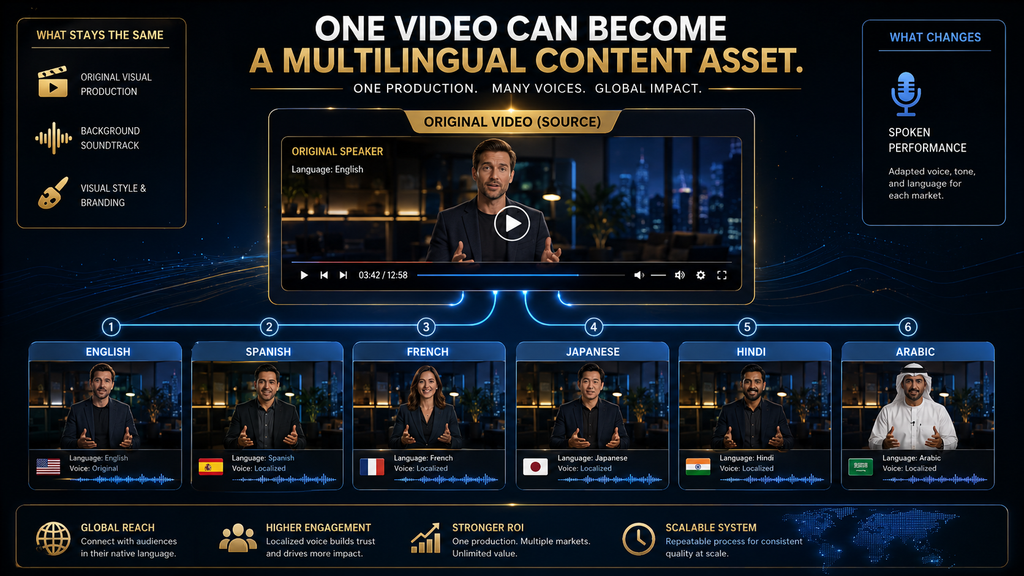
A successful video does not necessarily have a language problem. It may have a distribution problem created by language. You can spend days researching a topic, writing the script, recording the narration, editing the footage, designing the thumbnail and optimizing the video for search, only to discover that the finished content is naturally relevant to audiences outside your primary language. The production is already done. The information is already valuable. The visual story is already built. Yet an entirely different audience may never experience it because the spoken language creates a barrier.
That is where AI dubbing becomes interesting. The basic idea sounds simple: take an existing video, translate the spoken content, generate a new voice track and publish the localized version. But good dubbing is considerably more complicated than putting translated text through a text-to-speech model. A useful localized version has to preserve meaning while also dealing with speaker identity, pronunciation, timing, emotion, pacing, background audio and the expectations of people who actually speak the target language.
ElevenLabs Dubbing is designed around that broader problem. Its current Dubbing v2 system translates audio and video into more than 90 languages while attempting to preserve the original speaker’s emotion, timing, tone and vocal characteristics. It also retains the original background audio, allowing the localized version to preserve much of the original production rather than requiring the soundtrack to be rebuilt from scratch.
That does not mean AI dubbing is a perfect replacement for professional localization. Dubbing v2 is currently labeled an alpha model, and ElevenLabs itself documents trade-offs around speaker similarity and naturalness between languages. The current system also does not make every type of video equally suitable for automated dubbing. The more useful question, therefore, is not simply “Can ElevenLabs translate my video?” The better question is: “Can I take content that has already proven its value, localize it for another audience, and create enough additional value to justify the localization work?” That is the question this guide answers.
Test Dubbing on One Proven Video
Upload one video that already performs well and judge the dubbed version for meaning, timing and emotional fit before you localize anything else.
Test One Video With ElevenLabs Dubbing →Affiliate disclosure: We may earn a commission if you subscribe through this link, at no additional cost to you.
What Is ElevenLabs Dubbing?
ElevenLabs Dubbing is an AI-powered localization workflow that converts spoken audio or video from one language into another while attempting to preserve the characteristics of the original speakers and performance. For the wider platform, see our ElevenLabs review.
The current Dubbing v2 system supports more than 90 languages. It can detect multiple speakers, including overlapping speech, preserve speaker identity and emotional tone, and retain the original background audio. Supported source workflows include uploaded files as well as certain online sources such as YouTube and TikTok URLs. That makes it fundamentally different from a simple translation workflow. A translation system primarily asks, “What does this sentence mean in another language?”
A dubbing system has to ask several additional questions: “Who is saying it? How are they saying it? How quickly are they saying it? What emotion is being expressed? How does the translated sentence fit the original video? And how can the new voice exist naturally inside the original soundtrack?” Those additional variables are what make dubbing difficult.
Imagine an English-speaking creator saying something with excitement, slowing down before an important point and then laughing slightly at the end. A transcript may contain the words, but the transcript does not fully contain the performance. Dubbing has to reconstruct that performance in another language. ElevenLabs describes Dubbing v2 as conditioning directly on the original performance rather than generating disconnected audio from a transcript alone. According to the company’s explanation, this allows tone, pacing, delivery and emotional intent to carry across languages. That is the central idea behind modern AI dubbing.
Dubbing v2 vs Dubbing v1: What Each One Gives You
ElevenLabs now runs two dubbing models side by side, and in practice they are different products. We opened the Dubbing page in our own Free account on 10 October 2026 to see what a new user is offered. The model picker lists Dubbing v2, marked Alpha, as the default. Dubbing v1 sits below it as the legacy option that opens editable Dubbing Studio projects. The table combines what that screen showed with ElevenLabs’ dubbing documentation and pricing page.
| Dubbing v2 (alpha) | Dubbing v1 (legacy) | |
|---|---|---|
| Languages shown in the app | 92 | 29 |
| Editing in the app | None. The dub is automatic | Dubbing Studio: transcript editing, speaker reassignment and per-clip regeneration |
| Status | Alpha, and the default model | Maintenance mode, critical bug fixes only |
| Upload limit in the app | 1 GB and 180 minutes | 1 GB and 45 minutes in Dubbing Studio |
| Controls on the upload screen | Speaker similarity | Detect speakers, Disable cloning and, once a file is added, Watermark |
| Free plan allowance | 0.4 minutes a month | 5 minutes a month, watermarked |
| Bengali as a target language | Not in the menu | Not in the menu |
Two things in that table are easy to miss. First, the editing features most guides describe belong to the legacy model. If you want to fix one wrong sentence inside the app, you have to choose v1 and accept a shorter language list and a model that is no longer being developed. Second, the documentation and the app do not fully agree. The documentation says Dubbing v1 supports the same languages as the Eleven v3 speech model, which includes Bengali. The v1 menu in our account listed 29 languages, and Bengali was not one of them. It was not in the v2 menu either. If one language decides your project, open the menu in your own account before you plan around it.
Our Test: One Clip Dubbed From English to Hindi
On 11 October 2026 the founder dubbed one clip of himself in a Free account. The clip is 1 minute 6 seconds of English, read from a short script that includes his name, the price $19.99, a date and this site’s web address. We used Dubbing v1 because the Free plan’s credits do not stretch to a minute of v2. We chose Hindi because Bengali was not in the menu and the founder understands Hindi well enough to catch a wrong word. Everything else stayed at its default: source language on Auto-Detect, with speaker detection and cloning untouched.
| Check | Result |
|---|---|
| Did the dub finish | Yes, in about one minute |
| His name | Right |
| The price, $19.99 | Right |
| The date | Right |
| The web address | Partly right |
| Does it sound like his voice | Yes |
| Does the Hindi sound natural | Yes |
| Watermark or added sound heard | No |
| Credits used | 3,312 of the plan’s 10,000 |
For a one-minute clip with one speaker, that is a good result. The dub kept the name, the price and the date, the voice was recognisably the founder’s, and the Hindi sounded natural to him. The weak spot was the web address, which came out only partly right. That fits the advice later in this guide. Names, numbers and addresses are where a dub needs a human check, and a web address is a detail the viewer has to hear exactly.
The credit count needs a note. Before the dub started, the upload bar showed the Watermark option switched on and a quote of 2,209 credits. The finished dub’s details panel says “Watermarked: No” and shows 3,311.93 credits used. The first number matches 2,000 credits a minute for a 66-second clip, and the second matches 3,000 credits a minute, the rate for a dub with no watermark. Our records do not show whether the option was switched off before the start, so we report both numbers and draw no conclusion about the gap. The practical advice is to read the quote again at the moment you press start. This one dub took a third of the Free plan’s monthly credits.
The limits are plain. This is one clip, one speaker, one language pair and one listener. It says nothing about Dubbing v2, which is the default model and the one ElevenLabs is still developing. It does not test Dubbing Studio editing, several speakers, background music or a long video. The recording and the dub stay offline, because the Free plan has no commercial licence. The script, the screenshots and the log are in the public test folder on GitHub.
How We Researched This Guide
This guide is based on ElevenLabs’ current Dubbing documentation, API guidance, use policy and pricing information, together with YouTube’s official documentation for Multi-language Audio and automatic dubbing. Sources were re-checked on 10 October 2026. On the same day we opened the Dubbing page in our own Free account to record which models, languages and controls a new user is offered. Product capabilities and limitations are attributed to the relevant vendor; AI Hustle World ran one small dubbing test for this article, described below, but did not conduct a controlled, multilingual benchmark, so the guide does not present vendor claims as independent test results.
The article’s central framework is the Seven-Layer Dubbing Quality Stack, paired with the Dub the Winners strategy. The framework maps meaning, speaker identity, timing, emotion, pronunciation, background audio and audience fit to the production and review decisions that determine whether a dub is publishable. It is a source-based editorial model rather than a laboratory score, which means readers can reconstruct the reasoning and apply the same checks to their own videos.
What this guide adds: official documentation explains what individual features do, but it does not provide one integrated decision system connecting source quality, language demand, review burden, distribution choices and localization economics. This guide contributes that synthesis, distinguishes automatic generation from editable Enterprise workflows, and provides a verifiable framework for deciding what to dub, how to review it and when expansion is justified.
Translation, Dubbing and Localization Are Different Jobs
The three terms are closely related, but treating them as identical creates bad expectations. Translation changes the language while attempting to preserve the meaning. Dubbing takes that translated language and turns it into spoken performance that fits the original content. Localization goes one level further by considering whether the language, terminology, cultural references and delivery actually make sense to the target audience. That distinction matters because a translation can be technically correct and still sound wrong.
Consider a creator who says, “Let’s get this business off the ground.” A literal translation may communicate the basic meaning, but a native speaker might use a completely different expression to communicate the same idea naturally. If the video is educational or commercial, that difference can affect whether the audience perceives the creator as fluent, trustworthy and relevant. A good localized video therefore has to preserve the idea, not necessarily every individual word.
This is why AI dubbing should not be evaluated by opening the translated transcript and checking whether every sentence looks familiar. The actual test is whether the target-language audience hears something that feels natural, accurate and appropriate for the context. That is also why the smartest AI dubbing workflow leaves room for human judgment.
How ElevenLabs Dubbing Works From Start to Finish
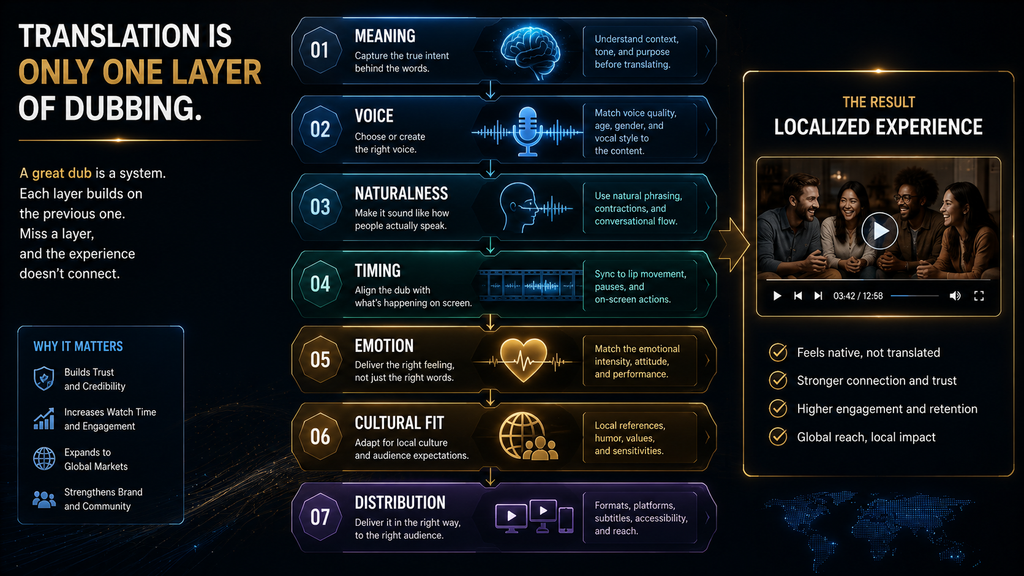
The most important thing to understand is that dubbing is not a collection of unrelated clicks. Each stage affects the stage that follows it.
1. Start with the original video or audio that you actually want to localize. The first step is choosing the source asset. ElevenLabs allows users to upload audio or video files and supports URL-based workflows for sources such as YouTube and TikTok. This sounds obvious, but the choice of source is strategically important.
If the original video has poor audio, excessive background noise, unclear speech or frequent speaker overlap, the dubbing process starts with weaker information. If the video already performs well and has clean narration, the same dubbing technology has a much more attractive economic case. This is why multilingual production should begin with content selection, not with the Dubbing button. You should first ask whether the underlying asset is worth localizing. If the answer is yes, then the technical workflow becomes worthwhile.
2. Make sure the source speech is clear before asking AI to transform it. The dubbing system has to understand the original performance before it can reproduce that performance in another language. Clean dialogue therefore matters.
A video with clear narration, reasonable pacing and controlled background audio gives the system a better starting point than a recording where speech is buried under music or environmental noise. YouTube makes a similar point in its own automatic-dubbing documentation, noting that background noise, accents, dialects and speech-recognition problems can contribute to errors. This is an important first-principles rule: AI cannot reliably localize information that the source system cannot reliably interpret. Improving the original recording can therefore improve the entire downstream workflow. If the original recording needs cleanup first, see our roundup of the best AI audio editors.
3. Let the system identify the spoken content and speakers. Once the source is supplied, the system needs to determine what was said and who said it. Speaker detection becomes particularly important for interviews, podcasts, documentaries and conversations because the final localized version needs to preserve distinctions between speakers. ElevenLabs says Dubbing can automatically detect multiple speakers, including overlapping speech, and preserve each speaker’s identity and emotional characteristics. That means a two-person interview is not treated as one anonymous voice that happens to contain different sentences. The system is trying to understand the structure of the performance before rebuilding it.
4. Choose the target language according to audience demand, not curiosity. After the source is ready, you choose the language or languages you want to create. ElevenLabs currently supports more than 90 languages, and Dubbing v2 also supports certain region-qualified language variants. Having a large language list creates an interesting temptation: translate everything. That is usually the wrong strategy.
5. Let Dubbing v2 translate and reconstruct the target-language performance. After the language is selected, Dubbing v2 performs the central transformation. It translates the source speech and generates the target-language performance while attempting to preserve characteristics of the original speaker. ElevenLabs says Dubbing v2 is designed to carry tone, pacing, delivery and emotional intent across languages rather than simply producing flat speech from translated text.
6. Let the new speech fit the original production rather than treating it as an isolated audio file. Timing is one of the hardest parts of dubbing because languages do not express ideas at identical speeds. A sentence that takes three seconds in English may naturally take longer or shorter in another language. Forcing every translation to occupy exactly the same amount of time can produce rushed speech. Allowing every sentence to expand freely can create synchronization problems. ElevenLabs says Dubbing v2 uses sync-aware translation logic designed to align starts and stops with the original performance.
7. Preserve the surrounding soundtrack where possible. ElevenLabs says Dubbing retains the original background audio, including music, effects and ambient sounds. This is more valuable than it might initially appear.
Imagine a finished documentary with carefully mixed music, environmental sound, transitions and effects. Rebuilding the entire soundtrack for every language would add unnecessary production work. If the dialogue can be localized while the surrounding soundscape remains intact, much of the original production investment survives. That means the localized version can feel like another language version of the same production rather than a completely separate project. The strategic advantage is therefore not simply “background music stays.” It is: The creative investment already embedded in the original production can be reused.
8. Review the generated dub before treating it as final. This stage is not optional for serious content. A generated dub can sound convincing and still contain translation problems. It can preserve the speaker’s identity while choosing an awkward expression. It can sound fluent while mispronouncing a product name. It can communicate the basic meaning while weakening a technical instruction. YouTube explicitly warns that automatic dubbing can encounter problems with pronunciation, accents, dialects, background noise, proper nouns, idioms and jargon, and it notes that quality can vary between languages.
The same principle should guide ElevenLabs workflows. The better the content matters to your business, the more carefully the result should be reviewed.
9. Correct the problems that matter before publishing. The review stage should not be a vague “sounds okay” check. Listen for translation accuracy, names, terminology, pronunciation, emotional delivery, timing and overall naturalness. If the content is commercially important, have someone who genuinely understands the target language review the result rather than assuming that an English-speaking creator can judge a foreign-language dub by sound alone. For Enterprise customers, the Dubbing v2 API supports transcript editing and regeneration of changed regions. The standard Dubbing v2 website workflow remains automatic and has no in-app editor, while the older Dubbing Studio interface uses v1 and is in maintenance mode.
That matters because localization should be iterative. A professional workflow is not: Generate once and hope. It is: Generate, inspect, correct the meaningful problem, regenerate the affected section and then approve the final version. Those stages belong together.
10. Export the finished localized audio or video for distribution. Once the dub passes review, it becomes a distribution asset. The important point is that distribution should have been considered before the dubbing process began. If your plan is YouTube multi-language audio, you need a usable audio track. If you are distributing localized videos elsewhere, you need the appropriate final media format. If your content requires translated titles, descriptions or thumbnails, those assets also need to be considered. The dub is not the final product. The audience experience is the final product.
11. Publish the localized version where the target audience can actually access it. For YouTube creators with access to Multi-language Audio, YouTube allows creators to upload additional audio tracks to an existing video rather than creating and managing separate channels for every language. YouTube says these tracks can be attached to new or previously uploaded videos, and viewers can switch audio languages from the player. The workflow on YouTube is connected to the previous step: you first need the finished dubbed audio, and only then can you attach it to the appropriate video.
12. Measure the result and use the data to decide what happens next. The process does not end when the localized track goes live. YouTube says creators using Multi-language Audio can analyze views and watch time by audio language. It also reports that creators who uploaded Multi-language Audio tracks saw more than 25% of watch time come from views in a video’s non-primary language. That does not mean every creator should expect the same result. It means multilingual content can be measured. If Spanish generates meaningful watch time, subscriber growth and revenue, you have evidence to continue.
If a language produces almost no meaningful engagement after a reasonable test, you have evidence not to invest heavily there. This is why the final stage of dubbing is not publishing. It is measurement.
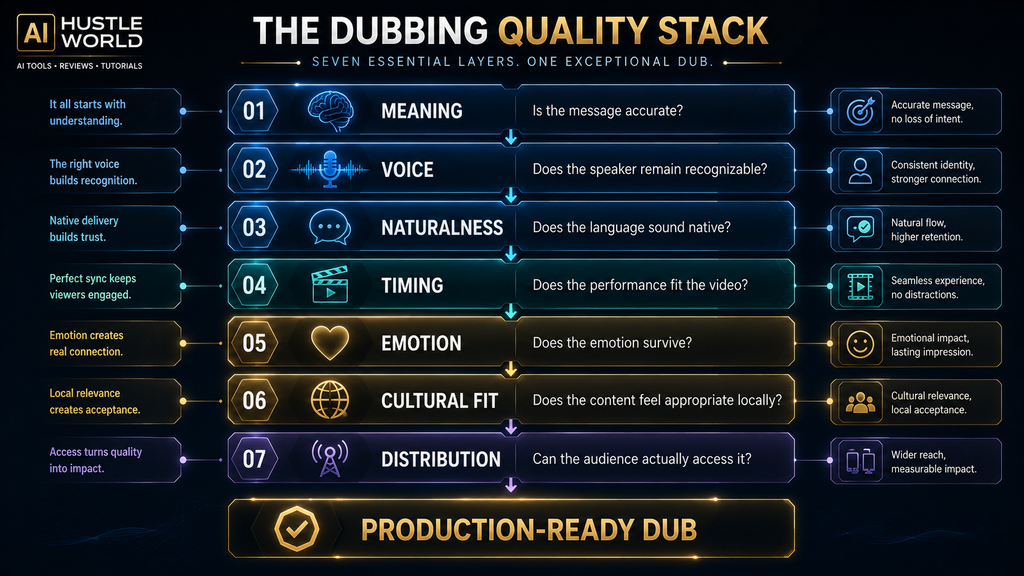
The Seven Layers of a High-Quality Dub
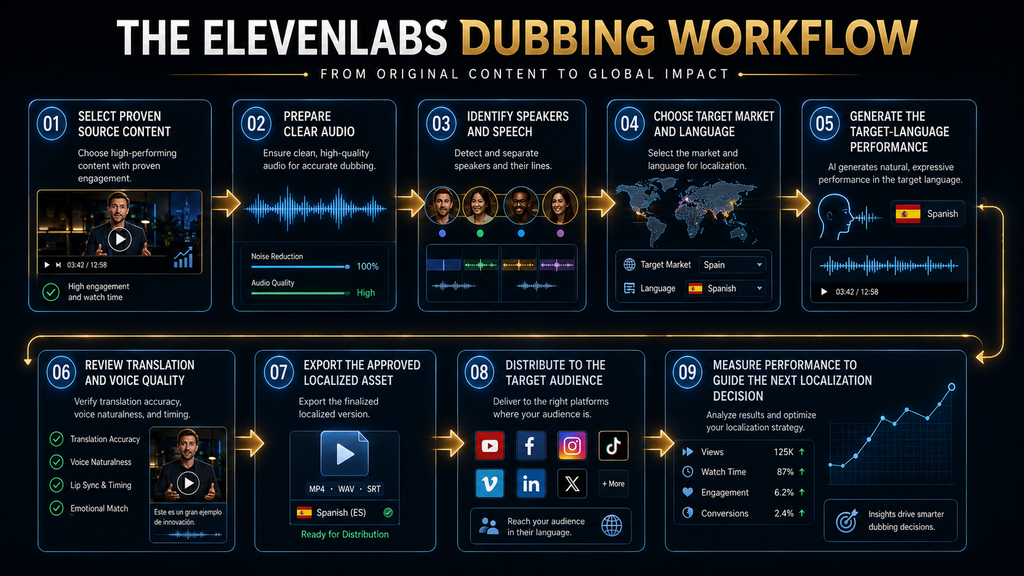
A useful way to evaluate multilingual content is to separate quality into seven connected layers.
- Meaning. The localized version must communicate the same core idea as the original. If the meaning is wrong, everything else becomes irrelevant.
- Voice. The audience should still perceive the speaker as the same person or at least as a coherent representation of the original speaker. This matters especially for creators whose personality is central to the content.
- Naturalness. The target-language speech should sound like something a fluent speaker would actually say. Correct grammar is not enough.
- Timing. The new speech must fit the original production without sounding unnaturally rushed or delayed.
- Emotion. Excitement should still feel exciting. Serious content should remain serious. Humor should retain the intended character wherever possible.
- Cultural fit. The content should make sense in the target market rather than sounding like a sentence translated from somewhere else.
- Distribution. The audience must actually be able to find and select the localized version. A perfect dub that nobody can access has no practical value.
These seven layers are connected. If meaning fails, voice cannot rescue the content. If meaning is correct but naturalness fails, the audience may still perceive the video as artificial. If the dub sounds excellent but distribution is poor, the commercial result can still be weak.
The Speaker-Similarity Trade-Off
One of ElevenLabs Dubbing v2’s most useful controls is also one of its easiest to misunderstand. The Dubbing documentation describes a configurable cloning-strength setting from 0 to 10. In the app, this appears as a Speaker similarity control on the upload screen, with a default value of 7. ElevenLabs says higher values prioritize resemblance to the original speaker, while lower values give the system more freedom to produce natural delivery in the target language. ElevenLabs’ Prohibited Use Policy bars replicating another person’s voice without consent, which matters whenever you dub content you did not record yourself.
That means higher is not automatically better. If the target language has substantially different phonetic characteristics, aggressively preserving the original speaker’s characteristics can introduce more of the original accent into the localized performance and potentially make the output sound less natural. ElevenLabs explicitly warns about this trade-off. The practical goal is therefore not maximum cloning. The practical goal is the right balance between identity and linguistic naturalness. For a personality-driven creator, speaker identity may deserve greater priority. For the underlying voice concepts, see our explainer on ElevenLabs voice cloning.
For a tutorial where clarity and native delivery are more important than recognizable vocal characteristics, greater linguistic freedom may be preferable. This is a good example of why AI tools should not be treated as systems with one universally correct setting. The correct setting depends on the job.
How Many Languages Should You Dub?
The answer is almost never “as many as possible.” ElevenLabs supports more than 90 languages, but language availability does not tell you which markets deserve your attention. The correct first language should usually be the one where you have the strongest combination of:
- existing audience demand;
- content relevance;
- commercial opportunity;
- manageable review requirements;
- realistic distribution access.
Suppose your English YouTube channel receives a meaningful percentage of views from Spanish-speaking countries. That is a stronger localization signal than simply noticing that Spanish has hundreds of millions of speakers. Likewise, if a software business has customers in Germany asking for localized training content, German demand already exists. The market has given you evidence. Use it.
See How Much Review a Dub Really Needs
Dub a single language, compare it with your source audio, and note how much correction it needs before you scale to more markets.
Try a Single-Language Dub →Affiliate disclosure: We may earn a commission if you subscribe through this link, at no additional cost to you.
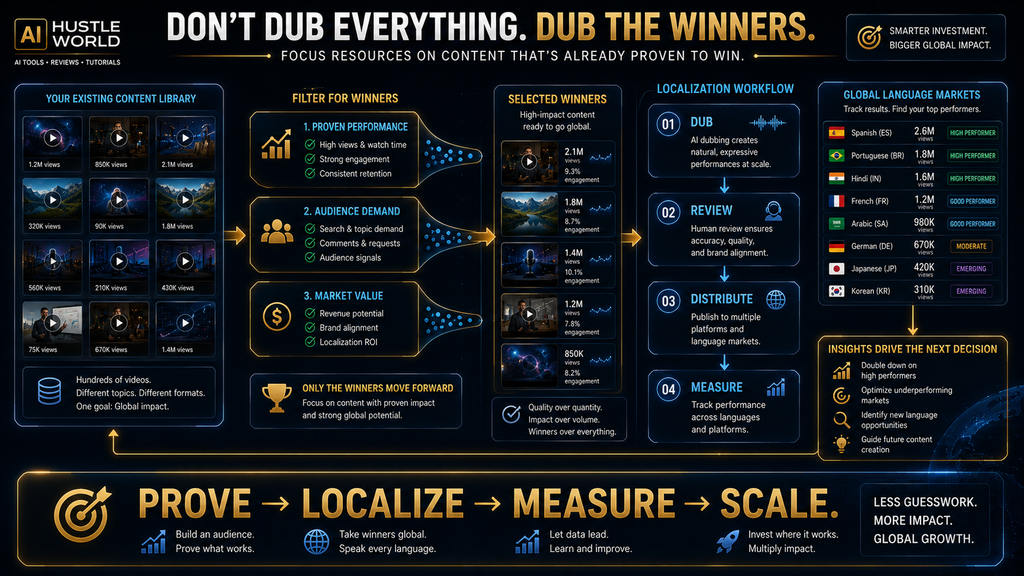
The “Dub the Winners” Strategy
This is the strategic framework I would recommend for creators and businesses. Do not start by asking: “Which videos can I dub?” Start by asking: “Which existing videos have already proven that they deserve another market?”
A successful localization workflow begins with proven content. From there, you identify the market showing demand, choose one target language, generate the localized version, review it, distribute it and measure what happens. Only after the first experiment demonstrates meaningful demand should you expand the process to additional videos or languages. This approach protects you from one of the biggest problems created by cheap AI production: producing more assets than the market actually wants.
YouTube’s own guidance supports a focused approach to multilingual content. It recommends prioritizing one or two languages, considering the back catalog and using analytics to understand where demand exists. That is a much stronger strategy than translating your entire library simply because the technology allows it.
Choosing a Language With a Simple Opportunity Framework
You can evaluate potential languages across several dimensions.
| Factor | What to Ask |
|---|---|
| Existing Demand | Are viewers from this market already watching? |
| Topic Fit | Does the subject naturally interest this audience? |
| Commercial Value | Can the audience generate revenue, leads or customers? |
| Competition | How crowded is the target-language content market? |
| Localization Difficulty | Will the material translate and localize naturally? |
| Review Capacity | Can a qualified speaker review the output? |
| Distribution | Can you effectively reach the audience on your chosen platform? |
| Expansion Potential | Could one successful dub lead to a larger localized library? |
The purpose is not to produce a mathematically perfect score. The purpose is to stop yourself from making localization decisions based on population statistics alone. A smaller audience with strong commercial intent can be more valuable than a huge audience with weak relevance.
YouTube Automatic Dubbing Changes the Competitive Landscape
ElevenLabs is not operating in a vacuum. YouTube itself now offers automatic dubbing for eligible creators and supported languages. The platform automatically generates translated audio tracks and allows creators to configure publication and review settings. That means creators should understand the difference between YouTube’s native dubbing system and an external dubbing workflow such as ElevenLabs.
YouTube’s automatic dubbing is attractive because it is built directly into the platform. Eligible creators can have dubs generated and can choose whether to review them before publication. YouTube also provides experimental lip-sync functionality to select channels for qualifying content and languages. ElevenLabs becomes more interesting when the creator wants a dedicated localization workflow, reusable audio assets, control over speaker similarity, or an API-based process that can exist beyond YouTube.
The decision is therefore not simply: “Which company has the better AI?” The better question is: “Where should my localization workflow live, and how much control do I need?”
ElevenLabs Dubbing vs YouTube Multi-Language Audio
These tools can actually work together. ElevenLabs can produce the localized audio. YouTube Multi-language Audio can host that localized track on the original video for eligible creators. YouTube says Multi-language Audio allows creators to upload their own dubbed audio tracks to a single video, rather than requiring separate language-specific channels. It also allows creators to analyze views and watch time by audio language. That creates a powerful workflow for creators who have access to the feature.
You can keep the original video centralized while adding language-specific audio experiences. This is particularly useful for channels that would otherwise face a choice between managing one English channel and creating several separate language channels. A single video with multiple audio tracks can simplify maintenance.
How to Publish an ElevenLabs Dub on YouTube
Once the localized audio has passed review, the distribution process becomes connected to the production workflow. For eligible creators using YouTube Multi-language Audio, open YouTube Studio on desktop and select the video that should receive the localized track. From the Languages section, add the target language, select the audio file and publish it when ready. YouTube says the uploaded audio track should be an audio-only file and roughly the same length as the video.
The important part is that this is not the same thing as YouTube’s automatic dubbing. Multi-language Audio allows you to supply the dub yourself. That is where a tool such as ElevenLabs fits naturally into the workflow. You create the localized audio externally, review it, and then use YouTube’s distribution infrastructure to make that audio available to viewers.
Does ElevenLabs Dubbing Support Lip Sync?
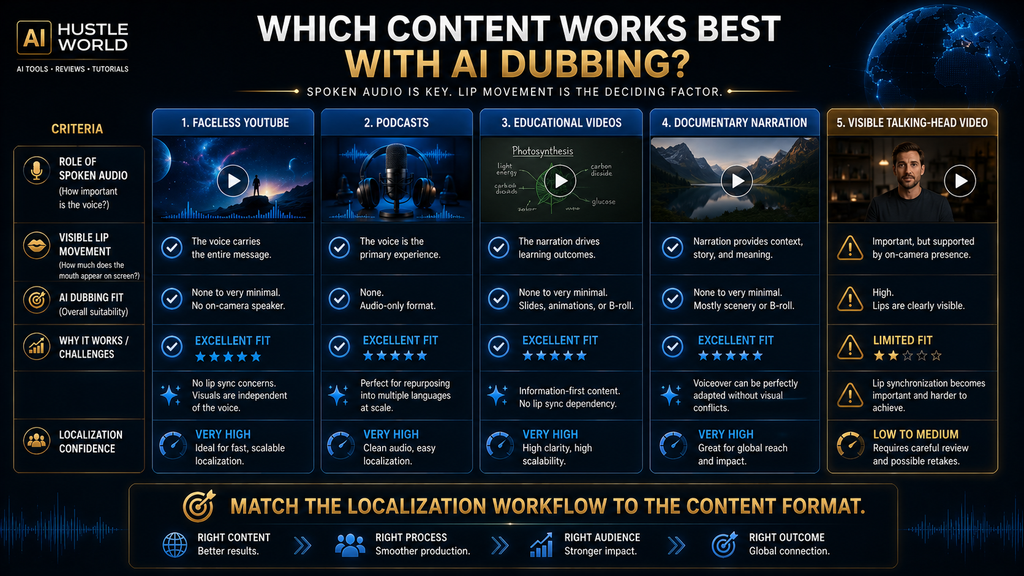
This question matters because the answer changes which videos are appropriate. The current ElevenLabs Dubbing documentation describes Dubbing v2 around voice translation, speaker preservation, timing, tone and background audio. It does not list lip synchronization as a Dubbing v2 feature. That means you should distinguish between audio localization and full visual localization. A faceless video can work beautifully with a new language track because the audience is not watching the narrator’s mouth.
A podcast video can also work because the audio is the central experience. A talking-head advertisement is different. If the speaker is visible throughout the video, the viewer may notice that the mouth movement corresponds to the original language rather than the new audio. YouTube itself currently has an experimental automatic lip-sync feature available to select channels, which shows how important this problem has become for video localization. The strategic conclusion is simple:
Choose your localization architecture based on the content format.
When You Should Think Twice
The same tool is not equally appropriate for every content category. If the video depends heavily on visible mouth movement, you should evaluate lip-sync requirements before committing to an ElevenLabs-only workflow. If the content contains highly specialized terminology, the translation should receive stronger human review. If humor is central to the video, literal translation may not be enough. If the content has legal, medical or financial consequences, the cost of a translation error can be much higher than the cost of the AI generation itself.
And if the original video has no evidence of audience demand, the biggest problem may not be localization technology at all. It may be that nobody wants the content.
Why Human Review Still Matters
The strongest AI localization workflow is not necessarily AI without humans. It is AI doing the repetitive transformation while humans focus on ambiguity and consequence. AI can perform the first-pass translation. AI can generate the target-language voice. AI can preserve speaker characteristics. AI can help with timing.
But a human reviewer can identify whether a phrase is culturally awkward, whether a technical term is being used correctly, whether a product name is being pronounced correctly and whether the final delivery actually sounds appropriate for the intended audience. That division of labor is much more realistic. The AI handles scale. The human handles judgment.
What If You Already Have a Human Translation?
You do not have to use automated translation for every project. For Enterprise customers, the current Dubbing v2 API allows developers to work with source transcripts and target-language translations as editable data, update individual segments and regenerate only the regions that changed. That creates a strong hybrid workflow for businesses. Suppose your company has already paid a professional translator to approve a Spanish version of a product-training script. There is no reason to throw that work away and ask another AI system to translate the same material again.
The approved translation can become the linguistic source for the dubbing stage. AI then focuses on turning the approved language into a voice performance and fitting it into the production. This is where AI and human localization become complementary rather than competitive.
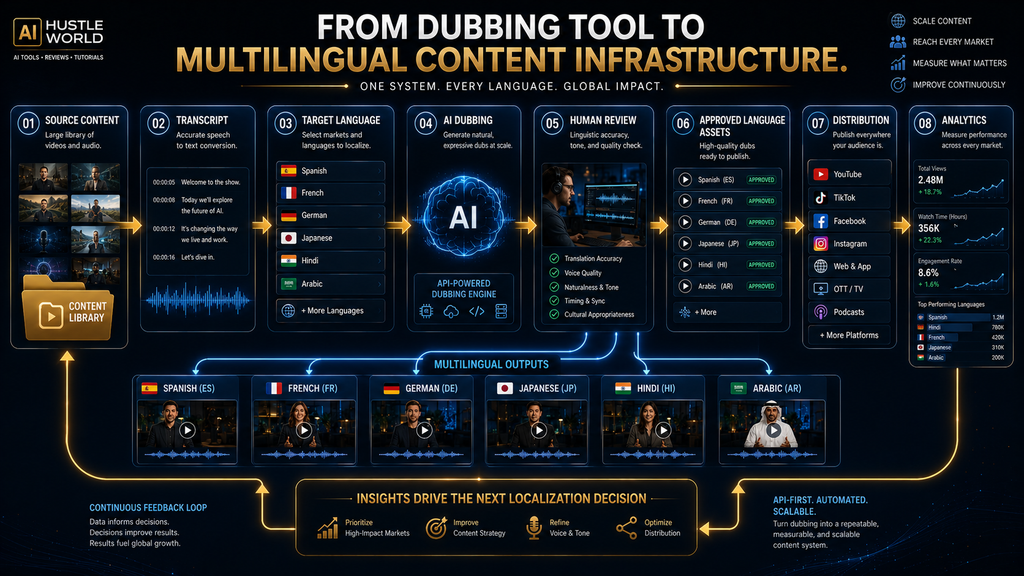
Why the API Matters for Larger Content Libraries
ElevenLabs describes the current Dubbing v2 API as a project-based system in which developers can create dubbing projects from files or URLs and add target languages. Transcript and translation editing with segment regeneration is currently an Enterprise capability, not a feature of the automatic Dubbing v2 website workflow. For an individual creator, the interface may be enough. For an organization with thousands of videos, an API can change the economics. Imagine a training company with 2,000 videos.
Manually opening each video, selecting a language and processing each one separately is an operational problem. An API allows localization to become part of a larger content system. The organization can potentially connect its content library to the dubbing process, route outputs through human review, store approved versions and distribute them through its own systems. The technology therefore moves from being a creator tool to becoming part of localization infrastructure.
The Economics of AI Dubbing
The cost of dubbing is not simply whatever appears on an ElevenLabs pricing page. The true localization cost has several components. There is the AI generation cost. There may be translation-review costs. There may be pronunciation corrections, editing, publishing and ongoing maintenance. If you create localized thumbnails, descriptions or captions, those activities add additional work. The important economic question is therefore not: “How cheap is AI dubbing?” It is: “How much additional value can this localized asset create relative to the total localization cost?” ElevenLabs lists its current plans and credit limits on its pricing page.
ElevenLabs’ pricing page converts each plan’s monthly credits into dubbing minutes. On 10 October 2026 it listed the figures below. Each figure assumes you spend the whole allowance on dubbing and nothing else.
| Plan | Dubbing v2 minutes | Extra v2 minute | Dubbing v1 minutes, watermarked | Extra v1 minute, watermarked |
|---|---|---|---|---|
| Free | 0.4 | $4.91 | 5 | $0.73 |
| Starter, $6 | 2 | $2.70 | 15 | $0.40 |
| Creator, $22 | 9 | $2.45 | 61 | $0.36 |
| Pro, $99 | 44 | $2.23 | 300 | $0.33 |
| Scale, $299 | 133 | $2.24 | 900 | $0.33 |
| Business, $990 | 444 | $2.23 | 3,000 | $0.33 |
The gap between the two models is the number to notice. On the Creator plan, the same credits buy 9 minutes of Dubbing v2 or 61 minutes of watermarked Dubbing v1. A single 20-minute video does not fit inside a Creator month on v2: 9 minutes are included and the other 11 are billed at $2.45 each, which is $26.95 on top of the $22 plan. The same page lists unwatermarked v1 minutes from the Creator plan up, starting at 40 minutes with each extra minute at $0.55. Budget from this table, not from the headline credit number on the plan card. Our own v1 dub was charged 3,312 credits for 66 seconds, which is the rate without a watermark. At the Creator plan’s credit price that is about $0.55 a minute, the same figure the page gives for an extra unwatermarked minute.
Suppose you have a successful 20-minute video. You create a Spanish version. If that version attracts a substantial new audience, generates additional watch time and creates new commercial opportunities, the localization cost may be small relative to the value created. But if you produce the same video in ten languages and nine produce negligible demand, the cheap production cost does not make the strategy efficient. Low production cost can encourage bad decisions just as easily as it can enable good ones.
Think in Incremental Value Per Dubbed Minute
A better metric is the value generated by each localized production unit. For a creator, that might mean: additional watch time + subscriber growth + advertising revenue + affiliate revenue For a SaaS company, it could mean: additional leads + conversions + product usage For an education business, it could mean: additional enrollments + course completion + learner retention The exact formula changes by business. The principle does not. Localization should be judged by incremental value, not by how impressive the AI output looks. That is the difference between a technology demonstration and a business system.
What Happens If You Do Nothing?
There is also an opportunity cost to never localizing. If international viewers are already finding your content, you may be leaving demand unserved. A viewer may discover an English video through search but leave because the spoken language creates too much friction. A customer may understand the visual demonstration of a product but struggle to follow the explanation. An educational creator may have globally relevant knowledge but only one language version.
In each case, the content itself may not be the problem. The language barrier is. But there is another side to this. If international demand does not exist, doing nothing may be the correct decision. That is why the best localization strategy starts with evidence. The decision should be: “There is enough evidence that this market may value the content, so localization is worth testing.” It should not be: “AI makes localization cheap, therefore we must localize.”
The Traditional Dubbing Industry Still Exists for a Reason
It would be easy to look at AI dubbing and conclude that professional dubbing has become obsolete. That would be too simplistic. Traditional dubbing can involve professional translators, voice actors, directors, localization specialists, editors and audio engineers. Those people contribute judgment that goes beyond converting sentences from one language to another. A professional localization team can rewrite jokes, adapt cultural references, direct performances and manage highly demanding synchronization requirements. AI changes the economics of that workflow.
It can reduce the amount of manual work required for many content categories. It can also make multilingual experimentation economically accessible to creators who previously could not afford a professional localization process. That is a more realistic way to think about the technology. AI is not necessarily eliminating the entire localization profession. It is changing which parts of the workflow require expensive human labor.
Common ElevenLabs Dubbing Mistakes
- Dubbing everything because you can. The ability to generate 20 languages does not create 20 audiences. Start with content that already has evidence of demand.
- Choosing languages based only on population. The largest language market is not automatically the best market for your specific content. Use your audience data.
- Treating translation accuracy as the entire quality test. A grammatically correct translation can still sound unnatural when spoken. Review the actual performance.
- Maximizing speaker similarity automatically. ElevenLabs explicitly warns that higher similarity can reduce naturalness in languages with significantly different phonetic characteristics. Choose the setting according to the audience and content.
- Ignoring terminology. Product names, technical terms, acronyms and proper nouns can create credibility problems when translated or pronounced incorrectly.
- Skipping human review. The more commercially or informationally important the video, the more valuable qualified review becomes.
- Ignoring the video format. A faceless video and a talking-head video have different localization requirements.
- Measuring only views. A localized version should be evaluated using the metrics that actually matter to the business.
- Building multiple language markets simultaneously. Start narrow enough that you can learn. Then expand.
- Confusing a good AI demo with a good business decision. A beautiful dub is not the objective. A valuable multilingual audience is.
How to Measure Whether Dubbing Worked
A creator should not evaluate a localized video using one metric. Start with reach. Did viewers from the target market actually discover the content? Then examine watch time. Did those viewers stay? Next, examine retention. Did the localized version hold attention reasonably well compared with the original? Then look at subscriber or follower conversion. Did viewers want more content from the creator? Finally, evaluate commercial outcomes. Did the additional audience generate revenue, leads, sales or another measurable business benefit?
What a Failed Dub Can Teach You
A weak result does not automatically mean the AI technology failed. Suppose the Spanish version receives almost no views. There are several possible explanations. Maybe the translation sounded unnatural. Maybe the content itself was not relevant to Spanish-speaking viewers. Maybe the thumbnail and title were not localized. Maybe the audience was never large enough. Maybe the video was not distributed effectively. Maybe the original topic had already reached its demand ceiling.
The data therefore needs interpretation. This is another reason not to dub 50 videos simultaneously. If you localize one proven video first, you can learn from the result. If you localize 50 videos simultaneously, you can spend much more money before understanding what actually went wrong.
The Second-Order Effect of Multilingual Content
There is a deeper effect beyond simply increasing views. A successful localized video can become evidence that an entire market deserves dedicated content. Suppose three English videos perform well after being dubbed into Spanish. That is no longer merely a translation experiment. It may be evidence that Spanish-speaking viewers represent a genuine audience segment. The next step could involve:
- localized thumbnails;
- translated titles and descriptions;
- more Spanish-language videos;
- native-language community engagement;
- partnerships with creators in that market;
- localized products or offers.
In other words, dubbing can become the first signal in a broader international expansion strategy. That is where the technology becomes strategically more interesting than simple translation.
ElevenLabs Dubbing for Faceless YouTube Channels
Faceless content is one of the clearest use cases because the viewer often never sees the narrator. A successful English video can potentially keep: Our guide to using ElevenLabs for YouTube and faceless videos covers the original narration side of that workflow.
- the same visual sequence;
- the same animations;
- the same stock footage;
- the same music;
- the same sound effects;
- the same editing.
Only the narration changes. That makes the localization problem considerably easier than it would be for a presenter whose mouth is visible throughout the video. This is also where the economics can become attractive. If the creator already has a library of successful faceless videos, each proven video becomes a candidate for additional language markets. The production system does not need to start from zero. The underlying asset already exists.
ElevenLabs Dubbing for Podcasts
Podcasts present a similar opportunity. Because the listener primarily consumes audio, lip synchronization is irrelevant. The most important quality factors become: If you publish audio, our guide to repurposing podcasts into short-form content shows another way to extend each episode.
- translation;
- speaker identity;
- naturalness;
- pacing;
- emotion;
- background audio.
A successful podcast episode can therefore potentially become a multilingual audio asset without requiring a new visual production. For podcasts with evergreen topics, this can be particularly interesting because the same episode may remain relevant long after its original publication.
ElevenLabs Dubbing for Education
Educational content has a different advantage. A good lesson is expensive to create because the creator has to research, structure and explain the material clearly. Once that lesson exists, the same intellectual work may be valuable in multiple markets. AI dubbing can reduce the cost of creating language versions. But educational content also has a higher accuracy requirement than casual entertainment. A wrong technical term or incorrect explanation can damage the usefulness of the entire lesson.
That makes human review particularly important for:
- software tutorials;
- technical courses;
- professional training;
- scientific explanations;
- financial education.
The higher the consequence of misunderstanding, the stronger the review process should become.
ElevenLabs Dubbing for Marketing
Marketing content creates another interesting challenge. Marketing language often depends on persuasion rather than literal information. A slogan that works perfectly in English may become weak when translated word-for-word. A localized marketing video may therefore require more than linguistic translation. The target-language version needs to preserve:
- the promise;
- the emotional appeal;
- the brand voice;
- the call to action;
- the market-specific context.
This is one area where a human localization specialist can create substantial value even when AI handles the first draft. The AI can reduce production time. The human can protect the brand.
Is ElevenLabs Dubbing Worth Using?
For the right workflow, yes. But the answer depends on what you are trying to accomplish. If you have proven audio-heavy content and want to test another language market, ElevenLabs Dubbing is a compelling use case. If you run a faceless YouTube channel with evergreen videos, the fit is particularly strong. If you manage a large content library, the current Dubbing v2 API makes the technology more interesting because localization can become part of a larger automated workflow. If you are still choosing a voice platform, compare ElevenLabs with other AI voice tools or browse the best AI voice generators.
If your videos depend heavily on visible lip movement, you need to consider the broader video-localization workflow rather than evaluating ElevenLabs Dubbing in isolation. If your content is highly sensitive or technically demanding, human review should be treated as part of the production cost. And if your content has never demonstrated demand, localization may be premature.
Final Thoughts
ElevenLabs Dubbing is most useful when you stop thinking of it as a translation button and start thinking of it as a content localization layer.
The technology can take existing audio and video, translate it into more than 90 languages, preserve important characteristics of the original speaker and retain background audio. Dubbing v2 also introduces a more performance-aware approach in which tone, pacing, delivery and emotional intent are considered alongside the words themselves. But those capabilities do not remove the need for strategy. You still need to choose the right content. You still need to choose the right market.
You still need to review the translation. You still need to check pronunciation and terminology. You still need to consider whether the content requires lip synchronization. You still need to distribute the localized version where the target audience can find it. And most importantly, you still need to measure whether the additional language actually creates value.
You are no longer forced to recreate the entire production for every language. You can reuse the creative work that has already been completed and selectively add new language experiences around it. But do not confuse scale with strategy. The fact that ElevenLabs can dub a video into dozens of languages does not mean you should create dozens of versions. Start with one proven piece of content. Choose one market where there is evidence of demand.
Create the localized version. Review it properly. Publish it. Measure it. Then decide. Don’t dub everything because AI makes dubbing easy. Dub the content that has already proven it deserves another audience. That is the real opportunity behind AI dubbing.
Decide Whether AI Dubbing Fits Your Content
Compare the languages, credit usage and review effort against the audience you want to reach before you commit to a plan.
Review ElevenLabs Plans →Affiliate disclosure: We may earn a commission if you subscribe through this link, at no additional cost to you.
FAQ
What is ElevenLabs Dubbing?
ElevenLabs Dubbing is an AI localization system that translates audio and video into other languages while attempting to preserve the original speakers’ identity, tone, emotion and delivery. The current Dubbing v2 system supports more than 90 languages.
How many languages does ElevenLabs Dubbing support?
ElevenLabs’ documentation says Dubbing supports more than 90 languages. In the app on 10 October 2026, the Dubbing v2 option was labelled 92 languages and the legacy Dubbing v1 option was labelled 29. Regional variants such as Mexican Spanish are offered on v2 only.
Does ElevenLabs Dubbing support Bengali?
Not as a target language when we checked. On 10 October 2026, Bengali was missing from both the Dubbing v2 and the Dubbing v1 language menus in our account, although the documentation lists Bengali for v1. ElevenLabs text to speech does read Bengali with Eleven v4 and v3, so a Bengali voiceover is possible, but an automatic Bengali dub was not on offer.
Can I use ElevenLabs Dubbing on the Free plan?
Yes, in a small way. The pricing page on 10 October 2026 listed 0.4 minutes of Dubbing v2 or 5 minutes of watermarked Dubbing v1 for the Free plan’s monthly credits. We dubbed one 66-second clip on v1 in a Free account, and it used 3,312 of the plan’s 10,000 credits. The Free plan has no commercial licence, so it suits a test, not a published video.
Does ElevenLabs Dubbing support lip sync?
The current ElevenLabs Dubbing documentation does not list lip synchronization as a Dubbing v2 feature. YouTube, separately, currently offers experimental automatic lip sync to selected eligible channels and languages.
Does ElevenLabs Dubbing clone the original speaker?
Dubbing v2 is designed to preserve the unique characteristics and identity of the original speaker. Its Speaker similarity control lets users adjust how strongly the generated voice should resemble the source speaker. In our one test on Dubbing v1, the founder judged that the Hindi dub sounded like his own voice.
Can I edit an ElevenLabs Dubbing v2 translation?
Not in the app. Dubbing v2 on the website is automatic and has no editor. Transcript and translation editing with regeneration is offered through the Dubbing v2 API on Enterprise plans only. To edit in the interface, you have to choose the legacy Dubbing v1 model and open a Dubbing Studio project, and ElevenLabs says Dubbing Studio is in maintenance mode.
Can I upload an ElevenLabs dub to YouTube?
Yes. Eligible creators can upload their own dubbed audio tracks through YouTube’s Multi-language Audio feature. YouTube allows multiple language tracks to be attached to a single video.
Why use ElevenLabs if YouTube already has automatic dubbing?
ElevenLabs can be useful when you want a dedicated dubbing workflow, greater control over speaker similarity, reusable localized audio assets or an API-based localization process. YouTube’s native system is attractive when simplicity and direct platform integration are the priority.
Which language should I dub first?
Start with the language that combines audience demand, content relevance and commercial opportunity. YouTube recommends focusing localization efforts on one or two languages rather than spreading resources too widely.
Written by
Muntasir Ahmad Chowdhury
Founder-AI Hustle World
Muntasir Ahmad Chowdhury is the Founder of AI Hustle World, an independent publication dedicated to making Artificial Intelligence practical, trustworthy, and easy to understand. He researches AI tools, automation, customer service, productivity, and real-world business applications, helping readers make smarter technology decisions through research-driven, experience-backed content.
Expertise:
AI Tools • AI Automation • AI Customer Service • AI Productivity • Generative AI • AI Workflows
Get Smarter With AI
Enjoyed this guide? Get practical AI tools, tutorials, and honest reviews delivered to your inbox.