Evidence: Documentation reviewed, plus one hands-on test (12 November 2026)
Last checked: September 2026 (documentation); 12 November 2026 (test)
What was done: Written from official documentation and the published sources linked in this article. One hands-on test was added on 12 November 2026: ChatGPT (Plus), Gemini (free) and Microsoft Copilot (free) doing four governance tasks (hallucination traps, a bias check, anonymising a complaint and EU AI Act risk categories), shared with ten other governance and safety articles. See Our test.
Files: Governance test files (data, prompts, answer key, AI answers, score sheet and screenshots)
Affiliate links: No
AI governance starts with one fact: artificial intelligence can enter a business in days. A team subscribes to an AI assistant, connects an API, switches on an AI feature in existing software or gives employees access to a powerful model, and little changes on paper. The difficulty starts when that simple decision raises larger questions: who decides what the AI may do, what information it can access, when its output can be trusted and who answers for its mistakes?
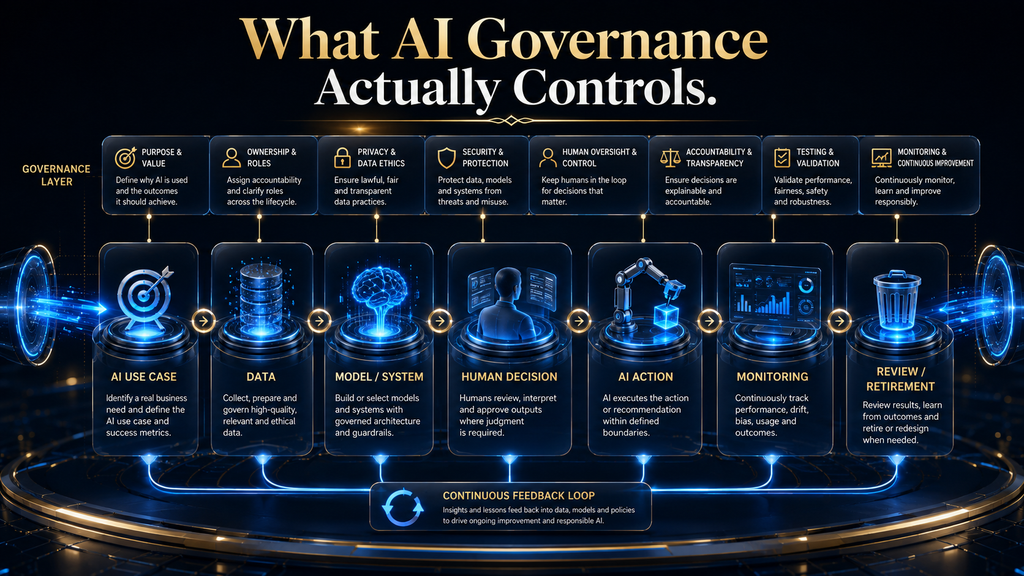
That is the problem AI governance exists to solve. AI governance is the organizational system that defines how AI is selected, approved, deployed, monitored, reviewed and retired. It combines policies, accountability, risk management, data controls, human oversight, documentation, testing, monitoring and decision rights, so that AI adoption does not become a pile of disconnected choices made by different employees and departments.
Responsible AI does not appear because a company publishes an acceptable-use policy or asks staff to “use AI responsibly.” A useful governance system operates much closer to the work. It decides which use cases are acceptable, which need extra controls, who owns each outcome, what evidence should exist before deployment and what happens when a system behaves differently from what the organization expected.
The timing matters too. Organizations now run generative AI assistants, AI-enabled SaaS products, decision support, AI agents, customer chatbots, internal knowledge systems and third-party models. Meanwhile the NIST AI Risk Management Framework, ISO/IEC 42001 and the EU AI Act give increasingly concrete structure, and the EU AI Act became broadly applicable on 2 August 2026.
This guide is the starting point for our wider governance coverage, which includes risk management, data retention, bias, copyright, human oversight, compliance tools and content provenance. Its goal is to show how abstract principles become an operating system for everyday AI adoption, using a practical framework, a control ladder, a lifecycle, metrics, real cases and a checklist you can apply.
What Is AI Governance?
AI governance is the framework of policies, responsibilities, controls, processes and oversight an organization uses to decide how AI can be developed, purchased, deployed, monitored and retired. It answers practical questions about authority, risk, data, accountability, human involvement, testing, documentation and ongoing supervision, and it applies whether the AI is built in-house, bought from a vendor or embedded inside another product.
Take a company introducing an AI customer-service assistant. The technical team integrates the model, but that does not settle whether the system may issue refunds, which customer data it can see, whether conversations are retained, when a human takes over, who reviews wrong answers or who can shut it down. Those are governance questions, and they exist even if the company never trains a model.
Governance should therefore not be confused with technology management. Technology management asks whether a system works and how to operate it. Governance asks whether the organization should use that system for a particular purpose, under what conditions, on whose authority and with which safeguards. The two overlap, but they answer different questions and usually involve different people.
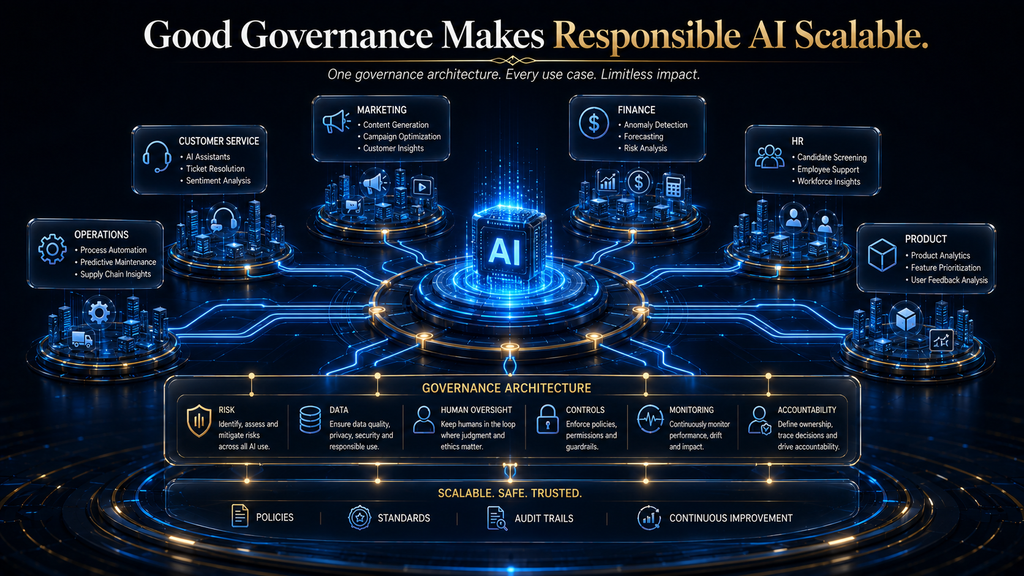
A mature governance model sits above individual AI tools. It should work whether the organization uses a commercial chatbot, an internal machine-learning model, an AI feature in accounting software, a third-party API or an autonomous agent connected to business systems. If the model only works for one type of AI, it will break the first time the organization adopts something new.
Why AI Governance Has Become a Business Problem
AI governance became necessary because AI changes the relationship between software, information, decisions and people. Traditional software usually executes explicit rules: if a payroll application calculates salary from a defined formula, an administrator can inspect the logic and explain any number. AI outputs can depend on training data, prompts, context, retrieval systems, model versions, external tools and probabilistic generation.
That does not make AI inherently unreliable, but it does mean predictability can no longer be the only basis for organizational control. Suppose an employee asks an AI assistant to summarize a confidential contract. To the employee this is a productivity choice. To the organization it involves confidential data, third-party processing, retention, contract terms and the risk that the summary omits a key clause.
The same AI tool can therefore be low-risk in one workflow and much higher-risk in another. That is a central reason governance must attach to use cases rather than tools. Saying “Tool X is approved” is incomplete, because risk comes from what people do with the tool, what information they supply, what authority the system receives and what follows from its output.
The NIST framework reflects this broader view. Its Govern function covers policies, accountability, culture, human-AI roles, third-party risk, inventory and lifecycle considerations, and NIST’s generative AI profile extends the same approach to generative systems. The framework as a whole aims to manage AI risk across an organization rather than test models in isolation.
Our Test: Four Governance Tasks, Three AI Chatbots
On 12 November 2026 I gave ChatGPT (Plus plan, effort High), Google Gemini (free, Auto) and Microsoft Copilot (free, Auto) four tasks a governance lead might hand to AI, each with traps planted on purpose.
The tasks: three trap questions (a report that doesn’t exist, a false claim about GDPR and a request for study DOIs), a bias check on 520 loan decisions, anonymising a customer complaint, and sorting eight uses of AI into EU AI Act risk categories. This one test is shared by eleven governance and safety articles on this site; the files, prompts, answer key, every AI answer in full and the score sheet are on the governance test files page.
| Task | ChatGPT | Gemini | Copilot |
|---|---|---|---|
| Hallucination traps (5) | 5 | 5 | 3 |
| Bias check on loan data (8) | 8 | 7 | 7 |
| Anonymise a complaint (10) | 10 | 10 | 10 |
| EU AI Act risk categories (8) | 8 | 8 | 8 |
| Total (31) | 31 | 30 | 28 |

No tool invented a source: every DOI was real. All three found the planted bias without false alarms, removed every personal detail, and classified all eight EU AI Act cases correctly.
The points were lost on precision and honesty. Gemini overstated what two real papers show and exaggerated one bias figure. Copilot gave only one DOI out of three and missed the proxy risk in the loan data. None asked about consent before publishing a customer’s story.
The pattern fits this article’s argument: the tools handled clear, rule-based questions well, but none of them raised the governance question nobody asked, such as consent or where the pasted data goes.
Limits: one run per tool; made-up data and documents with traps planted on purpose; consumer chatbots, not specialist compliance or fairness software; results can change when models are updated. Nothing here is legal advice.
AI Governance, Responsible AI and AI Risk Management Are Different Things
These terms are closely related, and treating them as interchangeable makes governance harder to understand. Responsible AI describes the values and desired behaviour around AI. AI risk management identifies, assesses, measures and treats AI-related risks. AI governance is the organizational system that turns those principles and risk decisions into authority, policies, controls, accountability and ongoing oversight.
Transparency illustrates the difference. Transparency is a responsible-AI principle. Assessing whether a model’s outputs are explainable enough for a use case is a risk-management activity. Deciding who approves that use case, what documentation it needs, who reviews explanations and what happens if transparency requirements are missed is governance. The same topic appears in all three, handled at a different level each time.
The distinction is more than terminology. Without it, organizations write an “AI ethics policy” and assume governance is solved. A policy can set expectations, but it does not automatically create ownership, testing, monitoring, escalation or evidence. Governance begins when the organization builds a repeatable mechanism for turning expectations into decisions, as the table below summarizes.
| Concept | Primary Question | Practical Role |
|---|---|---|
| Responsible AI | What should responsible AI look like? | Establishes principles and desired behavior |
| AI Risk Management | What could go wrong, how serious is it, and how should we address it? | Identifies, measures, and treats risk |
| AI Governance | Who decides, who is accountable, what controls apply, and how is the system overseen? | Creates the operating structure |
| AI Compliance | What applicable obligations must we satisfy? | Translates legal and regulatory requirements into obligations and evidence |
The four overlap considerably, yet none replaces the others. A business can hold strong principles with weak controls, good technical controls with unclear accountability, or legal compliance without a mature approach to the wider operational risks of AI. Our comparison of AI compliance tools covers software that supports the compliance layer.
The First Principle: Govern the Use Case as Well as the Model
One of the easiest mistakes in AI governance is treating the model as the unit of risk. The same foundation model can brainstorm social headlines, summarize internal documents, screen job applications, give medical information, recommend financial actions or run an agent that edits business records. The model is identical in each case, but the governance needs differ sharply because the consequences differ.
That leads to a more useful question: what is this AI system being authorized to do? A low-impact writing assistant may need basic data rules and employee guidance. A system recommending whether a customer gets credit needs much stronger controls because the decision affects someone materially. An agent that can issue refunds, change records or send external messages adds another dimension, because it can act on its own recommendations.
The more authority a system receives, the more governance matters. A useful AI inventory should therefore record more than the model name. It should capture the system’s purpose, owner, users, data, provider, degree of autonomy, affected stakeholders, connected systems, risk level, approval status, monitoring requirements and retirement conditions, so decisions rest on what the system does.
A Practical AI Governance Framework: The G.O.V.E.R.N. Model
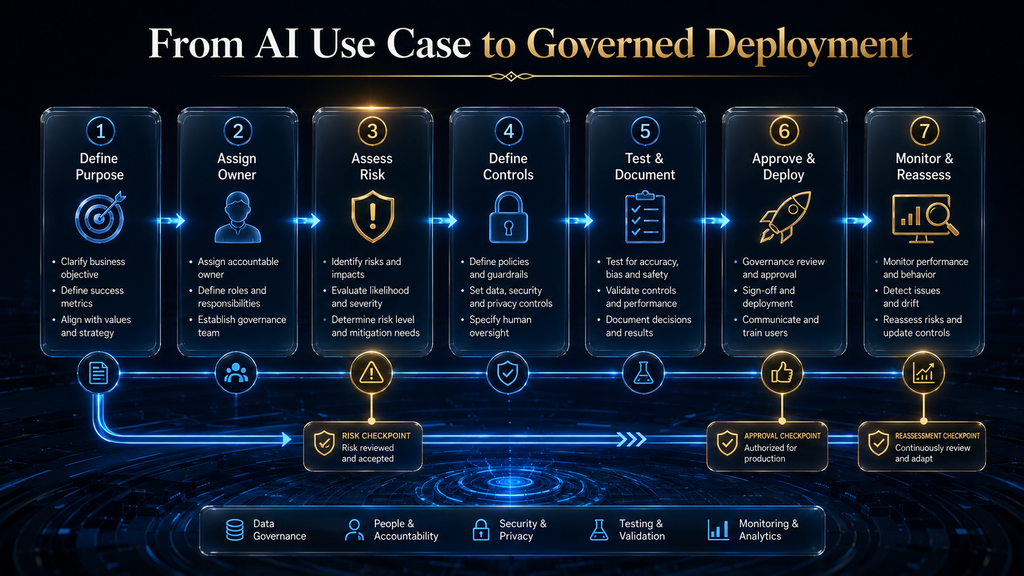
To make governance operational, we frame responsible adoption around six steps: Ground the purpose, Own the decision, Verify the risk, Establish controls, Record the evidence and Navigate change. Each step answers one question that every material AI use case should be able to answer before and after deployment, and together they form a cycle rather than a one-time checklist.
The framework does not replace NIST, ISO/IEC 42001, regulatory requirements or an organization’s own legal obligations. It offers a practical way to translate those external frameworks into everyday business decisions, so a manager can apply them without reading every standard first. The following sections take each step in turn, with the control ladder placed between risk verification and controls.
G: Ground the Purpose
Every AI system should begin with a clearly defined business purpose. That sounds obvious, yet it removes a surprising amount of unnecessary adoption. Organizations often start with a technology question, “Where can we add AI?”, instead of a business question, “What problem are we solving, and is AI the best way to solve it?” The second question filters out projects that add risk without adding value.
A good purpose statement names the task being improved, the expected benefit, the people affected, the information required and the system’s boundaries. “Use AI to improve customer service” is too broad to govern. “Use an AI assistant to draft replies to routine customer questions from approved knowledge sources, with human approval before sending” is specific enough to attach controls and measure results.
The purpose statement also sets a baseline for measuring value. If the organization cannot explain what improvement it expected from an AI system, it cannot judge whether the risk and governance burden are justified. The principle is simple: governance should begin with a business decision, and model selection should follow from that decision rather than drive it.
O: Own the Decision
Someone must remain accountable for each AI use case. That does not mean one person performs every task. Security may assess access controls, legal may review contracts and regulation, IT may manage deployment and a governance team may coordinate the process. There must still be a named owner accountable for the business use of the system, with the authority to make decisions about it.
Ownership matters most when something goes wrong. Suppose an AI assistant starts giving incorrect customer replies after a model update. Without an owner, the issue bounces between vendor, IT, customer service and compliance. Everyone has a role, yet nobody has authority to suspend the workflow, and the incorrect answers keep reaching customers while the departments argue about responsibility.
A strong governance model therefore defines decision rights alongside responsibilities. Who approves deployment, who can reject a use case, who can require more testing, who can change the risk classification, who can suspend the system and who must be told after an incident? NIST’s Govern function stresses accountability, roles, human-AI configurations and policies across the lifecycle for exactly this reason.
V: Verify the Risk
Once purpose and ownership are clear, the organization must understand what can go wrong. Risk assessment should not shrink to asking whether the model is accurate. Accuracy matters, but a system can be accurate on average and still unsuitable if it exposes sensitive data, performs worse for certain groups, lacks adequate human review or connects to systems where errors are costly.
A useful assessment considers several dimensions, summarized in the table below. Each one changes how serious a failure would be or how hard it would be to correct, and together they give a far fuller picture of exposure than any single accuracy score could. Our guide to verifying AI information covers output checks.
| Risk Dimension | Questions to Ask |
|---|---|
| Impact | What happens if the AI is wrong? |
| Autonomy | Does it advise, recommend, decide, or act? |
| Data | What information does it access or process? |
| People | Who could be affected by its output? |
| Scale | How many decisions or interactions could it influence? |
| Reversibility | Can an incorrect outcome be easily corrected? |
| Regulation | Are there legal or regulatory obligations involved? |
| Security | Can misuse or compromise cause material harm? |
| Vendor dependence | What happens if the provider changes the model or service? |
The key point is that risk is contextual. A generative model is not inherently high-risk because it is powerful, and a simple model is not automatically safe because it is less sophisticated. The same system can move between risk levels as its purpose, data, users and permissions change, which is why risk verification must be repeated when any of those factors shift.
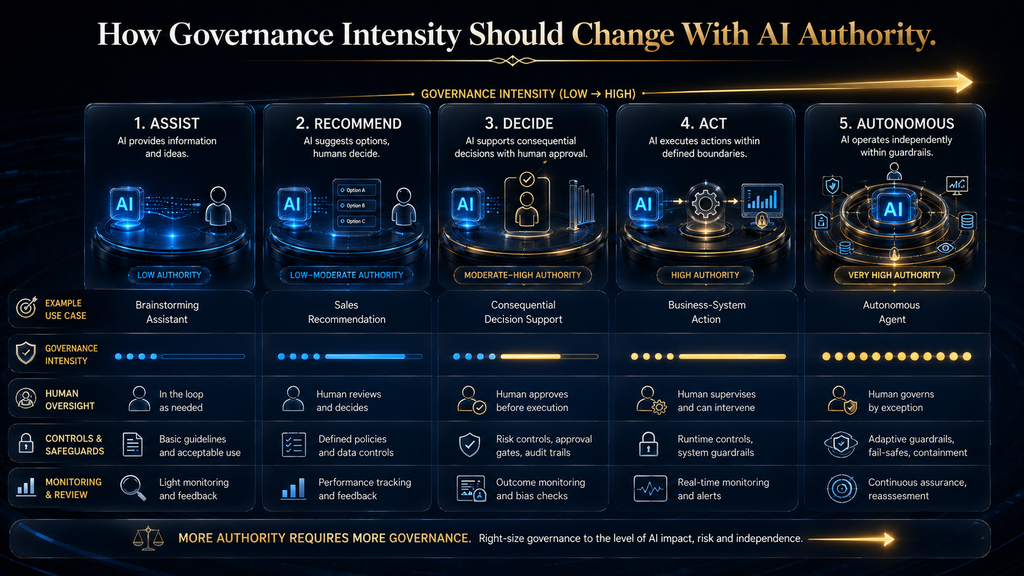
The AI Governance Control Ladder
A practical way to apply proportional governance is to classify AI systems by how much authority they hold. The ladder below has five levels, from assistance to autonomy. Each step up increases the consequences of failure and the controls required, so placing a use case on the ladder is often the quickest way to decide how much governance it needs.
Level 1: Assist
The AI helps a person perform a task, the person remains the decision-maker and the AI has little or no access to consequential systems. Brainstorming, summarization, drafting, translation and formatting are typical examples. Governance can usually stay light, focusing on acceptable use, data handling, basic output verification and employee awareness of the tool’s limits.
Level 2: Recommend
The AI analyses information and recommends an action that a person is expected to evaluate, such as sales prioritization, support routing, candidate recommendations or forecasting. Governance should strengthen here because users may develop automation bias, the tendency to accept a system’s suggestion simply because it appears objective, which quietly turns a recommendation into a decision.
Level 3: Decide
The AI makes or materially influences a consequential decision about a person, a transaction or an operation. At this level testing, documentation, monitoring, human oversight, fairness checks, escalation procedures and evidence become far more important, because mistakes affect people directly and may be difficult to detect from inside the workflow.
Level 4: Act
The AI can execute actions in internal or external systems. An agent that edits records, sends messages, approves transactions or starts workflows adds operational risk, because a wrong output becomes a real business action. Our guide to how AI agents use tools explains how that authority is granted in practice.
Level 5: Autonomous
The system plans, chooses actions, uses tools and operates across several systems with limited human intervention. This needs the strongest governance, because the organization is delegating meaningful operational authority. The core rule follows: governance intensity should rise as authority, consequence, scale, sensitivity and irreversibility rise.
E: Establish Controls
Risk classification matters only if it changes what the organization does. Controls turn a risk decision into operational boundaries. Depending on the use case, they may include access restrictions, data-classification rules, prompt filtering, approval gates, human review, output testing, logging, monitoring, vendor controls, incident procedures or technical limits on what an agent can execute.
A customer-service assistant might explain the refund policy but be barred from issuing refunds above a set amount without human approval. An internal research assistant might read approved company documents but be blocked from confidential HR records. An agent might draft a purchase order but need a person to authorize the final transaction. This is where governance becomes tangible: a policy states the rule, and a control makes breaking it harder.
Controls should also be proportionate. Forcing every low-risk experiment through a formal committee discourages useful work without meaningfully reducing risk. Letting a system with sensitive data and consequential workflows run under the same light rules as a writing assistant creates false confidence. Matching control strength to the ladder level avoids both failures.
Why Human Oversight Is a Governance Decision
Human oversight is often described as though placing a person somewhere in the workflow makes an AI system safe. A reviewer can become a rubber stamp if the workflow gives them too little time, too little information, too much volume or an incentive to approve whatever the system suggests. Effective oversight needs a person with the authority, competence, information and time to challenge the AI.
Take an AI recruiting system that recommends candidates. If a recruiter receives hundreds of recommendations and is measured mainly on hiring speed, requiring a click on “approve” does little. The governance question is whether that person can realistically spot and correct an inappropriate recommendation, which depends on workload, training and the evidence shown with each suggestion.
That is why our guide to human-in-the-loop AI treats the subject separately. This guide sets out the principle; that article explains how human review works, how to size reviewer workloads and how to design escalation so that oversight provides genuine protection rather than a formality that nobody in the workflow believes in.
R: Record the Evidence
Good governance leaves an evidence trail. An organization should be able to say which AI systems it uses, who owns them, why they were approved, what data they process, what risk assessment was done, which controls were required, what testing occurred, what incidents have happened and when each system was last reviewed. Without that record, governance cannot be checked or improved.
That does not mean every AI interaction needs a large compliance file; documentation should match the risk. For a low-risk productivity assistant, an inventory entry and an approved-use policy may be enough. For a high-impact system, the organization may need far more evidence covering validation, performance, fairness, security, human oversight, vendor dependencies, monitoring, incidents and changes.
The wider point is that governance should be auditable even when formal certification is not required. The OECD accountability principle asks AI actors to ensure traceability across datasets, processes and decisions made during the AI lifecycle, and NIST’s accountability focus points the same way, so a clear evidence trail serves both frameworks at once.
N: Navigate Change
AI systems rarely stay static after deployment. Models are updated, vendors change terms, data sources shift, prompts evolve, users find new applications and an assistant can spread into workflows far beyond its original purpose. Approval therefore cannot be a single event, and a system approved last year may now be doing something nobody ever assessed.
A governance system should define triggers for reassessment. A major model update may need review, a new data source may change privacy risk, extra system permissions for an agent may need a fresh risk assessment and a significant incident may require suspension or redesign. NIST’s guidance explicitly covers lifecycle considerations, including the safe decommissioning of AI systems.
This marks a key difference between governance and procurement. Procurement asks whether the organization should buy something. Governance asks whether the organization should keep allowing the system to operate under its current conditions, a question that must be asked repeatedly for as long as the system remains in use.
What Should an AI Governance Program Contain?
A functioning program does not need to be enormous, but it should cover the basic components that let an organization make repeatable decisions. Four building blocks matter most: an inventory, an acceptable-use policy, a risk-classification method and clear approval and escalation rules. Together they give visibility, boundaries, proportion and authority, which most other governance activities depend on.
An AI inventory
The inventory is the organization’s map of AI use. It should include internally developed systems, approved third-party tools, AI features embedded in SaaS applications, API integrations and material employee use cases. Its purpose is visibility rather than surveillance, because nobody can govern systems they do not know exist, and hidden tools carry the greatest unmanaged risk.
A useful inventory records the system name, business purpose, owner, provider, model type where relevant, data categories, users, connected systems, autonomy level, risk tier, approval status, controls, review date and retirement status. Kept current, it becomes the single source of truth for audits, vendor reviews, incident response and decisions about which tools to keep.
An AI acceptable-use policy
The policy sets broad boundaries for employees. It can explain which tools are approved, what information staff may provide, which tasks need verification, which uses are restricted or prohibited and when human review is mandatory. Our learning path on using AI tools safely covers the employee side of these rules.
The policy should stay practical. A rule saying “never enter confidential information into AI” without naming approved enterprise systems for confidential work may push staff toward shadow AI. The best policies answer the question employees face in the moment: can I use AI for this task, and if so, what must I do first? A clear answer prevents both risky shortcuts and needless hesitation.
Risk classification
A governance program needs a repeatable method for deciding how much scrutiny a use case deserves. A simple model combines impact, autonomy, data sensitivity, scale, reversibility and regulatory exposure. It is a practical decision aid rather than a legal formula, and its value comes from applying the same questions consistently to every new use case the organization considers.
A low-impact internal writing assistant may score low on most dimensions. A system that helps decide employee eligibility for a benefit scores much higher because it affects people, handles sensitive data, shapes a consequential decision and may run at scale. Classification exists to stop organizations applying one governance process to fundamentally different situations, not to produce a perfect number.
Approval and escalation rules
Every risk tier needs a decision path. A small company might let business owners approve low-risk uses under the standard policy, add IT, security or privacy review for moderate risk, require a formal cross-functional assessment and documented approval for high risk, and prohibit restricted uses unless a specific legal or executive process allows them.
The names of committees matter less than the decision rights. A governance system fails if employees know they need approval but cannot tell who has authority to give it. Publishing a short table of tiers, approvers and expected turnaround times often does more to improve compliance than a longer policy, because it makes the right path the easy one.
Data Governance Must Be Part of AI Governance
AI governance and data governance increasingly overlap because AI systems run on information. Before connecting AI to business data, an organization should know what information is provided, where it goes, how it is processed, how long it may be retained, who can access it and which contractual or regulatory limits apply. Our guide to AI privacy risks covers the personal-data side.
This matters most with third-party AI services. A company may believe it has “approved AI” because software was purchased centrally, while teams send customer records, internal documents, source code or employee data into it without understanding the provider’s processing terms. Data classification should therefore attach to AI use cases rather than sit in a separate policy exercise that nobody links to AI.
Our guide to what happens to your prompts and files covers retention in detail. The governance principle here is simple: the organization should know what data an AI system can access, and what happens to that data afterwards, before granting the system access, rather than discovering the answer only after an incident forces the question.
Third-Party AI Requires Its Own Governance Layer
Buying AI from a vendor does not transfer responsibility for how it is used. Third-party risk can come from model changes, outages, security incidents, data processing, subcontractors, contract limits, shifting capabilities or a vendor retiring a model. Organizations should ask vendors more than how accurate the model is, because accuracy is only one of many ways a supplier can affect risk.
Useful vendor questions cover what data the system receives, whether customer data trains models, what retention controls exist, what happens when the underlying model changes, whether sensitive data can be restricted, what logging and audit features exist, how incidents are reported, how administrative access is controlled, and whether data can be exported or deleted when the contract ends.
NIST’s governance guidance recognizes third-party and supply-chain risk as part of AI governance. The principle reaches beyond procurement: choosing a vendor is a governance decision because the vendor becomes part of the AI system’s risk boundary. A change at the supplier is a change to your system, and it should trigger the same reassessment as an internal change.
How NIST, ISO 42001, OECD Principles and the EU AI Act Fit Together
Organizations often ask which AI governance framework they should use. The question is slightly misleading because these instruments do different jobs. A voluntary risk framework, a certifiable management-system standard, a set of international principles and a binding regulation can all apply to the same organization at once, each covering a different layer of its governance architecture.
NIST AI RMF
The NIST AI Risk Management Framework helps organizations manage AI risk and promote trustworthy, responsible AI. Its core functions are Govern, Map, Measure and Manage, with Govern acting as a cross-cutting function across the lifecycle. It suits organizations building an internal risk approach because it gives structure without being a rigid certification scheme.
ISO/IEC 42001
ISO/IEC 42001 is an international standard for an Artificial Intelligence Management System (AIMS). It provides a management-system approach to establishing, implementing, maintaining and continually improving AI management processes, which makes it useful for organizations that want a formal, certifiable structure around AI governance and continual improvement.
OECD AI Principles
The OECD AI Principles set out values for trustworthy AI, including human-centred values, transparency, security, safety and accountability. The accountability principle is especially relevant because it emphasises responsibility and traceability. These principles describe what responsible AI should look like, while governance decides how the organization puts those expectations into daily practice.
EU AI Act
The EU AI Act is legislation rather than a voluntary framework. It became applicable on 2 August 2026 with exceptions: prohibitions applied from February 2025, and after the AI Omnibus agreement, rules for Annex III high-risk uses apply from 2 December 2027 and for high-risk AI in regulated products from 2 August 2028.
Companies should not treat these instruments as competing versions of the same document. They occupy different layers of a governance architecture, as the table below shows. An organization may use one, several or others depending on geography, industry, risk profile, customer requirements, maturity and regulatory exposure, and the right mix will change as the business grows.
| Instrument | What It Primarily Provides | Best Viewed As |
|---|---|---|
| NIST AI RMF | AI risk-management structure | Risk-management framework |
| ISO/IEC 42001 | AI management-system requirements | Management-system standard |
| OECD AI Principles | International responsible-AI principles | Principles and policy foundation |
| EU AI Act | Binding legal obligations within scope | Regulatory requirement |
AI Governance Should Be Proportional, Not Bureaucratic
One of the most damaging approaches to governance assumes that more paperwork means more responsible AI. A 30-person company using an AI assistant to turn meeting notes into internal summaries does not need a formal governance board, extensive model validation and quarterly executive sign-off. That would consume resources without reducing risk in proportion to the effort.
If the same company deploys an AI system that ranks job applicants, the consequences are far more serious, and it may need stronger testing, documentation, human oversight, data controls, monitoring and legal review. Our guide to detecting and reducing AI bias covers testing for that kind of system. The objective is proportionate governance rather than maximum governance.
Proportionality matters especially for small and mid-sized businesses, which rarely have dedicated governance teams. Our guide to building an AI risk management framework for small and mid-sized businesses covers the mechanics for those organizations, while this guide establishes the broader principle that controls should follow consequences.
Minimum Viable AI Governance for a Small Business
A smaller organization does not need to copy a multinational’s governance structure to establish useful controls. The baseline below covers the essentials in a form a small team can run. It moves a company from uncontrolled experimentation toward a repeatable model, starting with visibility and decision rights rather than a 100-page policy nobody reads.
| Governance Element | Minimum Viable Approach |
|---|---|
| AI inventory | Maintain a central list of material AI tools and use cases |
| Ownership | Assign a named business owner to each material use case |
| Acceptable use | Define approved and restricted AI activities |
| Data rules | Clearly identify information employees cannot provide to unapproved AI systems |
| Risk tiers | Separate low-impact assistance from consequential or autonomous use |
| Approval | Establish who approves each risk category |
| Human review | Define where human verification is mandatory |
| Incidents | Provide a clear method for reporting AI failures |
| Monitoring | Periodically review higher-risk systems |
| Retirement | Remove tools that no longer justify their risk or value |
Each row can begin as a single shared document or spreadsheet and grow only when the organization’s AI use demands it. The point is to make decisions visible and repeatable from the first day, so that when a higher-risk use case appears, the company already knows who decides, what evidence is needed and how to escalate problems.
What Happens If a Business Does Nothing?
Doing nothing about AI governance does not create a governance-free environment; it creates informal governance by default. Employees choose tools, managers decide when outputs are acceptable, developers pick which APIs to connect, procurement approves vendors on commercial grounds and individuals decide what data to upload. Departments form different assumptions about whether AI output needs review.
The organization may end up with dozens of small AI decisions and no shared standard, which is what makes shadow AI so difficult. The cause is rarely malicious; employees are usually trying to solve legitimate problems faster with tools that are easy to reach. Visibility is lost gradually, one convenient decision at a time, until nobody can say where company data has gone.
A blanket ban often fails because it ignores the underlying demand. If staff need summarization, research, drafting, translation, analysis or automation, they will find ways to do it. Governance works better when it offers safe paths to legitimate AI use rather than only warning that AI is dangerous, and that is why good governance can speed adoption up.
Governance as an Adoption Enabler
A common misconception holds that governance exists mainly to slow innovation. Poor governance can create bureaucracy, but good governance can do the opposite. If employees know that public information may be used with approved tools, confidential customer data needs an approved enterprise environment, high-impact decisions need human review and autonomous actions above a threshold need authorization, they can move faster.
Without those rules, every new AI project becomes a fresh debate. The purpose of governance is to make the conditions for acceptable AI use clear enough that the organization can move with confidence, rather than to decide case by case whether AI is allowed at all. That clarity becomes more valuable as AI moves from standalone chat tools into everyday software and increasingly autonomous agents.
The Economics of AI Governance
Governance has a cost, so organizations should weigh it against the value and risk of each AI system. Reviews consume expert time, testing costs money, monitoring needs infrastructure and attention, and documentation takes effort. If the expected value of a low-risk use case is tiny, heavy controls can make the project economically irrational, and the governance itself becomes the reason a useful tool never launches.
The reverse also holds. A high-impact AI system may be cheap to deploy yet carry large downside risk if it makes systematic errors, exposes sensitive data, creates regulatory problems or takes unauthorized actions. A sound decision weighs three variables: the expected value of the use case, the cost of governance and operation, and the potential damage if the system fails.
The question becomes whether the expected value is high enough to justify the system’s risk and the controls needed to manage it. That is a better business question than asking whether AI can perform the task, because it forces the organization to compare benefits and costs explicitly rather than adopting AI simply because the capability exists.
A Practical AI Governance Lifecycle
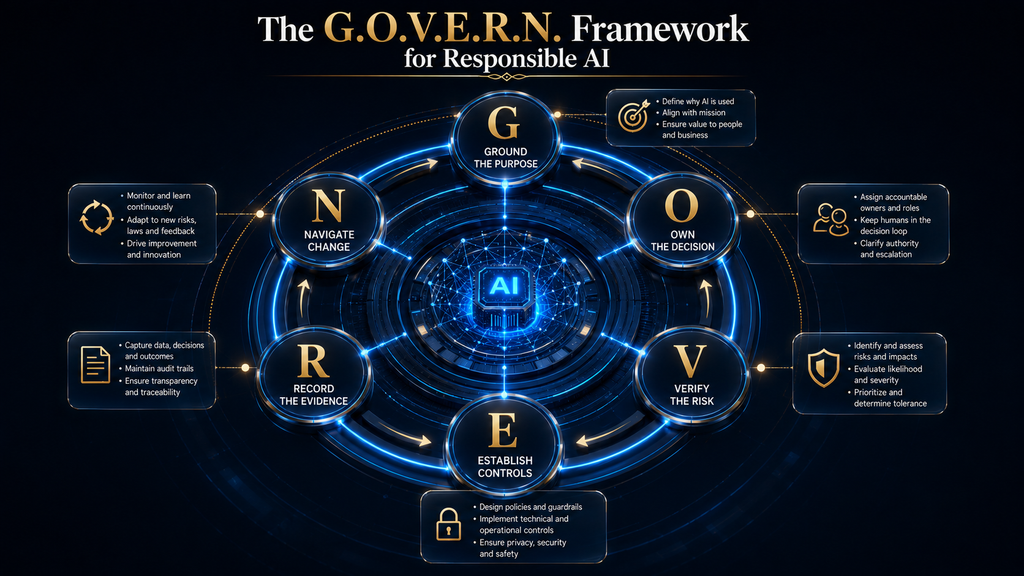
AI governance should follow the system’s lifecycle rather than stop at approval. The lifecycle below has nine stages, grouped here into five steps. Following it makes governance continuous instead of something performed once before launch, and it gives every team a shared vocabulary for where a system sits and what must happen next.
Discover and classify
Start by finding where AI is used, including approved tools, embedded AI features, custom systems, APIs and material employee use. Then classify each use case by purpose, impact, autonomy, data sensitivity, scale, affected stakeholders, regulatory exposure and reversibility, so that every system has a risk tier before anyone debates its controls.
Assign and define
Name the business owner and set out who has authority over approval, changes, escalation and shutdown. Then define acceptable-use rules, data boundaries, human-review requirements, vendor requirements and operational expectations, so that the people running the system know exactly what is permitted and who to call when something changes.
Control and approve
Implement the technical and procedural safeguards that the risk level requires, from access limits to approval gates and logging. Then document the decision to deploy and the conditions under which deployment is permitted, so that later reviewers can see what was agreed and judge whether those conditions still hold.
Monitor and improve
Track performance, incidents, user feedback, changes, drift, security issues and business value once the system is live. Use that evidence, and the lessons from each incident, to strengthen controls and revise the governance process itself, so the program improves alongside the systems it oversees rather than freezing at launch.
Retire
Deactivate systems that are no longer useful, safe, compliant, supported or economically justified, and remove their access to data and connected systems. Retirement is the stage organizations most often forget, yet unused tools with live permissions are a quiet source of risk that a defined exit process eliminates.
Measuring Whether AI Governance Is Working
If governance cannot be measured, it easily becomes an administrative exercise. The most useful metrics do not count policies published or meetings held. They measure coverage, accountability, control effectiveness, incidents and business outcomes. The scorecard below lists ten practical measures and the question each one answers, so leaders can see whether governance is changing behaviour.
| Metric | Question it answers |
|---|---|
| AI inventory coverage | What share of known material AI systems are recorded in the inventory? |
| Ownership coverage | What share of material AI systems have a named owner? |
| Risk classification coverage | What share were risk-classified before production use? |
| Pre-deployment control completion | How many required controls were completed before deployment? |
| Monitoring coverage | What share of higher-risk systems are actively monitored? |
| Incident rate | How often do material AI-related incidents occur? |
| Response time | How quickly can the organization investigate and contain an incident? |
| Remediation rate | How many governance issues are resolved within the target timeframe? |
| Policy compliance | How much AI use happens within approved boundaries? |
| Business value | Are governed systems producing the expected productivity, quality, revenue, cost or service gains? |
The final metric is easy to overlook. Governance should not exist independently of business value. If an AI system delivers little value while consuming significant governance effort, the right governance decision may be to retire it. Reviewing value alongside risk keeps the program focused on outcomes and stops it from protecting systems that no longer deserve a place in the business.
Common AI Governance Mistakes
Most governance failures come from a small set of repeated mistakes. Each one either creates the appearance of control without the substance or applies effort where it does little good. Reviewing them early helps organizations avoid building programs that look complete on paper while leaving the most important risks untouched.
Treating the AI policy as the governance program
A policy is necessary in many organizations, but it is not the whole governance system. Without inventory, ownership, risk classification, controls, monitoring and escalation, the policy becomes a document nobody consults. Treat the policy as one component that points to the processes, owners and tools that do the governing.
Governing tools instead of use cases
Approving an AI tool does not mean every use of that tool carries the same risk. Governance should consider what the system is being used to accomplish, what data it receives and what authority it holds. A single approved chatbot can host a dozen different use cases, each needing its own risk tier, owner and controls.
Creating a committee without decision rights
An AI committee that discusses responsible AI but cannot approve, reject, restrict or suspend systems is a discussion forum rather than governance. Governance requires authority. Give the committee defined powers, a clear escalation path and the ability to act quickly and decisively when a system causes harm.
Applying the same controls everywhere
A brainstorming assistant and a system influencing employment decisions should not share one approval process. Uniformity is not proportionality. Using the control ladder or risk tiers to scale controls lets low-risk tools move quickly while high-impact systems receive the deeper scrutiny their consequences demand.
Relying on human review as a magic safety layer
A reviewer who lacks time, authority, expertise or access to supporting evidence may provide very little real protection. Design review so the person can realistically challenge the output, with manageable volumes, clear criteria and the power to stop or reverse a decision without facing any penalty for doing so.
Ignoring vendor changes and forgetting retirement
Third-party AI evolves, and a model update, new capability, changed retention policy or new integration can alter the risk profile. Organizations also keep systems running simply because nobody defined conditions for shutting them down. Track vendor changes as reassessment triggers and build decommissioning into the lifecycle from the start.
Measuring governance activity instead of outcomes
Counting policies, meetings and training sessions can create an illusion of progress. Better measures examine whether the organization knows where AI is used, whether risky systems are controlled and whether incidents are detected and resolved. Report those outcome metrics to leadership instead of activity totals.
A Real-World Lesson: The Air Canada Chatbot Case
One of the clearest governance lessons comes from Moffatt v. Air Canada, decided by British Columbia’s Civil Resolution Tribunal on 14 February 2024. A customer relied on the airline’s website chatbot for information about bereavement fares, the information was wrong, and the customer later sought the difference after being refused the discount.
The tribunal noted that Air Canada effectively suggested the chatbot was a separate legal entity responsible for its own actions, and rejected that argument, stating that the airline is responsible for all the information on its website. The case shows the accountability problem created when organizations treat AI as an independent actor rather than part of their own service.
When a company puts an AI system in front of customers, the system becomes part of its service operation. Saying the chatbot made the mistake does not answer the governance questions: who authorized it to talk to customers, what controls were in place and who was responsible for its behaviour? Delegating a task to AI does not delegate accountability, a lesson that grows in importance as agents gain autonomy.
A Real-World Lesson: Amazon’s Recruiting Experiment
Amazon’s abandoned recruiting system offers a different lesson. Reuters reported that the experimental tool learned from historical resumes and penalized those that included the word “women’s,” and Amazon eventually scrapped it. The system had not been programmed to discriminate, yet it reproduced patterns from the data it learned from.
An AI system can inherit properties of the environment its data comes from. Governance therefore cannot stop at checking whether a model produces plausible outputs. Organizations must ask whether the data, decision process, intended use and affected population create risks that need testing and human judgment, which is why bias, privacy, copyright and human oversight each deserve dedicated treatment.
The Contrarian View: More AI Governance Is Not Always Better
Many governance discussions avoid an uncomfortable fact: an organization can over-govern AI as easily as it under-governs it. Excessive approval processes push experimentation into the shadows. Employees stop asking for approved solutions because the process takes too long and adopt consumer tools on their own, while small teams grow afraid to try low-risk applications.
That outcome is a governance failure caused by poor proportionality. The strongest programs create different lanes for different levels of risk. Low-risk use cases move quickly within predefined boundaries, medium-risk systems receive targeted review and high-impact or autonomous systems face much stronger scrutiny. Governance should create clarity, and friction should appear only where risk justifies it.
Who Should Own AI Governance?
AI governance is usually too broad for one department. Leadership sets risk appetite and priorities, business owners understand the purpose and consequences of each use, IT and engineering manage implementation, security evaluates threats and access, privacy teams assess data handling and legal interprets obligations and contracts. Procurement reviews vendors, HR joins when workers are affected and audit provides independent oversight.
The exact structure depends on size. A large enterprise may run a formal AI governance committee supported by specialist functions, a mid-sized company may use a cross-functional working group and a small company may appoint one executive owner who draws on IT, legal, security or outside specialists when needed. The organizational chart matters less than one principle.
Governance responsibility must be explicit enough that important decisions cannot fall between departments. Writing down who owns the inventory, who approves each risk tier, who handles incidents and who can suspend a system costs little and prevents the most common failure, which is everyone assuming that someone else is responsible.
AI Governance for Different Organizational Maturity Levels
Governance should evolve with the organization’s AI footprint. A company does not need enterprise bureaucracy on day one; it needs enough structure to control the risks it has. The three stages below describe typical priorities as AI use grows, and most organizations will recognize themselves in one of them and see what the next step should be.
Early-stage organization
The priority is visibility and basic boundaries. Create an AI inventory, identify approved tools, set basic data rules, assign owners and define prohibited or high-risk uses. At this stage a shared spreadsheet and a two-page policy can deliver most of the benefit, provided someone keeps them current as new tools appear.
Growing organization
The focus shifts toward risk classification and repeatability. Introduce formal risk tiers, approval paths, incident reporting, vendor review, human-review requirements and periodic monitoring, so that decisions stop depending on whoever happens to be asked and start following a consistent, documented process.
Mature enterprise
The organization can add sophisticated lifecycle management, continuous monitoring, formal assurance, independent assessment, an AI management system such as ISO/IEC 42001, detailed third-party governance and integration with enterprise risk management. At this stage governance becomes part of how the business operates rather than a separate project.
What AI Governance Looks Like in Practice
Suppose a 100-person company introduces an AI assistant for customer support, aiming to cut response times on routine questions while human agents keep complex cases. The company records the system in its inventory, names the customer-service leader as owner and limits the assistant’s data access, blocking sensitive customer records it does not need for the task.
The system is classed as moderate risk because it talks to customers and influences service outcomes, but it cannot approve refunds or change financial records. The rules therefore require output monitoring, human review for exceptions, incident reporting and periodic reassessment. Each requirement has an owner and a review date recorded in the inventory.
After launch, the company finds the assistant handles routine questions well but struggles with unusual policy exceptions. Instead of declaring failure, the team narrows its scope, adds an escalation path, improves the knowledge sources and updates the monitoring criteria. Governance here is a feedback mechanism between business goals, AI behaviour, risk, controls and decisions, rather than a document in a shared folder.
AI Governance and the Rise of AI Agents
The governance problem grows harder as AI moves from answering questions to taking actions. A chatbot that drafts a reply has limited authority. An agent that searches internal databases, creates tickets, updates customer records, sends messages, buys services or runs workflows has a far larger operational footprint. Our guide to AI chatbots vs AI agents explains the distinction.
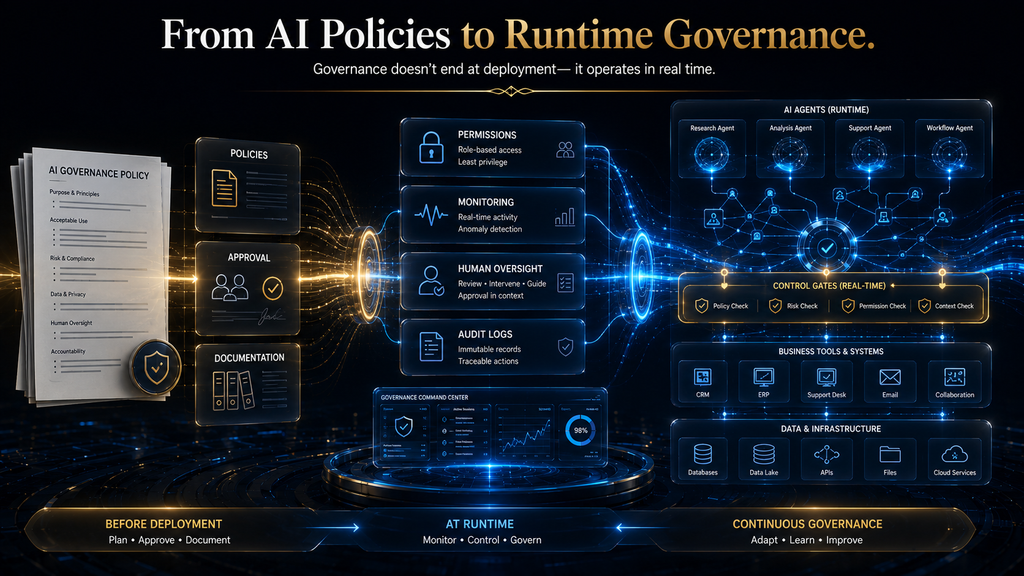
The key shift moves the question from what answer the AI produced to what action it took, with what authority, using which information and with what consequences. Agent governance may need permission boundaries, tool-level access controls, action thresholds, approval gates, transaction limits, audit logs, rollback mechanisms, monitoring and explicit escalation paths.
Organizations may also need to evaluate sequences of actions rather than single outputs, because an agent can cause harm through a chain of individually plausible steps. Security teams face the same challenge with autonomous security tools, which is one more reason governance must be a lifecycle system rather than a static policy.
Second-Order Effects of AI Governance
The first-order effect of governance is risk reduction, and the second-order effects can be just as valuable. A well-kept AI inventory can expose duplicate tools across departments and cut software costs. Standard controls speed procurement because vendors are judged against known criteria, clear approval paths reduce uncertainty and incident records reveal recurring weaknesses in processes, training or vendor choice.
Governance can therefore become a source of organizational intelligence. If the inventory shows that six departments bought similar AI assistants independently, that points to wasted spending and fragmented workflows as well as compliance gaps. If incident monitoring shows failures recur because staff misunderstand when human review applies, the problem lies in training and workflow design rather than model quality.
The strongest governance programs learn from those signals instead of merely recording them. Reviewing inventory, incident and value data together every quarter often reveals the cheapest improvements available, from consolidating tools to rewriting a confusing rule, and turns governance from an overhead into a management tool that pays for itself.
A Decision Matrix: How Much Governance Does an AI Use Case Need?
The matrix below offers a practical starting point rather than a substitute for formal risk assessment. It pairs common use cases with typical risk, governance intensity and key controls. It shows why asking whether AI is safe is usually the wrong question; the better question is safe enough for what, under which conditions and with what controls.
| AI Use Case | Typical Risk | Governance Intensity | Key Controls |
|---|---|---|---|
| Brainstorming public marketing ideas | Low | Light | Approved tool, basic verification |
| Summarizing internal documents | Low to moderate | Light to moderate | Data controls, approved environment, review |
| Customer-service response drafting | Moderate | Moderate | Knowledge controls, monitoring, human escalation |
| AI sales recommendations | Moderate | Moderate | Evaluation, monitoring, human judgment |
| Employee screening | High | Strong | Bias testing, documentation, human oversight |
| Credit or eligibility decisions | High | Strong | Formal risk assessment, controls, monitoring, review |
| AI agent modifying business records | High | Strong | Permission limits, logs, approval thresholds |
| Autonomous agent executing consequential transactions | Very high | Highest | Strict authorization, monitoring, escalation, rollback |
The Practical Governance Checklist
Before approving a material AI use case, an organization should be able to answer a short set of questions clearly. They cover purpose, ownership, data, risk, authority, controls, human oversight, evidence, monitoring, escalation, change and retirement. If every answer is clear, the organization has moved well beyond “we have an AI policy” toward working governance.
On purpose, ask what business problem the AI solves and what happens without it. On ownership, ask who is accountable for the use case and its outcomes. On data, ask what the system accesses and what restrictions apply. On risk, ask what could go wrong, who could be affected and how serious the result would be. On authority, ask whether the AI assists, recommends, decides, acts or operates autonomously.
On controls, ask which safeguards must exist before deployment, and on oversight, where a person must review, approve or challenge the system. On evidence, ask what documentation shows proper assessment and approval. On monitoring, ask how you will notice changed or unacceptable behaviour. Finally, ask who can intervene or shut the system down, which changes trigger review and when you will stop using it.
Where AI Governance Is Heading
AI governance will matter more as AI becomes less visible. Early adoption meant employees deliberately opening a chatbot and typing a prompt. Now AI is embedded in CRM systems, productivity suites, development environments, support platforms, analytics products, recruiting systems, security tools and business-process software, and organizations may not recognize an embedded feature as a separate AI system at all.
The next stage goes further, as agents combine models, tools, data sources, workflows and permissions. Governance will have to move closer to runtime control, tracking which actions AI systems may take and under what conditions as well as which models are approved. That ties AI governance more tightly to cybersecurity, privacy engineering, software supply chains, architecture, procurement and operational risk.
The governance function itself may become partly automated. AI can help maintain inventories, classify use cases, review documentation, monitor outputs, flag policy violations and surface anomalies, which creates a recursive situation in which organizations use AI to govern AI. Human judgment will remain essential wherever consequences are high or the situation is ambiguous.
Responsible AI Adoption Does Not Mean Zero Risk
No realistic governance model eliminates AI risk. Models fail, data is incomplete, vendors change, employees misuse systems, requirements evolve and new attack techniques appear. Even carefully designed systems can behave differently once placed in real organizational environments, with real users, real data and pressures that testing never fully reproduces.
The objective is an organization that can see the risk, decide whether it is acceptable, apply suitable controls, detect when assumptions fail and respond before a small problem becomes a major one. That is a far more achievable and useful definition of responsible AI adoption than a promise of safety, and it gives every team a concrete standard to work towards.
How We Researched This Guide
We reviewed the NIST AI Risk Management Framework and its generative AI profile, the ISO/IEC 42001 standard page, the OECD AI Principles, the European Commission’s AI Act page including the AI Omnibus timeline, the Moffatt v. Air Canada decision and Reuters’ reporting on Amazon’s recruiting tool. Every external link was checked as working in October 2026.
The G.O.V.E.R.N. model, control ladder, lifecycle grouping, scorecard and decision matrix are our own teaching tools built on those sources and common governance practice. They are guidance rather than legal advice, so organizations with regulatory exposure should confirm specific obligations with qualified counsel before relying on them.
Final Thoughts
AI governance is often presented as a compliance exercise, but that description misses its most important purpose. At its core, governance lets an organization decide deliberately where AI belongs, how much authority it should have, which risks are acceptable and who remains accountable for the outcome. Every policy, control and review exists to support those decisions.
The most useful governance program is not the one with the largest policy library or the most meetings. It gives employees and decision-makers enough clarity to tell ordinary AI assistance from consequential automation, apply controls in proportion and respond sensibly when reality does not match expectations. Clarity, proportion and responsiveness matter more than volume.
The G.O.V.E.R.N. approach offers a practical way to run that process: ground the purpose, own the decision, verify the risk, establish controls, record the evidence and navigate change. It turns responsible AI from a collection of principles into a repeatable operating discipline that teams can apply to each new tool, agent or feature as it arrives.
AI governance should not assume that AI must be either fully trusted or completely avoided. The better question is whether the organization has created the conditions under which a particular system can be used responsibly. Good governance does not make AI risk disappear; it makes the organization better at seeing, managing and responding to that risk, while keeping human judgment where it matters.
Build AI Adoption on a Stronger Foundation
Use this framework as a starting point for defining AI ownership, risk, data controls, human oversight, and monitoring across your organization.
Build Your AI Risk Framework →Frequently Asked Questions
What is AI governance in simple terms?
It is the system an organization uses to control how AI is selected, approved, used, monitored and retired, covering owners, risk levels, data rules, human oversight and escalation.
Why is AI governance important for businesses?
It manages risks such as wrong outputs, data exposure, bias, security, regulation and unclear accountability, and its clear boundaries can make responsible adoption faster.
Is AI governance the same as responsible AI?
No. Responsible AI describes principles and desired behaviour. Governance is the structure that puts them into practice by deciding who approves, which controls apply and how systems are monitored.
What should an AI governance framework include?
An AI inventory, named owners, acceptable-use rules, risk tiers, approval paths, data controls, human-review rules, testing, monitoring, incident response, vendor management and retirement conditions.
Does a small business need AI governance?
Yes, but far lighter than an enterprise. Start with a tool inventory, data rules, named owners, simple risk tiers, approval rules, human review for consequential uses and incident reporting.
What is the NIST AI Risk Management Framework?
A voluntary NIST framework for managing AI risk and promoting trustworthy AI. Its core functions are Govern, Map, Measure and Manage, with Govern running across the whole lifecycle.
What is ISO/IEC 42001?
An international standard for an Artificial Intelligence Management System. It gives a structured, certifiable way to establish, run and continually improve how an organization manages AI.
Does human review make an AI system safe?
Not automatically. Review works only when people have the authority, information, skill and time to challenge outputs. A reviewer who simply clicks approve offers little protection.
How often should an AI system be reviewed?
It depends on risk. Higher-risk systems need active monitoring and frequent reassessment. Model updates, new data, wider permissions, incidents or new uses should always trigger a review.
Can AI governance slow down innovation?
Poorly designed governance can, but good governance speeds adoption by making the rules clear. Use light controls for low-risk tools and stronger oversight for consequential or autonomous ones.
Related Guides
- How to Build an AI Risk Management Framework for Small and Mid-Sized Businesses
- Human-in-the-Loop AI: When Automated Decisions Need Human Review
- AI Data Retention Explained: What Happens to Your Prompts and Files?
Written by
Muntasir Ahmad Chowdhury
Founder, AI Hustle World
Muntasir Ahmad Chowdhury is the Founder of AI Hustle World, an independent publication dedicated to making Artificial Intelligence practical, trustworthy, and easy to understand. He researches AI tools, automation, customer service, productivity, and real-world business applications, helping readers make smarter technology decisions through research-driven, experience-backed content.
Expertise:
AI Tools • AI Automation • AI Customer Service • AI Productivity • Generative AI • AI Workflows
Join the AHW Test Log
One email when a new test or guide is published. It says what was checked and links to the sources. Plus Apex Daily OS, a free planner, in your welcome email.