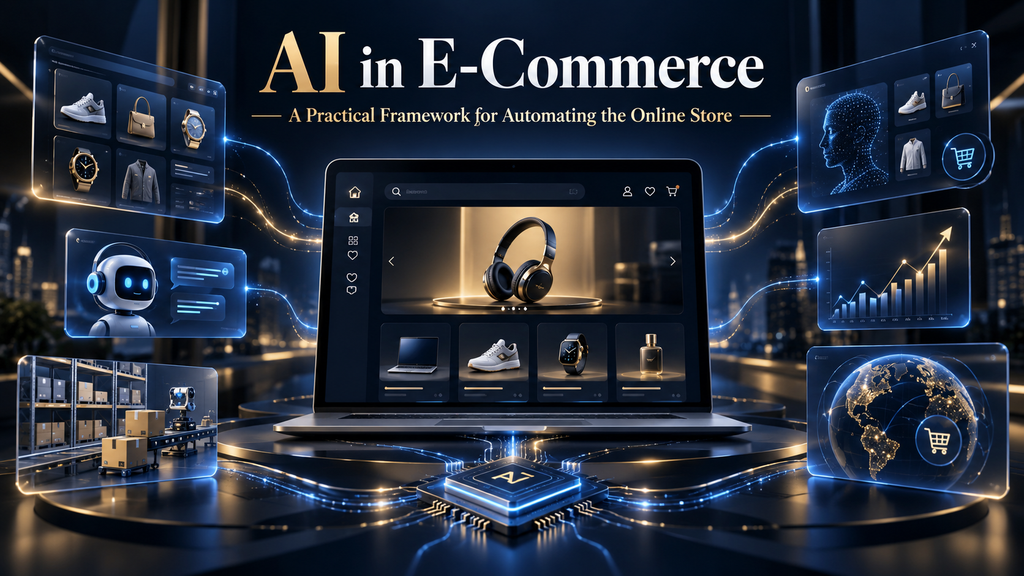
AI in E-Commerce: A Practical Framework for Automating the Online Store
For most online stores, growth creates an operational problem before it creates a technology problem. More customers generate more support requests, more products require more catalog maintenance, greater order volume makes inventory harder to monitor, and more marketing activity creates more data to interpret. At some point, adding more manual effort stops being an efficient answer because the number of decisions continues to grow faster than the team’s available attention.
This is where AI in ecommerce becomes genuinely useful, but the opportunity is often framed too narrowly. Businesses are surrounded by tools that promise AI-generated content, automated customer service, smarter recommendations, predictive inventory, dynamic pricing, and autonomous shopping, yet installing several of those tools does not necessarily create a coherent strategy.
The more important question is which recurring decisions are suitable for delegation, which still require human judgment, and what information the AI needs in order to make useful decisions in the first place.
The distinction matters because AI performs very differently depending on the nature of the workflow. A repetitive task supported by clean data, clear rules, and an observable outcome is usually a much stronger automation candidate than an ambiguous decision involving incomplete information, substantial financial consequences, or a high cost of error. The fact that a model can produce an answer does not by itself mean that the business should allow the model to act on that answer.
That leads to the central argument of this article: the strongest ecommerce AI strategy is not maximum automation but selective delegation. Machines are particularly useful for handling scale, retrieval, classification, pattern recognition, prediction, summarization, and other repetitive work, while people remain responsible for decisions where context, uncertainty, consequence, or strategic judgment matter. The objective is not to eliminate human involvement; it is to make human attention more valuable.
There is another reason this distinction matters in 2026. AI is increasingly participating on the customer side of ecommerce as well as the merchant side. NielsenIQ has reported growing consumer use of AI for shopping research and product discovery, while fully autonomous purchasing remains much less common than AI-assisted discovery and evaluation.
For retailers, this creates two connected strategic challenges: improving internal operations through appropriate automation and making product information sufficiently accurate and structured for AI systems to understand, compare, and recommend the products being sold.
This article examines both sides of that shift. Rather than presenting AI as a collection of fashionable features, it treats ecommerce as a set of decisions and workflows, then asks where AI can create measurable value, where automation becomes risky, what infrastructure should exist underneath the technology, and how a merchant can move from experimentation to a practical operating model.
What AI in Ecommerce Actually Means
AI in ecommerce is best understood as the use of artificial intelligence to interpret information, generate content, identify patterns, make predictions, recommend actions, or execute defined tasks across the commerce lifecycle. That includes technologies such as recommendation engines, predictive models, classification systems, natural-language interfaces, generative AI, fraud-detection systems, personalization engines, intelligent search, and increasingly AI agents that connect several of these capabilities together.
The common element is the workflow surrounding the model. A useful ecommerce AI system typically sits inside a chain that looks something like data → interpretation → recommendation or generation → business rules → action → measurement → feedback. The model provides intelligence, but the surrounding system determines what information it can access, what it is permitted to do, how exceptions are handled, and whether the resulting outcome is actually beneficial.
This is also why sophisticated AI can perform badly inside a poorly organized operation. If the product catalog contains contradictory information, inventory data is stale, policies are inconsistent, or there is no agreed definition of success, the model cannot simply solve those organizational problems by being more capable. In some cases, automation can make the situation worse because errors move faster and reach more customers before a person has an opportunity to intervene.
The first principle is therefore straightforward: AI should follow operational clarity rather than substitute for it. A business should understand the process first, identify the authoritative source of information, define acceptable risk, establish a measurable outcome, and only then determine how much of the workflow should be delegated.
Why Ecommerce Is Such a Strong Environment for AI
Ecommerce is a particularly attractive environment for AI because much of the customer journey is already digital and measurable. A retailer can observe searches, product views, clicks, add-to-cart behavior, purchases, returns, customer-service requests, inventory movement, reviews, promotional activity, traffic sources, and repeat-purchase behavior. Those signals create a substantial base of structured and semi-structured information that can support prediction, classification, ranking, and analysis.
The second advantage is repetition. Online businesses make thousands of similar decisions, from answering routine delivery questions to identifying low-stock products, categorizing merchandise, summarizing customer feedback, and preparing reports. A small efficiency gain on one decision may appear insignificant when viewed in isolation, but it can become commercially meaningful when the same task occurs hundreds or thousands of times.
Yet digital does not automatically mean automatable. Some processes are too infrequent to justify the complexity of automation, some depend on information that is not reliable enough, and some are sufficiently ambiguous that a machine-generated answer should remain advisory. A system that incorrectly classifies a product may be inconvenient; a system that approves an inappropriate refund, makes an unsupported product claim, or changes a strategically important price can create much greater damage.
That is why the most useful question is not “Where can we use AI?” The stronger question is “Which decisions happen often enough, have enough reliable data, can be measured clearly, and carry a manageable cost of error?” Once an ecommerce operator starts thinking in those terms, AI adoption becomes much more disciplined and much easier to prioritize.
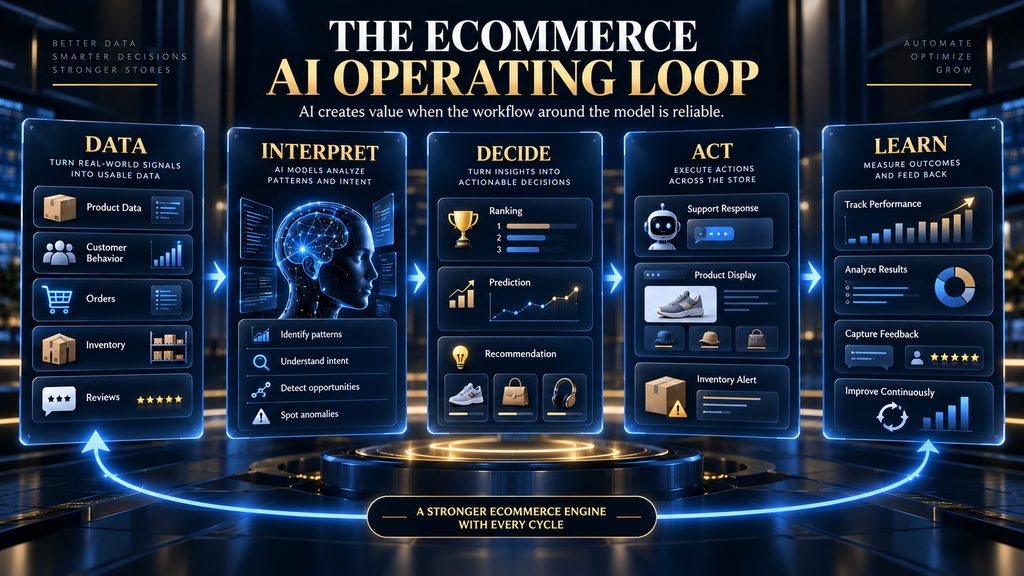
The Ecommerce AI Operating Loop
An online store can be understood as a continuous decision system rather than simply a website with products and checkout. A customer arrives with a need, the business uses information to determine what to show or recommend, the customer takes an action, and that action creates new information that can influence later decisions. AI can participate at many points in this cycle, but its practical value depends on the quality of the information entering the system and the controls surrounding the output.
Consider inventory management. A buyer responsible for several thousand products may previously have had to review stock levels, historical sales, current demand, promotional activity, and supplier lead times across a large spreadsheet or multiple dashboards. An AI-assisted system can examine those signals and produce a smaller list of products that deserve attention, allowing the buyer to investigate exceptions instead of manually searching the whole catalog.
The machine has not replaced the buyer in that example. It has changed the buyer’s work from broad inspection to targeted judgment, which is usually a much more valuable use of human attention. The same principle applies to customer service: an AI system can retrieve order information and answer routine questions while routing unusual disputes, complicated requests, or high-consequence cases to people.
This is an important distinction because greater model capability does not automatically justify greater autonomy. A system may be able to produce a plausible answer to almost any question, but the business still needs to decide whether the answer is sufficiently reliable to act upon. Technical capability determines what can be attempted; operational design determines what should actually happen.
The Data Layer Comes Before the AI Layer
The quality of an AI implementation is often constrained by something that receives far less attention than the model itself: the quality of the underlying business data. A retailer may have attractive product pages while maintaining inconsistent product attributes, duplicated categories, incomplete specifications, conflicting prices, or inventory information that is updated differently across several systems.
Humans can sometimes compensate for those inconsistencies because they recognize context. An experienced merchandiser may know that two differently named attributes describe essentially the same feature, or realize from previous experience that a supplier’s terminology is inconsistent. An AI system should not be expected to make those assumptions safely unless the business has deliberately designed and validated the workflow to handle them.
The problem becomes even more obvious when AI starts participating in product discovery. Imagine a shopper asks an AI system to find a lightweight waterproof jacket under $150, available in medium, and suitable for cold weather. The system needs reliable information about price, stock, size, weight, waterproofing, and the product’s appropriate use. If those attributes are missing or contradictory, improving the AI’s language ability does not solve the core problem.
Current guidance around AI-ready commerce increasingly emphasizes structured product information, centralized product data, and richer attributes because AI systems need machine-readable context to understand what products are and why they may be relevant to a particular shopper. This is important beyond any specific platform because the underlying principle applies regardless of which AI system eventually becomes part of the customer journey.
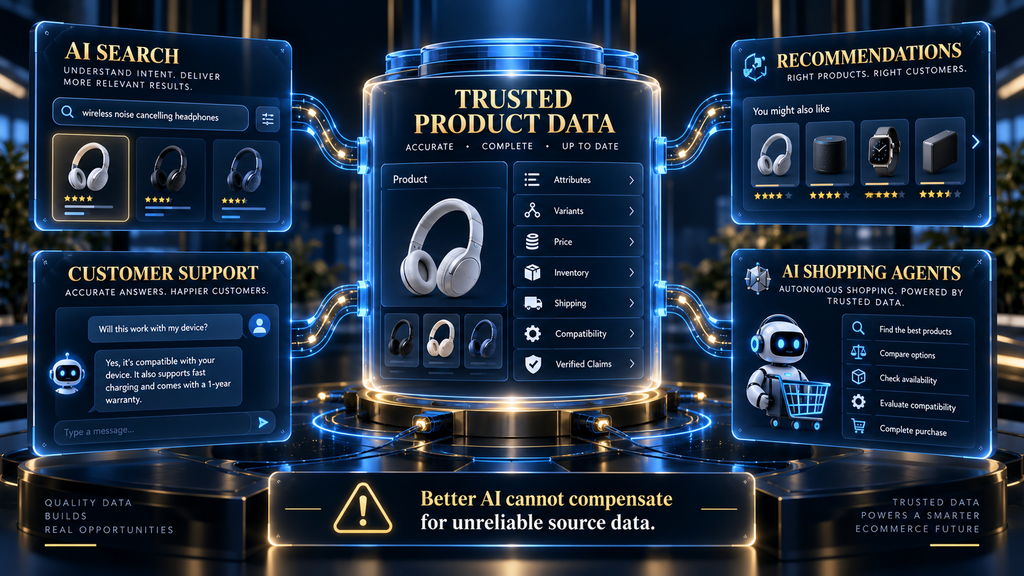
For that reason, product data should be treated as infrastructure rather than merely content. A reliable product-information layer can support search, recommendations, customer support, analytics, merchandising, content generation, and future AI integrations simultaneously, whereas fragmented or contradictory information can weaken all of them.
Where AI Creates Practical Ecommerce Value
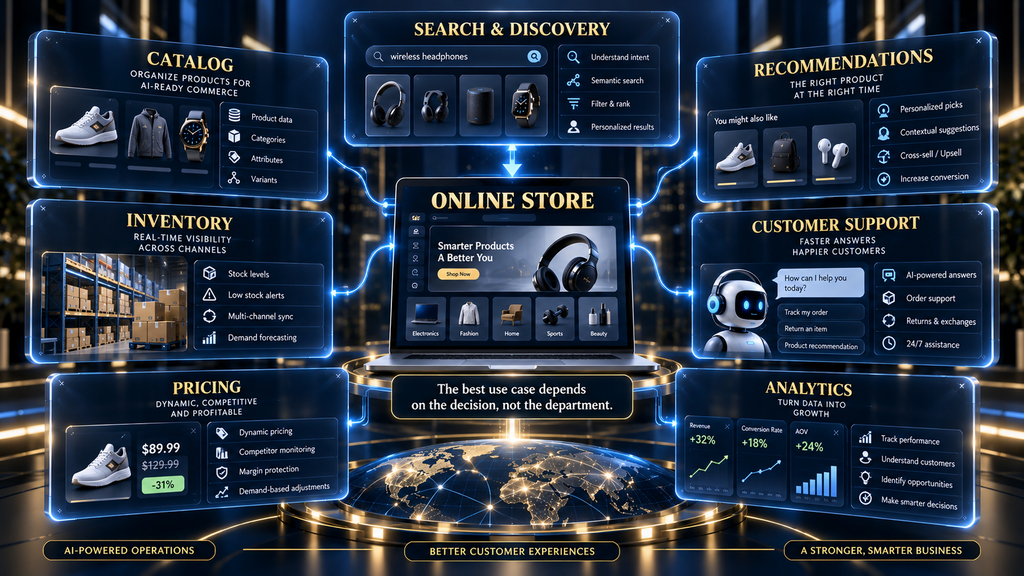
The strongest ecommerce AI applications are not necessarily the most futuristic. They are usually the workflows in which repetition, measurable outcomes, reliable inputs, and manageable risk combine to create a strong economic case. Different businesses will prioritize different functions, but the underlying decision logic remains similar.
Product Catalog and Merchandising
Large product catalogs create a maintenance burden because the number of records, attributes, categories, and variants can expand far more quickly than a merchandising team can manually keep everything consistent. AI can assist with product categorization, attribute extraction, title normalization, description drafting, specification summaries, variant grouping, tagging, and identification of incomplete or inconsistent fields.
These tasks are especially suitable for AI when the source data is already trustworthy. A merchant can supply approved specifications and ask the system to convert those facts into a customer-friendly description, summarize technical details, suggest category placement, or identify which attributes are missing. In that situation, AI is accelerating a transformation process rather than inventing knowledge.
The risk appears when generation is allowed to become the source of truth. If the supplier states that a backpack is water-resistant, the model should not upgrade the claim to “fully waterproof” simply because that phrase is more persuasive. If the manufacturer does not provide a temperature rating, the AI should not create one simply because a complete product description appears more professional.
This makes an important operational boundary clear: generation and verification are different jobs. AI can be extremely useful for transforming verified information into clearer and more useful content, but factual product claims should originate from authoritative information and be validated before they become production data.
AI Search and Product Discovery
Traditional ecommerce search works best when the shopper uses the terminology contained in the product catalog. Real customers often describe problems rather than product attributes, which means a query can contain a mixture of budget, use case, preferences, constraints, and expectations that do not map neatly to keywords.
Consider a shopper searching for “comfortable office shoes for standing all day under $120.” That request contains a category, price limit, intended use, and an attribute that is partly subjective. An AI search system can interpret those elements, convert them into structured requirements, retrieve candidate products, and rank the products according to how well they match the request.
The benefit is not that AI suddenly possesses human understanding. The benefit is that natural-language intent can be translated into a more useful retrieval problem. When the catalog contains meaningful attributes, this can improve the relationship between what a customer asks and the products the store returns.
The limitation is equally important. Better intent recognition cannot fully compensate for poor product information. If the store does not clearly record relevant attributes or maintains inconsistent descriptions across products, the search system may simply become better at asking the wrong database the right question.
The shift is becoming more strategically relevant as AI participates earlier in product discovery. NIQ’s 2026 research points to substantial consumer use of AI for shopping and product discovery, which suggests that retailers increasingly need to think about whether their products are understandable not only to human shoppers but also to the AI systems helping shoppers decide what to consider.
Product Recommendations and Personalization
Recommendation engines have been part of ecommerce for years, but AI can incorporate a wider range of signals when deciding what might be relevant to a customer. Depending on the system, those signals may include browsing behavior, past purchases, product similarity, customer segments, price sensitivity, inventory, seasonality, and the context of the current shopping session.
The important word is relevant. Personalization is not inherently valuable just because it is personalized, and a recommendation engine can easily optimize the merchant’s preferred metric while making the customer’s experience worse. If a shopper repeatedly chooses lower-priced products and the system constantly pushes higher-margin alternatives, the algorithm may be maximizing a commercial objective without improving the underlying buying decision.
That is why recommendation systems should be evaluated against a combination of customer and business outcomes. Depending on the store, useful measurements might include conversion, contribution margin, basket size, repeat purchase behavior, return rate, or customer satisfaction rather than simply click-through rate.
This also highlights a broader principle of AI governance: the system optimizes the objective you measure, not the objective you vaguely have in mind. A recommendation engine, support assistant, or inventory model can become highly effective at improving one narrow metric while quietly creating problems elsewhere if the business does not define appropriate guardrails.
Customer Support
Customer support is one of the strongest starting points for ecommerce AI because many support interactions are repetitive and based on information that already exists elsewhere in the business. Order-status requests, delivery questions, return policies, basic product information, and routine routing decisions can often be handled faster when the system has controlled access to the relevant source data.
The strongest implementation does not ask AI to handle everything. Instead, it uses automation for the routine majority and creates clear escalation rules for situations that require investigation or judgment. A straightforward tracking question can be answered from current carrier information, while a claim that a package was marked delivered but never received may require a person to investigate the circumstances.
The same principle applies to disputes and sensitive cases. A refund disagreement, serious product complaint, safety-related issue, or unusual customer situation may contain context that a generic automated response cannot safely resolve. The value of AI in those situations may still be significant, but it may lie in summarizing the case, retrieving relevant records, or suggesting possible next steps rather than making the final decision.
Current ecommerce guidance from Shopify identifies support automation, order information, FAQs, returns, and related repetitive tasks as practical applications for merchants. The strongest business case is therefore not “replace customer-support employees,” but remove repetitive retrieval and response work so people can devote more attention to exceptions and complex customer situations.
Inventory Forecasting and Demand Planning
Inventory is a particularly natural environment for predictive AI because ecommerce businesses already collect historical information about sales, seasonality, promotional activity, product lifecycles, supplier lead times, and inventory movement. The challenge is not necessarily a lack of data; it is the difficulty of interpreting many variables simultaneously and deciding which products require attention.
A forecasting system can estimate demand and identify products whose projected stock position creates an elevated risk of shortage or excess inventory. That does not mean the model knows exactly what will happen next month. Its value lies in improving the quality and speed of the analysis so that a buyer can investigate the products where the probability of a problem appears unusually high.
This changes the nature of human work in a useful way. Instead of checking every product manually, the buyer can investigate the exceptions and combine the model’s recommendation with information the system may not fully capture, such as supplier reliability, upcoming campaigns, cash constraints, or changes in commercial strategy.
That is why inventory forecasting is often better treated as AI-assisted decision support before it becomes an autonomous purchasing system. Once the organization has evidence that the forecasts are reliable and understands how the model behaves under unusual conditions, greater automation can be considered with much more confidence.
Pricing and Promotion
Pricing presents a more difficult automation problem because a wrong decision can directly affect revenue, margin, brand positioning, and customer expectations. AI can still provide substantial value by analyzing demand patterns, inventory levels, promotional history, competitive signals, and other variables, but the consequences of automated actions mean that greater control is usually justified.
A merchant can begin by using AI to identify products that appear unusually underpriced, overstocked, or sensitive to promotional changes. Those recommendations can be reviewed, tested in controlled situations, and compared against a baseline before the business considers allowing the system to execute changes automatically.
The reason for this caution is that pricing decisions often depend on context that is difficult to encode completely. A supplier may be discontinuing a product, a brand may intentionally protect a premium position, or a temporary market event may distort demand. If the system cannot see those factors, it may optimize a mathematically reasonable objective while producing a strategically poor outcome.
Pricing therefore illustrates a broader rule that applies throughout ecommerce: an AI recommendation does not automatically deserve permission to become an AI action. The level of autonomy should be earned through evidence.
The AI Hustle World Ecommerce AI Readiness Framework
The central ecommerce AI decision is not whether a model is technically capable of performing a task. Modern AI systems can generate useful outputs across an extraordinarily wide range of activities, so technical capability has become a weak criterion for prioritization.
A stronger approach is to evaluate whether a specific workflow is ready for delegation. AI Hustle World can assess that readiness through five dimensions: repeatability, data readiness, measurability, error cost, and human-review efficiency. These factors should be considered together because strength in one area cannot necessarily compensate for a fundamental weakness in another.
| Readiness factor | Core question | Strong signal |
|---|---|---|
| Repeatability | Does this decision happen frequently enough to create leverage? | Recurring, high-volume work |
| Data readiness | Are the inputs accurate, complete, and accessible? | Reliable source of truth |
| Measurability | Can the result be evaluated objectively? | Defined KPI and baseline |
| Error cost | What happens when the system gets it wrong? | Errors are detectable and manageable |
| Human-review efficiency | Can people focus on exceptions rather than every case? | Clear escalation path |
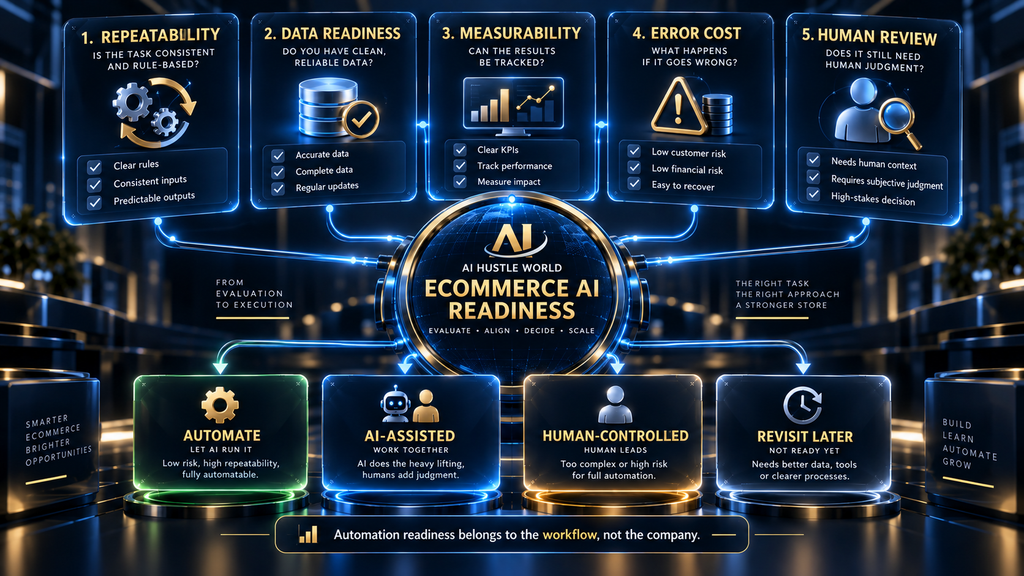
A routine order-status workflow can score highly because the required information is structured, the question occurs frequently, the correct response can often be verified, and unusual cases can be escalated. Inventory forecasting may fit better as AI-assisted because the prediction is valuable but still depends on contextual judgment before purchasing decisions are made.
Higher-consequence decisions may remain human-controlled even when AI can provide useful analysis. Sensitive disputes, significant pricing decisions, strategic merchandising choices, and unusual risk cases are examples where the value of contextual judgment may outweigh the efficiency of full automation.
There is also value in recognizing a fourth category: revisit later. A workflow may eventually be an excellent AI candidate but currently lack sufficient data, stable processes, transaction volume, or measurement. Delaying automation until those conditions improve is not indecision; it is a rational sequencing decision.
The important principle is that AI readiness belongs to the workflow, not to the company as a whole. An organization can be highly ready for automated reporting and completely unready for autonomous pricing, and treating both as one “AI maturity” score would hide that difference.
Building the Data Foundation Before Expanding Automation
One of the most common mistakes in ecommerce AI is treating data cleanup as a secondary concern that can be solved after the AI system is deployed. In practice, reliable data is what allows an AI workflow to produce dependable decisions in the first place.
A store should know which system is authoritative for product information, inventory, pricing, customer policies, shipping details, and other business facts. It should also know how updates move between systems and what happens when two sources disagree. Without that discipline, an AI system may retrieve conflicting information and present one version confidently simply because it happens to encounter that source first.
This is especially important for product information because the same data may eventually serve several purposes at once. The structured attributes that support search may also feed recommendations, customer support, product descriptions, analytics, merchandising systems, and AI shopping interfaces.
Google’s current guidance around AI-ready commerce emphasizes structured product information and centralized product data, while Shopify has been building commerce infrastructure designed to make merchant catalogs available to AI-driven shopping experiences. Although these are platform perspectives and should not be treated as neutral proof of market outcomes, the underlying operational requirement is difficult to ignore: AI works better when the business has a dependable representation of its own products and policies.
This is why the strongest AI roadmap often begins with work that does not look particularly “AI.” Cleaning attributes, consolidating sources, defining ownership, standardizing terminology, and establishing validation rules may create more long-term value than immediately deploying another generative tool.
The New Product-Discovery Environment
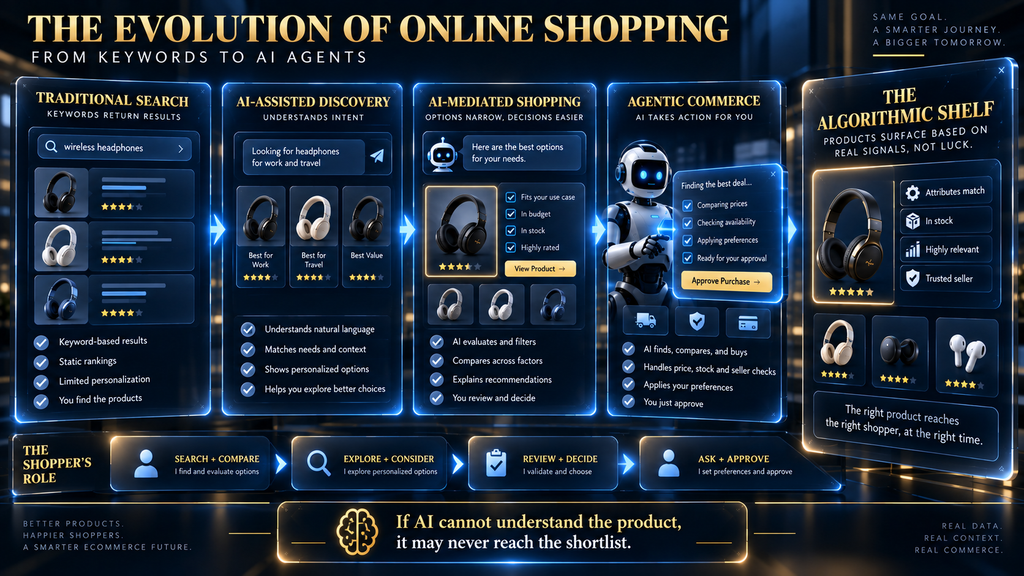
For decades, ecommerce merchants competed primarily for attention inside search engines, marketplaces, advertising platforms, and their own storefronts. AI introduces an additional layer because an assistant can now act as an intermediary between the shopper’s need and the products available in a catalog.
Imagine a consumer asking an AI system for a compact coffee machine suitable for a small apartment, under $200, easy to clean, and capable of making espresso. The assistant may not simply retrieve pages containing those keywords. It can interpret the requirements and build a shortlist based on product attributes, reviews, availability, pricing, and contextual relevance.
This is the emerging algorithmic shelf. A product is not merely competing to appear somewhere in a search result; it may be competing to be recognized as a suitable answer among a much smaller set of products selected by an AI system.
That possibility makes product-data quality increasingly strategic. A product with vague attributes, inconsistent specifications, or poorly defined use cases may be more difficult for an AI system to distinguish from alternatives, even if the human-facing product page is visually attractive.
The resulting lesson is not that conventional SEO is becoming irrelevant. It is that discoverability is becoming more layered. Merchants increasingly need to think about how products are found by search engines, marketplaces, social channels, recommendation engines, and AI systems that interpret customer intent.
From AI Automation to Agentic Commerce
The next major development in ecommerce AI is the increasing involvement of AI systems in the shopping journey itself. Traditional ecommerce asks the customer to perform much of the work: search for products, browse categories, compare features, inspect reviews, check availability, and decide what to buy. AI-mediated shopping can compress several of those steps into a conversation in which the customer describes the outcome they want rather than the exact product they already know they need.
The difference can be illustrated by the way a shopper might search for a gift. Instead of entering a sequence of keywords, the customer can describe the recipient, budget, preferences, restrictions, and occasion in ordinary language. An AI shopping system can then interpret those conditions, identify relevant products, explain trade-offs, and potentially take the process farther toward transaction.
Shopify has invested heavily in this direction, describing infrastructure designed to connect merchant catalogs and purchasing capabilities with AI-driven commerce experiences. Shopify has also reported significant growth in AI-driven traffic and orders on its platform, although those figures are vendor-reported data rather than independent measurements of the entire ecommerce market.
Independent research provides a useful counterweight to platform enthusiasm. NIQ’s 2026 studies indicate that AI-assisted shopping and discovery are already meaningful consumer behaviors, but fully autonomous purchasing remains far less common. The immediate implication for most merchants is therefore not that every store needs to become an autonomous agent-based operation. It is that product information, availability, policies, and other commercial facts need to be structured well enough to support increasingly intelligent discovery systems.
Why “AI-Powered” Is Not a Strategy
A store can have an AI chatbot, a recommendation engine, a content generator, an analytics assistant, and an automation platform while still lacking an actual AI strategy. The presence of technology does not prove that a business has improved its decisions, lowered costs, increased revenue, or created a better customer experience.
Consider two hypothetical merchants. One uses five AI tools and saves some administrative time but cannot demonstrate a meaningful improvement in customer satisfaction, inventory performance, conversion, or profitability. The other uses one narrowly focused AI workflow to reduce repetitive support work while maintaining service quality and allowing staff to concentrate on more difficult customer cases.
The second merchant has less visible AI. It may nevertheless have created more value.
This is why AI should be evaluated as an operational investment rather than a technology collection. Before implementing a workflow, the business should be able to state what problem it is solving, what baseline exists today, what outcome should improve, how errors will be detected, and what would justify expanding the system.
The useful question is not “How much AI has the store adopted?” It is “Which important business decisions are measurably better because AI is involved?” That is a much stronger definition of maturity.
The Failure Modes That Matter Most
AI systems tend to fail in ecommerce for several recurring reasons. One is hallucinated or unsupported product information, particularly when a generative model is allowed to fill missing specifications with plausible language. Another is automation bias, where employees begin trusting recommendations because they appear confident or technically sophisticated. A third is the creation of feedback loops in which the system’s own decisions change customer behavior and then use that changed behavior as evidence that the original decisions were correct.
There is also a problem with narrow optimization. A support system may improve automated resolution while frustrating customers with complex cases. A recommendation engine may increase clicks while increasing returns. An inventory system may reduce stockouts while producing excessive stock. The system may therefore succeed according to one metric while failing according to the actual purpose of the business.
This is why important AI workflows should have both a primary KPI and a guardrail KPI. The primary measure tells the organization whether the intended objective is improving, while the guardrail helps reveal whether the system is achieving that improvement by creating another problem.
The need for guardrails increases as autonomy increases. A recommendation can be reviewed before it reaches a customer, while an automated action can affect thousands of transactions before anyone recognizes the pattern. The stronger the downstream consequence, the more carefully the workflow should be monitored.
Measuring Whether AI Is Actually Working
The first level of measurement is operational efficiency. Depending on the workflow, that can include handling time, hours saved, task volume, automation rate, cost per interaction, or the amount of human review required.
The second level is commercial performance. A recommendation system might be evaluated through conversion, contribution margin, basket value, or repeat purchasing, while an inventory system may be judged through stockout reduction, inventory turnover, or forecast accuracy. The correct measure depends on the job the system is supposed to improve.
The third level is quality. Accuracy, customer satisfaction, correction rate, escalation quality, recommendation relevance, return rate, forecast error, and complaint frequency can reveal whether the faster process is actually a better process.
The fourth level is risk. For higher-impact workflows, organizations may need to monitor inappropriate product claims, policy violations, disputed decisions, fraud false positives, unauthorized actions, or other incidents associated with system errors.
The purpose of this layered measurement approach is simple: AI should be judged by business outcomes, not by how much AI-generated activity it produces. A workflow that handles twice as many cases automatically is not necessarily better if the number of mistakes has increased at the same time.
The Economics of Selective Automation
The value of ecommerce AI is sometimes overstated because businesses equate time saved with money saved. Saving employee time is useful, but the economic outcome depends on what the organization does with the capacity that becomes available.
Suppose an AI support system removes several hundred hours of repetitive work each month. The value of those hours may come from handling more orders without additional staff, responding more quickly, reducing backlog, improving customer retention, or allowing employees to work on more valuable operational tasks. If none of those outcomes changes, the business may have reduced effort without meaningfully increasing economic value.
The same logic applies to merchandising, catalog management, analytics, and inventory. AI creates leverage when the capacity it releases can be redeployed toward work that produces greater value than the activity that was automated.
This makes selective automation economically attractive. The business does not need to eliminate every manual step; it needs to remove low-value repetition while preserving enough human capacity to improve higher-value decisions.
The practical test is therefore not simply “How much work did AI automate?” It is “What became possible because that work no longer consumed the same amount of human attention?”
Why Better AI Can Increase the Value of Human Judgment
The most useful relationship between AI and ecommerce employees is not always replacement. In many cases, better automation makes human judgment more concentrated and therefore more valuable.
An inventory manager who once examined every product may eventually spend most of the week reviewing only the products that an AI system flags as unusual. A customer-support employee who previously handled basic tracking questions may spend more time on refunds, disputes, or difficult product issues. A merchandiser who previously performed large amounts of manual catalog cleanup may spend more time deciding how the store’s taxonomy should evolve.
The work has changed, but judgment has not disappeared.
This is important because human expertise is often most valuable at the edges of the system. Machines are good at processing large volumes of relatively structured information, while people are better positioned to interpret unusual circumstances, consider conflicting objectives, and take responsibility for consequential decisions.
The goal of automation should therefore be to concentrate human attention where its marginal value is highest, not to remove human involvement simply because the software can technically operate without it.
A Practical 30/60/90-Day Ecommerce AI Roadmap
The first 30 days should focus on understanding the operation before choosing the software. Map the recurring workflows across customer support, catalog management, merchandising, inventory, reporting, marketing operations, and fulfillment, then document what triggers each process, which data it requires, who performs it, how frequently it occurs, how long it takes, what errors appear, and which business outcome the process affects.
Once the workflows are documented, identify a small number of candidates and evaluate them using the readiness framework. Look for work that is frequent enough to matter, supported by reliable information, measurable through a clear baseline, manageable when errors occur, and suitable for exception-based human review.
Days 31 through 60 should be used to pilot one workflow rather than launching several simultaneously. If customer support is selected, begin with a tightly defined group of questions such as order tracking, delivery information, and basic policy requests. Give the system controlled access to authoritative information, establish clear escalation rules, and measure the results against the pre-AI baseline.
The purpose of the pilot is evidence, not spectacle. The team should care less about whether the AI sounds impressive and more about whether handling time improves, customer satisfaction remains stable, errors remain within acceptable limits, and employees actually recover useful capacity.
Days 61 through 90 should focus on expansion only where the evidence supports it. A successful support workflow may justify adding another category of request, while a useful inventory system may justify extending forecasting to additional products or regions. A catalog workflow that consistently produces accurate results may eventually support broader automation, but only after validation demonstrates that the process can be trusted.
The sequence should remain prove → standardize → expand. That approach is less exciting than deploying several AI tools immediately, but it creates something much more valuable: a documented understanding of which automation actually improves the business.
Preparing a Product Catalog for AI Discovery
A product catalog increasingly serves more than one audience. It still needs to persuade human shoppers, but it may also become the information layer from which search engines, recommendation systems, shopping assistants, analytics platforms, and AI agents determine what a product is and whether it matches a particular need.
That makes accuracy and structure especially important. Depending on the category, product records may need clearly defined names, categories, specifications, dimensions, materials, compatibility information, variants, pricing, availability, shipping information, warranty details, and verified use cases. The exact fields will differ, but the principle is consistent: important product facts should be explicit enough that an external system does not have to infer them from vague marketing language.
This is also where generative AI can play a useful supporting role. It can identify missing attributes, normalize terminology, convert specifications into clearer descriptions, create draft FAQs, and organize information, provided the underlying facts come from an authoritative source and the final result is validated.
The long-term advantage comes from maintaining a durable product-information layer beneath the AI tools. Models, vendors, and interfaces can change quickly, but the business should not need to rediscover what its own products are every time it replaces an AI platform.
Who Should Use Ecommerce AI Now?
The strongest candidates for ecommerce AI tend to have recurring operational work, reasonably reliable data, clear business processes, and enough volume for efficiency gains to matter. Stores with large catalogs, substantial support demand, complex inventory, significant customer-feedback volume, or repetitive reporting often have several possible entry points.
However, size alone does not determine readiness. A small store with a founder spending hours each week answering repetitive questions may have a better first automation opportunity than a much larger retailer with fragmented data and unstable processes.
The deciding factor is therefore workflow economics combined with workflow readiness. The best starting point is the process where AI can create measurable leverage without requiring the business to assume unnecessary risk.
Who Should Wait?
A business should be cautious about advanced automation when its data is unreliable, its processes change constantly, its KPIs are unclear, or nobody owns the workflow being automated. A technically impressive system still requires someone to monitor its behavior, investigate failures, validate data, and decide whether its recommendations should be trusted.
The same caution applies when the consequences of an error are disproportionately high. A store may have excellent historical data for pricing but still choose to keep final pricing authority with a human because brand strategy and customer expectations are difficult to represent completely in the model.
Waiting is not necessarily a sign that the business is behind. Sometimes it is evidence that the business understands its constraints.
The Second-Order Effects of Ecommerce AI
Some of the most valuable consequences of AI may appear outside the workflow that was originally automated.
A customer-support assistant may reveal that shoppers repeatedly ask whether a product is compatible with a particular device. That discovery can lead to better product pages, clearer specifications, improved search, fewer support interactions, and potentially fewer returns. The AI has therefore generated operational insight in addition to reducing response workload.
A catalog-enrichment system can create a similar effect. While identifying missing attributes, it may reveal that the store’s taxonomy is inconsistent or that product teams use different terminology for the same feature. Correcting those weaknesses can improve merchandising, search, recommendations, analytics, and future AI integrations simultaneously.
Inventory systems can also become early-warning mechanisms rather than simple forecasting tools. A sustained change in demand may indicate a new customer preference, a market shift, a promotional effect, or a product problem that deserves investigation beyond the immediate stock decision.
This is where a mature AI operation begins to compound its value. Instead of using AI only to automate isolated tasks, the business uses AI-generated signals to improve the wider system in which those tasks exist.
A Seven-Question Test Before Automating Any New Workflow
Before approving another ecommerce AI initiative, the business should be able to explain the decision in operational terms. Does the workflow occur frequently enough to justify automation, and is the required information reliable enough to support it? Can the organization define success with a meaningful KPI, and does it understand the likely cost of an incorrect decision?
The remaining questions are equally important: can humans review uncertain cases efficiently, will the automation improve economics rather than simply increase output, and what happens when the system fails? A good AI proposal should have clear answers because those questions expose whether the project is actually solving a business problem or simply taking advantage of a new technology.
This test also prevents a common mistake: assuming that technical possibility creates strategic value. A model may be able to perform a task extremely well, but if the task happens twice a month, has unreliable inputs, or carries high consequences when wrong, automation may still be the wrong choice.
The business should therefore treat every new AI workflow as a decision about value, risk, and readiness, rather than as a test of whether the newest model is capable enough.
The Practical Ecommerce AI Stack
A mature AI-enabled store is usually built in layers rather than around one central model. The first layer is the source of truth containing products, inventory, pricing, customer information, policies, orders, shipping details, returns, reviews, and other core facts. The second layer contains the AI capabilities used for prediction, classification, retrieval, recommendation, summarization, or generation.
The third layer is business logic, where the organization defines permissions, thresholds, policies, validation rules, and escalation conditions. The fourth layer is action, where an approved output becomes something operational such as an update, response, recommendation, task, or workflow change.
The final layers are measurement and human oversight. Measurement determines whether the workflow is improving and whether guardrails are holding, while human oversight handles exceptions, investigates failures, approves sensitive actions, and adjusts the system as the business evolves.
This architecture matters because the model should not become the business’s permanent source of truth. Models, providers, interfaces, and capabilities will change, but the underlying product information, operating rules, measurement systems, and governance structure should be durable enough to survive those changes.
That separation is one of the strongest ways to future-proof an ecommerce AI strategy.
Final Thoughts
AI in ecommerce is often described as a race toward complete automation, but that is not the most useful way to think about the opportunity. The real transformation is more practical: recurring business decisions are gradually becoming systems that can interpret information, recommend actions, perform routine work, identify exceptions, and feed new information back into the operation.
The more durable strategy is therefore neither “automate everything” nor “wait until AI is mature.” It is to build the business in a way that allows autonomy to increase gradually as evidence improves.
Start with the repetitive work. Establish the source of truth. Measure the current process. Choose one workflow where the economic case is clear. Keep humans involved where the consequences justify it. Use the results to determine what should happen next.
That is the real advantage of AI in ecommerce: not replacing judgment, but making the business better at deciding where judgment is needed and where machines can safely carry the workload.
Ready to Turn One Repetitive Task Into a Real AI Workflow?
Start with the workflow, not the software. Our guide to AI workflow automation tools will help you evaluate the platforms that can actually connect the right triggers, apps, decisions, and actions.
Compare AI Workflow Automation Tools →Frequently Asked Questions
What is AI in ecommerce?
AI in ecommerce refers to the use of artificial intelligence to interpret information, generate content, make predictions, provide recommendations, or automate tasks across an online store. Common applications include product discovery, recommendations, customer support, catalog management, demand forecasting, fraud detection, personalization, analytics, and AI-assisted shopping.
How can AI help an online store?
AI can reduce repetitive work and help businesses interpret large amounts of operational and customer data more efficiently. Depending on the store, it can assist with customer support, product categorization, product-content generation, inventory forecasting, search, recommendations, analytics, merchandising, and other workflows where reliable data and measurable outcomes exist.
What should an ecommerce business automate first?
A strong first candidate is a workflow that occurs frequently, uses relatively reliable data, has a clear KPI, carries a manageable cost of error, and allows humans to review exceptions efficiently. For many stores, this may involve routine customer-support questions, catalog classification, reporting, product-data enrichment, or inventory-risk identification.
Can AI replace ecommerce employees?
AI can automate portions of many ecommerce roles, particularly repetitive retrieval, classification, summarization, generation, analysis, and routing tasks. Whether entire roles should disappear is a much broader question, and many businesses can generate more value by redirecting employees toward exceptions, strategy, customer relationships, and decisions requiring contextual judgment.
Is AI-generated product content safe?
AI-generated product content can be useful when the model works from verified product information and the output is reviewed before publication. The main risk is allowing the model to invent missing attributes, specifications, or claims, so factual product information should come from an authoritative source rather than from the model’s assumptions.
Does ecommerce AI require a large amount of data?
Not every application requires a large dataset. FAQ automation, workflow routing, product-data transformation, and reporting assistance can work with relatively modest information, while advanced personalization, recommendations, and demand forecasting generally become more useful as the business accumulates larger quantities of accurate historical data.
What is agentic commerce?
Agentic commerce describes shopping experiences in which AI systems assist consumers with product discovery, comparison, selection, and potentially purchasing. Current research suggests that AI-assisted shopping and discovery are significantly more common than fully autonomous purchasing, so merchants should focus first on accurate product information and useful AI-mediated discovery rather than assuming that human-free transactions have already become the norm.
How should a store prepare for AI shopping agents?
The strongest foundation is accurate, structured product information. Important attributes such as product identity, specifications, variants, price, availability, compatibility, shipping information, and other relevant facts should be maintained in authoritative systems so AI tools can retrieve them consistently. Current guidance from Google and Shopify emphasizes structured product information as an important component of AI-ready commerce.
How should an ecommerce business measure AI success?
AI should be measured through the business outcome it is supposed to improve rather than through the volume of AI-generated activity. Useful metrics may include hours saved, handling time, conversion, contribution margin, average order value, customer satisfaction, error rate, return rate, forecast accuracy, stockout performance, and escalation quality, depending on the workflow.
What are the biggest risks of AI in ecommerce?
Major risks include hallucinated product information, unreliable source data, automation bias, inappropriate recommendations, weak escalation processes, feedback loops, privacy concerns, false fraud positives, and optimizing the wrong business metric. The appropriate controls depend on the use case, but reliable data, explicit business rules, human oversight, validation, monitoring, and fallback procedures are fundamental protections.
Written by
Muntasir Ahmad Chowdhury
Founder, AI Hustle World
Muntasir Ahmad Chowdhury is the Founder of AI Hustle World, an independent publication dedicated to making Artificial Intelligence practical, trustworthy, and easy to understand. He researches AI tools, automation, customer service, productivity, and real-world business applications, helping readers make smarter technology decisions through research-driven, experience-backed content.
Expertise:
AI Tools • AI Automation • AI Customer Service • AI Productivity • Generative AI • AI Workflows
Get Smarter With AI
Enjoyed this guide? Get practical AI tools, tutorials, and honest reviews delivered to your inbox.
6 thoughts on “AI in Ecommerce: How to Automate an Online Store”