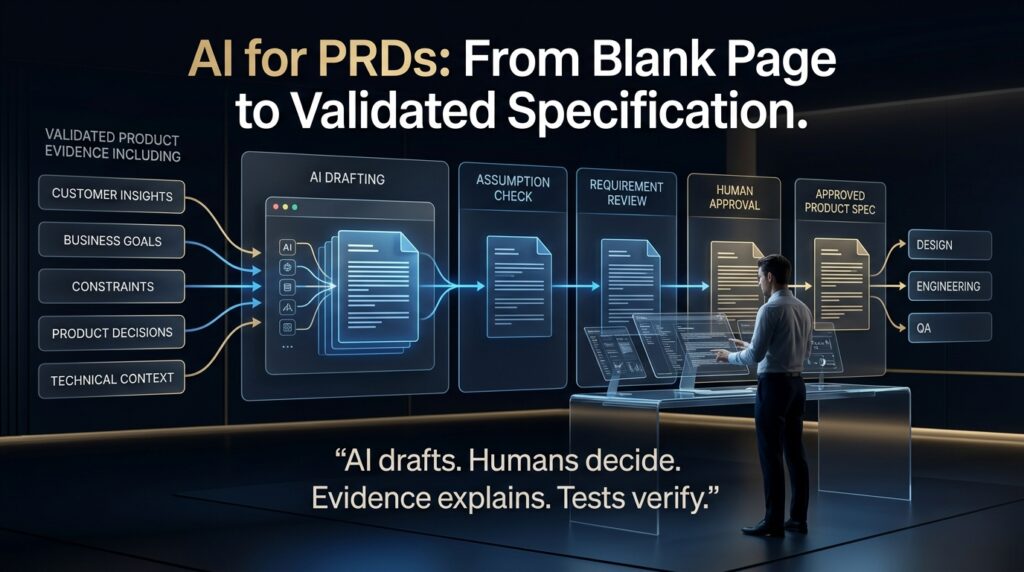
Evidence: Documentation reviewed
Last checked: October 2026
What was done: Written from official documentation and the published sources linked in this article. Not hands-on tested.
Files: None
Affiliate links: No
How to Use AI for PRDs, User Stories and Product Specs Without Losing Accountability
Using AI for PRDs works best when the model drafts, structures and critiques the document while people own the decisions behind it. AI can turn evidence into a first-pass product requirements document, user stories and acceptance criteria in minutes, and it cannot decide what the product should do.
The pressure to hand over more is easy to understand. A product manager has a deadline, customer interviews to synthesize, an existing flow to document, edge cases to consider and an engineering team waiting for clarity.
A model can produce a complete-looking document from a two-line request. The danger is that every gap in the request is filled with something plausible, and a polished page gives no sign of which parts were decided and which were invented.
That behavior is well documented. OpenAI’s research on why language models hallucinate explains that models are often rewarded for producing an answer instead of acknowledging uncertainty, which is exactly what happens when a specification has holes.
Requirements are a poor place for confident guesses. A wrong sentence in a blog draft costs an edit, while a wrong requirement becomes tickets, code, tests and customer-facing behavior.
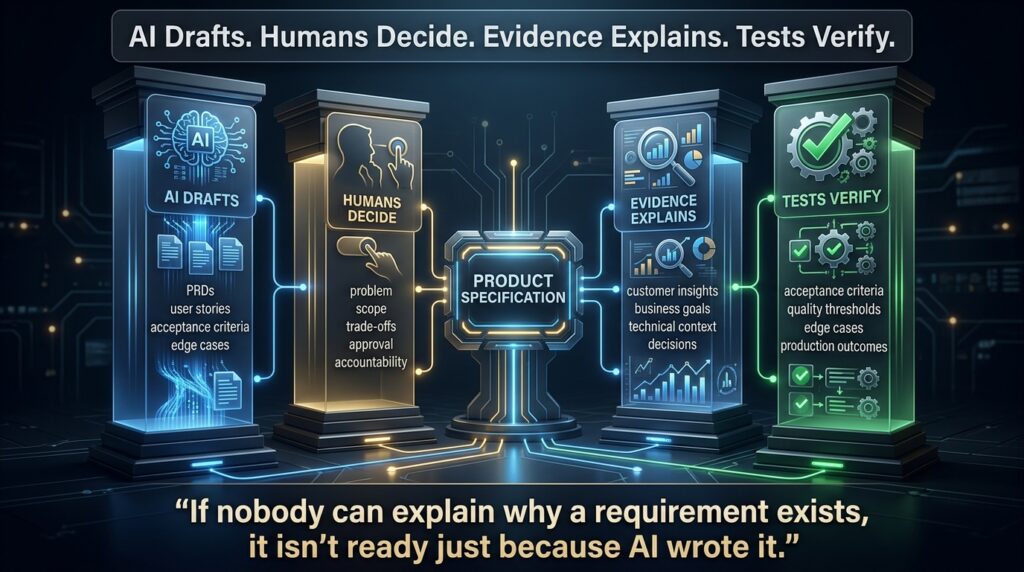
The principle of this guide is short: AI drafts, humans decide, evidence explains and tests verify. The rest of the article shows how to make that work in a real product process.
You will find the AI Hustle World Assumption Ledger, the AI PRD Review Matrix, the AI Requirements Control Loop, a Behavioral Contract for AI features, an accountability matrix, a worked example and a 90-day adoption plan.
What AI Can Do With PRDs, User Stories and Specs
AI is most useful in product documentation when it reduces the mechanical cost of structuring, reviewing and transforming information. It is least useful when it is asked to supply decisions nobody has made.
On the drafting side, it can turn research notes into a problem statement, convert an approved objective into candidate user stories and suggest acceptance criteria. It can also rewrite approved requirements into the formats that tickets and test plans need.
On the review side, it can find contradictions between two sections, flag requirements that cannot be tested, list missing edge cases and compare a new requirement with existing product behavior.
The review jobs are often more valuable than the drafting jobs. Writing a document is cheap, while finding a requirement defect before engineering builds against it prevents far more expensive work.
Why PRDs Exist: The Job of a Requirements Document
A product requirements document exists to create shared understanding. Atlassian’s guide to product requirements documents describes it as defining the product’s purpose, features and behavior, so that everyone works toward the same thing.
That purpose explains its traditional shape. The document records who the feature is for, what problem it solves, what is in and out of scope and how success will be judged.
Writing it was slow, and the slowness had a hidden benefit. To fill each section, the product manager had to make decisions, talk to people and notice what was still unknown.
AI removes the slowness and, with it, the forcing function. A document can now be complete on the page while the thinking behind it is unfinished, which is the central problem this guide addresses.
PRD, User Story, Acceptance Criteria and Spec Are Different Artifacts
AI-generated documentation becomes much more useful when each artifact has a clear job. Asking a model for “the document” produces a blend that does none of the jobs well.
| Artifact | Its job | Typical question it answers |
|---|---|---|
| PRD | Explain the problem, users, goals, scope and success measures | Why are we building this, and for whom? |
| User story | Express one user need in the user’s terms | What does this person want to achieve? |
| Acceptance criteria | Define conditions that must be true for the work to be accepted | How will we know it is done? |
| Product specification | Describe behavior, rules and boundaries in detail | What exactly should the system do? |
The artifacts connect, and they are not interchangeable. A user story without acceptance criteria cannot be tested, and a specification without a problem statement cannot be prioritized.
Ask for one artifact at a time. “Draft acceptance criteria for this approved story” gives a far better result than “write the PRD with stories and criteria.”
Context Sets the Quality Ceiling
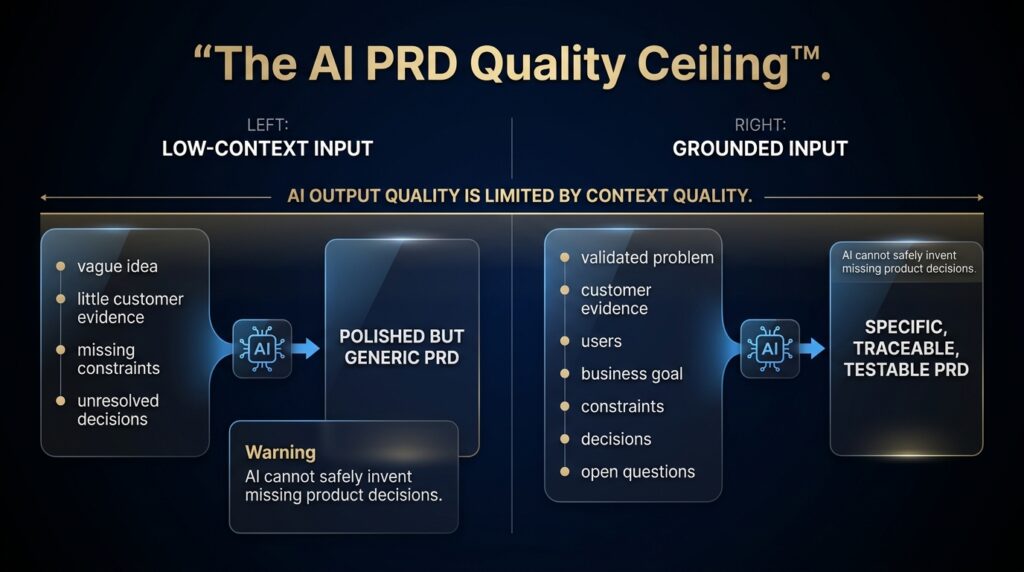
The quality of an AI-generated PRD is capped by the quality of the context it receives. A model given a feature name and one sentence can only produce generic requirements.
Useful context includes customer evidence, the current product behavior, the business objective, known constraints and decisions already made. Each of these replaces a guess with a fact.
Vendors are building on this idea. Productboard, for example, describes a customer insights workflow in which feedback is centralized and linked to feature ideas, so documents can be grounded in what customers said.
More context is not automatically better. The model needs the information that defines the decision, clearly separated from instructions, as our guide to context engineering explains.
Where the Evidence for a PRD Comes From
A PRD is only as good as the evidence behind it, and most of that evidence exists before drafting begins. Customer feedback, usage data and prioritization decisions are the raw material.
Feedback tells you what problem to solve and for whom. Our guide on turning customer feedback into product insights explains how to move from comments to a validated insight a PRD can cite.
Usage data shows how people behave today, which defines the current state the PRD must describe. Our guide to AI product data analysis covers how to combine it with qualitative evidence.
The decision to build comes from prioritization, covered in our guide to AI roadmap prioritization. When those three inputs are attached to the prompt, the AI drafts from facts, and the Assumption Ledger starts short.
The Better Workflow Starts Before the Draft
The weak workflow runs from idea to AI to PRD. It is fast, and it produces a document in which facts, assumptions and inventions look identical.
The stronger workflow has seven steps: evidence, gap analysis, clarification, AI draft, challenge, validation and approval. The difference is that questions are asked before text is written.
Gap analysis is the step most teams skip. Before any drafting, the AI reads the available evidence and lists what is missing, contradictory or undecided.
Those gaps go to people. The product manager answers what can be answered, marks the rest as open, and only then asks for a draft that uses the approved context.
What AI Should Do Before It Writes Anything
A good first prompt asks for analysis, not prose. It might read: “Review the supplied research, the existing product behavior and the business objective. List missing information, contradictions, unsupported assumptions and decisions that must be made before a PRD can be drafted. Do not invent answers.”
The output is a list of questions. Some are trivial, and a few will be uncomfortable, such as nobody having decided which users are in scope for the first release.
The second prompt comes after those questions are answered: “Using only the approved context, draft the PRD. Label assumptions and open questions clearly. Do not introduce new product behavior unless it is supported by the evidence or marked as a proposal.”
This two-step pattern takes a few minutes longer than a single request. It saves hours of review, because the draft contains far fewer invented requirements. Our guide to asking AI better questions explains why letting the model ask first works so well.
The Assumption Problem: AI Fills Empty Spaces
Suppose the team has not decided whether users can export data as CSV or Excel. A model writing the export section will choose one, usually CSV because it is common.
The PRD now says “the system shall export data as CSV.” Nobody decided that, and nothing in the document shows it was a guess.
The same thing happens with numbers. A missing performance target becomes “within two seconds,” a missing limit becomes “up to 10,000 records,” and each reads like a considered requirement.
The model is behaving as designed, producing the most plausible completion. The fix is a process that makes assumptions visible, which is what the next tool provides.
The Assumption Ledger
The AI Hustle World Assumption Ledger is a simple table kept beside the PRD. Every statement that is not a confirmed fact gets a row.
| Statement | Source | Confidence | Owner | Status |
|---|---|---|---|---|
| Enterprise admins can export user data | Current product permissions | High | Engineering | Validated |
| Export should support CSV | Customer request | Medium | Product manager | Proposed |
| Export must complete within 30 seconds | No approved requirement | Low | Product manager and engineering | Open |
| Email confirmation is required | AI-generated suggestion | None | Product manager | Discard |
| Exported files need retention controls | Compliance guidance | High | Security | To validate |
Ask the AI to build the first version: “List every statement in this draft that is not directly supported by the supplied evidence, and say where each came from.” Then review it with the team.
The ledger changes the conversation. Instead of debating a finished-looking document, people decide row by row what is true, what is proposed and what should be removed.
Requirement Contamination
Requirement contamination happens when an AI assumption becomes organizational truth. The statement appears in the PRD, is copied into tickets, shapes a design and is encoded in tests.
By the time someone questions it, a chain of work depends on it. Removing it now means changing several documents and possibly some code.
The original uncertainty has disappeared along the way. Each downstream document repeats the statement with more confidence, and nobody remembers that it began as a guess.
This is why the ledger matters most at the start. An assumption caught before the first ticket is written costs a minute, and the same assumption caught after release costs a sprint.
Why AI Makes Requirement Quality More Important
Requirements are increasingly read by machines as well as people. Coding assistants and agents take specifications as input and generate code and tests from them.
A human engineer who reads “the dashboard should load quickly” will ask what quickly means. A coding agent may simply choose an interpretation and build it.
The same applies to missing rules. If the specification does not say what happens when a user lacks permission, the agent will decide, and the decision came from nobody on the team.
So AI reduces the cost of generating requirements and raises the importance of making them precise. Our guide to how AI coding agents work shows how those tools consume the instructions they are given.
Requirements Need Quality, Not Just Good Prose
Well-written sentences are not the same as good requirements. Requirements engineering has long-established quality criteria, and they matter more when text is cheap to produce.
The international standard ISO/IEC/IEEE 29148 covers requirements engineering processes across the systems and software life cycle. It describes the characteristics of well-formed requirements, including being unambiguous, singular, feasible and verifiable.
Those characteristics give you a practical test. For each requirement, ask whether two people could read it differently, whether it describes one thing, whether it can be built and whether it can be checked.
AI is helpful here as a reviewer. Asked to assess a requirement against those four questions, a model will usually spot vague terms and bundled requirements that a tired author missed.
Weak Requirements and Testable Requirements
The difference is easiest to see in examples. A weak requirement uses words that sound clear and cannot be tested.
| Weak requirement | Why it fails | Testable version |
|---|---|---|
| “The dashboard should load quickly.” | “Quickly” is undefined | “For signed-in users under agreed production load, the dashboard shows primary content within two seconds for 95% of requests.” |
| “The export should be easy to use.” | “Easy” cannot be verified | “A first-time administrator can complete an export in three steps without leaving the page.” |
| “The system should handle large files.” | No size stated | “The system accepts files up to 50 MB and shows a clear error above that size.” |
| “Errors should be handled gracefully.” | No behavior described | “If the export fails, the user sees an error message and no partial file is offered.” |
AI can turn vague statements into testable candidates like these. It should not invent the thresholds.
The two seconds, the three steps and the 50 MB are decisions for the product manager and engineering. Ask the model to mark each threshold as “to be confirmed” until someone approves it.
Singularity: One Requirement, One Behavior
A singular requirement describes one behavior. “The system shall export data and email the user and log the action” is three requirements joined by “and.”
Bundled requirements cause trouble later. One part may be built and the others missed, a test may pass on one behavior and say nothing about the rest, and a change to one part forces a rewrite of all three.
AI is good at splitting these. A prompt such as “Find every requirement that contains more than one behavior and rewrite each as separate, numbered requirements” produces a cleaner list in seconds.
Review the split afterward. Occasionally two behaviors belong together because one is meaningless without the other, and that is a judgment for the team.
The AI PRD Review Matrix
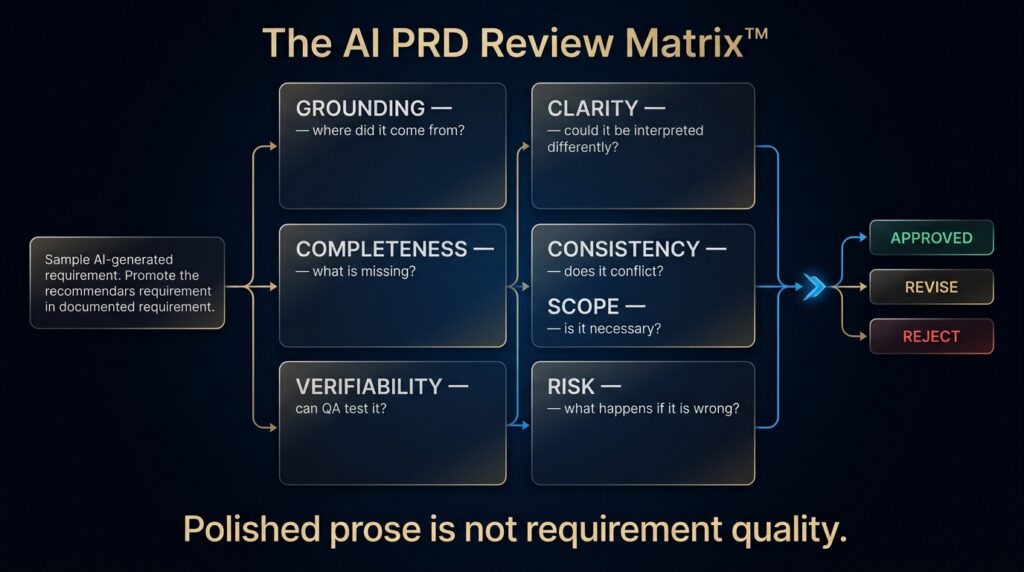
The AI Hustle World AI PRD Review Matrix gives every requirement eight questions. It turns review from a general read-through into a structured check.
| Dimension | Question |
|---|---|
| Grounding | Where did this requirement come from? |
| Clarity | Could two people interpret it differently? |
| Verifiability | Can QA test it objectively? |
| Completeness | Are important cases missing? |
| Consistency | Does it conflict with another requirement? |
| Scope | Is it required for this release? |
| Traceability | Can it be connected to a problem or decision? |
| Risk | What happens if it is wrong? |
Ask the AI to run the matrix first and report its findings as a table. Then have people validate the results, starting with the rows marked high risk.
The matrix works on human-written documents as well. Many teams find it most useful on older specifications, where it exposes vague requirements that have been causing rework for years.
AI as a Requirements Critic
“Make this PRD better” is a weak request. It invites the model to add polish and length, which is the opposite of what a specification needs.
Specific critique prompts work far better. Ask “Which requirements cannot be tested as written?”, “Which statements contradict each other?” and “What would an engineer need to ask before building this?”
Ask for the reader’s perspective too. “Read this as a QA engineer and list the cases you would not know how to test” produces questions the author did not think of.
Treat the critique as input. The model will raise some false alarms, and deciding which concerns are real is part of the product manager’s job.
Traceability: Every Requirement Needs a Reason
Traceability means each important requirement can be linked to its origin. That origin may be customer evidence, a business decision, a legal obligation or a technical constraint.
A requirement with no traceable reason is a warning sign. It may be a leftover from an earlier draft, a personal preference or an AI addition that nobody noticed.
AI can help build the links when evidence and requirements live in the same place. It can match each requirement to the interview notes, tickets or decisions that support it and list the ones with no match.
The unmatched list is the valuable output. Each item on it needs a decision: find the reason, mark it as a proposal or remove it.
Writing User Stories With AI
User stories express a need in the user’s own terms. Mike Cohn’s widely used guide to user stories describes the familiar template: as a type of user, I want some goal so that some reason.
AI drafts stories in that format easily. Given an approved objective, it will produce a reasonable set and often suggest user types the team had not listed.
The weakness is that a story is a starting point for a conversation and not a complete requirement. “As an administrator, I want to export user data so that I can analyze it” says nothing about formats, filters, permissions or failures.
Use AI to generate candidate stories and then to challenge them. Ask which stories overlap, which are too large for one release and which have no evidence behind them.
Acceptance Criteria: From Intent to Verification
Acceptance criteria are the bridge between what the team intends and what can be verified. They state the conditions that must be true for a story to be accepted.
A common format is Given, When, Then. The Gherkin reference from Cucumber documents the structure: a starting context, an action and an expected outcome.
A weak criterion reads, “Export works with filters.” A stronger one reads, “Given an administrator has applied a filter, when they select CSV export, then the file contains only records matching the filter.”
AI is well suited to drafting criteria in this structure and to listing the cases that are missing. Our guide to generating and maintaining software tests with AI covers how criteria become automated tests.
Edge Cases and Failure Behavior
Most requirement defects sit at the edges. The main path is described, and nobody wrote down what happens with an empty list, a very large file, a lost connection or a user without permission.
AI is useful for generating these cases. Ask “List the edge cases and failure conditions for this feature, grouped by input, permissions, volume and timing.”
The list will be long, and not every case deserves a requirement. The product manager and engineers decide which cases must be handled in this release and which can wait.
Write down the ones you defer. A deferred edge case that is recorded is a decision, and one that is forgotten is a bug waiting to be reported by a customer.
The Scope Problem: AI Likes to Add Helpful Features
Ask a model to draft requirements for an export feature and it may add scheduling, email delivery, format conversion and an audit log. Each sounds sensible.
They may also be completely outside the planned release. Because the additions appear in confident, well-formed sentences, they look as though someone approved them.
This is a quiet form of scope creep. It costs nothing to generate and can add weeks of work if it reaches the backlog unnoticed.
State the scope in the prompt and ask the model to separate anything extra. “List suggestions outside the stated scope under a separate heading called Proposals” keeps useful ideas without letting them slip into the requirements.
Unknown Is a Valid Product State
A specification with open questions feels less finished than one with every section filled. It is the more professional document.
An unresolved decision that is visible can be assigned, discussed and closed. A decision that looks resolved, and that nobody made, will surface later as a defect.
Make “unknown” an allowed value. Tell the AI to write “Open question” wherever the evidence does not settle a point, and to list all open questions at the end.
Never hide uncertainty to make a document look complete. The purpose of a PRD is shared understanding, and that includes a shared understanding of what is still undecided.
Non-Functional Requirements Are Easy to Forget
Performance, security, privacy, accessibility and reliability rarely appear in a first draft. They describe how well the system must work, where functional requirements describe what it does.
AI can prompt for them. Ask “Which non-functional requirements are missing from this PRD?” and it will list categories the draft ignored.
It cannot set the standards. Response-time targets, data retention periods and accessibility levels depend on your product, your customers and your legal obligations.
Add a short section for each relevant category, even if the entry is an open question. A missing privacy requirement is one of the most expensive defects to discover after launch.
Requirements for AI Features: The Behavioral Contract
Features that use AI need requirements of a different kind. A deterministic feature either works or does not, while an AI feature works some of the time and fails in varied ways.
The AI Hustle World Behavioral Contract captures what a conventional specification leaves out. It describes how the feature should behave under uncertainty.
| Contract element | What to define |
|---|---|
| Grounding | Which sources the feature may use |
| Quality threshold | What level of accuracy is acceptable, measured on what test set |
| Uncertainty handling | What the feature does when it lacks evidence |
| Out-of-scope behavior | How it responds to requests it should not handle |
| Fallback | Where the user is sent when the feature cannot help |
| Human review | Which outputs need a person before they are used |
| Monitoring | What is measured after launch, and who responds |
A weak requirement reads, “The assistant answers customer questions.” A stronger one says it answers from the approved knowledge base, cites the source and routes the conversation to a person when it cannot verify an answer.
Our guides to AI hallucinations and human-in-the-loop AI explain the failure modes this contract is designed to control.
Specs as Input for Coding Agents
When a specification feeds a coding agent, its precision decides the quality of the code. Ambiguity that a person would question is resolved silently by the tool.
AWS guidance on generative AI in the software development lifecycle notes that AI can generate artifacts such as user stories, design mock-ups, code snippets and test cases. Each of those inherits whatever is unclear upstream.
A few habits help. State boundaries explicitly, include examples of expected inputs and outputs, and list what the feature must not do. When the specification feeds a tool directly, a fixed format helps, as our guide to structured prompts explains.
Keep review in place at the other end. Our guide to reviewing AI-generated code shows how to check that what was built matches what was intended.
The AI Requirements Control Loop
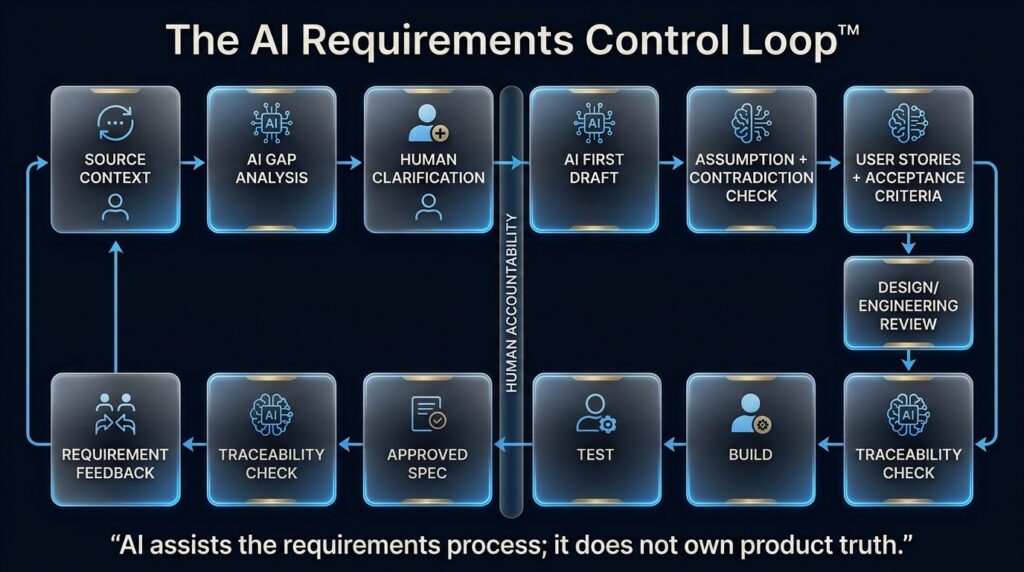
The AI Hustle World AI Requirements Control Loop connects the steps into one process. It runs from source context to AI gap analysis, human clarification, AI first draft, assumption and contradiction check, user stories and acceptance criteria, design and engineering review, traceability check and approved specification.
The loop continues after approval. Build and test results feed back into the requirements, so a defect found in testing leads to a clearer requirement next time.
Two features make it a control loop and not a checklist. People decide at every point where a product choice is made, and evidence from later stages returns to improve earlier ones.
Teams do not need to adopt the whole loop at once. Starting with the gap analysis and the assumption check captures most of the benefit.
Keeping the PRD Current After Approval
Requirements change after approval, and an outdated PRD is worse than none. People keep trusting a document that no longer matches what is being built.
AI helps with the upkeep. Given the old and new versions, it can list exactly what changed and which user stories, acceptance criteria and tests are affected.
Keep a short change log at the top of the document. Each entry should record what changed, why, who approved it and which downstream items were updated.
Review the document again at release. Comparing the final behavior with the PRD shows where requirements were unclear, and those lessons improve the next specification.
The Accountability Matrix
AI changes who does the typing, and it should not change who is accountable. A simple matrix keeps ownership clear.
| Activity | AI | Product manager | Design | Engineering | QA |
|---|---|---|---|---|---|
| Initial document draft | Assists | Owns | Input | Input | Input |
| Problem definition | Analyzes | Owns | Input | Input | None |
| User stories | Drafts | Approves | Input | Input | Input |
| Acceptance criteria | Drafts | Approves | Input | Validates feasibility | Tests |
| Technical constraints | Summarizes | Understands | Input | Owns | Input |
| Edge cases | Suggests | Prioritizes | Input | Validates | Tests |
| Final specification | Assists | Approves product intent | Approves experience | Approves technical behavior | Approves testability |
The AI column never contains the word “owns” or “approves.” That is the point of the matrix.
Share it with the team before you start. It prevents the awkward moment when a defect is traced to a requirement nobody remembers approving.
Risk-Based Human Review
Reviewing every AI-drafted sentence to the same standard wastes time. Review effort should follow risk.
Low-risk content, such as formatting, summaries of agreed points and restatements, needs a quick read. Medium-risk content, such as new user stories and acceptance criteria, needs the product manager’s approval.
High-risk content needs specialists. Anything touching money, permissions, privacy, security or legal obligations should be checked by the person accountable for that area.
Mark the risk level in the document. A simple tag beside each section tells reviewers where to spend their attention, and it keeps the review fast where speed is safe. Our guide to AI governance shows how to set these review rules across a whole organization.
A Practical Prompt Architecture
Reliable PRD prompts share a structure. They separate the context, the task, the rules and the output format.
The context block holds the evidence: research notes, current behavior, objectives and decisions made. The task block states one job, such as drafting acceptance criteria for a named story.
The rules block carries the controls: use only the supplied context, label assumptions, list open questions, do not add behavior that is not supported. The output block states the format.
Save the structure and reuse it. Our guide to writing AI prompts for accurate and reliable answers explains each element, and consistent prompts make results comparable across features.
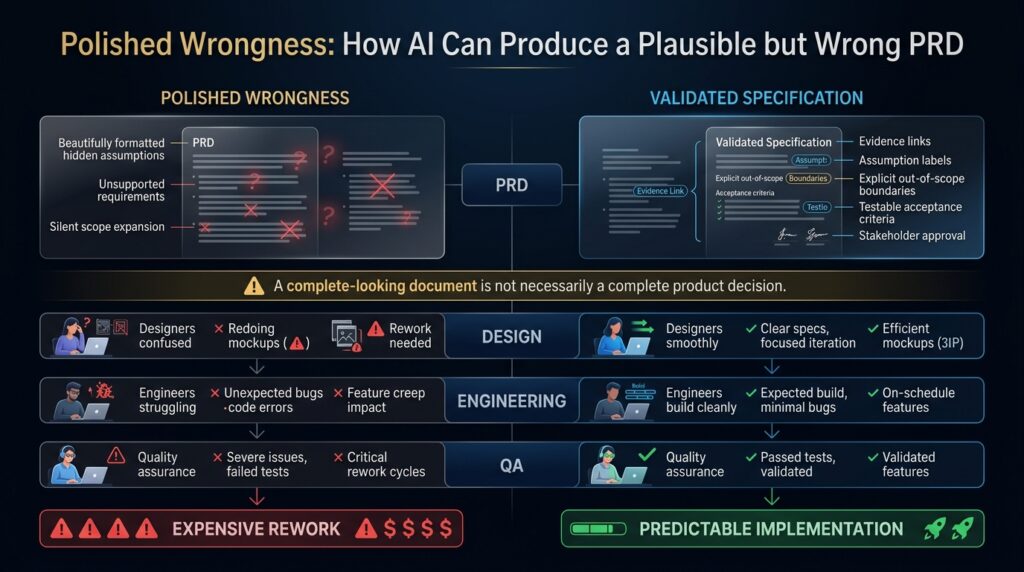
The Polished Wrongness Problem
Product teams naturally treat polished documents as authoritative. Clean formatting, confident language and complete sections signal that the work has been done.
AI produces all of those signals instantly. A document can look finished and still contain requirements that trace back to nothing.
We call this polished wrongness. It is more dangerous than an obviously rough draft, because a rough draft invites questions and a polished one discourages them.
A document earns trust when its important requirements can be traced, challenged and verified. Encourage reviewers to ask “where did this come from?” as a routine question, with no implication that the author did poor work.
A Worked Example: The CSV Export Feature
A worked example shows the method in practice. A team is adding data export for enterprise administrators.
The product manager gives the AI twelve interview summaries, the current permissions model and the business objective. The gap analysis returns nine questions, including which formats are needed and whether exports must respect existing filters.
The team answers six and marks three as open. The AI then drafts the PRD, and the Assumption Ledger shows fourteen statements, of which four came from the model with no evidence.
Two of the four are discarded, including an email confirmation nobody asked for. The Review Matrix flags “exports should be fast” as untestable, and engineering agrees a target for files under a set size.
Acceptance criteria are written in Given, When, Then form and reviewed by QA. The feature ships with three recorded open questions deferred to the next release, and no one is surprised by them later.
Vendor Examples: Productboard and Atlassian
Commercial tools are moving toward grounded drafting. Productboard positions its platform around linking customer feedback to feature ideas, so documents start from evidence instead of a blank page.
Atlassian builds AI into Jira Product Discovery using organization-specific context. Its documentation on AI in Jira Product Discovery also states that the quality, accuracy and reliability of information generated by AI may vary.
That caveat is worth noticing. Even when the model has access to your organization’s own data, the vendor tells you to check the output.
These are vendor descriptions, not independent evaluations. The lesson for any tool is the same: grounding improves the input, and review is still required. Our comparison of the best AI product management tools covers the wider market.
Common AI PRD Failure Modes
AI-assisted documentation fails in repeatable ways. Recognizing them makes them easier to prevent.
- Invented requirements: the model fills a missing decision.
- Hidden assumptions: proposed behavior is presented as fact.
- Over-specification: unnecessary functionality is added.
- Under-specification: failure behavior, permissions or edge cases are missing.
- Requirement contamination: an unsupported assumption spreads into tickets and code.
- Ambiguous language: words such as “fast” and “simple” appear without definitions.
- Scope inflation: a focused feature grows into a larger product.
- False completeness: every section is filled while major decisions remain open.
- Traceability loss: a requirement has no visible source.
The Assumption Ledger addresses the first three and the last. The Review Matrix addresses the rest, which is why the two tools are used together.
The Economics of Requirement Defects
The cost of a requirement defect grows with every stage it survives. A wrong statement caught in review costs a conversation.
The same statement caught in development costs rework, and caught after release it costs rework plus support time and customer trust. As an illustration, a defect that takes five minutes to fix in a document can take several days once code and tests depend on it.
AI changes this arithmetic in two directions. It makes defects cheaper to create, because plausible requirements appear instantly, and cheaper to find, because a model can review every requirement against a checklist.
The return comes from using it for the second purpose. A team that spends the time AI saves on drafting to run a structured review will ship fewer defects, and a team that spends it on more documents will ship more.
Metrics: Measure Requirement Quality, Not Document Volume
The number of PRDs produced says nothing about their value. Measure what happens downstream.
| Metric | What it shows |
|---|---|
| Requirement rework rate | How often requirements change after development starts |
| Defects traced to requirements | How many bugs began as unclear or wrong requirements |
| Clarification requests | How often engineers must ask what a requirement means |
| Open questions at approval | Whether uncertainty is visible and recorded |
| Traceability coverage | Share of requirements linked to evidence or a decision |
| Time to approved specification | Whether the process is faster without losing quality |
AI Hustle World calls the combined effect Requirement Rework Avoided. It is the reduction in downstream changes after the team adopts structured review.
Track it over several releases. A single feature proves little, and a steady fall in rework and clarification requests shows the process is working.
A 90-Day Adoption Plan
In days 1 to 30, use AI to critique existing documents. Run the Review Matrix on two or three recent PRDs and compare its findings with the defects that surfaced during development.
In days 31 to 60, introduce grounded drafting. Use the two-step prompt, gap analysis first and draft second, on one new feature, and keep an Assumption Ledger from the start.
In days 61 to 90, add traceability and connect the output to downstream work. Link requirements to evidence, write acceptance criteria in a consistent format and agree the accountability matrix with design, engineering and QA.
Review the metrics at the end of the quarter. The goal is a requirements process that produces higher-quality specifications with less avoidable effort.
Who Should Use AI Heavily for PRDs, and Who Should Be Cautious
If your team writes many specifications, has good customer evidence and works with engineers who value clear requirements, heavy use of AI will pay off. The same is true if your documents feed coding agents, where precision matters most.
Start with critique, which is low risk and immediately useful. Move to drafting once you have a habit of recording assumptions.
If you work in a regulated industry, on safety-critical systems or with sensitive data, move carefully. AI can still review and structure, with specialists approving anything that carries legal or safety weight.
If your team has little evidence and no agreed process for decisions, AI will not fix that. It will produce confident documents on a weak foundation, and the better first step is to improve how decisions are made and recorded.
What Happens If You Do Nothing
Teams that avoid AI for requirements will keep spending days on drafting and formatting. That time comes out of customer contact and thinking.
They will also miss the review benefit. A structured AI check finds vague and contradictory requirements that human reviewers skim past, and those defects will continue to appear in development.
The opposite mistake is worse. A team that adopts AI drafting with no controls will produce more documents, more assumptions and more rework than before.
The sensible position is in between. Use AI where it reduces mechanical effort and exposes defects, and keep decisions with the people accountable for them.
The AI Hustle World View
The common promise is that AI writes your PRD in minutes. That is accurate and beside the point.
The document was never the hard part. Deciding who the feature is for, what it must do, what it must not do and how success will be judged is the hard part, and none of that is done by generating text.
AI becomes valuable when it improves the thinking around the document. It can show what is missing, challenge what is vague and keep track of what was decided and why.
Our rule is simple. Never approve an AI-generated requirement that cannot be explained by evidence, an explicit decision or a clearly owned assumption.
Where PRDs Are Heading: Machine-Readable Product Contracts
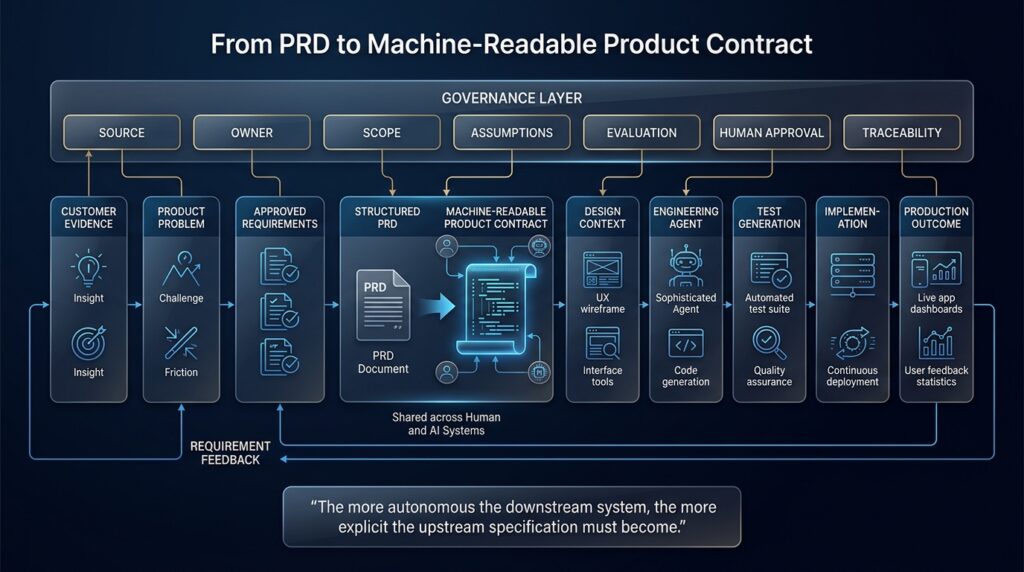
The next stage is structured product context that flows between systems. Customer evidence leads to a validated problem, then a decision, a structured PRD, design context, an engineering agent, generated tests and production behavior.
The document becomes part of a connected system instead of a static file. An engineering agent could ask why a requirement exists and receive the evidence, the decision and the acceptance criterion behind it.
That raises the standard. A machine-readable contract cannot safely contain hidden assumptions, because downstream tools will act on them without asking.
The more automated the downstream system becomes, the more disciplined the upstream definition must be. Our explainer on AI product management places this shift in the wider product lifecycle.
How We Researched This Guide
This guide was researched and drafted with AI assistance and checked against the primary sources linked in the article. Requirements quality references come from ISO/IEC/IEEE 29148, and the artifact definitions draw on published guidance from Atlassian, Mike Cohn and Cucumber.
The explanation of why models fill gaps comes from OpenAI’s research on hallucination. Vendor capabilities are described from Productboard’s and Atlassian’s own pages and are not independently verified.
We did not test a PRD tool hands-on, and no benchmark is claimed. The Assumption Ledger, the AI PRD Review Matrix, the Requirements Control Loop, the Behavioral Contract, the worked example and the cost illustration are AI Hustle World analysis.
Last updated October 2026. This version restructures the guide, adds the tables, worked example and economics sections, and removes research statistics we could not open to verify.
Final Thoughts: The PRD Is Getting Cheaper, the Decision Is Not
A team can now produce a beautiful PRD in five minutes and still spend three months building the wrong thing. It can generate twenty user stories when six belong in the release.
It can write detailed acceptance criteria around an assumption nobody approved, and once those assumptions enter tickets and code, they are hard to remove. The cost of the document has fallen, and the cost of a wrong decision has not.
A disciplined process is faster in practice, because the team spends less time cleaning up downstream. AI can review more material, surface more edge cases and preserve more context than any person working alone.
The strongest product manager of the AI era is not the one who produces the longest PRD. It is the one who makes the important decisions visible, knows which statements are facts and which are assumptions, and holds to one rule: AI drafts, humans decide, evidence explains and tests verify.
Use AI to Strengthen Product Requirements—Not Hide Uncertainty
AI can dramatically reduce the time required to draft PRDs, user stories and product specifications. The real advantage comes when AI also helps product teams find ambiguity, expose assumptions, identify missing edge cases and preserve traceability.
Explore AI Roadmap Prioritization →FAQ
Can AI write a PRD?
Yes, AI can draft a PRD quickly from the context you provide. People still need to supply the decisions, check assumptions and approve the result.
What is the best way to use AI for PRDs?
Ask the AI to find gaps in your evidence first, answer its questions, then have it draft from approved context with assumptions and open questions clearly labeled.
Can AI write user stories?
Yes. AI drafts user stories well from an approved objective. Review them for overlap, size and evidence, because a story is the start of a conversation.
Can AI write acceptance criteria?
Yes, especially in Given, When, Then form. The team must confirm thresholds and edge cases, because the model will otherwise invent plausible numbers.
What is an Assumption Ledger?
A table that lists every statement in a draft that is not a confirmed fact, with its source, confidence, owner and status. It keeps AI guesses visible.
What is requirement contamination?
It happens when an unsupported AI assumption spreads from a PRD into tickets, designs, code and tests, and becomes hard to remove.
How do I stop AI from adding features to my PRD?
State the scope in the prompt and ask the model to list anything outside it under a separate “Proposals” heading. Review that list separately.
Do AI features need different requirements?
Yes. They need a behavioral contract covering allowed sources, quality thresholds, uncertainty handling, fallbacks, human review and monitoring after launch.
Who is accountable for an AI-generated PRD?
The product manager and the reviewers who approve it. AI can assist and draft, and accountability for product decisions stays with people.
How should teams measure AI-assisted requirements work?
Measure rework after development starts, defects traced to requirements, clarification requests and traceability coverage, not the number of documents produced.
Related Guides
- How to Write AI Prompts for More Accurate and Reliable Answers
- How to Ask AI Better Questions to Save Time and Get Useful Answers
- Best AI Legal Tools in 2026: Research, Contract Review & Legal Workflows
- How to Verify AI Information: A Practical Accuracy Framework
- How AI Analyzes Product Usage Data, Support Tickets & User Feedback
Written by
Muntasir Ahmad Chowdhury
Founder, AI Hustle World
Muntasir Ahmad Chowdhury is the Founder of AI Hustle World, an independent publication dedicated to making Artificial Intelligence practical, trustworthy, and easy to understand. He researches AI tools, automation, customer service, productivity, and real-world business applications, helping readers make smarter technology decisions through research-driven, experience-backed content.
Expertise:
AI Tools • AI Automation • AI Customer Service • AI Productivity • Generative AI • AI Workflows
Get Smarter With AI
Enjoyed this guide? Get practical AI tools, tutorials, and honest reviews delivered to your inbox.