
Evidence: Documentation reviewed
Last checked: September 2026
What was done: Written from official documentation and the published sources linked in this article. Not hands-on tested.
Files: None
Affiliate links: No
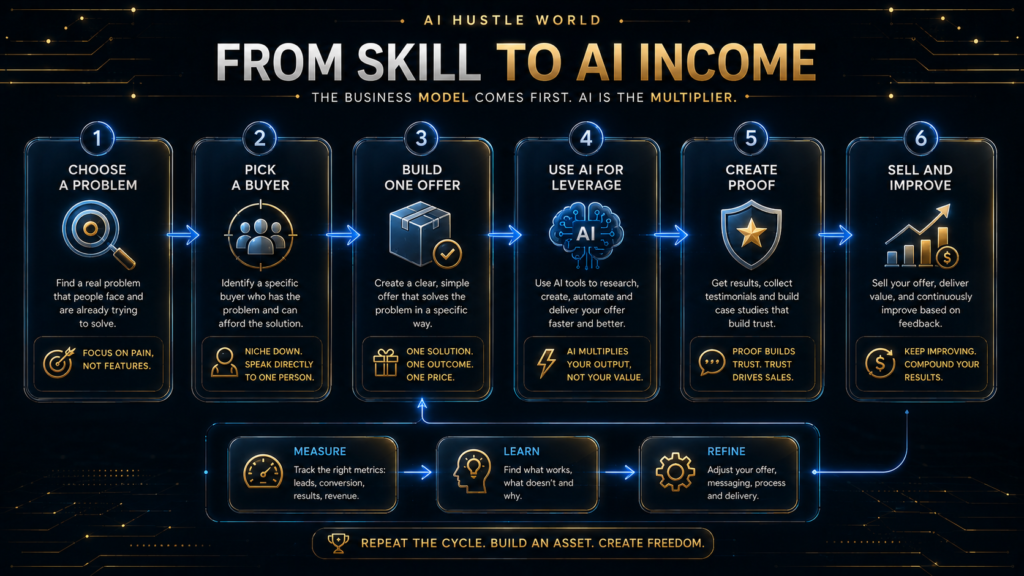
Make money with AI in 2026 is not mainly a prompt-writing challenge. It is a business-design challenge: find a problem somebody already pays to solve, use AI to improve the economics of solving it, and retain enough human judgment that the result is trustworthy. The tool can shorten research, production, or delivery, but it cannot manufacture demand, credibility, or a buyer.
That distinction matters because the market is moving in two directions at once. Upwork’s 2026 analysis of completed U.S. marketplace jobs found that skills explicitly referencing AI grew 109% year over year, with especially fast growth in AI video generation and editing, AI integration, data annotation, and chatbot development. Yet the same report says businesses still rely on skilled professionals for domain expertise, and Upwork’s August 2025 hiring analysis placed fact-checking and video editing among the AI-related skills businesses were actively hiring.
This guide does not attach invented monthly-income ranges to a list of tools. Instead, it separates the market into three income economies, gives you a transparent way to judge an opportunity, and shows how to reach a verifiable first sale without pretending that revenue is guaranteed. The evidence and platform rules were checked on September 25, 2026.
The Short Answer: Sell an Outcome Before You Build an AI Business
For most beginners, the most defensible starting point is an AI-assisted service built around a narrow outcome. A content creator may pay for a finished short-form content package, an ecommerce team may pay for a cleaned and enriched catalog, and a local business may pay for an appointment-intake workflow. None of those buyers needs to care which model produced the first draft; they care whether the deliverable is accurate, usable, and easier than doing the work themselves.
Services usually reach proof faster because you can speak to buyers before building much. Digital products can become more repeatable, but they require distribution and differentiated intellectual property. Automations and small software products may support recurring revenue, but they bring a larger testing, privacy, maintenance, and customer-support burden.
| Starting position | Best first model | What to sell | Proof to create first |
|---|---|---|---|
| You have a professional skill | AI-assisted service | A faster or more complete version of an outcome you already understand | One before-and-after sample using realistic source material |
| You understand a repeated workflow | Productized service | A fixed-scope package with clear inputs, outputs, and turnaround | A checklist, sample deliverable, and documented quality-control process |
| You know a niche audience | Digital asset or education | A template, guide, dataset, or training resource tied to a repeated problem | Buyer interviews, preorders, or a small paid pilot |
| You can build and maintain systems | Automation or micro-software | A workflow that removes a measurable operational bottleneck | A working pilot with logs, fallback steps, and a human escalation path |
| You have no audience, skill proof, or buyer access | Research and skill-building first | Do not force a product yet | Ten buyer conversations and one credible sample |
The rest of the article explains how to make that choice with evidence. If you are completely new to the tools themselves, begin with our guide to the best AI tools for beginners, then return here to design the offer.
What AI Actually Changes in an Income Model
AI can change four economic variables: the time required to produce a first draft, the range of formats one person can handle, the cost of repeating structured work, and the speed at which a provider can test alternatives. Those gains are real, but only when a workflow has defined inputs and an inspection standard. If the provider cannot recognize a bad answer, faster generation simply creates faster rework.
AI does not automatically improve distribution. A template still needs buyers, a YouTube channel still needs viewers and eligible content, and an automation still needs a business willing to trust it with part of an operation. Nor does AI remove the need for judgment: fact-checking, brand fit, legal rights, privacy, and final accountability remain human responsibilities.
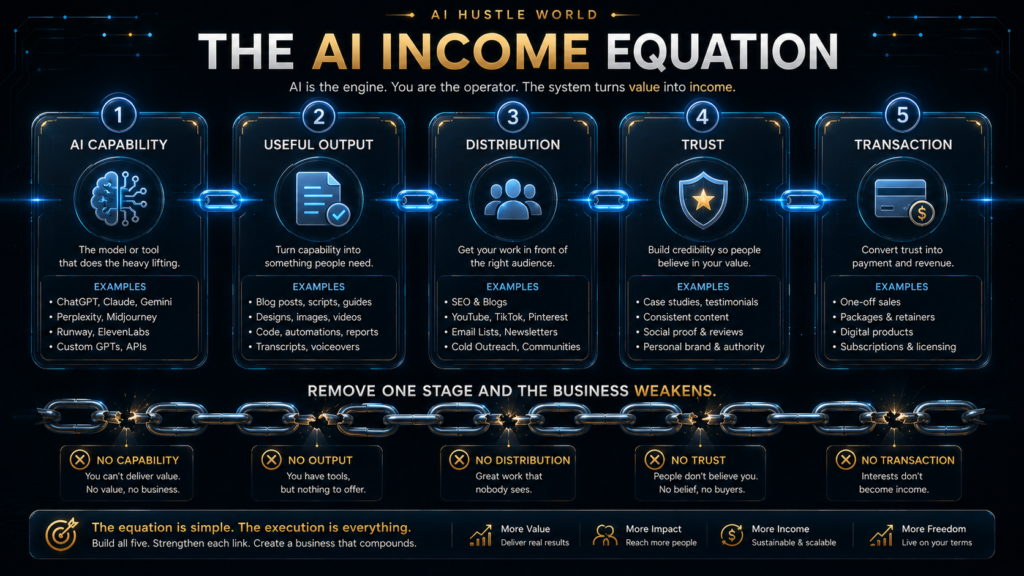
A useful way to read this equation is from right to left. No transaction occurs without trust and access to a buyer; trust is difficult without an inspectable result; and the result is not valuable unless it solves a problem the buyer recognizes. AI capability matters, but it sits at the beginning of the chain rather than at the end.
The 2026 AI Income Paradox: Demand Is Rising While Simple Work Loses Value
The most important 2026 market signal is not that AI work is growing; it is that the value of different AI work is separating. Upwork’s Future Workforce Index 2026 reports that generative-AI and creative-production work recorded 90% year-over-year growth in contract starts while per-contract earnings fell 13%. Across the report’s AI execution-task category, earnings fell 28%, which suggests that producing discrete text, image, or video outputs is becoming easier to buy and harder to defend.
The same dataset shows the opposite movement higher in the value chain. AI-augmented professional services grew 72% year over year while earnings rose 22%, and freelancers doing more complex work with AI saw earnings rise 45% in the first quarter of 2026. Upwork calls the emerging role an “AI orchestrator”: someone who combines tool fluency with domain knowledge, workflow design, judgment, and responsibility for a business result.
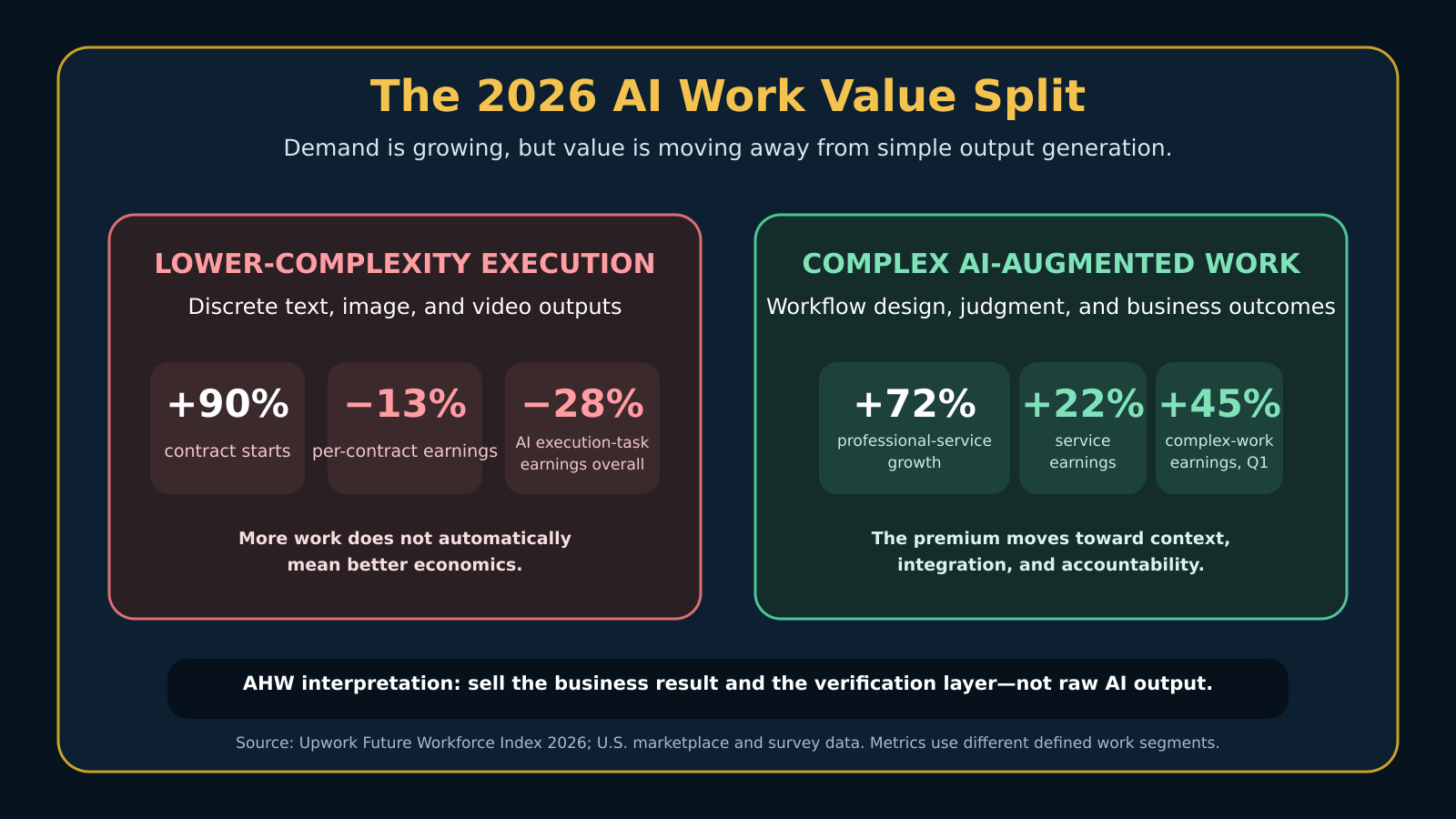
This is the clearest answer to the question, “What should I sell?” A provider who sells raw output competes with the model, the client’s subscription, and thousands of sellers using the same templates. A provider who owns diagnosis, source quality, integration, review, and a useful finished state competes on harder-to-copy judgment. The opportunity is not disappearing; it is moving away from generation alone.
Fiverr’s 2026 Business Trends Index points in the same direction from a different dataset. Global search growth was strongest in visible production and customer-facing workflows—AI-related Video & Animation searches grew 278%, n8n AI automation searches grew 125%, and AI UGC video-ad searches grew 265%—while demand for human video editing and short-form editing also increased. Search growth is not earnings evidence, but it shows where buyers are looking for help and why a combined production-plus-quality offer is stronger than a prompt-only service.
For content work, move from “I generate posts” to a package that includes source selection, editorial review, platform adaptation, and publishing-ready files; our guide to AI content repurposing shows how that transformation can be structured. For automation, move from “I build agents” to a monitored workflow with permissions, exception handling, documentation, and a measurable baseline. For digital products, move from volume to original methods, verified information, instructions, and a distribution advantage. The memorable rule is simple: as generation becomes abundant, responsibility becomes the premium.
Three Economies Are Hiding Inside “Make Money With AI”
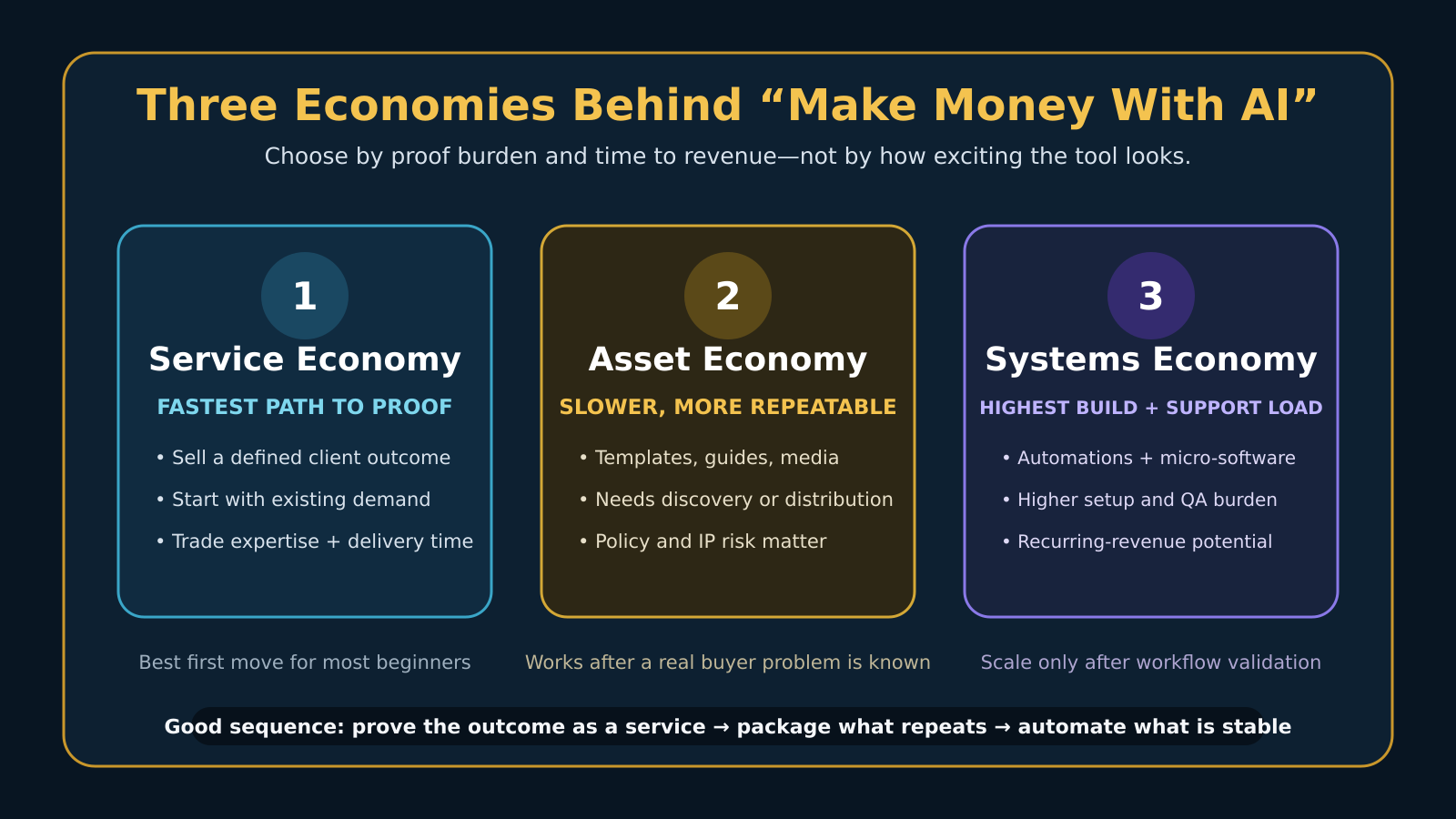
Most articles mix freelancing, digital products, affiliate sites, content channels, and software into one list even though their economics are fundamentally different. A freelance service converts labor and judgment into cash. A digital asset converts knowledge into something that can be sold repeatedly. A system or software product converts a stable workflow into infrastructure that customers expect to keep working.
The service economy turns competence into cash
A service is the fastest of the three models to validate because one buyer can approve a proposal and pay for a defined result. You do not need search traffic, a large audience, or a finished application. You do need enough subject knowledge to scope the work, detect errors, manage revisions, and explain what the buyer receives.
The weakness is capacity. Every new client consumes sales, communication, delivery, and support time, even when AI shortens production. The sensible goal is not to automate every step immediately; it is to learn which parts repeat, standardize those parts, and protect the judgment that makes the result credible.
The asset economy turns repeated knowledge into reusable value
Templates, playbooks, licensed media, research packs, courses, and niche content can be sold or monetized more than once. That makes the asset model attractive, but “create once, sell forever” is a misleading description. Product discovery, platform fees, customer support, updates, refund handling, and competitive imitation continue after the file is uploaded.
The strongest assets usually emerge from service work. Repeated client questions reveal what buyers need, completed projects reveal what formats are useful, and support requests reveal what instructions are missing. Building from those observations is more defensible than asking an AI tool to produce one hundred generic printables and hoping a marketplace supplies demand.
The systems economy turns a validated workflow into infrastructure
Automations, internal assistants, specialized agents, and micro-software can create recurring value when they sit inside a workflow that happens repeatedly. They also carry the highest obligation: integrations break, models change, edge cases appear, access permissions expire, and customers need a safe path when the system is uncertain. A demo that works once is not the same as an operational product.
The safest progression is service, then productized service, then system. By the time you automate, you should know the normal input, the acceptable output, the common exceptions, the escalation rule, and the cost of failure. That knowledge is the business asset; the automation is its implementation, and our comparison of AI workflow automation tools can help once those requirements are defined.
The AHW AI Income Viability Map
The AHW AI Income Viability Map is a decision method for comparing opportunities without inventing earnings forecasts. It evaluates whether a model has observable demand, inspectable proof, reachable buyers, tolerable delivery economics, defensible human contribution, and manageable platform risk. The result is not a promise of income; it is a way to reject weak ideas before they absorb months of work.
| Dimension | Strong signal | Weak signal | Evidence to collect |
|---|---|---|---|
| Demand | Buyers already spend money to solve the problem | The idea exists mainly because a tool can generate it | Job posts, buyer interviews, existing vendors, paid pilots |
| Proof | The buyer can inspect a sample or measure a before-and-after result | Value depends on vague claims about productivity or reach | Sample deliverable, error log, turnaround record, acceptance criteria |
| Distribution | You can name and reach a specific buyer group | The plan depends entirely on an algorithm discovering you | Prospect list, communities, partnerships, search demand, email access |
| Economics | Price covers selling, delivery, revisions, tools, and support | The margin works only if nothing goes wrong | Time log, software costs, platform fees, revision rate, refund history |
| Defensibility | Domain judgment, relationships, data, taste, or workflow knowledge improves the result | Any competitor can reproduce the offer with the same prompt | Process documentation, niche expertise, original examples, customer feedback |
| Platform and rights risk | Creation, disclosure, copyright, and monetization rules are understood | The offer depends on copied material, undisclosed synthesis, or mass production | Current policy pages, rights records, consent, disclosure, licenses |
How we researched
This framework was built from five evidence classes: completed-job marketplace data, marketplace search trends, current platform rules, official government guidance, and AI Hustle World’s editorial analysis of business-model mechanics. Upwork’s skills report analyzes completed U.S.-originating jobs and freelancer earnings, while its Future Workforce Index combines U.S. marketplace data with a March–April 2026 survey of 2,400 U.S.-based workers. Fiverr’s index measures global search growth between two defined periods, so it signals changing buyer interest rather than income or completed sales.
Claims are separated by type. A research finding retains the source’s defined sample and measurement; a platform rule links to the current official policy; a company or marketplace signal is attributed and not generalized beyond its data; an illustrative example uses explicitly invented numbers to explain a calculation; and AI Hustle World analysis connects those sources through the Viability Map, Buyer-and-Proof Map, Proof Ladder, and pricing logic. YouTube, Etsy, the U.S. Copyright Office, the IRS, the SBA, and the FTC supply the external policy or government boundaries used here.
Ratings remain qualitative rather than earnings estimates. “Fast” means a model can be offered to an identifiable buyer before an audience or full product is built; “high burden” means delivery requires substantial verification, maintenance, or support. AI Hustle World did not run a controlled income experiment for every method and does not present anecdotal revenue screenshots as general evidence.
What this framework contributes: It converts scattered 2026 labor-market data, marketplace demand, business economics, and platform rules into a reproducible decision system. The article shows the documented value split between low-complexity output work and higher-complexity AI-augmented services, then maps every method to a buyer, saleable deliverable, proof artifact, acquisition channel, hidden cost, price floor, and evidence level. That combination explains not only which methods exist, but what must become true before any of them deserves to scale.
Route One: Sell a Measurable Outcome as a Service
A buyer does not need “AI help” in the abstract. The buyer may need a weekly content package, a searchable knowledge base, a cleaned product catalog, or a lead-intake process that stops inquiries from falling through the cracks. The offer becomes credible when it names the input, finished output, turnaround, quality controls, revision boundary, and price.
Upwork’s 2026 data supports this outcome-first view. AI video generation and editing grew 329%, AI integration grew 178%, data annotation and labeling grew 154%, and AI chatbot development grew 71% in the completed-job dataset. These figures describe growth within Upwork’s U.S.-originating marketplace categories, not the entire economy, but they show that buyers are paying for applied work rather than for generic familiarity with a chatbot.
1. Content repurposing and editorial production
A content repurposing service converts a webinar, podcast, interview, or long video into a coordinated set of clips, posts, summaries, show notes, and email copy. AI can help transcribe, locate candidate moments, propose hooks, and create first drafts. The provider’s value comes from selecting the right moments, preserving meaning, checking claims, matching the client’s voice, and packaging the assets for each channel.
Do not sell “twenty AI posts.” Sell a defined publishing outcome, such as one reviewed transcript, four edited clips, a newsletter summary, and channel-specific copy delivered from one source recording. A sample should show the source excerpt beside the final asset so a prospect can judge accuracy and editorial transformation. Use a content atom workflow to keep every derivative tied to its source, while our guide to AI video tools for a phone-first workflow can help with tool selection; the offer should still lead with the finished package rather than the software.
2. Workflow automation for small teams
Small teams often lose time moving information between forms, inboxes, spreadsheets, calendars, and customer systems. An automation provider maps that movement, removes safe repetitive steps, and leaves human approval where judgment matters. Examples include routing qualified inquiries, drafting follow-up messages for approval, classifying support requests, or turning meeting notes into assigned tasks.
The first sale should be a narrow workflow audit and pilot, not an autonomous “AI employee.” Document the existing process, identify the failure cost, define the data that may enter the system, and set an exception path. Charge for discovery, implementation, documentation, and a limited support period; otherwise, the maintenance obligation can consume the project margin.
3. Ecommerce catalog and conversion support
Ecommerce operators need structured product data, accurate descriptions, variant normalization, comparison content, image preparation, customer-question analysis, and merchandising support. AI can accelerate classification and drafting, but the provider must prevent invented specifications, prohibited claims, duplicate copy, and inconsistent variants. A useful offer is a catalog-quality sprint with an agreed field schema and a documented review process; the broader opportunities and limits are explained in our guide to AI in ecommerce.
Start with a small batch and measure acceptance: how many listings required factual correction, how long review took, and which source fields were missing. Those observations help price future work and reveal whether the client’s upstream data needs repair. They also create a stronger portfolio artifact than an unsupported claim that AI “boosts conversions.”
4. Research, verification, and knowledge operations
Research services can include source discovery, competitor monitoring, literature triage, document extraction, interview synthesis, and internal knowledge-base preparation. The buyer pays for a traceable answer, not a fluent paragraph. Every material claim should point to a source, uncertainty should be visible, and confidential material should only enter approved systems; our comparison of AI research assistants can help match a tool to that evidence standard.
This category rewards people who already understand a domain because they can recognize missing context and weak evidence. A public sample can compare several official sources, explain the selection criteria, and show a claim-to-source ledger. If the work affects legal, medical, financial, hiring, or safety decisions, position AI as research assistance and keep qualified human review explicit.
How to Turn Freelance Work Into a Productized Service
Productization does not mean removing the human. It means reducing ambiguity. A productized service has a named buyer, qualifying conditions, standard inputs, a consistent deliverable, a turnaround range, a revision policy, and exclusions that prevent the project from expanding silently.
Suppose a general offer says, “I create AI content.” A productized version might say, “I turn one approved 45–90 minute founder interview into four captioned vertical clips, one newsletter summary, and eight platform-specific posts, with one factual review round.” The second offer is easier to buy, quote, deliver, compare, and improve.
- Define the entry condition. State what source material, access, approvals, and brand guidance the buyer must provide before work begins.
- Define the finished state. Specify file formats, quantities, quality checks, delivery location, and what “complete” means.
- Separate standard work from exceptions. Create an additional fee or a new scope for rush delivery, extra revision rounds, missing source data, and rights-clearing work.
- Record actual delivery time. Include communication, setup, revisions, uploads, and admin instead of counting only generation time.
- Improve the process after paid work. Templates and automation should respond to observed repetition, not assumptions made before a buyer exists.
Route Two: Build an Asset Only After You Understand the Buyer
An asset earns repeatedly only when people repeatedly discover and value it. That sounds obvious, but it is the missing step in many AI side-hustle plans. Generation is now cheap, which means generic supply grows quickly; the scarce parts are original judgment, trusted distribution, useful organization, and a reason to choose one seller’s version.
The best asset ideas often come from a narrow professional context. A construction estimator may create a field-ready project handoff checklist, a recruiter may create an interview evidence rubric, and a podcast producer may create a source-to-clip rights tracker. These assets encode decisions that a general model cannot infer reliably from a one-line prompt.
5. Templates, playbooks, and operational kits
A strong template reduces decision effort rather than merely decorating a blank page. It includes instructions, examples, edge cases, and a sequence that helps the buyer reach a result. AI can help create variants and explanations, but the seller should contribute the underlying method and test whether another person can use it without private guidance.
Sell to a situation, not to everyone. “Client onboarding kit for two-person design studios” is more useful than “ultimate business bundle” because the buyer can recognize the fit and the creator can include relevant decisions. Before building a large bundle, offer a small paid version or use the material inside a service engagement to expose missing steps.
6. Digital products with original utility
Digital products can include guides, spreadsheets, research databases, design systems, lesson materials, licensed media, and specialized prompt interfaces. The commercial question is whether the product saves time, lowers risk, improves a decision, or enables an outcome better than free alternatives. A large page count or thousands of generated files do not create value on their own.
Marketplace rules also matter. Etsy currently allows seller-prompted AI creations within its “designed by a seller” category, but it requires disclosure of AI use, and digital items must be made or designed by the seller. Etsy’s current listing guidance also says standalone AI prompts are not allowed. Anyone selling digital products should read the current marketplace rules directly rather than relying on screenshots from an old course.
Our guide to the best AI tools for creating and selling digital products covers production options. Use those tools after choosing a buyer and validating the problem, not as a substitute for validation.
7. Practical education and team training
Businesses and professionals need training that connects AI to their actual work. A credible trainer can teach a department how to verify model outputs, redesign a specific workflow, write an acceptable-use policy, or create an approval process. The value comes from domain context and implementation support, not from reading public feature lists aloud; for teams formalizing those boundaries, our AI governance explainer provides a practical starting point.
Start with a workshop or office-hours package before recording a full course. Live questions reveal misconceptions, policy constraints, and examples the final curriculum needs. If you cannot demonstrate a relevant workflow or explain when AI should not be used, build more experience before selling instruction.
8. Audience businesses: useful content before monetization
Newsletters, blogs, YouTube channels, podcasts, and niche communities can earn through advertising, sponsorships, affiliate commissions, products, or services. AI can accelerate research organization, transcription, editing, and repurposing, but audience businesses remain distribution businesses. The creator must earn attention repeatedly, and monetization usually follows evidence of trust rather than preceding it.
YouTube’s monetization policy makes the boundary explicit. The platform clarified in July 2025 that repetitive or mass-produced “inauthentic content” is ineligible for monetization, while original and authentic content remains the goal. AI use is not automatically disqualifying, but generic template videos at scale are a weak business foundation. If you plan a faceless channel, our faceless YouTube channel guide explains the workflow without treating automation as an excuse for low-value output.
Route Three: Build Automations or Micro-Software After the Workflow Is Stable
A small AI system becomes valuable when it removes a recurring bottleneck and behaves predictably enough to enter daily work. Possible products include a document-intake assistant, a structured proposal generator using approved company data, a support triage layer, an internal search tool, or a monitoring workflow that flags changes for human review. The narrower the responsibility, the easier it is to test.
Do not confuse a model response with a product. A product needs permissions, data handling, logging, retries, error messages, monitoring, documentation, and an owner when the result is wrong. If the system can send messages, change records, make purchases, publish content, or affect a person, human approval and rollback become part of the design; the human-in-the-loop AI guide explains how to place those checkpoints deliberately.
9. Managed automation for one recurring process
A managed automation combines implementation with ongoing oversight. Instead of selling a workflow file and disappearing, the provider monitors failures, updates integrations, and reviews exceptions. That can support recurring revenue, but the recurring fee must cover the actual support load and the provider must define response times and responsibilities.
Begin with a process whose mistakes are visible and reversible. Drafting internal summaries for approval is safer than automatically sending contractual commitments. Capture a baseline before implementation—time spent, backlog size, error categories, or response delay—so the client can evaluate whether the system produces a meaningful improvement.
10. Narrow micro-software with a human fallback
Micro-software serves a specific job for a specific user group rather than attempting to become a general AI platform. A useful concept might turn approved source documents into compliance-ready first drafts, compare catalog data against a required schema, or help a team review large batches of customer feedback. The winning feature is often reliable integration with existing work, not the novelty of the model.
Validate the workflow manually or as a concierge service before building a self-serve product. If buyers will not pay for the outcome when a human operates the process, software is unlikely to rescue the proposition. Manual delivery also reveals the exceptions the interface, data model, and support documentation must handle.
Two Additional Paths That Depend Heavily on Existing Expertise
11. AI readiness audits and implementation advisory
An audit maps where AI could help, where it should not be used, what data is involved, who approves outputs, and how success will be measured. This is not a beginner shortcut. The advisor needs operational knowledge, risk awareness, and enough technical understanding to separate a viable workflow from an impressive demo.
A credible deliverable includes the current process, prioritized opportunities, data and permission constraints, risk classification, pilot design, cost assumptions, and governance responsibilities. Avoid promising a percentage productivity gain before a baseline exists. Sell the quality of the diagnosis and the clarity of the implementation plan.
12. Specialist creative production with licensed inputs
Designers, editors, voice professionals, and producers can use AI to explore concepts, create controlled variations, clean audio, localize material, or accelerate pre-production. The defensible offer is art direction and reliable production, not unlimited generation. Buyers need consistent quality, usable rights, consent for voices and likenesses, and files that fit the final channel.
Rights documentation should travel with the project. Record the source of licensed assets, client permissions, production partners, model restrictions, and human modifications. This protects both parties and makes the result more valuable than an anonymous output with uncertain provenance; our guide to AI copyright explains the authorship, licensing, and documentation questions in more detail.
Which Model Fits Your Starting Position?
| Model | Time to test demand | Primary burden | Best evidence | Main risk |
|---|---|---|---|---|
| AI-assisted freelance service | Fast | Sales and delivery | Paid pilot and accepted sample | Underpricing revisions and communication |
| Productized service | Fast to moderate | Scope discipline | Repeatable delivery across several buyers | Exceptions breaking the standard package |
| Template or digital product | Moderate | Distribution | Preorders, conversions, and support patterns | Generic supply and platform dependence |
| Education or training | Moderate | Credibility and curriculum | Workshop feedback and demonstrated workflow | Teaching beyond real experience |
| Audience business | Slow | Consistent distribution | Returning audience and qualified actions | Algorithm dependence and inauthentic content |
| Managed automation | Moderate | Reliability and support | Baseline comparison and monitored pilot | Security, edge cases, and maintenance |
| Micro-software | Slow | Product, support, and retention | Active use and paid renewal | Building before validating the workflow |
| Advisory | Fast if expertise exists | Trust and accountability | Relevant track record and rigorous deliverable | Vague recommendations without implementation depth |
“Fast” describes how quickly a model can be put in front of a buyer, not how quickly anyone is guaranteed to earn. A freelancer with a strong professional network may validate an advisory offer quickly, while a beginner with no portfolio may need several weeks to build a credible sample. Use the table to choose the next experiment, then replace the qualitative label with your own observed data.
The Buyer-and-Proof Map for All 12 AI Income Methods
An income method becomes actionable only when you can name the buyer, finished deliverable, evidence required to trust it, and a realistic path to the first conversation. The table below does not estimate earnings because a credible price depends on scope, market, expertise, risk, and delivery cost. Instead, it identifies the commercial work that must exist before an idea can become a sale.
| Method | Likely buyer | Minimum saleable deliverable | Proof a buyer can inspect | Practical first channel | Hidden cost to price |
|---|---|---|---|---|---|
| Content repurposing | Podcaster, consultant, founder, or media team with long-form material | One approved source converted into edited clips, copy, and a source-linked handoff | Source excerpt beside the final asset, with factual and brand checks shown | Direct outreach to active publishers whose long-form content is under-repurposed | Source review, clip selection, captions, revisions, and upload formatting |
| Workflow automation | Small team losing time between forms, inboxes, spreadsheets, and a CRM | One mapped workflow with a controlled trigger, output, human approval, and fallback | Before-and-after process map, test log, and exception demonstration | Existing professional network, local businesses, or implementation partnerships | Discovery, permissions, integration failures, monitoring, and post-launch support |
| Ecommerce catalog support | Store with inconsistent or incomplete product data | A reviewed batch using an agreed product schema and source-of-truth fields | Error-rate sample, corrected variants, and a documented review checklist | Targeted audit of a small public catalog followed by owner outreach | Missing specifications, image cleanup, claim verification, and variant exceptions |
| Research and knowledge operations | Agency, executive, analyst, or team with document-heavy decisions | A traceable brief, comparison, or knowledge-base segment with source links | Claim-to-source ledger, uncertainty notes, and selection criteria | Niche professional communities, referrals, and role-specific freelance listings | Source access, paywalls, document cleanup, verification, and confidentiality controls |
| Templates and operational kits | Specific role repeatedly making the same decision or document | A guided template with examples, instructions, and edge-case handling | A real scenario completed from blank input to usable output | Communities and newsletters serving the exact role, plus former service clients | Documentation, support, compatibility changes, and future updates |
| Digital products | Niche consumer or professional audience with a repeated practical need | One focused asset that saves time, reduces uncertainty, or improves execution | Preview, sample page, use case, version history, and clear rights information | Preorders, an existing audience, search demand, or marketplace discovery | Listing work, refunds, customer questions, platform fees, and promotion |
| Training and education | Team, association, or professional group adopting AI in a defined workflow | A live workshop with exercises, policy boundaries, and a reusable job aid | Demonstrated workflow, curriculum excerpt, and participant outcome rubric | Professional associations, former employers, partners, and direct team outreach | Customization, preparation, questions, follow-up, and curriculum maintenance |
| Audience business | Reader or viewer first; advertiser, sponsor, or customer later | A repeatable editorial promise delivered through useful original content | Returning audience, qualified actions, original reporting, and transparent monetization | Search, platform distribution, collaborations, email, and community participation | Long pre-revenue period, research, production, moderation, and policy changes |
| Managed automation | Business with a stable recurring process and an owner for exceptions | An implemented workflow plus monitoring, logs, documentation, and support terms | Baseline comparison, monitored pilot, failure tests, and rollback procedure | Paid workflow audit that converts into implementation and support | Ongoing maintenance, vendor changes, usage fees, incidents, and service response |
| Micro-software | Defined role with a frequent narrow job not served well by general tools | A reliable product completing one job with onboarding and human fallback | Active pilot use, completion rate, support history, and willingness to renew | Concierge delivery to design partners before a public launch | Infrastructure, security, onboarding, support, churn, and integration maintenance |
| AI readiness audit | Organization experimenting with AI without priorities or governance | Current-state map, ranked opportunities, risk controls, pilot plan, and ownership | Relevant expertise, sample assessment logic, and reconstructable recommendations | Existing industry relationships, speaking, partnerships, and executive referrals | Stakeholder interviews, data review, legal coordination, and implementation scope |
| Specialist creative production | Brand, agency, publisher, or creator needing controlled media production | A finished asset package with art direction, licensed inputs, and export-ready files | Portfolio showing consistency, provenance, human modifications, and final-channel fit | Portfolio-led outreach, agency partnerships, and niche creative marketplaces | Rights clearance, revisions, rendering, storage, versioning, and production partners |
Notice how few of these routes begin with “post a generic gig and wait.” Service businesses usually reach the first buyer through proximity: an existing network, a visible problem in a narrowly selected prospect list, a community where the role already gathers, or a partner who serves the same client. Asset businesses depend more heavily on owned or marketplace distribution, while software benefits from design partners who tolerate an early product in exchange for influence over the workflow.
The acquisition channel changes the offer. A marketplace buyer compares visible scope, price, and reviews, so the service must be easy to understand. A referral buyer may accept a broader diagnosis because trust transfers from the referrer. A cold prospect needs evidence tied to a situation already visible in their business. Treat “where will the first five qualified conversations come from?” as a required design question, not a marketing task postponed until the product is finished.
Calculate the Unit Economics Before You Add More Tools
Revenue screenshots hide the cost of acquiring, delivering, and supporting the sale. A $300 project can be worse than a $180 project if the first requires repeated calls, five revisions, expensive software, and unpaid cleanup. The relevant question is what remains after direct costs and how many total hours the work consumed.
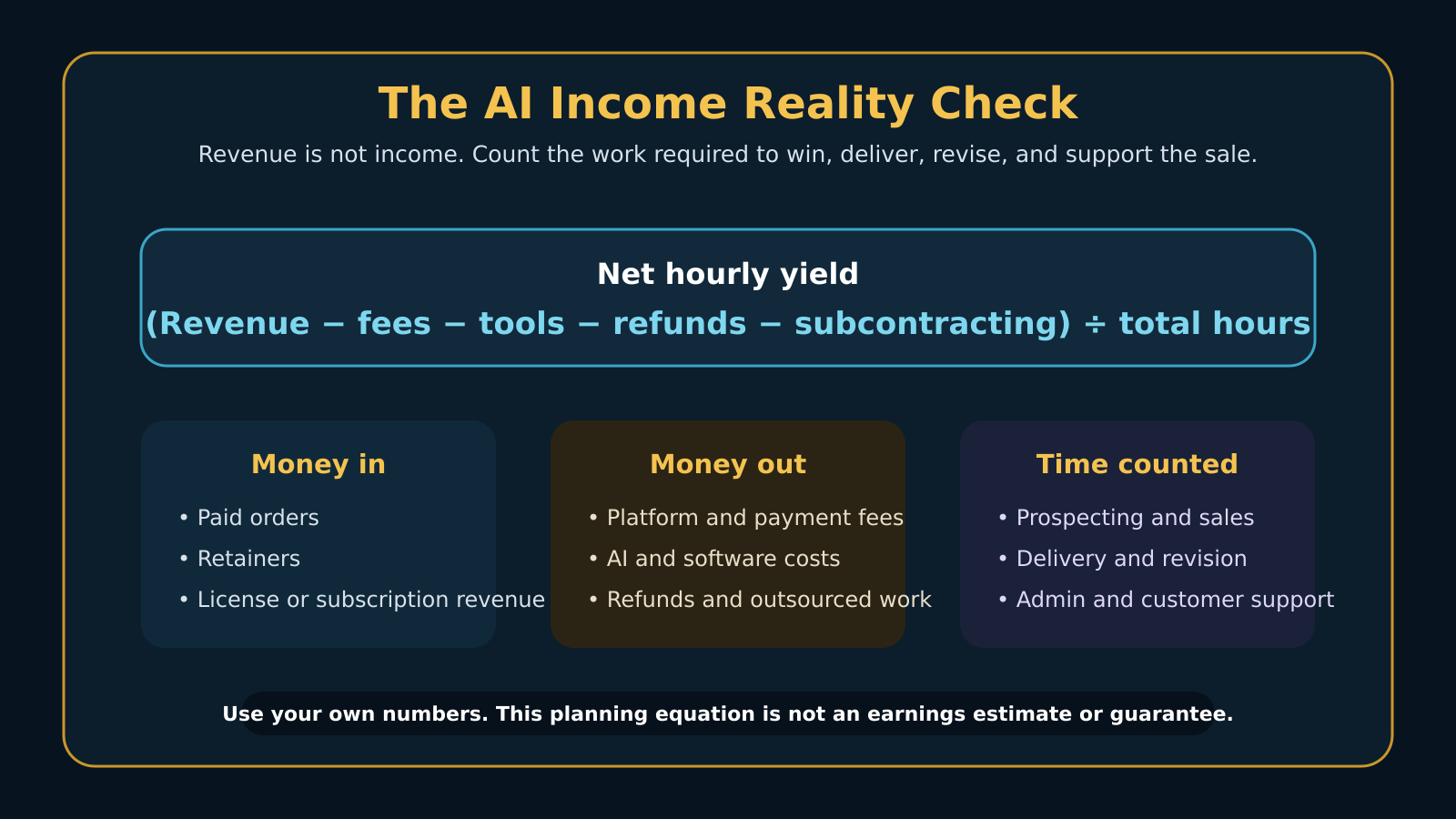
The equation is a planning tool, not an earnings forecast. Count prospecting, proposal writing, onboarding, setup, generation, review, revisions, meetings, uploads, invoicing, and support. For an asset business, allocate creation and update time across actual sales rather than an imaginary future sales volume; for software, include infrastructure, monitoring, support, refunds, and payment fees.
An illustrative calculation
Imagine a provider charges $400 for a content package. Payment and platform fees total $40, tool costs allocated to the project are $20, and an outsourced editing step costs $60, leaving $280 before taxes. If prospecting, calls, production, revision, and admin consume ten hours, the net hourly yield before taxes is $28—not $40 and certainly not $400.
Those numbers are illustrative, not typical earnings. Their purpose is to show how a provider can improve the model: tighten qualification, reduce preventable revisions, change scope, raise the price, remove unnecessary tools, or decline work that cannot be delivered responsibly. The same discipline prevents a low-priced digital product from looking profitable merely because fulfillment is automatic.
Set a minimum price floor before quoting a client
A quote needs to cover more than generation time. A practical internal floor is: direct project costs + allocated fixed costs + target compensation for total hours + an uncertainty reserve. Direct costs include contractors, usage charges, payment fees, and project-specific software; fixed-cost allocation covers the share of subscriptions, insurance, equipment, and administration that the work must support.
Suppose the same content package requires ten total hours, the provider’s target compensation is $35 per hour, direct costs are $120, fixed-cost allocation is $30, and the early-project uncertainty reserve is $50. The internal price floor becomes $550: $350 for labor, $120 in direct costs, $30 in overhead, and $50 for predictable uncertainty such as one difficult source file or an extra review cycle. These are invented teaching numbers, not market rates; replace every input with your own records.
The reserve should not become hidden padding. Define the uncertainties it covers, reduce it as the workflow becomes predictable, and quote out-of-scope work separately. If the buyer will not accept a price above the floor, narrow the deliverable, remove a costly feature, improve the workflow, or decline the project. Discounting below a known floor turns each new sale into a larger operational problem.
For products, use contribution margin and break-even volume. The U.S. Small Business Administration’s break-even guidance defines break-even units as fixed costs divided by sale price minus variable cost per unit. If creating and launching a template costs an illustrative $300 and each sale contributes $12 after variable fees, the product needs 25 sales to recover that fixed cost. The calculation does not predict whether those sales will occur; it shows the volume your distribution plan must plausibly support.
Match the pricing model to the obligation
Use fixed project pricing when the input and finished state are bounded, a retainer when recurring capacity and deliverables are predictable, and a paid discovery phase when the problem cannot be scoped responsibly in advance. Licensing or subscription pricing fits an asset or system that provides continuing access, but it also creates an expectation of updates and support. Usage-based pricing can align price with activity, although volatile model and infrastructure costs require careful monitoring.
Do not choose a retainer merely because recurring revenue sounds attractive. A retainer with undefined requests becomes an unlimited-service promise, while a subscription without continuing value becomes preventable churn. Price the obligation the customer actually receives, document its boundary, and review margin after delivery rather than assuming AI made the work cheap.
A 30-Day Plan Built Around Evidence, Not Optimism
The goal of the first month is not to build a brand empire. It is to determine whether a specific buyer will pay for a specific outcome and whether you can deliver it responsibly. Each week should produce evidence that changes the next decision.
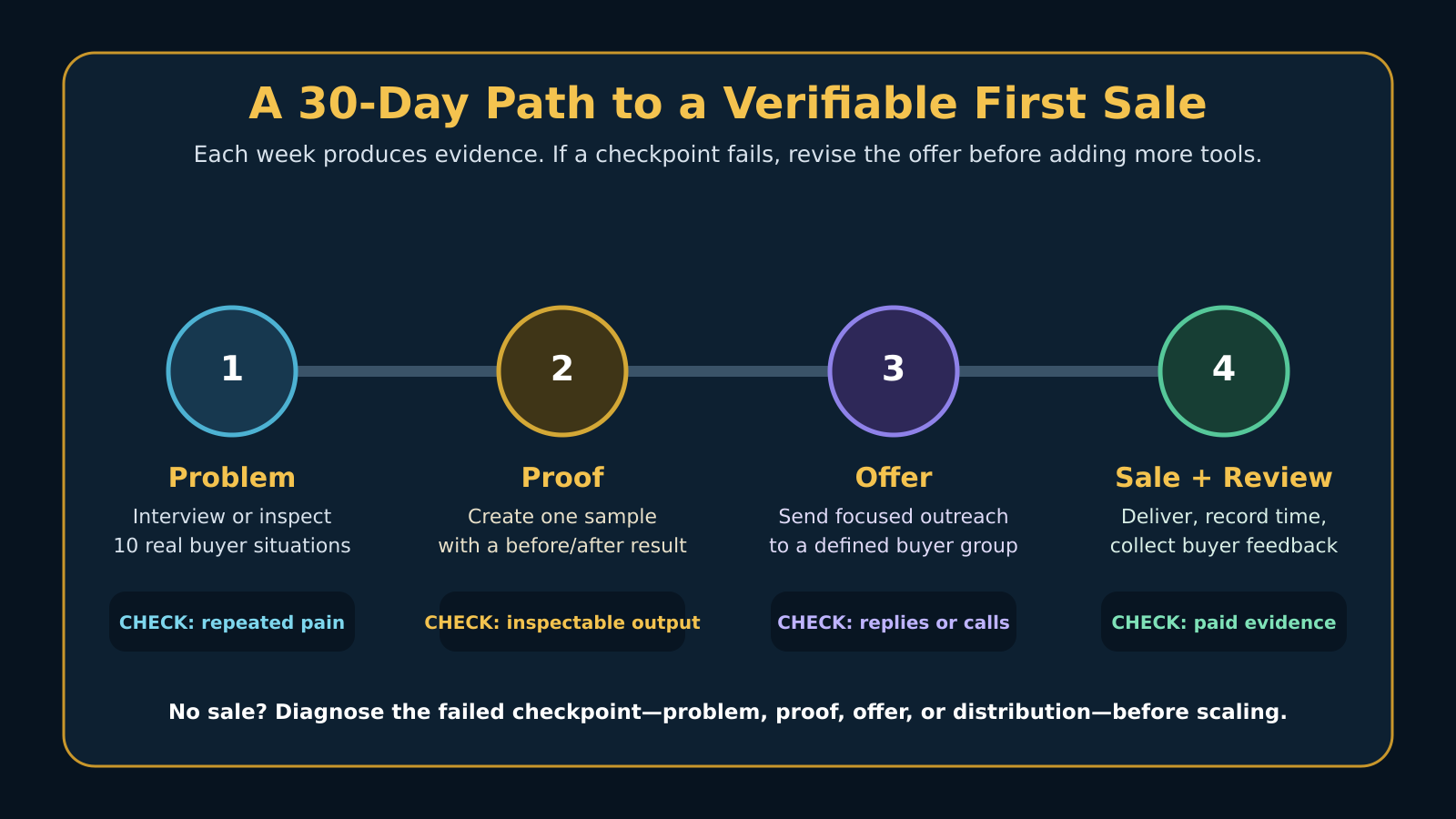
Week 1: Find repeated pain and choose one buyer
Choose a group you can reach and study ten real situations through interviews, job posts, forums, support questions, or public workflow descriptions. Ask what happens now, what triggers the task, where work stalls, how quality is judged, and what a mistake costs. Do not pitch during every conversation; the first objective is to discover repeated language and constraints.
At the end of the week, write one problem statement with a named buyer and observable consequence. “Creators need AI content” is too broad. “Weekly podcasters lose two days selecting accurate, self-contained moments for short clips” is specific enough to test.
Week 2: Build one sample and expose the quality controls
Create a representative deliverable using material you own, have permission to use, or can legally use for the sample. Show the input, the transformation, and the final output. Include a brief note explaining the checks you performed, such as source verification, brand alignment, accessibility, rights review, or human approval.
Ask several target buyers to critique the sample. A compliment is weaker evidence than a concrete objection, because objections reveal whether the output is incomplete, risky, or difficult to use. Revise the offer when the same objection appears more than once.
Week 3: Make a narrow offer to reachable prospects
Build a small prospect list from the buyer group you studied and send personalized messages that connect a visible situation to your sample. Explain the deliverable, turnaround, review boundary, and pilot price. Avoid mass-generated outreach; a short, specific message demonstrates more understanding than a long sequence that could have been sent to anyone.
Track delivery rather than vanity metrics: qualified replies, questions, calls, objections, and paid pilots. If nobody responds, diagnose buyer targeting and message relevance before rewriting the entire service. If people respond but do not buy, examine proof, scope, price, trust, and urgency.
Week 4: Deliver, record the hidden work, and decide what to repeat
For a paid pilot, record every hour and every exception. Note which AI outputs failed review, what information the client omitted, how many revisions occurred, and what part of the result the buyer valued most. Ask for permission before publishing any sample, metric, testimonial, or client name.
Then make a deliberate decision: repeat the offer, narrow it, raise the price, change the buyer, or stop. A failed pilot can still be useful if it identifies the failed checkpoint. The wasteful response is to add more software without resolving whether the problem, proof, offer, or distribution was weak.
The AHW Proof Ladder: Earn the Right to Scale
AI income advice often jumps from an idea to scale, but a defensible business moves through evidence levels. Each level answers a different objection: can you produce the result, will anyone pay, does the result survive real constraints, can delivery repeat, and will customers continue to value it? Scaling before those questions are answered magnifies uncertainty rather than revenue.
| Level | Evidence created | What it proves | What it does not prove | Next decision |
|---|---|---|---|---|
| 1. Representative sample | A realistic before-and-after deliverable made from permitted source material | You can produce something a buyer can inspect | That a buyer will pay or the workflow is profitable | Show it to the exact buyer group and collect specific objections |
| 2. Paid pilot | A small transaction with bounded scope and an acceptance decision | At least one buyer values the result enough to pay | Repeatability, healthy margin, or broad market demand | Record every hour, cost, revision, and exception |
| 3. Documented result | Permission-backed outcome, testimonial, or case evidence with context | The offer can work under stated conditions | That the outcome will generalize to every buyer | Refine qualification and state the boundary conditions |
| 4. Repeatable package | Several deliveries using stable inputs, checks, scope, and handoff | The process is becoming predictable | That acquisition or support can scale | Standardize the repeated parts and calculate true margin |
| 5. Recurring system | Renewal, repeated use, referral, or continued operational dependence | The result creates ongoing value | Permanent retention or platform independence | Invest carefully in automation, distribution, and resilience |
A free sample can prove production competence, but it does not prove demand. A paid pilot proves one transaction, but it does not prove that the price covers the hidden work. A case study is useful only when the result, timeframe, starting condition, and creator’s contribution are clear. This separation prevents a common mistake: treating attention, compliments, or a polished demo as if they were evidence of a functioning business.
The ladder also tells you when to invest. Do not build a large course before live teaching exposes the real questions, automate a workflow before manual delivery reveals its exceptions, or buy paid traffic before the offer converts through a smaller channel. Investment should follow the removal of a known constraint. When the constraint is still unknown, the right purchase is usually more evidence, not more software.
When the Offer Fails, Diagnose the Layer Instead of Starting Over
A weak result does not automatically mean the entire method is wrong. It may mean the prospect list was poorly chosen, the problem was not urgent, the deliverable was difficult to understand, the sample did not reduce risk, or the economics never worked. Change one layer at a time so the next attempt produces information.
| Observed result | Likely constraint | What to inspect | Next controlled test |
|---|---|---|---|
| No replies from relevant prospects | Targeting or message relevance | Whether the prospect visibly has the problem and whether the opening refers to evidence | Use a smaller, better-qualified list and rewrite only the problem-specific opening |
| Replies but no calls | Offer clarity or perceived relevance | Whether the deliverable, buyer, and outcome are understandable in one reading | Present one concrete sample and one bounded pilot rather than a menu of services |
| Calls but no paid pilots | Trust, proof, urgency, price, or decision authority | Repeated objections, current alternative, approval process, and cost of doing nothing | Strengthen proof, narrow risk, or target the person who owns the problem and budget |
| Sales but excessive revisions | Weak inputs, acceptance criteria, or scope | Where expectations diverged and which source information arrived late | Add an input checklist, approval gate, examples, and a priced revision boundary |
| Positive feedback but poor margin | Underpricing or hidden delivery labor | Total time, communication, exceptions, tools, and subcontracting | Raise the floor, narrow scope, standardize, or remove an expensive feature |
| One-time purchases but no repeat value | Infrequent problem or incomplete ongoing benefit | Whether the buyer’s need naturally recurs and what changed after delivery | Offer maintenance only when a genuine recurring job exists; otherwise keep it project-based |
| Product visits but few purchases | Positioning, proof, price, or weak buyer intent | Traffic source, preview quality, product specificity, and comparison alternatives | Interview visitors or customers before changing design, adding features, or buying traffic |
| Users start but do not continue | Onboarding friction or insufficient recurring value | First successful action, time-to-value, support questions, and abandonment point | Shorten the path to one useful result and observe a small group completing it |
Do not respond to every failure by lowering the price. A cheaper unclear offer is still unclear, and a cheaper unreliable workflow attracts more delivery burden with less room to absorb it. Price is the likely constraint only when the buyer understands the result, trusts the provider, has authority and urgency, and still chooses a credible lower-cost alternative.
The same discipline applies when a method works. A successful pilot may depend on an unusually cooperative client, clean source data, personal trust, or a scope that will not survive a broader market. Document the conditions that made delivery succeed before turning one win into a general claim. That qualification makes a case study more believable and a growth decision safer.
The Policy Boundaries That Change the Business Model
Platform policies are part of product design, not administrative details to read after launch. They determine what can be sold, what must be disclosed, what can be monetized, and what rights a creator may be able to claim. A model that works only when a platform does not inspect it is not a durable model.
YouTube rewards original value, not automated volume
YouTube’s current channel monetization policy says repetitive or mass-produced content is ineligible under its “inauthentic content” standard. The policy change announced in July 2025 was described as a clarification rather than a ban on AI. The practical lesson is that commentary, reporting, demonstrations, analysis, storytelling, and purposeful editing are stronger assets than a channel assembled from interchangeable scripts and visuals.
Creators should also separate platform eligibility from audience value. A video may technically comply and still fail because it is derivative or unhelpful. Build a channel around an editorial point of view, original reporting, demonstrated expertise, or access to useful source material; use AI to assist the production around that contribution.
Marketplaces require seller contribution and disclosure
Etsy states that seller-prompted AI creations may be sold as seller-designed items, but the use of AI must be disclosed. Its guidance also requires digital items to be made or designed by the seller and excludes standalone prompt listings. That makes originality, accurate listing information, and seller involvement operational requirements rather than optional branding choices.
Other marketplaces have their own definitions and disclosure controls, and those rules can change. Keep a policy log with the source URL and review date for every channel you depend on. If a business spans several platforms, design the asset to meet the strictest relevant standard instead of assuming one marketplace’s permission applies everywhere.
Human authorship and rights are commercial issues
The U.S. Copyright Office’s 2025 report on AI copyrightability concludes that generative outputs can be protected only where a human author has determined sufficient expressive elements. Human selection, arrangement, or modification may be protectable, while merely providing prompts is not enough. The exact result depends on the work and jurisdiction, so this article is not legal advice, but the commercial implication is clear: meaningful human authorship and documentation improve the rights position of an asset.
Do not use a tool’s ability to imitate a style, clone a voice, or reproduce a character as evidence that you have permission to sell the output. Secure licenses and consent, maintain source records, and avoid client promises about exclusivity that the production process cannot support. Our examination of AI voice cloning shows why consent and provenance belong in the production workflow; when rights are material to a deal, obtain qualified legal guidance.
Income records and taxes begin with the first paid work
For U.S. readers, the IRS says gig-economy income is taxable even when the work is part-time, temporary, or not reported on an information return. It also says people with $400 or more in net self-employment earnings generally must file a tax return, and independent contractors may need estimated tax payments. Rules differ by jurisdiction and personal circumstances, so keep records from the first sale and consult a qualified tax professional when needed.
Separate business income and expenses, save receipts, and record refunds, fees, software costs, contractors, and asset purchases. Good records reveal the true economics of the offer before tax time arrives. They also prevent a seller from mistaking gross payment volume for spendable income.
What Not to Buy—or Promise—in the AI Income Market
The Federal Trade Commission has repeatedly acted against schemes that allegedly used AI language and unsupported earnings claims to sell expensive business opportunities. In its 2024 crackdown on deceptive AI claims and schemes, the FTC described cases involving claims that AI-powered ecommerce systems could quickly produce thousands of dollars a month or even million-dollar businesses, while alleging that the promised gains did not materialize for many buyers. The agency’s 2026 Air AI settlement announcement again focused on allegedly deceptive business-growth, earnings, and refund claims.
That enforcement history does not mean every course, tool, or managed service is fraudulent. It does provide a useful screening principle: the larger and more certain the earnings claim, the stronger the evidence should be. A seller should be able to explain the workload, buyer-acquisition method, costs, failure rate, refund terms, and conditions behind any example.
- Avoid guaranteed passive-income claims. Every model in this article requires selling, distribution, delivery, maintenance, or capital, and most require several of those at once.
- Avoid expensive “done-for-you” stores without independent verification. Inspect the contract, ownership, advertising costs, supplier terms, refund conditions, platform risk, and actual operating responsibility.
- Avoid evidence made only of revenue screenshots. Revenue omits refunds, fees, advertising, inventory, subcontracting, taxes, and the seller’s time.
- Avoid models that depend on copied material or impersonation. A fast production method does not override copyright, trademark, publicity, privacy, or platform rules.
- Avoid a tool stack purchased before an offer exists. Start with the minimum needed to create one credible sample and serve one pilot.
The Five Numbers to Review Every Month
A simple evidence dashboard keeps the business grounded. Track qualified opportunities, close rate, average collected revenue per order, net hourly yield, and repeat or referral rate. Each number answers a different question: whether distribution works, whether the offer is credible, whether customers pay enough, whether delivery is economically sound, and whether the result creates trust.
| Measure | What it diagnoses | If weak, investigate |
|---|---|---|
| Qualified opportunities | Access to the right buyers | Niche definition, prospect source, outreach consistency, partnerships |
| Close rate | Offer, proof, trust, and price alignment | Sample relevance, objections, scope clarity, urgency, credibility |
| Average collected revenue | Actual order value after discounts and refunds | Packaging, upsells, payment terms, refund causes |
| Net hourly yield | Economic quality of delivery | Revision load, admin, tool costs, qualification, automation |
| Repeat or referral rate | Whether the result creates ongoing value | Outcome quality, communication, recurring need, handoff experience |
Do not optimize one number in isolation. Aggressive discounting may raise close rate while damaging net hourly yield, and automation may shorten delivery while increasing refunds if quality falls. Review the system as a whole, then choose one constraint to improve during the next month.
Decision Rules for Common Starting Situations
If you need income soon and already possess a marketable skill, package that skill as a narrow AI-assisted service. If you have expertise but dislike client work, run several paid workshops or pilots before converting the material into an asset. If you are technical, validate an operational problem as a managed service before building self-serve software. When two routes still look equally plausible, use the AI decision-making framework to compare evidence, reversibility, and downside before committing.
If you have an audience, examine the questions and tasks that repeat inside it; those patterns may support a product, membership, or service. If you have neither a skill nor an audience, spend the first phase learning a commercially useful workflow and helping a small number of people under realistic conditions. The honest beginner advantage is focus, not pretending to be an expert after a week of tool use.
If a method requires large upfront spending, borrowed money, paid traffic, inventory, or a long contract, raise the proof threshold. Demand independent evidence, model the downside, and understand the exit terms. A smaller reversible test is usually better than a large bet justified by urgency or fear of missing out.
Final Thoughts
The most durable way to make money with AI in 2026 is to treat AI as leverage inside a real value chain. Start with a buyer, an expensive or irritating problem, an inspectable result, and a distribution path you can influence. Then use AI where it improves speed or range without removing the review, rights, and accountability the buyer depends on.
For most people, the sequence is clearer than the hype suggests: prove an outcome as a service, package what genuinely repeats, and automate only after the workflow is stable. That sequence may look slower than buying a “passive income” system, but it produces the evidence a real business needs—paid demand, delivery data, customer language, and a reason to improve.
Choose the Smallest AI Stack That Can Prove Your Offer
Compare practical beginner tools by task, cost, learning curve, and real use case—then select only what you need to build one credible sample and deliver one paid pilot.
Compare Beginner-Friendly AI Tools →Frequently Asked Questions
What is the fastest realistic way to make money with AI?
For someone with an existing skill and buyer access, a narrow AI-assisted service is usually the fastest model to test because it can be offered before building an audience or software product. “Fastest to test” is not a guarantee of quick income; the result still depends on proof, trust, outreach, price, and delivery quality.
Can a complete beginner make money with AI in 2026?
Yes, but the beginner should expect to learn a useful workflow and create proof before charging professional rates. A sensible path is to choose one buyer group, study a repeated problem, build a realistic sample, ask for critique, and offer a small paid pilot with clear boundaries.
Do I need coding skills to earn with AI?
No. Content production, research support, ecommerce operations, training, design, and many productized services can be delivered without traditional coding. Coding becomes more important for custom integrations, reliable automations, and software products, where testing, security, logging, and maintenance are part of the obligation.
How much money can someone make with AI?
There is no responsible universal figure because income varies with the buyer, offer, proof, pricing, sales ability, costs, hours, location, and business model. Replace online earnings claims with your own unit economics: collected revenue minus direct costs, divided by all sales, delivery, revision, and support time.
Is selling AI-generated digital products allowed?
It depends on the product, rights, jurisdiction, and marketplace. Etsy currently permits seller-prompted AI creations within its seller-designed category but requires disclosure of AI use and seller involvement; other platforms have different rules. Always check the current policy, document licenses and human contribution, and avoid material you do not have the right to sell.
Can AI-generated YouTube channels be monetized?
AI use is not automatically disqualifying, but YouTube says repetitive or mass-produced inauthentic content is ineligible for monetization. A stronger channel adds original reporting, analysis, commentary, demonstrations, storytelling, or editing that gives viewers a clear reason to choose it.
Should I tell clients that I use AI?
Disclose AI use when a contract, platform, law, risk profile, or reasonable client expectation requires it, and never misrepresent authorship or process. Even when a tool does not require disclosure, explain the safeguards that matter: what data enters the system, how outputs are reviewed, who owns the inputs, and who is accountable for the final result.
Which AI income model is the most scalable?
Digital assets and software can serve more customers without proportional delivery time, but they also require distribution, updates, support, and stronger product validation. A service may be less scalable in theory yet more profitable in practice if it reaches buyers quickly and commands a healthy margin.
How many AI tools should I buy before starting?
Buy the minimum needed to create a credible sample and deliver a controlled pilot. A general model plus one task-specific production tool may be enough at first. Add software only when a repeated bottleneck, quality requirement, or client need justifies the cost.
What is the biggest mistake people make when trying to earn with AI?
The biggest mistake is starting with what a tool can generate instead of what a buyer needs. That leads to generic products, weak distribution, unsupported earnings expectations, and too much software. Begin with demand, create inspectable proof, and make the first experiment small enough to reverse.
Written by
Muntasir Ahmad Chowdhury
Founder-AI Hustle World
Muntasir Ahmad Chowdhury is the Founder of AI Hustle World, an independent publication dedicated to making Artificial Intelligence practical, trustworthy, and easy to understand. He researches AI tools, automation, customer service, productivity, and real-world business applications, helping readers make smarter technology decisions through research-driven, experience-backed content.
Expertise:
AI Tools • AI Automation • AI Customer Service • AI Productivity • Generative AI • AI Workflows
Get Smarter With AI
Enjoyed this guide? Get practical AI tools, tutorials, and honest reviews delivered to your inbox.