Evidence: Documentation reviewed
Last checked: August 2026
What was done: Written from official documentation and the published sources linked in this article. Not hands-on tested.
Files: None
Affiliate links: No
Last updated: October 2026
What Is a Large Language Model (LLM)? How LLMs Work
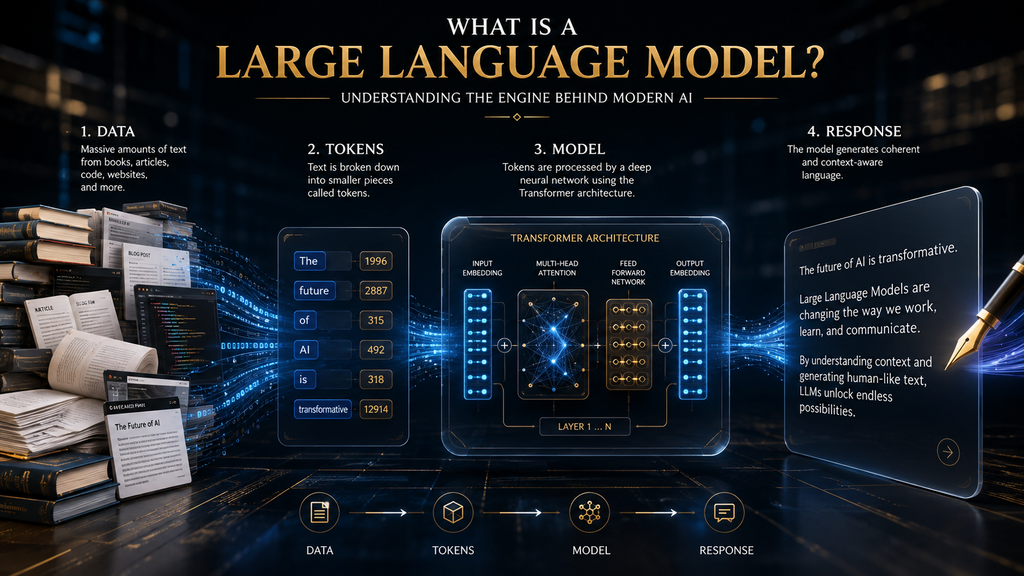
A large language model, or LLM, is an AI system trained on huge amounts of text to predict the next small piece of text, called a token. By repeating that prediction one token at a time, it can write, summarize, translate, answer questions and generate code. ChatGPT, Claude and Gemini are all built on large language models, with extra training and tools added on top.
AI can now draft an email in seconds, summarize a 100-page document, explain a hard concept, translate languages, write code and hold a conversation that feels natural. That raises a simple question with a surprisingly deep answer: what is happening inside the system when it does those things, and how much should you trust the result?
At its core, a language model learns statistical patterns in sequences of tokens and uses those patterns to generate new sequences. Modern systems then add further training for following instructions, ways to handle long context, retrieval of documents, tools and safety layers. Understanding those layers explains both what LLMs do well and where they fail.
This guide explains LLMs without math. You will learn why they are called “large,” how the Transformer architecture changed AI, what tokens are, how training and inference differ, what happens when you ask a question, why LLMs sometimes sound certain and wrong, how prompting, RAG and fine-tuning compare, and how to use LLMs more intelligently.
The Short Answer: What an LLM Is
A large language model is a neural network trained on a vast collection of text, and often images and other data, to estimate how likely each possible next token is, given the tokens that came before. Google’s introduction to large language models describes language models as estimating the probability of a token or sequence of tokens occurring within a longer sequence.
That single ability turns out to be remarkably general. Predicting the next token well requires capturing grammar, facts, styles, formats and patterns of reasoning that appear in the training data. When the model generates text one token at a time, those captured patterns show up as fluent answers, summaries, translations and code.
An LLM is not a search engine, a database or a person. It does not look up answers in a stored table, and it does not have beliefs or intentions. It produces the most plausible continuation according to what it learned, which is why it can be brilliant at language tasks and still state wrong facts with confidence.
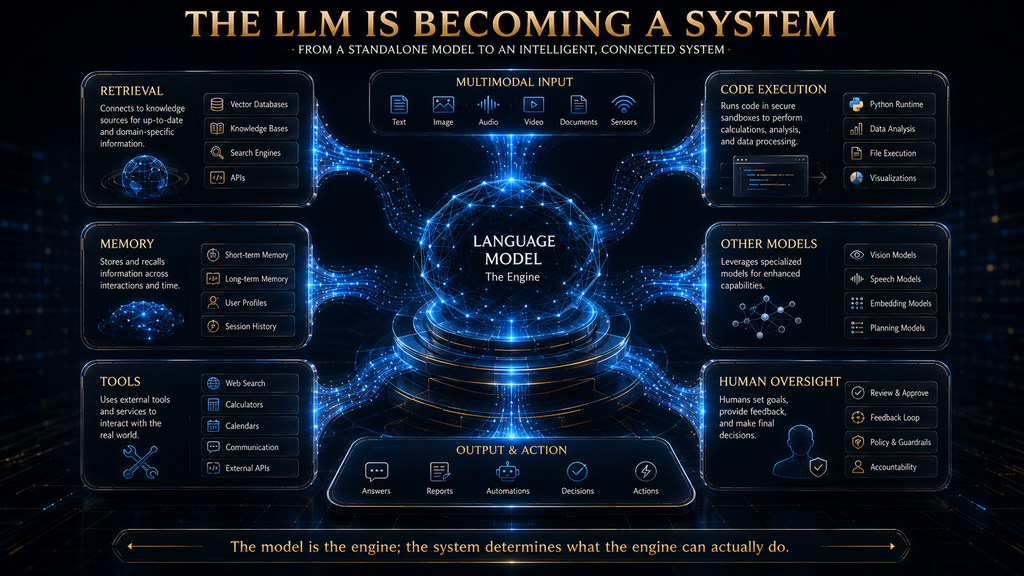
The products you use, such as ChatGPT, Claude and Gemini, are built around LLMs but include much more: instruction tuning, safety systems, memory features, web search, file handling and tools. When people say “the AI,” they usually mean the whole product, while the LLM is the engine at its center. Keeping that distinction in mind makes product behavior much easier to understand.
Why They Are Called “Large”
“Large” refers mainly to the number of parameters, the adjustable numbers inside the network that are tuned during training. Each parameter is a tiny dial, and together billions of them store the patterns the model has learned. More parameters give a model more capacity to represent complex patterns. Modern frontier models are believed to be far larger than early ones, though many companies no longer publish exact sizes.
The jump in scale was dramatic. OpenAI’s 2020 paper Language Models are Few-Shot Learners described GPT-3, a model with 175 billion parameters, ten times more than any previous non-sparse language model. It showed that a large enough model could perform many tasks from just a few examples in the prompt. That result changed how researchers thought about what scale could achieve.
“Large” also describes the training data and the computing power used. Research on scaling laws for neural language models found that performance improved predictably as model size, data and compute increased together, which encouraged the industry to build ever larger models through the early 2020s. Those findings shaped years of investment in bigger training runs.
Size is not everything, though. As later sections explain, training methods, data quality and post-training can matter as much as raw size. A well-trained smaller model can outperform a larger one on many tasks, and smaller models are cheaper and faster to run, which matters a great deal in practice. The right model is the one that fits the task and the budget.
LLM vs AI: Are They the Same?
No. Artificial intelligence is the broad field of making computers perform tasks that usually need human intelligence. Machine learning is a branch of AI where systems learn patterns from data. Deep learning uses large neural networks. LLMs are one kind of deep learning model, specialized in language and increasingly in other kinds of input.
Plenty of AI has nothing to do with LLMs: recommendation systems, fraud detection, image recognition, route planning and the forecasting models businesses use every day. Our guide to how AI learns from data explains machine learning more broadly. Those systems often work quietly in the background of apps you use every day.
LLMs became the face of AI because they work through language, which makes them easy for anyone to use. You do not need to code to ask a question or request a draft. That accessibility is why LLM-based assistants spread so quickly, and why understanding their limits now matters for almost everyone who works with information.
The Breakthrough Behind Modern LLMs: The Transformer
Modern LLMs are built on the Transformer architecture, introduced in the 2017 paper Attention Is All You Need. Earlier language models processed text more or less in order, word by word, which made it hard to connect information far apart in a long passage and slow to train on very large datasets. Those limits held language models back for years.
The Transformer uses a mechanism called attention. For each token, attention lets the model weigh how relevant every other token in the context is. In the sentence “The trophy did not fit in the suitcase because it was too big,” attention helps the model connect “it” to “trophy” rather than “suitcase.” That kind of connection is hard to capture with simple word-by-word rules.
Attention also allows much of the computation to happen in parallel, which made it practical to train on enormous datasets using modern hardware. That combination of better handling of long-range relationships and efficient training is the main reason language models improved so quickly after 2017. Almost every major language model today uses a Transformer variant.
You do not need to understand the math to use LLMs well. The useful takeaway is that a Transformer builds its understanding of each token from its relationships with all the others in the context, which is why the context you provide shapes the answer so strongly. Better context leads directly to better answers.
What Tokens Are
LLMs do not read whole words the way people do. Text is split into tokens, which can be whole words, parts of words, punctuation or spaces. For English, a token is roughly four characters or about three-quarters of a word on average, though this varies by model and language. Other languages and code often use more tokens for the same meaning.
The model works entirely in tokens. Your prompt is converted into tokens, the model predicts output tokens and those are converted back into text. Context windows, usage limits and API prices are all measured in tokens, which is why the concept matters even for non-technical users. Knowing that helps you understand limits and costs.
Tokenization also explains some quirks. Models can struggle to count letters in a word or handle very long numbers, because those may be split into tokens in unexpected ways. Our guide to AI tokens explains tokens in detail, including how to count them. Small quirks like these are a useful reminder that models see text differently from people.
How an LLM Learns
An LLM does not learn the way a student reads a textbook and consciously remembers facts. Training repeatedly shows the model huge amounts of text, asks it to predict the next token, measures how wrong the prediction was and nudges billions of parameters slightly to make that prediction a little better next time.
After trillions of these small adjustments, the parameters encode a rich statistical picture of language: which words follow which, how sentences are structured, which facts tend to appear together and how arguments, code and conversations usually unfold. Nobody programs those patterns in directly; they emerge from the training process.
That is why an LLM can write in styles it was never explicitly taught and answer questions it never saw word for word. It is also why it can confidently reproduce errors, biases or outdated information present in its training data. The model learns what is common in the data, not what is true. Common errors in the data can become confident errors in the output.
The LLM Training Pipeline
Building an LLM happens in stages. Data collection gathers very large datasets, usually including web pages, books, code, academic papers and licensed or curated material. Data quality matters enormously, so builders filter out spam, duplicates and harmful content and balance different kinds of text. Careful data work is one of the biggest differences between strong and weak models.
Pretraining is the expensive stage where the model learns next-token prediction across that data, using large clusters of specialized processors for weeks or months. The result is a base model: very knowledgeable about language patterns, but not yet good at following instructions or behaving like a helpful assistant.
Post-training turns the base model into an assistant. It typically includes training on examples of good instruction-following and learning from human or AI feedback about which answers are better. The InstructGPT research showed how powerful this stage can be. It is one of the most influential papers in the field.
In that study, people preferred outputs from a 1.3-billion-parameter model trained with human feedback over outputs from the 175-billion-parameter GPT-3 base model, despite it having 100 times fewer parameters. Post-training is a major reason modern assistants feel so much more useful than raw base models.
Training vs Inference: A Key Difference
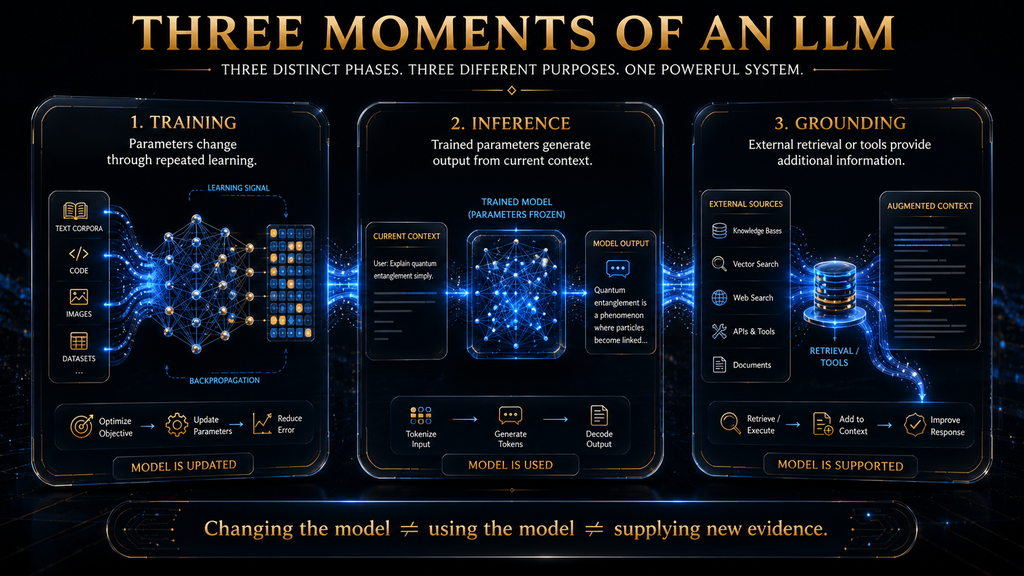
Training is when the model learns and its parameters change. It happens before release, using huge datasets and computing resources. Inference is when you use the model: it reads your prompt and generates a response using its fixed parameters, without changing them. Inference is what happens every time you send a message.
This distinction answers a common question. When you chat with an assistant, the underlying model does not learn from your conversation in real time. It may use your earlier messages within the same conversation as context, and some products store memories, but the model’s parameters stay the same during your chat.
Whether your conversations are used to improve future models is a separate, policy-level question that depends on the provider and your settings. Our guide to AI privacy risks explains how to check and control that. Settings differ between free, paid and business accounts, so check yours before sharing anything sensitive.
What Happens When You Ask an LLM a Question?
Step 1: input arrives. Your message, any earlier conversation, hidden system instructions and attached files are gathered together. Step 2: tokenization. All of it is converted into tokens. Step 3: context construction. The system assembles everything the model will see, possibly adding retrieved documents or tool results.
Step 4: Transformer processing. The model processes the tokens through many layers, using attention to relate each token to the others. Step 5: probability distribution. It produces a probability for every possible next token, such as a high chance for “Paris” after “The capital of France is.” Most other tokens get very low probabilities.
Step 6: token selection. A decoding process picks the next token according to those probabilities and generation settings, which may add some randomness for more varied answers. Step 7: repeat. The chosen token is added to the context, and the model predicts the next one, again and again. Each new token changes the context for the next prediction.
Step 8: final response. When the model produces a stop signal or reaches a length limit, the tokens are converted back to text and shown to you. This loop explains why answers appear word by word, and why the same question can produce slightly different answers each time. Lower randomness settings make answers more consistent.
Why an LLM Sounds Like It Understands You
LLMs were trained on vast amounts of human writing, including explanations, conversations and arguments. Producing the most plausible continuation of your message often means producing something that reads like a thoughtful human reply, complete with empathy, structure and confident explanation. The style comes from human writing in the training data.
Whether that counts as understanding is debated. The model clearly captures a great deal about how concepts relate, which lets it explain, compare and apply ideas in new situations. But it does not have experiences, goals or beliefs, and it does not check its answers against the world unless a tool lets it.
The practical lesson is to judge LLM output by its accuracy and usefulness, not by how human it sounds. Fluency is the model’s strongest skill, so it can make weak or wrong content sound convincing. A confident tone tells you nothing about whether a statement is true. Check what matters, however convincing it sounds.
Why LLMs Can Do So Many Different Tasks
During pretraining, the model sees examples of almost every kind of text task: questions and answers, summaries, translations, code with comments, lists, tables and arguments. Learning to predict text well across all of that gives it general skills that transfer to new requests. That breadth is what makes one model so versatile.
The GPT-3 paper showed this as “few-shot” learning: give the model a few examples of a task in the prompt, and it can often perform the task without any retraining. Our guide to few-shot and zero-shot prompting explains how to use this in practice. Examples are one of the simplest ways to improve results without any technical work.
Post-training then makes those general skills easier to access through plain instructions. That is why the same model can draft a contract clause, explain photosynthesis, write a Python function and plan a trip. It is one general system, steered by the instructions and context you give it. Clear instructions give you access to most of that versatility.
An LLM Is Not a Database
A database stores exact records and returns them on request. An LLM stores patterns spread across billions of parameters, with no exact record of most facts. When you ask a factual question, it generates the most plausible answer rather than retrieving a stored entry, which is why details can come out wrong.
This explains hallucinations, the confident but false statements LLMs sometimes produce. A survey of hallucination in natural language generation reviews how widespread the problem is across language tasks. Our guide to AI hallucinations explains why it happens. Understanding the cause helps you guard against it.
Models also have a knowledge cutoff: they know little about events after their training data ends, unless the product connects them to search or other live sources. For anything recent or precise, such as prices, laws, statistics or quotes, check a primary source rather than relying on the model’s memory.
Context Window vs Memory
The context window is the amount of text, measured in tokens, that the model can consider at once in a single request. It includes your prompt, earlier messages, documents and the answer being generated. Modern models can handle very large windows, sometimes hundreds of thousands of tokens or more. That space is shared between your input and the answer.
Memory is different. Some products store facts about you or past conversations and add relevant ones to the context in later chats. That feels like the model remembering you, but it is the product supplying stored notes, not the model’s parameters changing. Our guide to how AI memory works explains the difference.
A large context window does not guarantee the model uses everything well. Important details can be overlooked in very long inputs. Good results still depend on giving the model relevant, well-organized context, a skill covered in our guide to context engineering. Put the most important information where it is easy to find.
Prompting vs RAG vs Fine-Tuning
There are three main ways to adapt an LLM to your needs. Prompting means giving clear instructions, context and examples in your request. It is fast, cheap and flexible, and it is the right place to start for almost every use case. Our beginner’s guide to AI prompts covers the basics. Most improvements start with better prompts.
Retrieval-augmented generation, or RAG, searches a collection of documents for passages relevant to a question and adds them to the context before the model answers. The approach was described in the 2020 paper on retrieval-augmented generation and is now the standard way to ground answers in specific, current information.
Fine-tuning continues training a model on your own examples so it learns a specific style, format or specialized task. It changes the model’s parameters, unlike prompting and RAG. Our guides to fine-tuning AI models and RAG versus fine-tuning explain when each makes sense. Fine-tuning needs good training examples, which our guide to building a fine-tuning dataset explains.
A simple rule: use prompting first, add RAG when the model needs specific or up-to-date knowledge, and consider fine-tuning only when you need consistent behavior that prompting cannot achieve. Many successful systems never need fine-tuning at all, because good prompts and good retrieval cover most needs.
What LLMs Do Well
LLMs excel at summarization, turning long documents into short overviews, and transformation, rewriting text in a different tone, length or format. They are strong at information extraction, pulling names, dates, amounts or key points from messy text into a structured list or table. These tasks save the most time for everyday users.
They are useful for drafting emails, reports, articles and plans, giving you a starting point to edit. They provide coding assistance, writing, explaining and debugging code. They handle translation between many languages and classification, sorting messages, reviews or tickets into categories. Each of these is a language task at heart.
They are also excellent at interactive explanation: you can ask follow-up questions, request simpler wording or ask for examples until a concept makes sense. That patient, adaptive teaching is one of the most valuable everyday uses of LLMs for students and professionals alike. It is like having a patient tutor available at any hour.
Where LLMs Fail
LLMs can state false facts with confidence, especially about specific details such as numbers, dates, citations and niche topics. They can be out of date after their training cutoff. They may reflect biases present in their training data, and they can be inconsistent, giving different answers to the same question.
They struggle with precise tasks that depend on exact rules, such as long arithmetic, counting characters or following complex constraints perfectly, unless they can use a tool such as a calculator or code interpreter. They can also be misled by instructions hidden in content they read, a risk known as prompt injection.
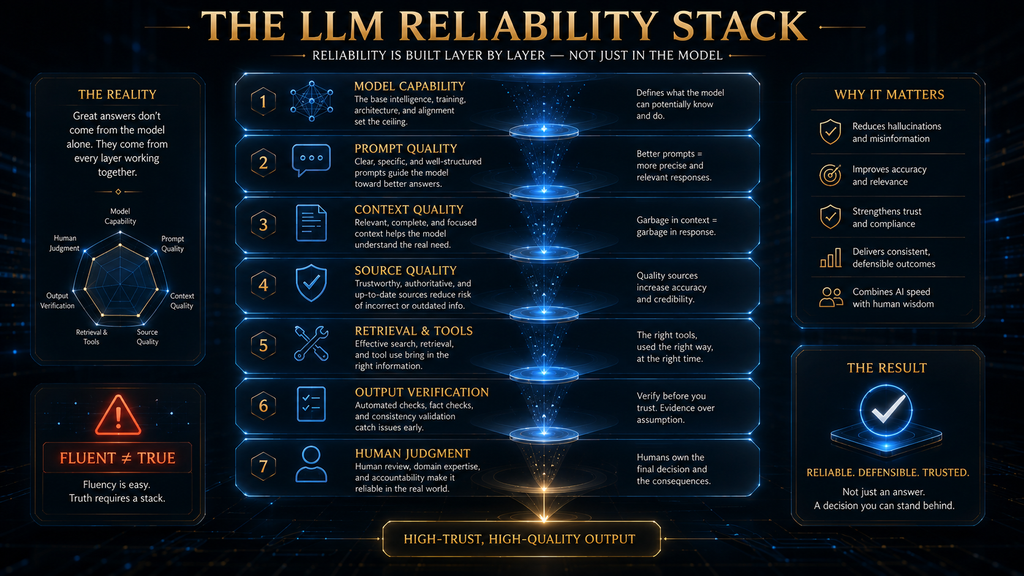
These weaknesses do not make LLMs useless; they make verification essential. Our framework for checking AI information gives a practical method for deciding which outputs to trust and how to check the rest. Matching the level of checking to the stakes keeps the effort reasonable while protecting you from the errors that matter.
Why Bigger Does Not Automatically Mean More Reliable
Larger models generally know more and reason better, but size alone does not guarantee reliability. The InstructGPT results showed that a much smaller model with good post-training could be preferred over a far larger base model. Training methods, data quality and safety work all shape how dependable a model is.
Reliability also depends on how a model is used. A smaller model given the right documents through RAG can answer questions about those documents more accurately than a larger model relying on memory. Clear prompts, good context and verification steps often matter more than the model’s size. Good process often beats a bigger model.
Smaller models also have practical advantages: they are cheaper, faster and can sometimes run on your own hardware. Our guides to local AI and quantization explain how smaller and compressed models are used in practice. Running models locally can also help with privacy, because data does not leave your device.
The LLM Capability Stack
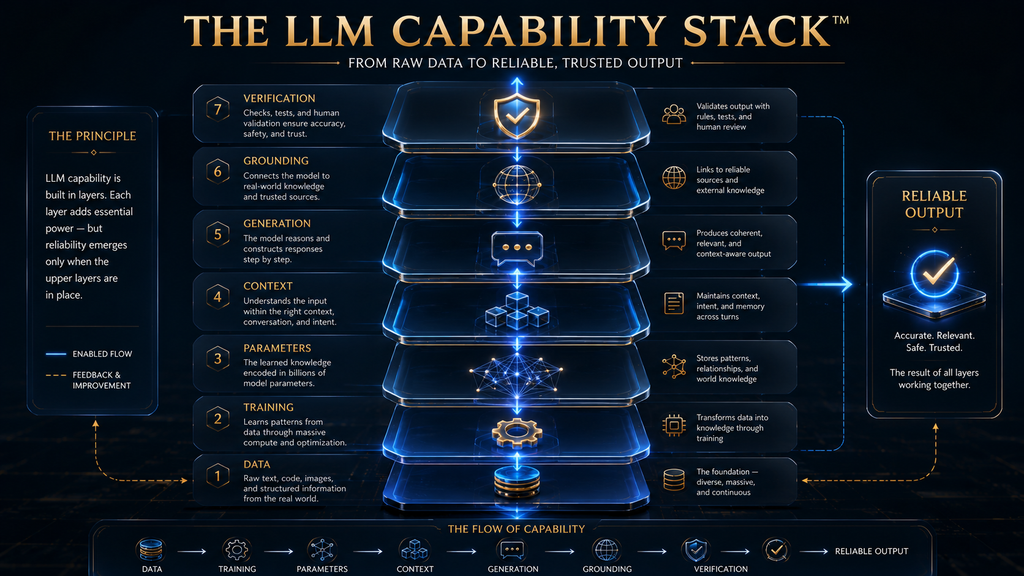
A useful mental model is to see an LLM-based system as seven layers, an AI Hustle World framework. Data sets what the model could learn. Training shapes how well it learned it. Parameters store what it learned. Context supplies the information for a specific task. Each layer adds something the others cannot.
Generation turns the context into an answer, token by token. Grounding connects the answer to sources such as documents, databases or search results. Verification checks whether the answer is correct before it is used. Each layer can be strong or weak independently of the others. A strong model with no verification can still produce costly errors.
When an answer is wrong, ask which layer failed. Was the information missing from the training data? Was the context incomplete? Was the answer not grounded in sources? Was it never checked? This approach turns vague frustration into specific fixes, such as adding documents or a review step. Most fixes are cheaper than switching models.
What LLMs “Know” and How They “Reason”
An LLM’s knowledge is spread across its parameters as patterns rather than stored as facts. It can recall common facts reliably, because they appeared many times in training. Rare facts, recent events and precise details are much less reliable, because the patterns behind them are weaker. That is why checking niche facts is so important.
LLMs can also perform what looks like reasoning: breaking problems into steps, comparing options and drawing conclusions. Many recent models spend extra computation working through a problem before answering, which improves results on complex tasks. Their reasoning can still contain errors that sound convincing.
A practical approach is to ask the model to show its working on important problems, then check the steps. Errors in reasoning are often easier to spot in the steps than in a final answer. For calculations and data analysis, let the model use tools such as code execution rather than doing arithmetic in its head.
LLMs, Generative AI, Assistants and Agents
An LLM is the model that generates text. Generative AI is the broader category of AI that creates content, including text, images, audio, video and code; LLMs are one type. An AI assistant, such as ChatGPT, Claude or Gemini, is a product built around one or more models with extra features. Those features include safety systems, memory and tools.
An AI agent is a system that uses a model to pursue a goal by planning steps and using tools, such as search, email or databases, with some independence. Our guide to what an AI agent is explains how agents build on LLMs. Agents add the ability to act, which raises both value and risk. That is why agents need stronger controls than chat assistants.
These layers stack. The LLM provides language ability, the assistant makes it easy to use and safe, and agents add the ability to take actions. Understanding which layer you are dealing with helps you set the right expectations and choose the right checks for the task in front of you. Each layer needs its own kind of oversight.
What Makes One LLM Different From Another?
Models differ in training data, which shapes their knowledge and strengths; architecture and parameter scale; training compute; and post-training, which shapes their style, helpfulness and safety. Two models of similar size can behave very differently because of these choices. No single model is best at everything.
They also differ in context capacity, tool access, retrieval features, modality (whether they handle images, audio or video), latency and cost, and safety and governance controls. For many real tasks, these practical differences matter more than benchmark scores. Benchmarks rarely capture how a model performs on your specific work.
The best way to choose is to test candidate models on your own tasks. Our comparison of prompting ChatGPT, Claude and Gemini shows how the same prompt can produce different results, and our list of ChatGPT alternatives covers the main options. A small test set of your own tasks is worth more than any leaderboard, because it reflects what you need.
Open-Weight vs Closed Models
Some LLMs are closed: you can use them only through the provider’s app or API, and their parameters are not published. ChatGPT, Claude and Gemini are examples. Closed models are usually the most capable and come with built-in safety systems, support and regular updates, but you depend on the provider’s pricing and policies.
Open-weight models publish their parameters so anyone can download and run them, often under licenses with conditions. They can run on your own servers or even a laptop, which gives you more control over data, cost and customization. They are popular for private deployments and for fine-tuning on specialized tasks.
The trade-off is effort. Running an open-weight model means handling hardware, updates, security and safety yourself. For most individuals and small businesses, a closed model through a trusted provider is simpler. Our guides to the best local AI tools and AI model hosting platforms explain the open-weight route.
Many organizations use both: closed models for general tasks and open-weight models where privacy, cost at scale or deep customization matters. Choosing between them is less about which is better overall and more about which fits a particular job, budget and risk level. Start with a closed model and revisit the choice as your needs grow.
Do You Need to Understand the Math?
No. You do not need to know linear algebra or neural network training to use LLMs well, just as you do not need to understand engines to drive. What helps most is a good mental model: LLMs predict plausible text from patterns, they work within a context window and they need verification for important facts.
That mental model leads directly to better habits. You give clear instructions and relevant context, you provide sources when accuracy matters, you ask for structured output and you check key claims. These habits improve results far more than technical knowledge of how attention is calculated. Good habits matter more than technical depth.
If you are curious about the technical side, Google’s free machine learning course is a good next step. For most people, though, the practical understanding in this guide is enough to use LLMs confidently and avoid their most common traps. Practical habits come first; theory can come later. Once the basics feel natural, the technical details become much easier to follow.
A Real-World Example
Imagine a small business owner who asks an assistant to summarize a 40-page supplier contract and list the payment terms. The LLM reads the contract within its context window, extracts the relevant clauses and produces a clear summary with a table of payment dates and amounts. It takes seconds rather than an hour of reading.
The summary is fast and mostly accurate, but it misses a clause that adds a late-payment fee, because that clause used unusual wording. The owner catches the gap by asking the model to quote each payment clause with its section number, then checking those sections in the original document. The fix took only a few minutes.
That example captures the right way to use LLMs: let them do the fast reading and drafting, ask for evidence such as quotes and section numbers, and check what matters. The model saves an hour of reading, and a few minutes of verification protects against the mistake it made. Speed plus checking is the winning combination.
Who Should Use LLMs?
Students and Learners
If you are a student, use LLMs to explain difficult ideas, generate practice questions and get feedback on drafts. Ask for explanations at your level and follow up until the idea is clear. Check facts against your course materials, and follow your institution’s rules on AI use. Use AI to learn, not to skip learning.
Professionals and Business Owners
If you work with documents and communication, LLMs can draft emails, summarize reports, extract data and prepare first versions of plans. Provide your own context, such as policies and facts, and review everything before it goes to customers, colleagues or regulators. Your context is what makes the output useful.
Developers and Builders
If you build software, LLMs can write, explain and debug code and power features in your own products. Use RAG for grounding, test outputs systematically and put guardrails around anything that takes actions. Our guide to retrieval-augmented generation is a good next step. Testing is what makes LLM features dependable.
Who Should Be Careful With LLMs?
Be especially careful if you work in medicine, law, finance or safety-critical fields, where an error can cause serious harm. Use LLMs to research and draft, but keep qualified people responsible for decisions, and verify every important fact against authoritative sources. Responsibility stays with the professional.
Be careful too with private or confidential information. Check your provider’s data settings and your organization’s rules before pasting sensitive material. And be careful when you cannot check the output yourself, because an LLM’s confident tone can hide errors you have no way of spotting. Caution protects both you and the people whose data you hold.
Common LLM Misconceptions
“LLMs Understand Everything”
LLMs capture a great deal about language and concepts, but they have gaps, especially for rare facts, recent events and precise details. They can also misunderstand ambiguous requests. Treat them as capable but fallible assistants, and give them clear context. Clarity reduces misunderstandings. The better your request, the better the result.
“LLMs Are Just Autocomplete”
Next-token prediction sounds simple, but at large scale it captures grammar, facts, styles and patterns of reasoning that let models write, explain and code. Calling them “just autocomplete” understates what they can do, even though prediction is the core mechanism. The truth lies between the hype and the dismissal.
“More Parameters Always Means Better”
Size helps, but training methods, data quality and post-training matter as much. A smaller, well-trained model can beat a larger one on many tasks, and smaller models are cheaper and faster. Test models on your own tasks rather than choosing by size alone. Real tasks reveal real differences. A short comparison on your own work beats any chart.
“The AI Learned From My Conversation”
During a chat, the model’s parameters do not change. It uses your messages as context, and some products store memories, but it does not retrain itself on the spot. Whether your chats are used for future training depends on the provider’s policy and your settings. Memory features are a product layer, not model learning.
“A Confident Answer Is Probably Correct”
Confidence and accuracy are unrelated in LLM output. The model sounds equally sure when it is right and when it is wrong. Verify facts that matter, especially numbers, dates, names, citations and anything you plan to publish or act on. The more important the claim, the more carefully you should check it.
“RAG Fixes Hallucinations Completely”
RAG greatly reduces hallucinations by grounding answers in documents, but it does not eliminate them. Retrieval can miss the right passage, and the model can still misread what it retrieved. Ask for citations and check the important ones. Good retrieval is necessary but not sufficient. Citations make the remaining errors easier to catch.
What Happens If You Misjudge LLMs?
Two opposite mistakes are common. Underestimating LLMs means missing out on real time savings in drafting, summarizing, learning and coding, while competitors and colleagues move faster. Many people tried an early chatbot, saw a mistake and never returned, missing years of improvement. Models have improved a great deal since then.
Overestimating LLMs means trusting fluent output without checking it, which leads to published errors, wrong decisions and embarrassing mistakes. Several high-profile incidents involved invented citations or false facts that someone forwarded without verification. Those incidents were avoidable with basic checking.
The right position sits between these extremes: use LLMs regularly for the tasks they do well, give them good context, and verify anything that matters. That balanced approach captures most of the benefit while avoiding most of the risk, and it improves with practice. Experience makes the balance easier to find.
The Future of LLMs
LLMs are becoming more capable at reasoning, more multimodal, handling text, images, audio and video together, and better at using tools. Context windows keep growing, and models increasingly work inside agents that plan and act on tasks rather than only answering questions. That shift will change how many jobs use AI.
Smaller, more efficient models are also improving quickly, making it possible to run capable models on laptops and phones. Our guide to fine-tuning with LoRA explains one technique that makes adapting models cheaper. That trend gives users more choice and control. It also lowers costs for businesses that run models at scale, which makes more uses affordable.
The core mechanism, predicting the next token from learned patterns, is likely to remain, along with its limits. Verification, grounding and human judgment will stay essential, even as models improve. The people who benefit most will be those who understand both what LLMs can do and where they need checking.
How to Use an LLM More Intelligently
Give the model context. Explain who you are, what you need and why, and include relevant facts or documents. Define the output. Ask for a specific format, length and audience. Separate generation from verification. Let the model draft, then check the important claims separately rather than assuming the draft is correct.
Provide authoritative sources when accuracy matters. Paste the relevant document or use a tool with retrieval, and ask the model to answer only from those sources and cite them. Keep humans responsible for consequential decisions. Use the model to inform and draft, while people decide and take responsibility.
These five habits work with any assistant and any model. They turn an LLM from an impressive but unpredictable tool into a reliable part of how you work. Our guide to writing AI prompts for accurate answers goes deeper on the first two. They apply to every task, from emails to research. Practice them until they become automatic.
How We Researched This Guide
This guide is based on published research and documentation, not hands-on benchmarking. We drew on the Transformer paper, the GPT-3 few-shot paper, research on scaling laws, the InstructGPT paper on training with human feedback, the original retrieval-augmented generation paper, a survey of hallucination in language generation and Google’s introduction to large language models.
The LLM capability stack and the practical habits are AI Hustle World’s editorial frameworks, designed to help non-technical readers reason about LLMs. The field moves quickly, so specific model capabilities may change, but the core concepts explained here are stable. We update this guide as the field changes.
Final Thoughts
A large language model is a neural network trained to predict the next token, and that simple objective, at enormous scale, produces systems that can write, explain, translate, summarize and code. Post-training, retrieval and tools turn those models into the assistants and agents people use every day. Understanding that stack helps you use each layer well and know where to check.
LLMs are not databases, people or oracles. They generate plausible text from learned patterns, which makes them excellent at language tasks and unreliable for unchecked facts. Knowing the difference between training and inference, context and memory, and prompting, RAG and fine-tuning helps you use them well.
The most important thing to remember is simple: use LLMs for what they do best, give them good context and verify what matters. That balance lets you capture their speed without inheriting their mistakes. To understand the building blocks in more detail, read our guide to AI tokens. It covers the units that every LLM reads and writes.
Want to Understand AI Beyond the Hype?
Go deeper into the technologies behind modern AI—from tokens and model training to prompting, context, and how AI systems actually produce their results.
Explore AI Basics →Frequently Asked Questions
What does LLM stand for?
LLM stands for large language model: an AI system trained on very large amounts of text to predict and generate language, one token at a time.
Is ChatGPT an LLM?
ChatGPT is an AI assistant built on large language models, with extra training, safety systems and features such as search, memory and file handling added on top.
How does an LLM generate text?
It converts your input into tokens, calculates probabilities for the next token, picks one and repeats, adding each new token to the context until the answer is complete.
Does an LLM understand language?
It captures a great deal about how words and concepts relate, which lets it explain and apply ideas. Whether that is true understanding is debated, and it has no beliefs or experiences.
What is the difference between an LLM and generative AI?
Generative AI is the broad category of AI that creates content, including images, audio and video. An LLM is one type of generative AI focused on language.
What are LLM parameters?
Parameters are the adjustable numbers inside the model that are tuned during training. Together, often billions of them, they store the patterns the model has learned.
Why do LLMs hallucinate?
They generate the most plausible text rather than retrieving stored facts, so they can produce confident but false details, especially about rare, recent or precise topics.
Does a bigger LLM always perform better?
Not always. Training quality and post-training matter as much as size. A smaller, well-trained model can outperform a larger one on many tasks and costs less to run.
What is RAG?
Retrieval-augmented generation searches documents for relevant passages and adds them to the model’s context before it answers, grounding responses in specific, current sources.
Can an LLM learn from my conversations?
The model’s parameters do not change during your chat. Whether your conversations are used to train future models depends on the provider’s policy and your settings.
Related Guides
- How AI Answers Questions: From Prompt to Response Explained
- How AI Chatbots Work: From User Message to Intelligent Response
- Understanding AI Hallucinations: Why AI Gives Wrong Answers
Written by
Muntasir Ahmad Chowdhury
Founder, AI Hustle World
Muntasir Ahmad Chowdhury is the Founder of AI Hustle World, an independent publication dedicated to making Artificial Intelligence practical, trustworthy, and easy to understand. He researches AI tools, automation, customer service, productivity, and real-world business applications, helping readers make smarter technology decisions through research-driven, experience-backed content.
Expertise:
AI Tools • AI Automation • AI Customer Service • AI Productivity • Generative AI • AI Workflows
Get Smarter With AI
Enjoyed this guide? Get practical AI tools, tutorials, and honest reviews delivered to your inbox.